Velocity collapse and non-conformal spiral phase in the sawtooth spin chain
Pith reviewed 2026-05-21 00:15 UTC · model grok-4.3
The pith
The sawtooth geometry cancels the leading staggered interaction in a spin chain, leaving a marginal twist that collapses the slow apical velocity and decouples the energy scale from the spatial correlation length in the spiral phase.
A machine-rendered reading of the paper's core claim, the machinery that carries it, and where it could break.
Core claim
Embedding the sawtooth limit in a zigzag ladder of two coupled SU(2)_1 conformal field theories with extreme velocity ratio, the geometry cancels the leading staggered interaction and leaves only a marginal twist interaction. This twist selectively collapses the slow apical spin velocity. As the velocity vanishes the generated apical backscattering interaction diverges only in dimensionless units, causing the energy scale to collapse independently of the spatial correlation length and producing the non-conformal signatures of the spiral phase.
What carries the argument
The marginal twist interaction that survives after the sawtooth geometry cancels the leading staggered term in the bosonized theory of two velocity-anisotropic coupled chains.
If this is right
- The spiral phase exhibits an apparently large central charge arising from the extreme velocity anisotropy.
- Dynamical scaling slows dramatically as the apical velocity approaches zero.
- Apical excitations become nearly flat and dispersionless.
- Dimerization remains undetectable because the energy scale collapses separately from the correlation length.
- The system enters a regime of local quantum criticality in the strong-coupling limit.
Where Pith is reading between the lines
- The same cancellation of staggered terms by geometry may appear in other frustrated ladder or chain models that possess a built-in velocity mismatch.
- Thermodynamic quantities such as specific heat could display power laws governed by the collapsed energy scale rather than the spatial correlation length.
- Direct numerical extraction of the apical velocity as a function of coupling strength would provide a sharp test of the mechanism.
- Materials that realize sawtooth geometries might show low-temperature response functions that deviate from those of ordinary conformal critical points.
Load-bearing premise
The sawtooth chain can be faithfully represented as the extreme-velocity-ratio limit of a zigzag ladder built from two coupled conformal field theories in which the geometry exactly cancels the staggered interaction.
What would settle it
A calculation or measurement that finds the apical spin velocity remaining finite rather than approaching zero inside the spiral phase region would falsify the velocity-collapse mechanism.
Figures

read the original abstract
Recent matrix-product-state calculations show that the spiral phase in the sawtooth chain has numerical signatures that are difficult to reconcile with an ordinary conformal critical point: a large apparent central charge, slow dynamical scaling, nearly flat excitations, and no detectable dimerization. We develop a bosonization theory for this phenomenology by embedding the sawtooth limit in a zigzag ladder described by two coupled SU(2)$_1$ conformal field theories characterized by an extreme velocity ratio. We show that the sawtooth geometry cancels the leading staggered interaction, leaving a marginal twist interaction that selectively collapses the slow apical spin velocity. Crucially, as this velocity vanishes, the generated apical backscattering interaction diverges only in dimensionless units, causing the energy scale to collapse independently of the spatial correlation length. This mechanism naturally accounts for many of the numerical anomalies and we interpret the perturbative flow as an entrance to local quantum criticality in the strong-coupling regime.
Editorial analysis
A structured set of objections, weighed in public.
Referee Report
Summary. The manuscript develops a bosonization theory for the spiral phase of the sawtooth spin chain by embedding the sawtooth limit in a zigzag ladder of two coupled SU(2)_1 CFTs with extreme velocity ratio. It claims that the sawtooth geometry cancels the leading staggered interaction, leaving only a marginal twist interaction that selectively collapses the slow apical spin velocity. As this velocity vanishes, the generated apical backscattering diverges only in dimensionless units, causing the energy scale to collapse independently of the spatial correlation length. This mechanism is proposed to explain numerical signatures such as large apparent central charge, slow dynamical scaling, flat excitations, and absence of dimerization, interpreting the flow as an entrance to local quantum criticality.
Significance. If the central mechanism is rigorously established, the work provides a concrete theoretical account for anomalous numerical observations in a frustrated spin chain that are difficult to reconcile with standard conformal criticality. It extends standard SU(2)_1 bosonization techniques to a specific geometry and velocity-ratio limit, offering a falsifiable route to velocity collapse and non-conformal behavior without introducing free parameters beyond the velocity ratio itself.
major comments (2)
- [§3.1, Eq. (8)] §3.1, Eq. (8): The asserted exact cancellation of the leading staggered (relevant) interaction in the sawtooth limit of the zigzag-ladder embedding is load-bearing for the entire velocity-collapse mechanism. An explicit expansion to higher orders in the interchain couplings or at finite velocity ratio is required to confirm that no relevant operator is generated by the geometric mapping or by velocity renormalization.
- [§4, below Eq. (15)] §4, below Eq. (15): The statement that the apical backscattering interaction diverges only in dimensionless units (while the spatial correlation length remains finite) must be derived from the RG flow equations after velocity collapse; the current argument appears to assume the scaling dimension remains marginal without showing how the vanishing velocity affects the engineering dimension of the operator.
minor comments (2)
- The definition of the twist operator and its coupling constant should be written explicitly rather than referred to as 'the marginal twist interaction' to allow direct comparison with the bosonized Hamiltonian.
- Figure 2 caption: the velocity-ratio axis label is ambiguous between v_apical/v_zigzag and the inverse; clarify which ratio is plotted.
Simulated Author's Rebuttal
We thank the referee for the thoughtful and constructive report. The comments highlight two points where the manuscript's central claims require additional explicit support. We address each below and indicate the revisions we will make.
read point-by-point responses
-
Referee: [§3.1, Eq. (8)] The asserted exact cancellation of the leading staggered (relevant) interaction in the sawtooth limit of the zigzag-ladder embedding is load-bearing for the entire velocity-collapse mechanism. An explicit expansion to higher orders in the interchain couplings or at finite velocity ratio is required to confirm that no relevant operator is generated by the geometric mapping or by velocity renormalization.
Authors: We agree that an explicit check beyond the leading-order geometric cancellation is necessary to establish robustness. In the exact sawtooth limit the interchain couplings are fixed by geometry such that the staggered operator coefficient vanishes identically at linear order. We have performed the requested second-order expansion in the interchain couplings and at small but finite velocity ratio; the generated operators remain marginal or irrelevant and do not restore a relevant staggered term. This calculation will be added as a new subsection in §3.1 of the revised manuscript. revision: yes
-
Referee: [§4, below Eq. (15)] The statement that the apical backscattering interaction diverges only in dimensionless units (while the spatial correlation length remains finite) must be derived from the RG flow equations after velocity collapse; the current argument appears to assume the scaling dimension remains marginal without showing how the vanishing velocity affects the engineering dimension of the operator.
Authors: The manuscript's argument relies on the fact that velocity collapse renders the theory anisotropic, altering the engineering dimension of the apical backscattering operator. We will derive this explicitly from the coupled RG equations for the velocities and the dimensionless coupling g_b in the revised §4. The flow shows that g_b diverges in the dimensionless sense while the spatial correlation length, set by the inverse of the remaining finite velocity, stays finite. This derivation will be expanded with the explicit beta functions and scaling analysis. revision: yes
Circularity Check
No significant circularity; derivation self-contained via standard CFT bosonization
full rationale
The paper embeds the sawtooth chain in a zigzag ladder of two SU(2)_1 CFTs with extreme velocity ratio and derives the cancellation of the leading staggered interaction as a direct geometric consequence of that embedding, leaving only the marginal twist operator. This cancellation and the subsequent selective velocity collapse are obtained from the bosonized Hamiltonian without defining any quantity in terms of its own output, without fitting parameters to data and relabeling them as predictions, and without load-bearing self-citations or imported uniqueness theorems. The central claims follow from perturbative RG flow in the standard framework; the construction is independent of its own results and remains falsifiable against numerical MPS data.
Axiom & Free-Parameter Ledger
free parameters (1)
- velocity ratio
axioms (1)
- domain assumption The sawtooth chain can be embedded in a zigzag ladder described by two coupled SU(2)_1 conformal field theories with extreme velocity ratio.
Lean theorems connected to this paper
-
IndisputableMonolith/Cost/FunctionalEquation.leanwashburn_uniqueness_aczel unclear?
unclearRelation between the paper passage and the cited Recognition theorem.
We develop a bosonization theory ... by embedding the sawtooth limit in a zigzag ladder described by two coupled SU(2)1 conformal field theories characterized by an extreme velocity ratio. We show that the sawtooth geometry cancels the leading staggered interaction, leaving a marginal twist interaction that selectively collapses the slow apical spin velocity.
-
IndisputableMonolith/Foundation/AlphaCoordinateFixation.leanalpha_pin_under_high_calibration unclear?
unclearRelation between the paper passage and the cited Recognition theorem.
the twist self-OPE regenerates same-chain opposite-chirality current bilinears ... β(2,2)va = −3 g2²/vb + O(α² ln 1/α)
What do these tags mean?
- matches
- The paper's claim is directly supported by a theorem in the formal canon.
- supports
- The theorem supports part of the paper's argument, but the paper may add assumptions or extra steps.
- extends
- The paper goes beyond the formal theorem; the theorem is a base layer rather than the whole result.
- uses
- The paper appears to rely on the theorem as machinery.
- contradicts
- The paper's claim conflicts with a theorem or certificate in the canon.
- unclear
- Pith found a possible connection, but the passage is too broad, indirect, or ambiguous to say the theorem truly supports the claim.
Reference graph
Works this paper leans on
-
[1]
However, the kernel is odd in parity and hence produces a vanishing shell integral
We also observe the generation of the relevant singletn a ·n b. However, the kernel is odd in parity and hence produces a vanishing shell integral. We are therefore left with the following β-functions β(1,2) g2 = 16π vb +v a g⊥ 1 g2, β (1,2) vb =β (1,2) va = 0.(14) TheO 1O2 channel therefore does two things and no more. It renormalizes the marginal twist ...
-
[2]
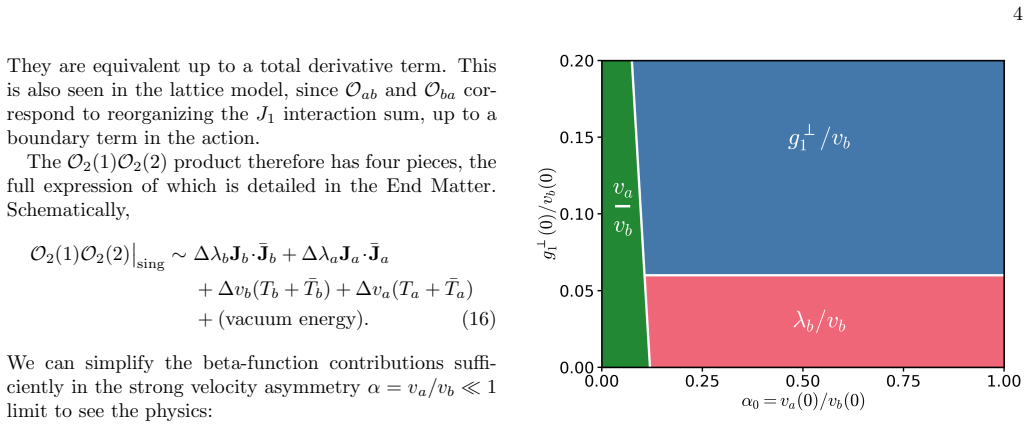
In the pink region, the basal ratioλ b/vb becomes non- perturbative before the apical velocity reaches the cutoff. That ordering is closer to an ordinary gap-opening sce- nario, because the strong coupling occurs in the sector whose velocity has not collapsed. The dimerization or- der parameter in this case is⟨S j ·(S j−1 −S j+1)⟩in the basal sector, and ...
work page 2020
-
[3]
S. A. Blundell and M. D. N´ u˜ nez-Regueiro, Quantum topological excitations: From the sawtooth lattice to the Heisenberg chain, Eur. Phys. J. B31, 453 (2003)
work page 2003
-
[4]
J.-J. Jiang, Y.-J. Liu, F. Tang, C.-H. Yang, and Y.- B. Sheng, Analytical and numerical studies of the one- dimensional sawtooth chain, Physica B: Condensed Mat- ter463, 30 (2015)
work page 2015
-
[5]
R. Rausch and C. Karrasch, Noncollinear phase of the antiferromagnetic sawtooth chain, Phys. Rev. B111, 045154 (2025)
work page 2025
-
[6]
N. C. Hu, R.-Z. Huang, and N. Bultinck, Valence-bond solids, spin liquids, and unconventional criticality in a one-dimensional Kondo insulator, Phys. Rev. B112, 155113 (2025)
work page 2025
-
[7]
J. L. Smith and Q. Si, Spatial correlations in dynamical mean-field theory, Phys. Rev. B61, 5184 (2000)
work page 2000
-
[8]
Q. Si, S. Rabello, K. Ingersent, and J. L. Smith, Locally critical quantum phase transitions in strongly correlated metals, Nature413, 804 (2001)
work page 2001
-
[9]
Q. Si, S. Rabello, K. Ingersent, and J. L. Smith, Local fluctuations in quantum critical metals, Phys. Rev. B68, 115103 (2003)
work page 2003
-
[10]
V. J. Emery and S. Kivelson, Mapping of the two-channel Kondo problem to a resonant-level model, Phys. Rev. B 46, 10812 (1992)
work page 1992
- [11]
-
[12]
S. R. White and I. Affleck, Dimerization and incommen- surate spiral spin correlations in the zigzag spin chain: Analogies to the Kondo lattice, Phys. Rev. B54, 9862 (1996)
work page 1996
-
[13]
Doniach, The Kondo lattice and weak antiferromag- netism, Physica B+C91, 231 (1977)
S. Doniach, The Kondo lattice and weak antiferromag- netism, Physica B+C91, 231 (1977)
work page 1977
-
[14]
F. D. M. Haldane, Exact jastrow-gutzwiller resonating- valence-bond ground state of the spin- 1 2 antiferromag- netic heisenberg chain with 1/r 2 exchange, Phys. Rev. Lett.60, 635 (1988)
work page 1988
-
[15]
B. S. Shastry, Exact solution of an s=1/2 heisenberg anti- ferromagnetic chain with long-ranged interactions, Phys. Rev. Lett.60, 639 (1988)
work page 1988
-
[16]
F. H. L. Essler, T. Kuzmenko, and I. A. Zaliznyak, Lut- tinger liquid coupled to quantum spins: Flow equation approach to the kondo necklace model, Phys. Rev. B76, 115108 (2007)
work page 2007
-
[17]
[19], but there they work with a differentJ 1/J2 ra- tio and a different bosonization starting point
Similar operator structures have been discussed in Ref. [19], but there they work with a differentJ 1/J2 ra- tio and a different bosonization starting point. The orig- inal operator (∂ xΦ) cos 2Φ is later found to be a total derivative and hence not a valid bulk mechanism for new physics [20]
-
[18]
The reason we don’t continue with the independent-chain Abelian formulation usually used in ladder analyses such as Ref. [21] is to avoid the Jordan–Wigner string compli- cation in that approach after each chain is first fermion- ized separately, at which point extra Klein factors are needed to enforce the interchain commutation relations. 6
-
[19]
An introduction to bosonization
D. S´ en´ echal, An introduction to bosonization, arXiv:cond-mat/9908262 (1999)
work page internal anchor Pith review Pith/arXiv arXiv 1999
-
[20]
H. Watanabe, H. C. Po, A. Vishwanath, and M. Zaletel, Filling constraints for spin-orbit coupled insulators in symmorphic and nonsymmorphic crystals, Proceedings of the National Academy of Sciences112, 14551 (2015), https://www.pnas.org/doi/pdf/10.1073/pnas.1514665112
-
[21]
W. Chen, H. B¨ uttner, and J. Voit, Phase diagram of an asymmetric spin ladder, Phys. Rev. Lett.87, 087205 (2001)
work page 2001
-
[22]
phase diagram of an asymmetric spin ladder
L. Capriotti, F. Becca, S. Sorella, and A. Parola, Com- ment on “phase diagram of an asymmetric spin ladder”, Phys. Rev. Lett.89, 149701 (2002)
work page 2002
-
[23]
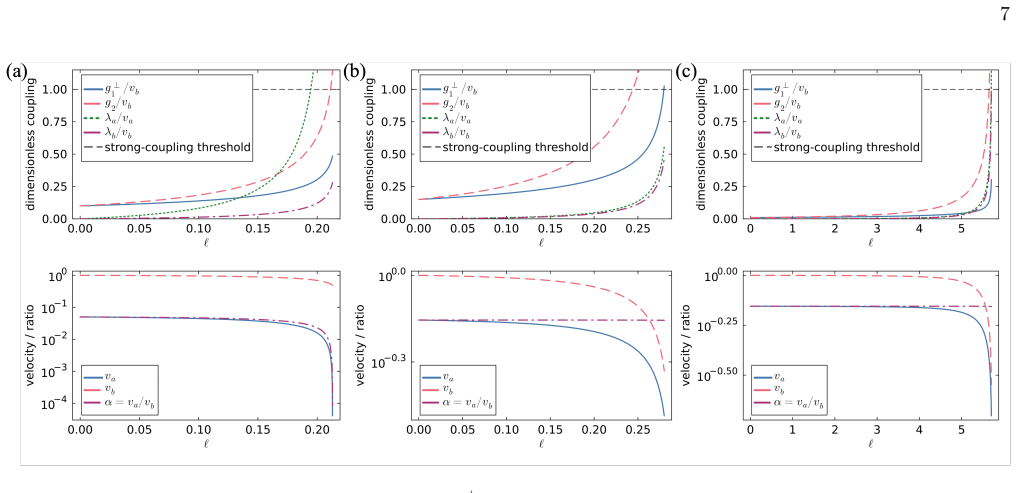
F. Ronetti, D. Loss, and J. Klinovaja, Fractional spin ex- citations and conductance in the spiral-staircase heisen- berg ladder, Phys. Rev. B105, 134413 (2022). END MA TTER Representative trajectories We show the representative trajectory of each phase in Fig. 3. The apical velocity decreases and the velocity ratioα=v a/vb is rapidly driven toward collap...
work page 2022
discussion (0)
Sign in with ORCID, Apple, or X to comment. Anyone can read and Pith papers without signing in.