NESSA: a compact 14 MeV D-T neutron source facility at Uppsala University
Pith reviewed 2026-05-20 08:27 UTC · model grok-4.3
The pith
Uppsala University's NESSA facility provides a compact 14 MeV D-T neutron generator reaching a maximum yield of 4.7×10^8 n/s in a shielded bunker.
A machine-rendered reading of the paper's core claim, the machinery that carries it, and where it could break.
Core claim
The NESSA facility hosts a compact 14 MeV deuterium-tritium sealed tube neutron generator housed in a bunker inside the FREIA hall that reaches a maximum yield of 4.7×10^8 n/s. The paper details the generator, bunker shielding, detector systems, and Monte Carlo models used to characterize the neutron field. It reports initial commissioning results from 93Nb activation foils for yield calibration, fission chamber response at two positions, simulated air and structural activation, indium foil activations, and single event effect tests on silicon devices.
What carries the argument
The compact 14 MeV D-T sealed-tube neutron generator together with its bunker shielding and Monte Carlo models that map the resulting neutron field.
If this is right
- The facility supports nuclear data measurements and neutron detector response studies at 14 MeV.
- Moderation and thermalization experiments can be performed with the characterized field.
- Irradiation testing of electronics for single-event effects becomes available in a controlled university environment.
- The setup serves training and education needs for students working with fast neutrons.
Where Pith is reading between the lines
- Other universities could adapt the sealed-tube-plus-bunker layout to add 14 MeV capability without building large accelerators.
- The reported yield and field maps allow quantitative planning of irradiation doses for future electronics or material tests.
- Extending the detector suite could produce finer spatial maps of the neutron field for more precise experiment design.
Load-bearing premise
The Monte Carlo models used to characterize the neutron field accurately capture the effects of the bunker shielding, air, and structural materials without significant discrepancies from reality.
What would settle it
A direct measurement of neutron flux or energy spectrum at a reference position that deviates substantially from the Monte Carlo predictions for the same geometry and source strength.
Figures

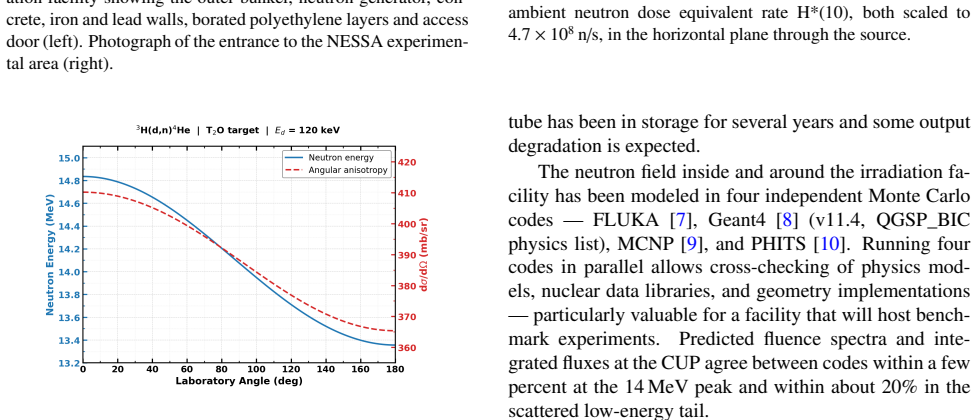


read the original abstract
The NESSA (Neutron Source in Uppsala) facility hosts a compact 14 MeV deuterium-tritium sealed tube neutron generator at the {\AA}ngstr\"om Laboratory, Uppsala University. The generator, housed in a bunker inside the FREIA hall, reaches a maximum yield of $4.7\times10^{8}$ n/s. This paper describes the facility: the generator, the bunker and its shielding, the detector systems, and the Monte Carlo models used to characterize the neutron field. We also report the first commissioning measurements: yield calibration with $^{93}$Nb activation foils, fission chamber response at two positions, and simulated air and structural activation. Initial indium foil activations and single event effect (SEE) tests on silicon devices are also presented. The facility will be used for nuclear data measurements, neutron detector response studies, moderation and thermalization experiments, irradiation testing of electronics as well as for training and education.
Editorial analysis
A structured set of objections, weighed in public.
Referee Report
Summary. The manuscript describes the NESSA facility at Uppsala University, which hosts a compact 14 MeV D-T sealed-tube neutron generator installed in a shielded bunker inside the FREIA hall. It reports a maximum yield of 4.7×10^8 n/s obtained from 93Nb foil activations, presents fission-chamber measurements at two positions, Monte Carlo models for neutron-field characterization (including air and structural activation), and preliminary indium-foil activations plus single-event-effect tests on silicon devices. The paper outlines the generator, bunker shielding, detector systems, and intended uses for nuclear-data measurements, detector-response studies, moderation experiments, electronics irradiation, and training.
Significance. If the reported yield and field characterization are placed on firmer quantitative footing, the work establishes a practical compact 14 MeV source for European nuclear-instrumentation research. The combination of facility description, shielding details, and commissioning data supplies a useful reference for similar installations and for planning experiments that require well-characterized 14 MeV neutrons. The inclusion of both experimental activation results and Monte Carlo predictions adds immediate utility for prospective users.
major comments (2)
- [Commissioning measurements] Commissioning measurements section: the headline yield of 4.7×10^8 n/s is given without error bars, background-subtraction procedure, or uncertainty budget; because the Nb-foil result is converted to source strength via the Monte Carlo spectrum, this omission directly affects the central quantitative claim.
- [Monte Carlo models] Monte Carlo models section: no quantitative closure test (e.g., ratio of measured to simulated fission-chamber count rates at both positions after all corrections) is reported; without such a test the bunker-scattering corrections remain unvalidated and the absolute normalization stays model-dependent.
minor comments (2)
- [Abstract] Abstract: the phrase 'simulated air and structural activation' should be clarified in the main text as to whether these are purely predictive or compared with any measurement.
- [Figures] Figure captions: ensure every figure that shows spectra or activation rates includes explicit units and states whether the data are experimental or simulated.
Simulated Author's Rebuttal
We thank the referee for the constructive and detailed review. The comments correctly identify areas where the quantitative presentation of the commissioning data and model validation can be strengthened. We have revised the manuscript to address both points directly.
read point-by-point responses
-
Referee: [Commissioning measurements] Commissioning measurements section: the headline yield of 4.7×10^8 n/s is given without error bars, background-subtraction procedure, or uncertainty budget; because the Nb-foil result is converted to source strength via the Monte Carlo spectrum, this omission directly affects the central quantitative claim.
Authors: We agree that a complete uncertainty treatment is required for the headline yield. In the revised manuscript we have added a dedicated paragraph in the commissioning section that describes the background-subtraction procedure (difference between generator-on and generator-off runs, with the off-run scaled to the same live time). We now quote the yield as 4.7(0.4)×10^8 n/s and include an explicit uncertainty budget table that lists contributions from counting statistics, foil mass determination, 93Nb(n,2n) cross-section uncertainty, detector efficiency, and Monte Carlo statistical precision. The revised text makes clear that the Monte Carlo spectrum is used only for the conversion factor and that the dominant uncertainty remains experimental. revision: yes
-
Referee: [Monte Carlo models] Monte Carlo models section: no quantitative closure test (e.g., ratio of measured to simulated fission-chamber count rates at both positions after all corrections) is reported; without such a test the bunker-scattering corrections remain unvalidated and the absolute normalization stays model-dependent.
Authors: We accept that an explicit closure test strengthens the validation of the scattering corrections. The revised Monte Carlo models section now reports the ratio of measured to simulated fission-chamber count rates at the two positions after all experimental corrections (dead-time, efficiency, and room-return subtraction). The ratios are 1.03 ± 0.07 and 0.97 ± 0.09, respectively. These values are presented together with the corresponding simulated spectra, demonstrating that the bunker-scattering component is reproduced to within the combined experimental and statistical uncertainties and thereby supporting the absolute normalization used for the Nb-foil yield. revision: yes
Circularity Check
No significant circularity in experimental facility description
full rationale
The paper reports the construction and commissioning of a neutron generator facility, including yield calibration via 93Nb foil activations and supporting Monte Carlo simulations for field characterization. No mathematical derivations, fitted parameters renamed as predictions, or self-referential equations are present in the abstract or described content. The yield value is obtained from direct experimental activation data with standard transport corrections; this is an independent measurement chain rather than a quantity defined in terms of itself or reduced by construction to prior self-citations. The work is self-contained as a measurement report without load-bearing uniqueness theorems or ansatzes smuggled via citation.
Axiom & Free-Parameter Ledger
axioms (2)
- domain assumption Neutron activation cross-sections for 93Nb and other foils are known to sufficient accuracy for yield calibration.
- domain assumption Monte Carlo neutron transport codes correctly model scattering, absorption, and activation in the bunker materials and air.
Lean theorems connected to this paper
-
IndisputableMonolith/Cost/FunctionalEquation.leanwashburn_uniqueness_aczel unclear?
unclearRelation between the paper passage and the cited Recognition theorem.
The absolute yield of the generator was determined by the activation of a niobium foil via the 93Nb(n,2n)92mNb reaction... the yield is Y=(4.33±0.29)×10^8 n/s.
-
IndisputableMonolith/Foundation/AlexanderDuality.leanalexander_duality_circle_linking unclear?
unclearRelation between the paper passage and the cited Recognition theorem.
The neutron field inside and around the irradiation facility has been modeled in four independent Monte Carlo codes — FLUKA, Geant4, MCNP, and PHITS.
What do these tags mean?
- matches
- The paper's claim is directly supported by a theorem in the formal canon.
- supports
- The theorem supports part of the paper's argument, but the paper may add assumptions or extra steps.
- extends
- The paper goes beyond the formal theorem; the theorem is a base layer rather than the whole result.
- uses
- The paper appears to rely on the theorem as machinery.
- contradicts
- The paper's claim conflicts with a theorem or certificate in the canon.
- unclear
- Pith found a possible connection, but the passage is too broad, indirect, or ambiguous to say the theorem truly supports the claim.
Reference graph
Works this paper leans on
-
[1]
Leunget al., Compact Neutron Generator De- velopment and Applications (2004)
K.N. Leunget al., Compact Neutron Generator De- velopment and Applications (2004)
work page 2004
-
[2]
Drosg, DROSG-2000: Neutron Source Reac- tions
M. Drosg, DROSG-2000: Neutron Source Reac- tions. IAEA report IAEA-NDS-87 Rev. 9 (2005)
work page 2000
-
[3]
Sjöstrandet al., Total Monte Carlo Evaluation for Dose Calculations (2014)
H. Sjöstrandet al., Total Monte Carlo Evaluation for Dose Calculations (2014)
work page 2014
-
[4]
Arnqvist, Neutron Spectrometry Using Activa- tion Detectors
E. Arnqvist, Neutron Spectrometry Using Activa- tion Detectors. Uppsala University Student Thesis (2024)
work page 2024
-
[5]
National Nuclear Data Center, Brookhaven National Laboratory, NuDat 3.0, https://www.nndc.bnl.gov/nudat3/
-
[6]
Brownet al., ENDF/B-VIII.0: The 8th ma- jor release of the nuclear reaction data library
D.A. Brownet al., ENDF/B-VIII.0: The 8th ma- jor release of the nuclear reaction data library. Nucl. Data Sheets148, 1–142 (2018)
work page 2018
-
[7]
Ahdidaet al., New Capabilities of the FLUKA Multi-Purpose Code
C. Ahdidaet al., New Capabilities of the FLUKA Multi-Purpose Code. Front. Phys.9, 788253 (2022)
work page 2022
-
[8]
Agostinelliet al., Geant4—a simulation toolkit
S. Agostinelliet al., Geant4—a simulation toolkit. Nucl. Instrum. Meth. A506, 250–303 (2003)
work page 2003
- [9]
-
[10]
Niitaet al., PHITS—a particle and heavy ion transport code system
K. Niitaet al., PHITS—a particle and heavy ion transport code system. Radiat. Meas.41, 1080–1090 (2006)
work page 2006
-
[11]
G. Ericssonet al., Development of a neutron field monitoring system for the DT neutron generator fa- cility NESSA. Report to the Carl Trygger Founda- tion, CTS 22:2218 (Uppsala University, 2026)
work page 2026
-
[12]
Sunithaet al., Measurements of 115In(n,2n)114mIn reaction cross sections at 14– 14.54 MeV
A.M. Sunithaet al., Measurements of 115In(n,2n)114mIn reaction cross sections at 14– 14.54 MeV . J. Radioanal. Nucl. Chem.326, 637–645 (2020)
work page 2020
-
[13]
J. Luo, L. Jiang and S. Li, Activation cross sec- tion and isomeric cross-section ratio for the (n,2n) reaction on 113,115In. Nucl. Sci. Eng.188, 198–206 (2017)
work page 2017
-
[14]
Lucsányiet al., G4SEE: A Geant4-based sin- gle event effect simulation toolkit and its validation
D. Lucsányiet al., G4SEE: A Geant4-based sin- gle event effect simulation toolkit and its validation. IEEE Trans. Nucl. Sci.69, 273–281 (2022)
work page 2022
discussion (0)
Sign in with ORCID, Apple, or X to comment. Anyone can read and Pith papers without signing in.