REVIEW 4 major objections 6 minor 26 references
DRONEAUDIONET: Noise Suppression for Drone Audition-based Search and Rescue
T0 review · 4 major / 6 minor · reviewed 2026-08-15 · deepseek-v4-flash
Pith's one-line read DRONEAUDIONET claims that reframing AudioSep as a drone-noise estimator with an unbounded mask and an additive complex residual consistently improves downstream sound classification in low-SNR drone recordings, most for human vocal sounds.
desk verdict A useful drone-audition benchmark and plausible noise-estimation tweaks, but the headline gains rest on shaky statistics and an overbroad abstract claim. read the letter →
The pith
A machine-rendered reading of the paper's core claim, the machinery that carries it, and where it could break.
The reading
What carries the argument
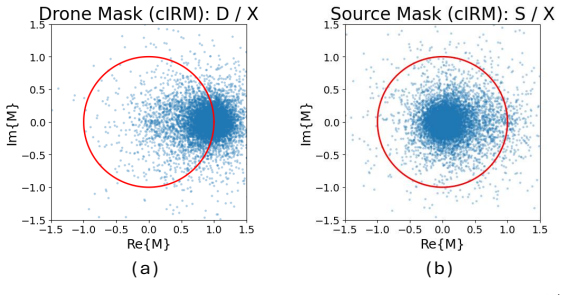
The central object is the complex ideal ratio mask $D/X$ for the drone component in a mixture $X$. The paper shows that in drone-dominant mixtures, nearly half of these values exceed the unit circle, so a sigmoid-bounded mask systematically underestimates the drone. DRONEAUDIONET carries the argument with two modifications: a learnable scalar $\alpha$ applied to the magnitude mask, which relaxes the bound, and an additive complex residual $\beta|R|e^{j\angle R}$, which corrects what the mask misses. The recovered source is the mixture minus the estimated drone signal, $\hat{s} = x - \hat{d}$, and the fixed text query 'Drone motor and propellor sounds' is embedded by CLAP and conditions the ResUNet to estimate the drone signal.
What would settle it
Record a human speaker under a drone model not present in DroneAudioSet or DREGON (for example, a fixed-wing or coaxial rotorcraft), mix at -20 dB SNR, and compare DRONEAUDIONET's downstream F1 for the recovered speech against AudioSep-FT; if it does not beat the fine-tuned baseline, the claim that the unbounded-mask and residual mechanism generalizes across unseen drone hardware fails.
Extended reading notes
Core claim
On its own terms, the discovery is that the dominant obstacle in drone audition is not the unknown target but the known drone, and that standard mask-based separators fail because their bounded sigmoid mask cannot represent drone-dominated mixtures. In DroneAudioSet test mixtures, 49.3% of the ideal complex ratio mask values for the drone component lie outside the unit circle, whereas only 0.25% do for the source. DRONEAUDIONET therefore replaces the bounded mask with a learnable scalar $\alpha$ that multiplies the sigmoid mask, and adds a residual term $\beta|R|e^{j\angle R}$ with learned complex values. Fine-tuned from AudioSep, it raises downstream classification F1 for human vocal sounds from 0.66 to 0.73 at -20 to -10 dB SNR and from 0.13 to 0.17 at -30 to -20 dB SNR, with similar gains out-of-domain on DREGON (0.69 versus 0.63).
Load-bearing premise
The method assumes the fixed text query 'Drone motor and propellor sounds' produces a CLAP embedding that captures the acoustic signature of any drone the system encounters; if that embedding misses an unseen drone's rotor noise, the estimated drone signal is wrong and subtraction will not recover the source.
Editorial extensions
If this is right
- At -20 to -10 dB SNR, downstream classification F1 for human vocal sounds rises from 0.66 to 0.73, meaning more speech and cries become detectable in realistic search-and-rescue conditions.
- The gains extend to out-of-domain recordings from DREGON with unseen drone hardware and flight modes, especially for human vocal and non-human sounds.
- Ablations show that the learnable mask scale $\alpha$ is the main driver of improvement, while the complex residual adds a smaller corrective effect; removing residual phase hurts performance.
- Because the method recovers the source by subtraction rather than by matching a target class, it remains class-agnostic and can preserve open-domain sounds such as alarms, cries, and mechanical events.
- Waveform-level reconstruction gains are modest, but the method's benefit shows up in semantic downstream recognition, suggesting that signal fidelity metrics alone understate its practical value.
Reading between the lines
- Editorial inference: if the language-query conditioning is what lets the estimator generalize, replacing the fixed drone query with richer multi-word queries or acoustic reference embeddings could extend the approach to other structured noise sources such as wind or rain.
- Editorial inference: the learned $\alpha$ stays near 1.02 and $\beta$ below 1, so one could test whether making these scalars frequency-dependent or per-band yields further low-SNR gains without destabilizing training.
- Editorial inference: the paper's own future-work direction suggests that jointly fine-tuning the enhancer with the downstream classifier could push F1 higher in the hardest -30 to -20 dB regime.
- Editorial inference: a natural stress test is to evaluate at SNRs below -30 dB and on transient events such as footsteps and clapping, where the paper reports little or no improvement.
Signed reviews
Editorial analysis
A structured set of objections, weighed in public.
Referee Report
Summary. DRONEAUDIONET adapts the query-based separation model AudioSep to drone noise suppression by estimating the drone component with the fixed text query 'Drone motor and propellor sounds' and subtracting it from the mixture. The two proposed architectural changes are a learnable scalar α that multiplies the sigmoid-bounded mask, allowing mask magnitudes above one, and an additive complex residual β|R|e^{j∠R} predicted by extra network output channels. The model is initialized from AudioSep and fine-tuned on DroneAudioSet; evaluation is on held-out DroneAudioSet natural mixtures and on a DREGON-based out-of-domain set, using SI-SDR and F1 of a frozen SSLAM classifier. The main reported finding is a statistically significant improvement in classification F1 for human vocal sounds at low SNR (0.66 to 0.73 at -20 to -10 dB; 0.13 to 0.17 at -30 to -20 dB), with smaller or negative effects for other categories. The paper also provides ablations, mask visualizations, and resource usage tables.
Significance. The paper is a solid applied contribution with reproducible elements: it uses public datasets, a held-out natural test set, an OOD test, three public baselines plus a fine-tuned baseline, and an ablation that isolates the mask-scaling mechanism. The cIRM analysis (Figure 2) provides principled motivation for allowing mask magnitudes above unity in drone-dominant mixtures, and the released code and website support reproducibility. However, the headline claim of consistent improvement is not supported by the full result table, and the statistical evidence for the main gains is currently under-specified. If the statistical analysis is corrected and the claims are scoped to the HV category, the paper would be a useful benchmark in drone audition; as it stands, the reported gains over the fine-tuned AudioSep baseline are modest and category-specific.
major comments (4)
- [§4.1, Table 1 footnote, §5.3] The significance markers in Tables 1 and 3 and Figure 3 are based on unadjusted pairwise t-tests that appear to treat each 5-second segment of each microphone channel as an independent observation. DroneAudioSet records each configuration across multiple microphones simultaneously (Section 4.1), so segments from the same physical event and the same drone are correlated; treating them as independent inflates the effective sample size and can produce spurious p-values. The manuscript reports no sample sizes, no pairing information, no clustering variable, and no multiple-comparison correction, despite at least nine F1 comparisons in Table 1, three in Table 3, and many mode/class comparisons in Figure 3. Please replace these tests with cluster-robust or mixed-effects analyses (e.g., clustering by recording configuration or by drone platform and source event), or at minimum report the number of independent recordings and apply a multiple-comparison correction. Without this, the central claim of statistically significant improvement for HV is not established.
- [Abstract and Table 1(b)] The abstract's claim that DRONEAUDIONET 'consistently improves downstream sound classification performance' is contradicted by Table 1(b), where DRONEAUDIONET is numerically worse than AudioSep-FT for HNV at -10 to 0 dB (0.69 vs 0.72) and for NH in all three bands (-10 to 0: 0.40 vs 0.44; -20 to -10: 0.38 vs 0.40; -30 to -20: 0.21 vs 0.24, the last marked as a significant advantage for AudioSep-FT). The narrative should be narrowed to category- and SNR-specific gains, mainly for human vocal sounds in the lower two SNR bands, and the significant NH degradation should be acknowledged.
- [§5.1, Table 1(a)] In Table 1(a), DRONEAUDIONET is numerically worse than AudioSep-FT in SI-SDR for the HV category in all three SNR bands (e.g., -9.71 vs -9.54 dB at -20 to -10 dB; -21.68 vs -21.64 dB at -30 to -20 dB). Section 5.1's statement that 'SI-SDR improvements over AudioSep-FT remain modest and are generally comparable' is therefore misleading for the headline category: the proposed model does not improve reconstruction fidelity over the fine-tuned baseline. The paper should state explicitly that the benefit is in downstream classification, not in waveform-level SI-SDR.
- [§5.2, Table 2] Table 2 shows that the full complex residual branch adds essentially nothing over the learnable α by itself: at -20 to -10 dB the F1 is 0.73 for both the α-only variant and DRONEAUDIONET, and at < -20 dB it is 0.16 vs 0.17. The only clear benefit of the residual branch appears in the < -20 dB band, and it is within one hundredth. This weakens the paper's claim that the additive complex residual is a complementary corrective mechanism (Section 3.2); the authors should either provide a stronger analysis (e.g., significance tests for the ablation differences, or a version without α) or temper the claim about the residual's contribution.
minor comments (6)
- [Abstract, Introduction] There are several typos and formatting artifacts: 'UA Vs' appears in the Abstract and Introduction, 'propellor' is used instead of 'propeller', and 'V ocal' appears with a stray space in multiple places. Please proofread the camera-ready version.
- [§4.1] The retention threshold 'input SNR ≥ −30 dB' is not justified. Since the paper targets extreme low-SNR conditions, please clarify why configurations below -30 dB were excluded and whether the main conclusions are sensitive to this choice.
- [§4.3] Fine-tuning details are incomplete: the manuscript does not report the learning rate, batch size, optimizer, number of epochs actually selected, or the validation-based early stopping criterion used for DRONEAUDIONET and AudioSep-FT. These details are needed for reproducibility.
- [Figure 3] The caption states 'Dregon OOD' rather than 'DREGON OOD', and the text in §5.3 refers to 'statistically significant gains in several cases' without identifying which modes and classes reached significance; please list these explicitly in the caption or main text.
- [§4.2] The SI-SDR evaluation takes the maximum over shifts of up to ±1000 samples (62.5 ms). This is an unusually large alignment window for SI-SDR and may mask reconstruction errors; please justify the 62.5 ms allowance and report results for the zero-shift case as well.
- [Table 1 footnote] The footnote assigns the dagger to the 'better-performing model,' which means a dagger can indicate a significant advantage for either method. Because the paper's focus is DRONEAUDIONET, it would be clearer to use two marker styles (e.g., upward and downward triangles) or to report the p-values for all comparisons in a supplementary table.
Circularity Check
No circularity: the core comparison is an empirical evaluation on held-out and out-of-domain audio, and no model component reduces to its own input.
full rationale
The paper's central claim is an empirical comparison: DRONEAUDIONET, an AudioSep variant with a learnable mask-scaling parameter alpha and an additive complex residual term, is fine-tuned on DroneAudioSet and evaluated against AudioSep-FT and other baselines on a held-out test partition of the same dataset plus an out-of-domain DREGON test set. The alpha and beta parameters are learned on training data and then evaluated on held-out data, so they are not fitted to the reported test statistics, and the recovered-source classification F1 scores are measured with a frozen SSLAM classifier on held-out recordings. The cIRM motivation in Figure 2 is a data-driven observation about mask magnitudes for drone signals, not an input to the evaluation or a self-defined target. The only self-citation is the DroneAudioSet dataset [7], which is a public, externally available resource used for fine-tuning and evaluation; this is not a load-bearing self-citation of a uniqueness theorem or an unverified prior claim, and the additional DREGON evaluation provides an external check. The reported statistical-significance markers involve pairwise t-tests with possible non-independence across channels and multiple comparisons, but that is a statistical-validity concern rather than circularity: it does not make the outcome equivalent to the model's inputs by construction. No equation reduces to its own input, no fitted parameter is renamed as a prediction, and no derivation is imported solely through an author's prior theorem. Therefore the circularity score is 0.
Assumptions & free parameters
free parameters (3)
- alpha (learnable mask scale) =
1.0196 (full model); 1.0294 in alpha-only ablation
- beta (learnable residual scale) =
0.9743 (full model); 0.8264 in magnitude-residual ablation
- Input SNR retention threshold =
-30 dB
assumptions (4)
- domain assumption The recorded mixture is a linear additive combination of drone noise and source signal, x = d + s.
- domain assumption The fixed text query 'Drone motor and propellor sounds' yields a CLAP embedding that adequately represents drone noise across seen and unseen drone hardware.
- domain assumption Training mixtures constructed by aligning drone-only and source-only recordings are representative of naturally recorded drone-with-source mixtures.
- domain assumption SSLAM frozen classifier F1 is a meaningful proxy for downstream search-and-rescue utility.
Cite this review
Pith. "Pith review of DRONEAUDIONET: Noise Suppression for Drone Audition-based Search and Rescue." pith.science (2026). https://pith.science/paper/RUAADWWK
@misc{pith2026260800875,
  author       = {Pith},
  title        = {Pith review of: DRONEAUDIONET: Noise Suppression for Drone Audition-based Search and Rescue},
  year         = {2026},
  howpublished = {\url{https://pith.science/paper/RUAADWWK}},
  note         = {Machine review of arXiv:2608.00875}
}
read the original abstract
Microphones mounted on UAVs enable aerial acoustic scene analysis applications such as search-and-rescue, wildlife monitoring, and industrial inspection. However, drone rotor noise often dominates the mixture signal at SNRs well below -10 dB, making source recovery extremely challenging. Existing enhancement and source separation methods are typically designed for near-balanced mixtures and degrade substantially in drone audition settings. In this work, we propose DRONEAUDIONET, a drone noise suppression method that reframes a source separation model as a drone noise estimator. To better model drone-dominant mixtures, we introduce a learnable mask-scaling mechanism that allows mask magnitudes beyond unity, together with an additive residual correction term for improved drone estimation and source recovery. We train and evaluate our model on a publicly available drone audition dataset and test generalizability on an out-of-domain dataset with unseen drone hardware and flight modes. Results show that DRONEAUDIONET consistently improves downstream sound classification performance, with the largest gains observed for human vocal sounds. Our findings demonstrate the importance of drone-specific modeling for robust aerial acoustic perception and highlight the potential of source separation methods for real-world drone-assisted search-and-rescue.
Figures


Figures from the paper (2 more)


Reference graph
Works this paper leans on
-
[1]
SSLAM: Enhancing self-supervised models with audio mixtures for polyphonic soundscapes
Tony Alex, Sara Atito, Armin Mustafa, Muhammad Awais, and Philip J B Jackson. SSLAM: Enhancing self-supervised models with audio mixtures for polyphonic soundscapes. InThe Thirteenth International Conference on Learning Representations, 2025
work page 2025
-
[2]
Zero-shot audio source separation through query-based learning from weakly-labeled data
Ke Chen, Xingjian Du, Bilei Zhu, Zejun Ma, Taylor Berg-Kirkpatrick, and Shlomo Dubnov. Zero-shot audio source separation through query-based learning from weakly-labeled data. In Proceedings of the AAAI Conference on Artificial Intelligence, volume 36, pages 4441–4449, 2022
2022
-
[3]
Drone audition for search and rescue: Datasets and challenges
Antoine Deleforge. Drone audition for search and rescue: Datasets and challenges. InQUIET DRONES International Symposium on UAV/UAS Noise, 2020
work page 2020
-
[4]
Gemmeke, Daniel P
Jort F. Gemmeke, Daniel P. W. Ellis, Dylan Freedman, Aren Jansen, Wade Lawrence, R. Chan- ning Moore, Manoj Plakal, and Marvin Ritter. Audio set: An ontology and human-labeled dataset for audio events. In2017 IEEE International Conference on Acoustics, Speech and Signal Processing (ICASSP), pages 776–780, 2017
2017
-
[5]
Understanding the difficulty of training deep feedfor- ward neural networks
Xavier Glorot and Yoshua Bengio. Understanding the difficulty of training deep feedfor- ward neural networks. InProceedings of the thirteenth international conference on artificial intelligence and statistics, pages 249–256. JMLR Workshop and Conference Proceedings, 2010
2010
-
[6]
Yeong-Ju Go and Jong-Soo Choi. An acoustic source localization method using a drone-mounted phased microphone array.Drones, 5(3):75, 2021
work page 2021
-
[7]
Droneaudioset: An audio dataset for drone-based search and rescue.Neurips, 2025
Chitralekha Gupta*, Soundarya Ramesh*, Praveen Sasikumar, Kian Peen Yeo, and Suranga Nanayakkara. Droneaudioset: An audio dataset for drone-based search and rescue.Neurips, 2025. 9
work page 2025
-
[8]
Qiuqiang Kong, Yin Cao, Haohe Liu, Keunwoo Choi, and Yuxuan Wang. Decoupling mag- nitude and phase estimation with deep resunet for music source separation.arXiv preprint arXiv:2109.05418, 2021
arXiv 2021
Show all 26 references
-
[9]
Universal source separation with weakly labelled data.arXiv preprint arXiv:2305.07447, 2023
Qiuqiang Kong, Ke Chen, Haohe Liu, Xingjian Du, Taylor Berg-Kirkpatrick, Shlomo Dubnov, and Mark D Plumbley. Universal source separation with weakly labelled data.arXiv preprint arXiv:2305.07447, 2023
2023 arXiv
-
[10]
Sdr–half-baked or well done? InICASSP 2019-2019 IEEE International Conference on Acoustics, Speech and Signal Processing (ICASSP), pages 626–630
Jonathan Le Roux, Scott Wisdom, Hakan Erdogan, and John R Hershey. Sdr–half-baked or well done? InICASSP 2019-2019 IEEE International Conference on Acoustics, Speech and Signal Processing (ICASSP), pages 626–630. IEEE, 2019
2019
-
[11]
Separate anything you describe.IEEE Transactions on Audio, Speech and Language Processing, 33:458–471, 2024
Xubo Liu, Qiuqiang Kong, Yan Zhao, Haohe Liu, Yi Yuan, Yuzhuo Liu, Rui Xia, Yuxuan Wang, Mark D Plumbley, and Wenwu Wang. Separate anything you describe.IEEE Transactions on Audio, Speech and Language Processing, 33:458–471, 2024
2024
-
[12]
Mp-senet: A speech enhancement model with parallel denoising of magnitude and phase spectra.arXiv preprint arXiv:2305.13686, 2023
Ye-Xin Lu, Yang Ai, and Zhen-Hua Ling. Mp-senet: A speech enhancement model with parallel denoising of magnitude and phase spectra.arXiv preprint arXiv:2305.13686, 2023
2023 arXiv
-
[13]
Conv-tasnet: Surpassing ideal time–frequency magnitude masking for speech separation.IEEE/ACM Trans
Yi Luo and Nima Mesgarani. Conv-tasnet: Surpassing ideal time–frequency magnitude masking for speech separation.IEEE/ACM Trans. Audio, Speech and Lang. Proc., 27(8):1256–1266, August 2019
2019
-
[14]
Drone audition: Sound source localization using on-board microphones.IEEE/ACM Transac- tions on Audio, Speech, and Language Processing, 30:508–519, 2022
Wageesha Manamperi, Thushara D Abhayapala, Jihui Zhang, and Prasanga N Samarasinghe. Drone audition: Sound source localization using on-board microphones.IEEE/ACM Transac- tions on Audio, Speech, and Language Processing, 30:508–519, 2022
2022
-
[15]
Wageesha N Manamperi, Thushara D Abhayapala, Prasanga N Samarasinghe, and Jihui Aimee Zhang. Drone audition: Audio signal enhancement from drone embedded microphones using multichannel wiener filtering and gaussian-mixture based post-filtering.Applied Acoustics, 216:109818, 2024
2024
-
[16]
A review on auditory perception for unmanned aerial vehicles.Sensors, 20(24), 2020
Jose Martinez-Carranza and Caleb Rascon. A review on auditory perception for unmanned aerial vehicles.Sensors, 20(24), 2020
2020
-
[17]
Urban traffic noise analysis using uav-based array of microphones.Sensors, 23(4):1912, 2023
Marius Minea and C˘at˘alin Marian Dumitrescu. Urban traffic noise analysis using uav-based array of microphones.Sensors, 23(4):1912, 2023
1912
-
[18]
A noise prediction and time-domain subtraction approach to deep neural network based speech enhancement
Babafemi O Odelowo and David V Anderson. A noise prediction and time-domain subtraction approach to deep neural network based speech enhancement. In2017 16th IEEE International Conference on Machine Learning and Applications (ICMLA), pages 372–377. IEEE, 2017
2017
-
[19]
Aira-uas: an evaluation corpus for audio processing in unmanned aerial system
Oscar Ruiz-Espitia, Jose Martinez-Carranza, and Caleb Rascon. Aira-uas: an evaluation corpus for audio processing in unmanned aerial system. In2018 International Conference on Unmanned Aircraft Systems (ICUAS), pages 836–845. IEEE, 2018
2018
-
[20]
Gunshot airborne surveillance with rotary wing uav-embedded microphone array.Sensors, 19(19):4271, 2019
Felipe Gonçalves Serrenho, José Antonio Apolinário Jr, António Luiz Lopes Ramos, and Rigel Procópio Fernandes. Gunshot airborne surveillance with rotary wing uav-embedded microphone array.Sensors, 19(19):4271, 2019
2019
-
[21]
Dregon: Dataset and meth- ods for uav-embedded sound source localization
Martin Strauss, Pol Mordel, Victor Miguet, and Antoine Deleforge. Dregon: Dataset and meth- ods for uav-embedded sound source localization. In2018 IEEE/RSJ International Conference on Intelligent Robots and Systems (IROS), pages 1–8. IEEE, 2018
2018
-
[22]
Attention is all you need in speech separation
Cem Subakan, Mirco Ravanelli, Samuele Cornell, Mirko Bronzi, and Jianyuan Zhong. Attention is all you need in speech separation. InICASSP 2021-2021 IEEE International Conference on Acoustics, Speech and Signal Processing (ICASSP), pages 21–25. IEEE, 2021
2021
-
[23]
Audio-visual sensing from a quadcopter: dataset and baselines for source localization and sound enhancement
Lin Wang, Ricardo Sanchez-Matilla, and Andrea Cavallaro. Audio-visual sensing from a quadcopter: dataset and baselines for source localization and sound enhancement. In2019 IEEE/RSJ International Conference on Intelligent Robots and Systems (IROS), pages 5320–5325. IEEE, 2019....
2019
-
[24]
Complex ratio masking for monau- ral speech separation.IEEE/ACM transactions on audio, speech, and language processing, 24(3):483–492, 2015
Donald S Williamson, Yuxuan Wang, and DeLiang Wang. Complex ratio masking for monau- ral speech separation.IEEE/ACM transactions on audio, speech, and language processing, 24(3):483–492, 2015
2015
-
[25]
Large-scale contrastive language-audio pretraining with feature fusion and keyword- to-caption augmentation
Yusong Wu, Ke Chen, Tianyu Zhang, Yuchen Hui, Taylor Berg-Kirkpatrick, and Shlomo Dubnov. Large-scale contrastive language-audio pretraining with feature fusion and keyword- to-caption augmentation. InICASSP 2023-2023 IEEE International Conference on Acoustics, Speech and Sign...
2023
-
[26]
Interactive speech and noise modeling for speech enhancement
Chengyu Zheng, Xiulian Peng, Yuan Zhang, Sriram Srinivasan, and Yan Lu. Interactive speech and noise modeling for speech enhancement. InProceedings of the AAAI conference on artificial intelligence, volume 35, pages 14549–14557, 2021. A Extended Analysis and Results A.1 Webpag...
2021
Reviewed August 15, 2026 · model on record in the stance chip above.
Discussion (0). Continue with ORCID to comment.