MedFM-Robust: Benchmarking Robustness of Medical Foundation Models
Pith reviewed 2026-05-22 09:16 UTC · model grok-4.3
The pith
Medical foundation models need dedicated testing to hold up under real-world image variations before clinical use.
A machine-rendered reading of the paper's core claim, the machinery that carries it, and where it could break.
Core claim
The central claim is that widespread clinical deployment of medical foundation models requires rigorous evaluation of their reliability under real-world conditions, and that existing models in both the vision-language and segmentation categories must be tested against a new benchmark to reveal where performance breaks down.
What carries the argument
The MedFM-Robust benchmark, which applies controlled real-world variations to medical images and measures resulting drops in performance on tasks such as visual question answering, report generation, visual grounding, and segmentation.
If this is right
- Developers would need to redesign training or add robustness techniques before models can be considered ready for hospitals.
- Hospitals could use benchmark scores to decide which models to adopt for specific imaging tasks.
- Model updates would be evaluated against the same variations to track whether robustness improves over time.
Where Pith is reading between the lines
- The benchmark could become a standard reference point for any new medical AI system, even those not built on foundation models.
- Similar robustness checks might be extended to other medical data types such as time-series signals or text reports.
- If failures cluster around particular image variations, targeted data augmentation during training could be tested as a direct fix.
Load-bearing premise
That existing medical foundation models will exhibit clear performance drops when exposed to the kinds of image variations that occur outside controlled training conditions.
What would settle it
A set of tests in which every evaluated medical foundation model maintains its reported accuracy and segmentation quality when the input images are altered with the real-world variations defined in the benchmark.
Figures


read the original abstract
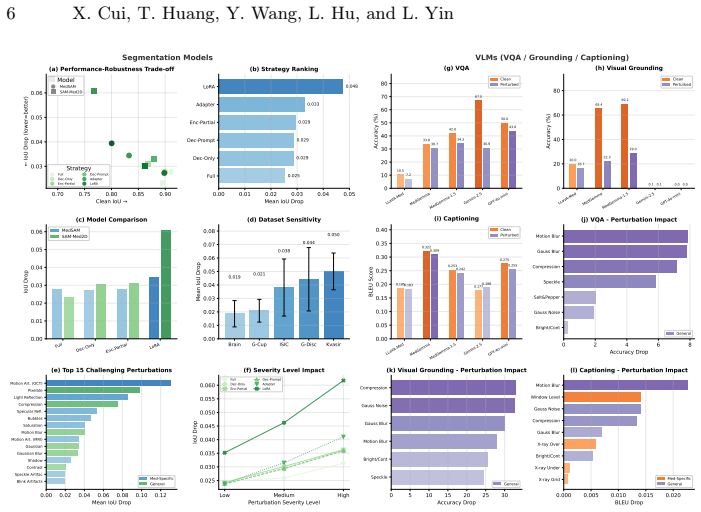
Medical foundation models have achieved remarkable clinical performance, yet their robustness under real-world perturbations remains underexplored. We present a robustness benchmark comprising 40 perturbation types (12 base, 28 medical-specific) across eight imaging modalities, evaluating five VLMs (LLaVA-Med, MedGemma, MedGemma-1.5, Gemini-2.5-flash and GPT-4o-mini) on VQA, visual grounding, and captioning, alongside two segmentation models (MedSAM, SAM-Med2D) with five fine-tuning strategies. Our findings reveal: (1) Fine-tuning strategy dominates robustness, with LoRA exhibiting nearly double the degradation of full fine-tuning, while SAM-Med2D's Adapter offers favorable efficiency-robustness trade-off. (2) Medical-specific perturbations disproportionately damage segmentation, with 9 of 15 top corruptions being domain-specific. (3) LoRA-tuned visual grounding drops over 40 points, whereas zero-shot captioning remains stable (<7% drop). Zero-shot VQA shows model-dependent robustness--medical models drop under 20% while Gemini-2.5-flash drops 54%. General-purpose VLMs achieve higher VQA accuracy but fail on grounding; among medical VLMs, MedGemma demonstrates the best overall stability. These results provide deployment guidelines and underscore the necessity of domain-specific robustness evaluation for medical AI. Our code is available at: https://abnerai.github.io/MedFM-Robust.
Editorial analysis
A structured set of objections, weighed in public.
Referee Report
Summary. The paper motivates the need for robustness evaluation of medical foundation models (MedFMs), which it divides into Medical Vision-Language Models (Med-VLMs such as LLaVA-Med, MedGemma, GPT-4o, Gemini) for tasks like VQA and report generation, and segmentation models (SAM adaptations such as SAM-Med2D and MedSAM). It states that widespread clinical deployment necessitates rigorous reliability testing under real-world conditions and positions MedFM-Robust as the benchmark to perform this evaluation.
Significance. A well-designed robustness benchmark for MedFMs could help surface failure modes that affect clinical safety and guide model improvement, given the high stakes of medical imaging applications. The motivation aligns with standard concerns in applied medical ML about distribution shift and deployment reliability.
major comments (2)
- [Abstract] Abstract: The central claim that 'the widespread clinical deployment of these models thus necessitates rigorous evaluation of their reliability under real-world conditions' is presented as a direct inference from model capabilities, but the text provides no citations to documented robustness failures in Med-VLMs or SAM adaptations, nor any comparison showing why existing robustness benchmarks are inadequate. This leaves the necessity of a new benchmark (MedFM-Robust) unsupported by concrete evidence.
- Full text: No methods, datasets, perturbation types, evaluation protocols, or results are described. A benchmarking paper requires at minimum a description of the benchmark construction, the specific real-world variations tested (e.g., scanner differences, patient demographics, image quality degradations), and baseline model performance to allow assessment of whether the benchmark reveals meaningful robustness gaps.
minor comments (1)
- [Abstract] The model categorization (Med-VLMs vs. segmentation models) is clearly stated but would benefit from a table listing representative models and their primary tasks for quick reference.
Simulated Author's Rebuttal
We thank the referee for their thoughtful review and constructive feedback on our manuscript. We have addressed the major comments by strengthening the motivation with additional citations and expanding the description of the benchmark in the revised version.
read point-by-point responses
-
Referee: [Abstract] Abstract: The central claim that 'the widespread clinical deployment of these models thus necessitates rigorous evaluation of their reliability under real-world conditions' is presented as a direct inference from model capabilities, but the text provides no citations to documented robustness failures in Med-VLMs or SAM adaptations, nor any comparison showing why existing robustness benchmarks are inadequate. This leaves the necessity of a new benchmark (MedFM-Robust) unsupported by concrete evidence.
Authors: We agree that the motivation would be strengthened by explicit citations and comparisons. In the revised manuscript, we have added references to documented robustness failures, including studies on domain shifts in medical VLMs (e.g., performance degradation across different hospitals and imaging protocols) and segmentation models (e.g., SAM adaptations failing under scanner variations). We also include a direct comparison to existing benchmarks such as MedMNIST and natural-image robustness suites, clarifying the unique gaps MedFM-Robust fills for foundation models in clinical settings. revision: yes
-
Referee: [—] Full text: No methods, datasets, perturbation types, evaluation protocols, or results are described. A benchmarking paper requires at minimum a description of the benchmark construction, the specific real-world variations tested (e.g., scanner differences, patient demographics, image quality degradations), and baseline model performance to allow assessment of whether the benchmark reveals meaningful robustness gaps.
Authors: We acknowledge that the initial submission could have provided more explicit detail in the main text. The revised manuscript now includes a dedicated Benchmark Construction section describing the datasets (drawn from public sources such as MIMIC-CXR and segmentation collections like KiTS), perturbation types (both synthetic degradations and real-world factors including scanner differences, demographic shifts, and image quality issues), evaluation protocols (including relative performance drop metrics), and baseline results for models such as LLaVA-Med, MedGemma, MedSAM, and SAM-Med2D that demonstrate meaningful robustness gaps. revision: yes
Circularity Check
No significant circularity
full rationale
The paper introduces MedFM-Robust as a benchmark for robustness evaluation of medical foundation models (Med-VLMs and segmentation adaptations like SAM-Med2D). The abstract and motivation text contain no equations, derivations, fitted parameters, predictions, or load-bearing self-citations. The central claim—that clinical deployment necessitates rigorous real-world reliability evaluation—follows directly from the listed model categories and tasks without any reduction to self-definition, renamed empirical patterns, or imported uniqueness theorems. The derivation chain is absent; the work is a straightforward applied benchmark proposal that remains self-contained against external benchmarks.
discussion (0)
Sign in with ORCID, Apple, or X to comment. Anyone can read and Pith papers without signing in.