Condition-Wise Sinkhorn Drifting for One-Shot Learned Channel Simulation
Pith reviewed 2026-06-26 23:04 UTC · model grok-4.3
The pith
Condition-wise Sinkhorn drifting supplies a one-shot generator that fixes the transmitted symbol and matches only the conditional output law p(y|x).
A machine-rendered reading of the paper's core claim, the machinery that carries it, and where it could break.
Core claim
A conditional Sinkhorn objective defined over repeated outputs conditioned on the same transmitted symbol can be optimized by finite-sample barycentric velocities followed by detached particle regression, yielding a generator that produces samples from p(y|x) in a single forward pass while exactly preserving the input symbol.
What carries the argument
Condition-wise Sinkhorn objective over repeated outputs at fixed transmitted symbol, optimized via finite-sample barycentric velocities and detached particle regression.
If this is right
- Enables millions of differentiable channel evaluations inside training loops at substantially lower cost than diffusion-style sampling.
- Exactly preserves the transmitted symbol while matching the conditional output distribution p(y|x).
- Among one-shot drifting variants, condition-wise Sinkhorn yields the strongest results on conditional diagnostics and symbolic-coding checks.
- Supplies a usable operating point whenever repeated channel calls make diffusion sampling prohibitive.
Where Pith is reading between the lines
- The explicit separation of symbol preservation from conditional transport may transfer to other conditional generation problems that require strict input conditioning.
- One-shot sampling could tighten computational budgets in larger end-to-end learned transceiver designs that currently rely on diffusion.
- Scaling tests on higher-dimensional or non-stationary channels would expose whether the barycentric-velocity training remains stable.
- The same training recipe might be applied to other optimal-transport divergences beyond Sinkhorn.
Load-bearing premise
Finite-sample barycentric velocities and detached particle regression correctly optimize the conditional Sinkhorn objective and produce unbiased samples from p(y|x) without artifacts that degrade downstream symbol-error-rate performance.
What would settle it
If samples drawn from the trained condition-wise Sinkhorn generator produce measurably higher symbol-error rates than either true channel realizations or diffusion samples on the same modulation and coding scheme, the claim of practical equivalence fails.
Figures


read the original abstract
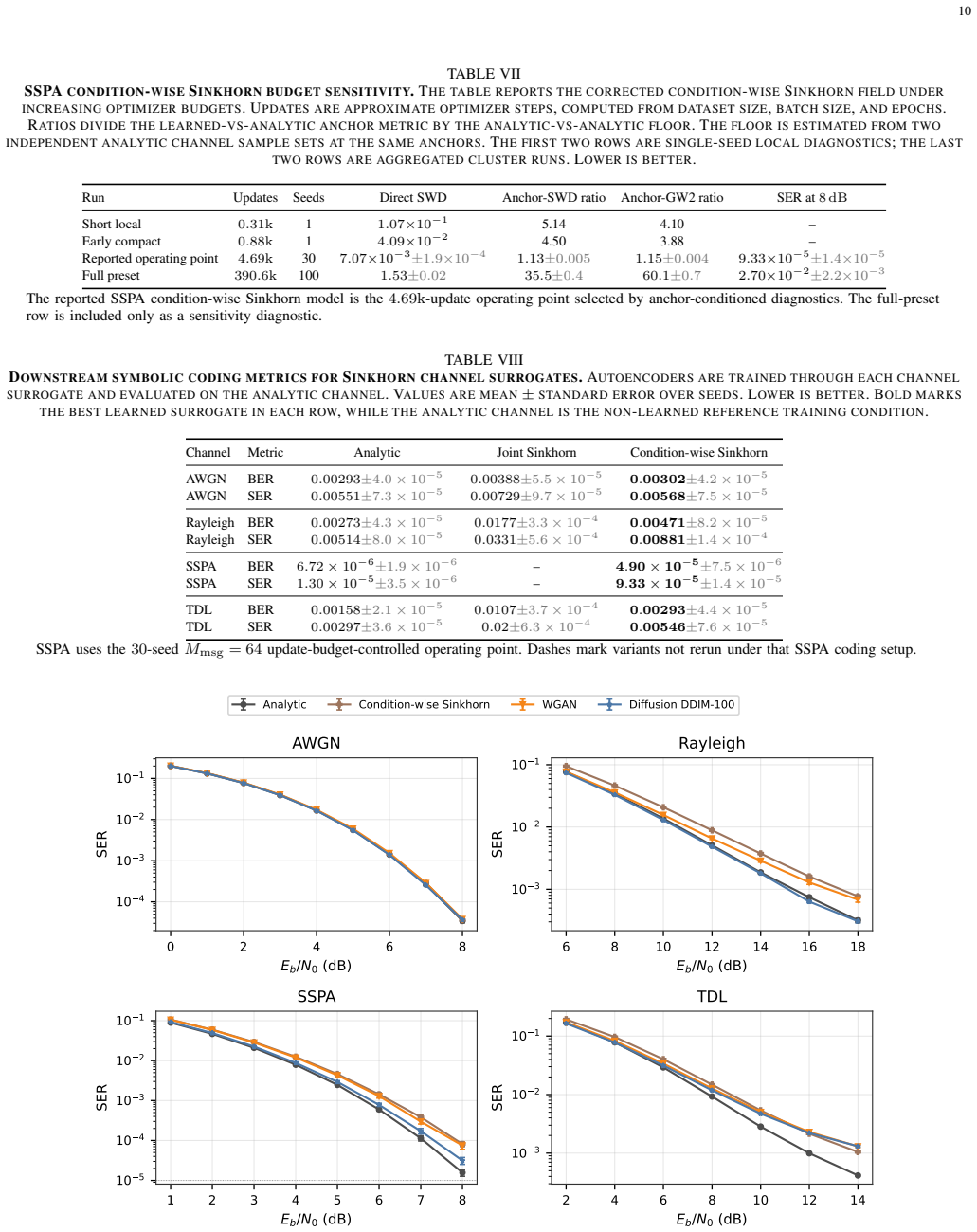
Learned communication systems may evaluate stochastic channel surrogates millions of times inside differentiable training loops, making diffusion-style reverse sampling expensive. This paper proposes condition-wise Sinkhorn drifting, a one-shot channel surrogate that preserves the transmitted symbol and transports only the conditional output laws \(p(y\mid x)\). We formulate a conditional Sinkhorn objective over repeated outputs at the same transmitted symbol and train the generator with finite-sample barycentric velocities followed by detached particle regression. Experiments on additive white Gaussian noise (AWGN), Rayleigh fading, solid-state power amplifier (SSPA) nonlinearity, and a compact tapped-delay-line (TDL) channel compare direct drifting, joint Sinkhorn drifting, condition-wise Sinkhorn drifting, conditional denoising diffusion probabilistic modeling (DDPM), denoising diffusion implicit modeling (DDIM), and Wasserstein generative adversarial network (WGAN) references. Within the evaluated one-shot drifting-family variants, condition-wise Sinkhorn is strongest under conditional diagnostics and symbolic-coding checks, while diffusion remains strongest on the hardest downstream symbol-error-rate (SER) curves. The resulting operating point is a condition-preserving one-shot simulator for settings where repeated channel calls make diffusion-style sampling too costly.
Editorial analysis
A structured set of objections, weighed in public.
Referee Report
Summary. The paper proposes condition-wise Sinkhorn drifting as a one-shot channel surrogate for learned communication systems. It preserves the transmitted symbol and transports only the conditional laws p(y|x) via a conditional Sinkhorn objective, trained using finite-sample barycentric velocities followed by detached particle regression. Experiments on AWGN, Rayleigh fading, SSPA nonlinearity, and TDL channels compare it to direct/joint drifting variants, conditional DDPM/DDIM, and WGAN, claiming condition-wise Sinkhorn is strongest on conditional diagnostics and symbolic-coding checks while diffusion excels on SER curves. The operating point targets settings where repeated channel calls make diffusion sampling too costly.
Significance. If the central training procedure produces faithful samples from p(y|x), the work supplies a computationally lighter one-shot alternative to diffusion models for repeated evaluations inside differentiable training loops. The explicit multi-channel comparison and emphasis on condition preservation are strengths that could support practical adoption in communication-system design.
major comments (2)
- [Abstract and training description] Abstract and training description: the claim that finite-sample barycentric velocities followed by detached particle regression optimizes the conditional Sinkhorn objective lacks any derivation or convergence argument showing that detachment preserves the marginal constraint and yields unbiased draws from p(y|x). This is load-bearing for all reported conditional diagnostics, symbolic-coding checks, and the final operating-point conclusion.
- [Experiments section] Experiments section: reported superiority of condition-wise Sinkhorn over joint drifting and WGAN on conditional diagnostics rests on the samples being faithful to p(y|x); without evidence that bias does not grow with particle count or conditioning granularity, the cross-method ranking is not established.
minor comments (1)
- [Abstract] The abstract refers to 'symbolic-coding checks' without defining the metric or procedure.
Simulated Author's Rebuttal
We thank the referee for the thoughtful and detailed report. The two major comments correctly identify that the manuscript presents the finite-sample barycentric-velocity + detached-regression procedure without a supporting derivation or bias analysis. We address both points below and will revise the manuscript to strengthen the justification and empirical support.
read point-by-point responses
-
Referee: [Abstract and training description] Abstract and training description: the claim that finite-sample barycentric velocities followed by detached particle regression optimizes the conditional Sinkhorn objective lacks any derivation or convergence argument showing that detachment preserves the marginal constraint and yields unbiased draws from p(y|x). This is load-bearing for all reported conditional diagnostics, symbolic-coding checks, and the final operating-point conclusion.
Authors: We agree that the current text does not supply a derivation. The procedure is motivated by the fact that barycentric projections yield a consistent estimator of the conditional OT map and that detaching the regression targets avoids differentiating through the Sinkhorn iterations. In expectation the marginal constraint on the generated particles is preserved because the targets are themselves obtained from a feasible conditional plan; however, we acknowledge that a rigorous convergence statement is missing. We will add a concise paragraph (with a short proof sketch) in the revised training section clarifying the approximation properties and the role of detachment, while explicitly noting that the method remains an empirical surrogate whose fidelity is assessed downstream. revision: yes
-
Referee: [Experiments section] Experiments section: reported superiority of condition-wise Sinkhorn over joint drifting and WGAN on conditional diagnostics rests on the samples being faithful to p(y|x); without evidence that bias does not grow with particle count or conditioning granularity, the cross-method ranking is not established.
Authors: The concern is valid: the reported rankings rest on the assumption that any approximation bias remains small across the tested regimes. We will augment the experimental section with two new figures that (i) sweep particle count from 64 to 1024 while monitoring the same conditional diagnostics and (ii) vary the number of distinct conditioning symbols (granularity) on the AWGN and Rayleigh channels. These additions will either confirm stability of the ranking or qualify the operating regime in which condition-wise Sinkhorn remains preferable. revision: yes
Circularity Check
No significant circularity detected
full rationale
The paper presents condition-wise Sinkhorn drifting as a novel one-shot surrogate formulated directly from a conditional Sinkhorn objective over repeated outputs at fixed symbols, trained via the stated finite-sample barycentric velocities plus detached particle regression procedure. No load-bearing step reduces a claimed prediction or uniqueness result to a self-citation, a fitted parameter renamed as output, or an ansatz imported from the authors' prior work. The empirical comparisons to DDPM, DDIM, WGAN and other drifting variants rest on external diagnostics (conditional metrics, SER curves) rather than internal redefinition of the target distribution. The derivation chain is therefore self-contained against the stated objective and does not exhibit any of the enumerated circularity patterns.
Axiom & Free-Parameter Ledger
axioms (1)
- domain assumption The Sinkhorn algorithm can be conditioned on the input symbol to transport only p(y|x) while leaving the symbol unchanged
Reference graph
Works this paper leans on
-
[1]
Diffusion models for accurate channel distribution generation,
M. Kim, R. Fritschek, and R. F. Schaefer, “Diffusion models for accurate channel distribution generation,”arXiv preprint arXiv:2309.10505, 2023
arXiv 2023
-
[2]
Robust generation of channel distributions with diffusion mod- els,
——, “Robust generation of channel distributions with diffusion mod- els,” inICC 2024 – IEEE International Conference on Communications, 2024, pp. 330–335
2024
-
[3]
Generating high dimen- sional user-specific wireless channels using diffusion models,
T. Lee, J. Park, H. Kim, and J. G. Andrews, “Generating high dimen- sional user-specific wireless channels using diffusion models,”IEEE Transactions on Wireless Communications, vol. 25, pp. 2907–2921, 2026
2026
-
[4]
Digital twin of channel: Diffusion model for sensing-assisted statistical channel state information generation,
X. Gong, X. Liu, A. A. Lu, X. Gao, X. G. Xia, C.-X. Wang, and X. You, “Digital twin of channel: Diffusion model for sensing-assisted statistical channel state information generation,”IEEE Transactions on Wireless Communications, vol. 24, no. 5, pp. 3805–3821, 2025
2025
-
[5]
Generative diffusion models for high dimensional channel estimation,
X. Zhou, L. Liang, J. Zhang, P. Jiang, Y . Li, and S. Jin, “Generative diffusion models for high dimensional channel estimation,”IEEE Trans- actions on Wireless Communications, vol. 24, no. 7, pp. 5840–5854, 2025
2025
-
[6]
Diffusion- based generative prior for low-complexity MIMO channel estimation,
B. Fesl, M. Baur, F. Strasser, M. Joham, and W. Utschick, “Diffusion- based generative prior for low-complexity MIMO channel estimation,” IEEE Wireless Communications Letters, vol. 13, no. 12, pp. 3493–3497, 2024
2024
-
[7]
Generative diffusion model- based variational inference for MIMO channel estimation,
Z. Chen, H. Shin, and A. Nallanathan, “Generative diffusion model- based variational inference for MIMO channel estimation,”IEEE Trans- actions on Communications, vol. 73, no. 10, pp. 9254–9269, 2025
2025
-
[8]
Joint channel estimation and data detection in massive MIMO systems based on diffusion models,
N. Zilberstein, A. Swami, and S. Segarra, “Joint channel estimation and data detection in massive MIMO systems based on diffusion models,” inICASSP 2024 – IEEE International Conference on Acoustics, Speech and Signal Processing, 2024, pp. 13 291–13 295
2024
-
[9]
Conditional denoising diffusion-based channel estimation for fast time-varying MIMO-OFDM systems,
H. Fu, W. Si, and R. Liu, “Conditional denoising diffusion-based channel estimation for fast time-varying MIMO-OFDM systems,”Digital Signal Processing, vol. 164, p. 105283, 2025
2025
-
[10]
Denoising diffusion probabilistic models,
J. Ho, A. Jain, and P. Abbeel, “Denoising diffusion probabilistic models,” inAdvances in Neural Information Processing Systems, vol. 33, 2020, pp. 6840–6851
2020
-
[11]
Denoising diffusion implicit models,
J. Song, C. Meng, and S. Ermon, “Denoising diffusion implicit models,” inInternational Conference on Learning Representations, 2021
2021
-
[12]
Consistency models,
Y . Song, P. Dhariwal, M. Chen, and I. Sutskever, “Consistency models,” inProceedings of the 40th International Conference on Machine Learning, ser. Proceedings of Machine Learning Research, vol. 202. PMLR, 2023, pp. 32 211–32 252. [Online]. Available: https://proceedings.mlr.press/v202/song23a.html
2023
-
[13]
One-step diffusion with distribution matching distillation,
T. Yin, M. Gharbi, R. Zhang, E. Shechtman, F. Durand, W. T. Freeman, and T. Park, “One-step diffusion with distribution matching distillation,” inProceedings of the IEEE/CVF Conference on Computer Vision and Pattern Recognition (CVPR), Jun. 2024, pp. 6613–6623
2024
-
[14]
Generative modeling via drifting,
M. Deng, H. Li, T. Li, Y . Du, and K. He, “Generative modeling via drifting,”arXiv preprint arXiv:2602.04770, 2026
Pith/arXiv arXiv 2026
-
[15]
The geometry of noise: Why diffusion models don’t need noise conditioning,
M. Sahraee-Ardakan, M. Delbracio, and P. Milanfar, “The geometry of noise: Why diffusion models don’t need noise conditioning,”arXiv preprint arXiv:2602.18428, 2026
arXiv 2026
-
[16]
One- step generative modeling via Wasserstein gradient flows,
J. Han, P. Li, Q. Guo, R. Xu, S. Ermon, and E. J. Cand `es, “One- step generative modeling via Wasserstein gradient flows,”arXiv preprint arXiv:2605.11755, 2026
Pith/arXiv arXiv 2026
-
[17]
Sinkhorn distances: Lightspeed computation of optimal transport,
M. Cuturi, “Sinkhorn distances: Lightspeed computation of optimal transport,” inAdvances in Neural Information Processing Systems, vol. 26, 2013, pp. 2292–2300
2013
-
[18]
Interpolating between optimal transport and MMD using Sinkhorn divergences,
J. Feydy, T. S ´ejourn´e, F.-X. Vialard, S.-i. Amari, A. Trouv ´e, and G. Peyr ´e, “Interpolating between optimal transport and MMD using Sinkhorn divergences,” inProceedings of the Twenty-Second International Conference on Artificial Intelligence and Statistics, ser. Proceedings of Machine Learning Research, vol. 89. PMLR, 2019, pp. 2681–2690. [Online]. ...
2019
-
[19]
Study on Channel Model for Frequencies from 0.5 to 100 GHz,
3GPP, “Study on Channel Model for Frequencies from 0.5 to 100 GHz,” 3GPP, Technical Report TR 38.901, 2022, version 17.1.0
2022
discussion (0)
Sign in with ORCID, Apple, or X to comment. Anyone can read and Pith papers without signing in.