Strong nanomechanical Duffing nonlinearity and interactions induced through cavity optomechanics
Pith reviewed 2026-05-20 00:19 UTC · model grok-4.3
The pith
Cavity optomechanics creates strong tunable Duffing nonlinearity in nanomechanical resonators via radiation pressure.
A machine-rendered reading of the paper's core claim, the machinery that carries it, and where it could break.
Core claim
The radiation-pressure interaction in a cavity optomechanical system generates a nonlinear optical spring that adds a Duffing term to the mechanical potential. This term is proportional to the square of the intracavity optical field and its sign is set by the detuning of the drive laser from the cavity resonance. When several mechanical modes couple to the same optical mode, the nonlinear spring produces effective nonlinear interactions between those modes that modify both their frequency response and their time evolution.
What carries the argument
The nonlinear optical spring effect produced by the radiation-pressure force, which supplies a controllable cubic term in the mechanical restoring force.
If this is right
- Duffing nonlinearity strength scales directly with intracavity photon number and can be increased or decreased at will.
- Nonlinearity sign switches from softening to hardening simply by changing laser detuning.
- Nonlinear coupling appears between any pair of mechanical modes that share the optical cavity.
- Spectral lines and dynamical trajectories of the resonators become reconfigurable by changing only the optical drive.
- Networks of resonators can be turned into platforms for simulating nonlinear dynamics with all-optical control.
Where Pith is reading between the lines
- The same optical control could be used to study how nonlinearity affects quantum behavior in cooled mechanical systems.
- Arrays of such resonators might serve as hardware for classical or quantum signal processing without custom material engineering.
- The approach suggests a route to dynamically reconfigure mechanical logic or sensing elements during operation.
Load-bearing premise
The measured amplitude-dependent frequency shifts and inter-mode effects arise from radiation-pressure nonlinearity rather than from material properties, heating, or other mechanisms inside the resonators.
What would settle it
If the size of the amplitude-dependent frequency shift fails to increase with optical power or fails to reverse sign when the laser is tuned from one side of the cavity resonance to the other, the radiation-pressure mechanism would be ruled out.
Figures



read the original abstract
Nonlinearity is a key resource in both classical and quantum signal processing. Nonlinear nanomechanical elements have found applications ranging from sensing to computing, while networks of nonlinear resonators, as well as nonlinearly coupled networks of linear resonators, constitute promising platforms for simulating complex dynamics. Here, we experimentally demonstrate an approach to realizing strong mechanical nonlinearity in nanomechanical resonators, fully controlled through optical laser drives. The mechanism exploits the nonlinearity of the radiation-pressure interaction in a cavity optomechanical system, which gives rise to a nonlinear optical spring effect. The resulting Duffing nonlinearity is conveniently tunable in strength via pump laser power, while its sign is controlled by laser detuning. Moreover, we demonstrate that the nonlinear optical spring mediates effective interactions between mechanical modes coupled to a common cavity, inducing tunable nonlinear interactions between them that impact spectral response and dynamics. These results establish cavity optomechanics as a versatile and in-situ reconfigurable platform for engineering nonlinear dynamics in resonators and networks.
Editorial analysis
A structured set of objections, weighed in public.
Referee Report
Summary. The manuscript experimentally demonstrates an approach to realizing strong, tunable Duffing nonlinearity in nanomechanical resonators via the nonlinear radiation-pressure interaction in a cavity optomechanical system. The resulting nonlinear optical spring effect is controlled in strength by pump laser power and in sign by laser detuning. The work further shows that this mechanism mediates effective tunable nonlinear interactions between multiple mechanical modes coupled to a common cavity, impacting spectral responses and dynamics including bistability.
Significance. If the central claims hold, the results establish cavity optomechanics as a versatile, in-situ reconfigurable platform for engineering nonlinear dynamics in nanomechanical resonators and networks. This is significant for applications in sensing, computing, and quantum simulation of complex systems, as it avoids reliance on intrinsic material nonlinearities. Strengths include the theoretical derivation of the cubic-order radiation-pressure force, power- and detuning-dependent spectra, dynamic measurements, and controls via observed sign reversal with detuning and linear scaling with intracavity photon number.
major comments (2)
- [§3.2, Eq. (8)] §3.2, Eq. (8): The effective Duffing coefficient is derived from the cubic expansion of the radiation-pressure force; however, the manuscript should explicitly compare the predicted amplitude dependence of the frequency shift to the measured data in Fig. 4 to confirm that higher-order terms or fitting parameters do not dominate the reported nonlinearity strength.
- [§5.1, Fig. 6] §5.1, Fig. 6: The demonstration of inter-mode nonlinear interactions relies on observed spectral shifts and dynamic coupling; a quantitative fit to the predicted interaction Hamiltonian (including the scaling with intracavity photon number) is needed to rule out residual linear coupling or thermal cross-talk as the source of the reported effects.
minor comments (2)
- [Fig. 3] The caption of Fig. 3 should include the exact detuning values and photon numbers used for each trace to allow direct comparison with the theory curves.
- [Experimental Methods] A brief discussion of the mechanical quality factors and their potential power dependence would clarify whether any observed damping changes are consistent with the radiation-pressure model.
Simulated Author's Rebuttal
We thank the referee for the positive assessment of our work and the recommendation for minor revision. The comments are constructive and we address them point by point below, incorporating revisions where they strengthen the manuscript without altering our central claims.
read point-by-point responses
-
Referee: [§3.2, Eq. (8)] §3.2, Eq. (8): The effective Duffing coefficient is derived from the cubic expansion of the radiation-pressure force; however, the manuscript should explicitly compare the predicted amplitude dependence of the frequency shift to the measured data in Fig. 4 to confirm that higher-order terms or fitting parameters do not dominate the reported nonlinearity strength.
Authors: We agree that an explicit comparison of the predicted amplitude dependence would improve clarity. In the revised manuscript we will add a direct overlay in Fig. 4 (or a new panel) of the measured frequency shift versus mechanical amplitude squared together with the curve predicted solely from the Duffing coefficient of Eq. (8). The data follow the expected linear dependence on amplitude squared over the full range explored, with no systematic deviation that would indicate higher-order terms or additional fitting parameters. This comparison uses the independently determined optomechanical parameters and confirms the cubic radiation-pressure term dominates. revision: yes
-
Referee: [§5.1, Fig. 6] §5.1, Fig. 6: The demonstration of inter-mode nonlinear interactions relies on observed spectral shifts and dynamic coupling; a quantitative fit to the predicted interaction Hamiltonian (including the scaling with intracavity photon number) is needed to rule out residual linear coupling or thermal cross-talk as the source of the reported effects.
Authors: We thank the referee for highlighting the value of a quantitative fit. In the revised version we will include a fit of the observed inter-mode frequency shifts and coupling rates to the effective interaction Hamiltonian, explicitly demonstrating the linear scaling with intracavity photon number (varied via pump power). The fit residuals are small and the extracted interaction strength matches the prediction from the single-mode Duffing coefficient. We already rule out residual linear coupling by its absence when the pump is detuned far from resonance and rule out thermal cross-talk by the observed sign reversal with laser detuning; these controls will be emphasized alongside the new quantitative comparison in §5.1 and Fig. 6. revision: yes
Circularity Check
No significant circularity; derivation is first-principles and experimentally validated
full rationale
The paper presents an experimental demonstration of tunable Duffing nonlinearity and inter-mode interactions induced via the radiation-pressure force in a cavity optomechanical system. The theoretical derivation expands the standard radiation-pressure interaction to cubic order in mechanical displacement to obtain the nonlinear optical spring term; this is a direct first-principles calculation from the optomechanical Hamiltonian and does not reduce to any fitted parameter or self-citation by construction. Experimental controls (sign reversal with laser detuning, linear scaling with intracavity photon number) are used to rule out material or thermal alternatives, providing independent falsification. No load-bearing step invokes a self-citation chain, renames a known result, or equates a prediction to its own input. The central claims rest on observable spectral and dynamic data rather than any circular reduction.
Axiom & Free-Parameter Ledger
Reference graph
Works this paper leans on
-
[1]
(left) and negative detuning ∆ − =−κ/(2 √
-
[2]
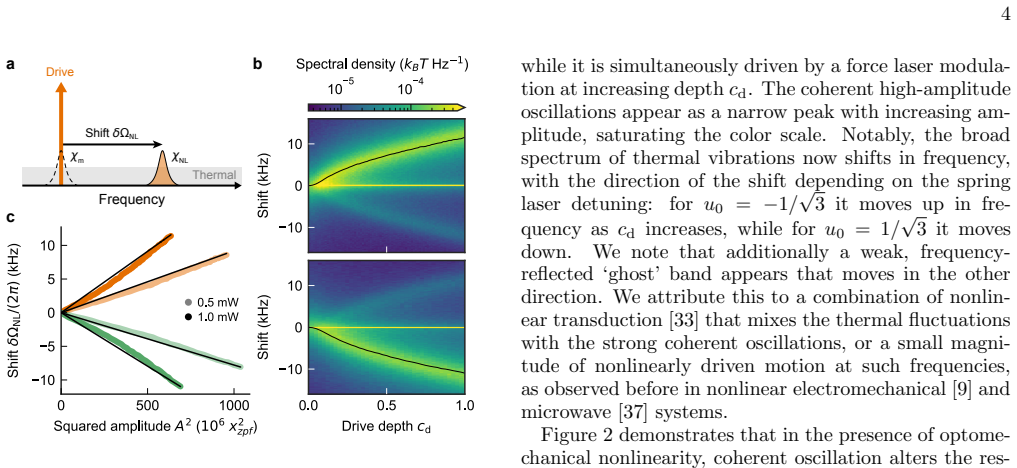
(right). Forward (blue) and backward (red) frequency sweeps are shown for increasing spring laser powersP in (offset for clarity), with theory overlaid (black). (e) Cubic coefficientsβ for increasingP in and drive amplitudeA max. Estimates from the experimental response (circles) match well with Eq. (6) (black line) for both ∆ + (green,β <0) and ∆ − (oran...
-
[3]
(top) or ∆ + =κ/(2 √
-
[4]
(bottom). Bright bands indicate thermal fluctations on top of the driven ampli- tude, while fainter bands result from nonlinear transduction. (c) Fitted center frequencies of the Lorentzian thermal contri- bution plotted against the square of the driven amplitude, for ∆− (orange) and ∆ + (green) at two powersP in. Expected susceptibility shifts from Eq. (...
-
[5]
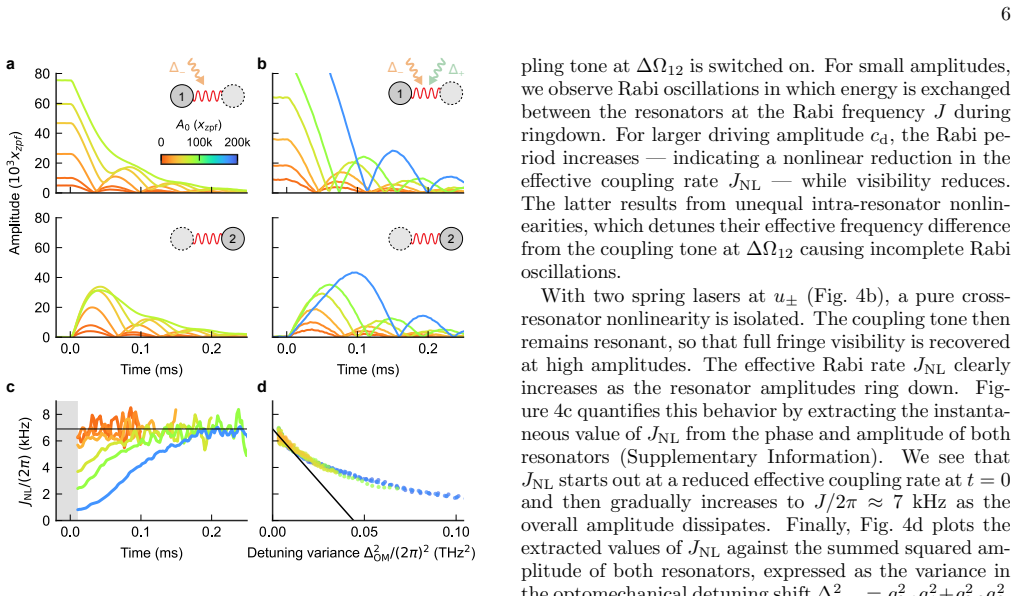
(c) Response of uncoupled resonator 1 with both spring lasers active
that cancels the intra-resonator nonlinearity while preserving the cross-resonator nonlinearity, resulting in reduced peak splitting with increasing amplitude. (c) Response of uncoupled resonator 1 with both spring lasers active. Cancellation of nonlinearity restores a Lorentzian lineshape and eliminates hysteresis between forward (blue) and backward (red...
-
[6]
spring laser. Here, resonator 2 is driven around its resonance frequency Ω 2 by an additional weak modulation of the spring laser at depthc d. For smallc d <0.02, two Lorentzian peaks are observed split by frequency 2J, signifying hybridis- ation of the two mechanical resonators by the effective optical coupling. For stronger drives, the larger ampli- tud...
-
[7]
R. Lifshitz and M. C. Cross, Nonlinear dynamics of nanomechanical and micromechanical resonators, inRe- views of Nonlinear Dynamics and Complexity(Wiley- VCH Verlag GmbH & Co. KGaA, 2008) pp. 1–52
work page 2008
-
[8]
J. Guckenheimer and P. Holmes,Nonlinear Oscillations, Dynamical Systems, and Bifurcations of Vector Fields, Applied Mathematical Sciences, Vol. 42 (Springer New York, New York, NY, 1983)
work page 1983
-
[9]
D. W. Jordan and P. Smith,Nonlinear Ordinary Dif- ferential Equations: An Introduction for Scientists and Engineers, 4th ed. (New York : Oxford University Press, Oxford [England], 2007)
work page 2007
-
[10]
P. Holmes and D. Rand, The bifurcations of Duffing’s equation: An application of catastrophe theory, J. Sound Vibr.44, 237 (1976)
work page 1976
-
[11]
I. Kovacic and M. J. Brennan,The Duffing Equation: Nonlinear Oscillators and Their Phenomena(Wiley, Chichester, West Sussex, U.K. ; Hoboken, N.J, 2011)
work page 2011
-
[12]
I. Mahboob, E. Flurin, K. Nishiguchi, A. Fujiwara, and H. Yamaguchi, Interconnect-free parallel logic circuits in a single mechanical resonator, Nat. Commun.2, 198 (2011)
work page 2011
-
[13]
I. Mahboob, H. Okamoto, and H. Yamaguchi, An elec- tromechanical Ising Hamiltonian, Sci. Adv.2, e1600236 (2016)
work page 2016
- [14]
-
[15]
J. S. Huber, G. Rastelli, M. J. Seitner, J. K¨ olbl, W. Belzig, M. I. Dykman, and E. M. Weig, Spectral ev- idence of squeezing of a weakly damped driven nanome- chanical mode, Phys. Rev. X10, 021066 (2020)
work page 2020
-
[16]
M. Serra-Garcia, A. Foehr, M. Moler´ on, J. Lydon, C. Chong, and C. Daraio, Mechanical autonomous stochastic heat engine, Phys. Rev. Lett.117, 010602 (2016)
work page 2016
-
[17]
T. J. Kippenberg, A. L. Gaeta, M. Lipson, and M. L. Gorodetsky, Dissipative kerr solitons in optical microres- onators, Science361, eaan8083 (2018)
work page 2018
-
[18]
J. S. Ochs, D. K. J. Boneß, G. Rastelli, M. Seitner, W. Belzig, M. I. Dykman, and E. M. Weig, Frequency comb from a single driven nonlinear nanomechanical mode, Phys. Rev. X12, 041019 (2022)
work page 2022
-
[19]
J. Sun, W. Yang, T. Zheng, X. Xiong, Y. Liu, Z. Wang, Z. Li, and X. Zou, Novel nondelay-based reservoir com- puting with a single micromechanical nonlinear resonator for high-efficiency information processing, Microsyst. & Nanoeng.7, 83 (2021)
work page 2021
- [20]
-
[21]
D. Markovi´ c, A. Mizrahi, D. Querlioz, and J. Grollier, Physics for neuromorphic computing, Nat. Rev. Phys.2, 499 (2020)
work page 2020
-
[22]
M. J. Hartmann, F. G. S. L. Brand˜ ao, and M. B. Ple- nio, Strongly interacting polaritons in coupled arrays of cavities, Nat. Phys.2, 849 (2006)
work page 2006
-
[23]
M. Ludwig and F. Marquardt, Quantum many-body dy- namics in optomechanical arrays, Phys. Rev. Lett.111, 073603 (2013)
work page 2013
-
[24]
D. Leykam and Y. D. Chong, Edge solitons in nonlinear- photonic topological insulators, Phys. Rev. Lett.117, 143901 (2016)
work page 2016
-
[25]
E. J. Meier, F. A. An, and B. Gadway, Observation of the topological soliton state in the Su–Schrieffer–Heeger model, Nat. Commun.7, 13986 (2016). 8
work page 2016
-
[26]
S. Mukherjee and M. C. Rechtsman, Observation of Flo- quet solitons in a topological bandgap, Science368, 856 (2020)
work page 2020
-
[27]
S. Mukherjee and M. C. Rechtsman, Observation of uni- directional solitonlike edge states in nonlinear Floquet topological insulators, Phys. Rev. X11, 041057 (2021)
work page 2021
-
[28]
S. Lin, L. Zhang, T. Tian, C.-K. Duan, and J. Du, Dy- namic Observation of Topological Soliton States in a Pro- grammable Nanomechanical Lattice, Nano Lett.21, 1025 (2021)
work page 2021
-
[29]
M. S. Kirsch, Y. Zhang, M. Kremer, L. J. Maczewsky, S. K. Ivanov, Y. V. Kartashov, L. Torner, D. Bauer, A. Szameit, and M. Heinrich, Nonlinear second-order photonic topological insulators, Nat. Phys.17, 995 (2021)
work page 2021
-
[30]
M. J¨ urgensen, S. Mukherjee, and M. C. Rechtsman, Quantized nonlinear Thouless pumping, Nature596, 63 (2021)
work page 2021
-
[31]
M. J¨ urgensen, S. Mukherjee, C. J¨ org, and M. C. Rechts- man, Quantized fractional Thouless pumping of solitons, Nat. Phys.19, 420 (2023)
work page 2023
- [32]
- [33]
- [34]
-
[35]
M. Aspelmeyer, T. J. Kippenberg, and F. Marquardt, Cavity optomechanics, Rev. Mod. Phys.86, 1391 (2014)
work page 2014
-
[36]
H. Li, Y. Chen, J. Noh, S. Tadesse, and M. Li, Multichan- nel cavity optomechanics for all-optical amplification of radio frequency signals, Nat. Commun.3, 1091 (2012)
work page 2012
-
[37]
J. N. Westwood-Bachman, T. Firdous, A. E. Kobryn, M. Belov, and W. K. Hiebert, Isolation of optomechanical nonlinearities in nanomechanical cantilevers, Phys. Rev. A105, 053517 (2022)
work page 2022
- [38]
-
[39]
R. Leijssen, G. R. La Gala, L. Freisem, J. T. Muhonen, and E. Verhagen, Nonlinear cavity optomechanics with nanomechanical thermal fluctuations, Nat. Commun.8, 16024 (2017)
work page 2017
- [40]
-
[41]
R. Leijssen and E. Verhagen, Strong optomechanical in- teractions in a sliced photonic crystal nanobeam, Sci. Rep.5, 15974 (2015)
work page 2015
-
[42]
J. P. Mathew, J. del Pino, and E. Verhagen, Syn- thetic gauge fields for phonon transport in a nano- optomechanical system, Nature Nanotechnology15, 198 (2020)
work page 2020
-
[43]
F. Fani Sani, I. C. Rodrigues, D. Bothner, and G. A. Steele, Level attraction and idler resonance in a strongly driven Josephson cavity, Phys. Rev. Research3, 043111 (2021)
work page 2021
-
[44]
M. Krack and J. Gross,Harmonic Balance for Non- linear Vibration Problems, Mathematical Engineering (Springer International Publishing, Cham, 2019)
work page 2019
-
[45]
M. Sato, B. E. Hubbard, and A. J. Sievers, Colloquium: Nonlinear energy localization and its manipulation in mi- cromechanical oscillator arrays, Rev. Mod. Phys.78, 137 (2006)
work page 2006
-
[46]
M. H. Matheny, M. Grau, L. G. Villanueva, R. B. Kara- balin, M. C. Cross, and M. L. Roukes, Phase synchro- nization of two anharmonic nanomechanical oscillators, Phys. Rev. Lett.112, 014101 (2014)
work page 2014
-
[47]
J. Jin, D. Rossini, R. Fazio, M. Leib, and M. J. Hart- mann, Photon solid phases in driven arrays of nonlinearly coupled cavities, Phys. Rev. Lett.110, 163605 (2013)
work page 2013
- [48]
-
[49]
C. Samanta, S. L. D. Bonis, C. B. Møller, R. Tormo- Queralt, W. Yang, C. Urgell, B. Stamenic, B. Thibeault, Y. Jin, D. A. Czaplewski, F. Pistolesi, and A. Bach- told, Nonlinear nanomechanical resonators approaching the quantum ground state, Nat. Phys.19, 1294 (2023)
work page 2023
-
[50]
T. M. F. Hirsch, N. P. Mauranyapin, E. Romero, G. I. Harris, X. Jin, N. Arora, C. J. Bekker, C. Meng, W. P. Bowen, and C. G. Baker, Tutorial: Membrane phononic integrated circuits, J. of Appl. Phys.139, 081102 (2026)
work page 2026
-
[51]
J. del Pino, J. J. Slim, and E. Verhagen, Non- Hermitian chiral phononics through optomechanically in- duced squeezing, Nature606, 82 (2022)
work page 2022
-
[52]
C. C. Wanjura, J. J. Slim, J. del Pino, M. Brunelli, E. Verhagen, and A. Nunnenkamp, Quadrature nonre- ciprocity in bosonic networks without breaking time- reversal symmetry, Nat. Phys.19, 1429 (2023)
work page 2023
-
[53]
J. J. Slim, C. C. Wanjura, M. Brunelli, J. Del Pino, A. Nunnenkamp, and E. Verhagen, Optomechanical re- alization of the bosonic Kitaev chain, Nature627, 767 (2024). 9 Supplementary Information I. NONLINEAR OPTICAL BACKACTION In this section, we present a detailed analysis of opti- cal backaction in fast-cavity optomechanical systems [29]. We start from t...
work page 2024
-
[54]
1− 9 4 g2 0,1 κ2 |a1(t)|2 + g2 0,2 κ2 |a2t)|2 !# + iJ a1(t)9 2
Expandingn c to third order inδuthen yields nc =n max h(u±) +h ′(u±)δu+ 1 6 h′′′(u±)(δu)3 (S28) =n max h(u±) +h ′(u±) δu− 3 4(δu)3 ,(S29) where we have usedh ′′(u±) = 0 andh ′′′(u±) = −(9/2)h′(u±). We plug this into the equation of motions to obtain ¨zj =−Ω 2 m,jz−γ j ˙zj + 2Ωm,jg0,j (S30) ×n max h(u±) +h ′(u±) δu− 3 4(δu)3 (S31) 11 Again, we remove the s...
discussion (0)
Sign in with ORCID, Apple, or X to comment. Anyone can read and Pith papers without signing in.