Four newly discovered HII galaxies
Pith reviewed 2026-05-25 17:50 UTC · model grok-4.3
The pith
Four new HII galaxies were identified through amateur spectroscopy campaigns targeting planetary nebula candidates.
A machine-rendered reading of the paper's core claim, the machinery that carries it, and where it could break.
Core claim
During spectroscopy campaigns at the Cote d'Azur observatory at Calern, four objects previously considered planetary nebula candidates were instead identified as HII galaxies: App 1 at RA 22h 49m 20.23s, DEC +46°07'37.17'', Pre 21 at RA 18h 04m 19.62s, DEC +00°08'04.96'', Pre 24 at RA 04h 25m 53.63s, DEC +39°49'19.69'', and Ra 69 at RA 19h 30m 23.64s, DEC +37°37'06.58''.
What carries the argument
Emission-line spectroscopy that distinguishes HII galaxies from other emission-line objects such as Seyferts by the location and ratios of spectral features.
If this is right
- The four objects can now be added to catalogs of known HII galaxies for follow-up study.
- Similar campaigns may locate additional misclassified objects among planetary nebula candidate lists.
- Amateur spectroscopy at modest telescopes can contribute new galactic identifications.
- These specific coordinates allow targeted imaging or further observations by other groups.
Where Pith is reading between the lines
- If amateur groups continue such campaigns, the fraction of unclassified emission-line objects in existing surveys may decrease.
- The work implies that some fraction of planetary nebula candidates in current lists are actually distant galaxies.
- Future all-sky surveys could cross-check against these positions to refine selection criteria for compact HII regions.
Load-bearing premise
The spectra obtained are sufficient to correctly classify the four objects as HII galaxies rather than Seyfert galaxies or other types.
What would settle it
Independent professional spectroscopy of any one of the four objects that shows line ratios inconsistent with HII galaxy classification.
Figures
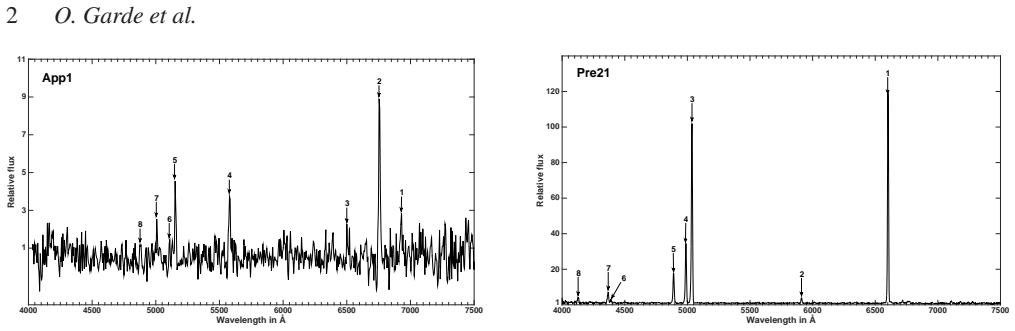


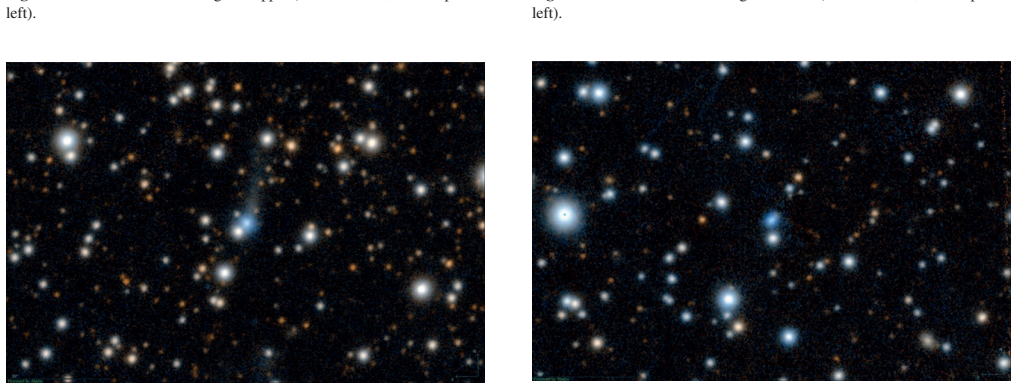
read the original abstract
We present the results of spectroscopy campaigns for planetary nebula candidates, where we have identified four objects as Seyfert galaxies. All observations have been carried out by a group of French amateur astronomers. During the campaigns at the Cote d'Azur observatory at Calern (France), four HII galaxies could be identified. Using the naming convention of our campaign, these objects are (1) App 1 (RA: 22h 49m 20.23s, DEC: +46{\deg}07{\arcmin}37.17{\arcsec}), (2) Pre 21 (RA: 18h 04m 19.62s, DEC: +00{\deg}08{\arcmin}04.96{\arcsec}), (3) Pre 24 (RA: 04h 25m 53.63s, DEC: +39{\deg}49{\arcmin}19.69{\arcsec}), and (4) Ra 69 (RA: 19h 30m 23.64s, DEC: +37{\deg}37{\arcmin}06.58{\arcsec}).
Editorial analysis
A structured set of objections, weighed in public.
Referee Report
Summary. The manuscript reports the discovery of four HII galaxies (App 1 at RA 22h 49m 20.23s, DEC +46°07'37.17'', Pre 21 at RA 18h 04m 19.62s, DEC +00°08'04.96'', Pre 24 at RA 04h 25m 53.63s, DEC +39°49'19.69'', and Ra 69 at RA 19h 30m 23.64s, DEC +37°37'06.58'') identified during amateur spectroscopy campaigns for planetary nebula candidates at the Cote d'Azur observatory at Calern.
Significance. If the classifications hold, the result would add four new HII galaxies with precise coordinates to the literature, which could be of modest interest for follow-up observations in galactic astronomy. No machine-checked proofs, reproducible code, or parameter-free derivations are present.
major comments (2)
- [Abstract] Abstract: The text first states that 'we have identified four objects as Seyfert galaxies' and then states that 'four HII galaxies could be identified,' applying both labels to the identical set of four objects (App 1, Pre 21, Pre 24, Ra 69). This direct internal contradiction is load-bearing for the central classification claim and prevents evaluation of whether the objects are HII galaxies rather than Seyferts.
- [Abstract] Abstract: No spectra, emission-line fluxes, line ratios, error estimates, or classification criteria (e.g., BPT diagram placement) are supplied to support the HII galaxy identifications. The claim that these are HII galaxies (rather than other emission-line types) therefore cannot be assessed from the manuscript.
minor comments (1)
- [Abstract] Coordinate notation mixes degree symbols and arcsecond markers inconsistently; adopt a uniform standard (e.g., 22:49:20.23, +46:07:37.17).
Simulated Author's Rebuttal
We thank the referee for the detailed report and for highlighting the issues in the abstract. We address each major comment below and indicate the changes planned for the revised manuscript.
read point-by-point responses
-
Referee: [Abstract] Abstract: The text first states that 'we have identified four objects as Seyfert galaxies' and then states that 'four HII galaxies could be identified,' applying both labels to the identical set of four objects (App 1, Pre 21, Pre 24, Ra 69). This direct internal contradiction is load-bearing for the central classification claim and prevents evaluation of whether the objects are HII galaxies rather than Seyferts.
Authors: We agree there is a clear internal contradiction in the abstract. This was an inadvertent drafting error from an earlier version of the text. The objects were classified as HII galaxies on the basis of the amateur spectroscopy, and the reference to Seyfert galaxies will be removed. The revised abstract will consistently describe the four objects (App 1, Pre 21, Pre 24, Ra 69) as HII galaxies. revision: yes
-
Referee: [Abstract] Abstract: No spectra, emission-line fluxes, line ratios, error estimates, or classification criteria (e.g., BPT diagram placement) are supplied to support the HII galaxy identifications. The claim that these are HII galaxies (rather than other emission-line types) therefore cannot be assessed from the manuscript.
Authors: The manuscript is a short discovery note whose primary aim is to supply precise coordinates for follow-up. No spectra, line fluxes or ratios appear in the current version. We accept that this prevents independent verification of the HII classification. In the revised manuscript we will add the emission-line measurements, ratios and a brief statement of the classification criteria used. revision: yes
Circularity Check
Pure observational discovery report with no derivations or self-referential logic
full rationale
The paper reports spectroscopic identification of four objects as HII galaxies from amateur campaigns, listing coordinates and naming them App 1, Pre 21, Pre 24, Ra 69. No equations, fitted parameters, predictions, ansatzes, or derivation chains exist. The abstract's internal wording inconsistency (Seyfert vs HII) is a drafting error unrelated to circularity. The classification claim rests on direct emission-line data, which is externally verifiable and does not reduce to its own inputs by construction. No self-citations or uniqueness theorems are invoked.
Axiom & Free-Parameter Ledger
Lean theorems connected to this paper
-
IndisputableMonolith/Foundation/RealityFromDistinction.leanreality_from_one_distinction unclear?
unclearRelation between the paper passage and the cited Recognition theorem.
We derive for the App 1 emission-line ratios the values log([OIII] λ5007/Hβ)=0.26 and log([SII]/H α)=-0.51, identifying App 1 as a HII-region-like galaxy... using the BPT-diagrams
What do these tags mean?
- matches
- The paper's claim is directly supported by a theorem in the formal canon.
- supports
- The theorem supports part of the paper's argument, but the paper may add assumptions or extra steps.
- extends
- The paper goes beyond the formal theorem; the theorem is a base layer rather than the whole result.
- uses
- The paper appears to rely on the theorem as machinery.
- contradicts
- The paper's claim conflicts with a theorem or certificate in the canon.
- unclear
- Pith found a possible connection, but the passage is too broad, indirect, or ambiguous to say the theorem truly supports the claim.
Reference graph
discussion (0)
Sign in with ORCID, Apple, or X to comment. Anyone can read and Pith papers without signing in.