Energy-efficient Alternating Iterative Secure Structure of Maximizing Secrecy Rate for Directional Modulation Networks
Pith reviewed 2026-05-24 21:01 UTC · model grok-4.3
The pith
An alternating iterative structure between beamforming and power allocation maximizes secrecy rate in directional modulation networks.
A machine-rendered reading of the paper's core claim, the machinery that carries it, and where it could break.
Core claim
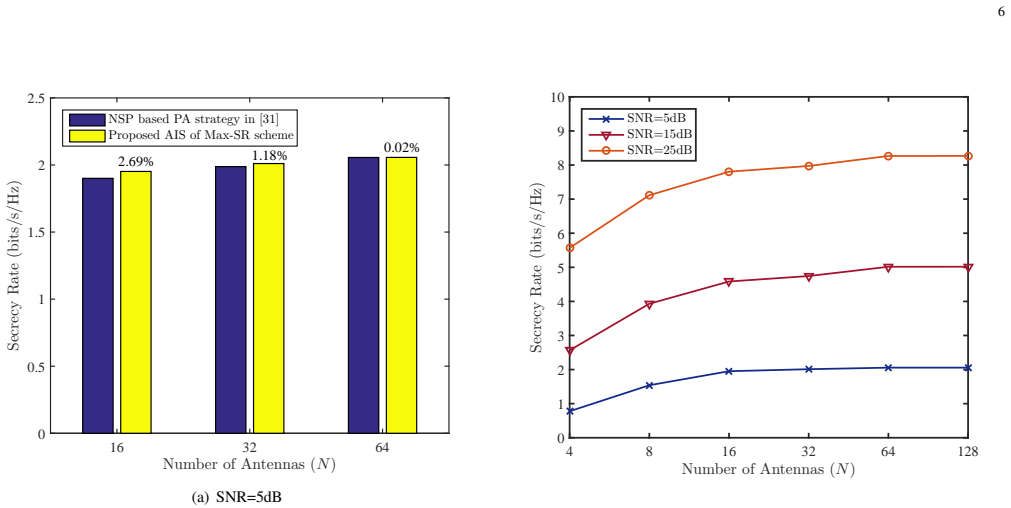
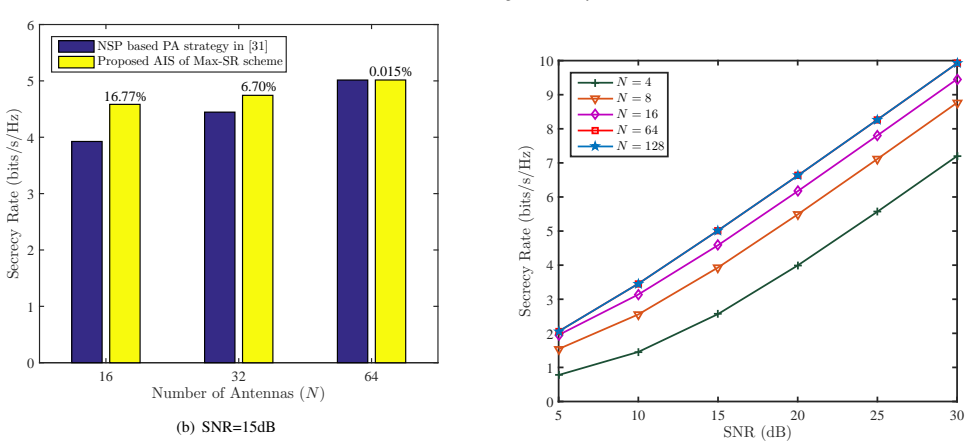
To maximize the secrecy rate, an alternating iterative structure between the beamforming and power allocation is proposed. With only two or three iterations, it can rapidly converge to its rate ceil. The SR performance of the proposed AIS is much better than the null-space projection based PA strategy in the medium and large SNR regions, especially when the number of antennas at the DM transmitter is small.
What carries the argument
The alternating iterative structure (AIS) that alternates updates between beamforming vectors and power allocation factors for the confidential message and artificial noise.
If this is right
- The structure converges to its rate ceiling after two or three iterations.
- Secrecy rate exceeds that of null-space projection power allocation in medium and large SNR.
- The performance advantage grows when the directional modulation transmitter uses few antennas.
Where Pith is reading between the lines
- The same alternating approach could be applied to secrecy rate maximization in other multi-antenna broadcast settings that use artificial noise.
- Checking convergence from multiple random initializations would test whether the method consistently avoids poor local points.
- Hardware experiments with measured directional modulation channels would show whether the simulated SNR-region advantage holds under real propagation.
Load-bearing premise
The alternating updates between beamforming and power allocation will reliably reach a high-quality operating point without getting stuck in poor local solutions, and that the simulation channel and noise models accurately reflect real conditions.
What would settle it
A set of Monte Carlo simulations in the medium SNR regime with few transmit antennas that shows no secrecy rate gain over null-space projection power allocation would falsify the performance claim.
Figures



read the original abstract
In a directional modulation (DM) network, the issues of security and privacy have taken on an increasingly important role. Since the power allocation of confidential message and artificial noise will make a constructive effect on the system performance, it is important to jointly consider the relationship between the beamforming vectors and the power allocation (PA) factors. To maximize the secrecy rate (SR), an alternating iterative structure (AIS) between the beamforming and PA is proposed. With only two or three iterations, it can rapidly converge to its rate ceil. Simulation results indicate that the SR performance of proposed AIS is much better than the null-space projection (NSP) based PA strategy in the medium and large signal-to-noise ratio (SNR) regions, especially when the number of antennas at the DM transmitter is small.
Editorial analysis
A structured set of objections, weighed in public.
Referee Report
Summary. The paper proposes an alternating iterative structure (AIS) between beamforming vectors and power allocation (PA) factors to maximize secrecy rate (SR) in directional modulation (DM) networks. It asserts that the AIS converges in only two or three iterations and that simulations demonstrate superior SR performance relative to null-space projection (NSP) based PA, particularly in medium-to-large SNR regimes and when the DM transmitter has few antennas.
Significance. A reliable joint beamforming-PA heuristic for non-convex SR maximization would be useful for secure DM systems. The manuscript receives credit for formulating the alternating updates, but the absence of any convergence analysis, stationarity guarantee, or reproducible simulation protocol means the claimed performance advantage cannot be assessed beyond the specific (unreported) setups; this limits significance to a preliminary heuristic whose advantage may not generalize.
major comments (2)
- [Abstract] Abstract: the claim that 'with only two or three iterations, it can rapidly converge to its rate ceil' is load-bearing for the central contribution, yet no monotonicity argument, stationarity condition, or initialization strategy is supplied anywhere in the manuscript.
- [Simulation Results] The simulation-based superiority claim over NSP (medium/large SNR, small antenna count) rests on unreported details: channel model, number of Monte-Carlo realizations, error bars, and exclusion criteria; without these the performance comparison cannot be reproduced or stress-tested.
minor comments (1)
- Title phrasing ('Energy-efficient Alternating Iterative Secure Structure of Maximizing Secrecy Rate') is awkward; consider 'An Energy-Efficient Alternating Iterative Structure for Maximizing Secrecy Rate in Directional Modulation Networks'.
Simulated Author's Rebuttal
We thank the referee for the detailed comments. We address each major point below and will revise the manuscript accordingly where the concerns are valid.
read point-by-point responses
-
Referee: [Abstract] Abstract: the claim that 'with only two or three iterations, it can rapidly converge to its rate ceil' is load-bearing for the central contribution, yet no monotonicity argument, stationarity condition, or initialization strategy is supplied anywhere in the manuscript.
Authors: We acknowledge that the manuscript provides no formal convergence analysis. The two-to-three iteration claim is an empirical observation repeated across all simulated scenarios in the paper. In revision we will add an explicit initialization description (equal power split between message and AN, random phases for beamformers) together with a short subsection showing that each alternating step produces a non-decreasing secrecy-rate value under the fixed-point updates. A rigorous stationarity guarantee for the non-convex joint problem is not available and will be noted as a limitation of the heuristic. revision: partial
-
Referee: [Simulation Results] The simulation-based superiority claim over NSP (medium/large SNR, small antenna count) rests on unreported details: channel model, number of Monte-Carlo realizations, error bars, and exclusion criteria; without these the performance comparison cannot be reproduced or stress-tested.
Authors: The omission was due to page limits. The revised manuscript will contain a dedicated simulation-setup subsection stating: (i) i.i.d. complex-Gaussian channels with distance-dependent path loss, (ii) 10 000 independent Monte-Carlo trials, (iii) error bars as one-standard-deviation intervals, and (iv) no trial exclusion. All other parameters (antenna counts, SNR grid, noise variance, etc.) will be tabulated. revision: yes
Circularity Check
No circularity detected; claims rest on proposed algorithm and simulations without self-referential reduction
full rationale
The provided text (abstract and context) describes a proposed alternating iterative structure (AIS) between beamforming and power allocation to maximize secrecy rate, with claims of rapid convergence in 2-3 iterations and superior SR performance versus NSP in simulations. No equations, fitting procedures, self-citations as load-bearing premises, or derivation steps are present that could reduce a result to its inputs by construction. The central claims are simulation-based rather than derived from a closed mathematical chain, making the paper self-contained against external benchmarks with no identifiable circular steps.
Axiom & Free-Parameter Ledger
Lean theorems connected to this paper
-
IndisputableMonolith/Cost/FunctionalEquation.leanwashburn_uniqueness_aczel unclear?
unclearRelation between the paper passage and the cited Recognition theorem.
an alternating iterative structure (AIS) between the beamforming and PA is proposed... maximize the secrecy rate (SR)
-
IndisputableMonolith/Foundation/DimensionForcing.leanalexander_duality_circle_linking unclear?
unclearRelation between the paper passage and the cited Recognition theorem.
the optimal vb can be obtained from the eigenvector corresponding to the largest eigenvalue
What do these tags mean?
- matches
- The paper's claim is directly supported by a theorem in the formal canon.
- supports
- The theorem supports part of the paper's argument, but the paper may add assumptions or extra steps.
- extends
- The paper goes beyond the formal theorem; the theorem is a base layer rather than the whole result.
- uses
- The paper appears to rely on the theorem as machinery.
- contradicts
- The paper's claim conflicts with a theorem or certificate in the canon.
- unclear
- Pith found a possible connection, but the passage is too broad, indirect, or ambiguous to say the theorem truly supports the claim.
Reference graph
Works this paper leans on
-
[1]
Distributed beamforming for physical- layer security of two-way relay networks,
H. Wang, Q. Yin, and X. Xia, “Distributed beamforming for physical- layer security of two-way relay networks,” IEEE Trans. Signal Process. , vol. 60, no. 7, pp. 3532–3545, Jul. 2012
work page 2012
-
[2]
Anti-eavesdro pping schemes for interference alignment (IA)-based wireless ne tworks,
N. Zhao, F. R. Y u, M. Li, and V . C. M. Leung, “Anti-eavesdro pping schemes for interference alignment (IA)-based wireless ne tworks,” IEEE Trans. Wireless Commun. , vol. 15, no. 8, pp. 5719–5732, Aug. 2016
work page 2016
-
[3]
A surve y on multiple-antenna techniques for physical layer security,
X. Chen, D. W. K. Ng, W. H. Gerstacker, and H. Chen, “A surve y on multiple-antenna techniques for physical layer security, ” IEEE Commun. Surveys Tuts., vol. 19, no. 2, pp. 1027–1053, Secondquarter 2017
work page 2017
-
[4]
Secure tr ansmission with large numbers of antennas and finite alphabet inputs,
Y . Wu, J. Wang, J. Wang, R. Schober, and C. Xiao, “Secure tr ansmission with large numbers of antennas and finite alphabet inputs,” IEEE Trans. Commun., vol. 65, no. 8, pp. 3614–3628, Aug. 2017
work page 2017
-
[5]
Chunk-based resource allocation in O FDMA systems - part I: chunk allocation,
H. Zhu and J. Wang, “Chunk-based resource allocation in O FDMA systems - part I: chunk allocation,” IEEE Trans. Commun. , vol. 57, no. 9, pp. 2734–2744, Sep. 2009. 6 16 32 64 Number of Antennas ( N ) 0 0.5 1 1.5 2 2.5Secrecy Rate (bits/s/Hz) NSP based PA strategy in [31] Proposed AIS of Max-SR scheme 1.18% 0.02% 2.69% (a) SNR=5dB 16 32 64 Number of Antenn...
work page 2009
-
[6]
Chunk-based resource allocation in O FDMA systems - part II: joint chunk, power and bit allocation,
H. Zhu and J. Wang, “Chunk-based resource allocation in O FDMA systems - part II: joint chunk, power and bit allocation,” IEEE Trans. Commun., vol. 60, no. 2, pp. 499–509, Feb. 2012
work page 2012
-
[7]
Massive MIMO for next generation wireless systems,
E. G. Larsson, O. Edfors, F. Tufvesson, and T. L. Marzetta , “Massive MIMO for next generation wireless systems,” IEEE Commun. Mag. , vol. 52, no. 2, pp. 186–195, Feb. 2014
work page 2014
-
[8]
K. Guan, B. Ai, B. Peng, D. He, G. Li, J. Y ang, Z. Zhong, and T. Krner, “Towards realistic high-speed train channels at 5 G millimeter- wave bandłpart I: Paradigm, significance analysis, and scen ario recon- struction,” IEEE Trans. V eh. Technol., vol. 67, no. 10, pp. 9112–9128, Oct. 2018
work page 2018
-
[9]
K. Guan, B. Ai, B. Peng, D. He, G. Li, J. Y ang, Z. Zhong, and T . Krner, “Towards realistic high-speed train channels at 5G millime ter-wave bandłpart II: Case study for paradigm implementation,” IEEE Trans. V eh. Technol., vol. 67, no. 10, pp. 9129–9144, Oct. 2018
work page 2018
-
[10]
A survey on hybrid beamforming techniques i n 5G: Architecture and system model perspectives,
I. Ahmed, H. Khammari, A. Shahid, A. Musa, K. S. Kim, E. De Poorter, and I. Moerman, “A survey on hybrid beamforming techniques i n 5G: Architecture and system model perspectives,” IEEE Commun. Surveys Tuts., vol. 20, no. 4, pp. 3060–3097, Fourthquarter 2018
work page 2018
-
[11]
H. Zhang, Y . Huang, C. Li, and L. Y ang, “Secure beamformi ng design for SWIPT in MISO broadcast channel with confidential messag es and 7 external eavesdroppers,” IEEE Trans. on Wireless Commun. , vol. 15, no. 11, pp. 7807–7819, Nov. 2016
work page 2016
-
[12]
An ove rview of sustainable green 5G networks,
Q. Wu, G. Y . Li, W. Chen, D. W. K. Ng, and R. Schober, “An ove rview of sustainable green 5G networks,” IEEE Wireless Commun. , vol. 24, no. 4, pp. 72–80, Aug. 2017
work page 2017
-
[13]
A green communication model for 5G systems,
M. M. Mowla, I. Ahmad, D. Habibi, and Q. V . Phung, “A green communication model for 5G systems,” IEEE Trans. Green Commun. Netw., vol. 1, no. 3, pp. 264–280, Sep. 2017
work page 2017
-
[14]
A. D. Wyner, “The wire-tap channel,” Bell. Syst. Tech. J. , vol. 54, no. 8, pp. 1355–1387, Oct. 1975
work page 1975
-
[15]
Guaranteeing secrecy using artific ial noise,
S. Goel and R. Negi, “Guaranteeing secrecy using artific ial noise,” IEEE Trans. Wireless Commun. , vol. 7, no. 6, pp. 2180–2189, Jun. 2008
work page 2008
-
[16]
A vector approach for the analys is and synthesis of directional modulation transmitters,
Y . Ding and V . F. Fusco, “A vector approach for the analys is and synthesis of directional modulation transmitters,” IEEE Trans. Antennas Propag., vol. 62, no. 1, pp. 361–370, Jan. 2014
work page 2014
-
[17]
Artificial noise: Transmission optimization in multi-inp ut single-output wiretap channels,
N. Y ang, S. Y an, J. Y uan, R. Malaney, R. Subramanian, and I. Land, “Artificial noise: Transmission optimization in multi-inp ut single-output wiretap channels,” IEEE Trans. Commun. , vol. 63, no. 5, pp. 1771 – 1783, May 2015
work page 2015
-
[18]
Three a rtificial- noise-aided secure transmission schemes in wiretap channe ls,
S. Y an, N. Y ang, I. Land, R. Malaney, and J. Y uan, “Three a rtificial- noise-aided secure transmission schemes in wiretap channe ls,” IEEE Trans. V eh. Technol., vol. 67, no. 4, pp. 3669–3673, Apr. 2018
work page 2018
-
[19]
Robust synthesis method for sec ure direc- tional modulation with imperfect direction angle,
J. Hu, F. Shu, and J. Li, “Robust synthesis method for sec ure direc- tional modulation with imperfect direction angle,” IEEE Commun. Lett. , vol. 20, no. 6, pp. 1084–1087, Jun. 2016
work page 2016
-
[20]
Robust synt hesis scheme for secure multi-beam directional modulation in broadcast ing systems,
F. Shu, X. Wu, J. Li, R. Chen, and B. Vucetic, “Robust synt hesis scheme for secure multi-beam directional modulation in broadcast ing systems,” IEEE Access , vol. 4, pp. 6614–6623, Oct. 2016
work page 2016
-
[21]
F. Shu, W. Zhu, X. Zhou, J. Li, and J. Lu, “Robust secure tr ansmission of using main-lobe-integration-based leakage beamforming in directional modulation MU-MIMO systems,” IEEE Syst. J., vol. 12, no. 4, pp. 3775– 3785, Dec. 2018
work page 2018
-
[22]
Artificial- noise-aided secure multicast precoding for directional modulation sys tems,
F. Shu, L. Xu, J. Wang, W. Zhu, and Z. Xiaobo, “Artificial- noise-aided secure multicast precoding for directional modulation sys tems,” IEEE Trans. V eh. Technol., vol. 67, no. 7, pp. 6658–6662, Jul. 2018
work page 2018
-
[23]
J. Hu, S. Y an, F. Shu, J. Wang, J. Li, and Y . Zhang, “Artific ial-noise- aided secure transmission with directional modulation bas ed on random frequency diverse arrays,” IEEE Access , vol. 5, pp. 1658–1667, 2017
work page 2017
-
[24]
F. Shu, X. Wu, J. Hu, J. Li, R. Chen, and J. Wang, “Secure an d precise wireless transmission for random-subcarrier-selection- based directional modulation transmit antenna array,” IEEE J. Sel. Areas Commun. , vol. 36, no. 4, pp. 890–904, Apr. 2018
work page 2018
-
[25]
F. Shu, Y . Qin, T. Liu, L. Gui, Y . Zhang, J. Li, and Z. Han, “ Low- complexity and high-resolution DOA estimation for hybrid a nalog and digital massive MIMO receive array,” IEEE Trans. Commun. , vol. 66, no. 6, pp. 2487–2501, Jun. 2018
work page 2018
-
[26]
X. Zhou and M. R. McKay, “Secure transmission with artifi cial noise over fading channels: Achievable rate and optimal power all ocation,” IEEE Trans. V eh. Technol., vol. 59, no. 8, pp. 3831–3842, Oct. 2010
work page 2010
-
[27]
Power allocation for artificial- noise secure MIMO precoding systems,
S. Tsai and H. V . Poor, “Power allocation for artificial- noise secure MIMO precoding systems,” IEEE Trans. Signal Process, vol. 62, no. 13, pp. 3479–3493, Jul. 2014
work page 2014
-
[28]
Secure massive MIMO transmission in the presence of an active eavesdropper ,
Y . Wu, R. Schober, D. K. Ng, C. Xiao, and G. Caire, “Secure massive MIMO transmission in the presence of an active eavesdropper ,” IEEE ICC, pp. 1434–1440, 2015
work page 2015
-
[29]
T. Zheng and H. Wang, “Optimal power allocation for arti ficial noise under imperfect CSI against spatially random eavesdropper s,” IEEE Trans. V eh. Technol., vol. 65, no. 19, pp. 8812–8817, Oct. 2016
work page 2016
-
[30]
Optimal powe r allocation for secrecy rate maximization in broadcast wire tap channels,
H. Song, H. Wen, L. Hu, Y . Chen, and R. Liao, “Optimal powe r allocation for secrecy rate maximization in broadcast wire tap channels,” IEEE Wireless Commun. Lett. , vol. 7, no. 4, pp. 514–517, Aug. 2018
work page 2018
-
[31]
Power allocation strategy of maximizing secre cy rate for secure directional modulation networks,
S. Wan, F. Shu, J. Lu, G. Gui, J. Wang, G. Xia, Y . Zhang, J. L i, and J. Wang, “Power allocation strategy of maximizing secre cy rate for secure directional modulation networks,” IEEE Access , vol. 6, pp. 38 794–38 801, 2018
work page 2018
-
[32]
F. Shu, Z. Lu, J. Lin, L. Sun, X. Zhou, T. Liu, S. Zhang, W. C ai, J. Lu, and J. Wang, “Alternating iterative secure structure between beam- forming and power allocation for UA V -aided directional mod ulation networks,” Physical Commun. , vol. 33, pp. 46–53, Apr. 2019
work page 2019
-
[33]
Optimal power allocation for secure directional mo dulation networks with a full-duplex UA V user,
Z. Lu, L. Sun, S. Zhang, X. Zhou, J. Lin, W. Cai, J. Wang, J. Lu, and F. Shu, “Optimal power allocation for secure directional mo dulation networks with a full-duplex UA V user,” Sci. China Inf. Sci. , vol. 62, no. 8, p. 80304, Jul. 2019
work page 2019
-
[34]
H. Y u, S. Wan, W. Cai, L. Xu, X. Zhou, J. Wang, Y . Wu, F. Shu, J. Wang, and J. Wang, “GPI-based secrecy rate maximization b eam- forming scheme for wireless transmission with AN-aided dir ectional modulation,” IEEE Access , vol. 6, pp. 12 044–12 051, Mar. 2018
work page 2018
discussion (0)
Sign in with ORCID, Apple, or X to comment. Anyone can read and Pith papers without signing in.