Explainable Ensemble-Based Machine Learning Models for Detecting the Presence of Cirrhosis in Hepatitis C Patients
Pith reviewed 2026-06-26 05:17 UTC · model grok-4.3
The pith
An Extra Trees model detects cirrhosis in hepatitis C patients at 96.92 percent accuracy using 16 features.
A machine-rendered reading of the paper's core claim, the machinery that carries it, and where it could break.
Core claim
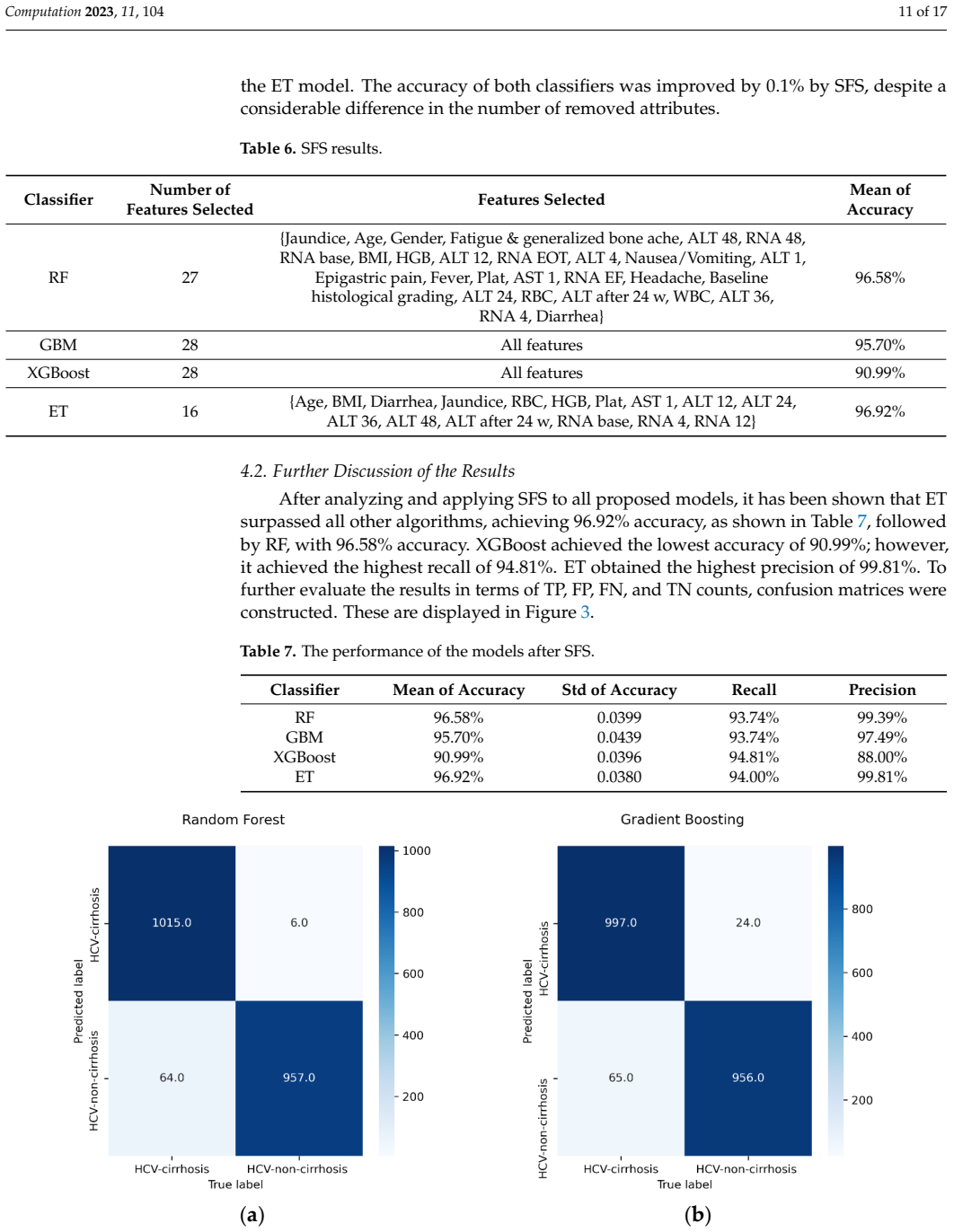
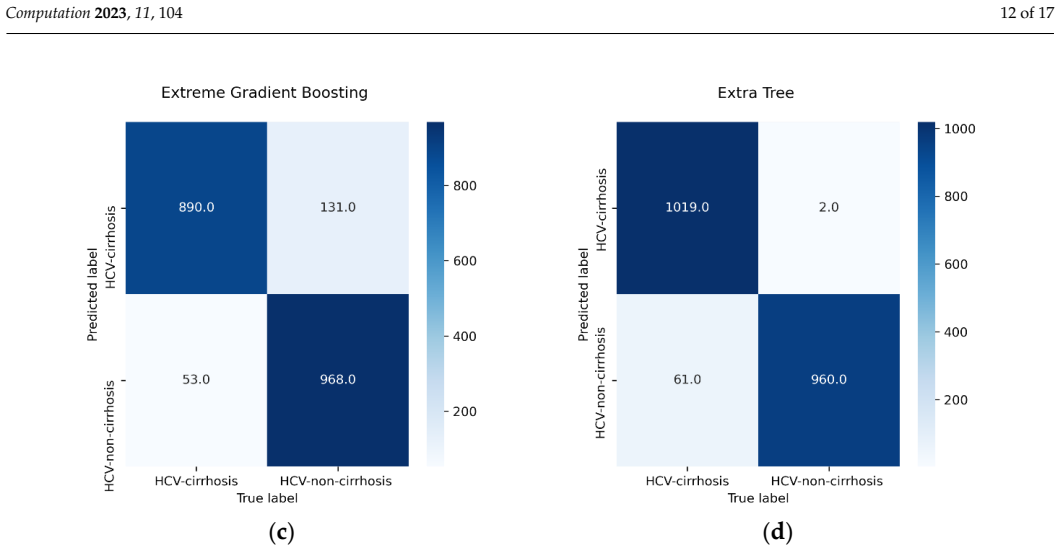
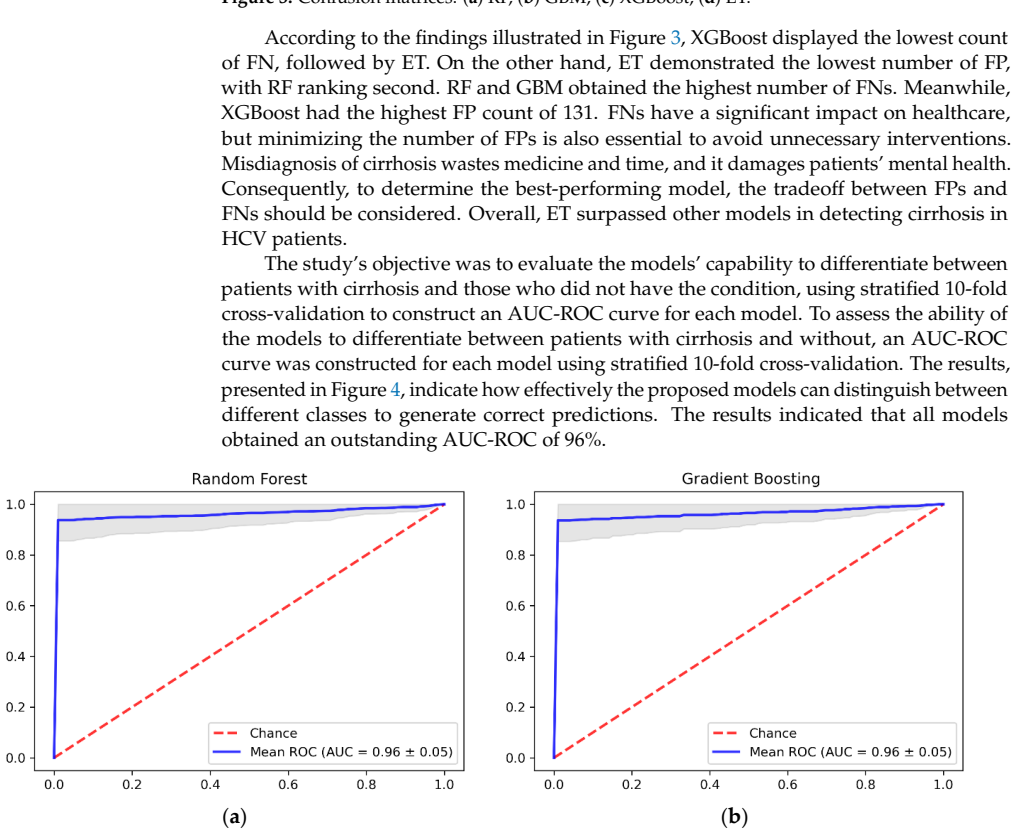
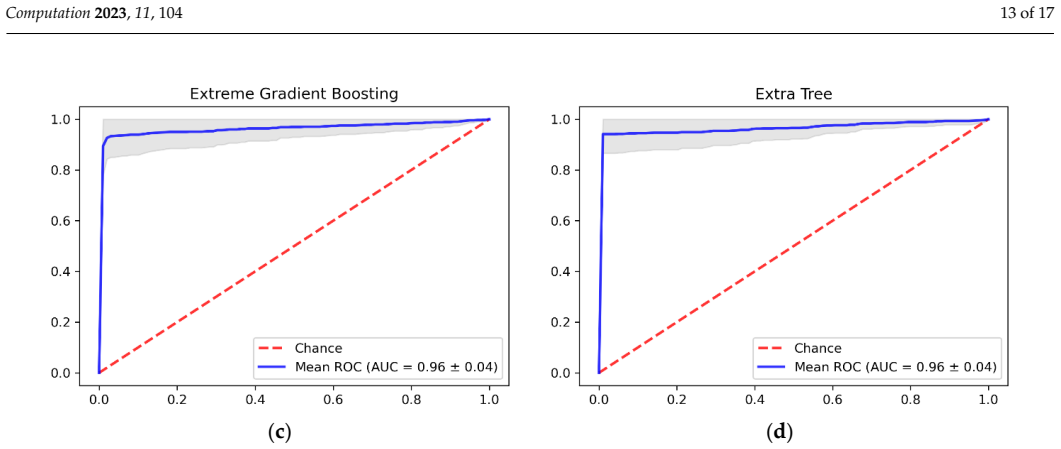
Four machine learning algorithms were trained on a dataset of 28 attributes from 2038 Egyptian patients with hepatitis C. The Extra Trees model achieved an accuracy of 96.92 percent, recall of 94.00 percent, precision of 99.81 percent, and area under the receiver operating characteristic curve of 96 percent using only 16 of the 28 features, outperforming Random Forest, Gradient Boosting Machine, and Extreme Gradient Boosting.
What carries the argument
The Extra Trees ensemble classifier, which constructs multiple decision trees on random subsets of features and data to classify patients as having cirrhosis or not based on the reduced 16-attribute input.
If this is right
- Hepatitis C patients could be screened for cirrhosis risk using fewer laboratory tests since only 16 features suffice.
- High precision reduces the chance of false positive diagnoses that might lead to unnecessary follow-up procedures.
- The same modeling approach could be applied to track disease progression if additional time-series data were collected.
- Early identification supports treatment focused on slowing liver damage before failure occurs.
Where Pith is reading between the lines
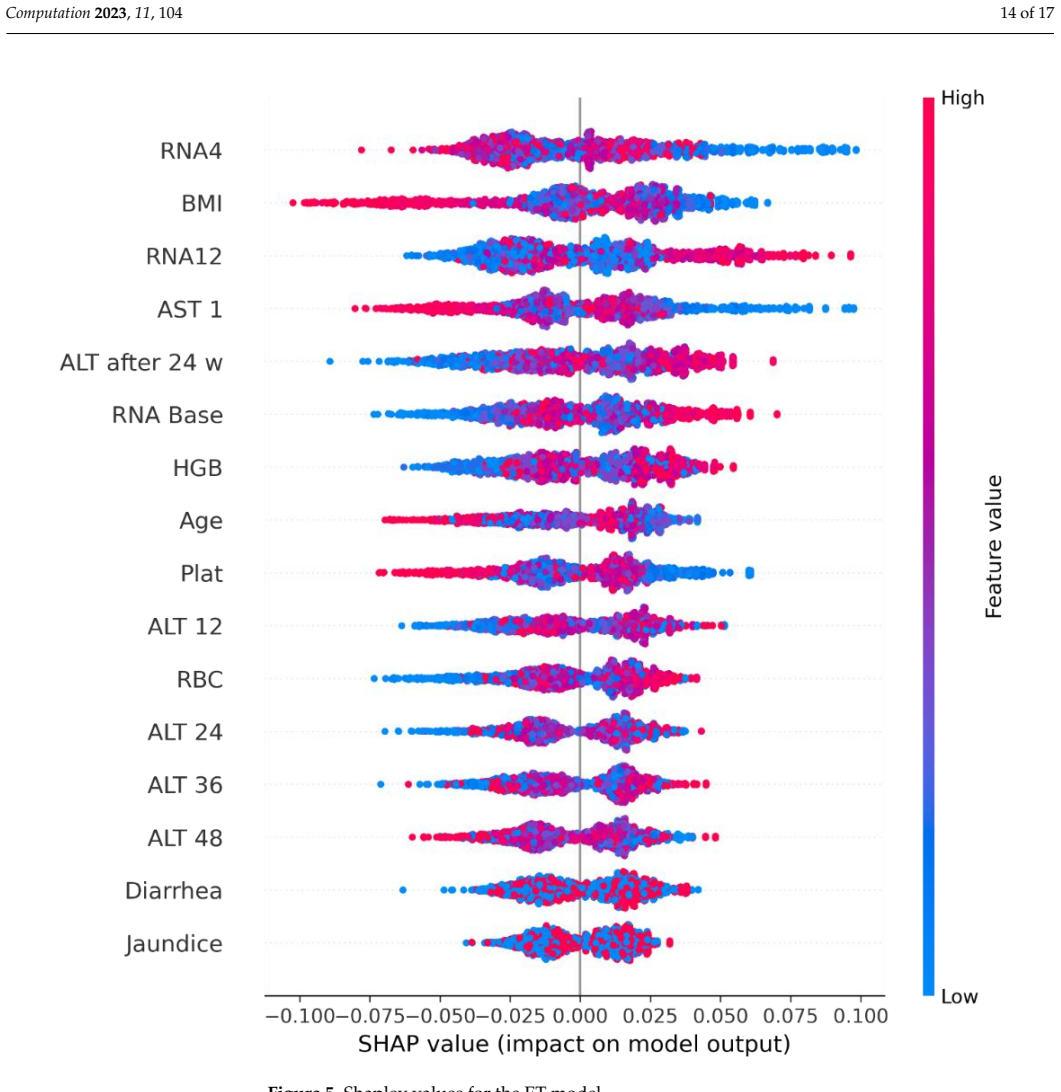
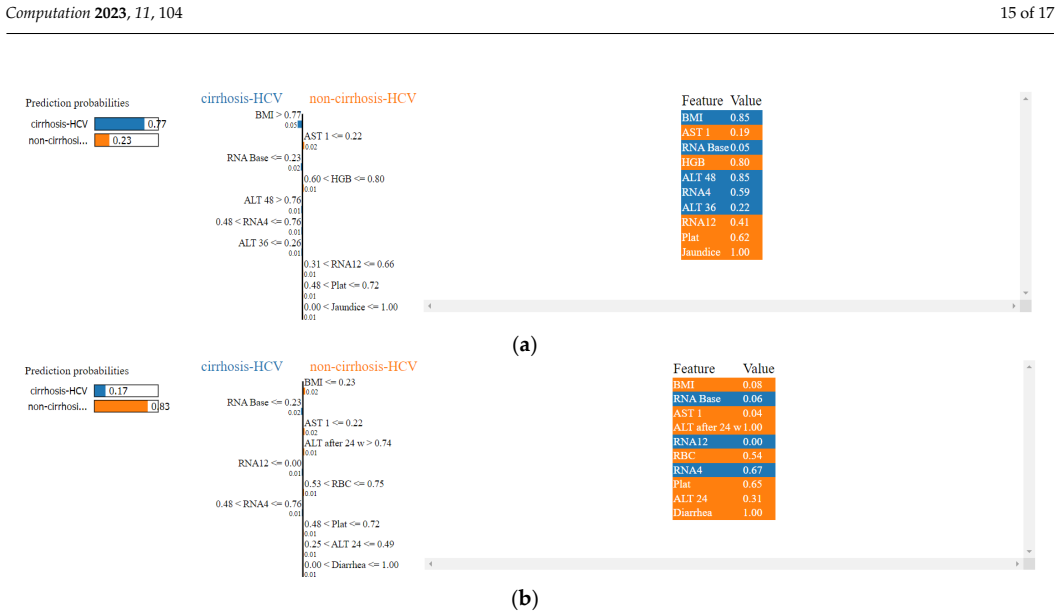
- The title mentions explainable models, so the feature importance outputs from Extra Trees could reveal which lab values most influence cirrhosis predictions for clinicians.
- Performance may drop if applied to populations with different age distributions, viral genotypes, or comorbidities not captured in the Egyptian data.
- Similar ensemble methods might be tested on datasets for other liver conditions such as fibrosis staging or hepatocellular carcinoma risk.
Load-bearing premise
The dataset of 2038 Egyptian patients represents the broader hepatitis C population and performance on internal data splits will hold for new patients in other clinical settings.
What would settle it
Running the trained Extra Trees model on an independent set of hepatitis C patient records from a different country or clinic and measuring accuracy below 85 percent.
Figures
read the original abstract
Hepatitis C is a liver infection caused by a virus, which results in mild to severe inflammation of the liver. Over many years, hepatitis C gradually damages the liver, often leading to permanent scarring, known as cirrhosis. Patients sometimes have moderate or no symptoms of liver illness for decades before developing cirrhosis. Cirrhosis typically worsens to the point of liver failure. Patients with cirrhosis may also experience brain and nerve system damage, as well as gastrointestinal hemorrhage. Treatment for cirrhosis focuses on preventing further progression of the disease. Detecting cirrhosis earlier is therefore crucial for avoiding complications. Machine learning (ML) has been shown to be effective at providing precise and accurate information for use in diagnosing several diseases. Despite this, no studies have so far used ML to detect cirrhosis in patients with hepatitis C. This study obtained a dataset consisting of 28 attributes of 2038 Egyptian patients from the ML Repository of the University of California at Irvine. Four ML algorithms were trained on the dataset to diagnose cirrhosis in hepatitis C patients: a Random Forest, a Gradient Boosting Machine, an Extreme Gradient Boosting, and an Extra Trees model. The Extra Trees model outperformed the other models achieving an accuracy of 96.92%, a recall of 94.00%, a precision of 99.81%, and an area under the receiver operating characteristic curve of 96% using only 16 of the 28 features.
Editorial analysis
A structured set of objections, weighed in public.
Referee Report
Summary. The manuscript applies four ensemble ML classifiers (Random Forest, Gradient Boosting Machine, XGBoost, Extra Trees) to a UCI dataset of 2038 Egyptian hepatitis C patients described by 28 attributes. It reports that the Extra Trees model, after reduction to 16 features, attains 96.92% accuracy, 94.00% recall, 99.81% precision and 96% AUC, outperforming the other three models, and positions the work as the first ML study for cirrhosis detection in this population.
Significance. If the evaluation pipeline is free of leakage and the performance generalizes, the result would supply a concrete, high-precision screening signal that could be integrated into hepatitis C management workflows. The emphasis on a modest feature subset is practically useful, but the lack of external validation or nested validation details currently prevents the numbers from being treated as evidence of clinical utility.
major comments (2)
- [Methods] Methods / experimental setup: the manuscript supplies no information on whether the reduction from 28 to 16 features, or any hyperparameter search, was performed inside or outside the train-test split (or inside CV folds). If selection occurred on the full data, the headline Extra Trees metrics (Abstract) are consistent with optimistic bias and cannot be interpreted as generalization performance.
- Results / evaluation protocol: no description is given of the train-test procedure, number of folds, stratification for class balance, or whether performance was averaged over multiple splits. Without these details the reported 96.92% accuracy and 99.81% precision cannot be assessed for robustness (Abstract and Results).
minor comments (2)
- [Abstract] The title advertises 'explainable' models yet the abstract and results contain no SHAP values, feature-importance tables, or other interpretability outputs; this mismatch should be resolved or the title adjusted.
- [Dataset] The dataset description states 2038 patients but does not report the cirrhosis prevalence or any class-imbalance statistics; adding these numbers would clarify the difficulty of the task.
Simulated Author's Rebuttal
We thank the referee for their detailed review and constructive comments on our manuscript. We address each major comment below and will revise the manuscript to incorporate the suggested clarifications.
read point-by-point responses
-
Referee: [Methods] Methods / experimental setup: the manuscript supplies no information on whether the reduction from 28 to 16 features, or any hyperparameter search, was performed inside or outside the train-test split (or inside CV folds). If selection occurred on the full data, the headline Extra Trees metrics (Abstract) are consistent with optimistic bias and cannot be interpreted as generalization performance.
Authors: The referee correctly identifies a lack of detail in the current manuscript regarding the feature selection and hyperparameter tuning process. We will revise the Methods section to explicitly describe that both the feature reduction to 16 features and any hyperparameter optimization were performed within the cross-validation folds to prevent data leakage and ensure unbiased performance estimates. revision: yes
-
Referee: [—] Results / evaluation protocol: no description is given of the train-test procedure, number of folds, stratification for class balance, or whether performance was averaged over multiple splits. Without these details the reported 96.92% accuracy and 99.81% precision cannot be assessed for robustness (Abstract and Results).
Authors: We agree that the evaluation protocol details are essential for assessing the robustness of the results. In the revised manuscript, we will provide a complete description of the train-test split procedure, the number of folds used in cross-validation, the use of stratification to maintain class balance, and confirmation that performance metrics were averaged across multiple splits or folds. revision: yes
Circularity Check
No circularity: empirical ML metrics on fixed dataset
full rationale
The paper reports only empirical performance numbers (accuracy, precision, etc.) obtained by training standard classifiers on the UCI hepatitis C dataset. No equations, closed-form derivations, fitted parameters renamed as predictions, or self-citation chains appear in the provided text. The central claim is a set of measured results on held-out data, not a reduction of any quantity to its own inputs by construction. This matches the default expectation of no significant circularity.
Axiom & Free-Parameter Ledger
free parameters (1)
- number of retained features =
16
axioms (2)
- domain assumption Patient records in the UCI dataset are independent and identically distributed
- domain assumption The 28 attributes contain sufficient signal for cirrhosis classification
Reference graph
Works this paper leans on
-
[1]
Available online: https://www.who.int/news-room/fact-sheets/detail/hepatitis-c (accessed on 10 November 2022)
Hepatitism, C. Available online: https://www.who.int/news-room/fact-sheets/detail/hepatitis-c (accessed on 10 November 2022)
2022
-
[2]
Characterizing hepatitis C virus epidemiology in Egypt: Systematic reviews, meta-analyses, and meta-regressions
Kouyoumjian, S.P .; Chemaitelly, H.; Abu-Raddad, L.J. Characterizing hepatitis C virus epidemiology in Egypt: Systematic reviews, meta-analyses, and meta-regressions. Sci. Rep. 2018, 8, 1661. [CrossRef]
2018
-
[3]
Hepatitis C in Egypt—Past, present, and future
Elgharably, A.; Gomaa, A.I.; Crossey, M.M.E.; Norsworthy, P .J.; Waked, I.; Taylor-Robinson, S.D. Hepatitis C in Egypt—Past, present, and future. Int. J. Gen. Med. 2016, 10, 1–6. [CrossRef]
2016
-
[4]
Liver cirrhosis
Pinzani, M.; Rosselli, M.; Zuckermann, M. Liver cirrhosis. Best Pract. Res. Clin. Gastroenterol. 2011, 25, 281–290. [CrossRef]
2011
-
[5]
The global, regional, and national burden of cirrhosis by cause in 195 countries and territories, 1990–2017: A systematic analysis for the Global Burden of Disease Study 2017
Sepanlou, S.G.; Safiri, S.; Bisignano, C.; Ikuta, K.S.; Merat, S.; Saberifiroozi, M.; Poustchi, H.; Tsoi, D.; Colombara, D.V .; Abdoli, A.; et al. The global, regional, and national burden of cirrhosis by cause in 195 countries and territories, 1990–2017: A systematic analysis for the Global Burden of Disease Study 2017. Lancet Gastroenterol. Hepatol. 2020,...
1990
-
[6]
Understanding the Complexities of Cirrhosis
Muir, A.J. Understanding the Complexities of Cirrhosis. Clin. Ther. 2015, 37, 1822–1836. [CrossRef]
2015
-
[7]
Evaluation of Aspartate Aminotransferase-to-Platelet Ratio Index as a Non-Invasive Marker for Liver Cirrhosis
Jain, P .; Tripathi, B.K.; Gupta, B.; Bhandari, B.; Jalan, D. Evaluation of Aspartate Aminotransferase-to-Platelet Ratio Index as a Non-Invasive Marker for Liver Cirrhosis. J. Clin. Diagn. Res. 2015, 9, OC22–OC24. [CrossRef]
2015
-
[8]
Cirrhosis and Chronic Liver Failure: Part I
Heidelbaugh, J.J.; Bruderly, M. Cirrhosis and Chronic Liver Failure: Part I. Diagnosis and Evaluation. Am. Fam. Physician 2006, 74, 756–762. Available online: https://www.aafp.org/pubs/afp/issues/2006/0901/p756.html (accessed on 9 May 2023)
2006
-
[9]
Limitations of non-invasive tests for assessment of liver fibrosis
Patel, K.; Sebastiani, G. Limitations of non-invasive tests for assessment of liver fibrosis. JHEP Rep. 2020, 2, 100067. [CrossRef]
2020
-
[10]
Fibrotest for evaluating fibrosis in non-alcoholic fatty liver disease patients: A systematic review and meta-analysis.J
Vali, Y .; Lee, J.; Boursier, J.; Spijker, R.; V erheij, J.; Brosnan, M.J.; Anstee, Q.M.; Bossuyt, P .M.; Zafarmand, M.H. Fibrotest for evaluating fibrosis in non-alcoholic fatty liver disease patients: A systematic review and meta-analysis.J. Clin. Med. 2021, 10, 2415. [CrossRef]
2021
-
[11]
Fibroscan (Transient Elastography) for the Measurement of Liver Fibrosis
Afdhal, N.H. Fibroscan (Transient Elastography) for the Measurement of Liver Fibrosis. Gastroenterol. Hepatol. 2012, 8, 605
2012
-
[12]
The impact of artificial intelligence in medicine on the future role of the physician
Ahuja, A.S. The impact of artificial intelligence in medicine on the future role of the physician. PeerJ 2019, 7, e7702. [CrossRef]
2019
-
[13]
The Assessment of Diagnostic Accuracy of Real Time Shear Wave Elastography in Detecting Liver Cirrhosis Keeping Histopathology as Reference Standard
Saleem, S.; Slehria, A.U.R.; Rauf, M.H.; Sohail, M.; Taufiq, N.; Khan, M.U. The Assessment of Diagnostic Accuracy of Real Time Shear Wave Elastography in Detecting Liver Cirrhosis Keeping Histopathology as Reference Standard. Pak. Armed Forces Med. J. 2022, 72, 590–593. [CrossRef]
2022
-
[14]
Explainable Artificial Intelligence: An Updated Perspective
Krajna, A.; Kovac, M.; Brcic, M.; Sarcevic, A. Explainable Artificial Intelligence: An Updated Perspective. In Proceedings of the 2022 45th Jubilee International Convention on Information, Communication and Electronic Technology (MIPRO), Opatija, Croatia, 23–27 May 2022; pp. 859–864. [CrossRef]
2022
-
[15]
Explainable artificial intelligence: A survey
Dosilovic, F.K.; Brcic, M.; Hlupic, N. Explainable artificial intelligence: A survey. In Proceedings of the 2018 41st International Convention on Information and Communication Technology, Electronics and Microelectronics (MIPRO), Opatija, Croatia, 21–25 May 2018; pp. 210–215. [CrossRef]
2018
-
[16]
Statistical Machine Learning Approaches to Liver Disease Prediction
Mostafa, F.; Hasan, E.; Williamson, M.; Khan, H.; Statistical, H.; Jaeschke, H.W. Statistical Machine Learning Approaches to Liver Disease Prediction. Livers 2021, 1, 294–312. [CrossRef] Computation 2023, 11, 104 17 of 17
2021
-
[17]
Available online: https://archive.ics.uci.edu/ml/datasets/HCV+data (accessed on 9 May 2023)
UCI Machine Learning Repository: HCV Data Data Set. Available online: https://archive.ics.uci.edu/ml/datasets/HCV+data (accessed on 9 May 2023)
2023
-
[18]
Machine Learning Models for Diagnostic Classification of Hepatitis C Tests
Oladimeji, O.O.; Oladimeji, A.; Olayanju, O. Machine Learning Models for Diagnostic Classification of Hepatitis C Tests. Front. Health Inform. 2021, 10, 70. [CrossRef]
2021
-
[19]
Applying data mining techniques to classify patients with suspected hepatitis C virus infection
Safdari, R.; Deghatipour, A.; Gholamzadeh, M.; Maghooli, K. Applying data mining techniques to classify patients with suspected hepatitis C virus infection. Intell. Med. 2022, 2, 193–198. [CrossRef]
2022
-
[20]
A Comparative Study on Hepatitis C Predictions Using Machine Learning Algorithms
Septina, P .L.; Sihotang, J.I. A Comparative Study on Hepatitis C Predictions Using Machine Learning Algorithms. 8ISC Proc. T echnol.2022, 33–42
2022
-
[21]
Hepatitis C Virus Detection Model by Using Random Forest, Logistic-Regression and ABC Algorithm
Li, T.H.S.; Chiu, H.J.; Kuo, P .H. Hepatitis C Virus Detection Model by Using Random Forest, Logistic-Regression and ABC Algorithm. IEEE Access 2022, 10, 91045–91058. [CrossRef]
2022
-
[22]
Hep-Pred: Hepatitis C Staging Prediction Using Fine Gaussian SVM
Ghazal, T.M.; Anam, M.; Hasan, M.K.; Hussain, M.; Farooq, M.S.; Ali, H.M.A.; Ahmad, M.; Soomro, T.R. Hep-Pred: Hepatitis C Staging Prediction Using Fine Gaussian SVM. Comput. Mater. Contin. 2021, 69, 191–203. [CrossRef]
2021
-
[23]
Available online: https://archive.ics
UCI Machine Learning Repository: Hepatitis C Virus (HCV) for Egyptian patients Data Set. Available online: https://archive.ics. uci.edu/ml/datasets/Hepatitis+C+Virus+%28HCV%29+for+Egyptian+patients (accessed on 9 May 2023)
2023
-
[24]
Diagnosing the Stage of Hepatitis C Using Machine Learning
Butt, M.B.; Alfayad, M.; Saqib, S.; Khan, M.A.; Ahmad, M.; Khan, M.A.; Elmitwally, N.S. Diagnosing the Stage of Hepatitis C Using Machine Learning. J. Healthc. Eng. 2021, 2021, 8062410. [CrossRef]
2021
-
[25]
Mamdouh, H.; Shams, M.Y.; Abd El-Hafeez, T. Hepatitis C Virus Prediction Based on Machine Learning Framework: A Real-world Case Study in Egypt Hepatitis C Virus Prediction based on Machine Learning Framework: A Real-World Case Study in Egypt. Knowl. Inf. Syst. 2022, 65, 2595–2617. [CrossRef]
2022
-
[26]
Prediction and Staging of Hepatic Fibrosis in Children with Hepatitis C Virus: A Machine Learning Approach
Barakat, N.H.; Barakat, S.H.; Ahmed, N. Prediction and Staging of Hepatic Fibrosis in Children with Hepatitis C Virus: A Machine Learning Approach. Healthc. Inform. Res. 2019, 25, 173–181. [CrossRef] [PubMed]
2019
-
[27]
Machine Learning Model for Diagnosing the Stage of Liver Fibrosis in Patients With Chronic Viral Hepatitis C
Tsvetkov, V .; Tokin, I.; Lioznov, D. Machine Learning Model for Diagnosing the Stage of Liver Fibrosis in Patients With Chronic Viral Hepatitis C. Preprints.org 2021, 2021020488. [CrossRef]
2021
-
[28]
A novel model based on non invasive methods for prediction of liver fibrosis
Nasr, M.; El-Bahnasy, K.; Hamdy, M.; Kamal, S.M. A novel model based on non invasive methods for prediction of liver fibrosis. In Proceedings of the 2017 13th International Computer Engineering Conference (ICENCO), Cairo, Egypt, 27–28 December 2017; pp. 276–281. [CrossRef]
2017
-
[29]
Random Forests; Chapman and Hall/CRC: Boca Raton, FL, USA, 2019; pp
Breiman, B.; Greenwell, B. Random Forests; Chapman and Hall/CRC: Boca Raton, FL, USA, 2019; pp. 1–122. [CrossRef]
2019
-
[30]
Available online: https://data-flair.training/blogs/artificial-neural-networks-for-machine-learning/amp/ (accessed on 9 May 2023)
Artificial Neural Networks for Machine Learning—Every Aspect You Need to Know About—DataFlair. Available online: https://data-flair.training/blogs/artificial-neural-networks-for-machine-learning/amp/ (accessed on 9 May 2023)
2023
-
[31]
Majority vote of diverse classifiers for late fusion
Morvant, E.; Habrard, A.; Ayache, S. Majority vote of diverse classifiers for late fusion. Lect. Notes Comput. Sci. Subser. Lect. Notes Artif. Intell. Lect. Notes Bioinform. 2014, 8621, 153–162. [CrossRef]
2014
-
[32]
Available online: https://analyticsindiamag.com/story-of-gradient- boosting-how-it-evolved-over-years/ (accessed on 9 May 2023)
Story of Gradient Boosting: How It Evolved over Years. Available online: https://analyticsindiamag.com/story-of-gradient- boosting-how-it-evolved-over-years/ (accessed on 9 May 2023)
2023
-
[33]
Research on travel time prediction model of freeway based on gradient boosting decision tree
Cheng, J.; Li, G.; Chen, X. Research on travel time prediction model of freeway based on gradient boosting decision tree. IEEE Access 2019, 7, 7466–7480. [CrossRef]
2019
-
[34]
xgboost: EXtreme Gradient Boosting
Chen, T.; He, T. xgboost: EXtreme Gradient Boosting. 2022. Available online: https://cran.r-project.org/web/packages/xgboost/ vignettes/xgboost.pdf (accessed on 18 June 2022)
2022
-
[35]
IBLP: An XGBoost-Based Predictor for Identifying Bioluminescent Proteins
Zhang, D.; Chen, H.D.; Zulfiqar, H.; Yuan, S.S.; Huang, Q.L.; Zhang, Z.Y.; Deng, K.J. IBLP: An XGBoost-Based Predictor for Identifying Bioluminescent Proteins. Comput. Math. Methods Med. 2021, 2021, 6664362. [CrossRef]
2021
-
[36]
Extremely randomized trees
Geurts, P .; Ernst, D.; Wehenkel, L. Extremely randomized trees. Mach Learn 2006, 63, 3–42. [CrossRef]
2006
-
[37]
Extra Trees Ensemble: A Machine Learning Model for Predicting Blast-Induced Ground Vibration Based on the Bagging and Sibling of Random Forest Algorithm
Bui, X.N.; Nguyen, H.; Soukhanouvong, P . Extra Trees Ensemble: A Machine Learning Model for Predicting Blast-Induced Ground Vibration Based on the Bagging and Sibling of Random Forest Algorithm. Lect. Notes Civ. Eng. 2022, 228, 643–652. [CrossRef]
2022
-
[38]
Floating Variants—Mlxtend
SequentialFeatureSelector: The Popular forward and Backward Feature Selection Approaches Incl. Floating Variants—Mlxtend. Available online: http://rasbt.github.io/mlxtend/user_guide/feature_selection/SequentialFeatureSelector/ (accessed on 8 May 2022)
2022
-
[39]
Interpretable Machine Learning—A Brief History, State-of-the-Art and Challenges
Molnar, C.; Casalicchio, G.; Bischl, B. Interpretable Machine Learning—A Brief History, State-of-the-Art and Challenges. Commun. Comput. Inf. Sci. 2020, 1323, 417–431. [CrossRef]
2020
-
[40]
Zafar, M.R.; Khan, N.M. DLIME: A Deterministic Local Interpretable Model-Agnostic Explanations Approach for Computer- Aided Diagnosis Systems. arXiv 2019, arXiv:1906.10263. Disclaimer/Publisher’s Note: The statements, opinions and data contained in all publications are solely those of the individual author(s) and contributor(s) and not of MDPI and/or the ...
Pith/arXiv arXiv 2019
discussion (0)
Sign in with ORCID, Apple, or X to comment. Anyone can read and Pith papers without signing in.