Resource Management in Heterogeneous Quantum Repeater Networks
Pith reviewed 2026-06-30 00:28 UTC · model grok-4.3
The pith
A unified quantum network architecture can integrate both memory-based and all-photonic repeaters using recursive design and a new bridging block.
A machine-rendered reading of the paper's core claim, the machinery that carries it, and where it could break.
Core claim
By adopting a recursive network design and programmable RuleSet-based protocols, together with a new emitter-photon building block, it is possible to create a unified architecture that supports both memory-based and all-photonic quantum repeaters in heterogeneous networks, making such mixed systems practical with current technologies.
What carries the argument
The recursive network design and programmable RuleSet-based protocols, supported by the emitter-photon building block that bridges memory-based and all-photonic segments.
If this is right
- Classical networking abstractions can be extended to manage quantum operations in mixed networks.
- The architecture supports diverse hardware components in one system.
- Simulation tools based on these principles can validate against existing models and analytical approaches.
- Resource management in heterogeneous setups becomes feasible without requiring a single dominant repeater technology.
Where Pith is reading between the lines
- The design might permit gradual upgrades where parts of the network use one repeater type and others use another as technology advances.
- New algorithms for optimizing resource allocation across mixed repeater types may be needed to maximize network performance.
- Small-scale experimental tests of the emitter-photon block in hybrid segments could provide early evidence of feasibility before full-scale deployment.
Load-bearing premise
The new emitter-photon building block can connect the two repeater types without causing major problems with fidelity or resource use.
What would settle it
An experiment or detailed simulation demonstrating that the emitter-photon building block introduces unacceptable fidelity losses or resource conflicts when linking memory-based and all-photonic segments would disprove the claim of practicality.
Figures







read the original abstract
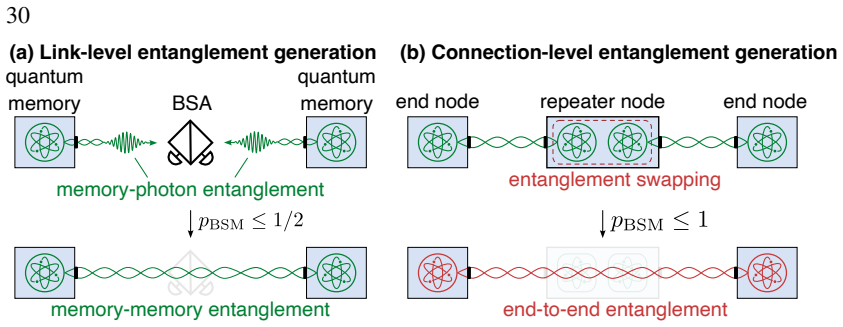
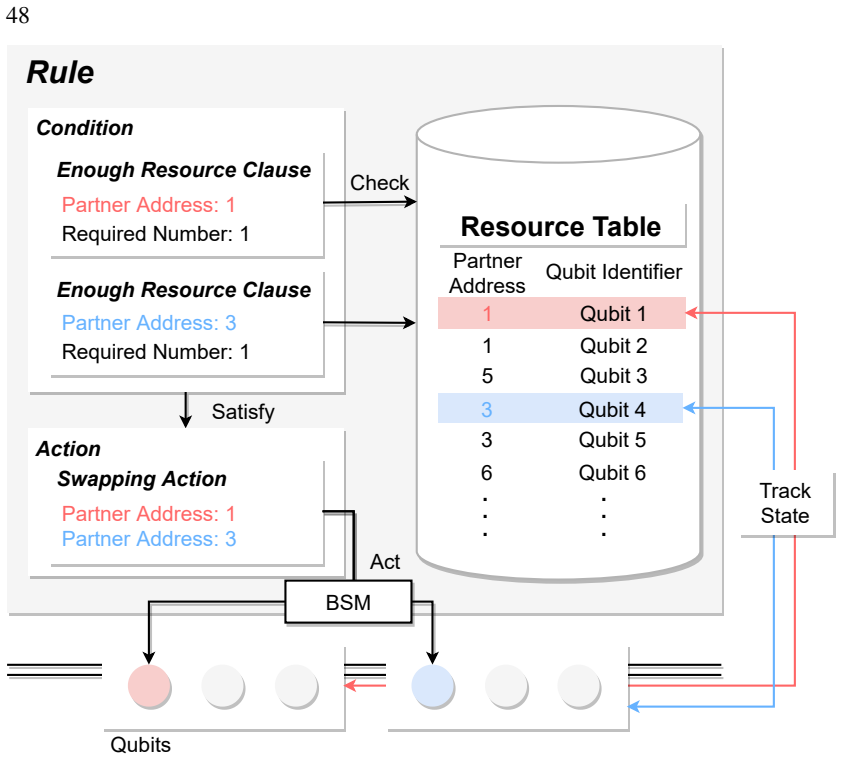
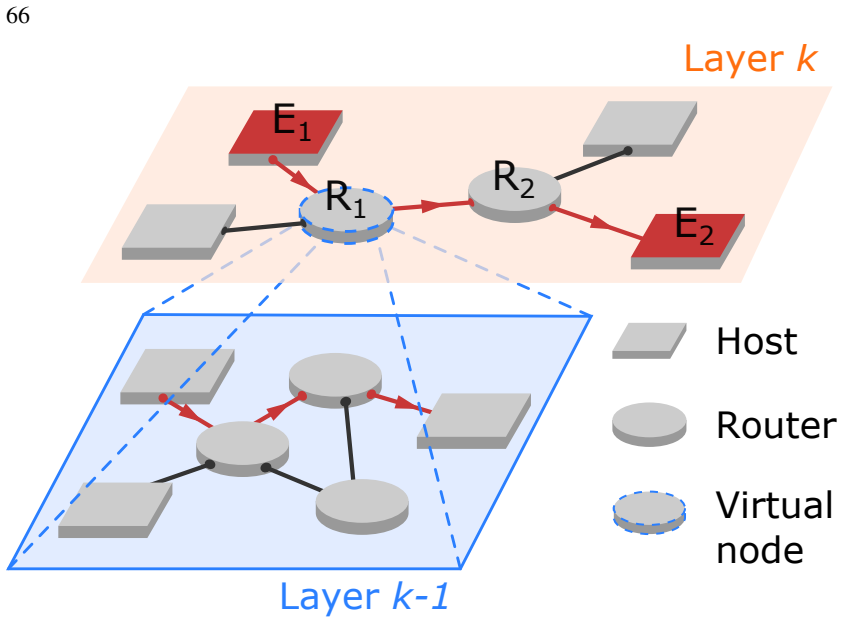
In this thesis, I explore whether it is possible to build a unified Quantum Internet architecture that supports different types of quantum repeaters -- especially the two most distinct and seemingly incompatible ones: memory-based quantum repeaters and all-photonic, memoryless repeaters. These technologies have traditionally been developed with the aim of becoming the single dominant solution, but I ask: Can they work together in the same network? What kind of architecture would support both? And how can simulation help us understand what is needed to manage such a network at scale? To address these questions, I propose an architecture based on an existing recursive network design and programmable RuleSet-based protocols that can coordinate diverse hardware components. I introduce a new emitter-photon building block to bridge memory-based and all-photonic segments, and show how classical networking abstractions can be extended to manage quantum operations. While I have developed a simulation tool grounded in these architectural principles and validated it against existing simulators and analytical models, a full-scale investigation of the resource trade-offs and performance implications remains future work. Nevertheless, the results so far suggest that a unified, heterogeneous quantum network is not only possible but increasingly practical with current technologies -- though ongoing experimental progress will be essential to fully realize this vision.
Editorial analysis
A structured set of objections, weighed in public.
Referee Report
Summary. The manuscript proposes a unified architecture for heterogeneous quantum repeater networks that integrates memory-based and all-photonic repeaters via recursive network design, programmable RuleSet-based protocols, and a novel emitter-photon building block. A simulation tool is developed and validated against existing simulators and analytical models, with preliminary results suggesting the approach is feasible; however, full-scale investigation of resource trade-offs and performance implications is explicitly deferred to future work.
Significance. If the emitter-photon building block and heterogeneous integration can be shown to function without prohibitive fidelity or resource penalties, the work would provide a valuable framework for flexible quantum network design, allowing coexistence of disparate repeater technologies and extending classical networking abstractions to quantum operations. The recursive RuleSet approach and simulation validation against benchmarks are constructive elements that could support further reproducible studies.
major comments (1)
- [Abstract] Abstract: The central practicality claim—that a unified heterogeneous network 'is not only possible but increasingly practical with current technologies'—is load-bearing for the thesis contribution yet rests solely on preliminary simulation validation. The abstract states that 'a full-scale investigation of the resource trade-offs and performance implications remains future work' and supplies no quantitative results on fidelity, latency, or overhead for mixed memory-based/all-photonic segments, leaving the bridging assumption of the emitter-photon building block unsupported.
minor comments (2)
- Clarify how the new emitter-photon building block differs in implementation from prior emitter-based interfaces in the literature to strengthen the novelty claim.
- The manuscript would benefit from an explicit statement of the simulation tool's scope (e.g., which network sizes and error models were tested) to allow readers to assess the preliminary validation's reach.
Simulated Author's Rebuttal
We thank the referee for their constructive review. We agree that the abstract's practicality claim exceeds the scope of the preliminary results and will revise it accordingly to better align with the manuscript's contributions as an architectural framework and simulation validation.
read point-by-point responses
-
Referee: [Abstract] Abstract: The central practicality claim—that a unified heterogeneous network 'is not only possible but increasingly practical with current technologies'—is load-bearing for the thesis contribution yet rests solely on preliminary simulation validation. The abstract states that 'a full-scale investigation of the resource trade-offs and performance implications remains future work' and supplies no quantitative results on fidelity, latency, or overhead for mixed memory-based/all-photonic segments, leaving the bridging assumption of the emitter-photon building block unsupported.
Authors: We agree with this assessment. The manuscript introduces the emitter-photon building block and demonstrates its integration via recursive RuleSet protocols and simulation validation against benchmarks, but provides no quantitative fidelity, latency, or overhead metrics for heterogeneous segments, as the full resource trade-off analysis is explicitly noted as future work. The claim in the abstract that the approach is 'increasingly practical with current technologies' is not supported by such data. We will revise the abstract to remove this phrasing and instead emphasize that the results indicate architectural feasibility, with the simulation tool validated but comprehensive performance evaluation deferred. revision: yes
Circularity Check
No circularity; architectural proposal with externally validated simulator and deferred full-scale analysis
full rationale
The paper proposes a recursive RuleSet-based architecture and emitter-photon building block to unify memory-based and all-photonic repeaters, then describes a simulation tool validated against existing simulators and analytical models. No equations, fitted parameters, or predictions are presented that reduce by construction to inputs defined within the work. The practicality suggestion is explicitly tentative, with full resource trade-off investigation stated as future work. No self-citation chains, uniqueness theorems, or ansatzes are invoked as load-bearing; the derivation chain consists of conceptual extension and external validation rather than self-referential reduction.
Axiom & Free-Parameter Ledger
axioms (1)
- domain assumption Recursive network designs and RuleSet-based protocols can be extended to coordinate heterogeneous quantum repeater hardware
invented entities (1)
-
emitter-photon building block
no independent evidence
Reference graph
Works this paper leans on
-
[1]
Quantum repeaters: From quantum networks to the quantum internet,
K. Azuma et al., “Quantum repeaters: From quantum networks to the quantum internet,”Reviews of Modern Physics, vol. 95, no. 4, p. 045006, Dec. 20, 2023, doi:10.1103/RevModPhys.95.045006
-
[2]
All-photonicquantumrepeaters,
K.Azuma,K.Tamaki,andH.-K.Lo,“All-photonicquantumrepeaters,”Nature Communications, vol. 6, no. 1, p. 6787, 1 Apr. 15, 2015,doi:10 . 1038 / ncomms7787
2015
-
[3]
Quantumcryptography:Publickeydistribution and coin tossing,
C.H.BennettandG.Brassard,“Quantumcryptography:Publickeydistribution and coin tossing,” inInternational Conference on Computer System and Signal Processing, India: IEEE, 1984, pp. 175–179
1984
-
[5]
Quantum sensing,
C. L. Degen, F. Reinhard, and P. Cappellaro, “Quantum sensing,”Reviews of Modern Physics, vol. 89, no. 3, p. 035002, Jul. 25, 2017,doi:10 . 1103 / RevModPhys.89.035002
2017
-
[6]
T.J.Proctor,P.A.Knott,andJ.A.Dunningham,“Networkedquantumsensing,” 2017, arXiv:1702.04271 [math-ph, physics:quant-ph]
Pith/arXiv arXiv 2017
-
[7]
Universal blind quantum com- putation,
A. Broadbent, J. Fitzsimons, and E. Kashefi, “Universal blind quantum com- putation,” in2009 50th Annual IEEE Symposium on Foundations of Computer Science, Oct. 2009, pp. 517–526,doi:10.1109/FOCS.2009.36
-
[8]
Blind quantum computation protocol in which Alice only makes measurements,
T. Morimae and K. Fujii, “Blind quantum computation protocol in which Alice only makes measurements,”Physical Review A, vol. 87, no. 5, p. 050301, May 13, 2013,doi:10.1103/PhysRevA.87.050301
-
[9]
Privatequantumcomputation:Anintroductiontoblindquan- tum computing and related protocols,
J.F.Fitzsimons,“Privatequantumcomputation:Anintroductiontoblindquan- tum computing and related protocols,”npj Quantum Information, vol. 3, no. 1, pp. 1–11, Jun. 15, 2017,doi:10.1038/s41534-017-0025-3
-
[10]
Optimal architectures for long distance quantum communication,
S. Muralidharan, L. Li, J. Kim, N. Lütkenhaus, M. D. Lukin, and L. Jiang, “Optimal architectures for long distance quantum communication,”Scientific Reports, vol. 6, no. 1, p. 20463, 1 Feb. 15, 2016,doi:10.1038/srep20463
-
[11]
Quantumteleportationacrossametropolitanfibrenetwork,
R.Valivarthietal.,“Quantumteleportationacrossametropolitanfibrenetwork,” Nature Photonics, vol. 10, no. 10, pp. 676–680, Oct. 2016,doi:10 . 1038 / nphoton.2016.180
2016
-
[12]
Quantum teleportation with independent sources and prior entanglement distribution over a network,
Q.-C. Sun et al., “Quantum teleportation with independent sources and prior entanglement distribution over a network,”Nature Photonics, vol. 10, no. 10, pp. 671–675, Oct. 2016,doi:10.1038/nphoton.2016.179
-
[13]
Teleportation Systems Toward a Quantum Internet,
R. Valivarthi et al., “Teleportation Systems Toward a Quantum Internet,”PRX Quantum, vol. 1, no. 2, p. 020317, Dec. 4, 2020,doi:10.1103/PRXQuantum. 1.020317 162
-
[14]
Realization of a multi-node quantum network of remote solid-statequbits,
M. Pompili et al., “Realization of a multi-node quantum network of remote solid-statequbits,”Science,vol.372,no.6539,pp.259–264,Apr.16,2021,doi: 10.1126/science.abg1919
-
[15]
Reconfigurable Quantum Local Area Network Over De- ployed Fiber,
M. Alshowkan et al., “Reconfigurable Quantum Local Area Network Over De- ployed Fiber,”PRX Quantum, vol. 2, no. 4, p. 040304, Oct. 6, 2021,doi: 10.1103/PRXQuantum.2.040304
-
[16]
Qubitteleportationbetweennon-neighbouringnodesinaquantum network,
S. L. N. Hermans, M. Pompili, H. K. C. Beukers, S. Baier, J. Borregaard, and R.Hanson,“Qubitteleportationbetweennon-neighbouringnodesinaquantum network,”Nature, vol. 605, no. 7911, pp. 663–668, May 26, 2022,doi:10. 1038/s41586-022-04697-y
2022
-
[17]
Entanglingsingleatomsover33kmtelecomfibre,
T.vanLeentetal.,“Entanglingsingleatomsover33kmtelecomfibre,”Nature, vol.607,no.7917,pp.69–73,Jul.2022,doi:10.1038/s41586-022-04764-4
-
[18]
Design and Implementation of the Illinois Express Quantum Metropolitan Area Network,
J. Chung et al., “Design and Implementation of the Illinois Express Quantum Metropolitan Area Network,”IEEE Transactions on Quantum Engineering, vol. 3, pp. 1–20, 2022,doi:10.1109/TQE.2022.3221029
-
[19]
Entanglement of Trapped-Ion Qubits Separated by 230 Meters,
V. Krutyanskiy et al., “Entanglement of Trapped-Ion Qubits Separated by 230 Meters,”PhysicalReviewLetters,vol.130,no.5,p.050803,Feb.2,2023,doi: 10.1103/PhysRevLett.130.050803
-
[20]
Teleportation of entanglement in the Fermilab Quantum Network,
S. I. Davis et al., “Teleportation of entanglement in the Fermilab Quantum Network,”inCLEO2024,Charlotte,NorthCarolina:OpticaPublishingGroup, 2024, FTu3F.7,doi:10.1364/CLEO_FS.2024.FTu3F.7
-
[21]
Automated Distribution of Polarization-Entangled Photons Using Deployed New York City Fibers,
A. N. Craddock, A. Lazenby, G. B. Portmann, R. Sekelsky, M. Flament, and M. Namazi, “Automated Distribution of Polarization-Entangled Photons Using Deployed New York City Fibers,”PRX Quantum, vol. 5, no. 3, p. 030330, Aug. 9, 2024,doi:10.1103/PRXQuantum.5.030330
-
[22]
Creation of memory–memory entanglement in a metropolitan quantum network,
J.-L. Liu et al., “Creation of memory–memory entanglement in a metropolitan quantum network,”Nature, vol. 629, no. 8012, pp. 579–585, May 2024,doi: 10.1038/s41586-024-07308-0
-
[23]
Entanglement of nanophotonic quantum memory nodes in a telecom network,
C. M. Knaut et al., “Entanglement of nanophotonic quantum memory nodes in a telecom network,”Nature, vol. 629, no. 8012, pp. 573–578, May 2024,doi: 10.1038/s41586-024-07252-z
-
[24]
Entanglement swapping systems toward a quantum internet,
S. I. Davis et al., “Entanglement swapping systems toward a quantum internet,” 2025, arXiv:2503.18906 [quant-ph]
arXiv 2025
-
[25]
Multiplexed entanglement of multi-emitter quantum network nodes,
A. Ruskuc et al., “Multiplexed entanglement of multi-emitter quantum network nodes,”Nature, vol. 639, no. 8053, pp. 54–59, Mar. 2025,doi:10 . 1038 / s41586-024-08537-z
2025
-
[26]
M.Senaetal.,“RobustHigh-FidelityQuantumEntanglementDistributionover Large-Scale Metropolitan Fiber Networks with Co-propagating Classical Sig- nals,” 2025, arXiv:2504.08927 [quant-ph]
arXiv 2025
-
[27]
Alinklayerprotocolforquantumnetworks,
A.Dahlbergetal.,“Alinklayerprotocolforquantumnetworks,”inProceedings of the ACM Special Interest Group on Data Communication, ser. SIGCOMM ’19, New York, NY, USA: Association for Computing Machinery, Aug. 19, 2019, pp. 159–173,doi:10.1145/3341302.3342070 163
-
[28]
Quantum Inter- net Protocol Stack: A Comprehensive Survey,
J. Illiano, M. Caleffi, A. Manzalini, and A. S. Cacciapuoti, “Quantum Inter- net Protocol Stack: A Comprehensive Survey,”Computer Networks, vol. 213, p. 109092, Aug. 2022,doi:10.1016/j.comnet.2022.109092
-
[29]
A. Dahlberg et al., “NetQASM—a low-level instruction set architecture for hybrid quantum–classical programs in a quantum internet,”Quantum Science and Technology, vol. 7, no. 3, p. 035023, Jun. 2022,doi:10.1088/2058- 9565/ac753f
-
[30]
An Architecture for Control of Entanglement Generation Switches in Quantum Networks,
S. Gauthier, G. Vardoyan, and S. Wehner, “An Architecture for Control of Entanglement Generation Switches in Quantum Networks,”IEEE Transactions on Quantum Engineering, vol. 4, pp. 1–17, 2023,doi:10.1109/TQE.2023. 3320047
-
[31]
RuleSet- basedRecursiveQuantumInternetworking,
S. Gauthier, G. Vardoyan, and S. Wehner, “A Control Architecture for Entan- glement Generation Switches in Quantum Networks,” inProceedings of the 1st Workshop on Quantum Networks and Distributed Quantum Computing, ser. QuNet ’23, New York, NY, USA: Association for Computing Machinery, Sep. 10, 2023, pp. 38–44,doi:10.1145/3610251.3610552
-
[32]
A Survey of Quantum InternetProtocolsFromaLayeredPerspective,
Y. Li, H. Zhang, C. Zhang, T. Huang, and F. R. Yu, “A Survey of Quantum InternetProtocolsFromaLayeredPerspective,”IEEECommunicationsSurveys &Tutorials,vol.26,no.3,pp.1606–1634,2024,doi:10.1109/COMST.2024. 3361662
-
[33]
Leveraging Internet Principles to Build a Quantum Net- work,
L. Bacciottini et al., “Leveraging Internet Principles to Build a Quantum Net- work,” 2025, arXiv:2410.08980 [quant-ph]
arXiv 2025
-
[34]
T.R.Beauchamp,H.Jirovská,S.Gauthier,andS.Wehner,“AModularQuantum Network Architecture for Integrating Network Scheduling with Local Program Execution,” 2025, arXiv:2503.12582 [quant-ph]
Pith/arXiv arXiv 2025
-
[35]
Quantum Internet: Technologies, Protocols, and Research Challenges,
V. Kumar, C. Cicconetti, M. Conti, and A. Passarella, “Quantum Internet: Technologies, Protocols, and Research Challenges,” 2025, arXiv:2502.01653 [quant-ph]
Pith/arXiv arXiv 2025
-
[36]
Recursivequantum repeaternetworks,
R.Van Meter,J.Touch, andHorsman,“Recursivequantum repeaternetworks,” Progress in Informatics, no. 8, p. 65, Mar. 2011,doi:10.2201/NiiPi.2011. 8.8
-
[37]
ARecursiveNetworkArchitecture,
J.D.Touch,Y.-S.Wang,andV.K.Pingali,“ARecursiveNetworkArchitecture,” ISI, ISI-TR-2006-626, Oct. 20, 2006, [Online]. Available:https : / / www . strayalpha.com/pubs/isi-tr-626.pdf
2006
-
[38]
J. Touch and V. Pingali, “The RNA Metaprotocol,” in2008 Proceedings of 17thInternationalConferenceonComputerCommunicationsandNetworks,St. Thomas, US Virgin Islands: IEEE, Aug. 2008, pp. 1–6,doi:10.1109/icccn. 2008.ecp.46
-
[39]
Physiological noise and signal-to-noise ratio in fMRI with multi-channel array coils
J. Touch et al., “A Dynamic Recursive Unified Internet Design (DRUID),” Computer Networks, vol. 55, no. 4, pp. 919–935, Mar. 2011,doi:10.1016/j. comnet.2010.12.016 164
work page doi:10.1016/j 2011
-
[40]
Simu- lationofEntanglementGenerationbetweenAbsorptiveQuantumMemories,
R. Van Meter et al., “A Quantum Internet Architecture,” in2022 IEEE Interna- tionalConferenceonQuantumComputingandEngineering(QCE),Broomfield, CO, USA: IEEE, Sep. 2022, pp. 341–352,doi:10.1109/QCE53715.2022. 00055
-
[41]
Simu- lationofEntanglementGenerationbetweenAbsorptiveQuantumMemories,
R.Satohetal.,“QuISP:AQuantumInternetSimulationPackage,”in2022IEEE InternationalConferenceonQuantumComputingandEngineering(QCE),Sep. 2022, pp. 353–364,doi:10.1109/QCE53715.2022.00056
-
[42]
SeQUeNCe:Acustomizablediscrete-eventsimulatorofquantum networks,
X.Wuetal.,“SeQUeNCe:Acustomizablediscrete-eventsimulatorofquantum networks,”Quantum Science and Technology, vol. 6, no. 4, p. 045027, Sep. 2021,doi:10.1088/2058-9565/ac22f6
-
[43]
Cross-Validating Quantum Network Simulators,
J. Chung et al., “Cross-Validating Quantum Network Simulators,” inIEEE IN- FOCOM 2025 - IEEE Conference on Computer Communications, in Workshop on Quantum Networked Applications and Protocols, to be published, Apr. 2, 2025,doi:10.48550/arXiv.2504.01290
-
[44]
One-Way Quantum Repeater Based on Near-Deterministic Photon- EmitterInterfaces,
J. Borregaard, H. Pichler, T. Schröder, M. D. Lukin, P. Lodahl, and A. S. Sørensen, “One-Way Quantum Repeater Based on Near-Deterministic Photon- EmitterInterfaces,”PhysicalReviewX,vol.10,no.2,p.021071,Jun.30,2020, doi:10.1103/PhysRevX.10.021071
-
[45]
Analytical Per- formanceEstimationsforQuantumRepeaterNetworkScenarios,
N. Benchasattabuse, M. Hajdušek, and R. Van Meter, “Architecture and Pro- tocols for All-Photonic Quantum Repeaters,” in2024 IEEE International Con- ference on Quantum Computing and Engineering (QCE), vol. 01, Sep. 2024, pp. 1879–1889,doi:10.1109/QCE60285.2024.00217
-
[46]
Engineering Challenges in All-Photonic Quantum Repeaters,
N. Benchasattabuse, M. Hajdušek, and R. Van Meter, “Engineering Challenges in All-Photonic Quantum Repeaters,”IEEE Network, vol. 39, no. 1, pp. 132– 139, Jan. 2025,doi:10.1109/MNET.2024.3411802
-
[47]
Bridging All-photonic and Memory-based Quantum Repeaters,
N. Benchasattabuse, M. Hajdušek, and R. Van Meter, “Bridging All-photonic and Memory-based Quantum Repeaters,” submitted for publication, 2025
2025
-
[48]
IntegratingEntanglement PurificationintoAll-PhotonicQuantumRepeaters,
N.Benchasattabuse,M.Hajdušek,andR.VanMeter,“IntegratingEntanglement PurificationintoAll-PhotonicQuantumRepeaters,”in2025IEEEInternational Conference on Quantum Computing and Engineering (QCE), to be published, Apr. 25, 2025,doi:10.48550/arXiv.2504.18121
-
[49]
Deterministic Generation of All-Photonic Quantum Repeaters from Solid-State Emitters,
D. Buterakos, E. Barnes, and S. E. Economou, “Deterministic Generation of All-Photonic Quantum Repeaters from Solid-State Emitters,”Physical Review X,vol.7,no.4,p.041023,Oct.27,2017,doi:10.1103/PhysRevX.7.041023
-
[50]
Resourcerequirementsforefficient quantum communication using all-photonic graph states generated from a few matter qubits,
P.Hilaire,E.Barnes,andS.E.Economou,“Resourcerequirementsforefficient quantum communication using all-photonic graph states generated from a few matter qubits,”Quantum, vol. 5, p. 397, Feb. 15, 2021,doi:10 . 22331 / q - 2021-02-15-397
2021
-
[51]
Role of memory errors in quantumrepeaters,
L. Hartmann, B. Kraus, H.-J. Briegel, and W. Dür, “Role of memory errors in quantumrepeaters,”PhysicalReviewA,vol.75,no.3,p.032310,Mar.8,2007, doi:10.1103/PhysRevA.75.032310 165
-
[52]
Quantum repeaters with imperfect memories: Cost and scalability,
M. Razavi, M. Piani, and N. Lütkenhaus, “Quantum repeaters with imperfect memories: Cost and scalability,”Physical Review A, vol. 80, no. 3, p. 032301, Sep. 1, 2009,doi:10.1103/PhysRevA.80.032301
-
[53]
M. Mobayenjarihani, G. Vardoyan, and D. Towsley, “Optimistic Entanglement PurificationinQuantumNetworks,”in2023IEEEInternationalConferenceon Quantum Computing and Engineering (QCE), vol. 01, Sep. 2023, pp. 1143– 1153,doi:10.1109/QCE57702.2023.00129
-
[54]
Distributed quantum computing: A survey,
M. Caleffi, M. Amoretti, D. Ferrari, J. Illiano, A. Manzalini, and A. S. Cac- ciapuoti, “Distributed quantum computing: A survey,”Computer Networks, vol. 254, p. 110672, Dec. 1, 2024,doi:10.1016/j.comnet.2024.110672
-
[55]
ReviewofDistributedQuantumComputing:FromsingleQPU toHighPerformanceQuantumComputing,
D.Barraletal.,“ReviewofDistributedQuantumComputing:FromsingleQPU toHighPerformanceQuantumComputing,”ComputerScienceReview,vol.57, p. 100747, Aug. 2025,doi:10.1016/j.cosrev.2025.100747
-
[56]
Challenges and Opportunities in Quantum Optimization,
A. Abbas et al., “Challenges and Opportunities in Quantum Optimization,” Nature Reviews Physics, vol. 6, no. 12, pp. 718–735, Oct. 28, 2024,doi:10. 1038/s42254-024-00770-9
2024
-
[57]
Simu- lationofEntanglementGenerationbetweenAbsorptiveQuantumMemories,
N. Benchasattabuse, T. Satoh, M. Hajdušek, and R. Van Meter, “Amplitude Amplification for Optimization via Subdivided Phase Oracle,” in2022 IEEE InternationalConferenceonQuantumComputingandEngineering(QCE),Sep. 2022, pp. 22–30,doi:10.1109/QCE53715.2022.00020
-
[58]
Lower bounds on the number of rounds of the quantum approximate optimization algorithm required for guaranteed approximation ra- tios,
N. Benchasattabuse, A. Bärtschi, L. P. García-Pintos, J. Golden, N. Lemons, and S. Eidenbenz, “Lower bounds on the number of rounds of the quantum approximate optimization algorithm required for guaranteed approximation ra- tios,”Physical Review A, vol. 111, no. 6, p. 062411, Jun. 9, 2025,doi:10. 1103/PhysRevA.111.062411
2025
-
[59]
Lower Bounds on Quantum Annealing Times,
L. P. García-Pintos, L. T. Brady, J. Bringewatt, and Y.-K. Liu, “Lower Bounds on Quantum Annealing Times,”Physical Review Letters, vol. 130, no. 14, p. 140601, Apr. 5, 2023,doi:10.1103/PhysRevLett.130.140601
-
[60]
Cambridge: Cambridge University Press, 2010, doi:10.1017/CBO9780511976667
M.A.NielsenandI.L.Chuang,QuantumComputationandQuantumInforma- tion: 10th Anniversary Edition. Cambridge: Cambridge University Press, 2010, doi:10.1017/CBO9780511976667
-
[61]
Stabilizer Codes and Quantum Error Correction,
D. Gottesman, “Stabilizer Codes and Quantum Error Correction,” Ph.D. dis- sertation, California Institute of Technology, May 28, 1997,doi:10.48550/ arXiv.quant-ph/9705052
Pith/arXiv arXiv 1997
-
[62]
Improved simulation of stabilizer circuits,
S. Aaronson and D. Gottesman, “Improved simulation of stabilizer circuits,” Physical Review A, vol. 70, no. 5, p. 052328, Nov. 30, 2004,doi:10.1103/ PhysRevA.70.052328
2004
-
[63]
TheHeisenbergRepresentationofQuantumComputers,
D.Gottesman,“TheHeisenbergRepresentationofQuantumComputers,”1998, arXiv:quant-ph/9807006
Pith/arXiv arXiv 1998
-
[64]
Teleporting an unknown quantum state via dual classical and Einstein- Podolsky-Rosen channels,
C. H. Bennett, G. Brassard, C. Crépeau, R. Jozsa, A. Peres, and W. K. Woot- ters, “Teleporting an unknown quantum state via dual classical and Einstein- Podolsky-Rosen channels,”Physical Review Letters, vol. 70, no. 13, pp. 1895– 1899, Mar. 29, 1993,doi:10.1103/PhysRevLett.70.1895 166
-
[65]
Quantum Complexity Theory,
E. Bernstein and U. Vazirani, “Quantum Complexity Theory,”SIAM Journal on Computing, vol. 26, no. 5, pp. 1411–1473, Oct. 1997,doi:10 . 1137 / S0097539796300921
1997
-
[66]
Onthepowerofquantumcomputation,
D.Simon,“Onthepowerofquantumcomputation,”inProceedings35thAnnual SymposiumonFoundationsofComputerScience,Nov.1994,pp.116–123,doi: 10.1109/SFCS.1994.365701
-
[67]
Rapid solution of problems by quantum compu- tation,
D. Deutsch and R. Jozsa, “Rapid solution of problems by quantum compu- tation,”Proceedings of the Royal Society of London. Series A: Mathemati- cal and Physical Sciences, vol. 439, no. 1907, pp. 553–558, Jan. 1997,doi: 10.1098/rspa.1992.0167
-
[68]
Multipartyentanglementingraphstates,
M.Hein,J.Eisert,andH.J.Briegel,“Multipartyentanglementingraphstates,” Physical Review A, vol. 69, no. 6, p. 062311, Jun. 9, 2004,doi:10 . 1103 / PhysRevA.69.062311
2004
-
[69]
Entanglement in Graph States and its Applications,
M. Hein, W. Dür, J. Eisert, R. Raussendorf, M. V. den Nest, and H.-J. Briegel, “Entanglement in Graph States and its Applications,” Feb. 11, 2006,doi:10. 48550/arXiv.quant-ph/0602096
Pith/arXiv arXiv 2006
-
[70]
Fastsimulationofstabilizercircuitsusingagraph state representation,
S.AndersandH.J.Briegel,“Fastsimulationofstabilizercircuitsusingagraph state representation,”Physical Review A, vol. 73, no. 2, p. 022334, Feb. 21, 2006,doi:10.1103/PhysRevA.73.022334
-
[71]
𝜅-Transformations, Local Complementations and Switching,
A. Bouchet, “𝜅-Transformations, Local Complementations and Switching,” in Cycles and Rays, G. Hahn, G. Sabidussi, and R. E. Woodrow, Eds., Dordrecht: Springer Netherlands, 1990, pp. 41–50,doi:10.1007/978-94-009-0517- 7_5
-
[72]
A One-Way Quantum Computer,
R. Raussendorf and H. J. Briegel, “A One-Way Quantum Computer,”Physical Review Letters, vol. 86, no. 22, pp. 5188–5191, May 28, 2001,doi:10.1103/ PhysRevLett.86.5188
2001
-
[73]
Measurement-basedquantum computation on cluster states,
R.Raussendorf,D.E.Browne,andH.J.Briegel,“Measurement-basedquantum computation on cluster states,”Physical Review A, vol. 68, no. 2, p. 022312, Aug. 25, 2003,doi:10.1103/PhysRevA.68.022312
-
[74]
S. Liu, N. Benchasattabuse, D. Q. Morgan, M. Hajdušek, S. J. Devitt, and R. Van Meter, “A Substrate Scheduler for Compiling Arbitrary Fault-Tolerant GraphStates,”in2023IEEEInternationalConferenceonQuantumComputing and Engineering (QCE), Bellevue, WA, USA: IEEE, Sep. 17, 2023, pp. 870– 880,doi:10.1109/QCE57702.2023.00101
-
[75]
Compilation of algorithm-specific graph states for quantum circuits,
M. Krishnan Vijayan, A. Paler, J. Gavriel, C. R. Myers, P. P. Rohde, and S. J. Devitt, “Compilation of algorithm-specific graph states for quantum circuits,” Quantum Science and Technology, vol. 9, no. 2, p. 025005, Feb. 2024,doi: 10.1088/2058-9565/ad1f39
-
[76]
MultipartiteEntanglementDistribu- tion in Quantum Networks using Subgraph Complementations,
A.Sen,K.Goodenough,andD.Towsley,“MultipartiteEntanglementDistribu- tion in Quantum Networks using Subgraph Complementations,” 2024, arXiv: 2308.13700 [quant-ph]. 167
arXiv 2024
-
[77]
Optimization of deterministic photonic-graph-state generation via local oper- ations,
S. Ghanbari, J. Lin, B. MacLellan, L. Robichaud, P. Roztocki, and H.-K. Lo, “Optimization of deterministic photonic-graph-state generation via local oper- ations,”Physical Review A, vol. 110, no. 5, p. 052605, Nov. 15, 2024,doi: 10.1103/PhysRevA.110.052605
-
[78]
Van Meter,Quantum Networking(Networks and Telecommunications Se- ries)
R. Van Meter,Quantum Networking(Networks and Telecommunications Se- ries). Hoboken, NJ: Wiley, 2014, 1 p.,doi:10.1002/9781118648919
-
[79]
Quantum networks: Where should we be heading?
M. Sasaki, “Quantum networks: Where should we be heading?”Quantum Sci- ence and Technology, vol. 2, no. 2, p. 020501, Jun. 1, 2017,doi:10.1088/ 2058-9565/aa6994
2017
-
[80]
Towards a global quantum network,
C. Simon, “Towards a global quantum network,”Nature Photonics, vol. 11, no. 11, pp. 678–680, Nov. 2017,doi:10.1038/s41566-017-0032-0
-
[81]
Designing tomorrow’s quantum internet,
W. J. Munro, N. L. Piparo, J. Dias, M. Hanks, and K. Nemoto, “Designing tomorrow’s quantum internet,”AVS Quantum Science, vol. 4, no. 2, p. 020503, Jun. 8, 2022,doi:10.1116/5.0092069
discussion (0)
Sign in with ORCID, Apple, or X to comment. Anyone can read and Pith papers without signing in.