Learning Generalizable Skill Policy with Data-Efficient Unsupervised RL
Pith reviewed 2026-07-02 16:37 UTC · model grok-4.3
The pith
GenDa addresses non-stationary skill semantics and brittle generalization in unsupervised RL via skill relabeling and a Complementary Information Bottleneck.
A machine-rendered reading of the paper's core claim, the machinery that carries it, and where it could break.
Core claim
GenDa is a unified framework that introduces a skill relabeling mechanism to mitigate non-stationarity and improve data efficiency for pre-training, together with a Complementary Information Bottleneck that encourages the learned skill policy to focus on ego-centric features and become robust to distribution shifts for downstream tasks, yielding enhanced scalability of URL with superior generalizability and data efficiency.
What carries the argument
Skill relabeling mechanism paired with Complementary Information Bottleneck (CIB) to stabilize skill semantics during pre-training and promote robustness under shifts.
If this is right
- Skill relabeling reduces non-stationarity and raises data efficiency during pre-training.
- The CIB directs the skill policy toward ego-centric features that survive distribution shifts.
- The resulting policies transfer more reliably to downstream control tasks.
- Overall URL becomes more scalable for building skill libraries without rewards.
Where Pith is reading between the lines
- If relabeling stabilizes semantics, similar corrective labels could be added to other skill-discovery algorithms.
- Ego-centric feature focus may prove especially useful in real-robot settings where camera or sensor changes are common.
- The two components could be tested separately to measure how much each contributes to the reported gains.
Load-bearing premise
The skill relabeling mechanism and Complementary Information Bottleneck will reliably reduce non-stationary skill semantics and brittle generalization without creating new instabilities or needing heavy tuning.
What would settle it
An experiment on a downstream task with controlled distribution shift where GenDa shows no gain in success rate or sample efficiency over standard URL baselines.
Figures





read the original abstract
Unsupervised Reinforcement Learning (URL) aims to pre-train scalable, skill-conditioned policies without extrinsic rewards, serving as a foundation for downstream control tasks. Despite recent progress, we argue that current off-policy URL methods are limited by two critical, overlooked bottlenecks: (1) non-stationary skill semantics and (2) brittle generalization. To address these challenges, we propose GenDa (Generalizable Data-efficient Agent), a unified framework for robust unsupervised reinforcement learning. First, we introduce a skill relabeling mechanism to mitigate non-stationarity and significantly improve data efficiency for pre-training. Second, we propose a Complementary Information Bottleneck (CIB), encouraging the learned skill policy to focus on ego-centric features and become robust to distribution shifts for downstream tasks. Through various experiments, we demonstrate that GenDa significantly enhances the scalability of URL with superior generalizability and data efficiency. Our code and videos are available at https://ihatebroccoli.github.io/official-GenDa.
Editorial analysis
A structured set of objections, weighed in public.
Referee Report
Summary. The paper proposes GenDa, a framework for unsupervised reinforcement learning (URL) that introduces a skill relabeling mechanism to address non-stationary skill semantics and improve data efficiency during pre-training, along with a Complementary Information Bottleneck (CIB) to encourage the skill policy to focus on ego-centric features and improve robustness to distribution shifts. The central claim is that these components jointly enhance the scalability, generalizability, and data efficiency of URL, as demonstrated through various experiments.
Significance. If the empirical claims hold, GenDa could provide a more robust and efficient approach to pre-training skill-conditioned policies in URL, addressing key bottlenecks that limit current off-policy methods. The public release of code and videos is a strength that supports reproducibility and allows independent verification of the reported improvements in generalizability and data efficiency.
major comments (1)
- [Abstract] Abstract: The manuscript asserts that 'through various experiments, we demonstrate that GenDa significantly enhances the scalability of URL with superior generalizability and data efficiency,' yet supplies no quantitative metrics, ablation results, baseline comparisons, or description of the experimental setup, environments, or evaluation protocol. This absence makes it impossible to assess whether the proposed mechanisms deliver the claimed benefits or introduce instabilities, directly undermining evaluation of the central empirical claim.
Simulated Author's Rebuttal
We thank the referee for their review and for highlighting the need for clearer presentation of empirical support in the abstract. We address the comment below and note that the full manuscript contains the requested details.
read point-by-point responses
-
Referee: [Abstract] Abstract: The manuscript asserts that 'through various experiments, we demonstrate that GenDa significantly enhances the scalability of URL with superior generalizability and data efficiency,' yet supplies no quantitative metrics, ablation results, baseline comparisons, or description of the experimental setup, environments, or evaluation protocol. This absence makes it impossible to assess whether the proposed mechanisms deliver the claimed benefits or introduce instabilities, directly undermining evaluation of the central empirical claim.
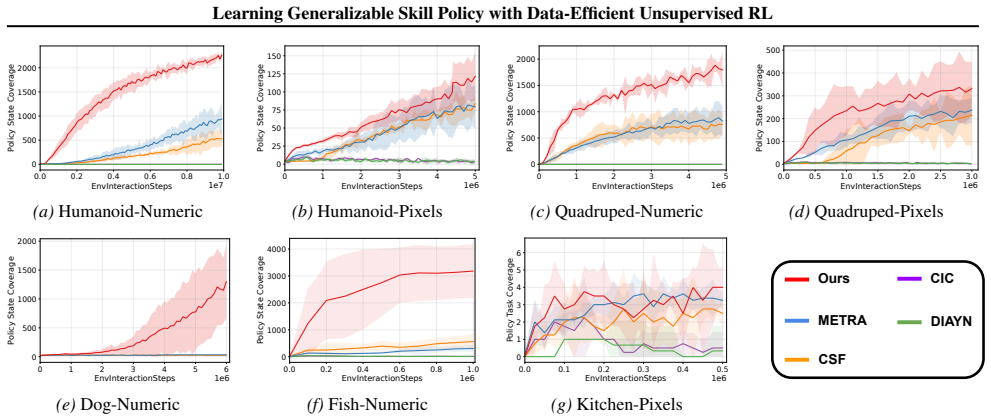
Authors: The abstract is a concise summary constrained by length limits and is not intended to contain full experimental details. Quantitative metrics (e.g., success rates, sample efficiency gains), ablation studies, baseline comparisons (including prior URL methods), environment descriptions (standard MuJoCo and manipulation benchmarks), and evaluation protocols are provided in Sections 4 and 5 of the main manuscript, along with figures and tables reporting the claimed improvements in scalability, generalizability, and data efficiency. We agree the abstract could better signal these results and will revise it to include one or two key quantitative highlights while remaining within length constraints. revision: yes
Circularity Check
No significant circularity
full rationale
The paper proposes GenDa as an empirical framework consisting of a skill relabeling mechanism and Complementary Information Bottleneck (CIB) to address non-stationarity and generalization issues in unsupervised RL. The abstract and description present these as novel additions whose effects are validated through experiments, with no equations, fitted parameters renamed as predictions, or load-bearing self-citations that reduce the central claim to its own inputs by construction. The derivation chain is therefore self-contained as an empirical demonstration rather than a mathematical reduction.
Axiom & Free-Parameter Ledger
invented entities (1)
-
Complementary Information Bottleneck (CIB)
no independent evidence
Reference graph
Works this paper leans on
-
[1]
International Conference on Learning Representations (ICLR) , year =
Diversity Is All You Need: Learning Skills without a Reward Function , author =. International Conference on Learning Representations (ICLR) , year =
-
[2]
Neural Information Processing Systems (NeurIPS) , year =
Unsupervised Reinforcement Learning with Contrastive Intrinsic Control , author =. Neural Information Processing Systems (NeurIPS) , year =
-
[3]
International Conference on Learning Representations (ICLR) , year =
METRA: Scalable Unsupervised RL with Metric-Aware Abstraction , author =. International Conference on Learning Representations (ICLR) , year =
-
[4]
International Conference on Learning Representations (ICLR) , year =
Can a MISL Fly? Analysis and Ingredients for Mutual Information Skill Learning , author =. International Conference on Learning Representations (ICLR) , year =
-
[5]
Variational Intrinsic Control , author=. arXiv preprint arXiv:1611.07507 , year=
work page internal anchor Pith review Pith/arXiv arXiv
-
[6]
International Conference on Machine Learning (ICML) , year =
Unsupervised Skill Discovery with Bottleneck Option Learning , author =. International Conference on Machine Learning (ICML) , year =
-
[7]
International Conference on Learning Representations (ICLR) , year =
Direct then Diffuse: Incremental Unsupervised Skill Discovery for State Covering and Goal Reaching , author =. International Conference on Learning Representations (ICLR) , year =
-
[8]
International Conference on Machine Learning (ICML) , year =
Controllability-Aware Unsupervised Skill Discovery , author =. International Conference on Machine Learning (ICML) , year =
-
[9]
International Conference on Machine Learning (ICML) , year =
Behavior Contrastive Learning for Unsupervised Skill Discovery , author =. International Conference on Machine Learning (ICML) , year =
-
[10]
Neural Information Processing Systems (NeurIPS) Datasets and Benchmarks Track , year =
URLB: Unsupervised Reinforcement Learning Benchmark , author =. Neural Information Processing Systems (NeurIPS) Datasets and Benchmarks Track , year =
-
[11]
International Conference on Machine Learning (ICML) , year =
Mastering the Unsupervised Reinforcement Learning Benchmark from Pixels , author =. International Conference on Machine Learning (ICML) , year =
-
[12]
International Conference on Learning Representations (ICLR) , year =
Mastering Visual Continuous Control: Improved Data-Augmented Reinforcement Learning , author=. International Conference on Learning Representations (ICLR) , year =
-
[13]
International Conference on Learning Representations (ICLR) , year =
Dynamics-Aware Unsupervised Discovery of Skills , author =. International Conference on Learning Representations (ICLR) , year =
-
[14]
International Conference on Machine Learning (ICML) , year =
Soft Actor-Critic: Off-Policy Maximum Entropy Deep Reinforcement Learning with a Stochastic Actor , author =. International Conference on Machine Learning (ICML) , year =
-
[15]
International Conference on Learning Representations (ICLR) , year =
Unsupervised Control Through Non-Parametric Discriminative Rewards , author =. International Conference on Learning Representations (ICLR) , year =
-
[16]
International Conference on Machine Learning (ICML) , year =
Explore, Discover and Learn: Unsupervised Discovery of State-Covering Skills , author =. International Conference on Machine Learning (ICML) , year =
-
[17]
International Conference on Learning Representations (ICLR) , year =
Dynamical Distance Learning for Semi-Supervised and Unsupervised Skill Discovery , author =. International Conference on Learning Representations (ICLR) , year =
-
[18]
Neural Information Processing Systems (NeurIPS) , year =
Unsupervised Skill Discovery via Recurrent Skill Training , author =. Neural Information Processing Systems (NeurIPS) , year =
-
[19]
Neural Information Processing Systems (NeurIPS) , year =
A Mixture of Surprises for Unsupervised Reinforcement Learning , author =. Neural Information Processing Systems (NeurIPS) , year =
-
[20]
International Conference on Learning Representations (ICLR) , year =
Learning More Skills through Optimistic Exploration , author =. International Conference on Learning Representations (ICLR) , year =
-
[21]
Neural Information Processing Systems (NeurIPS) , year =
Discovering and Achieving Goals via World Models , author =. Neural Information Processing Systems (NeurIPS) , year =
-
[22]
International Conference on Learning Representations (ICLR) , year =
Lipschitz-Constrained Unsupervised Skill Discovery , author =. International Conference on Learning Representations (ICLR) , year =
-
[23]
Association for the Advancement of Artificial Intelligence (AAAI) , year =
Wasserstein Unsupervised Reinforcement Learning , author =. Association for the Advancement of Artificial Intelligence (AAAI) , year =
-
[24]
Neural Information Processing Systems (NeurIPS) , year =
Wasserstein Dependency Measure for Representation Learning , author =. Neural Information Processing Systems (NeurIPS) , year =
-
[25]
Representation Learning with Contrastive Predictive Coding
Representation Learning with Contrastive Predictive Coding , author=. arXiv preprint arXiv:1807.03748 , year=
work page internal anchor Pith review Pith/arXiv arXiv
-
[26]
Empirical Methods in Natural Language Processing (EMNLP) , year =
Noise Contrastive Estimation and Negative Sampling for Conditional Models: Consistency and Statistical Efficiency , author =. Empirical Methods in Natural Language Processing (EMNLP) , year =
-
[27]
International Conference on Machine Learning (ICML) , year =
Data-Efficient Image Recognition with Contrastive Predictive Coding , author =. International Conference on Machine Learning (ICML) , year =
-
[28]
International Conference on Machine Learning (ICML) , year =
Learning Temporal Distances: Contrastive Successor Features Can Provide a Metric Structure for Decision-Making , author =. International Conference on Machine Learning (ICML) , year =
-
[29]
International Conference on Learning Representations (ICLR) , year =
Task Adaptation from Skills: Information Geometry, Disentanglement, and New Objectives for Unsupervised Reinforcement Learning , author =. International Conference on Learning Representations (ICLR) , year =
-
[30]
Neural Information Processing Systems (NeurIPS) , year =
Disentangled Unsupervised Skill Discovery for Efficient Hierarchical Reinforcement Learning , author =. Neural Information Processing Systems (NeurIPS) , year =
-
[31]
Zizhao Wang and Jiaheng Hu and Caleb Chuck and Stephen Chen and Roberto Mart. Ski. Neural Information Processing Systems (NeurIPS) , year=
-
[32]
Neural Information Processing Systems (NeurIPS) , year =
Periodic Skill Discovery , author =. Neural Information Processing Systems (NeurIPS) , year =
-
[33]
International Conference on Learning Representations (ICLR) , year =
Fast Task Inference with Variational Intrinsic Successor Features , author =. International Conference on Learning Representations (ICLR) , year =
-
[34]
Neural Information Processing Systems (NeurIPS) , year =
Behavior From the Void: Unsupervised Active Pre-Training , author =. Neural Information Processing Systems (NeurIPS) , year =
-
[35]
International Conference on Learning Representations (ICLR) , year=
Data-Efficient Reinforcement Learning with Self-Predictive Representations , author=. International Conference on Learning Representations (ICLR) , year=
-
[36]
Neural Information Processing Systems (NeurIPS) , year=
Hindsight Experience Replay , author=. Neural Information Processing Systems (NeurIPS) , year=
-
[37]
International Conference on Learning Representations (ICLR) , year=
Deep Variational Information Bottleneck , author=. International Conference on Learning Representations (ICLR) , year=
-
[38]
DeepMind Control Suite , author=. arXiv preprint arXiv:1801.00690 , year =
work page internal anchor Pith review Pith/arXiv arXiv
-
[39]
IEEE/RSJ International Conference on Intelligent Robots and Systems (IROS) , year =
MuJoCo: A Physics Engine for Model-Based Control , author =. IEEE/RSJ International Conference on Intelligent Robots and Systems (IROS) , year =
-
[40]
International Conference on Learning Representations (ICLR) , year=
High-Dimensional Continuous Control Using Generalized Advantage Estimation , author=. International Conference on Learning Representations (ICLR) , year=
-
[41]
Conference on Robot Learning (CoRL) , year =
Relay Policy Learning: Solving Long-Horizon Tasks via Imitation and Reinforcement Learning , author =. Conference on Robot Learning (CoRL) , year =
discussion (0)
Sign in with ORCID, Apple, or X to comment. Anyone can read and Pith papers without signing in.