Tracing the very early disruption of the Sagittarius dwarf galaxy in the distant Milky Way halo
Pith reviewed 2026-06-27 00:11 UTC · model grok-4.3
The pith
Spectroscopy identifies four red giant stars as the earliest-stripped material from the Sagittarius dwarf galaxy in a distant halo spur.
A machine-rendered reading of the paper's core claim, the machinery that carries it, and where it could break.
Core claim
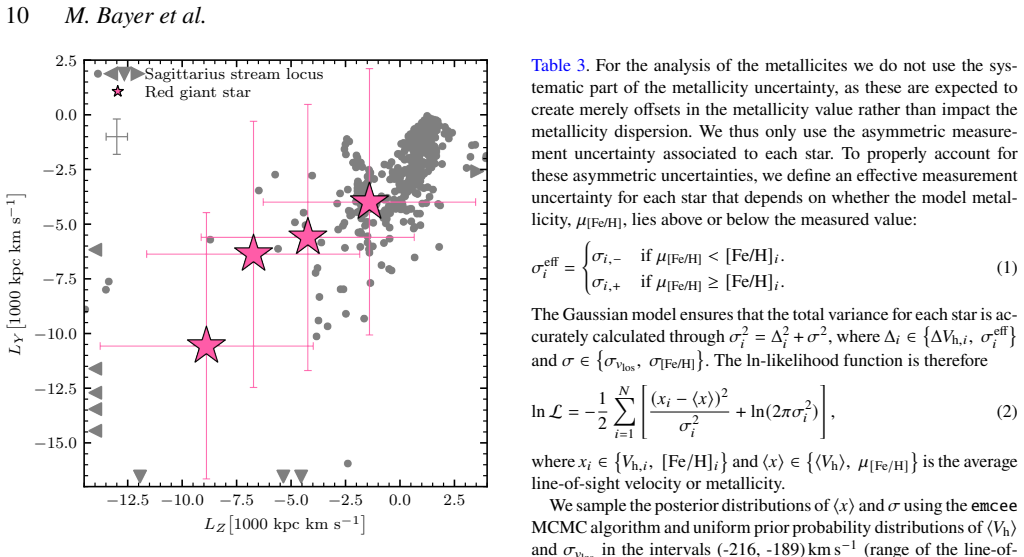
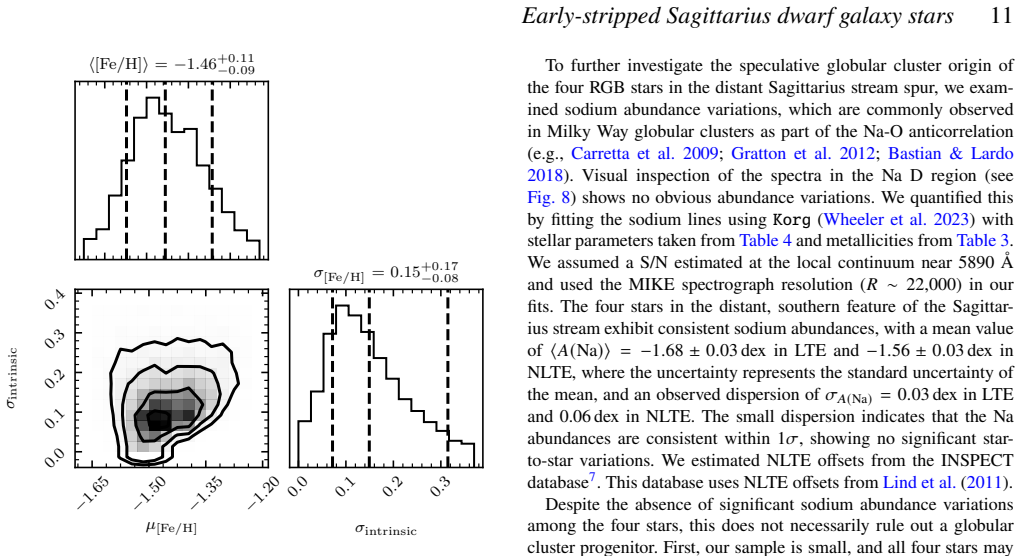
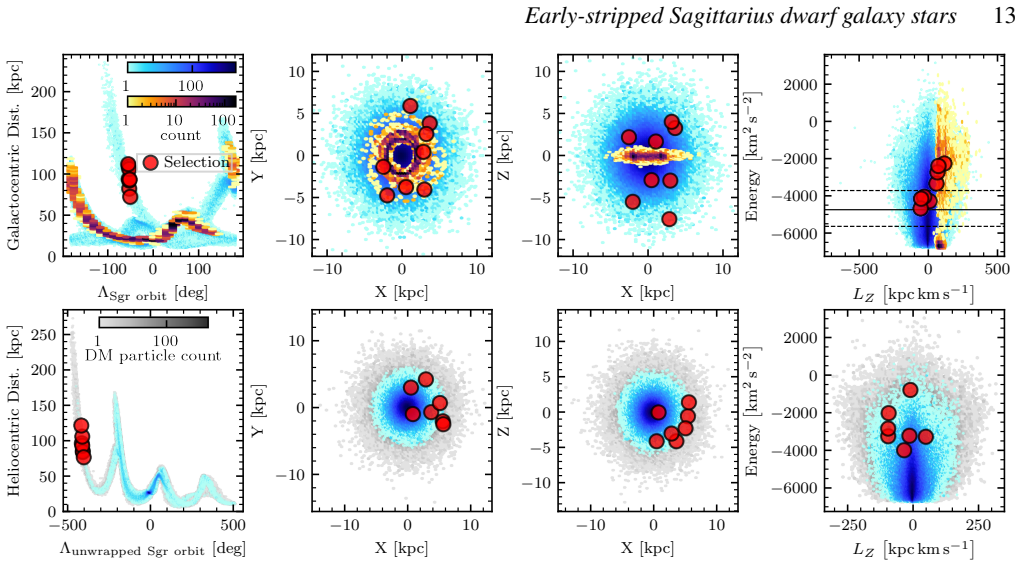
Spectral analysis confirms the significant tight clustering of four RGB stars in full 6D phase space. This clump lies inside a larger spur-like feature of the Sagittarius stream. Model comparison indicates the spur consists of stars originally in the halo of the Sagittarius dwarf galaxy and stripped during the earliest phases of the interaction, with a metallicity dispersion of 0.15 around [Fe/H] = -1.46.
What carries the argument
The 6D phase-space clump of four RGB stars identified by radial-velocity and metallicity measurements, placed against Sagittarius stream models to assign it to the earliest stripping epoch.
If this is right
- The distant southern spur now has its first spectroscopic confirmation as Sagittarius debris.
- Stars from a dwarf galaxy's outer halo can reach distances beyond 80 kpc while remaining recognizable in phase space.
- The low metallicity dispersion supports the idea that the clump preserves the chemical homogeneity of the original Sagittarius halo population.
- Similar early-stripped features can be searched for with the same combination of spectroscopy and stream modeling.
Where Pith is reading between the lines
- If the assignment holds, the timing of the first pericentric passage in Sagittarius models can be tested against the observed location of this clump.
- Comparable spurs in other satellite streams would offer a way to map the sequence of stripping events across multiple mergers.
- Deeper surveys could check whether the spur contains only halo stars or includes a small fraction of disk material from the dwarf.
Load-bearing premise
Sagittarius stream models correctly locate and characterize the earliest-stripped halo material without large uncertainties from contamination or model inaccuracies.
What would settle it
Additional stars observed in the same sky region whose velocities or metallicities fall outside the range predicted by the Sagittarius models for early-stripped material.
Figures


read the original abstract
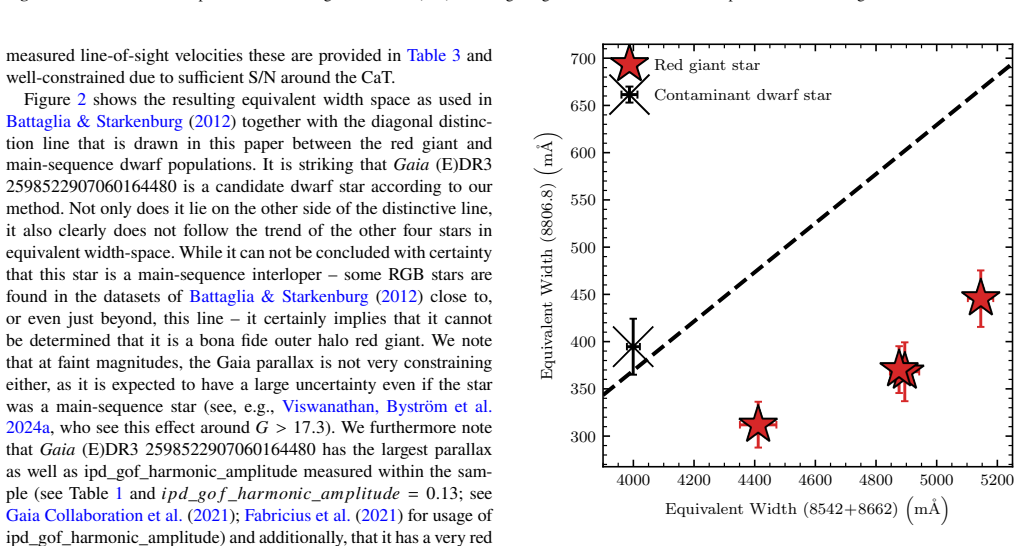
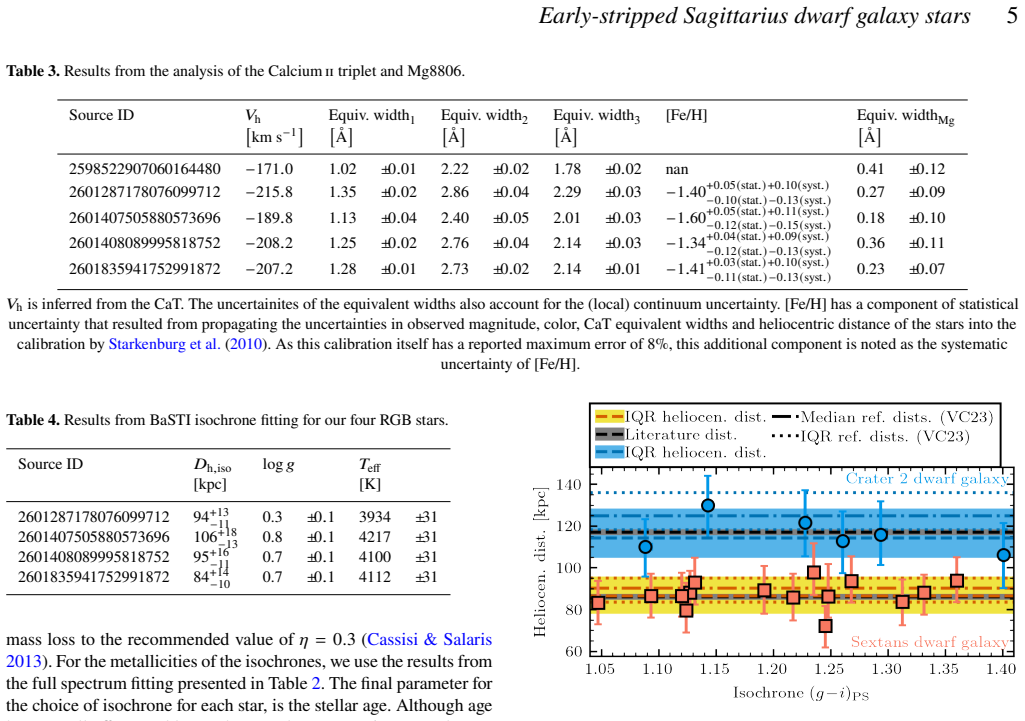
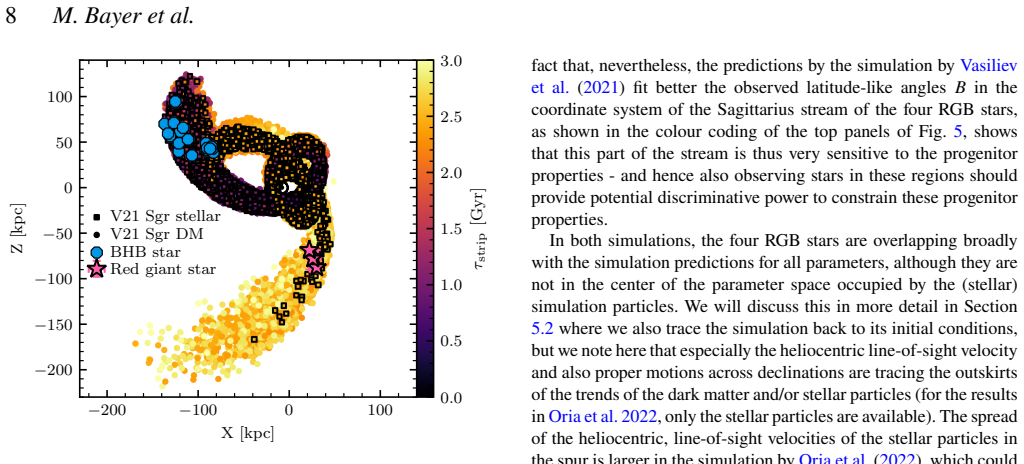
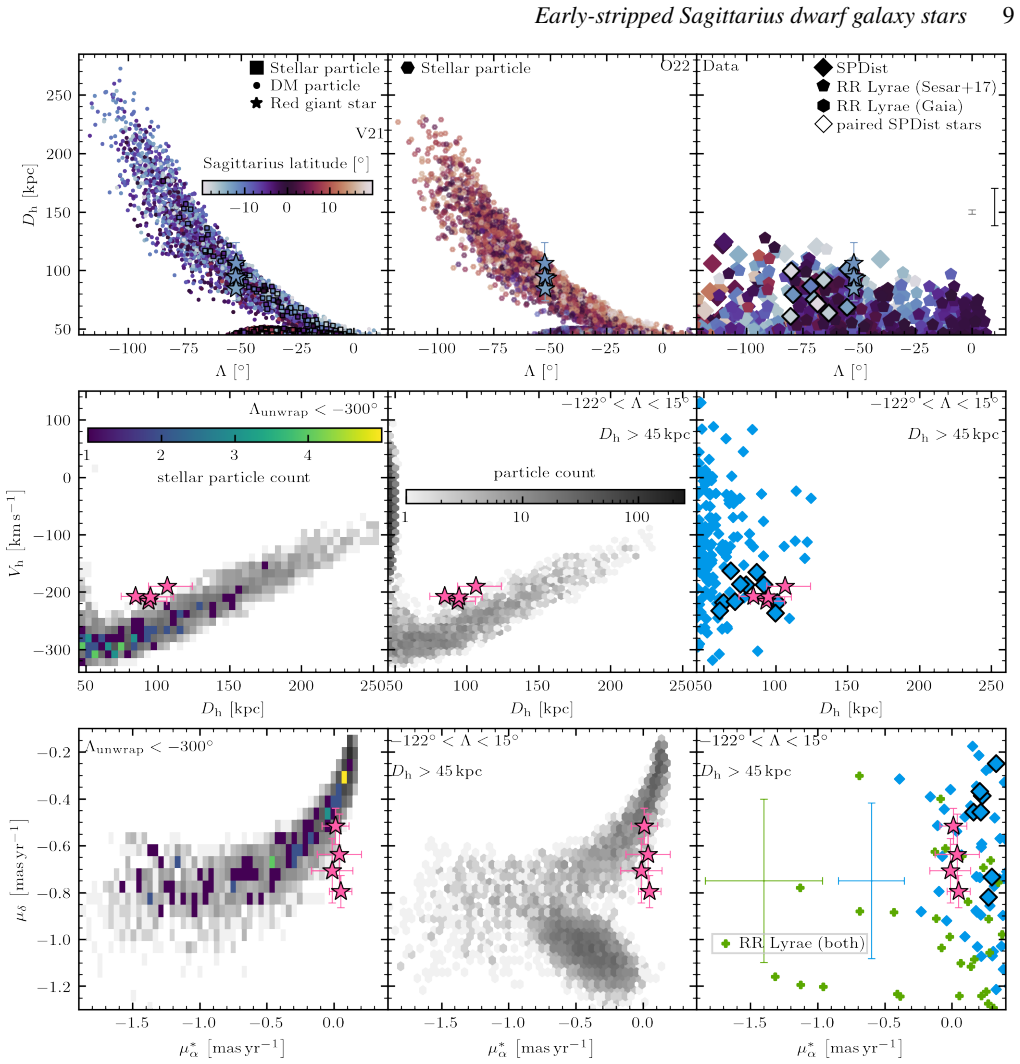
Current models predict that at distances beyond 80 kpc in the Milky Way halo, we can find the earliest escaped stars from the merging Sagittarius dwarf galaxy. However, observational data on the Sagittarius stream at these distances is limited. This study examines an overdensity of red giant branch (RGB) stars potentially linked to Sagittarius merger debris. Using the Magellan Inamori Kyocera Echelle spectrograph of Las Campanas Observatory's Clay Telescope, we measured the radial velocities and metallicities of these stars. We compared their properties with model predictions of Sagittarius' disruption and other stellar tracers from the Dark Energy Spectroscopic Instrument Data Release 1 and RR Lyrae catalogs. Our spectral analysis confirms the significant tight clustering of four of these RGBs in full 6D phase space. This tight clump is embedded within a larger spur-like feature of the Sagittarius stream in the southern sky. A comparison with Sagittarius stream models further strengthens this hypothesis and shows that this far spur could be composed of stars originally in the halo of the Sagittarius dwarf galaxy, stripped in the earliest phases of the interaction. The metallicity dispersion of the four stars of $0.15 ^ {+0.17} _ {-0.08}$ around the average of [Fe/H] = $-1.46 ^ {+0.11} _ {-0.09}$ is very low. This study provides the first spectroscopic view of the distant southern spur of Sagittarius, composed of stars likely stripped from Sagittarius's halo.
Editorial analysis
A structured set of objections, weighed in public.
Referee Report
Summary. The manuscript reports spectroscopic follow-up of an overdensity of RGB stars at >80 kpc, identifying four stars that exhibit tight clustering in full 6D phase space, low metallicity dispersion (0.15 dex), and alignment with a spur-like feature in the southern Sagittarius stream; comparison to existing Sagittarius disruption models is used to argue that these stars were stripped from the Sagittarius halo in the earliest phases of the interaction.
Significance. If robust, the result would supply the first spectroscopic characterization of the distant southern spur and direct evidence for very early-stripped Sagittarius material, extending the observational timeline of the merger. The reported low metallicity dispersion around [Fe/H] = -1.46 is a concrete strength supporting a common origin.
major comments (3)
- [model comparison section] Model-comparison section: the claim that the spur traces earliest-stripped halo material rests on visual/qualitative alignment with one set of stream models, but no quantitative goodness-of-fit metric, no sensitivity tests to variations in Milky Way potential or Sagittarius initial mass/orbit, and no cross-check against independent simulations are reported; these omissions are load-bearing because small changes in those parameters can shift the predicted locus of first-stripped stars by tens of kpc and hundreds of km/s at these distances.
- [results section] Results on the four-star clump: the 'significant tight clustering' in 6D phase space is asserted for a sample of only four stars, yet the manuscript provides neither the individual measurement uncertainties on distance, proper motion, and radial velocity nor a statistical test (e.g., comparison to a control sample of halo stars or a p-value for the observed dispersion) that would establish the clump is unlikely to arise by chance; this directly affects the robustness of the central identification.
- [observations and data analysis] Sample selection and error propagation: the criteria used to select the parent overdensity and the four stars from it, together with how distance and velocity errors propagate into the 6D clustering metric, are not quantified; without these details the reported low dispersion cannot be assessed for robustness against observational uncertainties.
minor comments (2)
- [metallicity analysis] The asymmetric uncertainties on the metallicity dispersion and mean [Fe/H] are quoted but the method used to derive them (bootstrap, MCMC, etc.) is not stated.
- [figures] Figure showing the 6D phase-space distribution would benefit from explicit overlay of the model particles and error ellipses for the four stars.
Simulated Author's Rebuttal
We thank the referee for their careful and constructive review. The comments highlight important areas for strengthening the robustness of our claims. We address each major comment below and have revised the manuscript accordingly where feasible.
read point-by-point responses
-
Referee: [model comparison section] Model-comparison section: the claim that the spur traces earliest-stripped halo material rests on visual/qualitative alignment with one set of stream models, but no quantitative goodness-of-fit metric, no sensitivity tests to variations in Milky Way potential or Sagittarius initial mass/orbit, and no cross-check against independent simulations are reported; these omissions are load-bearing because small changes in those parameters can shift the predicted locus of first-stripped stars by tens of kpc and hundreds of km/s at these distances.
Authors: We agree the comparison is primarily qualitative and will add a quantitative alignment metric (e.g., RMS deviation in 6D phase space between the four stars and model particles). Full sensitivity tests across Milky Way potentials and Sagittarius parameters would require new N-body simulations beyond the scope of this observational study; we will explicitly note this limitation and reference that the adopted models are standard in the literature. We will also cross-check against one additional independent simulation set if suitable public data are available. revision: partial
-
Referee: [results section] Results on the four-star clump: the 'significant tight clustering' in 6D phase space is asserted for a sample of only four stars, yet the manuscript provides neither the individual measurement uncertainties on distance, proper motion, and radial velocity nor a statistical test (e.g., comparison to a control sample of halo stars or a p-value for the observed dispersion) that would establish the clump is unlikely to arise by chance; this directly affects the robustness of the central identification.
Authors: We will add a table with individual uncertainties for distance, proper motion, and radial velocity for each star. We will also include a statistical test: Monte Carlo sampling of halo stars from DESI DR1 at comparable distances to compute the probability of obtaining a 6D dispersion as low as observed by chance, reporting the resulting significance. revision: yes
-
Referee: [observations and data analysis] Sample selection and error propagation: the criteria used to select the parent overdensity and the four stars from it, together with how distance and velocity errors propagate into the 6D clustering metric, are not quantified; without these details the reported low dispersion cannot be assessed for robustness against observational uncertainties.
Authors: We will expand the methods section to explicitly list all photometric, spatial, and quality cuts used to define the parent overdensity and to isolate the four stars. Error propagation into the 6D metric will be quantified via Monte Carlo resampling of each star's observables within their uncertainties to verify the reported dispersion remains robust. revision: yes
Circularity Check
No significant circularity; claim rests on direct observations and external model comparison
full rationale
The paper reports new spectroscopic observations (radial velocities, metallicities) of candidate RGB stars, identifies a tight 6D phase-space clump in the data, and notes alignment with existing Sagittarius stream models from the literature. No load-bearing step reduces by the paper's own equations, fits, or self-citations to its inputs; the model comparison is external support, not a self-referential derivation. The analysis is self-contained against external benchmarks and receives the default non-circularity finding.
Axiom & Free-Parameter Ledger
axioms (1)
- domain assumption Sagittarius stream models from prior literature accurately represent the spatial and kinematic distribution of early-stripped material.
Reference graph
Works this paper leans on
-
[1]
Marino, A. F. and Milone, A. P. and Renzini, A. and D'Antona, F. and Anderson, J. and Bedin, L. R. and Bellini, A. and Cordoni, G. and Lagioia, E. P. and Piotto, G. and Tailo, M. , title=". , year=2019, month=aug, volume=. doi:10.1093/mnras/stz1415 , eprint=
-
[2]
Usman, Sam A. and Ji, Alexander P. and Li, Ting S. and Pace, Andrew B. and Cullinane, Lara R. and Da Costa, Gary S. and Koposov, Sergey E. and Lewis, Geraint F. and Zucker, Daniel B. and Belokurov, Vasily and et al. , title=". , year=2024, month=apr, volume=. doi:10.1093/mnras/stae185 , eprint=
-
[3]
Vesperini, Enrico and McMillan, Stephen L. W. and D'Antona, Francesca and D'Ercole, Annibale , title=". , year=2010, month=aug, volume=. doi:10.1088/2041-8205/718/2/L112 , eprint=
-
[4]
Decressin, T. and Baumgardt, H. and Charbonnel, C. and Kroupa, P. , title=". , year=2010, month=jun, volume=. doi:10.1051/0004-6361/200913703 , eprint=
-
[5]
Decressin, T. and Baumgardt, H. and Kroupa, P. , title=". , year=2008, month=dec, volume=. doi:10.1051/0004-6361:200810275 , eprint=
-
[6]
D'Ercole, Annibale and Vesperini, Enrico and D'Antona, Francesca and McMillan, Stephen L. W. and Recchi, Simone , title=". , year=2008, month=dec, volume=. doi:10.1111/j.1365-2966.2008.13915.x , eprint=
-
[7]
, archivePrefix = "arXiv", eprint =
Bekki, K. and Campbell, S. W. and Lattanzio, J. C. and Norris, J. E. , title=". , year=2007, month=may, volume=. doi:10.1111/j.1365-2966.2007.11606.x , eprint=
-
[8]
Lind, K. and Asplund, M. and Barklem, P. S. and Belyaev, A. K. , title=". , year=2011, month=apr, volume=. doi:10.1051/0004-6361/201016095 , eprint=
-
[9]
Wheeler, Adam J. and Abruzzo, Matthew W. and Casey, Andrew R. and Ness, Melissa K. , title=". , year=2023, month=feb, volume=. doi:10.3847/1538-3881/acaaad , eprint=
-
[10]
, year=2018, month=sep, volume=
Bastian, Nate and Lardo, Carmela , title=". , year=2018, month=sep, volume=. doi:10.1146/annurev-astro-081817-051839 , eprint=
-
[11]
and Carretta, Eugenio and Bragaglia, Angela , title="
Gratton, Raffaele G. and Carretta, Eugenio and Bragaglia, Angela , title=". , year=2012, month=feb, volume=. doi:10.1007/s00159-012-0050-3 , eprint=
-
[12]
Na-O anticorrelation and HB. VII. The chemical composition of first and second-generation stars in 15 globular clusters from GIRAFFE spectra. , keywords =. doi:10.1051/0004-6361/200912096 , archivePrefix =. 0909.2938 , primaryClass =
work page internal anchor Pith review Pith/arXiv arXiv doi:10.1051/0004-6361/200912096
-
[13]
S ^ 5 : The Orbital and Chemical Properties of One Dozen Stellar Streams. , keywords =. doi:10.3847/1538-4357/ac46d3 , archivePrefix =. 2110.06950 , primaryClass =
-
[14]
Bystr. Exploring the interaction between the MW and LMC with a large sample of blue horizontal branch stars from the DESI survey. , year=2025, month=sep, volume=. doi:10.1093/mnras/staf1219 , eprint=
-
[15]
Yu, Fengqing and Li, Ting S. and Speagle, Joshua S. and Medina, Gustavo E. and Koposov, Sergey E. and Bland-Hawthorn, Joss and Cullinane, Lara R. and Eadie, Gwendolyn M. and Erkal, Denis and Lewis, Geraint F. and Limberg, Guilherme and Zucker, Daniel B. , title=". , year=2024, month=nov, volume=. doi:10.3847/1538-4357/ad738f , eprint=
-
[16]
Mapping the anisotropic Galactic stellar halo with blue horizontal branch stars
Amarante, Jo. Mapping the anisotropic Galactic stellar halo with blue horizontal branch stars. , year=2024, month=oct, volume=. doi:10.1051/0004-6361/202450351 , eprint=
-
[17]
, year=2024, month=jan, volume=
Ju, Jie and Cui, Wenyuan and Huo, Zhenyan and Liu, Chao and Xue, Xiangxiang and Liu, Jiaming and Feng, Shuai and Sun, Mingxu and Li, Linlin , title=". , year=2024, month=jan, volume=. doi:10.3847/1538-4365/ad0df9 , eprint=
-
[18]
and Li, Zhao-Yu and Smith, Martin C
Vickers, John J. and Li, Zhao-Yu and Smith, Martin C. and Shen, Juntai , title=". , year=2021, month=may, volume=. doi:10.3847/1538-4357/abe4d0 , eprint=
-
[19]
Luo, A. -Li and Zhao, Yong-Heng and Zhao, Gang and Deng, Li-Cai and Liu, Xiao-Wei and Jing, Yi-Peng and Wang, Gang and Zhang, Hao-Tong and Shi, Jian-Rong and Cui, Xiang-Qun and Chu, Yao-Quan and Li, Guo-Ping and Bai, Zhong-Rui and Wu, Yue and Cai, Yan and Cao, Shu-Yun and Cao, Zi-Huang and Carlin, Jeffrey L. and Chen, Hai-Yuan and Chen, Jian-Jun and Chen,...
-
[20]
Culpan, R. and Pelisoli, I. and Geier, S. , title=". , year=2021, month=oct, volume=. doi:10.1051/0004-6361/202040074 , eprint=
-
[21]
Thomas, Guillaume F. and McConnachie, Alan W. and Ibata, Rodrigo A. and C. A-type stars in the Canada-France Imaging Survey I. The stellar halo of the Milky Way traced to large radius by blue horizontal branch stars. , year=2018, month=dec, volume=. doi:10.1093/mnras/sty2604 , eprint=
-
[22]
and Rix, Hans-Walter and Xue, Xiang-Xiang , title="
Ruhland, Christine and Bell, Eric F. and Rix, Hans-Walter and Xue, Xiang-Xiang , title=". , year=2011, month=apr, volume=. doi:10.1088/0004-637X/731/2/119 , eprint=
-
[23]
The SDSS-Gaia View of the Color-Magnitude Relation for Blue Horizontal-branch Stars
Barbosa, Fabr. The SDSS-Gaia View of the Color-Magnitude Relation for Blue Horizontal-branch Stars. , year=2022, month=nov, volume=. doi:10.3847/1538-4357/ac983f , eprint=
-
[24]
Xue, Xiang-Xiang and Rix, Hans-Walter and Yanny, Brian and Beers, Timothy C. and Bell, Eric F. and Zhao, Gang and Bullock, James S. and Johnston, Kathryn V. and Morrison, Heather and Rockosi, Constance and Koposov, Sergey E. and Kang, Xi and Liu, Chao and Luo, Ali and Lee, Young Sun and Weaver, Benjamin A. , title=". , year=2011, month=sep, volume=. doi:1...
-
[25]
Xue, X. X. and Rix, H. W. and Zhao, G. and Re Fiorentin, P. and Naab, T. and Steinmetz, M. and van den Bosch, F. C. and Beers, T. C. and Lee, Y. S. and Bell, E. F. and Rockosi, C. and Yanny, B. and Newberg, H. and Wilhelm, R. and Kang, X. and Smith, M. C. and Schneider, D. P. , title=". , year=2008, month=sep, volume=. doi:10.1086/589500 , eprint=
-
[26]
and Adelman-McCarthy, Jennifer K
Yanny, Brian and Rockosi, Constance and Newberg, Heidi Jo and Knapp, Gillian R. and Adelman-McCarthy, Jennifer K. and Alcorn, Bonnie and Allam, Sahar and Allende Prieto, Carlos and An, Deokkeun and Anderson, Kurt S. J. and Anderson, Scott and Bailer-Jones, Coryn A. L. and Bastian, Steve and Beers, Timothy C. and Bell, Eric and Belokurov, Vasily and Bizyae...
work page internal anchor Pith review doi:10.1088/0004-6256/137/5/4377 2009
-
[27]
and Rix, Hans-Walter and Aerts, Conny and Aird, James and Vera Alfaro, Pablo and Almeida, Andr
Kollmeier, Juna A. and Rix, Hans-Walter and Aerts, Conny and Aird, James and Vera Alfaro, Pablo and Almeida, Andr. Sloan Digital Sky Survey. V. Pioneering Panoptic Spectroscopy. , year=2026, month=jan, volume=. doi:10.3847/1538-3881/ae0576 , eprint=
-
[28]
and Veljanoski, Jovan , title="
Breddels, Maarten A. and Veljanoski, Jovan , title=". , year=2018, month=oct, volume=. doi:10.1051/0004-6361/201732493 , eprint=
-
[29]
Identification of Sagittarius stream members in angular momentum space with gaussian mixture techniques. MNRAS , keywords =. doi:10.1093/mnrasl/slab090 , archivePrefix =. 2106.11984 , primaryClass =
-
[30]
A Diffuse Metal-poor Component of the Sagittarius Stream Revealed by the H3 Survey. ApJ , keywords =. doi:10.3847/1538-4357/abab08 , archivePrefix =. 2007.14408 , primaryClass =
-
[31]
Taylor, M. B. , title=". Astronomical Data Analysis Software and Systems XIV , year=2005, editor=
2005
-
[32]
Taylor, M. B. , title=". Astronomical Data Analysis Software and Systems XV , year=2006, editor=
2006
-
[33]
Michael L. Waskom , title=. 2021 , publisher=. doi:10.21105/joss.03021 , url=
-
[34]
and Haberland, Matt and Reddy, Tyler and Cournapeau, David and Burovski, Evgeni and Peterson, Pearu and Weckesser, Warren and Bright, Jonathan and
Virtanen, Pauli and Gommers, Ralf and Oliphant, Travis E. and Haberland, Matt and Reddy, Tyler and Cournapeau, David and Burovski, Evgeni and Peterson, Pearu and Weckesser, Warren and Bright, Jonathan and. Nature Methods , year=
-
[35]
and Varoquaux, G
Pedregosa, F. and Varoquaux, G. and Gramfort, A. and Michel, V. and Thirion, B. and Grisel, O. and Blondel, M. and Prettenhofer, P. and Weiss, R. and Dubourg, V. and Vanderplas, J. and Passos, A. and Cournapeau, D. and Brucher, M. and Perrot, M. and Duchesnay, E. , journal=. Scikit-learn: Machine Learning in
-
[36]
doi:10.5281/zenodo.3509134 , url=
The pandas development team , title=. doi:10.5281/zenodo.3509134 , url=
-
[37]
Proceedings of the 9th Python in Science Conference , pages=
Wes McKinney , title=. Proceedings of the 9th Python in Science Conference , pages=. 2010 , editor=
2010
-
[38]
Charles R. Harris and K. Jarrod Millman and St. Array programming with. 2020 , month=sep, journal=. doi:10.1038/s41586-020-2649-2 , publisher=
-
[39]
Hunter, J. D. , Title=. Computing in Science & Engineering , Volume=
-
[40]
Terlouw, J. P. and Vogelaar, M. G. R. , title="
-
[41]
Jupyter Notebooks a publishing format for reproducible computational workflows
Kluyver, Thomas and Ragan-Kelley, Benjain and P. Jupyter Notebooks a publishing format for reproducible computational workflows. IOS Press , year=2016, pages=
2016
-
[42]
2018", month=
Green,. dustmaps: A Python interface for maps of interstellar dust. The Journal of Open Source Software , year="2018", month="Jun", volume=
2018
-
[43]
Good Colour Maps: How to Design Them
Kovesi, Peter , title=". arXiv e-prints , year=2015, month=sep, eid=. doi:10.48550/arXiv.1509.03700 , eprint=
work page internal anchor Pith review Pith/arXiv arXiv doi:10.48550/arxiv.1509.03700 2015
-
[44]
Fabricius, C. and Luri, X. and Arenou, F. and Babusiaux, C. and Helmi, A. and Muraveva, T. and Reyl. Gaia Early Data Release 3. Catalogue validation. , year=2021, month=may, volume=. doi:10.1051/0004-6361/202039834 , eprint=
-
[45]
, archivePrefix = "arXiv", eprint =
Battaglia, G. and Irwin, M. and Tolstoy, E. and Hill, V. and Helmi, A. and Letarte, B. and Jablonka, P. , title=". , year=2008, month=jan, volume=. doi:10.1111/j.1365-2966.2007.12532.x , eprint=
-
[46]
Foreman-Mackey, Daniel and Hogg, David W. and Lang, Dustin and Goodman, Jonathan , title=". , year=2013, month=mar, volume=. doi:10.1086/670067 , eprint=
-
[47]
Ginsburg, Adam and Sip. astroquery: An Astronomical Web-querying Package in Python. , year=2019, month=mar, volume=. doi:10.3847/1538-3881/aafc33 , eprint=
-
[48]
The Astropy Project: Sustaining and Growing a Community-oriented Open-source Project and the Latest Major Release (v5.0) of the Core Package. , year=2022, month=aug, volume=. doi:10.3847/1538-4357/ac7c74 , eprint=
work page internal anchor Pith review doi:10.3847/1538-4357/ac7c74 2022
-
[49]
The Astropy Project: Building an Open-science Project and Status of the v2.0 Core Package. , year=2018, month=sep, volume=. doi:10.3847/1538-3881/aabc4f , eprint=
-
[50]
Astropy: A community Python package for astronomy. , year=2013, month=oct, volume=. doi:10.1051/0004-6361/201322068 , eprint=
-
[51]
, year=2019, month=jan, volume=
Vasiliev, Eugene , title=". , year=2019, month=jan, volume=. doi:10.1093/mnras/sty2672 , eprint=
-
[52]
Vasiliev, Eugene , title="
-
[53]
and Canducci, M
Awad, P. and Canducci, M. and Balbinot, E. and Viswanathan, A. and Woudenberg, H. C. and Koop, O. and Peletier, R. and Ti. Swarming in stellar streams: Unveiling the structure of the Jhelum stream with ant colony-inspired computation. , year=2024, month=mar, volume=
2024
-
[54]
Yuan, Zhen and Martin, Nicolas F. and Ibata, Rodrigo A. and Caffau, Elisabetta and Bonifacio, Piercarlo and Mashonkina, Lyudmila I. and Errani, Rapha. The Pristine survey - XVII. The C-19 stream is dynamically hot and more extended than previously thought. , year=2022, month=aug, volume=. doi:10.1093/mnras/stac1399 , eprint=
-
[55]
Li, Ting S. and Koposov, Sergey E. and Erkal, Denis and Ji, Alexander P. and Shipp, Nora and Pace, Andrew B. and Hilmi, Tariq and Kuehn, Kyler and Lewis, Geraint F. and Mackey, Dougal and Simpson, Jeffrey D. and Wan, Zhen and Zucker, Daniel B. and Bland-Hawthorn, Joss and Cullinane, Lara R. and Da Costa, Gary S. and Drlica-Wagner, Alex and Hattori, Kohei ...
-
[56]
Baumgardt, H. and Hilker, M. and Sollima, A. and Bellini, A. , title=". , year=2019, month=feb, volume=. doi:10.1093/mnras/sty2997 , eprint=
-
[57]
Baumgardt, H. and Hilker, M. , title=". , year=2018, month=aug, volume=. doi:10.1093/mnras/sty1057 , eprint=
-
[58]
McLaughlin, Dean E. and van der Marel, Roeland P. , title=". , year=2005, month=dec, volume=. doi:10.1086/497429 , eprint=
-
[59]
, title="
Harris, William E. , title=". , year=1996, month=oct, volume=
1996
-
[60]
Cunningham, Emily C. and Hunt, Jason A. S. and Price-Whelan, Adrian M. and Johnston, Kathryn V. and Ness, Melissa K. and Lu, Yuxi (Lucy) and Escala, Ivanna and Stelea, Ioana A. , title=". , year=2024, month=mar, volume=. doi:10.3847/1538-4357/ad187b , eprint=
-
[61]
Limberg, Guilherme and Queiroz, Anna B. A. and Perottoni, H. Phase-space Properties and Chemistry of the Sagittarius Stellar Stream Down to the Extremely Metal-poor ([Fe/H] -3) Regime. , year=2023, month=apr, volume=. doi:10.3847/1538-4357/acb694 , eprint=
-
[62]
Gibbons, S. L. J. and Belokurov, V. and Evans, N. W. , title=". , year=2017, month=jan, volume=. doi:10.1093/mnras/stw2328 , eprint=
-
[63]
Muraveva, T. and Bellazzini, M. and Garofalo, A. and Clementini, G. and Monti, L. and Valentini, M. L. , title=". , year=2025, month=sep, volume=. doi:10.1051/0004-6361/202555670 , eprint=
-
[64]
Gibbons, S. L. J. and Belokurov, V. and Evans, N. W. , title=". , year=2014, month=dec, volume=. doi:10.1093/mnras/stu1986 , eprint=
-
[65]
Abdurro'uf and Accetta, Katherine and Aerts, Conny and Silva Aguirre, V. The Seventeenth Data Release of the Sloan Digital Sky Surveys: Complete Release of MaNGA, MaStar, and APOGEE-2 Data. , year=2022, month=apr, volume=. doi:10.3847/1538-4365/ac4414 , eprint=
-
[66]
Majewski, Steven R. and Schiavon, Ricardo P. and Frinchaboy, Peter M. and Allende Prieto, Carlos and Barkhouser, Robert and Bizyaev, Dmitry and Blank, Basil and Brunner, Sophia and Burton, Adam and Carrera, Ricardo and Chojnowski, S. Drew and Cunha, K. The Apache Point Observatory Galactic Evolution Experiment (APOGEE). , year=2017, month=sep, volume=. do...
-
[67]
Robust Data-driven Metallicities for 175 Million Stars from Gaia XP Spectra
Andrae, Ren. Robust Data-driven Metallicities for 175 Million Stars from Gaia XP Spectra. , year = 2023, month=jul, volume=. doi:10.3847/1538-4365/acd53e , eprint=
-
[68]
Cole, Andrew A. , title=". , year=2001, month=sep, volume=. doi:10.1086/323723 , eprint=
-
[69]
Daniel Foreman-Mackey , title =. 2016 , month=. doi:10.21105/joss.00024 , url=
-
[70]
and Battaglia, Giuseppina , title="
Thomas, Guillaume F. and Battaglia, Giuseppina , title=". , year=2022, month=apr, volume=. doi:10.1051/0004-6361/202142347 , eprint=
-
[71]
and Conroy, Charlie and Bonaca, Ana and Johnson, Benjamin D
Naidu, Rohan P. and Conroy, Charlie and Bonaca, Ana and Johnson, Benjamin D. and Ting, Yuan-Sen and Caldwell, Nelson and Zaritsky, Dennis and Cargile, Phillip A. , title=". , year=2020, month=sep, volume=. doi:10.3847/1538-4357/abaef4 , eprint=
-
[72]
Epanechnikov, V. A. , title=. Theory of Probability & Its Applications , volume=. 1969 , doi=
1969
-
[73]
and Conroy, Charlie and Ji, Alexander P
Chandra, Vedant and Naidu, Rohan P. and Conroy, Charlie and Ji, Alexander P. and Rix, Hans-Walter and Bonaca, Ana and Cargile, Phillip A. and Han, Jiwon Jesse and Johnson, Benjamin D. and Ting, Yuan-Sen and Woody, Turner and Zaritsky, Dennis , title=". , year=2023, month=jul, volume=. doi:10.3847/1538-4357/accf13 , eprint=
-
[74]
Robin, A. C. and Luri, X. and Reyl. Gaia Universe model snapshot. A statistical analysis of the expected contents of the Gaia catalogue. , year=2012, month=jul, volume=. doi:10.1051/0004-6361/201118646 , eprint=
-
[75]
Viswanathan, Akshara and Bystr. The Pristine Survey -- XXVII. Journey to the Galactic outskirts -- Mapping the outer halo red giant stars down to the very metal-poor end. , year=2024, month=aug, eid=. doi:10.48550/arXiv.2408.17250 , eprint=
-
[76]
, year=2022, month=dec, volume=
Liu, Gaochao and Huang, Yang and Bird, Sarah Ann and Zhang, Huawei and Wang, Fei and Tian, Haijun , title=". , year=2022, month=dec, volume=. doi:10.1093/mnras/stac2666 , eprint=
-
[77]
Bird, Sarah A. and Xue, Xiang-Xiang and Liu, Chao and Shen, Juntai and Flynn, Chris and Yang, Chengqun and Zhao, Gang and Tian, Hai-Jun , title=". , year=2021, month=sep, volume=. doi:10.3847/1538-4357/abfa9e , eprint=
-
[78]
Youakim, K. and Starkenburg, E. and Martin, N. F. and Matijevi. The Pristine Survey - VIII. The metallicity distribution function of the Milky Way halo down to the extremely metal-poor regime. , year=2020, month=mar, volume=. doi:10.1093/mnras/stz3619 , eprint=
-
[79]
and Zaritsky, Dennis and Bonaca, Ana and Cargile, Phillip and Johnson, Benjamin D
Conroy, Charlie and Naidu, Rohan P. and Zaritsky, Dennis and Bonaca, Ana and Cargile, Phillip and Johnson, Benjamin D. and Caldwell, Nelson , title=". , year=2019, month=dec, volume=. doi:10.3847/1538-4357/ab5710 , eprint=
-
[80]
and Belokurov, Vasily and Evans, N
Lancaster, Lachlan and Koposov, Sergey E. and Belokurov, Vasily and Evans, N. Wyn and Deason, Alis J. , title=". , year=2019, month=jun, volume=. doi:10.1093/mnras/stz853 , eprint=
discussion (0)
Sign in with ORCID, Apple, or X to comment. Anyone can read and Pith papers without signing in.