Higher cosystoles of matroids
Pith reviewed 2026-05-21 06:50 UTC · model grok-4.3
The pith
Regular matroids of rank at most six have an optimal upper bound on their three-cosystole.
A machine-rendered reading of the paper's core claim, the machinery that carries it, and where it could break.
Core claim
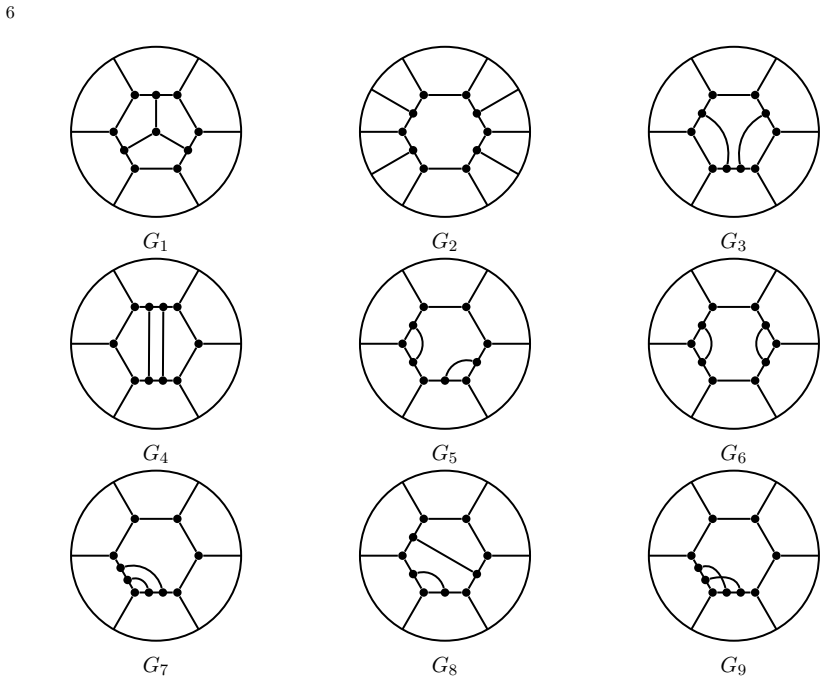
We define a matroid invariant called the three-cosystole and prove an optimal upper bound for it in the class of regular matroids of rank at most six. To accomplish this, we show that it is increasing under matroid extensions and then estimate it for each of the maximal simple regular matroids of rank at most six.
What carries the argument
The three-cosystole, a matroid invariant measuring a higher-order form of cogirth on weighted matroids, which is shown to be non-decreasing under extensions so that its maximum occurs among maximal simple examples.
If this is right
- The three-cosystole attains its maximum on the maximal simple regular matroids of each rank up to six.
- Explicit computation on those finitely many matroids determines the optimal upper bound.
- The same monotonicity argument applies to any matroid invariant that increases under extensions.
Where Pith is reading between the lines
- The monotonicity technique could be tested on four-cosystoles or on non-regular matroids to see whether similar bounds hold.
- If the three-cosystole relates to minimum weights in linear codes, the bound might translate into a concrete guarantee on code parameters for small-rank regular representations.
Load-bearing premise
The three-cosystole is non-decreasing under matroid extensions, allowing the maximum over all regular matroids of rank at most six to be attained on the maximal simple ones.
What would settle it
A regular matroid of rank at most six whose three-cosystole exceeds the value computed for its maximal simple extensions would disprove the claimed optimal bound.
Figures


read the original abstract
We define a matroid invariant called the three-cosystole that is related to higher notions of cogirth for weighted matroids, and we prove an optimal upper bound for it in the class of regular matroids of rank at most six. To accomplish this, we show that it is increasing under matroid extensions and then estimate it for each of the maximal simple regular matroids of rank at most six.
Editorial analysis
A structured set of objections, weighed in public.
Referee Report
Summary. The paper defines the three-cosystole, a matroid invariant extending higher cogirth notions to weighted matroids. It proves that the three-cosystole is non-decreasing under matroid extensions and uses this monotonicity to reduce the problem of finding its maximum value over all regular matroids of rank at most six to the computation on the finite list of maximal simple regular matroids of rank ≤6, thereby establishing an optimal upper bound.
Significance. If the monotonicity proof is complete and the enumeration of maximal matroids exhaustive, the result supplies a sharp, explicitly computed bound on a new invariant in a well-studied class. The reduction-to-maximal-objects strategy is efficient for bounded rank and may serve as a template for analogous results on higher cosystoles.
major comments (2)
- [§3] §3 (Monotonicity theorem): The proof that the three-cosystole is non-decreasing under single-element extensions must be checked against the precise definition of the invariant; if the three-cosystole is defined via a minimum over weighted 3-cocircuits, an extension that introduces a new low-weight cocircuit could decrease the value, contradicting the claimed monotonicity and invalidating the reduction to maximal matroids.
- [§4] §4 (Enumeration of maximal matroids): The completeness of the list of maximal simple regular matroids of rank ≤6 must be justified by reference to a known classification (e.g., via the regular matroid database or explicit generation); any missing matroid would mean the reported maximum is only a lower bound on the true supremum.
minor comments (2)
- [Definition 2.1] Definition 2.1: The precise formula for the three-cosystole (including how weights on cocircuits are aggregated) should be stated in a single displayed equation for easy reference.
- [Table 5] Table 5 (Computed values): Include the explicit three-cosystole value attained on each listed maximal matroid so that the claimed optimum can be directly verified.
Simulated Author's Rebuttal
We thank the referee for the detailed review and for highlighting these important points regarding the monotonicity proof and the enumeration of maximal matroids. We respond to each major comment below.
read point-by-point responses
-
Referee: [§3] §3 (Monotonicity theorem): The proof that the three-cosystole is non-decreasing under single-element extensions must be checked against the precise definition of the invariant; if the three-cosystole is defined via a minimum over weighted 3-cocircuits, an extension that introduces a new low-weight cocircuit could decrease the value, contradicting the claimed monotonicity and invalidating the reduction to maximal matroids.
Authors: We have carefully re-examined the definition of the three-cosystole and the proof of the monotonicity theorem in §3. The three-cosystole is indeed defined as the minimum weight of any 3-cocircuit, where the weight of a cocircuit is the sum of the weights of its elements (assuming positive real weights on the ground set). In a single-element extension by an element e with weight w(e) > 0, any new 3-cocircuit must contain e. Therefore, its weight is strictly greater than the weight of the corresponding cocircuit in the original matroid obtained by deleting e (or contracting, depending on the extension type). Consequently, the minimum cannot decrease, as all pre-existing 3-cocircuits remain with their original weights, and new ones have higher weights. The proof accounts for this by considering the possible types of extensions in regular matroids and verifying that no new low-weight 3-cocircuit can appear without a corresponding lower or equal weight one in the base matroid. We believe the proof is complete as written. revision: no
-
Referee: [§4] §4 (Enumeration of maximal matroids): The completeness of the list of maximal simple regular matroids of rank ≤6 must be justified by reference to a known classification (e.g., via the regular matroid database or explicit generation); any missing matroid would mean the reported maximum is only a lower bound on the true supremum.
Authors: We agree that the completeness of the list should be explicitly justified. In the revised manuscript, we will add a reference to the known classification of regular matroids of small rank, specifically citing the work on the enumeration of regular matroids or the database maintained in the literature on matroid theory (e.g., references to Oxley's work or computational classifications up to rank 6). This ensures that the list of maximal simple regular matroids of rank at most 6 is exhaustive, thereby confirming that our computed maximum is indeed the sharp upper bound. revision: yes
Circularity Check
No significant circularity; standard monotonicity reduction to finite check
full rationale
The derivation defines the three-cosystole, proves the non-decreasing property under extensions as an independent lemma, and then performs explicit evaluation only on the finite list of maximal simple regular matroids of rank ≤6. This is a self-contained proof strategy with no reduction of the bound to a fitted parameter, self-referential equation, or load-bearing self-citation chain. The monotonicity step and the case checks are logically prior to and independent of the final upper bound.
Axiom & Free-Parameter Ledger
axioms (2)
- standard math Matroids satisfy the standard independence axioms and extension operations preserve regularity when starting from a regular matroid.
- domain assumption The three-cosystole is non-decreasing under matroid extensions.
invented entities (1)
-
three-cosystole
no independent evidence
Lean theorems connected to this paper
-
IndisputableMonolith/Cost/FunctionalEquation.leanwashburn_uniqueness_aczel unclear?
unclearRelation between the paper passage and the cited Recognition theorem.
Theorem B (Monotonicity). Suppose M is a regular matroid. If e is an element... sys*_3(M) = sys*_3(si(M)).
What do these tags mean?
- matches
- The paper's claim is directly supported by a theorem in the formal canon.
- supports
- The theorem supports part of the paper's argument, but the paper may add assumptions or extra steps.
- extends
- The paper goes beyond the formal theorem; the theorem is a base layer rather than the whole result.
- uses
- The paper appears to rely on the theorem as machinery.
- contradicts
- The paper's claim conflicts with a theorem or certificate in the canon.
- unclear
- Pith found a possible connection, but the passage is too broad, indirect, or ambiguous to say the theorem truly supports the claim.
Reference graph
Works this paper leans on
-
[1]
Mohar, Bojan and Thomassen, Carsten , TITLE =
- [2]
- [3]
-
[4]
Archdeacon, Dan , TITLE =. J. Graph Theory , FJOURNAL =. 1981 , NUMBER =. doi:10.1002/jgt.3190050305 , URL =
-
[5]
Glover, Henry H. and Huneke, John P. and Wang, Chin San , TITLE =. J. Combin. Theory Ser. B , FJOURNAL =. 1979 , NUMBER =. doi:10.1016/0095-8956(79)90022-4 , URL =
-
[6]
J Graph Theory , year = 2008, volume = 57, pages =
Maharry, John , title =. J Graph Theory , year = 2008, volume = 57, pages =
work page 2008
-
[7]
Welsh, D. J. A. , TITLE =. Handbook of combinatorics,. 1995 , MRCLASS =
work page 1995
-
[8]
P.D. Seymour , FAUTHOR =. Decomposition of regular matroids , JOURNAL =. 1980 , NUMBER =. doi:10.1016/0095-8956(80)90075-1 , URL =
-
[9]
Seymour, P. D. , TITLE =. Handbook of combinatorics,. 1995 , MRCLASS =
work page 1995
-
[10]
Oxford University Press, 2002.doi:10
Oxley, James , TITLE =. 2011 , PAGES =. doi:10.1093/acprof:oso/9780198566946.001.0001 , URL =
work page doi:10.1093/acprof:oso/9780198566946.001.0001 2011
- [11]
-
[12]
J.F. Adams. On the non-existence of elements of Hopf invariant one. Ann. of Math. 1960
work page 1960
-
[13]
J. Adem. The iteration of the Steenrod squares in algebraic topology. Proc. Nat. Acad. Sci. USA. 1952
work page 1952
-
[14]
P. Albin and J. Gell-Redman , FAUTHOR =. The index of. SIGMA Symmetry Integrability Geom. Methods Appl. , FJOURNAL =. 2016 , PAGES =. doi:10.3842/SIGMA.2016.089 , URL =
-
[15]
C. Allday and V. Puppe. Cohomological methods in transformation groups. 1993
work page 1993
-
[16]
S. Aloff and N.R. Wallach , FAUTHOR =. An infinite family of distinct. Bull. Amer. Math. Soc. , FJOURNAL =. 1975 , PAGES =. doi:10.1090/S0002-9904-1975-13649-4 , URL =
-
[17]
M. Amann. preprint , volume =
-
[18]
M. Amann and L. Kennard , TITLE =. Geom. Funct. Anal. , FJOURNAL =. 2014 , NUMBER =. doi:10.1007/s00039-014-0300-9 , URL =
- [19]
-
[20]
M. Amann and L. Kennard , FAUTHOR =. On a generalized conjecture of. Compos. Math. , FJOURNAL =. 2017 , NUMBER =. doi:10.1112/S0010437X16008150 , URL =
-
[21]
D. An and P. Nurwoski , FAUTHOR =. Twistor space for rolling bodies , JOURNAL =. 2014 , NUMBER =. doi:10.1007/s00220-013-1839-2 , URL =
-
[22]
B. Andrews , FAUTHOR =. Gauss curvature flow: the fate of the rolling stones , JOURNAL =. 1999 , NUMBER =. doi:10.1007/s002220050344 , URL =
-
[23]
M. Amann and L. Kennard , FAUTHOR =. Positive curvature and symmetry in small dimensions , JOURNAL =. 2020 , NUMBER =. doi:10.1142/S0219199719500536 , URL =
-
[24]
S. Arakai and Y. Shikata. Cohomology mod 2 of the compact exceptional group E_8. Proc. Japan Acad. Ser. A Math. Sci. 1961
work page 1961
-
[25]
R.M. Arroyo and R.A. Lafuente , FAUTHOR =. The. Math. Ann. , FJOURNAL =. 2017 , NUMBER =. doi:10.1007/s00208-016-1386-1 , URL =
-
[26]
T. Asoh , journal =. Compact transformation groups on _2 --cohomology spheres with orbit of codimension 1. 1981 , pages =
work page 1981
- [27]
-
[28]
L. Astey and E. Micha and G. Pastor , FAUTHOR =. Homeomorphism and diffeomorphism types of. Differential Geom. Appl. , FJOURNAL =. 1997 , NUMBER =. doi:10.1016/S0926-2245(96)00034-4 , URL =
-
[29]
M.F. Atiyah and I.M. Singer , FAUTHOR =. The index of elliptic operators. Ann. of Math. (2) , FJOURNAL =. 1968 , PAGES =. doi:10.2307/1970717 , URL =
-
[30]
C. B\". Real. Comm. Math. Phys. , FJOURNAL =. 1993 , NUMBER =
work page 1993
-
[31]
V. Bangert. On the existence of closed geodesics on two-spheres. Internat. J. Math. 1993
work page 1993
-
[32]
J. Barge and J. Lannes and F. Latour and P. Vogel , FAUTHOR =. Ann. Sci. \'Ecole Norm. Sup. (4) , FJOURNAL =. 1974 , PAGES =
work page 1974
-
[33]
J. Barge , FAUTHOR =. Structures diff\'erentiables sur les types d'homotopie rationnelle simplement connexes , JOURNAL =. 1976 , NUMBER =
work page 1976
-
[34]
Y.V. Baza. On a family of. Sibirsk. Mat. Zh. , FJOURNAL =. 1996 , NUMBER =. doi:10.1007/BF02106732 , URL =
- [35]
-
[36]
L. Berard-Bergery , TITLE =. J. Math. Pures Appl. (9) , VOLUME =. 1976 , NUMBER =
work page 1976
-
[37]
M. Berger. Les vari\'et\'es riemanniennes homog\`enes normales simplement connexes \`a courbure strictement positive. Ann. Scuola Norm. Sup. Pisa. 1961
work page 1961
-
[38]
M. Berger. Trois remarques sur les vari\'et\'es riemanniennes \`a courbure positive. C. R. Math. Acad. Sci. Paris. 1966
work page 1966
-
[39]
M. Berger. Riemannian geometry during the second half of the twentieth century. 1998
work page 1998
-
[40]
M. Berger , FAUTHOR =. A panoramic view of. 2003 , PAGES =. doi:10.1007/978-3-642-18245-7 , URL =
-
[41]
M. Berger , TITLE =. 2010 , PAGES =. doi:10.1007/978-3-540-70997-8 , URL =
-
[42]
Y. Bernard and T. Rivi\`. Energy quantization for. Ann. of Math. (2) , FJOURNAL =. 2014 , NUMBER =. doi:10.4007/annals.2014.180.1.2 , URL =
-
[43]
A.L. Besse. Einstein Manifolds. 2008
work page 2008
-
[44]
R.G. Bettiol , TITLE =. Asian J. Math. , FJOURNAL =. 2017 , NUMBER =. doi:10.4310/AJM.2017.v21.n2.a7 , URL =
-
[45]
R.G. Bettiol and R.A.E. Mendes , FAUTHOR =. Flag manifolds with strongly positive curvature , JOURNAL =. 2015 , NUMBER =. doi:10.1007/s00209-015-1464-1 , URL =
-
[46]
R.L. Bishop and S.I. Goldberg. Some implications of the generalized Gauss-Bonnet theorem. Trans. Amer. Math. Soc. 1964
work page 1964
-
[47]
C. B\". Immortal homogeneous. Invent. Math. , FJOURNAL =. 2018 , NUMBER =. doi:10.1007/s00222-017-0771-z , URL =
-
[48]
C. B\"ohm and B. Wilking , FAUTHOR =. Manifolds with positive curvature operators are space forms , JOURNAL =. 2008 , NUMBER =. doi:10.4007/annals.2008.167.1079 , URL =
-
[49]
B. Bollob\'. Girth of sparse graphs , JOURNAL =. 2002 , NUMBER =. doi:10.1002/jgt.10023 , URL =
-
[50]
A. Borel. Sur la cohomologie des espaces fibres principaux et des espaces homogenes de groupes de Lie compacts. Ann. of Math. 1953
work page 1953
-
[51]
G.E. Bredon , FAUTHOR =. The cohomology ring structure of a fixed point set , JOURNAL =. 1964 , PAGES =. doi:10.2307/1970661 , URL =
-
[52]
G.E. Bredon. Introduction to compact transformation groups. 1972
work page 1972
-
[53]
S. Brendle and R. Schoen , FAUTHOR =. Manifolds with. J. Amer. Math. Soc. , FJOURNAL =. 2009 , NUMBER =. doi:10.1090/S0894-0347-08-00613-9 , URL =
-
[54]
A. Borel , FAUTHOR =. Some remarks about. Bull. Amer. Math. Soc. , FJOURNAL =. 1949 , PAGES =
work page 1949
-
[55]
A. Borel. Seminar on transformation groups. Ann. of Math. Stud. 1960
work page 1960
-
[56]
W. Browder , TITLE =. Trans. Amer. Math. Soc. , VOLUME =. 1963 , PAGES =
work page 1963
-
[57]
W. Browder and W. Hsiang. Some problems on homotopy theory, manifolds, and transformation groups. Proc. Sympos. Pure Math.: Algebraic and Geometric Topology, Part 2. 1978
work page 1978
-
[58]
E.H. Brown and F.P. Peterson. Whitehead products and cohomology operations. Quart. J. Math. Oxford. 1964
work page 1964
-
[59]
Metrics with exceptional holonomy,
R.L. Bryant , FAUTHOR =. Metrics with exceptional holonomy , JOURNAL =. 1987 , NUMBER =. doi:10.2307/1971360 , URL =
-
[60]
R.L. Bryant , FAUTHOR =. Some remarks on. Proceedings of. 2006 , MRCLASS =
work page 2006
-
[61]
R.L. Bryant and L. Hsu , FAUTHOR =. Rigidity of integral curves of rank. Invent. Math. , FJOURNAL =. 1993 , NUMBER =. doi:10.1007/BF01232676 , URL =
-
[62]
On the construction of some complete metrics with exceptional holonomy,
R.L. Bryant and S.M. Salamon , FAUTHOR =. On the construction of some complete metrics with exceptional holonomy , JOURNAL =. 1989 , NUMBER =. doi:10.1215/S0012-7094-89-05839-0 , URL =
-
[63]
D. Burago and S. Ivanov , FAUTHOR =. Riemannian tori without conjugate points are flat , JOURNAL =. 1994 , NUMBER =. doi:10.1007/BF01896241 , URL =
- [64]
-
[65]
M. Cahen and S. Gutt , FAUTHOR =. Spin structures on compact simply connected. Simon Stevin , FJOURNAL =. 1988 , NUMBER =
work page 1988
-
[66]
T. Chang and T. Skjelbred , FAUTHOR =. The topological. Ann. of Math. (2) , FJOURNAL =. 1974 , PAGES =. doi:10.2307/1971074 , URL =
-
[67]
T. Chang and T. Skjelbred , FAUTHOR =. Lie group actions on a. Amer. J. Math. , FJOURNAL =. 1976 , NUMBER =
work page 1976
-
[68]
J. Cheeger , FAUTHOR =. Some examples of manifolds of nonnegative curvature , JOURNAL =. 1973 , PAGES =
work page 1973
-
[69]
J. Cheeger and D. Gromoll , TITLE =. Ann. of Math. (2) , VOLUME =. 1972 , PAGES =
work page 1972
-
[70]
H. Chen , FAUTHOR =. Pointwise. Ann. Global Anal. Geom. , FJOURNAL =. 1991 , NUMBER =. doi:10.1007/BF00776854 , URL =
- [71]
-
[72]
X. Chen and P. Lu and G. Tian , TITLE =. Proc. Amer. Math. Soc. , VOLUME =. 2006 , NUMBER =
work page 2006
-
[73]
S.-S. Chern. On the curvature and characteristic classes of a Riemannian manifold. Abh. Math. Semin. Univ. Hambg. 1956
work page 1956
-
[74]
J.J. Cho and Y. Chen and Y. Ding , FAUTHOR =. On the (co)girth of a connected matroid , JOURNAL =. 2007 , NUMBER =. doi:10.1016/j.dam.2007.06.015 , URL =
-
[75]
L. Conlon. On the topology of EIII and EIV. Proc. Amer. Math. Soc. 1965
work page 1965
-
[76]
P.E. Conner. On the action of the circle group. Michigan Math. J. 1957
work page 1957
-
[77]
D. Cooper and D.D. Long , journal=. Free actions of finite groups on rational homology 3-spheres
-
[78]
O. Cornea and G. Lupton and J. Oprea and D. Tanr \'e. Lusternik-Schnirelmann category. 2003
work page 2003
- [79]
-
[80]
Crenshaw, Cameron and Oxley, James , TITLE =. Adv. in Appl. Math. , FJOURNAL =. 2023 , PAGES =. doi:10.1016/j.aam.2023.102515 , URL =
discussion (0)
Sign in with ORCID, Apple, or X to comment. Anyone can read and Pith papers without signing in.