REVIEW 6 major objections 5 minor 1 cited by
On Fairness of Unified Multimodal Large Language Model for Image Generation
T0 review · 6 major / 5 minor · reviewed 2026-08-09 · deepseek-v4-flash
Pith's one-line read The paper claims that demographic bias in unified multimodal LLM image generation originates mostly in the language model's token predictions, and that a balanced preference loss reduces VILA-U gender bias from 0.89 to 0.25 while…
desk verdict Useful first bias benchmark for U-MLLMs, but the localization and mitigation claims rest on unvalidated labels and a flawed understanding protocol. read the letter →
The pith
A machine-rendered reading of the paper's core claim, the machinery that carries it, and where it could break.
The reading
What carries the argument
Two mechanisms carry the argument. The first is the bias-localization audit: using Jensen-Shannon divergence to compare the empirical distribution over image tokens sampled for a neutral prompt with the distribution for demographic-augmented prompts; the close match between neutral and majority-demographic distributions is the evidence that bias lives in token generation. The second is the balanced preference loss, $L_{\mathrm{bal}}(\theta)=\log\left[1+\left(\sigma\left(\log \mathrm{OR}_\theta(y_{d_i},y_{d_j})\right)-\frac12\right)^2\right]$ summed over demographic pairs, where $\mathrm{OR}_\theta$ is the odds ratio of the model's probability of generating one demographic variant over another. This loss penalizes any pair whose preference probability deviates from $1/2$, so it drives the policy toward equal likelihood across demographics; it is applied after a supervised finetuning stage, with LoRA for parameter-efficient updates.
What would settle it
Generate 100 images from FLUX.1-dev for prompts like "a photo of an Asian nurse" and ask human raters to label the gender and ethnicity actually depicted; if the diffusion model rarely renders the requested attribute, the training pairs are mislabeled and the balanced preference loss is optimizing on the wrong demographic groups. A second check is to replace the pretrained attribute classifier in the evaluation with human-annotated demographic labels for the same generated images and recompute representation disparity; if the disparity scores diverge sharply, the reported reductions may be classifier artifacts rather than true demographic balance.
Extended reading notes
Core claim
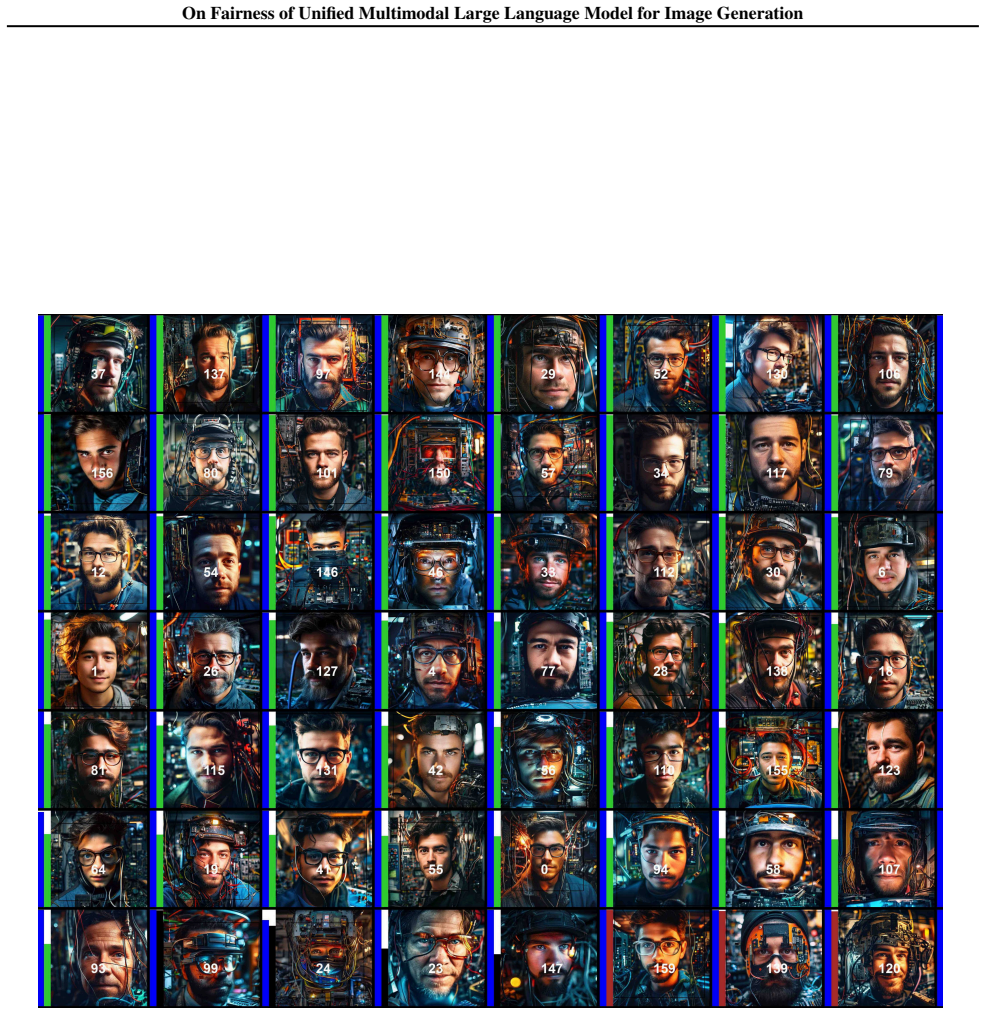
The central claim on the paper's own terms is that demographic bias in U-MLLM text-to-image generation originates primarily in the language model's autoregressive distribution over image tokens, not in the vision encoder or decoder that turns images into and out of those tokens. The supporting analysis compares empirical token distributions: for a neutral prompt such as "a photo of a firefighter", the distribution over image tokens is far closer to that of "a photo of a male firefighter" than to "a photo of a female firefighter", matching the majority demographic actually generated. The paper further claims that its balanced preference loss reduces that skew: VILA-U's gender representation disparity falls from 0.89 to 0.25 and its inception score rises to 2.10, with similar but smaller gains for race and intersectional bias while CLIP-based semantic alignment remains essentially flat. It also reports a "partial alignment" phenomenon: models with low or guarded understanding bias can still generate heavily skewed images, and finetuning for understanding does not reduce generation bias.
Load-bearing premise
The whole mitigation chain assumes that the diffusion model used to create the synthetic training images actually depicts the demographic attribute written in the prompt, since each image is labeled by its prompt with no classifier or human check.
Editorial extensions
If this is right
- For VILA-U, gender bias falls from 0.89 to 0.25 (a 71.91% reduction) while the inception score rises from 1.87 to 2.10, indicating that demographic balancing need not cost image quality on this model.
- Race debiasing on VILA-U reduces race bias from 0.48 to 0.26 and improves the inception score to 2.31, while the combined gender-race bias drops to 0.15.
- Finetuning the same balanced data in the image-to-text (understanding) direction does not reduce generation bias, so understanding-level debiasing does not carry over to generation.
- The same two-stage protocol applied to TokenFlow lowers its gender bias from 0.84 to 0.55, suggesting the approach transfers to other U-MLLMs.
- Because the bias is localized to image-token generation, model builders can target the language model's conditional distribution over those tokens rather than replacing the vision tokenizer.
Reading between the lines
- If the localization result holds, decoding-time interventions that steer the language model's image-token distribution toward uniform demographic likelihood could debias generation without any finetuning; the paper does not test this.
- The method's effectiveness is bounded by the demographic fidelity of the synthetic-data generator, so as diffusion models improve, the training signal should improve as well—and a diffusion generator with its own biases would cap the achievable fairness.
- A testable extension is measuring whether the balanced policy generalizes to occupation prompts outside the 50 used for evaluation and to finer-grained groups such as age or religion, both listed by the paper as future work.
- Because the evaluation labels come from a pretrained classifier, human-annotation studies of the debiased model's outputs would decide how much of the reported reduction is real demographic balance rather than classifier agreement.
Editorial analysis
A structured set of objections, weighed in public.
Referee Report
Summary. This paper studies demographic bias (gender and race) in unified multimodal large language models (U-MLLMs) for text-to-image generation. It benchmarks six recent U-MLLMs using a classifier-based representation disparity metric, proposes a 'locate-then-fix' strategy in which bias is attributed to the language model via linear probing of vision-encoder embeddings and Jensen-Shannon divergence between image-token distributions, and introduces a balanced preference optimization (BPO) loss that encourages equal likelihood of images from different demographic groups during fine-tuning on synthetic FLUX.1-dev data. Experiments on VILA-U and TokenFlow report substantial bias reductions (e.g., VILA-U gender bias from 0.89 to 0.25) with modest effects on CLIP scores and inception score.
Significance. If the results are reproducible, the paper provides one of the first systematic fairness audits of U-MLLMs and a practical debiasing method for autoregressive token-based generation. The benchmark across six models is a useful contribution, and the balanced-preference-loss idea is simple and clearly described in Algorithm 1. The paper also explicitly acknowledges limitations in Appendix F, including the focus on overt demographic categories and the limited number of open-source models tested. However, the wide adoption of this method is contingent on the evaluation being robust to label noise and sampling variability, which the current manuscript does not demonstrate.
major comments (6)
- [Section 3.2] The JSD-based localization argument is not well-defined as written. The empirical token distribution is defined in Eq. (3) as 1/M times a sum of delta functions over full token sequences; for long image token sequences, two independently sampled sets will almost surely have disjoint support, in which case the JSD equals log 2 for every comparison and the claim that 'the JSD ... is significantly smaller' when the prompt matches the predicted demographic is vacuous. The authors need to specify a meaningful distribution (e.g., over individual token positions or a smoothed n-gram distribution) and report actual JSD values with variance or a significance test.
- [Section 4.1 and Section 5.1] The entire debiasing evaluation rests on two unvalidated labeling steps: the synthetic training images are labeled with the demographic attribute inserted into the FLUX.1-dev prompt, with no check that the image actually depicts that attribute, and the demographic classifier from Shen et al. (2024) is applied to generated images without reporting its accuracy on U-MLLM outputs or on the synthetic images. If FLUX misrenders modifiers or the classifier is biased on debiased outputs, the bias reductions in Table 1 could be artifacts of label noise. Please add a validation of the synthetic labels (human or classifier) and report the classifier's accuracy on the evaluated model outputs.
- [Section 5.2, Table 1] Table 1 reports single point estimates of RD with no confidence intervals, standard errors, or significance tests. Given that each prompt is sampled with N=160 generations, the variability across the 50 prompts is likely to be substantial; for instance, comparisons such as Finetune(T→I) gender bias 0.27 vs. BPO 0.25 are within plausible sampling noise. The authors should report bias over seeds or bootstrap intervals, and test whether the differences between BPO and SFT baselines are statistically significant.
- [Section 5.2, Table 1] The claim that the approach preserves semantic fidelity is only partially supported. For BPO in the Gender block, CLIP-S drops from 28.24 (VILA-U) to 27.74 and CLIP-IQA from 0.84 to 0.77, while IS increases. The paper should discuss this trade-off explicitly rather than asserting that quality is preserved, and the choice of which quality metric is most appropriate for token-based generation should be justified.
- [Section 5.3] The understanding-bias protocol is not a valid measure of visual understanding: it feeds an 'empty image' and asks the model to answer 'What is the gender of {occupation}?' This measures the language model's prior, not the model's multimodal understanding. The 'partial alignment' conclusion (e.g., Janus shows low understanding bias but high generation bias) is therefore not established. Either use a proper image-understanding task (e.g., caption or VQA on images with known demographic attributes) or frame the result as a comparison of language-prior bias versus generation bias.
- [Section 5.1] It is not stated whether the 50 evaluation prompts are disjoint from the 1,000 training prompts. If they overlap, the finetuning results could reflect memorization of the test prompts. The authors should state the proportion of overlap or make the split explicit.
minor comments (5)
- [Abstract and Section 1] There are several typos and grammatical errors, such as 'we audit show how' in the abstract, 'obatin' in Section 4.1, and 'Qualitive' in Section 5.3; these should be corrected.
- [Algorithm 1, line 11] The notation L^{(d_{k-1}, d_k)}_{bal} is inconsistent with the pairwise definition in Eq. (10); it should be written as a sum over all pairs (d_k, d_l) with k < l.
- [Section 5.1] The bias(P) formula uses a pairwise average of absolute frequency differences; please cite the exact metric from Shen et al. (2024) and clarify whether this is their 'representation disparity' metric.
- [Section 4.1] The use of ChatGPT-4o for paraphrasing is not reproducible without a list of paraphrases or a fixed seed; provide the paraphrased prompts or include them in a supplement.
- [Figure 4] The y-axis label 'Bias Score' and the legend are present, but no numbers are given; the finding that 'most models exhibit a pronounced understanding bias' is not supported by the figure as printed.
Circularity Check
No significant circularity: the benchmark, bias localization, and mitigation results are empirical and do not reduce to their own inputs by construction.
full rationale
The paper's three load-bearing claims are each supported by independent empirical procedures rather than by definitional equivalence or self-citation. First, the demographic bias benchmark is measured with an external attribute classifier from Shen et al. (2024) and external U-MLLMs, so the reported bias scores are observations, not derived quantities. Second, the claim that bias originates primarily from the language model is supported by a Jensen-Shannon divergence comparison between token distributions for neutral and demographic-augmented prompts; this is an observational localization step, and while the choice of grouping by the classifier's predicted label makes the 'majority group has smallest JSD' finding partly descriptive, it is not a fitted identity or a renamed input. Third, the balanced preference loss (Eq. 10) is designed to equalize demographic likelihoods, and the evaluation metric measures demographic frequency, so the training objective is intentionally aligned with the evaluation goal; however, the evaluation is performed on held-out prompts and compares against multiple baselines, so the reported bias reduction is an empirical generalization result rather than a quantity forced by construction. The paper contains a self-citation (Chen et al., 2024) used as background for the existence of bias in training data, but that citation is not load-bearing for any derivation. The unvalidated demographic labeling of synthetic images and the lack of reported classifier accuracy are validity concerns for correctness, not circularity, because the paper never derives a prediction from those labels in a way that makes the conclusion equivalent to the input. Overall, no circular step with quoted text and a specific reduction can be exhibited.
Assumptions & free parameters
free parameters (1)
- Trade-off parameter lambda (Algorithm 1) =
Not reported
assumptions (5)
- domain assumption The demographic classifier from Shen et al. (2024) correctly labels generated images.
- domain assumption An unbiased model should generate a uniform distribution of demographic groups.
- domain assumption FLUX.1-dev renders the demographic attribute specified in the augmented prompt.
- domain assumption High linear-probing accuracy on vision embeddings implies the vision encoder is not a source of generation bias.
- domain assumption Empty-image responses to demographic questions measure understanding bias.
Cite this review
Pith. "Pith review of On Fairness of Unified Multimodal Large Language Model for Image Generation." pith.science (2026). https://pith.science/paper/SK2CPNOF
@misc{pith2026250203429,
  author       = {Pith},
  title        = {Pith review of: On Fairness of Unified Multimodal Large Language Model for Image Generation},
  year         = {2026},
  howpublished = {\url{https://pith.science/paper/SK2CPNOF}},
  note         = {Machine review of arXiv:2502.03429}
}
read the original abstract
Unified multimodal large language models (U-MLLMs) have demonstrated impressive performance in visual understanding and generation in an end-to-end pipeline. Compared with generation-only models (e.g., Stable Diffusion), U-MLLMs may raise new questions about bias in their outputs, which can be affected by their unified capabilities. This gap is particularly concerning given the under-explored risk of propagating harmful stereotypes. In this paper, we benchmark the latest U-MLLMs and find that most exhibit significant demographic biases, such as gender and race bias. To better understand and mitigate this issue, we propose a locate-then-fix strategy, where we audit and show how the individual model component is affected by bias. Our analysis shows that bias originates primarily from the language model. More interestingly, we observe a "partial alignment" phenomenon in U-MLLMs, where understanding bias appears minimal, but generation bias remains substantial. Thus, we propose a novel balanced preference model to balance the demographic distribution with synthetic data. Experiments demonstrate that our approach reduces demographic bias while preserving semantic fidelity. We hope our findings underscore the need for more holistic interpretation and debiasing strategies of U-MLLMs in the future.
Figures


Figures from the paper (10 more)


Forward citations
Cited by 1 Pith paper
-
Bias Analysis in Unconditional Image Generative Models
In unconditional image generators, measured attribute bias shifts are small and are strongly influenced by whether the attribute classifier's decision boundary falls in a dense or sparse region of the attribute's dist...
Reference graph
Works this paper leans on
-
[1]
Direct pref- erence optimization with an offset
Amini, A., Vieira, T., and Cotterell, R. Direct pref- erence optimization with an offset. arXiv preprint arXiv:2402.10571,
-
[5]
URL https://arxiv.org/abs/ 2302.00070. Elazar, Y ., Bhagia, A., Magnusson, I., Ravichander, A., Schwenk, D., Suhr, A., Walsh, P., Groeneveld, D., Sol- daini, L., Singh, S., et al. What’s in my big data? arXiv preprint arXiv:2310.20707,
-
[7]
Hong, J., Lee, N., and Thorne, J
URL https://arxiv.org/abs/2308.14761. Hong, J., Lee, N., and Thorne, J. Orpo: Monolithic prefer- ence optimization without reference model,
-
[8]
URL https://arxiv.org/abs/2403.07691. Hu, E. J., Shen, Y ., Wallis, P., Allen-Zhu, Z., Li, Y ., Wang, S., Wang, L., and Chen, W. Lora: Low-rank adaptation of large language models,
-
[11]
Li, C., Chen, M., Wang, J., Sitaram, S., and Xie, X
URL https://arxiv.org/ abs/2411.16318. Li, C., Chen, M., Wang, J., Sitaram, S., and Xie, X. Cul- turellm: Incorporating cultural differences into large lan- guage models. arXiv preprint arXiv:2402.10946, 2024a. Li, C., Teney, D., Yang, L., Wen, Q., Xie, X., and Wang, J. Culturepark: Boosting cross-cultural understanding in large language models. arXiv pre...
-
[12]
Ouyang, L., Wu, J., Jiang, X., Almeida, D., Wainwright, C
URL https://arxiv.org/abs/2405.14734. Ouyang, L., Wu, J., Jiang, X., Almeida, D., Wainwright, C. L., Mishkin, P., Zhang, C., Agarwal, S., Slama, K., Ray, A., Schulman, J., Hilton, J., Kelton, F., Miller, L., Simens, M., Askell, A., Welinder, P., Christiano, P., Leike, J., and Lowe, R. Training language models to follow instructions with human feedback,
-
[13]
Park, R., Rafailov, R., Ermon, S., and Finn, C
URL https: //arxiv.org/abs/2203.02155. Park, R., Rafailov, R., Ermon, S., and Finn, C. Disentan- gling length from quality in direct preference optimiza- tion,
-
[14]
URL https://arxiv.org/abs/2403. 19159. Qu, L., Zhang, H., Liu, Y ., Wang, X., Jiang, Y ., Gao, Y ., Ye, H., Du, D. K., Yuan, Z., and Wu, X. Tokenflow: Unified image tokenizer for multimodal understanding and generation. arXiv preprint arXiv:2412.03069,
Show all 18 references
-
[15]
Tong, S., Fan, D., Zhu, J., Xiong, Y ., Chen, X., Sinha, K., Rabbat, M., LeCun, Y ., Xie, S., and Liu, Z
URL https://arxiv.org/abs/ 2311.07604. Tong, S., Fan, D., Zhu, J., Xiong, Y ., Chen, X., Sinha, K., Rabbat, M., LeCun, Y ., Xie, S., and Liu, Z. Metamorph: Multimodal understanding and generation via instruc- tion tuning,
-
[16]
Wang, P., Bai, S., Tan, S., Wang, S., Fan, Z., Bai, J., Chen, K., Liu, X., Wang, J., Ge, W., Fan, Y ., Dang, K., Du, M., Ren, X., Men, R., Liu, D., Zhou, C., Zhou, J., and Lin, J
URL https://arxiv.org/abs/ 2412.14164. Wang, P., Bai, S., Tan, S., Wang, S., Fan, Z., Bai, J., Chen, K., Liu, X., Wang, J., Ge, W., Fan, Y ., Dang, K., Du, M., Ren, X., Men, R., Liu, D., Zhou, C., Zhou, J., and Lin, J. Qwen2-vl: Enhancing vision-language model’s perception of ...
-
[17]
Transfusion: Predict the next token and dif- fuse images with one multi-modal model
Zhou, C., Yu, L., Babu, A., Tirumala, K., Yasunaga, M., Shamis, L., Kahn, J., Ma, X., Zettlemoyer, L., and Levy, O. Transfusion: Predict the next token and dif- fuse images with one multi-modal model. arXiv preprint arXiv:2408.11039,
-
[18]
Since then, numerous new loss functions have been proposed (Meng et al., 2024; Park et al., 2024; Hong et al., 2024; Ethayarajh et al., 2024; Azar et al., 2023)
has emerged as a promising technique to address biases in machine learning models, especially LLM. Since then, numerous new loss functions have been proposed (Meng et al., 2024; Park et al., 2024; Hong et al., 2024; Ethayarajh et al., 2024; Azar et al., 2023). Recent advances ...
2024
-
[1952]
Chen, H., Raj, B., Xie, X., and Wang, J
URL https: //api.semanticscholar.org/CorpusID: 125209808. Chen, H., Raj, B., Xie, X., and Wang, J. On catastrophic inheritance of large foundation models. arXiv preprint arXiv:2402.01909,
-
[2019]
URL https: //arxiv.org/abs/1908.04913. Labs, B. F. Flux. https://github.com/ black-forest-labs/flux,
1908 arXiv
-
[2021]
org/abs/2106.09685
URL https://arxiv. org/abs/2106.09685. Kim, Y ., Na, B., Park, M., Jang, J., Kim, D., Kang, W., and Moon, I.-C. Training unbiased diffusion models from biased dataset. In The Twelfth International Conference on Learning Representations,
-
[2022]
Bradley, R
URL https://arxiv.org/abs/2210.15230. Bradley, R. A. and Terry, M. E. Rank analysis of incomplete block designs: I. the method of paired comparisons. Biometrika, 39:324,
-
[2023]
Bachmann, R., Kar, O
URL https://arxiv.org/abs/ 2310.12036. Bachmann, R., Kar, O. F., Mizrahi, D., Garjani, A., Gao, M., Griffiths, D., Hu, J., Dehghan, A., and Zamir, A. 4m-21: An any-to-any vision model for tens of tasks and modalities. arXiv preprint arXiv:2406.09406,
-
[2024]
Gandikota, R., Orgad, H., Belinkov, Y ., Materzy´nska, J., and Bau, D
URL https://arxiv.org/abs/ 2402.01306. Gandikota, R., Orgad, H., Belinkov, Y ., Materzy´nska, J., and Bau, D. Unified concept editing in diffusion models,
Reviewed August 9, 2026 · model on record in the stance chip above.
Discussion (0). Continue with ORCID to comment.