REVIEW 3 major objections 6 minor 44 references
TGOSPA Metric Parameters Selection and Evaluation for Visual Multi-object Tracking
T0 review · 3 major / 6 minor · reviewed 2026-08-11 · deepseek-v4-flash
Pith's one-line read A distance threshold or minimum duration sets the TGOSPA track-switch penalty.
desk verdict Useful parameter-selection rules for TGOSPA, honestly bounded but empirically thin where it matters most: the switch-calibration claim is proven only in a toy scenario. read the letter →
The pith
A machine-rendered reading of the paper's core claim, the machinery that carries it, and where it could break.
The reading
What carries the argument
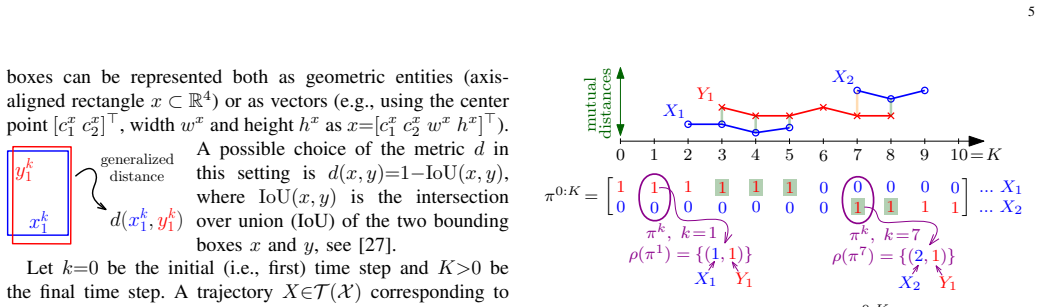
The carrying object is the TGOSPA metric $d^{(c,\gamma)}_p$ (Definition 1), a metric between finite sets of discrete-time trajectories that minimizes over time-indexed assignment vectors and decomposes (equation 14) into a localization term, a missed-objects term, a false-alarms term, and a switch term. The parameter-selection rules are produced by equating the cost of a no-switch assignment with the cost of a switch assignment in a simplified two-trajectory, one-estimate scenario; the equality gives closed-form formulas for $\gamma$ in terms of $g_1$ or $n$. Because exact TGOSPA is NP-hard, the numerical evaluations use the LP relaxation from [16], which is itself a metric and agreed with exact TGOSPA in all cases tested in the paper.
What would settle it
Construct the exact two-trajectory scenario, set $\gamma$ by (19) for a fixed $g_1$, and vary the wrong-track distance $d$ around $g_1$: the optimal TGOSPA assignment should flip from no switch to two switches exactly at $d = g_1$; if the boundary shifts when a third trajectory is added or when $c$ is enlarged, the threshold interpretation is refuted.
Extended reading notes
Core claim
The central claim is that the TGOSPA switching penalty $\gamma$ can be set through threshold distances. In a scenario where one estimate briefly tracks the wrong ground-truth trajectory, TGOSPA counts the episode as two switches exactly when $\gamma < ((c^p - d^p)/2)^{1/p}$, where $d$ is the estimate's distance to the wrong trajectory at the switched time step; hence a user-provided threshold $g_1$ yields $\gamma = ((c^p - g_1^p)/2)^{1/p}$. For permanent changes, TGOSPA counts the change as one switch when $\gamma < (\ell c^p - \sum d_k^p)^{1/p}$, and setting $\gamma = n^{1/p} c$ guarantees that changes lasting at most $n$ time steps are ignored. The authors validate the interpretation on a two-pedestrian occlusion segment of MOT17-09, show that different $\gamma$ choices reorder BoT SORT and Tracktor++v2, and propose the three recommended setups. They further show that HOTA and $1 - \text{HOTA}$ violate the metric axioms, and that the TGOSPA decomposition into localization, missed, false, and switch terms gives reasons for algorithm orderings that CV scores cannot provide.
Load-bearing premise
The load-bearing assumption is that the two-trajectory, one-estimate derivation describes real scenes: the estimate is correctly assigned before the change, the wrong-track distance at the change is below the relevant threshold, and no third trajectory competes for the assignment; the paper itself flags that this interpretation is no longer valid with more trajectories or larger $c$, and its Observation 11 records a real BoT SORT case where the predicted threshold does not hold.
Editorial extensions
If this is right
- Users can replace the opaque switching penalty $\gamma$ with a distance tolerance $g_1$ or a minimum switch duration $n$, making evaluation results interpretable before the metric is computed.
- Setting $\gamma = n^{1/p} c$ implements 'ignore switches shorter than $n+1$ time steps' as a hard specification, which is directly relevant for scene-understanding applications that only care about long track fragmentations.
- Detector training should use $\gamma = 0$, because with any positive $\gamma$ the temporary disconnections of a per-frame detector are counted as switches and the detector ranking becomes misleading.
- The three recommended parameter triples produce different orderings of the same trackers, so application-specific scoring is not cosmetic: the same algorithm can be the right choice for online surveillance and the wrong choice for offline scene understanding under TGOSPA.
Reading between the lines
- My inference (not the paper's claim): in crowded scenes the effective threshold will be stricter than $g_1$ because nearby third trajectories compete for the same assignment; a practical workaround would be to set $g_1$ from the observed distribution of inter-object distances and verify switch counts on validation data.
- A testable extension the paper does not pursue: use the same cost-equality argument to derive thresholds for other event types, such as a track that splits into two estimates for a few frames, rather than only for temporary or permanent switches.
- Since the paper's $\gamma = 0$ case reduces TGOSPA to per-frame GOSPA and forfeits the metric property, any use of TGOSPA as a true metric between two algorithms' outputs requires a positive switching penalty; this makes the parameter-selection rules not just a convenience but a prerequisite for the metric interpretation.
Editorial analysis
A structured set of objections, weighed in public.
Referee Report
Summary. The paper introduces the TGOSPA metric to computer-vision multi-object tracking evaluation, argues that common CV scores such as HOTA and 1−HOTA are not mathematical metrics, and proposes principled rules for selecting the TGOSPA parameters (cut-off c, exponent p, and switching penalty γ). The central methodological contribution is an indirect calibration of γ: Eq. (19) sets γ from a short-term threshold distance g1, and Eq. (24) sets γ from a minimum switch length n, with derivations carried out in simplified two-ground-truth, one-estimate scenarios. The paper also proposes a histogram-based c and p selection procedure, recommends three concrete parameter setups for detector training, online surveillance, and offline scene understanding, and evaluates several trackers on the MOT17-09 sequence. The algebraic derivations are presented transparently, and the paper explicitly discloses conditions under which its interpretation breaks, including after Eq. (20), after Eq. (24), and in Observation 11.
Significance. If the proposed calibration survives contact with realistic scenarios, the paper provides a useful bridge between the mathematically principled TGOSPA metric and practical CV evaluation, giving users an intuitive handle on the otherwise unintuitive switching penalty. The paper is honest about the scope of its derivations and ships concrete parameter recommendations with decomposition-style evaluation tables, which is valuable for practitioners. The main significance hinges on whether the recommended g1- and n-based settings actually deliver the intended switch behavior in scenes with multiple trajectories and moderate c; the paper's own Observation 11 shows a violation of the threshold interpretation in exactly such a setting, so the practical claim currently rests on an extrapolation from a toy scenario.
major comments (3)
- [III-D1, III-D2 and VI] The central claim that γ can be set indirectly through g1 or n is proved only for the simplified scenario with two ground-truth trajectories, one estimated trajectory, and a fixed pre-switch assignment. The paper itself states after Eq. (20) and after Eq. (24) that the interpretation is no longer valid with more trajectories or considerably larger c, and Observation 11 concretely shows a BoT SORT estimate with distance larger than g1=0.255 still producing four switches because d(x^t_1,y^t_1)>c fails. Section VI nevertheless recommends γ=0.31 (from g1=0.17) and γ=5 (from n=10) and evaluates them on the full MOT17-09 video, where the simplifying assumptions are violated. The manuscript therefore does not establish that the recommended γ values realize the intended g1 or n switch thresholds in the evaluated scenes. Please add a quantitative robustness analysis, for example by measuring effective switch thresholds as a function of target count and c, or by calibrating on controlled scenarios with the same trajectory density and showing the deviation from the intended g1/n.
- [IV-B, IV-C and VI-A] The values of c, p, and γ used in the recommended setups in Section VI are selected using the same MOT17-09 data that is later used for the evaluations in Tables V and VI. In particular, Combinations A-C are read off the histograms in Fig. 11 and the visualization in Fig. 12, which are computed from the algorithms that are subsequently ranked. This creates a mild in-sample selection, and the paper does not report how sensitive the rankings or the metric decompositions are to the chosen parameter values. Please add a sensitivity analysis, for example by varying c and p within interval I2 and reporting the resulting rankings, or by validating the recommended setups on an additional MOT17 sequence, so that the recommendations can be distinguished from an overfit to a single video.
- [III-D2, Section V] The statement around Eq. (24) that setting n>K/2 makes TGOSPA behave as if γ→∞ deserves a more careful justification. The maximum possible length of a track-change segment depends on the pre-switch segment length, and the paper's own caveat that the assumption of a sufficiently long pre-switch assignment is 'crucial for the validity of the interpretation of (24)' makes the claim nontrivial. In particular, the text uses both K and K+1 inconsistently in this discussion, and the derivation leading to Eq. (21) does not cover the case where a tracker switches after a very short initial segment and then persists on the wrong target for the remainder of the sequence. Please clarify the exact conditions under which the 'n>K/2 implies no switches' statement holds, or restrict the claim accordingly.
minor comments (6)
- [II-C] There is a typo in the phrase 'the funciton dHOTA(X, Y)' near Eq. (1); it should read 'the function dHOTA(X, Y)'.
- [II-B] The tracker name is written as 'Bot SORT' in the description 'Bag-of-tricks for simple online and real-time tracking (Bot SORT)', while everywhere else it is 'BoT SORT'; please unify the capitalization.
- [V] The observations are numbered starting from Observation 2, but there is no Observation 1 in the manuscript; either renumber or add the missing observation.
- [VI-A, Table VI] The caption 'online surveillance and offline scene understanding tracking algorithms evaluation using the IoU metric, MOT17-09 video processing the public FRCNN detections' should be reworded, for example 'evaluation on the MOT17-09 video using the public FRCNN detections', since the current phrasing is grammatically incomplete.
- [III-C and Observation 7] The notation 'γ> c 2√p' is ambiguous; it should be written as γ > c/2^{1/p} or, equivalently, γ^p > c^p/2, to make the comparison with the missed/false-object cost cp/2 explicit.
- [III-D2] The text 'Setting n> K/2 results in TGOSPA behaving as if γ→+∞' should use n>(K+1)/2 consistently with the preceding sentence that refers to the total number of time steps K+1.
Circularity Check
No significant circularity: the gamma-calibration rules are algebraic consequences of the TGOSPA definition, not fitted to outcomes.
full rationale
The paper's central contribution is a set of rules translating user-chosen threshold quantities (g1 or n) into the TGOSPA switching penalty gamma. These rules are derived by equating the TGOSPA costs of two explicitly written candidate assignment matrices in two simplified scenarios: Eq. (19) follows from Eq. (17), which sets the no-switch cost (15) equal to the two-switch cost (16), and Eq. (24) follows analogously from Eq. (22) with h_l=0. These are algebraic consequences of the published TGOSPA definition, so the threshold behavior is not an input renamed as an output. The paper is explicit that the interpretation is valid only under the stated two-trajectory assumptions, with qualifications after Eq. (20) and Eq. (24), and Observation 11 demonstrates a real violation in the MOT17-09 data; this is a limitation of the parameter-selection method's applicability in dense scenes, not circularity, because the derivation does not assume the conclusion it uses the scenario to illustrate. Self-citations to [16], [17], and [27] supply the metric definition, the LP-relaxation implementation, and the c-selection guideline functions, but the novel gamma-calibration claim does not reduce to those citations. The recommended c, p, and gamma values are chosen with the aid of MOT17-09 distance histograms and later illustrated on the same video, which is in-sample parameter tuning; however, the paper does not present a statistical prediction from a fitted parameter, and the numerical tables are computed evaluations rather than forced forecasts. No step in the derivation chain is equivalent to its own input by construction.
Assumptions & free parameters
free parameters (6)
- cut-off c =
0.34, 0.255, 0.5 (recommended setups)
- exponent p =
1, 1.71, 2.409, 1.8
- maximum admissible error a =
0.17, 0.255, 0.34, 0.25
- switching penalty gamma =
0, 0.043, 0.079, 0.149, 0.31, 0.981, 3.4, 5
- short-term threshold g1 =
0.75c in examples
- minimum switch length n =
10, 31
assumptions (5)
- standard math TGOSPA is a metric on the space of finite sets of trajectories
- standard math dIoU = 1 - IoU is a metric on bounding boxes
- domain assumption The LP relaxation coincides with the exact TGOSPA metric for all computations in this paper
- ad hoc to paper Simplified switch scenarios with one estimate, two ground truths, and a fixed pre-switch assignment are representative for gamma selection
- domain assumption The interval I2 in the histogram can be identified by hand
Cite this review
Pith. "Pith review of TGOSPA Metric Parameters Selection and Evaluation for Visual Multi-object Tracking." pith.science (2026). https://pith.science/paper/SKWMU6SQ
@misc{pith2026241208321,
  author       = {Pith},
  title        = {Pith review of: TGOSPA Metric Parameters Selection and Evaluation for Visual Multi-object Tracking},
  year         = {2026},
  howpublished = {\url{https://pith.science/paper/SKWMU6SQ}},
  note         = {Machine review of arXiv:2412.08321}
}
read the original abstract
Multi-object tracking algorithms are deployed in various applications, each with different performance requirements. For example, track switches pose significant challenges for offline scene understanding, as they hinder the accuracy of data interpretation. Conversely, in online surveillance applications, their impact is often minimal. This disparity underscores the need for application-specific performance evaluations that are both simple and mathematically sound. The trajectory generalized optimal sub-pattern assignment (TGOSPA) metric offers a principled approach to evaluate multi-object tracking performance. It accounts for localization errors, the number of missed and false objects, and the number of track switches, providing a comprehensive assessment framework. This paper illustrates the effective use of the TGOSPA metric in computer vision tasks, addressing challenges posed by the need for application-specific scoring methodologies. By exploring the TGOSPA parameter selection, we enable users to compare, comprehend, and optimize the performance of algorithms tailored for specific tasks, such as target tracking and training of detector or re-ID modules.
Figures


Figures from the paper (15 more)




Reference graph
Works this paper leans on
-
[15]
How trustworthy are performance evaluations for basic vision tasks?,
T. T. D. Nguyen, H. Rezatofighi, B.-N. V o, B.-T. V o, S. Savarese, and I. Reid, “How trustworthy are performance evaluations for basic vision tasks?,” IEEE Transactions on Pattern Analysis and Machine Intelligence, vol. 45, no. 7, pp. 8538–8552, 2023
work page 2023
-
[1]
Blackman and R
S. Blackman and R. Popoli, Design and Analysis of Modern Tracking Systems. Artech House, 1999
1999
-
[2]
Y . Bar-Shalom, P. K. Willet, and X. Tian, Tracking and Data Fusion: A Handbook of Algorithms . YBS Publishing, 2011
work page 2011
-
[3]
B.-N. V o, M. Mallick, Y . Bar-Sshalom, S. Coraluppi, R. Osborne III, R. Mahler, and B.-T. V o,Multitarget Tracking, pp. 1–15. Wiley Enc. of Electrical and Electronics Eng., 2015
work page 2015
-
[4]
Multiple target tracking based on sets of trajectories,
´A. F. Garc´ıa-Fern´andez, L. Svensson, and M. R. Morelande, “Multiple target tracking based on sets of trajectories,” EEE Transactions on Aerospace and Electronic Systems, vol. 56, no. 3, pp. 1685–1707, 2019
work page 2019
-
[5]
Feature- based multi-object tracking with maximally one object per class,
J. Krej ˇc´ı, O. Straka, J. Vysko ˇcil, M. Ji ˇr´ık, and U. Dahmen, “Feature- based multi-object tracking with maximally one object per class,” in 2022 25th International Conference on Information Fusion (FUSION) , pp. 1–8, 2022
work page 2022
-
[6]
W. Faber, S. Chakravorty, and I. I. Hussein, “Multi-object tracking with multiple birth, death, and spawn scenarios using a randomized hypothesis generation technique (RFISST),” in 2016 19th Int. Conf. on Inf. Fus. (FUSION) , pp. 154–161, 2016
work page 2016
-
[7]
Advances in multi-target tracking performance evalua- tion,
S. Coraluppi, “Advances in multi-target tracking performance evalua- tion,” in 2023 26th Int. Conf. on Inf. Fus. (FUSION) , pp. 1–7, 2023
work page 2023
Show all 44 references
-
[8]
Evaluating multiple object tracking performance: The clear mot metrics,
K. Bernardin and R. Stiefelhagen, “Evaluating multiple object tracking performance: The clear mot metrics,” EURASIP Journal on Image and Video Processing, vol. 2008, no. 1, p. 246309, 2008
2008
-
[9]
MOT16: A benchmark for multi-object tracking,
A. Milan, L. Leal-Taixe, I. Reid, S. Roth, and K. Schindler, “MOT16: A benchmark for multi-object tracking,” arXiv:1603.00831, 2016
2016 arXiv
-
[10]
HOTA: A higher order metric for evaluating multi-object tracking,
J. Luiten, A. O ˘sep, P. Dendorfer, P. Torr, A. Geiger, L. Leal-Taix ´e, and B. Leibe, “HOTA: A higher order metric for evaluating multi-object tracking,” International Journal of Computer Vision , vol. 129, no. 2, pp. 548–578, 2021
2021
-
[11]
Learning a neural solver for multiple object tracking,
G. Bras ´o and L. Leal-Taix ´e, “Learning a neural solver for multiple object tracking,” in 2020 IEEE/CVF Conference on Computer Vision and Pattern Recognition (CVPR) , pp. 6246–6256, 2020
2020
-
[12]
website of Multiple Object Tracking Benchmark MOT17,
A. Milan, L. Leal-Taix ´e, I. Reid, S. Roth, and K. Schindler, “website of Multiple Object Tracking Benchmark MOT17,” at https://motchallenge. net/data/MOT17/ , last checked 2024 Nov. 1
2024
-
[13]
T. M. Apostol, Mathematical Analysis. Addison Wesley, 1974
1974
-
[14]
A metric for performance evaluation of multi-target tracking algorithms,
B. Ristic, B.-N. V o, D. Clark, and B.-T. V o, “A metric for performance evaluation of multi-target tracking algorithms,” IEEE Trans. on Signal Processing, vol. 59, no. 7, pp. 3452–3457, 2011
2011
-
[16]
A metric on the space of finite sets of trajectories for evaluation of multi-target tracking algorithms,
´A. F. Garc´ıa-Fern´andez, A. S. Rahmathullah, and L. Svensson, “A metric on the space of finite sets of trajectories for evaluation of multi-target tracking algorithms,” IEEE Transactions on Signal Processing , vol. 68, pp. 3917–3928, 2020
2020
-
[17]
A time- weighted metric for sets of trajectories to assess multi-object tracking algorithms,
´A. F. Garc´ıa-Fern´andez, A. S. Rahmathullah, and L. Svensson, “A time- weighted metric for sets of trajectories to assess multi-object tracking algorithms,” in 2021 IEEE 24th Int. Conf. on Inf. Fus. (FUSION), pp. 1– 8, 2021
2021
-
[18]
A metric for sets of trajectories that is practical and mathematically consistent,
J. Bento and J. J. Zhu, “A metric for sets of trajectories that is practical and mathematically consistent,” 2020
2020
-
[19]
A solution for large-scale multi- object tracking,
M. Beard, B. T. V o, and B.-N. V o, “A solution for large-scale multi- object tracking,” IEEE Transactions on Signal Processing , vol. 68, pp. 2754–2769, 2020
2020
-
[20]
A new performance metric for multiple target tracking based on optimal subpattern assignment,
T. Vu and R. Evans, “A new performance metric for multiple target tracking based on optimal subpattern assignment,” in 17th Int. Conf. on Information Fusion (FUSION) , pp. 1–8, 2014
2014
-
[21]
Motchallenge: A benchmark for single- camera multiple target tracking,
P. Dendorfer, A. O ˘sep, A. Milan, K. Schindler, D. Cremers, I. Reid, S. Roth, and L. Leal-Taix ´e, “Motchallenge: A benchmark for single- camera multiple target tracking,” International Journal of Computer Vision, vol. 129, no. 4, pp. 845–881, 2021
2021
-
[22]
Very deep convolutional networks for large-scale image recognition,
K. Simonyan and A. Zisserman, “Very deep convolutional networks for large-scale image recognition,” in 3rd International Conference on Learning Representations, ICLR 2015, San Diego, CA, USA, May 7-9, 2015, Conference Track Proceedings (Y . Bengio and Y . LeCun, eds.), 2015
2015
-
[23]
Tracking without bells and whistles,
P. Bergmann, T. Meinhardt, and L. Leal-Taixe, “Tracking without bells and whistles,” in 2019 IEEE/CVF International Conference on Computer Vision (ICCV), (Los Alamitos, CA, USA), pp. 941–951, IEEE Computer Society, nov 2019
2019
-
[24]
BoT-SORT: Robust associations multi-pedestrian tracking
N. Aharon, R. Orfaig, and B.-Z. Bobrovsky, “BoT-SORT: Robust associations multi-pedestrian tracking.” arXiv:2206.14651, 2022
2022 arXiv
-
[25]
Yolox: Exceeding yolo series in 2021,
Z. Ge, S. Liu, F. Wang, Z. Li, and J. Sun, “Yolox: Exceeding yolo series in 2021,” 2021
2021
-
[26]
Online multi-object tracking with GMPHD filter and occlusion group manage- ment,
Y .-M. Song, K. Yoon, Y .-C. Yoon, K. C. Yow, and M. Jeon, “Online multi-object tracking with GMPHD filter and occlusion group manage- ment,” IEEE Access, vol. 7, pp. 165103–165121, 2019
2019
-
[27]
Bounding box detection in visual tracking: Measurement model parameter estimation,
J. Krej ˇc´ı, O. Kost, and O. Straka, “Bounding box detection in visual tracking: Measurement model parameter estimation,” in 2023 26th Int. Conf. on Inf. Fus. (FUSION) , pp. 1–8, 2023
2023
-
[28]
Gener- alized optimal sub-pattern assignment metric,
A. S. Rahmathullah, ´A. F. Garc´ıa-Fern´andez, and L. Svensson, “Gener- alized optimal sub-pattern assignment metric,” in 2017 20th Int. Conf. on Inf. Fus. (Fusion) , pp. 1–8, 2017
2017
-
[29]
Efficient evaluation of target tracking using entropic optimal transport,
V . Nevelius Wernholm and A. W ¨arns¨ater, “Efficient evaluation of target tracking using entropic optimal transport,” Master’s thesis, Chalmers University of Technology, 2024
2024
-
[30]
Generalized intersection over union,
H. Rezatofighi, N. Tsoi, J. Gwak, A. Sadeghian, I. Reid, and S. Savarese, “Generalized intersection over union,” in The IEEE Conf. on Computer Vision and Pat. Rec. (CVPR) , June 2019
2019
-
[31]
Bound- ary iou: Improving object-centric image segmentation evaluation,
B. Cheng, R. Girshick, P. Dollar, A. C. Berg, and A. Kirillov, “Bound- ary iou: Improving object-centric image segmentation evaluation,” in Proceedings of the IEEE/CVF Conf. on Computer Vision and Pat. Rec. (CVPR), pp. 15334–15342, June 2021
2021
-
[32]
Enhancing geometric factors in model learning and inference for object detection and instance segmentation,
Z. Zheng, P. Wang, D. Ren, W. Liu, R. Ye, Q. Hu, and W. Zuo, “Enhancing geometric factors in model learning and inference for object detection and instance segmentation,” IEEE Transactions on Cybernetics, vol. 52, no. 8, pp. 8574–8586, 2022
2022
-
[33]
Rudin, Real and Complex Analysis
W. Rudin, Real and Complex Analysis . McGraw-Hill, New York, international ed., 1987
1987
-
[34]
Distance between sets,
M. Levandowsky and D. Winter, “Distance between sets,” Nature, vol. 234, no. 5323, pp. 34–35, 1971
1971
-
[35]
Iof-tracker: A two-stage multiple targets tracking method using spatial-temporal fusion algorithm,
H. Liu, Z. Yongze, D. Peng, G. Xiuyi, and W. Yilin, “Iof-tracker: A two-stage multiple targets tracking method using spatial-temporal fusion algorithm,” Applied Sciences, vol. 15(1), no. 107, 2025
2025
-
[36]
Featuresort: Essential features for effective tracking,
H. Hashempoor, R. Koikara, and Y . D. Hwang, “Featuresort: Essential features for effective tracking,” 2024
2024
-
[37]
Learning to track with object permanence,
P. Tokmakov, J. Li, W. Burgard, and A. Gaidon, “Learning to track with object permanence,” in Proceedings of the IEEE/CVF International Conference on Computer Vision (ICCV) , pp. 10860–10869, October 2021
2021
-
[38]
Transcenter: Transformers with dense representations for multiple- object tracking,
Y . Xu, Y . Ban, G. Delorme, C. Gan, D. Rus, and X. Alameda-Pineda, “Transcenter: Transformers with dense representations for multiple- object tracking,” 2022
2022
-
[39]
Pixel-guided association for multi-object tracking,
A. Boragule, H. Jang, N. Ha, and M. Jeon, “Pixel-guided association for multi-object tracking,” Sensors, vol. 22, no. 22, 2022
2022
-
[40]
Goodman, H
I. Goodman, H. T. Nguyen, and R. Mahler, Mathematics of Data Fusion. Kluwer Academic Publishers, 1997. 22
1997
-
[41]
Stoyan, W
D. Stoyan, W. S. Kendall, and J. Mecke, Stochastic Geometry and its Applications, 2nd edition . Wiley, September 1995
1995
-
[42]
A hausdorff distance between hyper-rectangles for clus- tering interval data,
M. Chavent, “A hausdorff distance between hyper-rectangles for clus- tering interval data,” in Classification, Clustering, and Data Mining Applications (D. Banks, F. R. McMorris, P. Arabie, and W. Gaul, eds.), pp. 333–339, Springer Berlin Heidelberg, 2004
2004
-
[43]
Villani, Topics in Optimal Transportation , vol
C. Villani, Topics in Optimal Transportation , vol. 58. American Mathematical Society, 2003
2003
-
[44]
Dynamic clustering of interval data using a wasserstein-based distance,
A. Irpino and R. Verde, “Dynamic clustering of interval data using a wasserstein-based distance,” Pattern Recognition Letters, vol. 29, no. 11, pp. 1648–1658, 2008
2008
Reviewed August 11, 2026 · model on record in the stance chip above.
Discussion (0). Continue with ORCID to comment.