Subgrid Modelling for Relativistic Magnetohydrodynamics with Machine Learning
Pith reviewed 2026-06-26 13:17 UTC · model grok-4.3
The pith
A neural network subgrid model for special relativistic magnetohydrodynamics reproduces magnetic field amplification from four-times-higher resolution at 44 times lower cost.
A machine-rendered reading of the paper's core claim, the machinery that carries it, and where it could break.
Core claim
The authors construct a neural-network subgrid model for special relativistic magnetohydrodynamics and demonstrate, through both a priori tests and online a posteriori runs of the Kelvin-Helmholtz instability, that the low-resolution simulation equipped with the model reproduces the magnetic field amplification obtained from a reference simulation at four times the grid resolution, at a computational cost reduced by a factor of 44.
What carries the argument
A neural network trained to supply unresolved magnetic stresses and energy transfer, inserted as a subgrid closure inside a large-eddy simulation of special relativistic magnetohydrodynamics.
If this is right
- Large-eddy simulations of relativistic flows can now incorporate the dynamical effect of unresolved magnetic turbulence without resolving the smallest scales.
- The same training and insertion procedure supplies a template for subgrid closures in other relativistic MHD regimes.
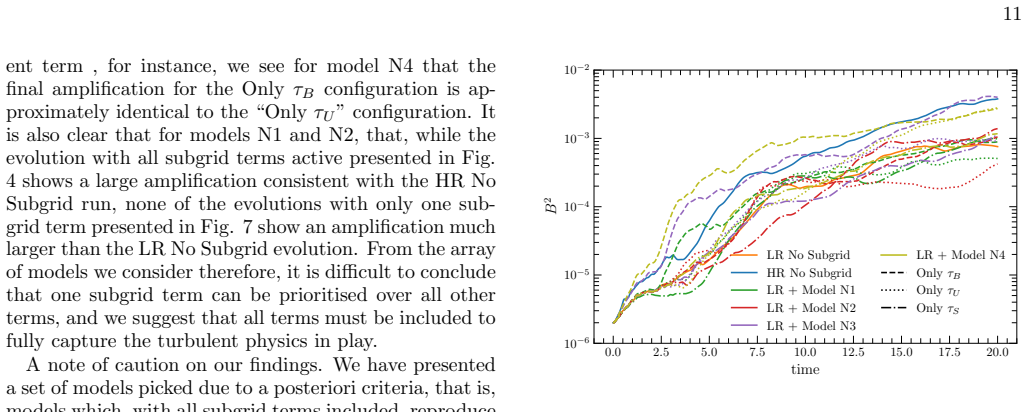
- Computational resources that previously went into resolution can be redirected to longer integration times or larger domains in studies of neutron-star mergers and accretion disks.
- The demonstrated 44-fold speed-up makes previously marginal three-dimensional relativistic MHD calculations routine.
Where Pith is reading between the lines
- The identical network architecture could be retrained on data from full general-relativistic MHD runs to produce a subgrid model usable inside merger simulations.
- Because the model is local in space and time, it can be ported to existing relativistic MHD codes with only modest interface changes.
- Systematic variation of the training resolution and the neural-network depth would map the accuracy-cost trade-off surface for this class of closures.
- If the model preserves the divergence-free constraint on the magnetic field to machine precision, it can be used without additional cleaning steps.
Load-bearing premise
A neural network trained offline on high-resolution snapshots will remain stable and physically consistent when evaluated at every time step inside a live low-resolution simulation.
What would settle it
A low-resolution run that includes the neural network model produces magnetic field energy histories that diverge from the high-resolution reference by more than the difference between successive resolution doublings, or triggers numerical instabilities that the pure low-resolution run does not exhibit.
Figures



read the original abstract
Resolving the impact of magnetic field instabilities in triggering small scale turbulent flow and the associated rearrangement of the field is of critical importance in understanding multimessenger observables in binary neutron star mergers, and angular momentum transport in neutron stars and accretion disks. Direct simulation of these instabilities are unfeasible, however large-eddy simulations can incorporate the impact of this turbulence with a subgrid model. We present the first machine-learning-based subgrid model for special relativistic magnetohydrodynamics, trained using a neural network. We demonstrate its performance in online simulations of the 3D Kelvin-Helmholtz instability through both a priori and a posteriori tests. Evaluated in a low resolution simulation, our model captures magnetic field amplification of a simulation at 4 times the resolution with a speed-up of a factor 44. This demonstrates the applicability of such methods in general relativistic simulations of neutron star mergers and other scenarios.
Editorial analysis
A structured set of objections, weighed in public.
Referee Report
Summary. The paper presents the first machine-learning-based subgrid model for special relativistic magnetohydrodynamics, using a neural network trained on high-resolution simulation data. It reports both a priori and a posteriori tests on the 3D Kelvin-Helmholtz instability, claiming that the model in a low-resolution run reproduces the magnetic field amplification seen in a simulation at 4 times higher resolution, while providing a factor of 44 speedup. The work positions this as enabling subgrid modeling for general relativistic MHD applications such as binary neutron star mergers.
Significance. If the central performance claim holds under full scrutiny, the result would be significant for computational astrophysics: it offers a pathway to effective higher resolution in RMHD simulations of magnetic instabilities without the full cost of direct high-resolution runs. The explicit combination of a priori training and a posteriori online testing is a methodological strength worth noting, as is the focus on the relativistic regime relevant to multimessenger sources.
major comments (2)
- [Abstract / a posteriori tests] Abstract and a posteriori tests section: the headline claim that the NN captures 4x-resolution magnetic amplification with 44x speedup requires that the online low-resolution evolution preserves the divergence-free constraint on B and the conservation properties of the RMHD system. The manuscript must report quantitative diagnostics (e.g., time evolution of max|div B| and relative conservation errors) for the coupled NN-RMHD runs; without these, drift in the constraints would undermine both the amplification match and the speedup assertion.
- [Methods / a posteriori tests] Training and insertion procedure: the neural network is trained a priori on high-resolution data and then inserted into low-resolution runs. The paper needs to specify the exact coupling (how subgrid terms are added to the RMHD equations, any projection or cleaning steps for div B=0) and demonstrate that this insertion does not introduce numerical artifacts that violate the underlying special relativistic MHD equations at the reported effective resolution.
minor comments (2)
- The abstract states that both a priori and a posteriori tests were performed but provides no information on network architecture, loss function, training dataset size, or error bars on the reported amplification and speedup; these details are required for reproducibility and independent verification.
- Figure captions and text should clarify whether the 4x resolution comparison is performed at identical grid spacing or via effective resolution metrics, and whether the speedup includes only the hydro step or the full coupled system.
Simulated Author's Rebuttal
We thank the referee for their careful review and constructive comments. We address each major comment below.
read point-by-point responses
-
Referee: [Abstract / a posteriori tests] Abstract and a posteriori tests section: the headline claim that the NN captures 4x-resolution magnetic amplification with 44x speedup requires that the online low-resolution evolution preserves the divergence-free constraint on B and the conservation properties of the RMHD system. The manuscript must report quantitative diagnostics (e.g., time evolution of max|div B| and relative conservation errors) for the coupled NN-RMHD runs; without these, drift in the constraints would undermine both the amplification match and the speedup assertion.
Authors: We agree that explicit verification of the divergence-free constraint and conservation properties is necessary to support the performance claims. In the revised manuscript we will add time-evolution diagnostics of max|div B| and relative conservation errors for the NN-coupled low-resolution runs, shown alongside the high-resolution reference and the baseline low-resolution simulation. revision: yes
-
Referee: [Methods / a posteriori tests] Training and insertion procedure: the neural network is trained a priori on high-resolution data and then inserted into low-resolution runs. The paper needs to specify the exact coupling (how subgrid terms are added to the RMHD equations, any projection or cleaning steps for div B=0) and demonstrate that this insertion does not introduce numerical artifacts that violate the underlying special relativistic MHD equations at the reported effective resolution.
Authors: We will expand the methods section to describe the precise insertion of the neural-network subgrid terms into the RMHD equations, including any divergence-cleaning or projection steps. We will also include additional diagnostics or test cases demonstrating that the coupling does not introduce artifacts inconsistent with the special relativistic MHD system. revision: yes
Circularity Check
No significant circularity; claims rest on independent high-resolution benchmarks
full rationale
The paper trains a neural network subgrid model on a priori high-resolution data and validates it via a posteriori insertion into low-resolution 3D Kelvin-Helmholtz simulations. The headline performance metric (capturing 4x-resolution magnetic amplification at 44x speedup) is obtained by direct numerical comparison to separate high-resolution runs, not by re-expressing fitted quantities or self-citations as predictions. No self-definitional steps, fitted-input-as-prediction reductions, or load-bearing self-citation chains appear; the derivation chain is externally falsifiable against the independent high-resolution reference data.
Axiom & Free-Parameter Ledger
free parameters (1)
- neural network weights and biases
axioms (1)
- domain assumption High-resolution simulation data contain the correct statistical effect of unresolved scales that can be learned and transferred to low-resolution runs
Reference graph
Works this paper leans on
-
[1]
While filtered individual conserved variables are directly accessible in the simulation, since they are evolved variables, filtered products of variables are not
Machine Learning Approach The subgrid tensor terms demonstrated in Eqs 19-21 and Eqs 42 - 45 for Newtonian and SR MHD respec- tively are not closed. While filtered individual conserved variables are directly accessible in the simulation, since they are evolved variables, filtered products of variables are not. We therefore provide a closure, specifying th...
-
[2]
low resolution
Conserved to Primitive In SRMHD the above algorithm must be slightly modi- fied, since the conserved to primitive variable inversion is not linear, and hence does not commute with the filtering operation. The primitive variables that are evaluated in the fluxes of a numerical simulation are calculated from the conserved variables, and are not evolved vari...
-
[3]
In [53], the inputs passed to the NN were not just these variables at a given point, but also those at neighbouring grid points in a stencil of fixed size
Choice of input and outputs for NN Following the approach of [53], we use as inputs for the NNs the state of the fluid, as well as its spatial deriva- tives at a given spatial point, with the corresponding out- put, the subgrid tensor at that point. In [53], the inputs passed to the NN were not just these variables at a given point, but also those at neig...
-
[4]
Optimised evaluation The aim of incorporating a subgrid model is to allow computationally inexpensive low resolution simulations to capture physics that would otherwise only be accessi- ble in higher resolution, more expensive simulations. It is therefore necessary that the cost of evaluating the sub- grid model is relatively cheap compared to the overall...
-
[5]
For the Newtonian problem we evolve the system using the codeAthena++[65], while the SR case is evolved withGR-Athena++[71–75]
Numerical approach Within this paper we consider two test problems, firstly a 2D KHI in Newtonian MHD, and secondly a 3D KHI in SR. For the Newtonian problem we evolve the system using the codeAthena++[65], while the SR case is evolved withGR-Athena++[71–75]. The numer- ical fluxes are constructed using an LLF approximate Riemann solver and PPM reconstruc...
-
[6]
Newtonian initial data For initial data for the 2D Newtonian problem we fol- low the initial data of [53], reproduced below. ρ=ρ 0 +ρ 1sgn(y) tanh |y| −y l al ,(46) vx =v x 0 sgn(y) tanh |y| −y l al +δv x sin (2πnxy) (47) vy = sgn(y)δv y sin (2πnyx) exp −(|y| −y l)2 σ2y (48) Bx =B 0 (49) By = 0 (50) p=p 0,(51) with chosen parameter valuesp 0 = 1, a l = 0....
-
[7]
Special Relativistic initial data For a fully turbulent 3D KHI in special relativity we follow the initial data specified by [45]. We initialise the primitive variables as follows: ρ=ρ 0 +ρ 1sgn(y) tanh |y| −y l al ,(52) vx =v x 0 sgn(y) tanh |y| −y l al +δv x sin 2πnxx Lx (53) vy =v y 0sgn(y) tanh |y| −y l al +δv y sin 2πnyy Ly sgn(y) exp −(|y| −y l)2 σ2...
-
[8]
Training Dataset construction We evolve the initial data detailed in Sec. II E 2 up to t= 100, ensuring that, for an extended period in the sim- ulation, the initial configuration has been totally washed out, and that a fully turbulent evolution has developed, at two resolutions, LR and HR. We only use data from after this burn in period in the training d...
-
[9]
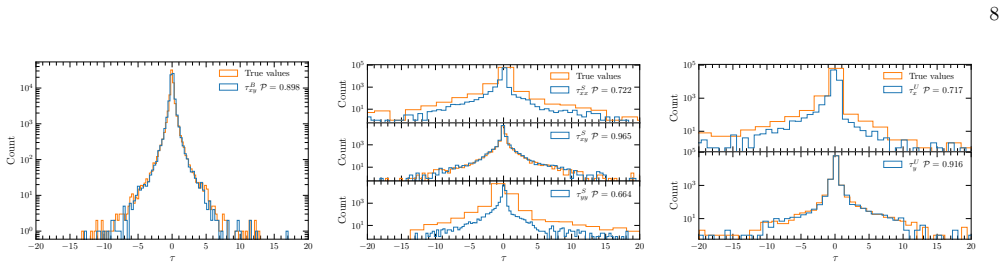
Model training and a priori testing We train a number of NNs on this training dataset ex- ploring a range of hyperparameters as detailed in App. A. In Fig. 1 we demonstrate the mean square error loss 0 25 50 75 100 125 150 175 200 Epochs 10−1 100 Training Error N1 N2 N3 N4 τB τU τS FIG. 1: The error of the NN during training. We show 4 models with differe...
-
[10]
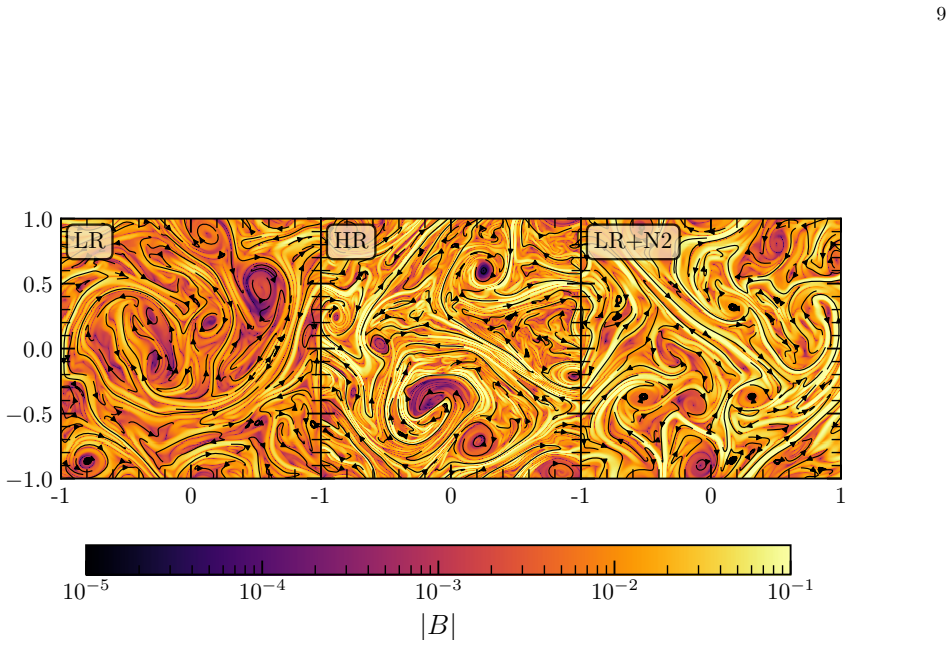
A posteriori testing To validate the a posteriori performance of the mod- els, we perform simulations at LR with the subgrid terms activated, provided by a variety of models. In Fig. 3 we demonstrate the magnetic field strength at the end of the simulation att= 20 for our fiducial LR and HR simula- tions, as well as one representative configuration at LR ...
-
[11]
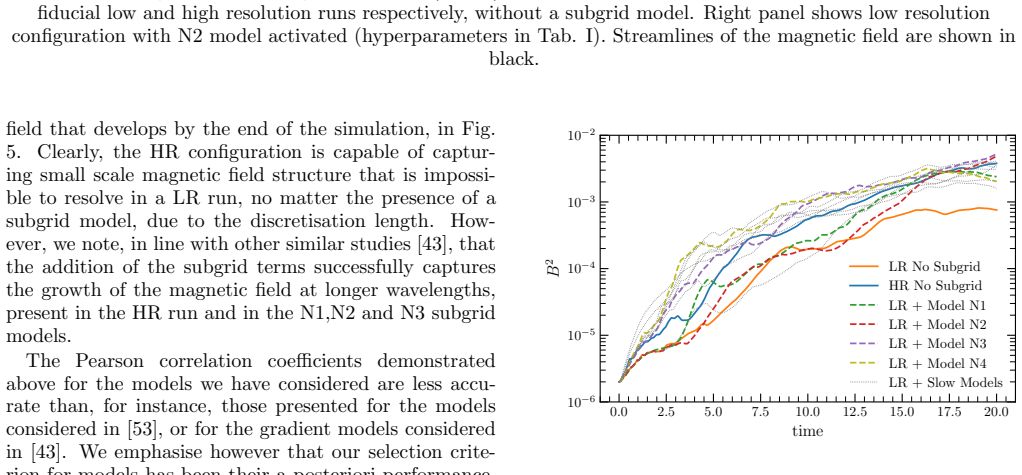
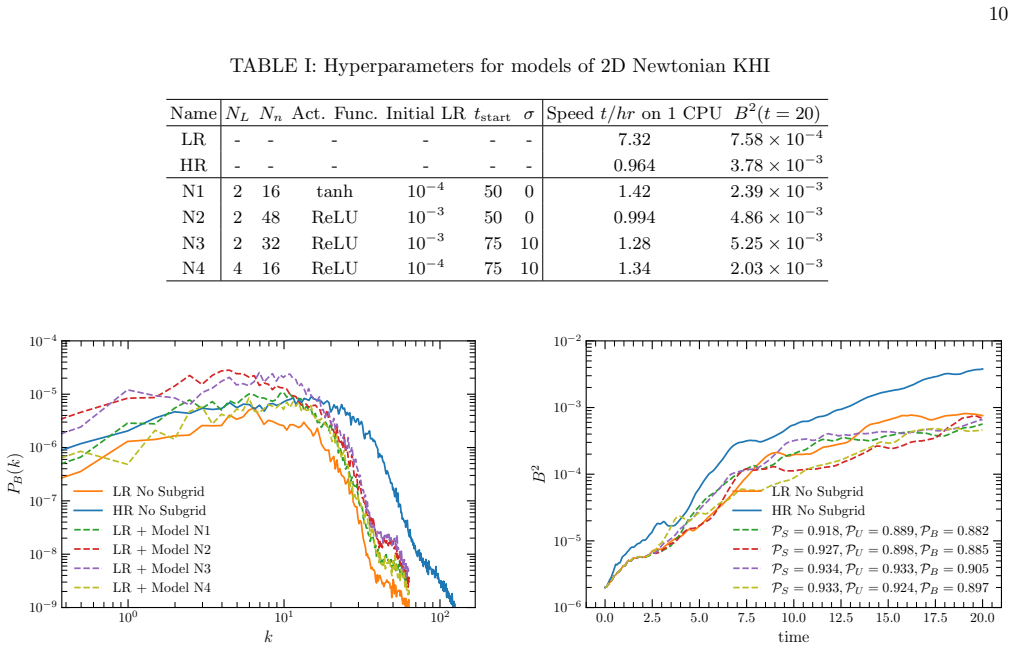
Clearly, the HR configuration is capable of captur- ing small scale magnetic field structure that is impossi- ble to resolve in a LR run, no matter the presence of a subgrid model, due to the discretisation length. How- ever, we note, in line with other similar studies [43], that the addition of the subgrid terms successfully captures the growth of the ma...
-
[12]
In contrast, other works constructing such models have focused on the impacts of specific terms
The role of individual subgrid tensors In the results above we have looked at modelling all the subgrid terms that arise from non-commutation of the fil- tering operation with the non linear fluxes in the MHD equations. In contrast, other works constructing such models have focused on the impacts of specific terms. For instance in [42] only the subgrid te...
-
[13]
II E 3 using the codeGR-Athena++, up tot= 40 at resolutions LR, SR and HR, corresponding to 128, 256 and 512 points in each direction over the domain
Training Dataset construction We evolve the initial data detailed in Sec. II E 3 using the codeGR-Athena++, up tot= 40 at resolutions LR, SR and HR, corresponding to 128, 256 and 512 points in each direction over the domain. As in Sec. III A, we take the high resolution data, calculate the subgrid terms appearing in Eqs 42 - 45, and filter this down to a ...
-
[14]
We demonstrate the model training error in Fig
Model training and a priori testing Following the same training procedure as in the New- tonian case we monitor the online training error with a validation dataset separated from our training dataset. We demonstrate the model training error in Fig. 8, for a subset of successful models (according to the same a posteriori criterion as before) that we focus ...
-
[15]
effective
A posteriori testing We perform simulations at resolution LR with the trained models from both thef2andf4families. We then select the best performing models from our a poste- riori test in terms of their ability to reproduce the final magnetic field amplification of either the SR or HR no subgrid run. The best performing models and their hy- perparameters...
2000
-
[16]
Magnetfelddynamik in Neutronensternen Sternen
Robustness of models withτ D In the models presented above we have included the impact of all subgrid terms, including that which enters the right hand side of the density evolution equationτ D. In our a posteriori tests, we have empirically found that it is easier to find successful models in hyperparameter space that match the target magnetic field ampl...
2000
-
[17]
D. Radice and I. Hawke, Liv. Rev. Comput. Astrophys. 10, 1 (2024), arXiv:2402.03224 [astro-ph.HE]
arXiv 2024
-
[18]
D. Price and S. Rosswog, Science312, 719 (2006), arXiv:astro-ph/0603845 [astro-ph]
Pith/arXiv arXiv 2006
-
[19]
S. A. Balbus and J. F. Hawley, Astrophys. J.376, 214 (1991)
1991
- [20]
-
[21]
S. I. Blinnikov, I. D. Novikov, T. V. Perevodchikova, and A. G. Polnarev, Soviet Astronomy Letters10, 177 (1984), arXiv:1808.05287 [astro-ph.HE]
Pith/arXiv arXiv 1984
-
[22]
Paczynski, Astrophys
B. Paczynski, Astrophys. J.308, L43 (1986)
1986
-
[23]
Goodman, Astrophys
J. Goodman, Astrophys. J. Lett.308, L47 (1986)
1986
-
[24]
Eichler, M
D. Eichler, M. Livio, T. Piran, and D. N. Schramm, Nature340, 126 (1989)
1989
-
[25]
R. Narayan, B. Paczynski, and T. Piran, Astrophys. J. 395, L83 (1992), arXiv:astro-ph/9204001
Pith/arXiv arXiv 1992
-
[26]
B. P. Abbottet al.(LIGO Scientific, Virgo), Phys. Rev. Lett.119, 161101 (2017), arXiv:1710.05832 [gr-qc]
Pith/arXiv arXiv 2017
-
[27]
B. P. Abbottet al.(LIGO Scientific, Virgo, Fermi GBM, INTEGRAL, IceCube, AstroSat Cadmium Zinc Telluride Imager Team, IPN, Insight-Hxmt, ANTARES, Swift, AGILE Team, 1M2H Team, Dark Energy Camera GW-EM, DES, DLT40, GRAWITA, Fermi-LAT, ATCA, ASKAP, Las Cumbres Observatory Group, OzGrav, DWF (Deeper Wider Faster Program), AST3, CAAS- TRO, VINROUGE, MASTER, J...
Pith/arXiv arXiv 2017
-
[28]
B. P. Abbottet al.(LIGO Scientific, Virgo, Fermi-GBM, INTEGRAL), Astrophys. J. Lett.848, L13 (2017), arXiv:1710.05834 [astro-ph.HE]
Pith/arXiv arXiv 2017
-
[29]
A. Goldsteinet al., Astrophys. J.848, L14 (2017), arXiv:1710.05446 [astro-ph.HE]
Pith/arXiv arXiv 2017
-
[30]
V. Savchenkoet al., Astrophys. J.848, L15 (2017), arXiv:1710.05449 [astro-ph.HE]
Pith/arXiv arXiv 2017
-
[31]
C. Palenzuela, R. Aguilera-Miret, F. Carrasco, R. Ciolfi, J. V. Kalinani, W. Kastaun, B. Mi˜ nano, and D. Vigan` o, Phys. Rev. D106, 023013 (2022), arXiv:2112.08413 [gr- qc]
arXiv 2022
-
[32]
K. Hayashi, K. Kiuchi, K. Kyutoku, Y. Sekiguchi, and M. Shibata, Phys. Rev. Lett.134, 211407 (2025), arXiv:2410.10958 [astro-ph.HE]
arXiv 2025
- [33]
-
[34]
C. Musolino, L. Rezzolla, and E. R. Most, (2024), arXiv:2410.06253 [astro-ph.HE]
arXiv 2024
-
[35]
E. R. Most, J. Peterson, L. Scurto, H. Pais, and V. Dex- heimer, (2025), arXiv:2506.21696 [astro-ph.HE]
arXiv 2025
-
[36]
E. M. Guti´ errez, W. Cook, D. Radice, S. Bernuzzi, J. Fields, P. Hammond, B. Daszuta, H. Bandyopadhyay, and M. Jacobi, (2025), arXiv:2506.18995 [astro-ph.HE]
arXiv 2025
-
[37]
W. Cook, E. M. Guti´ errez, S. Bernuzzi, D. Radice, B. Daszuta, J. Fields, P. Hammond, H. Bandyopadhyay, and M. Jacobi, (2025), arXiv:2508.19342 [astro-ph.HE]
arXiv 2025
- [38]
-
[39]
K. Kiuchi, A. Reboul-Salze, Y. Sekiguchi, and M. Shi- bata, (2026), arXiv:2606.11299 [astro-ph.HE]
Pith/arXiv arXiv 2026
-
[40]
A. Wen, J. V. Kalinani, M. Chabanov, M. Campanelli, R. Ciolfi, and Y. Zlochower, (2026), arXiv:2605.30548 [astro-ph.HE]
Pith/arXiv arXiv 2026
-
[41]
A. Tsokaros, M. Ruiz, S. L. Shapiro, and K. Ury¯ u, Phys. Rev. Lett.128, 061101 (2022), arXiv:2111.00013 [gr-qc]
arXiv 2022
-
[42]
A. Sur, W. Cook, D. Radice, B. Haskell, and S. Bernuzzi, Mon. Not. Roy. Astron. Soc.511, 3983 (2022), arXiv:2108.11858 [astro-ph.HE]
arXiv 2022
-
[43]
W. Cook, R. K. Joshi, S. Bernuzzi, B. Haskell, and J. Fields, Mon. Not. Roy. Astron. Soc.547, stag136 (2026), arXiv:2506.08037 [astro-ph.HE]. 21
Pith/arXiv arXiv 2026
-
[44]
F. V. Pi˜ nas, A. K. L. Yip, P. C.-K. Cheong, and M. Ruiz, (2025), arXiv:2508.20220 [astro-ph.HE]
arXiv 2025
-
[45]
A. Capobianco, W. Cook, S. Bernuzzi, B. Haskell, and J. Fields, (2026), arXiv:2605.22921 [astro-ph.HE]
Pith/arXiv arXiv 2026
-
[46]
E. M. Guti´ errez, D. Radice, J. Fields, and J. M. Stone, (2026), arXiv:2601.20953 [astro-ph.HE]
arXiv 2026
-
[47]
Smagorinsky, Monthly Weather Review91, 99 (1963)
J. Smagorinsky, Monthly Weather Review91, 99 (1963)
1963
-
[48]
Germano, U
M. Germano, U. Piomelli, P. Moin, and W. H. Cabot, inStudying Turbulence Using Numerical Simula- tion Databases. 3: Proceedings of the 1990 Summer Pro- gram, edited by D. Spinks (1990) pp. 5–17
1990
-
[49]
W. K. Yeo,A Generalized High Pass/Low Pass Averag- ing Procedure for Deriving and Solving Turbulent Flow Equations, Ph.D. thesis, Ohio State University (1987)
1987
-
[50]
R. A. Clark, J. H. Ferziger, and W. C. Reynolds, Journal of Fluid Mechanics91, 1 (1979)
1979
-
[51]
M. L. Theobald, P. A. Fox, and S. Sofia, Physics of Plasmas1, 3016 (1994)
1994
-
[52]
M¨ uller and D
W.-C. M¨ uller and D. Carati, Physics of Plasmas9, 824 (2002)
2002
-
[53]
Grete,Large eddy simulations of compressible magne- tohydrodynamic turbulence, Ph.D
P. Grete,Large eddy simulations of compressible magne- tohydrodynamic turbulence, Ph.D. thesis, Georg August University of Gottingen, Germany (2016)
2016
-
[54]
P. Grete, D. G. Vlaykov, W. Schmidt, and D. R. G. Schleicher, Physics of Plasmas23, 062317 (2016), arXiv:1606.01573 [physics.flu-dyn]
Pith/arXiv arXiv 2016
-
[55]
D. G. Vlaykov, P. Grete, W. Schmidt, and D. R. G. Schleicher, Physics of Plasmas23, 062316 (2016), arXiv:1606.02064 [physics.flu-dyn]
Pith/arXiv arXiv 2016
-
[56]
M. Miesch, W. Matthaeus, A. Brandenburg, A. Pet- rosyan, A. Pouquet, C. Cambon, F. Jenko, D. Uzdensky, J. Stone, S. Tobias, J. Toomre, and M. Velli, Space Sci. Rev.194, 97 (2015), arXiv:1505.01808 [astro-ph.SR]
Pith/arXiv arXiv 2015
-
[57]
Schmidt, Living Reviews in Computational Astro- physics1, 2 (2015), arXiv:1404.2483 [astro-ph.CO]
W. Schmidt, Living Reviews in Computational Astro- physics1, 2 (2015), arXiv:1404.2483 [astro-ph.CO]
Pith/arXiv arXiv 2015
-
[58]
D. Radice, Astrophys. J.838, L2 (2017), arXiv:1703.02046 [astro-ph.HE]
Pith/arXiv arXiv 2017
-
[59]
D. Vigan` o, R. Aguilera-Miret, and C. Palenzuela, Physics of Fluids31, 105102 (2019), arXiv:1904.04099 [physics.flu-dyn]
arXiv 2019
-
[60]
F. Carrasco, D. Vigan` o, and C. Palenzuela, Phys. Rev. D101, 063003 (2020), arXiv:1908.01419 [astro-ph.HE]
arXiv 2020
-
[61]
D. Vigan` o, R. Aguilera-Miret, F. Carrasco, B. Mi˜ nano, and C. Palenzuela, Phys. Rev. D101, 123019 (2020), arXiv:2004.00870 [gr-qc]
arXiv 2020
-
[62]
M. Shibata, K. Kiuchi, and Y.-i. Sekiguchi, Phys. Rev. D95, 083005 (2017), arXiv:1703.10303 [astro-ph.HE]
Pith/arXiv arXiv 2017
-
[63]
A. Pandya and F. Pretorius, Phys. Rev. D104, 023015 (2021), arXiv:2104.00804 [gr-qc]
arXiv 2021
-
[64]
H. L. H. Shum, F. Abalos, Y. Bea, M. Bezares, P. Figueras, and C. Palenzuela, Phys. Rev. D113, 084029 (2026), arXiv:2509.15303 [gr-qc]
Pith/arXiv arXiv 2026
-
[65]
E. R. Most, Phys. Rev. D108, 123012 (2023), arXiv:2311.03333 [astro-ph.HE]
arXiv 2023
-
[66]
J. Ling, A. Kurzawski, and J. Templeton, Journal of Fluid Mechanics807, 155 (2016)
2016
-
[67]
A. Beck, D. Flad, and C.-D. Munz, Journal of Compu- tational Physics398, 108910 (2019), arXiv:1806.04482 [cs.CE]
arXiv 2019
-
[68]
Z. Wang, K. Luo, D. Li, J. Tan, and J. Fan, Physics of Fluids30, 125101 (2018), https://pubs.aip.org/aip/pof/article- pdf/doi/10.1063/1.5054835/13826537/125101 1 online.pdf
-
[69]
S. G. Rosofsky and E. A. Huerta, Phys. Rev. D101, 084024 (2020), arXiv:1912.11073 [physics.comp-ph]
arXiv 2020
-
[70]
E. A. Huerta, (2026), arXiv:2605.19057 [astro-ph.HE]
Pith/arXiv arXiv 2026
-
[71]
D. George and E. Huerta, Phys. Lett. B778, 64 (2018), arXiv:1711.03121 [gr-qc]
Pith/arXiv arXiv 2018
-
[72]
D. George and E. Huerta, inNiPS Summer School 2017 (2017) arXiv:1711.07966 [gr-qc]
Pith/arXiv arXiv 2017
-
[73]
A. J. K. Chua, C. R. Galley, and M. Vallisneri, Phys. Rev. Lett.122, 211101 (2019), arXiv:1811.05491 [astro- ph.IM]
Pith/arXiv arXiv 2019
-
[74]
S. G. Rosofsky, H. A. Majed, and E. A. Huerta, Mach. Learn. Sci. Tech.4, 025022 (2023), arXiv:2203.12634 [physics.comp-ph]
arXiv 2023
-
[75]
S. G. Rosofsky and E. A. Huerta, Mach. Learn. Sci. Tech. 4, 035002 (2023), arXiv:2302.08332 [physics.comp-ph]
arXiv 2023
- [76]
-
[77]
T. Dieselhorst, W. Cook, S. Bernuzzi, and D. Radice, Symmetry13(2021), 10.3390/sym13112157, arXiv:2109.02679 [astro-ph.IM]
- [78]
-
[79]
R. Mudimadugula, F. Schianchi, A. Neuweiler, T. Wouters, H. Gieg, and T. Dietrich, Eur. Phys. J. A61, 193 (2025), arXiv:2503.08289 [astro-ph.HE]
arXiv 2025
-
[80]
N. Bhojwani, C. Wang, H.-Y. Wang, C. Sun, E. R. Most, and A. Anandkumar, in38th conference on Neural In- formation Processing Systems(2025) arXiv:2512.01576 [astro-ph.HE]
arXiv 2025
discussion (0)
Sign in with ORCID, Apple, or X to comment. Anyone can read and Pith papers without signing in.