Implementing the principal stratum strategy for intercurrent events with survival outcomes: a tutorial
Pith reviewed 2026-06-29 15:20 UTC · model grok-4.3
The pith
The principal stratum strategy for intercurrent events with survival outcomes can be implemented using mixture model and weighting methods with explicit assumptions and R code.
A machine-rendered reading of the paper's core claim, the machinery that carries it, and where it could break.
Core claim
The paper establishes that the principal stratum strategy can be applied to survival outcomes by identifying causal effects within strata of patients who would or would not experience the intercurrent event under each treatment, and that these effects can be estimated from observed data using either a mixture model or a weighting approach when the corresponding identification assumptions hold.
What carries the argument
The mixture model method and the weighting method for estimating stratum-specific survival effects under the principal stratum strategy.
If this is right
- Stratum-specific survival effects become estimable in binary treatment and binary discontinuation settings.
- Sensitivity analyses can be conducted to assess how results change under different assumptions about the intercurrent event.
- R code is provided so that the methods can be applied directly to similar trial data.
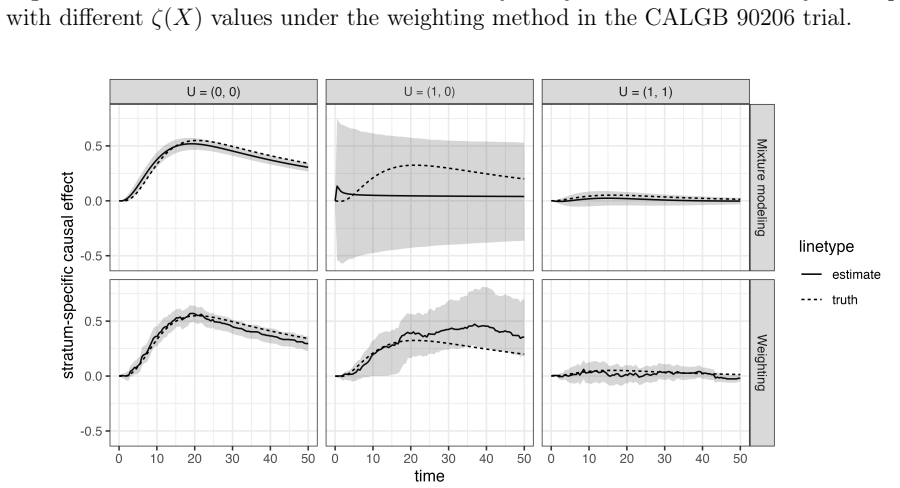
- Simulation results characterize the bias, variance, and coverage properties of the estimators under the study scenarios.
Where Pith is reading between the lines
- The tutorial may enable more trials to adopt the principal stratum strategy as one option within the ICH E9(R1) estimand framework.
- The same mixture and weighting machinery could be tested on data with multiple or continuous intercurrent events if the identification assumptions can be plausibly maintained.
- Direct numerical comparison of principal-stratum estimates with estimates from other intercurrent-event strategies on the same dataset would clarify how interpretations differ.
Load-bearing premise
The identification assumptions needed to recover the unobserved stratum-specific effects from the observed data hold in the oncology trial context and simulation scenarios.
What would settle it
A simulation study or trial dataset in which the estimated stratum-specific survival effects show large bias relative to the known true values when the mixture or weighting identification assumptions are violated.
Figures


read the original abstract
The International Council for Harmonization (ICH) E9 (R1) addendum provides the estimand framework to formulate treatment effects in a clinical trial. One of the attributes of an estimand the framework describes is intercurrent events. Among the five strategies to intercurrent events the guidance lists, the principal stratum strategy is the most conceptually and technically challenging because it defines treatment effects on unobserved strata. Its application to survival outcomes is particularly inaccessible to practitioners. This tutorial reviews the methodology and implementation of the estimand framework with the principal stratum strategy to address intercurrent events with survival outcomes. We illustrate using a clinical trial in oncology and focus on a simple case with binary treatment and a single binary intercurrent event of discontinuation of the assigned treatment. We define the causal effects and review two main methods for estimating the effects: the mixture model method and the weighting method. For each method, we elaborate the associated assumptions, models, sensitivity analysis, software and provide example R code. We conduct simulation studies that mimic the real study to study the operation characteristics of these methods.
Editorial analysis
A structured set of objections, weighed in public.
Referee Report
Summary. The paper is a tutorial on applying the principal stratum strategy from the ICH E9(R1) estimand framework to handle a binary intercurrent event (treatment discontinuation) with survival outcomes. It defines the target causal effects in a binary-treatment setting, reviews the mixture-model and weighting estimators, details their identifying assumptions and sensitivity analyses, supplies R code for implementation, and reports simulation results that mimic an oncology trial.
Significance. If the identification assumptions hold and the provided code is correct, the tutorial would lower the barrier for practitioners to implement principal-stratum survival analyses, a currently inaccessible but policy-relevant estimand. The explicit provision of R code, sensitivity-analysis templates, and simulation studies that mimic a real trial are concrete strengths that support reproducibility and adoption.
major comments (2)
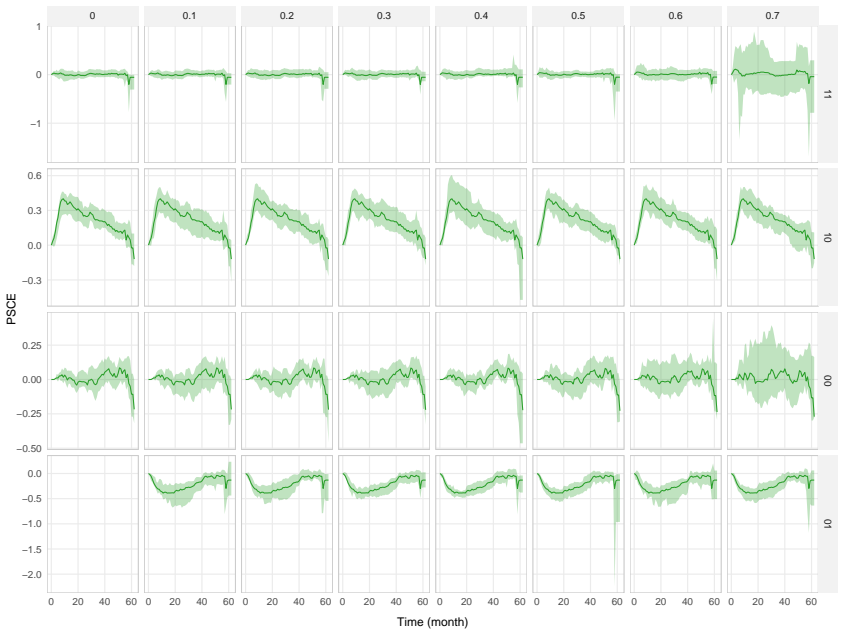
- [mixture model method] Section on mixture-model identification assumptions: the conditional independence assumption linking discontinuation to potential survival times given covariates is stated as sufficient to separate the four principal strata, yet no oncology-specific justification, empirical check, or range of sensitivity parameters is supplied; because the estimator recovers stratum-specific survival curves only under this untestable assumption, its validity for the target contrast is load-bearing.
- [simulation studies] Simulation studies section: every data-generating process enforces the monotonicity and conditional-independence assumptions required by both estimators by construction; this design cannot reveal bias under realistic violations (e.g., unmeasured prognostic factors affecting both discontinuation and hazard), which directly limits the tutorial's claim that the methods have favorable operating characteristics in the oncology context.
minor comments (2)
- [causal effects definition] The notation for potential outcomes and principal strata is introduced without an explicit table mapping observed data patterns to the four strata; adding such a table would improve clarity for readers new to the framework.
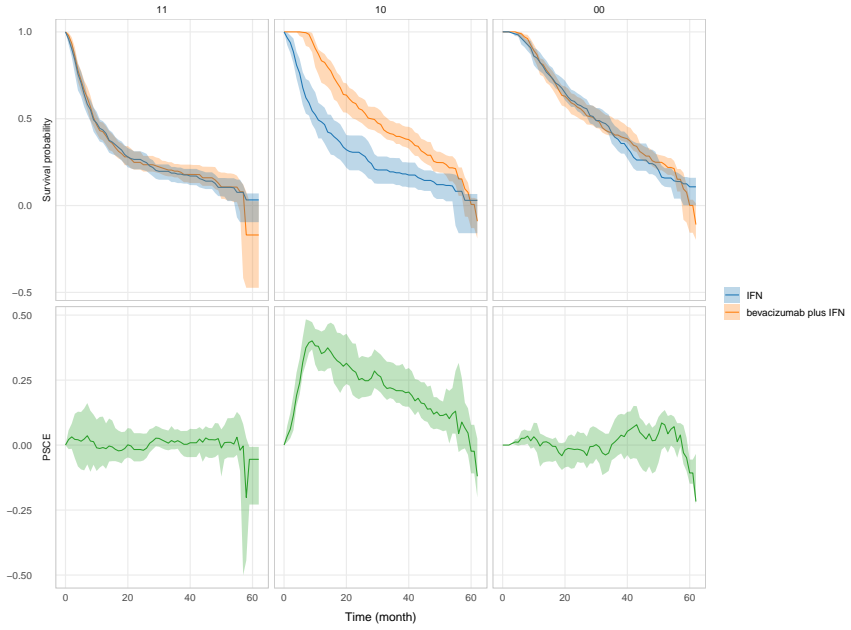
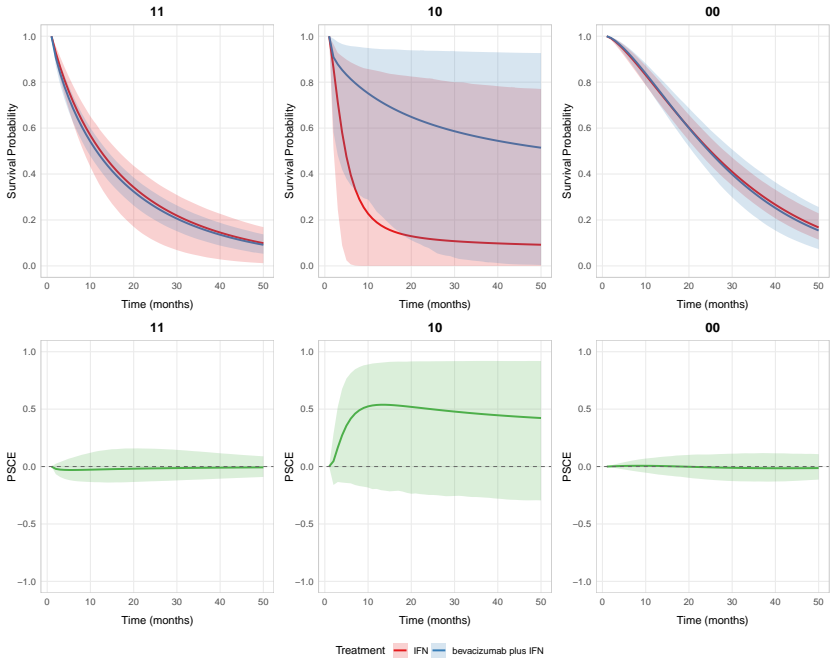
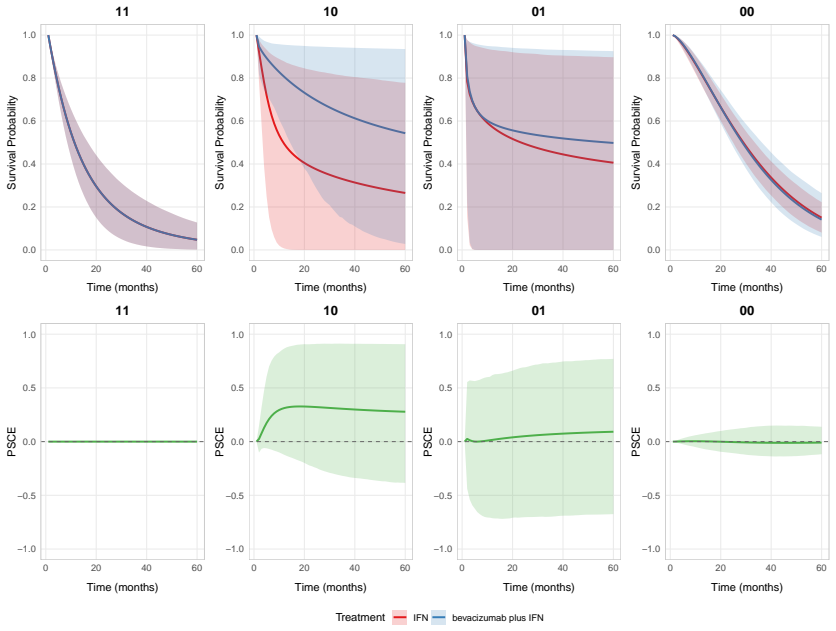
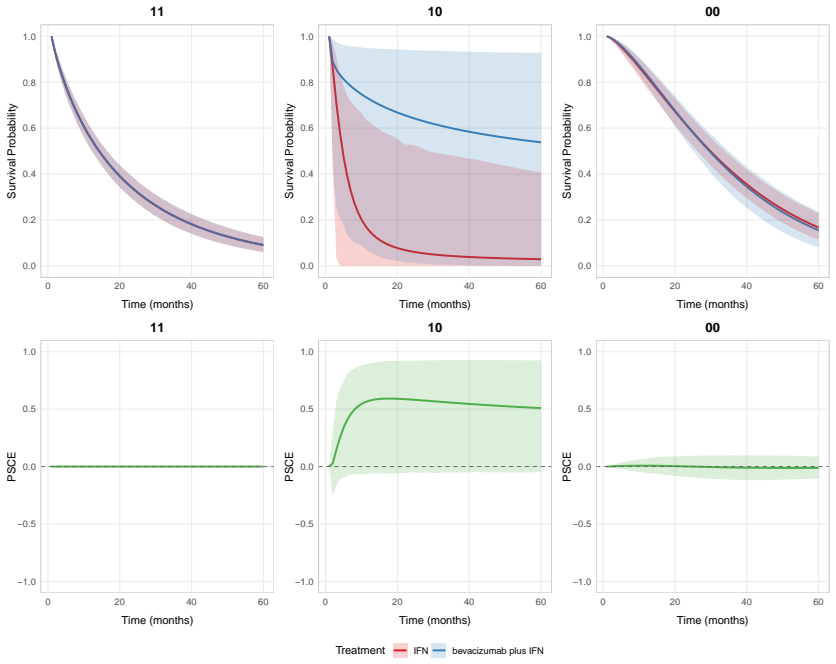
- [oncology example] Figure captions for the estimated survival curves do not state the exact sensitivity parameter values used; this makes it harder to reproduce the displayed results from the supplied R code.
Simulated Author's Rebuttal
We thank the referee for the constructive comments on our tutorial manuscript. The feedback highlights important aspects of the identifying assumptions and simulation design that we will address to improve the paper's clarity and utility for practitioners.
read point-by-point responses
-
Referee: [mixture model method] Section on mixture-model identification assumptions: the conditional independence assumption linking discontinuation to potential survival times given covariates is stated as sufficient to separate the four principal strata, yet no oncology-specific justification, empirical check, or range of sensitivity parameters is supplied; because the estimator recovers stratum-specific survival curves only under this untestable assumption, its validity for the target contrast is load-bearing.
Authors: We agree that the conditional independence assumption is untestable and central to the mixture model estimator. The current manuscript states the assumption and outlines a sensitivity analysis framework, but we acknowledge the need for more applied guidance. In revision, we will expand this section with oncology-specific discussion (e.g., clinical literature on how discontinuation due to toxicity relates to observed covariates such as baseline performance status or tumor burden) and provide an extended sensitivity analysis with a grid of parameter values. We will also suggest simple empirical checks based on observed associations between covariates and discontinuation. These changes will better convey the assumption's load-bearing role without overstating identifiability. revision: yes
-
Referee: [simulation studies] Simulation studies section: every data-generating process enforces the monotonicity and conditional-independence assumptions required by both estimators by construction; this design cannot reveal bias under realistic violations (e.g., unmeasured prognostic factors affecting both discontinuation and hazard), which directly limits the tutorial's claim that the methods have favorable operating characteristics in the oncology context.
Authors: The referee is correct that the simulations evaluate performance only when the monotonicity and conditional independence assumptions hold by design. This is standard for illustrating consistency but does not demonstrate robustness to violations. We will revise the simulation section by adding scenarios that introduce violations via unmeasured confounding factors affecting both discontinuation and survival, reporting the resulting bias. The discussion will be updated to qualify the operating characteristics claims and to stress that sensitivity analyses remain essential in oncology applications. This addition directly responds to the concern while preserving the tutorial's focus on implementation when assumptions are plausible. revision: yes
Circularity Check
Tutorial on established methods contains no circular derivations
full rationale
The manuscript is explicitly a tutorial that reviews and implements two existing methods (mixture models and weighting) for principal stratum estimands under survival outcomes. It states identification assumptions, provides sensitivity analyses, supplies R code, and runs simulations under those assumptions, but does not derive new quantities, rename fitted parameters as predictions, or rely on self-citation chains for its central claims. All load-bearing steps are external methodological references or explicit modeling choices rather than reductions to the paper's own inputs by construction.
Axiom & Free-Parameter Ledger
axioms (1)
- domain assumption Standard causal assumptions for principal stratum identification (no unmeasured confounding for the intercurrent event and outcome, plus any monotonicity or other identifying restrictions needed for the chosen estimator).
Reference graph
Works this paper leans on
-
[1]
Aligning estimators with estimands in clinical trials: putting the ich e9 (r1) guidelines into practice.Therapeutic innovation & regulatory science, 54:353–364, 2020
CH Mallinckrodt, J Bell, G Liu, B Ratitch, M O’kelly, I Lipkovich, P Singh, L Xu, and Geert Molenberghs. Aligning estimators with estimands in clinical trials: putting the ich e9 (r1) guidelines into practice.Therapeutic innovation & regulatory science, 54:353–364, 2020. 30
2020
-
[2]
Causal inference and estimands in clinical trials.Statistics in Biopharmaceutical Research, 12(1):54–67, 2020
Ilya Lipkovich, Bohdana Ratitch, and Craig H Mallinckrodt. Causal inference and estimands in clinical trials.Statistics in Biopharmaceutical Research, 12(1):54–67, 2020
2020
-
[3]
Translating questions to estimands in randomized clinical trials with intercurrent events.Statistics in Medicine, 41(16):3211–3228, 2022
Mats J Stensrud and Oliver Dukes. Translating questions to estimands in randomized clinical trials with intercurrent events.Statistics in Medicine, 41(16):3211–3228, 2022
2022
-
[4]
Defining estimands in clinical trials: a unified procedure
Shasha Han and Xiao-Hua Zhou. Defining estimands in clinical trials: a unified procedure. Statistics in Medicine, 42(12):1869–1887, 2023
2023
-
[5]
Applying the estimands framework to non-inferiority trials: Guidance on choice of hypothetical estimands for non-adherence and comparison of estimation methods
Katy E Morgan, Ian R White, Clémence Leyrat, Simon Stanworth, and Brennan C Kahan. Applying the estimands framework to non-inferiority trials: Guidance on choice of hypothetical estimands for non-adherence and comparison of estimation methods. Statistics in medicine, 44(5):e10348, 2025
2025
-
[6]
Adopting the estimand framework in prophylactic vaccine trials.Vaccine, 64:127645, 2025
Francois Beckers, Naveen Karkada, Ye Yang, John Scott, Lei Huang, Florian Klinglmüller, Michael P Fay, Stefan Englert, Bart Spiessens, Ilse Van Dromme, et al. Adopting the estimand framework in prophylactic vaccine trials.Vaccine, 64:127645, 2025
2025
-
[7]
Principal stratification in causal inference
Constantine E Frangakis and Donald B Rubin. Principal stratification in causal inference. Biometrics, 58:21–29, 2002
2002
-
[8]
Likelihood-based analysis of causal effects of job-training programs using principal stratification.Journal of the American Statistical Association, 104(485):166–176, 2009
Junni L Zhang, Donald B Rubin, and Fabrizia Mealli. Likelihood-based analysis of causal effects of job-training programs using principal stratification.Journal of the American Statistical Association, 104(485):166–176, 2009
2009
-
[9]
Multiply robust estimation of causal effects under principal ignorability.Journal of the Royal Statistical Society Series B: Statistical Methodology, 84(4):1423–1445, 2022
Zhichao Jiang, Shu Yang, and Peng Ding. Multiply robust estimation of causal effects under principal ignorability.Journal of the Royal Statistical Society Series B: Statistical Methodology, 84(4):1423–1445, 2022
2022
-
[10]
Using principal stratification in analysis of clinical trials.Statistics in Medicine, 41(19):3837–3877, 2022
Ilya Lipkovich, Bohdana Ratitch, Yongming Qu, Xiang Zhang, Mingyang Shan, and Craig Mallinckrodt. Using principal stratification in analysis of clinical trials.Statistics in Medicine, 41(19):3837–3877, 2022. 31
2022
-
[11]
Bayesian inference for causal effects in randomized experiments with noncompliance.The annals of statistics, pages 305–327, 1997
Guido W Imbens and Donald B Rubin. Bayesian inference for causal effects in randomized experiments with noncompliance.The annals of statistics, pages 305–327, 1997
1997
-
[12]
Alessandra Mattei, Fan Li, and Fabrizia Mealli. Exploiting multiple outcomes in bayesian principal stratification analysis with application to the evaluation of a job training program.Annals of Applied Statistics, 7:2336–2360, 2013. ISSN 19326157. doi: 10.1214/13-AOAS674
-
[13]
On the use of propensity scores in principal causal effect estimation.Statistics in medicine, 28(23):2857–2875, 2009
Booil Jo and Elizabeth A Stuart. On the use of propensity scores in principal causal effect estimation.Statistics in medicine, 28(23):2857–2875, 2009
2009
-
[14]
Principalstratificationanalysisusingprincipalscores.Journal of the Royal Statistical Society: Series B (Statistical Methodology), 79(3):757–777, 2017
PengDingandJiannanLu. Principalstratificationanalysisusingprincipalscores.Journal of the Royal Statistical Society: Series B (Statistical Methodology), 79(3):757–777, 2017
2017
-
[15]
Multiply robust estimation of principal causal effects with noncompliance and survival outcomes.Clinical Trials, page 17407745241251773, 2024
Chao Cheng, Yueqi Guo, Bo Liu, Lisa Wruck, Fan Li, and Fan Li. Multiply robust estimation of principal causal effects with noncompliance and survival outcomes.Clinical Trials, page 17407745241251773, 2024
2024
-
[16]
Pstrata: An r package for principal stratification.arXiv:2304.02740, 2023
Bo Liu and Fan Li. Pstrata: An r package for principal stratification.arXiv:2304.02740, 2023
-
[17]
Multiply robust estimation for causal survival analysis with treatment noncompliance.Annals of Applied Statistics, 20 (1):1–24, 2026
Chao Cheng, Bo Liu, Lisa Wruck, Fan Li, and Fan Li. Multiply robust estimation for causal survival analysis with treatment noncompliance.Annals of Applied Statistics, 20 (1):1–24, 2026
2026
-
[18]
mrpstrata: Multiply robust estimation in causal survival analysis with treatment noncompliance.https://rpubs.com/chaocheng/mrPStrata,
Chao Cheng, Bo Liu, and Fan Li. mrpstrata: Multiply robust estimation in causal survival analysis with treatment noncompliance.https://rpubs.com/chaocheng/mrPStrata,
-
[19]
Silvia Noirjean, Daniele Bottigliengo, Elisa Cinconze, Ali Charkhi, Toufik Zahaf, Fan Li, and Andrea Callegaro. Implementation of the ich e9 (r1) addendum in vaccine efficacy 32 studies: the hypothetical and principal stratum strategies.Journal of Biopharmaceutical Statistics, pages 1–18, 2025
2025
-
[20]
Chasing shadows: how implausible as- sumptions skew our understanding of causal estimands.Statistics in Biopharmaceutical Research, 17(4):507–513, 2025
Stijn Vansteelandt and Kelly Van Lancker. Chasing shadows: how implausible as- sumptions skew our understanding of causal estimands.Statistics in Biopharmaceutical Research, 17(4):507–513, 2025
2025
-
[21]
Principal stratification—uses and limitations.The international journal of biostatistics, 7(1):28, 2011
Tyler J VanderWeele. Principal stratification—uses and limitations.The international journal of biostatistics, 7(1):28, 2011
2011
-
[22]
chasing shadows: How implausible assumptions skew our understanding of causal estimands
Peng Ding and Sizhu Lu. The roles of estimands and assumptions in causal inference: Comment on “chasing shadows: How implausible assumptions skew our understanding of causal estimands”.Statistics in Biopharmaceutical Research, 17(4):523–529, 2025
2025
-
[23]
Brian I Rini, Susan Halabi, Jonathan E Rosenberg, Walter M Stadler, Daniel A Vaena, San-San Ou, Laura Archer, James N Atkins, Joel Picus, Piotr Czaykowski, et al. Bevacizumab plus interferon alfa compared with interferon alfa monotherapy in patients with metastatic renal cell carcinoma: Calgb 90206.Journal of Clinical Oncology, 26(33): 5422–5428, 2008
2008
-
[24]
Brian I Rini, Susan Halabi, Jonathan E Rosenberg, Walter M Stadler, Daniel A Vaena, Laura Archer, James N Atkins, Joel Picus, Piotr Czaykowski, Janice Dutcher, et al. Phase iii trial of bevacizumab plus interferon alfa versus interferon alfa monotherapy in patients with metastatic renal cell carcinoma: final results of calgb 90206.Journal of clinical onco...
2010
-
[25]
Interferon-alpha and survival in metastatic renal carcinoma: Early results of a randomised controlled trial.Lancet, 353: 14–17, 1999
Medical Research Council Renal Cancer Collaborators. Interferon-alpha and survival in metastatic renal carcinoma: Early results of a randomised controlled trial.Lancet, 353: 14–17, 1999
1999
-
[26]
On the propensity score weighting 33 analysis with survival outcome: Estimands, estimation, and inference.Statistics in medicine, 37(26):3745–3763, 2018
Huzhang Mao, Liang Li, Wei Yang, and Yu Shen. On the propensity score weighting 33 analysis with survival outcome: Estimands, estimation, and inference.Statistics in medicine, 37(26):3745–3763, 2018
2018
-
[27]
Principal stratification analysis of noncompliance with time-to-event outcomes.Biometrics, 80(1):1–14, 2024
Bo Liu, Lisa Wruck, and Fan Li. Principal stratification analysis of noncompliance with time-to-event outcomes.Biometrics, 80(1):1–14, 2024
2024
-
[28]
Identification of causal effects using instrumental variables.Journal of the American Statistical Association, 91: 444–455, 1996
Joshua D Angrist, Guido W Imbens, and Donald B Rubin. Identification of causal effects using instrumental variables.Journal of the American Statistical Association, 91: 444–455, 1996
1996
-
[29]
The consquences of adjustment for a concomitant variable that has been affected by the treatment.Journal of the Royal Statistical Society
Paul R Rosenbaum. The consquences of adjustment for a concomitant variable that has been affected by the treatment.Journal of the Royal Statistical Society. Series A, 147: 656–666, 1984. URLhttps://about.jstor.org/terms
1984
-
[30]
Bounds on causal effects in three-arm trials with non- compliance.Journal of the Royal Statistical Society Series B: Statistical Methodology, 68 (5):815–836, 2006
Jing Cheng and Dylan S Small. Bounds on causal effects in three-arm trials with non- compliance.Journal of the Royal Statistical Society Series B: Statistical Methodology, 68 (5):815–836, 2006
2006
-
[31]
Principal stratum strategy: potential role in drug development.Pharmaceutical Statistics, 20(4):737–751, 2021
Björn Bornkamp, Kaspar Rufibach, Jianchang Lin, Yi Liu, Devan V Mehrotra, Satrajit Roychoudhury, Heinz Schmidli, Yue Shentu, and Marcel Wolbers. Principal stratum strategy: potential role in drug development.Pharmaceutical Statistics, 20(4):737–751, 2021
2021
-
[32]
Frumento, F
P. Frumento, F. Mealli, B. Pacini, and D. B. Rubin. Evaluating the effect of training on wages in the presence of noncompliance, nonemployment, and missing outcome data. Journal of the American Statistical Association, 107:450–466, 2012
2012
-
[33]
Application of the principal stratification approach to the faenza randomized experiment on breast self-examination.Biometrics, 63(2):437–446, 2007
Alessandra Mattei and Fabrizia Mealli. Application of the principal stratification approach to the faenza randomized experiment on breast self-examination.Biometrics, 63(2):437–446, 2007. 34
2007
-
[34]
Assessing the effect of an influenza vaccine in an encouragement design.Biostatistics, 1(1):69–88, 2000
Keisuke Hirano, Guido W Imbens, Donald B Rubin, and Xiao-Hua Zhou. Assessing the effect of an influenza vaccine in an encouragement design.Biostatistics, 1(1):69–88, 2000
2000
-
[35]
Regression models and life-tables.Journal of the Royal Statistical Society: Series B (Methodological), 34(2):187–202, 1972
David R Cox. Regression models and life-tables.Journal of the Royal Statistical Society: Series B (Methodological), 34(2):187–202, 1972
1972
-
[36]
Maximum likelihood from incomplete data via the em algorithm.Journal of the royal statistical society: series B (methodological), 39(1):1–22, 1977
Arthur P Dempster, Nan M Laird, and Donald B Rubin. Maximum likelihood from incomplete data via the em algorithm.Journal of the royal statistical society: series B (methodological), 39(1):1–22, 1977
1977
-
[37]
RStan: the R interface to Stan
Stan Development Team. RStan: the R interface to Stan. https://mc-stan.org/,
-
[38]
R package version 2.21.7
-
[39]
Agnostic notes on regression adjustments to experimental data: Reexam- ining freedman’s critique.The Annals of Applied Statistics, 7(1):295–318, 2013
Winston Lin. Agnostic notes on regression adjustments to experimental data: Reexam- ining freedman’s critique.The Annals of Applied Statistics, 7(1):295–318, 2013
2013
-
[40]
N. E. Breslow. Discussion of professor cox’s paper.Journal of the Royal Statistical Society: Series B (Statistical Methodology), 34:216–217, 1972
1972
-
[41]
Estimation of causal effects via principal strat- ification when some outcomes are truncated by “death”.Journal of Educational and Behavioral Statistics, 28(4):353–368, 2003
Junni L Zhang and Donald B Rubin. Estimation of causal effects via principal strat- ification when some outcomes are truncated by “death”.Journal of Educational and Behavioral Statistics, 28(4):353–368, 2003
2003
-
[42]
Causal inference through potential outcomes and principal stratification: application to studies with censoring due to death.Statistical Science, 91:299–321, 2006
DB Rubin. Causal inference through potential outcomes and principal stratification: application to studies with censoring due to death.Statistical Science, 91:299–321, 2006
2006
-
[43]
Peng Ding, Zhi Geng, Wei Yan, and Xiao-Hua Zhou. Identifiability and estimation of causal effects by principal stratification with outcomes truncated by death.Journal of the American Statistical Association, 106(496):1578–1591, 2011
2011
-
[44]
data.rds
Eric J Tchetgen Tchetgen. Identification and estimation of survivor average causal effects. Statistics in medicine, 33(21):3601–3628, 2014. 35 0.0 0.2 0.4 0.6 0.8 1.0 0 20 40 60 Time (months) Survival Probability 11 0.0 0.2 0.4 0.6 0.8 1.0 0 20 40 60 Time (months) Survival Probability 10 0.0 0.2 0.4 0.6 0.8 1.0 0 20 40 60 Time (months) Survival Probabilit...
2014
discussion (0)
Sign in with ORCID, Apple, or X to comment. Anyone can read and Pith papers without signing in.