Reducing the upper bound for the Borsuk number in mathbb{R}⁴ to 8
Pith reviewed 2026-05-20 08:08 UTC · model grok-4.3
The pith
Any set of unit diameter in four-dimensional Euclidean space can be partitioned into eight subsets of strictly smaller diameter.
A machine-rendered reading of the paper's core claim, the machinery that carries it, and where it could break.
Core claim
The Borsuk number b(4) satisfies b(4) ≤ 8. This is established by partitioning several variants of the truncated Lassak cover into 8 parts of diameter less than 1.
What carries the argument
Variants of the truncated Lassak cover partitioned into eight sets of diameter less than 1.
If this is right
- Any unit-diameter set in R^4 can be partitioned into at most eight subsets of smaller diameter.
- The 1982 Lassak upper bound of 9 is improved for the relevant truncated covers.
- The minimal number of pieces sufficient to reduce diameter in four dimensions is at most 8.
Where Pith is reading between the lines
- The same truncation and partitioning technique could be tested on candidate worst-case sets in five dimensions to check for similar reductions.
- Computational enumeration of diameter-1 sets up to isometry could independently verify whether any evade the eight-part partitions.
- The explicit partitions supply concrete examples that may help close the remaining gap to the known lower bound of 6.
Load-bearing premise
The variants of the truncated Lassak cover include all worst-case configurations that would require more than eight parts.
What would settle it
A concrete unit-diameter set in R^4 that cannot be partitioned into eight or fewer subsets each of strictly smaller diameter.
Figures


read the original abstract
The Borsuk number $b(n)$ of $n$-dimensional Euclidean space $\mathbb{R}^n$ is the smallest integer such that any set $F \subset \mathbb{R}^n$ of unit diameter can be partitioned into $b(n)$ subsets of strictly smaller diameter. For $n=4$, the best known upper bound $b(4) \leq 9$ follows from a construction by M. Lassak (1982). In the present paper, we construct partitions of several variants of the truncated Lassak cover into 8 parts of diameter less than 1, thereby showing that $b(4) \leq 8$.
Editorial analysis
A structured set of objections, weighed in public.
Referee Report
Summary. The paper claims to improve the upper bound on the Borsuk number b(4) from 9 to 8. It does so by constructing explicit partitions of several variants of the truncated Lassak cover (the configuration underlying Lassak's 1982 bound) into 8 subsets each of diameter strictly less than 1.
Significance. If the partitions are correct and the variants are shown to be exhaustive for the extremal cases, the result would be a concrete improvement on a long-standing bound in the Borsuk problem for dimension 4. The explicit, construction-based approach is a strength; machine-checked verification or reproducible coordinate lists for the partitions would further strengthen it.
major comments (2)
- [Abstract and §1] Abstract and §1: The claim that the 8-partitions of the truncated Lassak cover variants imply b(4) ≤ 8 requires an explicit reduction showing that every unit-diameter set F ⊂ R^4 is either contained in one of the treated variants or can be mapped to such a variant without increasing the minimal number of smaller-diameter parts. No such lemma or reference to a prior reduction is supplied, leaving the quantification over all F unaddressed.
- [Construction sections (e.g., §3–§5)] The manuscript focuses on the geometric construction for the specific covers but supplies no verification that these variants include all configurations that previously forced nine parts under Lassak's method. Without this, the improvement from 9 to 8 remains conditional on an unstated completeness assumption.
minor comments (2)
- Notation for the truncated Lassak cover and its variants should be introduced with a single diagram or coordinate table early in the paper to aid readability.
- Diameter calculations for the eight parts would benefit from an explicit table listing the maximum pairwise distances in each part.
Simulated Author's Rebuttal
We thank the referee for the thoughtful and detailed report. The major comments correctly identify that the manuscript does not explicitly articulate the reduction from an arbitrary unit-diameter set F to one of the treated variants of the truncated Lassak cover. We agree this step must be made rigorous and will revise the paper to supply it. We respond to each comment below.
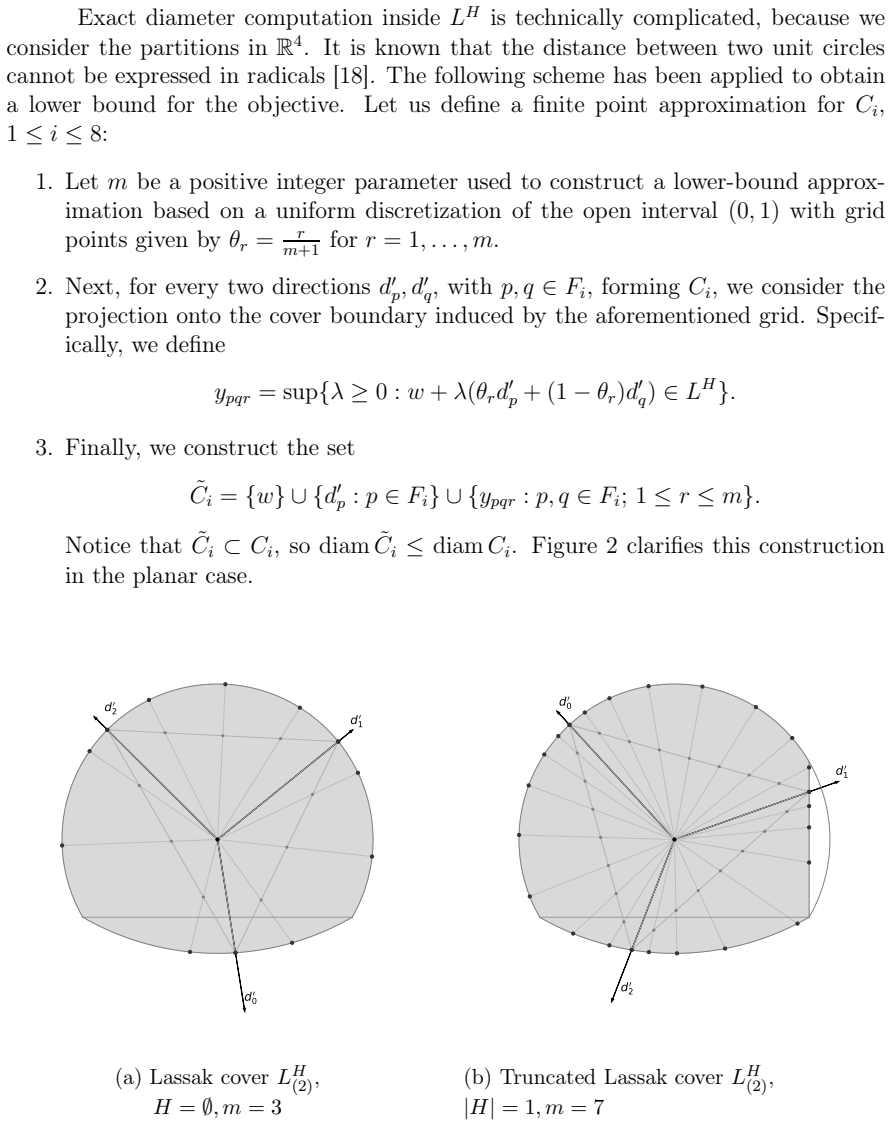
read point-by-point responses
-
Referee: [Abstract and §1] Abstract and §1: The claim that the 8-partitions of the truncated Lassak cover variants imply b(4) ≤ 8 requires an explicit reduction showing that every unit-diameter set F ⊂ R^4 is either contained in one of the treated variants or can be mapped to such a variant without increasing the minimal number of smaller-diameter parts. No such lemma or reference to a prior reduction is supplied, leaving the quantification over all F unaddressed.
Authors: We acknowledge the gap. In the revised manuscript we will insert a new lemma (placed after the statement of the main result) that supplies the required reduction. The lemma will state that any set F of unit diameter in R^4 is congruent to a subset of one of the enumerated variants of the truncated Lassak cover, or can be affinely mapped into such a variant while preserving or decreasing all pairwise distances. The argument relies on the extremal properties already established by Lassak together with a case analysis on the possible supporting hyperplanes and diameter-realizing pairs; we will include a short proof sketch and a reference to the relevant parts of Lassak’s 1982 construction. revision: yes
-
Referee: [Construction sections (e.g., §3–§5)] The manuscript focuses on the geometric construction for the specific covers but supplies no verification that these variants include all configurations that previously forced nine parts under Lassak's method. Without this, the improvement from 9 to 8 remains conditional on an unstated completeness assumption.
Authors: We agree that an explicit completeness argument is missing. In the revision we will add a short subsection (new §2.3) that verifies the chosen variants are exhaustive for the configurations that required nine parts in Lassak’s original partition. The argument proceeds by enumerating the possible ways a 9-partition can arise from the truncated cover (via the positions of the four truncated vertices and the equatorial belt) and showing that each such configuration is isometric to one of the variants we partition into eight sets. This will remove the conditional character of the bound. revision: yes
Circularity Check
No circularity: explicit geometric partitions of specific covers
full rationale
The paper's derivation consists of constructing explicit 8-partitions for several variants of the truncated Lassak cover, each with diameter less than 1. This is a direct constructive argument that does not invoke fitted parameters renamed as predictions, self-definitional loops, or load-bearing self-citations whose content reduces to the present work. The central claim follows from the geometry of the chosen covers without any reduction by construction to the input assumptions; the derivation remains self-contained against external benchmarks such as the prior Lassak bound.
Axiom & Free-Parameter Ledger
axioms (1)
- standard math Euclidean distance defines diameter in the usual way
Lean theorems connected to this paper
-
IndisputableMonolith/Foundation/AlexanderDuality.leanalexander_duality_circle_linking unclear?
unclearRelation between the paper passage and the cited Recognition theorem.
we construct partitions of several variants of the truncated Lassak cover into 8 parts of diameter less than 1, thereby showing that b(4)≤8
What do these tags mean?
- matches
- The paper's claim is directly supported by a theorem in the formal canon.
- supports
- The theorem supports part of the paper's argument, but the paper may add assumptions or extra steps.
- extends
- The paper goes beyond the formal theorem; the theorem is a base layer rather than the whole result.
- uses
- The paper appears to rely on the theorem as machinery.
- contradicts
- The paper's claim conflicts with a theorem or certificate in the canon.
- unclear
- Pith found a possible connection, but the passage is too broad, indirect, or ambiguous to say the theorem truly supports the claim.
Reference graph
Works this paper leans on
-
[1]
A. Berdnikov and A. Raigorodskii. Bounds on Borsuk numbe rs in distance graphs of a special type. Problems of Information Transmission , 57:136–142, 04 2021
work page 2021
-
[2]
A. Bondarenko. On Borsuk’s conjecture for two-distance sets. Discrete & Com- putational Geometry, 51(3):509–515, 2014
work page 2014
-
[3]
K. Borsuk. Drei S¨ atze ¨ uber die n-dimensionale euklidi sche Sph¨ are. Fundamenta Mathematicae, 20:177–190, 1933
work page 1933
-
[4]
J. Bourgain and J. Lindenstrauss. On convering a set in Rn by balls of the same diameter. Geometric Aspects of Functional Analysis , pages 138–144, 1991
work page 1991
-
[5]
H. G. Eggleston. Covering a three-dimensional set with s ets of smaller diameter. Journal of the London Mathematical Society , s1-30(1):11–24, jan 1955
work page 1955
- [6]
-
[7]
B. Gr¨ unbaum. A simple proof of borsuk’s conjecture in th ree dimensions. In Math- ematical Proceedings of the Cambridge Philosophical Socie ty, volume 53, pages 776–778. Cambridge University Press, 1957
work page 1957
-
[8]
A. Heppes. T´ erbeli ponthalmazok feloszt´ asa kisebb ´ a tm´ er˝ oj˝ u r´ eszhalmazok ¨ osszeg´ ere.A magyar tudom´ anyos akad´ emia, 7:413–416, 1957. 11
work page 1957
-
[9]
T. Jenrich and A. E. Brouwer. A 64-dimensional counterex ample to Borsuk’s conjecture. The Electronic Journal of Combinatorics , pages 4–29, 2014
work page 2014
-
[10]
H. W. E. Jung. ¨Uber die kleinste kugel, die eine r¨ aumliche figur einschließt. Journal f¨ ur die reine und angewandte Mathematik , 123:241–257, 1901
work page 1901
-
[11]
J. Kahn and G. Kalai. A counterexample to borsuk’s conje cture. Bulletin of the American Mathematical Society , 29(1):60–62, 1993
work page 1993
-
[12]
D. P. Kingma and J. Ba. Adam: A method for stochastic opti mization. arXiv preprint arXiv:1412.6980 , 2017
work page internal anchor Pith review Pith/arXiv arXiv 2017
-
[13]
Blackbox: A procedure for parallel optimization of expensive black-box functions
P. Knysh and Y. Korkolis. Blackbox: A procedure for para llel optimization of expensive black-box functions. arXiv preprint arXiv:1605.00998 , 2016
work page internal anchor Pith review Pith/arXiv arXiv 2016
-
[14]
A. Kupavskii and A. Raigorodskii. Partition of three-d imensional sets into five parts of smaller diameter. Mathematical Notes , 87:218–229, 01 2010
work page 2010
-
[15]
M. Lassak. An estimate concerning borsuk partition pro blem. Bulletin de l’Acad´ emie Polonaise des Sciences. S´ erie des Sciences Ma th´ ematiques, 30(9- 10):449–451, 1982
work page 1982
-
[16]
V. V. Makeev. Affine images of the rhombo-dodecahedron th at are circum- scribed about a three-dimensional convex body. Journal of Mathematical Sciences , 100(3):2307–2309, 2000
work page 2000
-
[17]
J. C. Mitchell. Sampling rotation groups by successive orthogonal images. SIAM Journal on Scientific Computing , 30(1):525–547, 2008
work page 2008
-
[18]
C. A. Neff. Finding the distance between two circles in th ree-dimensional space. IBM journal of research and development , 34(5):770–775, 1990
work page 1990
-
[19]
J. A. Nelder and R. Mead. A simplex method for function mi nimization. The computer journal, 7(4):308–313, 1965
work page 1965
-
[20]
A. Paszke, S. Gross, F. Massa, A. Lerer, J. Bradbury, G. C hanan, T. Killeen, Z. Lin, N. Gimelshein, L. Antiga, A. Desmaison, A. K¨ opf, E. Y ang, Z. DeVito, M. Raison, A. Tejani, S. Chilamkurthy, B. Steiner, L. Fang, a nd S. Chintala. Pytorch: An imperative style, high-performance deep learn ing library. In Advances in Neural Information Processing Syste...
work page 2019
-
[21]
J. Perkal. Sur la subdivision des ensembles en parties d e diam` etre inf´ erieur. In Colloq. Math , volume 1, page 45, 1947
work page 1947
-
[22]
X. Qi, X. Zhang, Y. Lyu, and S. Wu. Universal covering sys tem and borsuk’s problem in finite dimensional banach spaces. Axioms, 14(4):277, 2025
work page 2025
-
[23]
A. Raigorodskii. On a bound in borsuk’s problem. Russian Mathematical Surveys , 54(2):453–454, 1999. 12
work page 1999
-
[24]
A. Raigorodskii. Coloring distance graphs and graphs o f diameters. thirty essays on geometric graph theory. Lecture Notes in Math. , pages 429–460, 01 2013
work page 2013
-
[25]
A. Raigorodskii. On dividing sets into parts of smaller diameter. Doklady Mathe- matics, 102:510–512, 11 2020
work page 2020
-
[26]
A. M. Raigorodskii. Three lectures on the borsuk partit ion problem. In Surveys in Contemporary Mathematics, volume 347 of London Mathematical Society Lecture Note Series , pages 202–247. Cambridge University Press, Cambridge, 20 07
-
[27]
A. Tolmachev and V. Voronov. Borsuk number in R4, 2026. https://github.com/Alexandr-Tolmachev/borsuk-problem-r4
work page 2026
-
[28]
A. D. Tolmachev and D. S. Protasov. Covering planar sets . Doklady Mathematics , 104(1):196–199, July 2021
work page 2021
-
[29]
A. D. Tolmachev, D. S. Protasov, and V. A. Voronov. Cover ings of planar and three-dimensional sets with subsets of smaller diameter. Discrete Applied Mathe- matics, 320:270–281, 10 2022
work page 2022
- [30]
-
[31]
C. Zong. Borsuk’s partition conjecture. Japanese Journal of Mathematics , 16(2):185–201, July 2021. A. Construction of a circumscribed polyhedron in Rn We describe a procedure for constructing a polyhedral outer approximation (circumscribed polyhedron) of a set arising from a universa l covering set (UCS) in Rn
work page 2021
-
[32]
Let LH =L(n)∩ ( ⋂t i=1{x∈ Rn :⟨x,a i⟩ +bi≤ 0} ) be a subset of the UCS obtained as the intersection of the Lassak cover L(n) (see Theorem 4) with a finite family of t halfspaces defined by H ={(ai,b i) : ai∈ Rn, b i∈ R, i = 1,...,t }
-
[33]
Consider a uniform discretization of the boundary of the u nit hypercube: G = { 0, 1 m,..., m− 1 m , 1 }n \ { 1 m,..., m− 1 m }n , i.e., G = { (i1,...,i n) : ij∈{ 0, 1 m,..., m− 1 m , 1}, ∃j such that ij∈{ 0, 1} } . This set represents the discretization of the hypercube boundar y. The integer param- eter m used as “grid_size” in our code [27]. Table 1 pr...
-
[34]
Let the ball B0, forming L(n), is centered at c0 with radius r. Define G1 ={c0 +r·(p− (1/ 2,..., 1/ 2)) : p∈ G}, which corresponds to the discretized boundary of a hypercub e centered at c0. For each X∈ G1, consider the ray c0X and define G2 ={c0X∩ ∂L(n) :X∈ G1}, i.e., the set of intersection points of these rays with the bo undary of L(n)
-
[35]
Define the polyhedron P =⋂ p∈ G2Hp, where Hp is the halfspace bounded by hp and containing c0
For each point p∈ G2, let hp be the supporting (tangent) hyperplane to L(n) at p (in practice, to one of the balls defining L(n)). Define the polyhedron P =⋂ p∈ G2Hp, where Hp is the halfspace bounded by hp and containing c0
-
[36]
Define PH = P∩ ( ⋂t i=1{x :⟨x,a i⟩ +bi≤ 0} ) , which serves as a polyhedral approximation of LH
The set P is a convex polyhedral outer approximation of L(n). Define PH = P∩ ( ⋂t i=1{x :⟨x,a i⟩ +bi≤ 0} ) , which serves as a polyhedral approximation of LH . Figure 3 illustrates this construction in the planar case. F or n = 2 the in- tersection of the two spheres forming the boundary of the Las sak cover is a circle of radius 1
-
[37]
This figure shows a discretized set of directions, the corre sponding boundary points obtained by radial projection from the center, and th e supporting lines defining a polygonal outer approximation of these covers in planar ca se. Note that, due to the simmetricity of the following truncation (see Figure 3b), b oth filled sets are universal covering sets i...
discussion (0)
Sign in with ORCID, Apple, or X to comment. Anyone can read and Pith papers without signing in.