REVIEW 2 major objections 2 minor 1 cited by
Robust Shattering Arguments
T0 review · 2 major / 2 minor · reviewed 2026-06-29 · grok-4.3
Pith's one-line read Shattering arguments for distributed algorithms require new decay bounds after independence assumptions fail.
desk verdict The paper shows independence assumptions fail in super-constant-round shattering and supplies counterexamples plus new decay bounds to repair MIS, coloring, and Fischer-Ghaffari LLL analyses. read the letter →
The pith
A machine-rendered reading of the paper's core claim, the machinery that carries it, and where it could break.
The reading
What carries the argument
General tools that capture common patterns in modern algorithms and produce decay bounds on unresolved components without relying on independence assumptions.
What would settle it
A concrete calculation or simulation on a graph family showing that the probability of large unresolved components after the pre-shattering phase does not decay at the rate claimed by the new bounds.
Extended reading notes
Core claim
The central claim is that locality-based independence assumptions do not hold for pre-shattering phases lasting more than a constant number of rounds, so several standard shattering arguments are incomplete; the repair derives the required probability decay bounds on the size of unresolved node sets directly from the algorithm structure, without independence, and applies this method to obtain a correct shattering analysis for the Fischer-Ghaffari LLL algorithm while also giving counterexamples to common shattering lemmas.
Load-bearing premise
The new decay bounds on the probability of large unresolved sets are correctly derived from the algorithm behavior without using independence.
Editorial extensions
If this is right
- The shattering analysis of the Fischer-Ghaffari LLL algorithm is now complete.
- The shattering arguments for maximal independent set and (Δ+1)-coloring are repaired by the same method.
- Explicit counterexamples demonstrate that several commonly used shattering lemmas are false.
- Shattering arguments can be made robust even when long-range dependencies are present.
Reading between the lines
- The same dependency-accumulation problem may appear in other distributed techniques that rely on locality to separate random choices.
- The new tools could be tested on additional algorithms that combine many rounds of local computation with a shattering step.
- If the decay bounds hold in practice, they would also support analyses in the CONGEST model where message sizes constrain information flow.
Editorial analysis
A structured set of objections, weighed in public.
Referee Report
Summary. The paper argues that locality-based independence assumptions underlying standard shattering arguments fail when pre-shattering procedures run for super-constant rounds, because dependencies accumulate. It supplies explicit counterexamples to commonly used shattering lemmas, develops general tools for obtaining the required decay bounds without those assumptions, and uses the tools to repair the analyses for maximal independent set, (Δ+1)-coloring, and especially the Fischer-Ghaffari distributed LLL algorithm.
Significance. Shattering is a foundational technique for sublogarithmic-time LOCAL algorithms; a reusable set of decay-bound tools that replace invalidated independence steps would strengthen many existing results. The explicit counterexamples and the corrected Fischer-Ghaffari analysis are concrete contributions that directly address load-bearing gaps in the literature.
major comments (2)
- [§4.2, Theorem 4.4] §4.2, Theorem 4.4 (general decay tool): the claimed exponential decay rate is obtained by iterating a recurrence that bounds the probability a node remains bad after t rounds; the recurrence step invokes a union bound whose error term depends on the maximum degree of the dependency graph induced by the pre-shattering procedure. The manuscript does not explicitly verify that this degree remains O(Δ) rather than growing with t, which is load-bearing for the subsequent application to the Fischer-Ghaffari LLL.
- [§5.3] §5.3, the repaired LLL analysis: the final success probability 1-1/poly(n) is obtained by plugging the new decay bound into the standard LLL criterion. If the constant hidden in the O(·) of the decay rate is larger than the manuscript assumes, the criterion fails for the parameter regime stated in the original Fischer-Ghaffari paper; a concrete numerical check of the constants would confirm the repair goes through.
minor comments (2)
- [§3] Notation for the dependency graph G_dep is introduced in §3 but used without redefinition in §4; a one-sentence reminder would improve readability.
- [Figure 2] Figure 2 (counterexample for the MIS shattering lemma) would benefit from an explicit statement of the round complexity at which the independence assumption breaks.
Simulated Author's Rebuttal
We thank the referee for the careful reading and constructive comments on the decay bounds and LLL application. We respond to each major comment below.
read point-by-point responses
-
Referee: [§4.2, Theorem 4.4] §4.2, Theorem 4.4 (general decay tool): the claimed exponential decay rate is obtained by iterating a recurrence that bounds the probability a node remains bad after t rounds; the recurrence step invokes a union bound whose error term depends on the maximum degree of the dependency graph induced by the pre-shattering procedure. The manuscript does not explicitly verify that this degree remains O(Δ) rather than growing with t, which is load-bearing for the subsequent application to the Fischer-Ghaffari LLL.
Authors: We agree that an explicit verification is required for rigor. The pre-shattering procedures analyzed (e.g., for MIS and coloring) perform only constant-radius local operations per round, so each bad event depends on a fixed-radius neighborhood; consequently the induced dependency graph has maximum degree O(Δ) independent of t. We will add an explicit lemma in the revised §4.2 proving this degree bound. revision: yes
-
Referee: [§5.3] §5.3, the repaired LLL analysis: the final success probability 1-1/poly(n) is obtained by plugging the new decay bound into the standard LLL criterion. If the constant hidden in the O(·) of the decay rate is larger than the manuscript assumes, the criterion fails for the parameter regime stated in the original Fischer-Ghaffari paper; a concrete numerical check of the constants would confirm the repair goes through.
Authors: We will incorporate a concrete numerical verification in the revised §5.3, evaluating the hidden constants in the decay rate for representative Δ values and confirming that the resulting bound satisfies the LLL criterion (and yields 1-1/poly(n) success) for the parameter regime of the original Fischer-Ghaffari algorithm. revision: yes
Circularity Check
No circularity: new decay bounds derived independently of invalidated independence assumptions
full rationale
The paper explicitly identifies the failure of locality-based independence for super-constant-round pre-shattering procedures and supplies general tools to derive the required decay bounds without those assumptions. The central contribution is a corrected analysis of the Fischer-Ghaffari LLL plus repairs for MIS and coloring; these rest on the new tools rather than re-using the flawed steps, self-definitions, or load-bearing self-citations. No quoted equations or steps reduce by construction to the paper's own inputs or prior self-citations. The derivation chain is therefore self-contained against external probabilistic bounds.
Assumptions & free parameters
assumptions (1)
- standard math Standard axioms of probability theory and graph theory
Cite this review
Pith. "Pith review of Robust Shattering Arguments." pith.science (2026). https://pith.science/paper/SSU6XOCJ
@misc{pith2026260627847,
  author       = {Pith},
  title        = {Pith review of: Robust Shattering Arguments},
  year         = {2026},
  howpublished = {\url{https://pith.science/paper/SSU6XOCJ}},
  note         = {Machine review of arXiv:2606.27847}
}
abstract
Graph shattering is a central technique underlying sublogarithmic-time distributed algorithms in the LOCAL model. Its analysis typically relies on bounding the probability that large sets of distant nodes remain unresolved, often via independence assumptions justified by locality. We show that these assumptions fail for pre-shattering procedures that run for super-constant rounds, where dependencies accumulate over time. As a result, several standard shattering arguments in the literature are incomplete, including those for maximal independent set, $(\Delta+1)$-coloring, and the distributed Lov\'asz Local Lemma (LLL). We provide a systematic repair of these analyses. Our main contribution is a corrected shattering analysis of the Fischer--Ghaffari LLL algorithm. In addition, we develop general tools that capture common patterns in modern algorithms and yield the required decay bounds without relying on independence. We also present explicit counterexamples to commonly used shattering lemmas. Overall, we establish a robust and reusable foundation for shattering arguments in the presence of long-range dependencies.
Figures

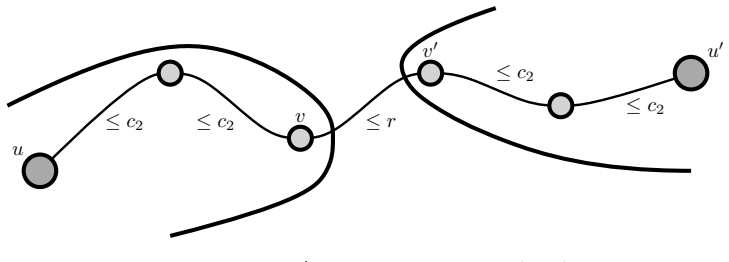

Forward citations
Cited by 1 Pith paper
-
Distributed Symmetry Breaking on Hyperbolic Random Graphs
MIS and MM on hyperbolic random graphs admit Õ(log^{5/3} log n)-round LOCAL algorithms and an Ω(log log n / log log log n) lower bound, via new d-ary tree substructures.
Reference graph
Works this paper leans on
-
[1]
Halld´ orsson, and Alexandre Nolin
Duncan Adamson, Magn´ us M. Halld´ orsson, and Alexandre Nolin. Distributed coloring of hypergraphs. In Sergio Rajsbaum, Alkida Balliu, Joshua J. Daymude, and Dennis Olivetti, editors,Proc. Int. Coll. on Structural Information and Communication Complexity (SIROCCO), volume 13892 ofLecture Notes in Computer Science, pages 89–111. Springer, 2023
2023
-
[2]
Ziegler.Proofs from THE BOOK
Martin Aigner and G¨ unter M. Ziegler.Proofs from THE BOOK. Springer-Verlag Berlin Heidelberg. Springer, 6 edition, 2018
2018
-
[3]
A parallel algorithmic version of the local lemma.Random Struct
Noga Alon. A parallel algorithmic version of the local lemma.Random Struct. Algorithms, 2(4):367–378, 1991
1991
-
[4]
Almost global prob- lems in the LOCAL model
Alkida Balliu, Sebastian Brandt, Dennis Olivetti, and Jukka Suomela. Almost global prob- lems in the LOCAL model. In32nd International Symposium on Distributed Computing, DISC 2018, New Orleans, LA, USA, October 15-19, 2018, pages 9:1–9:16, 2018. 26
2018
-
[5]
Korhonen, Tuomo Lempi¨ ainen, Dennis Olivetti, and Jukka Suomela
Alkida Balliu, Juho Hirvonen, Janne H. Korhonen, Tuomo Lempi¨ ainen, Dennis Olivetti, and Jukka Suomela. New classes of distributed time complexity. InProceedings of the 50th Annual ACM SIGACT Symposium on Theory of Computing, STOC 2018, Los Angeles, CA, USA, June 25-29, 2018, pages 1307–1318, 2018
2018
-
[6]
On the complexity of distributed splitting problems
Philipp Bamberger, Mohsen Ghaffari, Fabian Kuhn, Yannic Maus, and Jara Uitto. On the complexity of distributed splitting problems. In Peter Robinson and Faith Ellen, editors, Proceedings of the 2019 ACM Symposium on Principles of Distributed Computing, PODC 2019, Toronto, ON, Canada, July 29 - August 2, 2019, pages 280–289. ACM, 2019
2019
-
[7]
Barenboim
L. Barenboim. Deterministic (∆ + 1)-coloring in sublinear (in ∆) time in static, dynamic and faulty networks. InProc. 34th ACM Symposium on Principles of Distributed Comput- ing (PODC), pages 345–354, 2015
2015
-
[8]
Morgan & Claypool Publishers, 2013
Leonid Barenboim and Michael Elkin.Distributed Graph Coloring: Fundamentals and Recent Developments. Morgan & Claypool Publishers, 2013
2013
Show all 66 references
-
[9]
Goldenberg
Leonid Barenboim, Michael Elkin, and U. Goldenberg. Locally-iterative distributed (∆+1)- coloring below Szegedy-Vishwanathan barrier, and applications to self-stabilization and to restricted-bandwidth models. InProc. ACM Symp. on Principles of Distributed Computing (PODC), 2018
2018
-
[10]
The locality of distributed symmetry breaking.J
Leonid Barenboim, Michael Elkin, Seth Pettie, and Johannes Schneider. The locality of distributed symmetry breaking.J. ACM, 63(3):20:1–20:45, 2016
2016
-
[11]
Nearly-optimal distributed ruling sets for trees and high-girth graphs
Malte Baumecker, Yannic Maus, and Jara Uitto. Nearly-optimal distributed ruling sets for trees and high-girth graphs. In Alkida Balliu and Fabian Kuhn, editors,Proceedings of the ACM Symposium on Principles of Distributed Computing, PODC 2025, Hotel Las Brisas Huatulco, Huatul...
2025
-
[12]
An algorithmic approach to the Lov´ asz local lemma
J´ ozsef Beck. An algorithmic approach to the Lov´ asz local lemma. I.Random Struct. Algorithms, 2(4):343–366, 1991
1991
-
[13]
The randomized local compu- tation complexity of the Lov´ asz local lemma
Sebastian Brandt, Christoph Grunau, and V´ aclav Rozhon. The randomized local compu- tation complexity of the Lov´ asz local lemma. In Avery Miller, Keren Censor-Hillel, and Janne H. Korhonen, editors,PODC ’21: ACM Symposium on Principles of Distributed Computing, Virtual Even...
2021
-
[14]
On the locality of Hall’s theorem
Sebastian Brandt, Yannic Maus, Ananth Narayanan, Florian Schager, and Jara Uitto. On the locality of Hall’s theorem. In Yossi Azar and Debmalya Panigrahi, editors,Proceedings of the 2025 Annual ACM-SIAM Symposium on Discrete Algorithms, SODA 2025, New Orleans, LA, USA, January...
2025
-
[15]
PhD thesis, University of Michigan, USA, 2019
Yi-Jun Chang.Locality of Distributed Graph Problems. PhD thesis, University of Michigan, USA, 2019
2019
-
[16]
Distributed edge coloring and a special case of the constructive Lov´ asz local lemma.ACM Trans
Yi-Jun Chang, Qizheng He, Wenzheng Li, Seth Pettie, and Jara Uitto. Distributed edge coloring and a special case of the constructive Lov´ asz local lemma.ACM Trans. Algorithms, 16(1):8:1–8:51, 2020
2020
-
[17]
An exponential separation between ran- domized and deterministic complexity in the LOCAL model.SIAM J
Yi-Jun Chang, Tsvi Kopelowitz, and Seth Pettie. An exponential separation between ran- domized and deterministic complexity in the LOCAL model.SIAM J. Comput., 48(1):122– 143, 2019
2019
-
[18]
An optimal distributed (∆+1)-coloring algorithm? InProc
Yi-Jun Chang, Wenzheng Li, and Seth Pettie. An optimal distributed (∆+1)-coloring algorithm? InProc. ACM Symp. on Theory of Computing (STOC), pages 445–456, 2018. 27
2018
-
[19]
Distributed (∆ + 1)-coloring via ultrafast graph shattering.SIAM Journal on Computing, 49(3):497–539, 2020
Yi-Jun Chang, Wenzheng Li, and Seth Pettie. Distributed (∆ + 1)-coloring via ultrafast graph shattering.SIAM Journal on Computing, 49(3):497–539, 2020
2020
-
[20]
A time hierarchy theorem for the LOCAL model.SIAM J
Yi-Jun Chang and Seth Pettie. A time hierarchy theorem for the LOCAL model.SIAM J. Comput., 48(1):33–69, 2019
2019
-
[21]
Distributed algorithms for the Lov´ asz local lemma and graph coloring.Distributed Comput., 30(4):261–280, 2017
Kai-Min Chung, Seth Pettie, and Hsin-Hao Su. Distributed algorithms for the Lov´ asz local lemma and graph coloring.Distributed Comput., 30(4):261–280, 2017
2017
-
[22]
Component Stability in Low-Space Mas- sively Parallel Computation
Artur Czumaj, Peter Davies, and Merav Parter. Component Stability in Low-Space Mas- sively Parallel Computation. InProc. ACM Symp. on Principles of Distributed Computing (PODC), 2021
2021
-
[23]
Improved deterministic (∆+1) coloring in low-space MPC
Artur Czumaj, Peter Davies, and Merav Parter. Improved deterministic (∆+1) coloring in low-space MPC. In Avery Miller, Keren Censor-Hillel, and Janne H. Korhonen, editors, PODC ’21: ACM Symposium on Principles of Distributed Computing, Virtual Event, Italy, July 26-30, 2021, p...
2021
-
[24]
Improved distributed algorithms for the lov´ asz local lemma and edge coloring
Peter Davies. Improved distributed algorithms for the lov´ asz local lemma and edge coloring. In Nikhil Bansal and Viswanath Nagarajan, editors,Proc. ACM-SIAM Symp. on Discrete Algorithms (SODA), pages 4273–4295. SIAM, 2023
2023
-
[25]
Problems and Results on 3-chromatic Hypergraphs and some Related Questions.Colloquia Mathematica Societatis J´ anos Bolyai, pages 609–627, 1974
Paul Erd¨ os and L´ aszl´ o Lov´ asz. Problems and Results on 3-chromatic Hypergraphs and some Related Questions.Colloquia Mathematica Societatis J´ anos Bolyai, pages 609–627, 1974
1974
-
[26]
Sublogarithmic distributed algorithms for Lov´ asz local lemma, and the complexity hierarchy
Manuela Fischer and Mohsen Ghaffari. Sublogarithmic distributed algorithms for Lov´ asz local lemma, and the complexity hierarchy. InProc. Int. Symp. on Distributed Computing (DISC), volume 91 ofLIPIcs, pages 18:1–18:16. SD - LZI, 2017
2017
-
[27]
Halld´ orsson, and Alexandre Nolin
Maxime Flin, Magn´ us M. Halld´ orsson, and Alexandre Nolin. Fast coloring despite con- gested relays. In Rotem Oshman, editor,Proc. Int. Symp. on Distributed Computing (DISC), volume 281 ofLIPIcs, pages 19:1–19:24. Schloss Dagstuhl - Leibniz-Zentrum f¨ ur Informatik, 2023
2023
-
[28]
Halld´ orsson, and Alexandre Nolin
Maxime Flin, Magn´ us M. Halld´ orsson, and Alexandre Nolin. Decentralized distributed graph coloring II: degree+1-coloring virtual graphs. In Dan Alistarh, editor,38th Inter- national Symposium on Distributed Computing, DISC 2024, Madrid, Spain, October 28 - November 1, 2024,...
2024
-
[29]
Halld´ orsson, and Alexandre Nolin
Maxime Flin, Magn´ us M. Halld´ orsson, and Alexandre Nolin. Decentralized distributed graph coloring: Cluster graphs. In Alkida Balliu and Fabian Kuhn, editors,Proceedings of the ACM Symposium on Principles of Distributed Computing, PODC 2025, Hotel Las Brisas Huatulco, Huatu...
2025
-
[30]
Local conflict coloring
Pierre Fraigniaud, Marc Heinrich, and Adrian Kosowski. Local conflict coloring. InProc. Symp. on Foundations of Computer Science (FOCS), pages 625–634, 2016
2016
-
[31]
A randomized distributed algorithm for the maximal in- dependent set problem in growth-bounded graphs
Beat Gfeller and Elias Vicari. A randomized distributed algorithm for the maximal in- dependent set problem in growth-bounded graphs. InProc. ACM Symp. on Principles of Distributed Computing (PODC), pages 53–60. ACM, 2007
2007
-
[32]
An improved distributed algorithm for maximal independent set
Mohsen Ghaffari. An improved distributed algorithm for maximal independent set. In Robert Krauthgamer, editor,Proceedings of the Twenty-Seventh Annual ACM-SIAM Sym- posium on Discrete Algorithms, SODA 2016, Arlington, VA, USA, January 10-12, 2016, pages 270–277. SIAM, 2016. 28
2016
-
[33]
Distributed maximal independent set using small messages
Mohsen Ghaffari. Distributed maximal independent set using small messages. In Tim- othy M. Chan, editor,Proceedings of the Thirtieth Annual ACM-SIAM Symposium on Discrete Algorithms, SODA 2019, San Diego, California, USA, January 6-9, 2019, pages 805–820. SIAM, 2019
2019
-
[34]
Local computation of maximal independent set
Mohsen Ghaffari. Local computation of maximal independent set. In63rd IEEE Annual Symposium on Foundations of Computer Science, FOCS 2022, Denver, CO, USA, October 31 - November 3, 2022, pages 438–449. IEEE, 2022
2022
-
[35]
Faster deterministic distributed MIS and approx- imate matching
Mohsen Ghaffari and Christoph Grunau. Faster deterministic distributed MIS and approx- imate matching. In Barna Saha and Rocco A. Servedio, editors,Proceedings of the 55th Annual ACM Symposium on Theory of Computing, STOC 2023, Orlando, FL, USA, June 20-23, 2023, pages 1777–17...
2023
-
[36]
Near-optimal network decomposition and ruling set, and improved mis
Mohsen Ghaffari and Christoph Grunau. Near-optimal network decomposition and ruling set, and improved mis. InProc. Symp. on Foundations of Computer Science (FOCS), 2024
2024
-
[37]
Harris, and Fabian Kuhn
Mohsen Ghaffari, David G. Harris, and Fabian Kuhn. On derandomizing local distributed algorithms. In59th IEEE Annual Symposium on Foundations of Computer Science, FOCS 2018, Paris, France, October 7-9, 2018, pages 662–673, 2018
2018
-
[38]
Improved distributed delta-coloring
Mohsen Ghaffari, Juho Hirvonen, Fabian Kuhn, and Yannic Maus. Improved distributed delta-coloring. In Calvin Newport and Idit Keidar, editors,Proceedings of the 2018 ACM Symposium on Principles of Distributed Computing, PODC 2018, Egham, United Kingdom, July 23-27, 2018, pages...
2018
-
[39]
Deterministic distributed vertex coloring: Simpler, faster, and without network decomposition
Mohsen Ghaffari and Fabian Kuhn. Deterministic distributed vertex coloring: Simpler, faster, and without network decomposition. In62nd IEEE Annual Symposium on Foun- dations of Computer Science, FOCS 2021, Denver, CO, USA, February 7-10, 2022, pages 1009–1020. IEEE, 2021
2021
-
[40]
On the complexity of local distributed graph problems
Mohsen Ghaffari, Fabian Kuhn, and Yannic Maus. On the complexity of local distributed graph problems. InProceedings of the 49th Annual ACM SIGACT Symposium on Theory of Computing, STOC 2017, Montreal, QC, Canada, June 19-23, 2017, pages 784–797, 2017
2017
-
[41]
Distributed degree splitting, edge coloring, and ori- entations
Mohsen Ghaffari and Hsin-Hao Su. Distributed degree splitting, edge coloring, and ori- entations. In Philip N. Klein, editor,Proc. ACM-SIAM Symp. on Discrete Algorithms (SODA), pages 2505–2523. SIAM, 2017
2017
-
[42]
Sparsifying distributed algorithms with ramifications in massively parallel computation and centralized local computation
Mohsen Ghaffari and Jara Uitto. Sparsifying distributed algorithms with ramifications in massively parallel computation and centralized local computation. In Timothy M. Chan, editor,Proceedings of the Thirtieth Annual ACM-SIAM Symposium on Discrete Algo- rithms, SODA 2019, San...
2019
-
[43]
Halld´ orsson, Fabian Kuhn, Yannic Maus, and Alexandre Nolin
Magn´ us M. Halld´ orsson, Fabian Kuhn, Yannic Maus, and Alexandre Nolin. Coloring fast without learning your neighbors’ colors. In Hagit Attiya, editor,34th International Sym- posium on Distributed Computing, DISC 2020, October 12-16, 2020, Virtual Conference, volume 179 ofLI...
2020
-
[44]
Halld´ orsson, Fabian Kuhn, Yannic Maus, and Tigran Tonoyan
Magn´ us M. Halld´ orsson, Fabian Kuhn, Yannic Maus, and Tigran Tonoyan. Efficient ran- domized distributed coloring in CONGEST. In Samir Khuller and Virginia Vassilevska Williams, editors,STOC ’21: 53rd Annual ACM SIGACT Symposium on Theory of Com- puting, Virtual Event, Ital...
2021
-
[45]
Halld´ orsson, Fabian Kuhn, Alexandre Nolin, and Tigran Tonoyan
Magn´ us M. Halld´ orsson, Fabian Kuhn, Alexandre Nolin, and Tigran Tonoyan. Near- optimal distributed degree+1 coloring. In Stefano Leonardi and Anupam Gupta, editors, Proc. ACM Symp. on Theory of Computing (STOC), pages 450–463. ACM, 2022
2022
-
[46]
Halld´ orsson, Yannic Maus, and Alexandre Nolin
Magn´ us M. Halld´ orsson, Yannic Maus, and Alexandre Nolin. Fast distributed vertex split- ting with applications. In Christian Scheideler, editor,Proc. Int. Symp. on Distributed Computing (DISC), volume 246 ofLIPIcs, pages 26:1–26:24. Schloss Dagstuhl - Leibniz- Zentrum f¨ u...
2022
-
[47]
Halld´ orsson, Yannic Maus, and Saku Peltonen
Magn´ us M. Halld´ orsson, Yannic Maus, and Saku Peltonen. Distributed Lov´ asz local lemma under bandwidth limitations.CoRR, abs/2405.07353, 2024
2024
-
[48]
Halld´ orsson and Alexandre Nolin
Magn´ us M. Halld´ orsson and Alexandre Nolin. Superfast coloring in CONGEST via efficient color sampling.Theor. Comput. Sci., 948:113711, 2023
2023
-
[49]
Halld´ orsson, Alexandre Nolin, and Tigran Tonoyan
Magn´ us M. Halld´ orsson, Alexandre Nolin, and Tigran Tonoyan. Overcoming congestion in distributed coloring. In Alessia Milani and Philipp Woelfel, editors,PODC ’22: ACM Symposium on Principles of Distributed Computing, Salerno, Italy, July 25 - 29, 2022, pages 26–36. ACM, 2022
2022
-
[50]
A fast and simple randomized parallel algorithm for maximal matching.Inf
Amos Israeli and Alon Itai. A fast and simple randomized parallel algorithm for maximal matching.Inf. Process. Lett., 22(2):77–80, 1986
1986
-
[51]
Feedback from nature: simple randomised dis- tributed algorithms for maximal independent set selection and greedy colouring.Distributed Comput., 29(5):377–393, 2016
Peter Jeavons, Alex Scott, and Lei Xu. Feedback from nature: simple randomised dis- tributed algorithms for maximal independent set selection and greedy colouring.Distributed Comput., 29(5):377–393, 2016
2016
-
[52]
Simple distributed ∆ + 1-coloring of graphs.Inf
¨Ojvind Johansson. Simple distributed ∆ + 1-coloring of graphs.Inf. Process. Lett., 70(5):229–232, 1999
1999
-
[53]
Locality in distributed graph algorithms.SIAM Journal on computing, 21(1):193–201, 1992
Nathan Linial. Locality in distributed graph algorithms.SIAM Journal on computing, 21(1):193–201, 1992
1992
-
[54]
Distributed graph coloring made easy
Yannic Maus. Distributed graph coloring made easy. In Kunal Agrawal and Yossi Azar, editors,SPAA ’21: 33rd ACM Symposium on Parallelism in Algorithms and Architectures, Virtual Event, USA, 6-8 July, 2021, pages 362–372. ACM, 2021
2021
-
[55]
Distributed symmetry breaking on power graphs via sparsification
Yannic Maus, Saku Peltonen, and Jara Uitto. Distributed symmetry breaking on power graphs via sparsification. In Rotem Oshman, Alexandre Nolin, Magn´ us M. Halld´ orsson, and Alkida Balliu, editors,Proceedings of the 2023 ACM Symposium on Principles of Distributed Computing, P...
2023
-
[56]
Distributed symmetry breaking on power graphs via sparsification.Distributed Comput., 38(3):261–296, 2025
Yannic Maus, Saku Peltonen, and Jara Uitto. Distributed symmetry breaking on power graphs via sparsification.Distributed Comput., 38(3):261–296, 2025
2025
-
[57]
Efficient CONGEST algorithms for the Lov´ asz local lemma
Yannic Maus and Jara Uitto. Efficient CONGEST algorithms for the Lov´ asz local lemma. In Seth Gilbert, editor,Proc. Int. Symp. on Distributed Computing (DISC), volume 209 of LIPIcs, pages 31:1–31:19. Schloss Dagstuhl - Leibniz-Zentrum f¨ ur Informatik, 2021
2021
-
[58]
Michael Molloy and Bruce A. Reed. Further algorithmic aspects of the local lemma. In Jeffrey Scott Vitter, editor,Proc. ACM Symp. on Theory of Computing (STOC), pages 524–529. ACM, 1998
1998
-
[59]
Moser and G´ abor Tardos
Robin A. Moser and G´ abor Tardos. A Constructive Proof of the General Lov´ asz Local Lemma.J. ACM, pages 11:1–11:15, 2010. 30
2010
-
[60]
Conflict-free colourings of graphs and hypergraphs.Comb
J´ anos Pach and G´ abor Tardos. Conflict-free colourings of graphs and hypergraphs.Comb. Probab. Comput., 18(5):819–834, 2009
2009
-
[61]
Distributed coloring algorithms for triangle-free graphs
Seth Pettie and Hsin-Hao Su. Distributed coloring algorithms for triangle-free graphs. Information and Computation, 243:263–280, 2015. 40th International Colloquium on Au- tomata, Languages and Programming (ICALP 2013)
2015
-
[62]
Polylogarithmic-time deterministic network decom- position and distributed derandomization
V´ aclav Rozhoˇ n and Mohsen Ghaffari. Polylogarithmic-time deterministic network decom- position and distributed derandomization. InProc. ACM Symp. on Theory of Computing (STOC), pages 350–363, 2020
2020
-
[63]
Fast local computation algo- rithms
Ronitt Rubinfeld, Gil Tamir, Shai Vardi, and Ning Xie. Fast local computation algo- rithms. InProc. Innovations in Computer Science (ICS), pages 223–238. Tsinghua Uni- versity Press, 2011
2011
-
[64]
Symmetry breaking depending on the chromatic number or the neighborhood growth.Theor
Johannes Schneider, Michael Elkin, and Roger Wattenhofer. Symmetry breaking depending on the chromatic number or the neighborhood growth.Theor. Comput. Sci., 509:40–50, 2013. A Small Ball Covers in Post-shattering Degree Reduction.Shattering-based vertex coloring algorithms, e...
2013
-
[65]
It is the element ofRnearest tovinG c[B], with ties broken with IDs
For eachv∈B,b(v)∈Ris theballofv. It is the element ofRnearest tovinG c[B], with ties broken with IDs. Ifdist Gc[B](v, R) =∞, thenvis part of no ball, which we denote byb(v) =⊥. For an elementu∈R, we denote byBall(u) =b −1(u)⊆Bthe nodesv∈Bs.t.b(v) =u
-
[66]
Note that given a setsRandBthe cost of computing a cluster graph essentially scales with how far a node inBcan be from the nearest node inR
For eachu, u ′ ∈R, there is an edge betweenuandu ′ inG ′ iffdist G(Ball(u),Ball(u ′))≤r, i.e., if there exists(v, v ′)∈Ball(u)×Ball(u ′)s.t.dist G(v, v′)≤r. Note that given a setsRandBthe cost of computing a cluster graph essentially scales with how far a node inBcan be from t...
Reviewed June 29, 2026 · model on record in the stance chip above.
Discussion (0). Continue with ORCID to comment.