Kinetics of template-directed multistate copolymerization
Pith reviewed 2026-06-26 09:29 UTC · model grok-4.3
The pith
The kinetic equations for multistate template-directed copolymerization admit exact solutions via a matrix factorization ansatz with backward and forward iterations along the template.
A machine-rendered reading of the paper's core claim, the machinery that carries it, and where it could break.
Core claim
The kinetic equations of these processes can be exactly solved for the mean growth velocity, the sequence probabilities of the grown copy, and the local probabilities and fractions of monomeric units in the copy. Asymptotically, in the long-time limit, the kinetic equations are solved with a matrix factorization ansatz in terms of a backward iteration, forming an iterated matrix function system, and a complementary forward iteration, both running along the template sequence.
What carries the argument
The matrix factorization ansatz consisting of a backward iteration that forms an iterated matrix function system together with a complementary forward iteration, both running along the template sequence.
If this is right
- The mean growth velocity is obtained directly from the iterated matrices without integrating the time-dependent equations.
- The probabilities of every possible sequence in the grown copy follow from the forward iteration once the backward system has converged.
- Local probabilities and the fractions of each monomeric unit at every position along the copy are given by the same matrix products.
- The iterative procedure runs much faster than standard numerical methods for templates of realistic length.
Where Pith is reading between the lines
- The same iteration could be used to extract position-dependent error rates by tracking how the sequence probabilities deviate from the template.
- Because the method separates the backward system from the forward pass, it may allow separate analysis of initiation versus elongation regimes in polymerase models.
- The structure of the iterated matrix function system suggests that changes in a single template site affect only a localized segment of the solution, which could be exploited for modular calculations.
Load-bearing premise
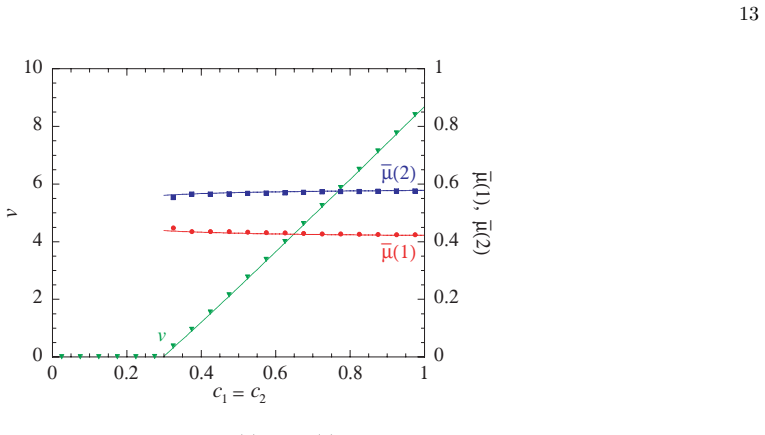
The multistate conformational or activation model is sufficient to capture the dynamics and the long-time asymptotic regime applies so that boundary effects at the template ends can be neglected.
What would settle it
Direct numerical integration of the full set of kinetic equations for a concrete multistate model and a long but finite template, compared against the iterative matrix solution evaluated at the same parameter values, would reveal systematic deviation if the long-time assumption fails.
Figures


read the original abstract
We consider processes of template-directed multistate copolymerization by molecular machines such as polymerases or ribosomes, having multiple states of conformation or activation. We show that the kinetic equations of these processes can be exactly solved for the mean growth velocity, the sequence probabilities of the grown copy, and the local probabilities and fractions of monomeric units in the copy. Asymptotically, in the long-time limit, the kinetic equations are solved with a matrix factorization ansatz in terms of a backward iteration, forming an iterated matrix function system, and a complementary forward iteration, both running along the template sequence. The iterative method is very significantly faster than usual computational methods, as demonstrated with a numerical example.
Editorial analysis
A structured set of objections, weighed in public.
Referee Report
Summary. The paper claims that the kinetic equations for template-directed multistate copolymerization by molecular machines can be exactly solved asymptotically in the long-time limit for the mean growth velocity, sequence probabilities of the grown copy, and local monomer probabilities/fractions. The solution uses a matrix factorization ansatz consisting of a backward iteration (iterated matrix function system along the template) and a complementary forward iteration; the method is asserted to be significantly faster than standard computations, as illustrated by a numerical example.
Significance. If the central derivation holds, the result supplies an exact, closed-form iterative solution for multistate kinetic models of template-directed polymerization. This is a useful advance for theoretical modeling of polymerases, ribosomes, and similar machines, particularly because the matrix ansatz directly satisfies the steady-state master equations for arbitrary templates and yields reproducible, parameter-free outputs once the rate matrices are specified.
minor comments (2)
- [Abstract and § on asymptotic solution] The long-time asymptotic regime and neglect of template-end boundary effects are stated without explicit error bounds or convergence rates; while the framing as asymptotic is appropriate, a brief remark on the expected scaling of the error with template length would strengthen the presentation.
- [Methods/derivation section] Notation for the iterated matrix functions and the forward/backward operators should be introduced with a single consolidated table or definition block to aid readability.
Simulated Author's Rebuttal
We thank the referee for their positive assessment of the manuscript and for recommending acceptance.
Circularity Check
No significant circularity; derivation is self-contained
full rationale
The paper presents a direct solution of the multistate kinetic master equations via an explicitly constructed matrix factorization ansatz (backward iterated matrix function system plus forward iteration) that is designed to satisfy the steady-state conditions along the template in the long-time limit. The ansatz is introduced as a computational method, not derived from or equivalent to the target observables by definition. No load-bearing self-citations, fitted inputs renamed as predictions, or uniqueness theorems imported from prior work appear in the derivation chain. The approach is asymptotically framed with numerical verification on an example, rendering the central claims independent of the inputs.
Axiom & Free-Parameter Ledger
axioms (1)
- domain assumption Kinetic equations for multistate copolymerization are standard master equations for Markov processes with sequence-dependent transition rates.
Reference graph
Works this paper leans on
-
[1]
Length distribution, mean length, and mean growth veloci ty The probability distribution of the copolymer length at time t is defined as pt(l) ≡ I∑ i=1 ∑ m1···ml Pt(m1 · · ·ml,l,i ), (10) which obeys the normalization condition ∑∞ l=0pt(l) = 1, in consistency with Eq. (9). The mean length of the copolymer chain at time t is thus given by ⟨l⟩t ≡ ∞∑ l=0 lp t...
-
[2]
The sequence probabilities In the long-time limit, the probability to find the copy with the sequenc e m1 · · ·ml given that its length is equal to l and the catalyst is found in any one of its internal states is defined a s µ (m1 · · ·ml;l) ≡ lim t→∞ I∑ i=1 Pt(m1 · · ·ml,l,i )/p t(l), (13) such that ∑ m1···mlµ (m1 · · ·ml;l) = 1. 5
-
[3]
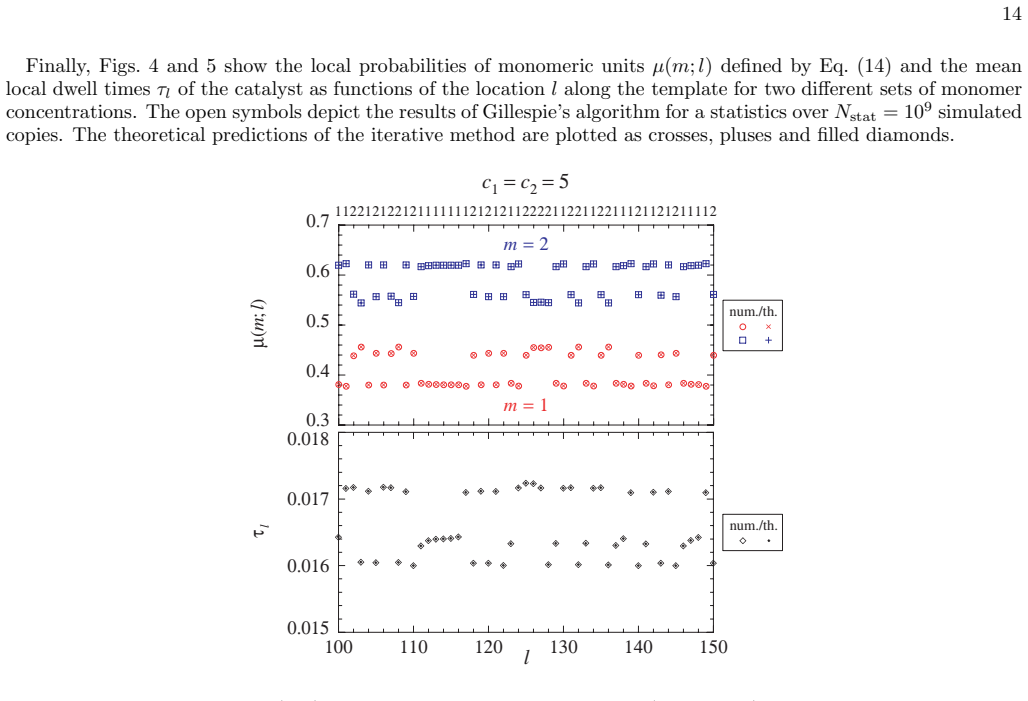
The local probabilities of monomeric units in the copy As a consequence of Eq. (13), the probability to find the monomeric unitm =ml at the location l in a grown copy sequence is given by µ (m;l) ≡ lim L→∞ ∑ m1···ml− 1 ∑ ml+1···mL µ (m1 · · ·ml− 1mm l+1 · · ·mL,L ), (14) which is normalized according to ∑ mµ (m;l) = 1
-
[4]
The mean fractions of monomeric units Therefore, the mean fraction of the monomeric unit m anywhere in an arbitrarily long copy sequence can be calculated as ¯µ (m) ≡ lim L→∞ 1 L L∑ l=1 µ (m;l), (15) satisfying the normalization condition, ∑ m ¯µ (m) = 1. D. The different regimes of the process If the template is periodic, we may expect two generic regimes...
-
[5]
The backward and forward iterations The factorization ansatz (37) can be substituted into the equatio ns for Ψ l, Ψ l(ml),... . As shown in Appendix A, we obtain the results: Yml,l = ( Vl − W0 ml,l + Wd − ml,l )− 1 ·Wc +ml,l (38) in terms of the I × I matrices Vl, obeying the following backward iteration: Vl− 1 = ∑ ml Wd +ml,l − ∑ ml Wc − ml,l · ( Vl − W0...
-
[6]
The mean growth velocity Having computed the matrices Vl and Ψ l with the backward and forward iterations (39) and (41), respect ively, the mean growth velocity (12) is given by v = 1 ⟨τl⟩, where τl = 1 C tr Ψ l (44) is the mean local dwell time of the catalyst at the location l of the template and ⟨τl⟩ ≡ limL→∞ L− 1 ∑L l=1τl is its statistical average, C...
-
[7]
The sequence probabilities Using the factorization (37) and Eq. (17), the sequence probabilit y (13) is given in the long-time limit by µ (ml− r+1 · · ·ml− 1ml;l) = 1 tr Ψ l tr(Yml,l ·Yml− 1,l − 1 · · ·Yml− r+1,l − r+1 ·Ψ l− r) for r = 1, 2, 3,... (45) The normalization condition ∑ ml− r+1···ml− 1ml µ (ml− r+1 · · ·ml− 1ml;l) = 1 is satisfied, because of t...
-
[8]
(41) and using the fact that Ψ l− 1 = Rl− 1 · · ·R1 · Ψ 0
The local probabilities of monomeric units The probability (14) of finding the monomeric unit m =ml at the location l along a template of length L can thus be computed with µ (m;l) = lim L→∞ 1 tr Ψ L tr(Sl ·Ym,l ·Ψ l− 1), (46) where the matrices Sl ≡ RL · · ·Rl+1 (47) are obtained by chain multiplication of the matrices Rl defined in Eq. (41) and using the ...
-
[9]
Relations to the solutions for simpler processes In summary, the backward and forward iterations (39) and (41) p rovide the exact asymptotic solution of the kinetic equations (8) ruling the stochastic process (1)-(2). 10 We note that, in the simpler processes where wi→ j ± m,l = 0 for i ̸=j, the matrices (19) and (20) are equal to each other, so that the ...
-
[10]
Indeed, for the computation of the results plotted in Figs
But, the point is that the theoretical values of the iterative meth od are obtained very much faster with only Nloop = 10 2. Indeed, for the computation of the results plotted in Figs. 4 and 5 , the iterative method is about 4 × 10⁶ times faster than the numerical simulation with Gillespie’s algorithm, de monstrating that the iterative method is extremely...
-
[11]
Equations for the probability matrices (22), (23), (24), ... Summing the matrix kinetic equations (18) over m1 · · ·ml, we first deduce the equations for the probability matri- ces (22): d dt Pt(l) = ∑ ml Wc +ml,l ·Pt(l − 1) + ∑ ml+1 Wc − ml+1,l +1 ·Pt(ml+1,l + 1) + ∑ ml ( W0 ml,l − Wd − ml,l ) ·Pt(ml,l ) − ∑ ml+1 Wd +ml+1,l +1 ·Pt(l). (A1) Next, summing t...
-
[12]
(A1), (A2),
Equations for the particular solutions (29) Inserting the expressions (29) for the particular solution into Eqs . (A1), (A2), ... , we infer the following matrix equations for the modes of wave number q: sq Gq(l) = e − ıq ∑ ml Wc +ml,l ·Gq(l − 1) + e+ıq ∑ ml+1 Wc − ml+1,l +1 ·Gq(ml+1,l + 1) + ∑ ml ( W0 ml,l − Wd − ml,l ) ·Gq(ml,l ) − ∑ ml+1 Wd +ml+1,l +1 ...
-
[13]
(A3), (A4),
Proof of the matrix factorization (37) Using the expansions (30) for sq and (31) for Gq, and taking the limit q → 0, Eqs. (A3), (A4), ... yield the following equations for the quantities (32): 0 = ∑ ml Wc +ml,l ·Ψ l− 1 + ∑ ml+1 Wc − ml+1,l +1 ·Ψ l+1(ml+1) + ∑ ml ( W0 ml,l − Wd − ml,l ) ·Ψ l(ml) − ∑ ml+1 Wd +ml+1,l +1 ·Ψ l, (A5) 0 = Wc +ml,l ·Ψ l− 1 + ∑ ml...
-
[14]
(A7), the expression (38) f or the matrix Yml,l is obtained after the inversion of Eq
Proof of the backward iteration (39) Now, if we define the following matrix, Vl ≡ ∑ ml+1 Wd +ml+1,l +1 − ∑ ml+1 Wc − ml+1,l +1 ·Yml+1,l +1, (A8) and use it inside the parenthesis of Eq. (A7), the expression (38) f or the matrix Yml,l is obtained after the inversion of Eq. (A7). Replacing l with l − 1 in Eq. (A8) and substituting therein the expression (38)...
-
[15]
(44) for the mean growth velocity If we take the derivative of Eq
Proof of Eq. (44) for the mean growth velocity If we take the derivative of Eq. (A3) with respect to the wave numb er q and set q = 0, we get −ıv Ψ l = ∑ ml Wc +ml,l · ( − ıΨ l− 1 + Ψ ′ l− 1 ) + ∑ ml+1 Wc − ml+1,l +1 · [ ıΨ l+1(ml+1) + Ψ ′ l+1(ml+1) ] + ∑ ml ( W0 ml,l − Wd − ml,l ) ·Ψ ′ l(ml) − ∑ ml+1 Wd +ml+1,l +1 ·Ψ ′ l (A9) in terms of the quantities (...
-
[16]
(43) can be proved as follows
Proof of the invariance property (43) Now, Eq. (43) can be proved as follows. Using again Eq. (A8) with l → l − 1, we deduce tr(Vl− 1 ·Ψ l− 1) = ∑ ml tr [ (Wd +ml,l − Wc − ml,l ·Yml,l ) ·Ψ l− 1 ] = ∑ ml tr [ (Wc +ml,l − Wc − ml,l ·Yml,l ) ·Ψ l− 1 ] = ∑ ml tr [ (Vl − W0 ml,l + Wd − ml,l − Wc − ml,l ) ·Ψ l(ml) ] = tr( Vl ·Ψ l). (A15) From the first to the se...
-
[17]
(A1) and using the identities (A10) and (A11) for X = Pt(·)
Equation for the length distribution The equation for the length distribution (28) can be deduced by tak ing the trace of Eq. (A1) and using the identities (A10) and (A11) for X = Pt(·). We find that d dtpt(l) = alpt(l − 1) +bl+1pt(l + 1) − (al+1 +bl)pt(l) (B1) with the following coefficients, al ≡ 1 tr Pt(l − 1) ∑ ml tr [ Wc +ml,l ·Pt(l − 1) ] , (B2) bl ≡ 1...
-
[18]
Therefore, the exponent γ can be computed using Eqs
The regime of sublinear growth in time If the copolymer chain grows along a disordered template, its mean le ngth may increase sublinearly in time as ⟨l⟩t ∼ tγ with an exponent 0 <γ < 1, which is the root of the following equation: ⟨(bl al )γ ⟩ = 1, (B6) as shown for random drifts in one-dimensional disordered media [39, 40] and for unistate templated-dir...
-
[19]
In the case of Figs
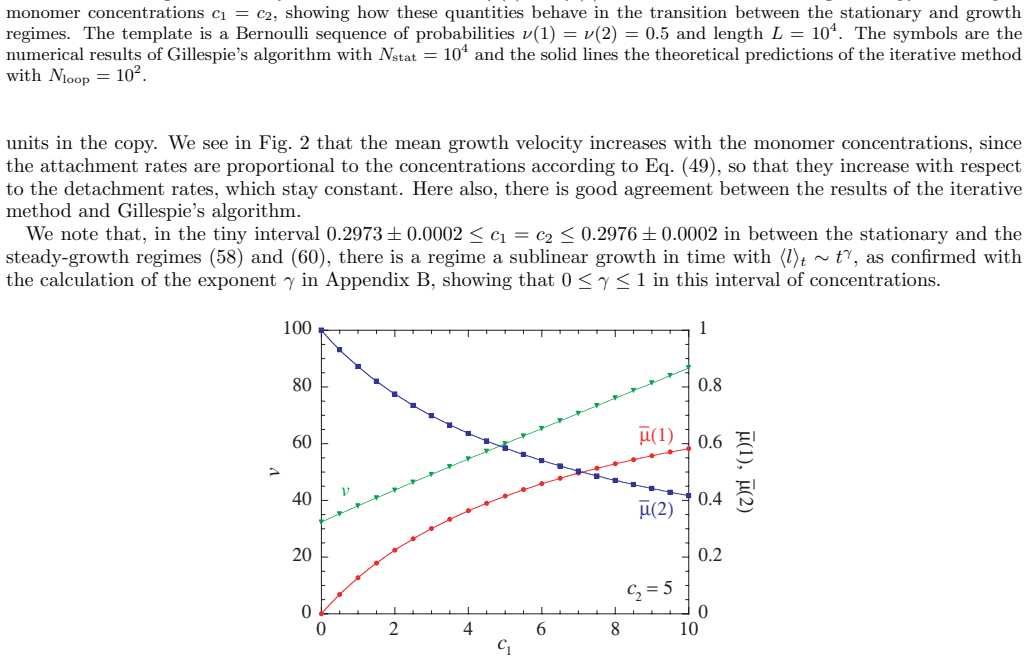
Application to the numerical example The formula (B6) is applied to the numerical example of rate constan ts (50)-(52) for a template of length L = 10 4, finding the root of ⟨(bl/a l)γ ⟩ =L− 1 ∑L l=1(bl/a l)γ = 1 as a function of the concentrations. In the case of Figs. 1 and 2, where the concentrations are equal, w e find that γ = 0 if c1 =c2 = 0. 2974 ± 0...
-
[20]
the attachment of either m1 = 1 or m1 = 2 without transition for the catalyst; 3) & 4) the attachment of e ither m1 = 1 or m1 = 2 with the transition i → j ̸=i for the catalyst; 5) the transition i → j ̸=i without attachment. The random waiting time ∆ t(ω → ω ′) before the jump ω → ω ′ has the exponential probability density p(∆ t) = T − 1 exp(− ∆ t/ T ) ...
-
[21]
Tsai and K
Y.-C. Tsai and K. A. Johnson, A new paradigm for DNA polymerase specificity , Biochem. 45, 9675–9687 (2006)
2006
-
[22]
K. A. Johnson, The kinetic and chemical mechanism of high-fidelity DNA poly merases, Biochim. Biophys. Acta 1804, 1041–1048 (2010)
2010
-
[23]
T. L. Dangerfield and K. A. Johnson, Optimized incorporation of an unnatural fluorescent amino a cid affords measurement of conformational dynamics governing high-fidelity DNA rep lication, J. Biol. Chem. 295, 17265–17820 (2020)
2020
-
[24]
T. L. Dangerfield and K. A. Johnson, Conformational dynamics during high-fidelity DNA replicat ion and translocation defined using a DNA polymerase with a fluorescent artificial am ino acid , J. Biol. Chem. 296, 100143 (2021)
2021
-
[25]
T. L. Dangerfield, S. Kirmizialtin, and K. A. Johnson, Conformational dynamics during misincorporation and mism atch extension defined using a DNA polymerase with a fluorescent ar tificial amino acid , J. Biol. Chem. 298, 101451 (2022)
2022
-
[26]
L. Bai, A. Shundrovsky, and M. D. Wang, Sequence-dependent kinetic model for transcription elong ation by RNA poly- merase, J. Mol. Biol. 344, 335–349 (2004)
2004
-
[27]
L. Bai, R. M. Fulbright, and M. D. Wang, Mechanochemical kinetics of transcription elongation , Phys. Rev. Lett. 98, 068103 (2007). 21
2007
-
[28]
Dangkulwanich, T
M. Dangkulwanich, T. Ishibashi, S. Liu, M. L. Kireeva, L. Lubkowska, M. Kashlev, and C. J. Bustamante, Complete dissection of transcription elongation reveals slow trans location of RNA polymerase II in a linear ratchet mechanism , eLife 2, e00971 (2013)
2013
-
[29]
Ishibashi, M
T. Ishibashi, M. Dangkulwanich, Y. Coello, T. A. Lionber ger, L. Lubkowska, A. S. Ponticelli, M. Kashlev, and C. Bus- tamante, Transcription factors IIS and IIF enhance transcription effi ciency by differentially modifying RNA polymerase pausing dynamics , Proc. Natl. Acad. Sci. USA 111, 3419–3424 (2014)
2014
-
[30]
Garai, D
A. Garai, D. Chowdhury, D. Chowdhury, and T. V. Ramakris hnan, Stochastic kinetics of ribosomes: Single motor properties and collective behavior , Phys. Rev. E 80, 011908 (2009)
2009
-
[31]
J.-D. Wen, L. Lancaster, C. Hodges, A.-C. Zeri, S. H. Yos himura, H. F. Noller, C. Bustamante, and I. Tinoco Jr, Following translation by single ribosomes one codon at a time , Nature 452, 598–603 (2008)
2008
-
[32]
Ieong, ¨U
K.-W. Ieong, ¨U. Uzun, M. Selmer, and M. Ehrenberg, Two proofreading steps amplify the accuracy of genetic code trans- lation, Proc. Natl. Acad. Sci. USA 113, 13744–13749 (2016)
2016
-
[33]
A. B. Loveland, G. Demo, and A. A. Korostelev, Cryo-EM of elongating ribosome with EF-Tu • GTP elucidates tRNA proofreading, Nature 584, 640–645 (2020)
2020
-
[34]
C. H. Bennett, Dissipation-error tradeoff in proofreading , Biosystems 11, 85–91 (1979)
1979
-
[35]
Andrieux and P
D. Andrieux and P. Gaspard, Molecular information processing in nonequilibrium copol ymerizations, J. Chem. Phys. 130, 014901 (2009)
2009
-
[36]
Gaspard and D
P. Gaspard and D. Andrieux, Kinetics and thermodynamics of first-order Markov chain cop olymerization, J. Chem. Phys. 141, 044908 (2014)
2014
-
[37]
Sartori and S
P. Sartori and S. Pigolotti, Thermodynamics of error correction , Phys. Rev. X 5, 041039 (2015)
2015
-
[38]
Gaspard, Kinetics and thermodynamics of exonuclease-deficient DNA p olymerases, Phys
P. Gaspard, Kinetics and thermodynamics of exonuclease-deficient DNA p olymerases, Phys. Rev. E 93, 042419 (2016)
2016
-
[39]
Gaspard, Kinetics and thermodynamics of DNA polymerases with exonuc lease proofreading, Phys
P. Gaspard, Kinetics and thermodynamics of DNA polymerases with exonuc lease proofreading, Phys. Rev. E 93, 042420 (2016)
2016
-
[40]
Midha, A
T. Midha, A. B. Kolomeisky, and O. A. Igoshin, Insights into error control mechanisms in biological proce sses: Copoly- merization and enzyme-kinetics revisited , J. Phys. Chem. B 128, 5612–5622 (2024)
2024
-
[41]
Midha, A
T. Midha, A. B. Kolomeisky, and O. A. Igoshin, Linear-decoupling enables accurate speed and accuracy pre dictions for copolymerization processes, J. Phys. Chem. Lett. 15, 9361–9368 (2024)
2024
-
[42]
D. F. Anderson, J. Ma, and P. Gagrani, Mathematical analysis for a class of stochastic copolymeri zation processes, Bull. Math. Biol. 88, 15 (2026)
2026
-
[43]
Qureshi, J
B. Qureshi, J. Juritz, J. M. Poulton, A. Beersing-Vasqu ez, and T. E. Ouldridge, A universal method for analyzing copolymer growth, J. Chem. Phys. 158, 104906 (2023)
2023
-
[44]
J. E. B. Guntoro, B. J. Qureshi, and T. E. Ouldridge, The interplay of heterogeneity and product detachment in te mplated polymer copying, J. Chem. Phys. 162, 055103 (2025)
2025
-
[45]
M. F. Barnsley and S. Demko, Iterated function systems and the global construction of fr actals, Proc. R. Soc. Lond. A 399, 243–275 (1985)
1985
-
[46]
Gaspard, Template-directed copolymerization, random walks along d isordered tracks, and fractals , Phys
P. Gaspard, Template-directed copolymerization, random walks along d isordered tracks, and fractals , Phys. Rev. Lett. 117, 238101 (2016)
2016
-
[47]
Gaspard, Kinetic theory and thermodynamics of template-directed co polymerization, J
P. Gaspard, Kinetic theory and thermodynamics of template-directed co polymerization, J. Stat. Mech.: Th. Exp. 024003 (2017)
2017
-
[48]
Gaspard, Iterated function systems for DNA replication , Phys
P. Gaspard, Iterated function systems for DNA replication , Phys. Rev. E 96, 042403 (2017)
2017
-
[49]
Li, P.-D
Q.-S. Li, P.-D. Zheng, Y.-G. Shu, Z.-C. Ou-Yang, and M. L i, Template-specific fidelity of DNA replication with high-ord er neighbor effects: A first-passage approach , Phys. Rev. E 100, 012131 (2019)
2019
-
[50]
Li, Y.-G
Q.-S. Li, Y.-G. Shu, Z.-C. Ou-Yang, and M. Li, Kinetic assays of DNA polymerase fidelity: A theoretical per spective beyond Michaelis–Menten kinetics , Phys. Rev. E 104, 014408 (2021)
2021
-
[51]
B. D. Coleman and T. G. Fox, Multistate mechanism for homogeneous ionic polymerizatio n. I. The diastereosequence distribution, J. Chem. Phys. 38, 1065–1075 (1963)
1963
-
[52]
B. D. Coleman and T. G Fox, Multistate mechanism for homogeneous ionic polymerizatio n. II. The molecular weight distribution, J. Am. Chem. Soc. 85, 1241–1244 (1963)
1963
-
[53]
B. D. Coleman and T. G Fox, General theory of stationary random sequences with applica tions to the tacticity of polymers , J. Polym. Sci. A 1, 3183–3197 (1963)
1963
-
[54]
Gaspard, Multistate reversible copolymerization of non-Markovian chains under low conversion conditions , J
P. Gaspard, Multistate reversible copolymerization of non-Markovian chains under low conversion conditions , J. Chem. Phys. 150, 164903 (2019)
2019
-
[55]
Gaspard, Template-directed growth of copolymers , Chaos 30, 043114 (2020)
P. Gaspard, Template-directed growth of copolymers , Chaos 30, 043114 (2020)
2020
-
[56]
N. G. van Kampen, Stochastic Processes in Physics and Chemistry (North-Holland, Amsterdam, 1981)
1981
-
[57]
C. W. Gardiner, Handbook of Stochastic Methods for Physics, Chemistry and t he Natural Sciences , 3rd edition (Springer, Berlin, 2004)
2004
-
[58]
Schuster, Stochasticity in Processes: Fundamentals and Application s to Chemistry and Biology (Springer, Switzerland, 2016)
P. Schuster, Stochasticity in Processes: Fundamentals and Application s to Chemistry and Biology (Springer, Switzerland, 2016)
2016
-
[59]
Derrida, Velocity and diffusion constant of a periodic one-dimensiona l hopping model , J
B. Derrida, Velocity and diffusion constant of a periodic one-dimensiona l hopping model , J. Stat. Phys. 31, 433–450 (1983)
1983
-
[60]
Bouchaud and A
J.-P. Bouchaud and A. Georges, Anomalous diffusion in disordered media: Statistical mechan isms, models and physical applications, Phys. Reports 195, 127–293 (1990)
1990
-
[61]
D. T. Gillespie, A general method for numerically simulating the stochastic time evolution of coupled chemical reactions , J. Comput. Phys. 22, 403–434 (1976). 22
1976
-
[62]
D. T. Gillespie, Exact stochastic simulation of coupled chemical reactions , J. Phys. Chem. 81, 2340–2361 (1977)
1977
-
[63]
Gaspard, Kinetics of multistate DNA polymerases , companion paper, preprint (2026)
P. Gaspard, Kinetics of multistate DNA polymerases , companion paper, preprint (2026)
2026
discussion (0)
Sign in with ORCID, Apple, or X to comment. Anyone can read and Pith papers without signing in.