Generative Recursive Reasoning
Pith reviewed 2026-05-20 05:53 UTC · model grok-4.3
The pith
GRAM turns recursive reasoning probabilistic so models can follow many trajectories instead of one.
A machine-rendered reading of the paper's core claim, the machinery that carries it, and where it could break.
Core claim
GRAM models reasoning as a stochastic latent trajectory inside an iterative refinement loop that reuses the same transition function, producing a latent-variable generative model that supports p(y|x) for conditional reasoning and p(x) for unconditional generation when inputs are absent or fixed, and is trained by amortized variational inference to improve over deterministic recursive baselines on structured tasks.
What carries the argument
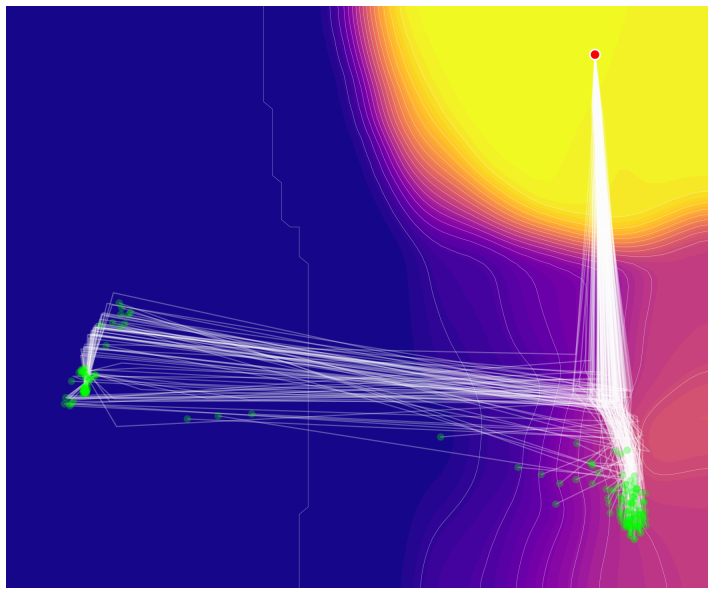
Stochastic latent trajectory formed by repeated application of a shared probabilistic transition function in latent space, which permits parallel sampling of distinct reasoning paths.
If this is right
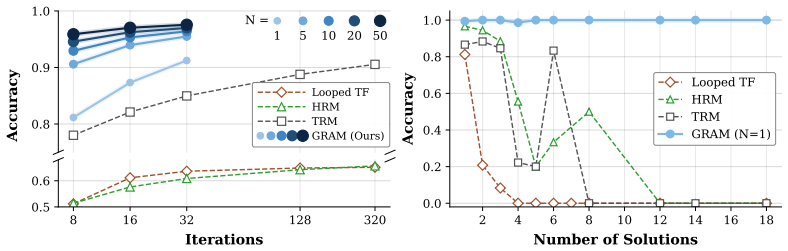
- The model outperforms deterministic recurrent and recursive baselines on structured reasoning and multi-solution constraint tasks.
- Inference-time scaling is possible by increasing recursive depth or drawing more parallel trajectories.
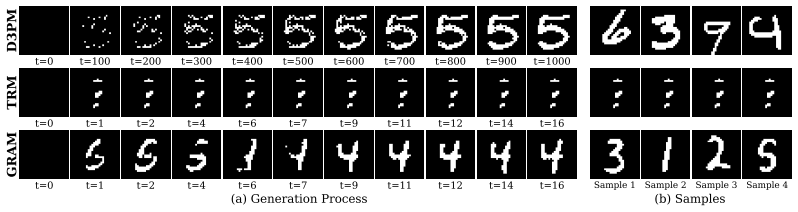
- Unconditional generation of inputs becomes possible by sampling from the marginal p(x).
- Multiple hypotheses and alternative solution strategies arise naturally from different latent trajectories.
Where Pith is reading between the lines
- The same mechanism could be tested on planning problems where several valid action sequences exist for one goal.
- Parallel trajectory sampling offers a direct way to trade extra compute for higher solution coverage without retraining.
Load-bearing premise
That amortized variational inference applied to stochastic trajectories will yield coherent and diverse reasoning paths instead of mode collapse or incoherent outputs.
What would settle it
On a multi-solution constraint satisfaction task, if increasing the number of sampled trajectories produces no gain in solution diversity or validity compared with a single trajectory, the benefit of the generative component is falsified.
Figures





read the original abstract
How should future neural reasoning systems implement extended computation? Recursive Reasoning Models (RRMs) offer a promising alternative to autoregressive sequence extension by performing iterative latent-state refinement with shared transition functions. Yet existing RRMs are largely deterministic, following a single latent trajectory and converging to a single prediction. We introduce Generative Recursive reAsoning Models (GRAM), a framework that turns recursive latent reasoning into probabilistic multi-trajectory computation. GRAM models reasoning as a stochastic latent trajectory, enabling multiple hypotheses, alternative solution strategies, and inference-time scaling through both recursive depth and parallel trajectory sampling. This yields a latent-variable generative model supporting conditional reasoning via $p_\theta(y \mid x)$ and, with fixed or absent inputs, unconditional generation via $p_\theta(x)$. Trained with amortized variational inference, GRAM improves over deterministic recurrent and recursive baselines on structured reasoning and multi-solution constraint satisfaction tasks, while demonstrating an unconditional generation capability. https://ahn-ml.github.io/gram-website
Editorial analysis
A structured set of objections, weighed in public.
Referee Report
Summary. The manuscript introduces Generative Recursive reAsoning Models (GRAM), a probabilistic framework that extends deterministic Recursive Reasoning Models by modeling reasoning as stochastic latent trajectories. Trained via amortized variational inference, GRAM supports conditional reasoning p_θ(y|x) and unconditional generation p_θ(x), with inference-time scaling via recursive depth and parallel trajectory sampling. The central empirical claim is that GRAM outperforms deterministic recurrent and recursive baselines on structured reasoning and multi-solution constraint satisfaction tasks while enabling unconditional generation.
Significance. If the reported gains hold under rigorous controls, the work would be significant for neural reasoning systems by addressing the single-trajectory limitation of prior RRMs and providing a generative model for multi-hypothesis reasoning. The combination of recursive structure with latent stochasticity and unconditional generation capability is a notable modeling advance.
major comments (2)
- [§4] §4 (Experiments): The abstract and framework description assert measurable improvements and diversity benefits from stochastic trajectories, yet the manuscript must include explicit quantitative results (e.g., accuracy deltas, error bars, dataset sizes, and ablation controls on the number of trajectories) to substantiate the central empirical claim; without these, the degree of support for outperformance over deterministic baselines cannot be assessed.
- [§3.2] §3.2 (Training and Inference): The claim that amortized variational inference on stochastic latent trajectories yields diverse, useful reasoning paths (rather than mode collapse or incoherent samples) is load-bearing for the multi-trajectory advantage; the manuscript should report specific diversity metrics (e.g., sample entropy or distinct solution counts) and controls for posterior collapse to verify this assumption holds in the reported tasks.
minor comments (2)
- [Abstract] Notation for the generative model p_θ(x) in the unconditional case should be clarified with respect to the input x being absent or fixed, to avoid ambiguity in the conditional vs. unconditional distinction.
- [Abstract] The website link is provided but the manuscript should include a brief summary of any additional results or visualizations hosted there to make the paper self-contained.
Simulated Author's Rebuttal
We thank the referee for their insightful comments. We address the two major comments point by point below. We have made revisions to the manuscript to provide the requested quantitative details and metrics, which we believe strengthen the empirical section.
read point-by-point responses
-
Referee: [§4] §4 (Experiments): The abstract and framework description assert measurable improvements and diversity benefits from stochastic trajectories, yet the manuscript must include explicit quantitative results (e.g., accuracy deltas, error bars, dataset sizes, and ablation controls on the number of trajectories) to substantiate the central empirical claim; without these, the degree of support for outperformance over deterministic baselines cannot be assessed.
Authors: We agree that the manuscript would benefit from more explicit quantitative results to allow readers to assess the improvements. In the revised manuscript, we have included additional tables in Section 4 that provide accuracy values with error bars (standard deviations over 5 independent runs), the exact dataset sizes for each experiment, and ablation studies showing performance for different numbers of trajectories (specifically 1, 5, and 10). These results demonstrate the advantage of GRAM's stochastic trajectories. revision: yes
-
Referee: [§3.2] §3.2 (Training and Inference): The claim that amortized variational inference on stochastic latent trajectories yields diverse, useful reasoning paths (rather than mode collapse or incoherent samples) is load-bearing for the multi-trajectory advantage; the manuscript should report specific diversity metrics (e.g., sample entropy or distinct solution counts) and controls for posterior collapse to verify this assumption holds in the reported tasks.
Authors: We thank the referee for this suggestion. To verify that the stochastic trajectories provide diverse reasoning paths without mode collapse, we have added in the revised manuscript specific metrics in Section 3.2, including the average entropy of the trajectory distributions and the number of distinct valid solutions obtained from sampling multiple trajectories. We also report the evolution of the KL divergence to confirm the absence of posterior collapse. These additions support our claim that the generative model produces useful diversity. revision: yes
Circularity Check
No significant circularity
full rationale
The paper presents GRAM as a modeling framework that extends deterministic recursive reasoning models into a stochastic latent-variable generative model trained via amortized variational inference. No derivation chain, equations, or first-principles results are shown in the abstract or description that reduce any claimed prediction or result to fitted inputs or self-citations by construction. The central claims concern empirical improvements on reasoning tasks and unconditional generation capability, which are presented as outcomes of the proposed architecture rather than identities or renamings of prior results. No load-bearing self-citation, ansatz smuggling, or uniqueness theorem from overlapping authors is visible. The framework is self-contained as an architectural proposal with independent empirical content.
Axiom & Free-Parameter Ledger
axioms (1)
- domain assumption Amortized variational inference can train a latent-variable model of stochastic reasoning trajectories without mode collapse or loss of diversity.
invented entities (1)
-
Stochastic latent trajectory
no independent evidence
Lean theorems connected to this paper
-
IndisputableMonolith/Cost/FunctionalEquation.leanwashburn_uniqueness_aczel unclear?
unclearRelation between the paper passage and the cited Recognition theorem.
GRAM models reasoning as a stochastic latent trajectory... z_t = u_t + ε_t with ε_t ~ N(μ_θ(u_t), σ²_θ(u_t)I)
-
IndisputableMonolith/Foundation/AlexanderDuality.leanalexander_duality_circle_linking unclear?
unclearRelation between the paper passage and the cited Recognition theorem.
hierarchical instantiation... low-level K updates then high-level stochastic transition
What do these tags mean?
- matches
- The paper's claim is directly supported by a theorem in the formal canon.
- supports
- The theorem supports part of the paper's argument, but the paper may add assumptions or extra steps.
- extends
- The paper goes beyond the formal theorem; the theorem is a base layer rather than the whole result.
- uses
- The paper appears to rely on the theorem as machinery.
- contradicts
- The paper's claim conflicts with a theorem or certificate in the canon.
- unclear
- Pith found a possible connection, but the passage is too broad, indirect, or ambiguous to say the theorem truly supports the claim.
discussion (0)
Sign in with ORCID, Apple, or X to comment. Anyone can read and Pith papers without signing in.