VesNet: Neural network accelerated solver for simulating Stokesian vesicle suspensions
Pith reviewed 2026-06-25 20:50 UTC · model grok-4.3
The pith
A neural network can approximate vesicle self-interactions to deliver over 100x faster simulations of Stokesian vesicle suspensions while matching the original dynamics.
A machine-rendered reading of the paper's core claim, the machinery that carries it, and where it could break.
Core claim
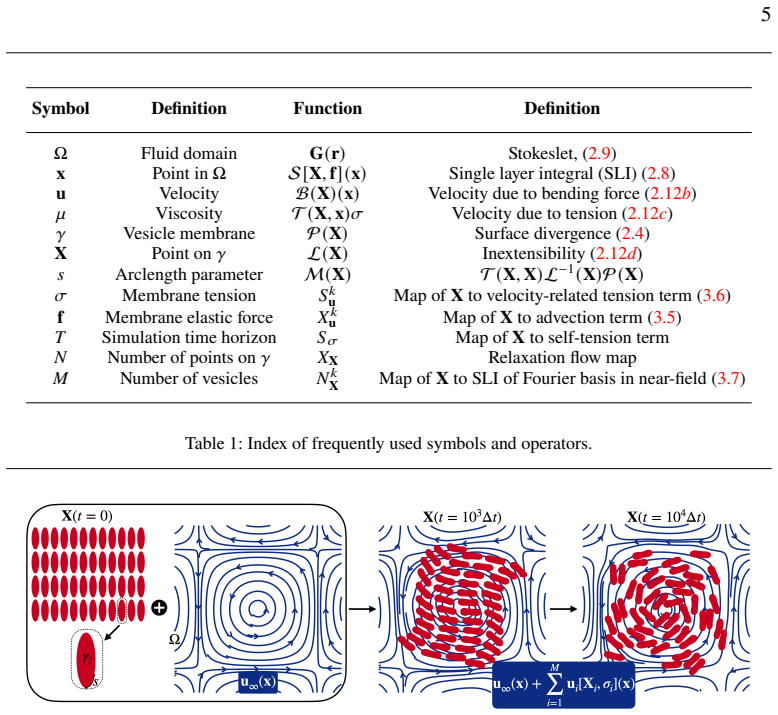
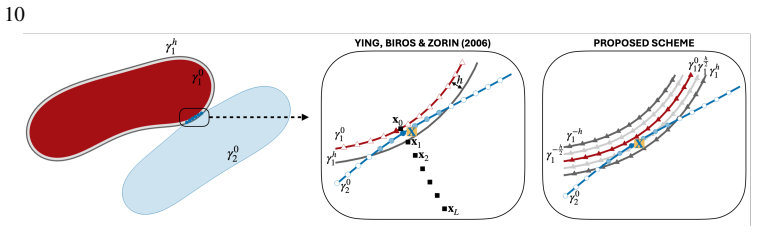
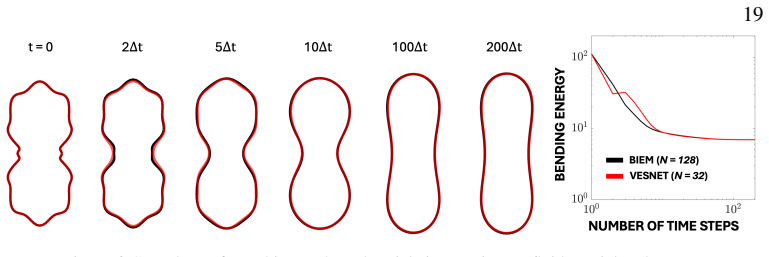
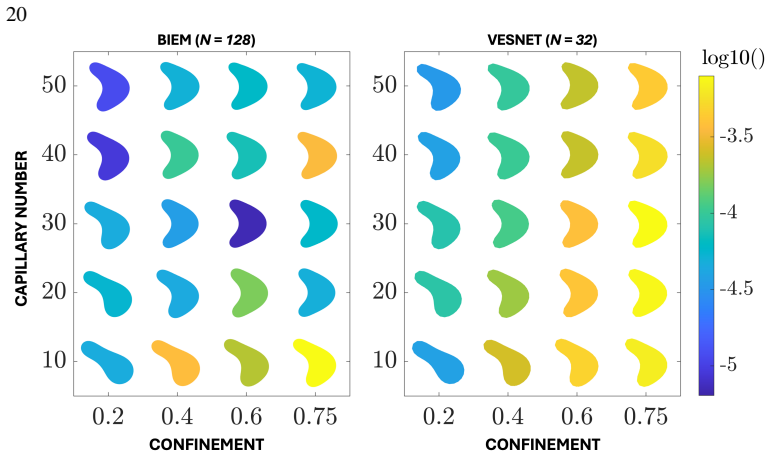
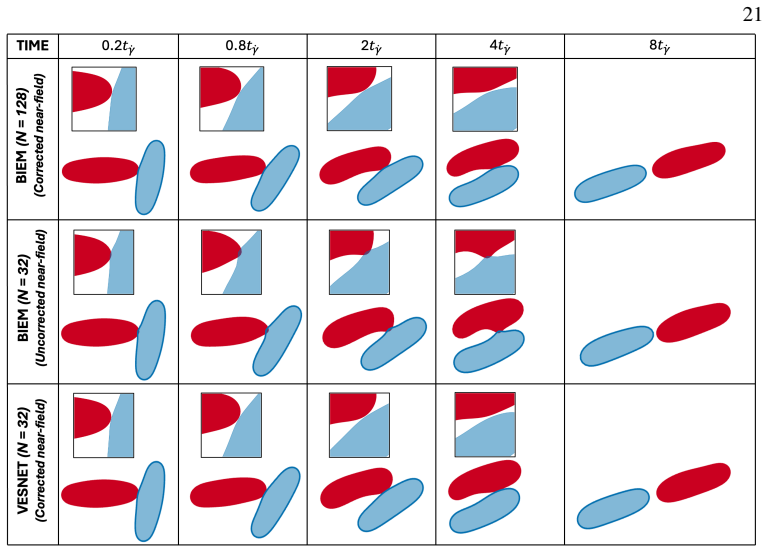
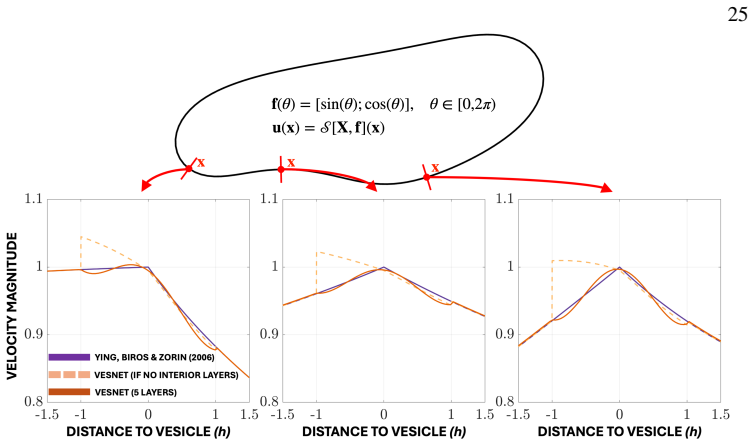
VesNet accelerates two-dimensional vesicle suspension simulations by approximating vesicle self interactions, including background flow coupling and short-range lubrication forces, while retaining conventional modules for boundary reparameterization and far-field hydrodynamics. A GPU-accelerated implementation achieves over 100x speedup compared to a multithreaded MATLAB CPU boundary integral solver and about 5x relative to its GPU counterpart. VesNet accurately captures key dynamics, including single-vesicle phase behavior, pair interactions, and large-scale suspensions in Taylor-Green and Poiseuille flows, enabling efficient simulations of thousands of vesicles on modest computational reso
What carries the argument
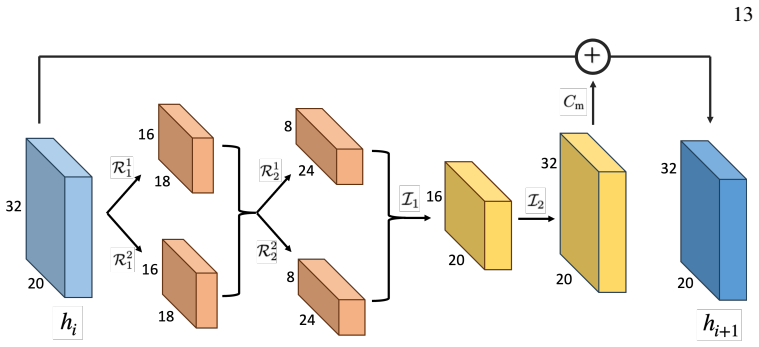
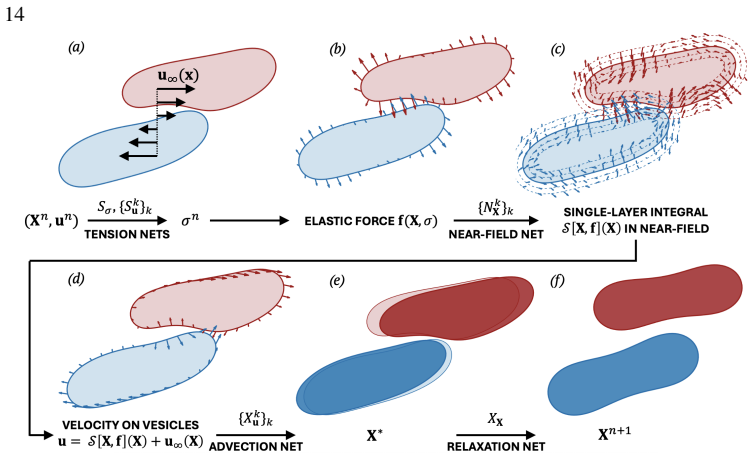
VesNet, the hybrid framework that substitutes a neural network for the self-interaction terms of each vesicle while keeping conventional modules for boundary reparameterization and far-field hydrodynamics.
If this is right
- Thousands of vesicles can be simulated on standard hardware instead of requiring large clusters.
- Collective behaviors in prescribed flows such as Taylor-Green and Poiseuille become practical to explore at scale.
- Pairwise interactions and single-vesicle phase transitions remain faithful to the underlying boundary integral formulation.
Where Pith is reading between the lines
- The same substitution of neural approximations for local interactions could be tested on other deformable particles in Stokes flow after retraining.
- Extension to three dimensions would require generating and validating new training data from three-dimensional boundary integral runs.
- Parameter studies over vesicle properties or flow strengths could now be performed at higher resolution or with more realizations.
- pacs':['47.57.ef','47.63.Gd','47.11.-j'],
Load-bearing premise
The neural network approximation of vesicle self interactions, including background flow coupling and short-range lubrication forces, remains sufficiently accurate to reproduce the dynamics of the original boundary integral method without introducing errors that alter the reported behaviors.
What would settle it
A side-by-side run of identical initial conditions in VesNet and the full boundary integral solver that produces visibly different single-vesicle phase diagrams or pair-interaction trajectories would falsify the accuracy claim.
Figures






read the original abstract
Numerical simulation of deformable particle suspensions in Stokes flow is computationally expensive due to nonlinear fluid-structure interactions, evolving interfaces, and multiscale hydrodynamics. We present VesNet, a hybrid framework that accelerates two-dimensional vesicle suspension simulations by approximating vesicle self interactions, including background flow coupling and short-range lubrication forces, while retaining conventional modules for boundary reparameterization and far-field hydrodynamics. A GPU-accelerated implementation achieves over 100x speedup compared to a multithreaded MATLAB CPU boundary integral solver and about 5x relative to its GPU counterpart. VesNet accurately captures key dynamics, including single-vesicle phase behavior, pair interactions, and large-scale suspensions in Taylor-Green and Poiseuille flows, enabling efficient simulations of thousands of vesicles on modest computational resources.
Editorial analysis
A structured set of objections, weighed in public.
Referee Report
Summary. The manuscript presents VesNet, a hybrid solver for 2D Stokesian vesicle suspensions that uses a neural network to approximate vesicle self-interactions (background flow coupling and short-range lubrication) while retaining conventional boundary-integral modules for far-field hydrodynamics and interface reparameterization. A GPU implementation is reported to deliver >100x speedup versus a multithreaded MATLAB CPU BIE solver and ~5x versus its own GPU counterpart, with claims that the method accurately reproduces single-vesicle phase behavior, pair interactions, and large-scale dynamics in Taylor-Green and Poiseuille flows.
Significance. If the NN surrogate for self-interactions can be shown to control long-time error accumulation and preserve qualitative dynamics, the hybrid approach would enable previously intractable simulations of O(10^3) vesicles on modest hardware, directly addressing the computational bottleneck in vesicle suspension studies. The decision to keep far-field and reparameterization steps exact is a sound architectural choice that limits the scope of approximation error.
major comments (2)
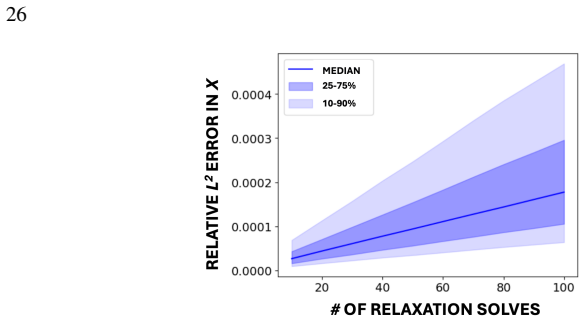
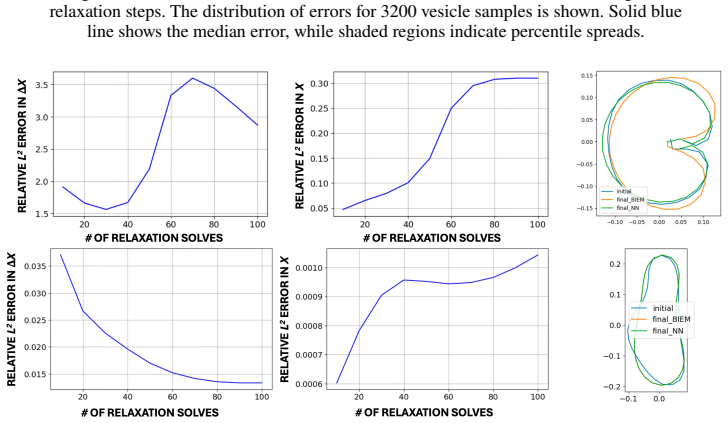
- [Abstract] Abstract: the headline accuracy claim (that VesNet 'accurately captures key dynamics' for single-vesicle, pair, and large-scale cases) is unsupported by any quantitative error metrics, area/volume conservation drift, or direct long-time trajectory comparisons against the reference BIE solver over O(10^3–10^4) steps; without these, it is impossible to verify that local surrogate discrepancies do not alter reported phase behavior or suspension statistics.
- [Abstract] The central performance claim rests on the NN approximation of self-interactions (including lubrication) remaining sufficiently accurate that the hybrid evolution reproduces the original BIE dynamics; the manuscript provides no a-posteriori error bounds, conservation properties, or accumulation analysis for this surrogate, leaving open the possibility that repeated pair interactions amplify small discrepancies.
Simulated Author's Rebuttal
We thank the referee for the constructive feedback. We address the two major comments point-by-point below and will revise the manuscript to strengthen the presentation of accuracy and error analysis.
read point-by-point responses
-
Referee: [Abstract] Abstract: the headline accuracy claim (that VesNet 'accurately captures key dynamics' for single-vesicle, pair, and large-scale cases) is unsupported by any quantitative error metrics, area/volume conservation drift, or direct long-time trajectory comparisons against the reference BIE solver over O(10^3–10^4) steps; without these, it is impossible to verify that local surrogate discrepancies do not alter reported phase behavior or suspension statistics.
Authors: We agree that the abstract would benefit from quantitative support. The results section contains error metrics, conservation data, and trajectory comparisons; we will revise the abstract to report key quantitative measures (e.g., shape errors, area conservation drift, and long-time agreement) drawn from those sections. revision: yes
-
Referee: [Abstract] The central performance claim rests on the NN approximation of self-interactions (including lubrication) remaining sufficiently accurate that the hybrid evolution reproduces the original BIE dynamics; the manuscript provides no a-posteriori error bounds, conservation properties, or accumulation analysis for this surrogate, leaving open the possibility that repeated pair interactions amplify small discrepancies.
Authors: We will add an explicit subsection summarizing a-posteriori error bounds, conservation properties, and accumulation analysis for the NN surrogate over long trajectories to directly address concerns about error propagation in repeated interactions. revision: yes
Circularity Check
No circularity: empirical NN surrogate validated against reference BIE
full rationale
The VesNet framework trains a neural network on data generated by the conventional boundary-integral solver to approximate local self-interactions and lubrication, then couples it to unchanged far-field and reparameterization modules. Speedup and accuracy statements are direct empirical measurements on held-out single-vesicle, pair, and suspension test cases; none of the reported quantities is obtained by fitting a parameter to the same data and relabeling it a prediction. No uniqueness theorem, self-citation chain, or ansatz is invoked to force the architecture or the reported behaviors. The method remains externally falsifiable by comparison to the original BIE code.
Axiom & Free-Parameter Ledger
Reference graph
Works this paper leans on
-
[1]
and Yeung, D
Zhang, Y. and Yeung, D. , title =. In Proc. ACM SIGKDD Conf. , year =
-
[2]
Newman, M. E. J. , title =
-
[3]
and Fortunato, S
Lancichinetti, A. and Fortunato, S. , title =. Phys. Rev. E. , volume =. 2009 , pages =
2009
-
[4]
Procedia IUTAM , volume =
High-order adaptive time stepping for vesicle suspensions with viscosity contrast , author =. Procedia IUTAM , volume =
-
[5]
Li, Zongyi and Kovachki, Nikola and Azizzadenesheli, Kamyar and Liu, Burigede and Bhattacharya, Kaushik and Stuart, Andrew and Anandkumar, Anima , year =. Fourier. 2010.08895 , primaryclass =
Pith/arXiv arXiv 2010
-
[6]
Learning Nonlinear Operators via
Lu, Lu and Jin, Pengzhan and Pang, Guofei and Zhang, Zhongqiang and Karniadakis, George Em , year =. Learning Nonlinear Operators via. Nat Mach Intell , volume =
-
[7]
2024 , month = jan, journal =
Derivative-. 2024 , month = jan, journal =
2024
- [8]
-
[9]
Kopani. 2024 , month = jan, number =. 2401.02016 , primaryclass =
arXiv 2024
-
[10]
PNAS , volume =
A vesicle bioreactor as a step toward an artificial cell assembly , author =. PNAS , volume =
-
[11]
Biomimetic nanoscale reactors and networks , author =. Ann. Rev. Phys. Chem. , volume =
-
[12]
Science , volume =
Drug delivery systems: Entering the mainstream , author =. Science , volume =
-
[13]
Trends Biotechnol
Engineering liposomes for drug delivery , author =. Trends Biotechnol. , volume =
-
[14]
Journal of Computational Physics , volume =
A fast algorithm for particle simulations , author =. Journal of Computational Physics , volume =
-
[15]
Journal of Computational Physics , volume =
Non-intrusive reduced order modeling of unsteady flows using artificial neural networks with application to a combustion problem , author =. Journal of Computational Physics , volume =
-
[16]
The viscosity of the blood in narrow capillary tubes , author =. Am. J. Physiol. , volume =
-
[17]
AIAA Journal , volume =
Interpolation Method for Adapting Reduced-Order Models and Application to Aeroelasticity , author =. AIAA Journal , volume =
-
[18]
Large scale simulation of red blood cell aggregation in shear flows , author =. J. Biomech. , volume =
-
[19]
The Annals
Kernel Methods in machine learning , author =. The Annals. of Statistics , volume =
-
[20]
Dhairya Malhotra and Abtin Rahimian and Denis Zorin and George Biros , title =
-
[21]
Veerapaneni and Denis Zorin and George Biros , title =
Abtin Rahimian and Shravan K. Veerapaneni and Denis Zorin and George Biros , title =. Journal of Computational Physics , volume = 298, pages =
-
[22]
Kelley and David E
C.T. Kelley and David E. Keyes , title =. SIAM Journal on Numerical Analysis , volume = 35, pages =
-
[23]
Mohandas and E
N. Mohandas and E. Evans , title =. Annu. Rev. Biophys. Biomol. Struct. , volume =
-
[24]
Mohandas and P.G
N. Mohandas and P.G. Gallagher , title =. Blood , volume =
-
[25]
Journal of Computational Physics , volume = 347, pages =
Libin Lu and Abtin Rahimian and Denis Zorin , title =. Journal of Computational Physics , volume = 347, pages =
-
[26]
Journal of Computational Physics , volume = 274, pages =
Bryan Quaife and George Biros , title =. Journal of Computational Physics , volume = 274, pages =
-
[27]
Hou and John S
Thomas Y. Hou and John S. Lowengrub and Michael J. Shelley , title =. 1994 , journal =
1994
-
[28]
Cordasco and A
D. Cordasco and A. Yazdani and P. Bagchi , title =. Physics of Fluids , volume =
-
[29]
Helsing and R
J. Helsing and R. Ojala , title =. 2008 , journal =
2008
-
[30]
G. R. Baker and M. J. Shelley , title =. 1990 , journal =
1990
-
[31]
Zhang and E-A
Y. Zhang and E-A. Kim , title =. 2017 , journal =
2017
-
[32]
Snyder and M
J.C. Snyder and M. Rupp and K. Hansen and K-R. Muller and K. Burke , title =. 2012 , journal =
2012
-
[33]
Wei and R.G
Q. Wei and R.G. Melko and J.Z.Y. Chen , title =. 2017 , journal =
2017
-
[34]
Wang , title =
L. Wang , title =. 2016 , journal =
2016
-
[35]
Muravleva and I
E. Muravleva and I. Oseledets and D. Koroteev , title =. 2018 , journal =
2018
-
[36]
Hornik and M
K. Hornik and M. Stinchombe and H. White , title =. 1989 , journal =
1989
-
[37]
Chakrabarti and C
B. Chakrabarti and C. Gaillardac and D. Saintillan , title =. 2020 , journal =
2020
-
[38]
R. T. Fraley and C. S. Fornari and S. Kaplan , title =. 1979 , journal =
1979
-
[39]
LaGrone and R
J. LaGrone and R. Cortez and W. Yan and L. Fauci , title =. 2019 , journal =
2019
-
[40]
Flormann and O
D. Flormann and O. Aouane and L. Kaestner and C. Ruloff and C. Misbah and T. Podgorski and C. Wagner , title =. Scientific Reports , volume =
-
[41]
S. E. Spagnolie and G. R. Moreno-Flores and D. Bartolo and E. Lauga , title =. 2015 , journal =
2015
-
[42]
Gera and D
P. Gera and D. Salac and S. E. Spagnolie , title =. 2022 , journal =
2022
-
[43]
Thomas and T
D. Thomas and T. O'Brien and A. Pandit , title =. 2018 , journal =
2018
-
[44]
Pivkin and Z
I. Pivkin and Z. Peng and G. E. Karniadakis and P. A. Buffet and M. Dao and S. Suresh , title =. 2016 , journal =
2016
-
[45]
Reichel and J
F. Reichel and J. Mauer and A. A. Nawaz and G. Gompper and J. Guck and D. A. Fedosov , title =. 2019 , journal =
2019
-
[46]
Henry and S
E. Henry and S. H. Holm and Z. Zhang and J. P. Beech and J. O. Tegenfeldt and D. A. Fedosov and G. Gompper , title =. 2016 , journal =
2016
-
[47]
G. S. Patterson and S. A. Orszag , title =. 1974 , journal =
1974
-
[48]
Canuto and M
C. Canuto and M. Y. Hussaini and A. Quarteroni and T. A. Zang , title =. 1987 , address =
1987
-
[49]
Fung , title =
Y.C. Fung , title =. 1990 , address =
1990
-
[50]
James and D
G. James and D. Witten and T. Hastie and R. Tibshirani , title =. 2013 , address =
2013
-
[51]
Goodfellow and Y
I. Goodfellow and Y. Bengio and A. Courville , publisher=. Deep
-
[52]
S. A. Orszag , title =. 1971 , journal =
1971
-
[53]
S. A. Orszag , title =. 1974 , journal =
1974
-
[54]
A. G. Kravchenko and P. Moin , title =. 1997 , journal =
1997
-
[55]
2026 , eprint=
IV-Net: A neural network for elliptic PDEs with random and highly varying coefficients , author=. 2026 , eprint=
2026
-
[56]
Chemical Engineering Journal , volume=
An improved machine learning approach for predicting granular flows , author=. Chemical Engineering Journal , volume=. 2022 , publisher=
2022
-
[57]
Journal of Machine Learning Research , volume=
Neural operator: Learning maps between function spaces with applications to pdes , author=. Journal of Machine Learning Research , volume=
-
[58]
arXiv preprint arXiv:2411.09678 , year=
NeuralDEM-Real-time Simulation of Industrial Particulate Flows , author=. arXiv preprint arXiv:2411.09678 , year=
-
[59]
npj Biosensing , volume=
A wearable device for continuous monitoring of circulating cells at single-cell resolution , author=. npj Biosensing , volume=. 2025 , publisher=
2025
-
[60]
Harmon and E
D. Harmon and E. Vouga and B. Smith and R. Tamstorf and E. Grinspun , title =
-
[61]
Computer Methods in Applied Mechanics and Engineering , volume = 200, pages =
Etienne Vouga and David Harmon and Rasmus Tamstorf and Eitan Grinspun , title =. Computer Methods in Applied Mechanics and Engineering , volume = 200, pages =
-
[62]
Besl and Neil D
Paul J. Besl and Neil D. McKay , title =. IEEE Transactions on Pattern Analysis and Machine Intelligence , volume = 14, pages =
-
[63]
Journal of Computational Physics , volume = 306, pages =
Bryan Quaife and George Biros , title =. Journal of Computational Physics , volume = 306, pages =
-
[64]
Dutt and L
A. Dutt and L. Greengard and V. Rokhlin , title=. BIT Numerical Mathematics , year=
-
[65]
Veerapaneni and George Biros , title =
Abtin Rahimian and Shravan K. Veerapaneni and George Biros , title =. Journal of Computational Physics , year =
-
[66]
Journal of Computational Physics , year =
Lexing Ying and George Biros and Denis Zorin , title =. Journal of Computational Physics , year =
-
[67]
Fendler , title =
Janos H. Fendler , title =. Acc. Chem. Res. , year =
-
[68]
J. O. Dabiri and M. Gharib , title =. Proc. R. Soc. B. , year =
-
[69]
J. O. Dabiri , title =. Annu. Rev. Fluid Mech. , year =
-
[70]
2017 , URL =
Accelerating Eulerian Fluid Simulation With Convolutional Networks , author =. 2017 , URL =
2017
-
[71]
Power and G
H. Power and G. Miranda , title =. SIAM Journal of Applied Mathematics , volume =. 1987 , pages =
1987
-
[72]
Power , title =
H. Power , title =. IMA Journal of Applied Mathematics , volume =
-
[73]
Kraus and W
M. Kraus and W. Wintz and U. Seifert and R. Lipowsky , journal =
-
[74]
Ebrahimi and P
E. Ebrahimi and P. Balogh and P. Bagchi , journal =
-
[75]
G. I. Taylor F. R. S. , journal =
-
[76]
Lipowsky , journal =
R. Lipowsky , journal =
-
[77]
U. M. Ascher and L. R. Petzold , title =. 1998 , address =
1998
-
[78]
Lipowsky and E
R. Lipowsky and E. Sackmann , title =. 1995 , address =
1995
-
[79]
B. K. Alpert , title =. SIAM Journal on Scientific Computing , volume =. 1999 , pages =
1999
-
[80]
S. K. Veerapaneni and A. Rahimian and G. Biros and D. Zorin , title =. Journal of Computational Physics , volume =. 2011 , pages =
2011
discussion (0)
Sign in with ORCID, Apple, or X to comment. Anyone can read and Pith papers without signing in.