Enhancing Dynamic Symbolic Execution by Automatically Learning Search Heuristics
Pith reviewed 2026-05-24 17:39 UTC · model grok-4.3
The pith
Automatically learned parametric search heuristics for dynamic symbolic execution outperform manually designed ones in branch coverage and bug finding.
A machine-rendered reading of the paper's core claim, the machinery that carries it, and where it could break.
Core claim
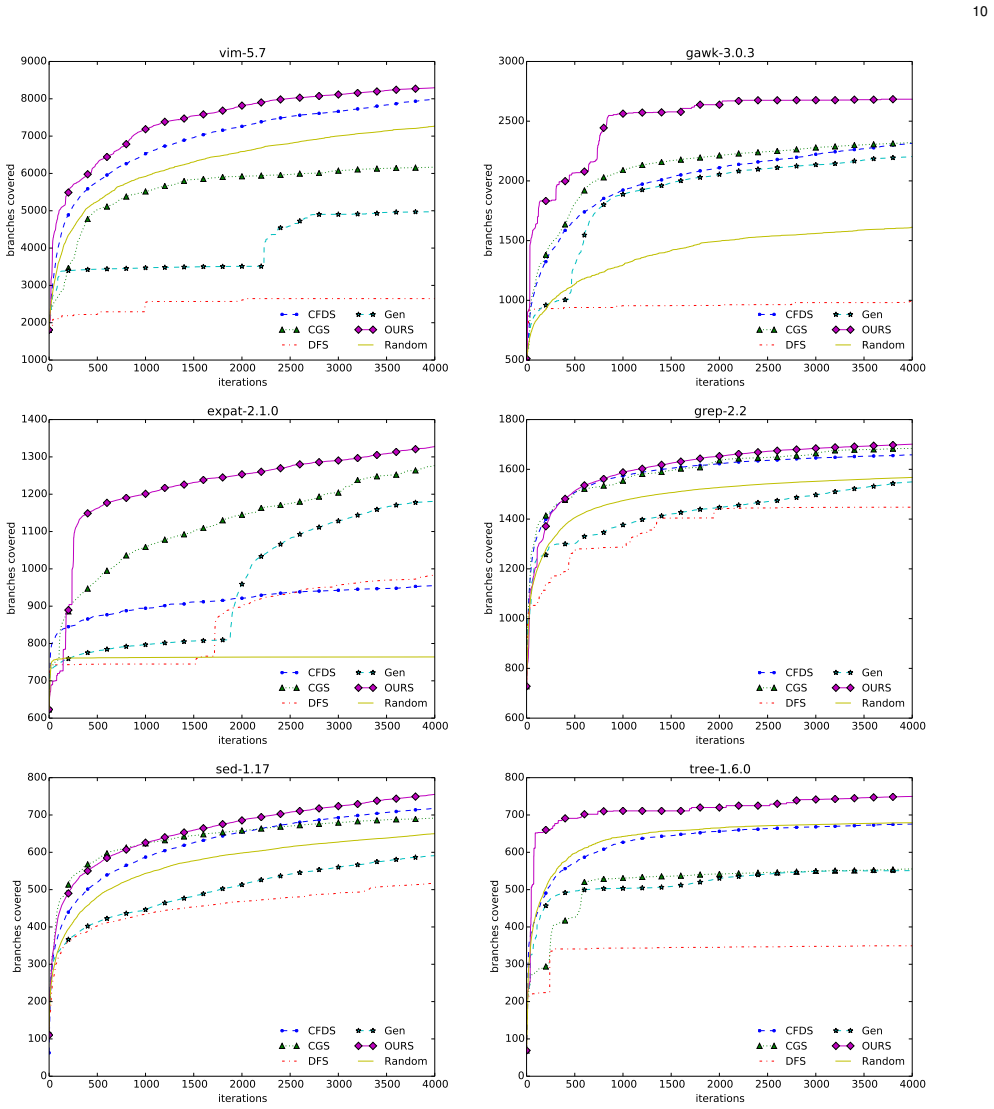
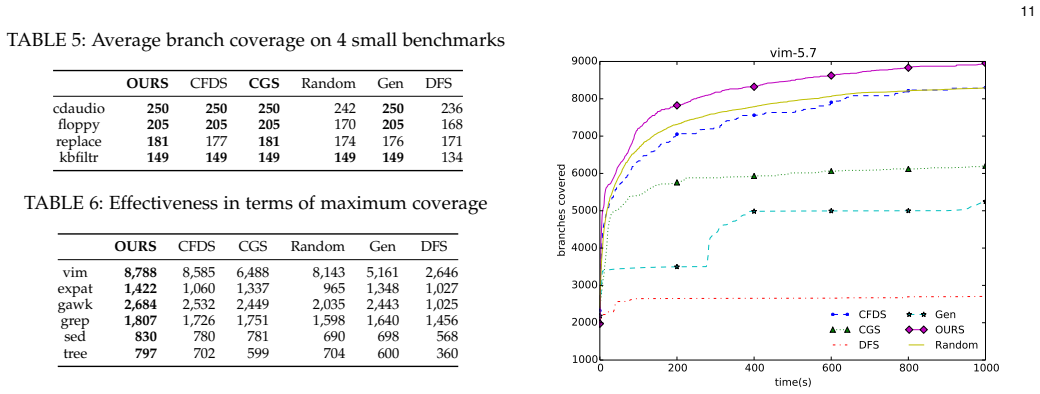
We define a class of parametric search heuristics and present an algorithm that efficiently finds an optimal heuristic for each subject program. Experimental results with industrial-strength symbolic execution tools show that the generated heuristics significantly outperform existing manually-crafted heuristics in terms of branch coverage and bug-finding.
What carries the argument
A parametric search heuristic whose parameters are optimized by a dedicated learning algorithm to maximize coverage on a given program.
If this is right
- Higher branch coverage is achieved within the same time budget.
- More bugs are discovered during the execution runs.
- Search behavior becomes tuned to the specific program rather than relying on a single general-purpose rule.
- The manual effort required to craft and maintain heuristics across different programs is reduced.
Where Pith is reading between the lines
- The same learning loop could be applied to other search-based analyses that currently depend on hand-tuned priority functions.
- Retraining the parameters on new versions of a program might be needed if code changes alter the optimal exploration order.
- The approach opens the possibility of comparing learned heuristics across families of similar programs to identify transferable parameter patterns.
Load-bearing premise
The parametric form chosen for the heuristics is expressive enough to contain near-optimal strategies for the subject programs.
What would settle it
A head-to-head experiment on held-out programs in which the learned heuristic produces no higher branch coverage on average than the strongest existing manual heuristic.
Figures




read the original abstract
We present a technique to automatically generate search heuristics for dynamic symbolic execution. A key challenge in dynamic symbolic execution is how to effectively explore the program's execution paths to achieve high code coverage in a limited time budget. Dynamic symbolic execution employs a search heuristic to address this challenge, which favors exploring particular types of paths that are most likely to maximize the final coverage. However, manually designing a good search heuristic is nontrivial and typically ends up with suboptimal and unstable outcomes. The goal of this paper is to overcome this shortcoming of dynamic symbolic execution by automatically learning search heuristics. We define a class of search heuristics, namely a parametric search heuristic, and present an algorithm that efficiently finds an optimal heuristic for each subject program. Experimental results with industrial-strength symbolic execution tools (e.g., KLEE) show that our technique can successfully generate search heuristics that significantly outperform existing manually-crafted heuristics in terms of branch coverage and bug-finding.
Editorial analysis
A structured set of objections, weighed in public.
Referee Report
Summary. The paper claims to automatically generate effective search heuristics for dynamic symbolic execution (DSE) by defining a parametric class of heuristics and presenting an algorithm that optimizes parameters per subject program. Experiments using industrial tools such as KLEE are said to show that the learned heuristics significantly outperform manually crafted ones on branch coverage and bug-finding.
Significance. If the results are robust to the overfitting risks inherent in per-program optimization, the approach could meaningfully reduce the manual effort in tuning DSE tools and improve their practical effectiveness for software testing.
major comments (2)
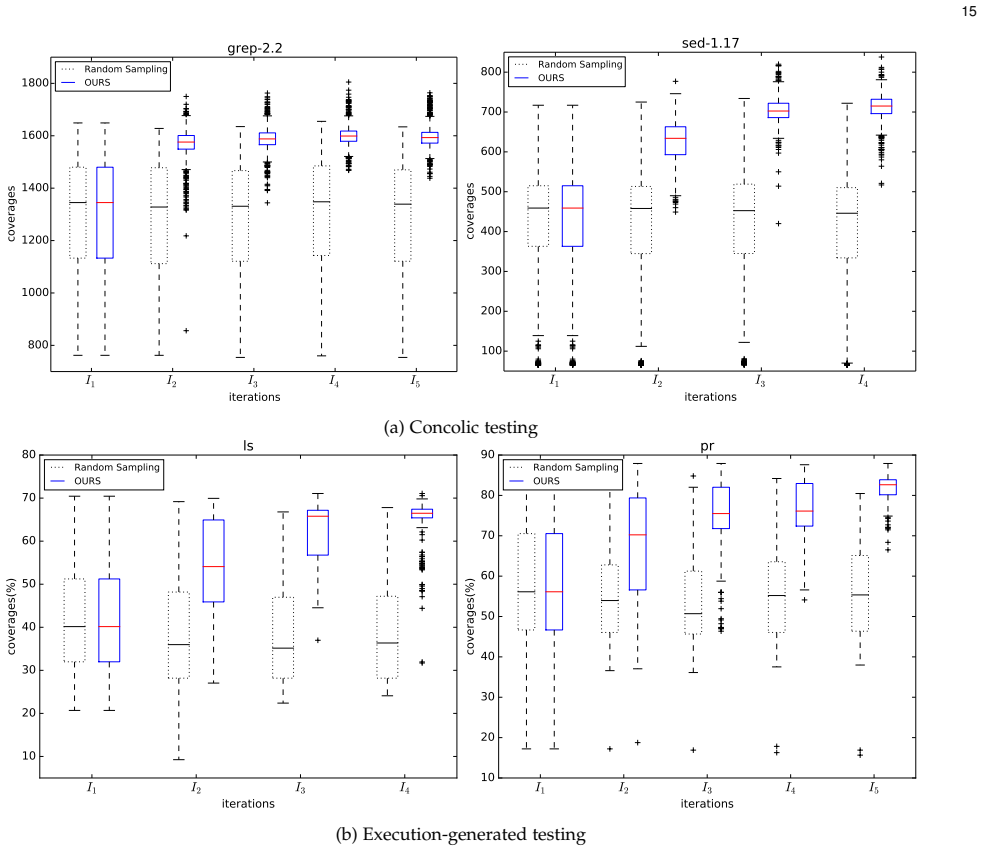
- [§5] §5 (Experimental Evaluation): the central empirical claim of outperformance lacks any description of held-out validation sets, multiple random seeds for the learning procedure, or variance across independent runs; without these, the per-program parameter search on the same traces used for final reporting risks producing inflated coverage numbers that do not generalize.
- [§4] §4 (Learning Algorithm): no expressiveness argument or bound is given showing that the chosen parametric family is rich enough to contain near-optimal heuristics for the evaluated programs, leaving open the possibility that reported gains are artifacts of the specific parameterization rather than a general advance.
minor comments (1)
- [Abstract] Abstract: asserts 'significantly outperform' without any quantitative numbers, protocol details, or subject-program counts, making it impossible to gauge the magnitude of the claimed improvement from the summary alone.
Simulated Author's Rebuttal
We thank the referee for the constructive feedback. We address the two major comments below, acknowledging where the manuscript is currently limited and outlining planned revisions.
read point-by-point responses
-
Referee: §5 (Experimental Evaluation): the central empirical claim of outperformance lacks any description of held-out validation sets, multiple random seeds for the learning procedure, or variance across independent runs; without these, the per-program parameter search on the same traces used for final reporting risks producing inflated coverage numbers that do not generalize.
Authors: We agree this is a valid concern. The current evaluation optimizes and reports on the same program traces without held-out sets or multi-seed variance, which limits claims of robustness. In the revision we will rerun the learning procedure with multiple random seeds, report mean and variance of branch coverage and bug-finding results, and add a discussion of overfitting risks and how per-program optimization is meant to be applied in practice. revision: yes
-
Referee: §4 (Learning Algorithm): no expressiveness argument or bound is given showing that the chosen parametric family is rich enough to contain near-optimal heuristics for the evaluated programs, leaving open the possibility that reported gains are artifacts of the specific parameterization rather than a general advance.
Authors: The parametric family was constructed to subsume several standard hand-crafted heuristics (e.g., random, coverage-guided) as special cases, which is why we expected it to be sufficiently expressive. However, no formal expressiveness argument or bound was provided. We will add a subsection discussing the design rationale and empirical evidence that the family recovers or improves upon known good heuristics on the evaluated subjects; a general theoretical bound is beyond the scope of this work but we will clarify the intended scope. revision: partial
Circularity Check
No circularity; empirical learning and evaluation are independent
full rationale
The paper defines a parametric class of search heuristics, presents an optimization algorithm to select parameters per program, and reports experimental coverage/bug-finding results on KLEE. No equations, predictions, or uniqueness claims reduce by construction to fitted inputs or self-citations. The central claim is an empirical comparison whose validity rests on held-out test runs rather than any definitional equivalence. No load-bearing self-citation chains or ansatz smuggling appear in the abstract or described method.
Axiom & Free-Parameter Ledger
Reference graph
Works this paper leans on
-
[1]
CUTE: A concolic unit testing engine for C,
K. Sen, D. Marinov, and G. Agha, “CUTE: A concolic unit testing engine for C,” in Proceedings of the 10th European Software Engineer- ing Conference Held Jointly with 13th ACM SIGSOFT International Symposium on Foundations of Software Engineering , ser. ESEC/FSE ’05, 2005, pp. 263–272
work page 2005
-
[2]
DART: Directed auto- mated random testing,
P . Godefroid, N. Klarlund, and K. Sen, “DART: Directed auto- mated random testing,” in Proceedings of the 2005 ACM SIGPLAN Conference on Programming Language Design and Implementation, ser. PLDI ’05, 2005, pp. 213–223
work page 2005
-
[3]
Execution generated test cases: How to make systems code crash itself,
C. Cadar and D. Engler, “Execution generated test cases: How to make systems code crash itself,” in Proceedings of the 12th International Conference on Model Checking Software , ser. SPIN’05, 2005, pp. 2–23
work page 2005
-
[4]
EXE: Automatically generating inputs of death,
C. Cadar, V . Ganesh, P . M. Pawlowski, D. L. Dill, and D. R. Engler, “EXE: Automatically generating inputs of death,” in Proceedings of the 13th ACM Conference on Computer and Communications Security , ser. CCS ’06, 2006, pp. 322–335
work page 2006
-
[5]
Enhancing symbolic execution with veritesting,
T. Avgerinos, A. Rebert, S. K. Cha, and D. Brumley, “Enhancing symbolic execution with veritesting,” in Proceedings of the 36th International Conference on Software Engineering, ser. ICSE ’14, 2014, pp. 1083–1094
work page 2014
-
[6]
Guiding dynamic symbolic execution toward unverified program executions,
M. Christakis, P . M ¨uller, and V . W ¨ustholz, “Guiding dynamic symbolic execution toward unverified program executions,” in Proceedings of the 38th International Conference on Software Engineer- ing, ser. ICSE ’16, 2016, pp. 144–155
work page 2016
-
[7]
Regular property guided dynamic symbolic execution,
Y. Zhang, Z. Clien, J. Wang, W. Dong, and Z. Liu, “Regular property guided dynamic symbolic execution,” in Proceedings of the 37th International Conference on Software Engineering - Volume 1 , ser. ICSE ’15, 2015, pp. 643–653
work page 2015
-
[8]
CAB- Fuzz: Practical concolic testing techniques for COTS operating sys- tems,
S. Y. Kim, S. Lee, I. Yun, W. Xu, B. Lee, Y. Yun, and T. Kim, “CAB- Fuzz: Practical concolic testing techniques for COTS operating sys- tems,” in 2017 USENIX Annual Technical Conference , ser. USENIX ATC ’17, 2017, pp. 689–701
work page 2017
-
[9]
Driller: Augmenting fuzzing through selective symbolic execution,
N. Stephens, J. Grosen, C. Salls, A. Dutcher, R. Wang, J. Corbetta, Y. Shoshitaishvili, C. Kruegel, and G. Vigna, “Driller: Augmenting fuzzing through selective symbolic execution,” in Proceedings of the Symposium on Network and Distributed System Security , ser. NDSS ’16, 2016, pp. 1–16
work page 2016
-
[10]
S. Y. Chau, O. Chowdhury, E. Hoque, H. Ge, A. Kate, C. Nita- Rotaru, and N. Li, “SymCerts: Practical symbolic execution for exposing noncompliance in x.509 certificate validation implemen- tations,” in 2017 IEEE Symposium on Security and Privacy , ser. S&P ’17, 2017, pp. 503–520
work page 2017
-
[11]
FirmUSB: Vetting usb device firmware using domain informed symbolic execution,
G. Hernandez, F. Fowze, D. J. Tian, T. Yavuz, and K. R. Butler, “FirmUSB: Vetting usb device firmware using domain informed symbolic execution,” in Proceedings of the 2017 ACM SIGSAC Conference on Computer and Communications Security , ser. CCS ’17, 2017, pp. 2245–2262
work page 2017
-
[12]
Inception: System-wide security testing of real-world embedded systems software,
N. Corteggiani, G. Camurati, and A. Francillon, “Inception: System-wide security testing of real-world embedded systems software,” in 27th USENIX Security Symposium , ser. USENIX Se- curity ’18, 2018, pp. 309–326
work page 2018
-
[13]
Concolic testing for deep neural networks,
Y. Sun, M. Wu, W. Ruan, X. Huang, M. Kwiatkowska, and D. Kroening, “Concolic testing for deep neural networks,” in Pro- ceedings of the 33rd ACM/IEEE International Conference on Automated Software Engineering, ser. ASE ’18, 2018, pp. 109–119
work page 2018
-
[14]
DeepConcolic: Testing and debugging deep neural networks,
Y. Sun, X. Huang, D. Kroening, J. Sharp, M. Hill, and R. Ashmore, “DeepConcolic: Testing and debugging deep neural networks,” in Proceedings of the 41st International Conference on Software Engineer- ing: Companion Proceedings, ser. ICSE ’19, 2019, pp. 111–114
work page 2019
-
[15]
A new approach to program testing,
J. C. King, “A new approach to program testing,” SIGPLAN Not., pp. 228–233, 1975
work page 1975
-
[16]
Symbolic execution and program testing,
——, “Symbolic execution and program testing,” Commun. ACM, pp. 385–394, 1976
work page 1976
-
[17]
SELECT–a formal system for testing and debugging programs by symbolic execution,
R. S. Boyer, B. Elspas, and K. N. Levitt, “SELECT–a formal system for testing and debugging programs by symbolic execution,” SIGPLAN Not., pp. 234–245, 1975
work page 1975
-
[18]
Symbolic testing and the dissect symbolic evalu- ation system,
W. E. Howden, “Symbolic testing and the dissect symbolic evalu- ation system,” IEEE Transactions on Software Engineering , pp. 266– 278, 1977
work page 1977
-
[19]
Symbolic execution for software testing: Three decades later,
C. Cadar and K. Sen, “Symbolic execution for software testing: Three decades later,” Commun. ACM, pp. 82–90, 2013
work page 2013
-
[20]
Heuristics for scalable dynamic test gener- ation,
J. Burnim and K. Sen, “Heuristics for scalable dynamic test gener- ation,” in Proceedings of 23rd IEEE/ACM International Conference on Automated Software Engineering, ser. ASE ’08, 2008, pp. 443–446
work page 2008
-
[21]
Automated white- box fuzz testing,
P . Godefroid, M. Y. Levin, and D. A. Molnar, “Automated white- box fuzz testing,” in Proceedings of the Symposium on Network and Distributed System Security, ser. NDSS ’08, 2008, pp. 151–166
work page 2008
-
[22]
KLEE: Unassisted and automatic generation of high-coverage tests for complex systems programs,
C. Cadar, D. Dunbar, and D. Engler, “KLEE: Unassisted and automatic generation of high-coverage tests for complex systems programs,” in Proceedings of the 8th USENIX Conference on Oper- ating Systems Design and Implementation , ser. OSDI ’08, 2008, pp. 209–224
work page 2008
-
[23]
How we get there: A context-guided search strategy in concolic testing,
H. Seo and S. Kim, “How we get there: A context-guided search strategy in concolic testing,” in Proceedings of the 22nd ACM SIG- SOFT International Symposium on Foundations of Software Engineer- ing, ser. FSE ’14, 2014, pp. 413–424
work page 2014
-
[24]
CarFast: Achieving higher statement coverage faster,
S. Park, B. M. M. Hossain, I. Hussain, C. Csallner, M. Grechanik, K. Taneja, C. Fu, and Q. Xie, “CarFast: Achieving higher statement coverage faster,” in Proceedings of the ACM SIGSOFT 20th Interna- tional Symposium on the Foundations of Software Engineering, ser. FSE ’12, 2012, pp. 35:1–35:11
work page 2012
-
[25]
Steering symbolic execution to less traveled paths,
Y. Li, Z. Su, L. Wang, and X. Li, “Steering symbolic execution to less traveled paths,” in Proceedings of the 2013 ACM SIGPLAN International Conference on Object Oriented Programming Systems Languages, and Applications, ser. OOPSLA ’13, 2013, pp. 19–32
work page 2013
-
[26]
Automatically generating search heuristics for concolic testing,
S. Cha, S. Hong, J. Lee, and H. Oh, “Automatically generating search heuristics for concolic testing,” in Proceedings of the 40th International Conference on Software Engineering, ser. ICSE ’18, 2018, pp. 1244–1254
work page 2018
-
[27]
Y. Kim, M. Kim, Y. Kim, and Y. Jang, “Industrial application of concolic testing approach: A case study on libexif by using crest- bv and klee,” in Proceedings of the 34th International Conference on Software Engineering, ser. ICSE ’12, 2012, pp. 1143–1152
work page 2012
-
[28]
A survey of symbolic execution techniques,
R. Baldoni, E. Coppa, D. C. D’elia, C. Demetrescu, and I. Finocchi, “A survey of symbolic execution techniques,” ACM Comput. Surv., pp. 50:1–50:39, 2018
work page 2018
-
[29]
Parallel symbolic execution for automated real-world software testing,
S. Bucur, V . Ureche, C. Zamfir, and G. Candea, “Parallel symbolic execution for automated real-world software testing,” in Proceed- ings of the Sixth Conference on Computer Systems , ser. EuroSys ’11, 2011, pp. 183–198
work page 2011
-
[30]
DASE: Document- assisted symbolic execution for improving automated software testing,
E. Wong, L. Zhang, S. Wang, T. Liu, and L. Tan, “DASE: Document- assisted symbolic execution for improving automated software testing,” in Proceedings of the 37th International Conference on Soft- ware Engineering - Volume 1, ser. ICSE ’15, 2015, pp. 620–631
work page 2015
-
[31]
C. A. concolic test generation tool for C, https://github.com/ jburnim/crest, 2008
work page 2008
-
[32]
Feedback-directed unit test generation for c/c++ using concolic execution,
P . Garg, F. Ivancic, G. Balakrishnan, N. Maeda, and A. Gupta, “Feedback-directed unit test generation for c/c++ using concolic execution,” in Proceedings of the 2013 International Conference on Software Engineering, ser. ICSE ’13, 2013, pp. 132–141
work page 2013
-
[33]
The S2E Platform: Design, implementation, and applications,
V . Chipounov, V . Kuznetsov, and G. Candea, “The S2E Platform: Design, implementation, and applications,” ACM Trans. Comput. Syst., pp. 2:1–2:49, 2012
work page 2012
-
[34]
Make Test-zesti: A symbolic exe- cution solution for improving regression testing,
P . D. Marinescu and C. Cadar, “Make Test-zesti: A symbolic exe- cution solution for improving regression testing,” in Proceedings of the 34th International Conference on Software Engineering , ser. ICSE ’12, 2012, pp. 716–726. 19
work page 2012
-
[35]
Post- conditioned symbolic execution,
Q. Yi, Z. Yang, S. Guo, C. Wang, J. Liu, and C. Zhao, “Post- conditioned symbolic execution,” in 2015 IEEE 8th International Conference on Software Testing, Verification and Validation , ser. ICST ’15, 2015, pp. 1–10
work page 2015
-
[36]
Eliminating path redundancy via postconditioned symbolic execution,
——, “Eliminating path redundancy via postconditioned symbolic execution,” IEEE Trans. Softw. Eng., pp. 25–43, 2018
work page 2018
-
[37]
Efficient state merging in symbolic execution,
V . Kuznetsov, J. Kinder, S. Bucur, and G. Candea, “Efficient state merging in symbolic execution,” in Proceedings of the 33rd ACM SIGPLAN Conference on Programming Language Design and Imple- mentation, ser. PLDI ’12, 2012, pp. 193–204
work page 2012
-
[38]
D. Trabish, A. Mattavelli, N. Rinetzky, and C. Cadar, “Chopped symbolic execution,” in Proceedings of the 40th International Confer- ence on Software Engineering, ser. ICSE ’18, 2018, pp. 350–360
work page 2018
-
[39]
Abstraction-driven concolic testing,
P . Daca, A. Gupta, and T. A. Henzinger, “Abstraction-driven concolic testing,” in Proceedings of the 17th International Conference on Verification, Model Checking, and Abstract Interpretation - Volume 9583, ser. VMCAI ’16, 2016, pp. 328–347
work page 2016
-
[40]
SCORE: A scalable concolic testing tool for reliable embedded software,
Y. Kim and M. Kim, “SCORE: A scalable concolic testing tool for reliable embedded software,” in Proceedings of the 19th ACM SIG- SOFT Symposium and the 13th European Conference on Foundations of Software Engineering, ser. ESEC/FSE ’11, 2011, pp. 420–423
work page 2011
-
[41]
RWset: Attacking path explosion in constraint-based test generation,
P . Boonstoppel, C. Cadar, and D. Engler, “RWset: Attacking path explosion in constraint-based test generation,” in International Conference on Tools and Algorithms for the Construction and Analysis of Systems, ser. TACAS ’08, 2008, pp. 351–366
work page 2008
-
[42]
Sym- bolic execution with existential second-order constraints,
S. Mechtaev, A. Griggio, A. Cimatti, and A. Roychoudhury, “Sym- bolic execution with existential second-order constraints,” in Pro- ceedings of the 2018 26th ACM Joint Meeting on European Software Engineering Conference and Symposium on the Foundations of Software Engineering, ser. ESEC/FSE 2018, 2018, pp. 389–399
work page 2018
-
[43]
Gnu Bug Report (gawk), http://gnu.utils.bug.narkive.com/ Udtl5IZR/gawk-bug, 2005
work page 2005
-
[44]
GNU Bug Report (grep), https://www.gnu.org/software/grep/ manual/html node/Reporting-Bugs.html, 2014
work page 2014
-
[45]
B. Dutertre and L. D. Moura, “The yices smt solver,” Tech. Rep., 2006
work page 2006
-
[46]
A decision procedure for bit-vectors and arrays,
V . Ganesh and D. L. Dill, “A decision procedure for bit-vectors and arrays,” in International Conference on Computer Aided Verification , ser. CAV ’07, 2007, pp. 519–531
work page 2007
-
[47]
Fitness- guided path exploration in dynamic symbolic execution,
T. Xie, N. Tillmann, J. de Halleux, and W. Schulte, “Fitness- guided path exploration in dynamic symbolic execution,” in 2009 IEEE/IFIP International Conference on Dependable Systems Networks , 2009, pp. 359–368
work page 2009
-
[48]
R. Majumdar and K. Sen, “Hybrid concolic testing,” in Proceedings of the 29th International Conference on Software Engineering, ser. ICSE ’07, 2007, pp. 416–426
work page 2007
-
[49]
K. Inkumsah and T. Xie, “Improving structural testing of object- oriented programs via integrating evolutionary testing and sym- bolic execution,” in Proceedings of the 23rd IEEE/ACM International Conference on Automated Software Engineering , ser. ASE ’08, 2008, pp. 297–306
work page 2008
-
[50]
Improving function coverage with munch: A hybrid fuzzing and directed symbolic execution approach,
S. Ognawala, T. Hutzelmann, E. Psallida, and A. Pretschner, “Improving function coverage with munch: A hybrid fuzzing and directed symbolic execution approach,” in Proceedings of the 33rd Annual ACM Symposium on Applied Computing , ser. SAC ’18, 2018, pp. 1475–1482
work page 2018
-
[51]
American Fuzzy Lop (AFL) Fuzzer, https://github.com/ mirrorer/afl, 2017
work page 2017
-
[52]
Boosting concolic testing via interpolation,
J. Jaffar, V . Murali, and J. A. Navas, “Boosting concolic testing via interpolation,” in Proceedings of the 9th Joint Meeting on Foundations of Software Engineering, ser. ESEC/FSE ’13, 2013, pp. 48–58
work page 2013
-
[53]
Compositional dynamic test generation,
P . Godefroid, “Compositional dynamic test generation,” in Pro- ceedings of the 34th Annual ACM SIGPLAN-SIGACT Symposium on Principles of Programming Languages, ser. POPL ’07, 2007, pp. 47–54
work page 2007
-
[54]
Com- positional may-must program analysis: Unleashing the power of alternation,
P . Godefroid, A. V . Nori, S. K. Rajamani, and S. D. Tetali, “Com- positional may-must program analysis: Unleashing the power of alternation,” in Proceedings of the 37th Annual ACM SIGPLAN- SIGACT Symposium on Principles of Programming Languages , ser. POPL ’10, 2010, pp. 43–56
work page 2010
-
[55]
Template-guided concolic testing via online learning,
S. Cha, S. Lee, and H. Oh, “Template-guided concolic testing via online learning,” in Proceedings of the 33rd ACM/IEEE International Conference on Automated Software Engineering , ser. ASE ’18, 2018, pp. 408–418
work page 2018
-
[56]
Boost symbolic execution using dynamic state merging and forking,
C. Zhang, W. Yin, and Z. Lin, “Boost symbolic execution using dynamic state merging and forking,” in International Workshop on Quantitative Approaches to Software Quality, 2018, pp. 14–21
work page 2018
-
[57]
MultiSE: Multi-path symbolic execution using value summaries,
K. Sen, G. Necula, L. Gong, and W. Choi, “MultiSE: Multi-path symbolic execution using value summaries,” in Proceedings of the 2015 10th Joint Meeting on Foundations of Software Engineering , ser. ESEC/FSE ’15, 2015, pp. 842–853
work page 2015
-
[58]
Solving complex path conditions through heuristic search on induced polytopes,
P . Dinges and G. Agha, “Solving complex path conditions through heuristic search on induced polytopes,” in Proceedings of the 22nd ACM SIGSOFT International Symposium on Foundations of Software Engineering, ser. FSE ’14, 2014, pp. 425–436
work page 2014
-
[59]
Yet another local search method for constraint solving,
P . Codognet and D. Diaz, “Yet another local search method for constraint solving,” in International Symposium on Stochastic Algo- rithms, 2001, pp. 73–90
work page 2001
-
[60]
Search-driven string constraint solving for vulnerability detection,
J. Thom ´e, L. K. Shar, D. Bianculli, and L. Briand, “Search-driven string constraint solving for vulnerability detection,” in Proceed- ings of the 39th International Conference on Software Engineering , ser. ICSE ’17, 2017, pp. 198–208
work page 2017
-
[61]
Symbolic execution of complex program driven by ma- chine learning based constraint solving,
X. Li, Y. Liang, H. Qian, Y.-Q. Hu, L. Bu, Y. Yu, X. Chen, and X. Li, “Symbolic execution of complex program driven by ma- chine learning based constraint solving,” in Proceedings of the 31st IEEE/ACM International Conference on Automated Software Engineer- ing, ser. ASE ’16, 2016, pp. 554–559
work page 2016
-
[62]
Accelerating array constraints in symbolic execution,
D. M. Perry, A. Mattavelli, X. Zhang, and C. Cadar, “Accelerating array constraints in symbolic execution,” in Proceedings of the 26th ACM SIGSOFT International Symposium on Software Testing and Analysis, ser. ISSTA ’17, 2017, pp. 68–78
work page 2017
-
[63]
Learn&fuzz: Machine learning for input fuzzing,
P . Godefroid, H. Peleg, and R. Singh, “Learn&fuzz: Machine learning for input fuzzing,” in Proceedings of the 32nd IEEE/ACM International Conference on Automated Software Engineering, ser. ASE ’17, 2017, pp. 50–59
work page 2017
-
[64]
Skyfire: Data-driven seed generation for fuzzing,
J. Wang, B. Chen, L. Wei, and Y. Liu, “Skyfire: Data-driven seed generation for fuzzing,” in 2017 IEEE Symposium on Security and Privacy, ser. S&P ’17, 2017, pp. 579–594
work page 2017
-
[65]
Qbe: Qlearning-based exploration of android applications,
Y. Koroglu, A. Sen, O. Muslu, Y. Mete, C. Ulker, T. Tanriverdi, and Y. Donmez, “Qbe: Qlearning-based exploration of android applications,” in 2018 IEEE 11th International Conference on Software Testing, Verification and Validation, ser. ICST ’18, 2018, pp. 105–115
work page 2018
-
[66]
Guided gui testing of an- droid apps with minimal restart and approximate learning,
W. Choi, G. Necula, and K. Sen, “Guided gui testing of an- droid apps with minimal restart and approximate learning,” in Proceedings of the 2013 ACM SIGPLAN International Conference on Object Oriented Programming Systems Languages, and Applications , ser. OOPSLA ’13, 2013, pp. 623–640
work page 2013
-
[67]
H. Spieker, A. Gotlieb, D. Marijan, and M. Mossige, “Reinforce- ment learning for automatic test case prioritization and selection in continuous integration,” in Proceedings of the 26th ACM SIGSOFT International Symposium on Software Testing and Analysis, ser. ISSTA ’17, 2017, pp. 12–22
work page 2017
-
[68]
An exploration of statistical models for automated test case generation,
J. Sant, A. Souter, and L. Greenwald, “An exploration of statistical models for automated test case generation,” in Proceedings of the Third International Workshop on Dynamic Analysis , ser. WODA ’05, 2005, pp. 1–7
work page 2005
-
[69]
Search-based software testing: Past, present and future,
P . McMinn, “Search-based software testing: Past, present and future,” in 2011 IEEE Fourth International Conference on Software Testing, Verification and Validation Workshops, 2011, pp. 153–163
work page 2011
-
[70]
Search-based software engineering: Trends, techniques and applications,
M. Harman, S. A. Mansouri, and Y. Zhang, “Search-based software engineering: Trends, techniques and applications,” ACM Comput. Surv., pp. 11:1–11:61, 2012
work page 2012
discussion (0)
Sign in with ORCID, Apple, or X to comment. Anyone can read and Pith papers without signing in.