REVIEW 3 major objections 7 minor 56 references
A Simple Contrastive Framework Of Item Tokenization For Generative Recommendation
T0 review · 3 major / 7 minor · reviewed 2026-08-15 · deepseek-v4-flash
Pith's one-line read SimCIT replaces reconstruction-based item tokenization with contrastive learning and reports large Recall@10 gains in generative recommendation.
desk verdict SimCIT delivers a useful multi-modal tokenizer and solid industrial-scale results, but the paper's core claim that contrastive tokenization beats reconstruction is untested because extra modalities drive the gain, and the 'first' claim is undercut by CoST. read the letter →
The pith
A machine-rendered reading of the paper's core claim, the machinery that carries it, and where it could break.
The reading
What carries the argument
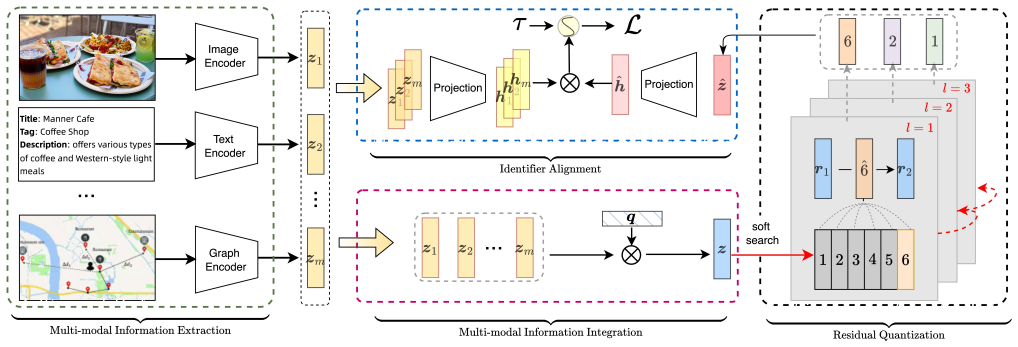
The load-bearing mechanism is a soft residual quantization codebook trained without reconstruction. A set of learnable codebooks, each with multiple codewords, converts a fused multi-modal item embedding $z$ into a tuple of tokens: at each level a Gumbel-softmax temperature anneals from soft to hard assignment, the residual is updated by subtracting the weighted codeword, and the sum of chosen codewords forms $\hat{z}$. The contrastive NT-Xent loss, computed between a projection of $\hat{z}$ and projections of each modality embedding inside a batch, is the only training signal; it pushes identifiers of different items apart and aligns the identifier with every modality at once. An attention module over modalities supplies the fused embedding, and graph encoders provide spatial and collaborative embeddings, making the codebook a shared bridge between modalities.
What would settle it
A decisive experiment would fix the input features: train SimCIT and LETTER with the same text-only item embeddings, codebook size, and generator, then compare Recall@10 on AMap. If text-only SimCIT does not clearly beat LETTER's 0.2758, or if LETTER fed the same extra modalities closes the gap, the claim that contrastive tokenization improves discriminative capability would be unsupported. A second check is codebook collision: measure the fraction of items sharing identical token tuples and per-code entropy; the paper predicts contrastive training lowers collision and raises entropy relative to reconstruction.
Extended reading notes
Core claim
The paper's central claim is that the reconstruction objective is mismatched with generative retrieval, and that replacing it with a fully contrastive objective produces more discriminative item identifiers. SimCIT treats each item's modalities as views, passes their attention-fused embedding through multiple levels of residual quantization with Gumbel-softmax assignment, and trains the codebooks by pulling the quantized identifier toward every modality embedding while pushing it away from other items in the batch. The authors argue this implicitly aligns modalities through the shared codebooks and acts as implicit diversity regularization, so identifiers spread across the codebook and collisions drop. They report that this yields consistent Recall@K gains over reconstruction-based tokenizers and over sequential baselines, with the largest margin on a six-million-item point-of-interest dataset.
Load-bearing premise
The load-bearing premise is that the contrastive objective itself, not the extra image, collaborative, and spatial inputs that SimCIT receives and its baselines do not, explains the reported gains.
Editorial extensions
If this is right
- Future item tokenizers can drop reconstruction and commitment losses entirely, simplifying the objective while keeping the discrete code structure that generative decoding needs.
- Semantic identifiers should be evaluated by discriminative quality and collision rate, not by embedding reconstruction error.
- Multi-modal side information can be integrated into the identifier itself through the codebook bridge, rather than fused only at the input or scoring stage.
- On the industrial AMap benchmark the method raises Recall@10 from 0.2758 for LETTER to 0.3206, with consistent gains at Recall@100 and Recall@1000.
- The tokenizer learns a hierarchical item taxonomy that narrows beam search to a smaller candidate set, which should reduce generation cost at large scale.
Reading between the lines
- The paper's own ablation indicates that on AMap, removing the extra modalities drops Recall@10 from 0.3206 to 0.2809, only slightly above LETTER's 0.2758; an inference the authors do not spell out is that most of the headline gain is modality enrichment, not contrastive learning alone, until a like-for-like test proves otherwise.
- A testable extension, not reported here, is to apply the same contrastive residual quantization to generative document retrieval, where semantic IDs also suffer from reconstruction-oriented clustering and collision.
- The three-phase training dynamics the paper observes suggest codebook perplexity could be used as a production monitoring signal: a plateau or drop in per-code entropy should coincide with a recall plateau, so operators could early-stop or retune temperature without waiting for end-to-end evaluation.
Signed reviews
Editorial analysis
A structured set of objections, weighed in public.
Referee Report
Summary. This paper proposes SimCIT, a contrastive-learning-based item tokenization framework for generative retrieval-based recommendation. Instead of the usual RQ-VAE reconstruction objective, SimCIT applies an NT-Xent-style contrastive loss between soft-residual-quantized code summaries and multi-modal item representations (text, image, collaborative-filtering, and spatial-graph), with Gumbel-softmax relaxation and an annealing schedule. Experiments on Amazon (INS, BEA), Foursquare (NYC, TKY), and the AMap industrial POI dataset compare offline Recall@K against TIGER, LETTER, and classical sequential models, supported by ablations, training-dynamics analysis, and qualitative codebook visualizations. The paper's central claim is that a fully contrastive tokenizer yields more discriminative identifiers and alleviates collisions compared to reconstruction-based tokenizers.
Significance. The question addressed---whether reconstruction-based quantization is mis-specified for generative retrieval---is timely, and the proposed framework is simple, scalable, and validated at industrial scale on AMap with a full-ranking evaluation protocol. The ablation suite (temperature, batch size, codebook size, modality composition, training dynamics) is a strength, as is the effort to analyze codebook diversity and hierarchical structure. If the central claim were established by controlled experiments, the contribution would be a useful design principle for semantic tokenization. However, the experiments as designed do not isolate the tokenizer objective from the input modalities, and the paper's own ablation suggests that most of the headline gain on AMap comes from added image and spatial inputs rather than from the contrastive objective; the significance is therefore conditional on the outcome of the additional controlled comparisons requested below.
major comments (3)
- [§IV-B-IV-C, Tables III-IV] The headline comparison on AMap (Table III: SimCIT Recall@10 = 0.3206 vs. LETTER = 0.2758, a 15% relative gain) does not isolate the tokenizer objective, because SimCIT additionally consumes image and spatial-graph features while TIGER and LETTER are evaluated under what the paper itself describes as common text-only settings (Section IV-C, definition of the 'w/o m.f.' variant). The paper's own ablation shows that text-only SimCIT ('w/o m.f.') attains 0.2809 Recall@10 on AMap, essentially tied with LETTER's 0.2758, so the 0.3206 headline number is mostly explained by the extra input modalities rather than by replacing the reconstruction loss with a contrastive loss. The same confound affects the NYC and TKY rows of Table II, where SimCIT uses spatial-graph features that the TIGER and LETTER rows do not receive. To support the paper's central claim---that contrastive tokenization outperforms reconstruction-based tokenization (abstract and Section I)---the authors must compare SimCIT against TIGER/LETTER under identical input features (e.g., text-only for all methods, or all four modalities for all methods) and report whether the gap persists.
- [§II-B, Tables II-III] CoST [13], which the related-work section describes as a contrastive quantization-based semantic tokenizer, is cited in Section II-B but never appears in any experiment. Since the contribution bullet in Section I claims 'for the first time, a fully contrastive learning-based item tokenization framework,' the absence of CoST from Tables II and III leaves both the novelty claim and the claimed superiority over prior contrastive quantization untested. The authors should include CoST with matched input features and, if the novelty claim is kept, explicitly state the technical difference between SimCIT's objective and CoST's contrastive quantization objective.
- [§III-C.1-III-C.2] The theoretical justifications for the two central claims are asserted rather than derived. In III-C.1, the reformulation of Eq. (6) splits the negatives into Bc and Bm and then concludes, after 'ignoring other negative samples in Bm,' that the loss brings the identifier closer to the anchor while maximizing dispersion; dropping terms from a denominator is not an argument, and the conclusion that the loss implicitly promotes diversity is in tension with Table IV, where removing the Gumbel noise or the annealing schedule ('w/o g.s.', 'w/o a.s.') collapses the codebook, suggesting that diversity in practice is driven by the exploration mechanism rather than by the contrastive loss alone. In III-C.2, the chain of inequalities on mutual information is not connected by any derivation to the NT-Xent objective in Eq. (6), so the 'minimal sufficient identifier' statement is an informal analogy rather than a proof. Because these sections are the only theoretical support for the 'alleviating collision' and 'discriminative capability' claims, they should either be replaced by actual derivations or explicitly reframed as intuition whose validity is to be judged from the ablation results.
minor comments (7)
- [§I (last paragraph)] The paper organization paragraph contains a typo: 'Simple Contrastive Item Tokenzization' should be 'Tokenization'.
- [§IV-A, §IV-C (Table IV)] The temperature settings are reported inconsistently: the implementation details state alpha = 0.1, while the ablation describes the annealing schedule as 'alpha: 0.2 -> 0' and the 'w/o a.s.' variant as 'constant' without specifying the constant value; please reconcile these numbers.
- [§III-B, Eq. (1)] The notation p_m = softmax(q^T z_m) is ambiguous: if the softmax is intended over the modality index m, it should be written p_m = exp(q^T z_m) / sum_j exp(q^T z_j); if it is a per-modality scalar, the normalization is unclear.
- [References] Reference [56] (Gupta et al., on the projection head) is listed with year 2016 in the bibliography, but the paper appeared at NeurIPS 2022; please correct the year.
- [Tables II-III] The reported results appear to be single runs with no variance or significance information; given that the text-only SimCIT gap over LETTER on AMap is only 0.2809 vs. 0.2758 at Recall@10, reporting mean and standard deviation over multiple seeds (or at least a significance test) is necessary to interpret the differences.
- [Fig. 4 and Fig. 6] The captions and text refer to 24 codewords/classes per codebook, while the implementation details state codebook size 48 for public datasets and 128 for AMap; please clarify which configuration the visualizations use.
- [§IV (research questions)] RQ2 ('What impact does our diverse token generation strategy and collision avoidance strategy have?') is not directly answered by a dedicated quantitative experiment; the diversity analysis in Section IV-D is qualitative (t-SNE plots and perplexity curves), so consider reporting a quantitative identifier-collision or diversity metric.
Circularity Check
Mild theoretical self-definition in the minimal-sufficient-identifier claim; empirical evaluation is confounded but not circular.
-
self definitional
[Section III-C.2 (Minimal Sufficient Identifier), after Eq. (6)]
"Therefore, our proposed loss function can be taken as finding the minimal identifier to identify y, that is, L= min_{\hat z} I({z_m}; \hat z)."
The paper's actual objective, Eq. (6), is an NT-Xent contrastive loss over the quantized embedding \hat z and modality projections h_m. Section III-C.2 asserts, without derivation, that this loss 'can be taken as finding the minimal identifier' that minimizes I({z_m}; \hat z). No theorem or chain of inequalities connects the NT-Xent objective to that mutual-information minimization; the 'therefore' supplies the entire argument. The minimal-sufficient-identifier property is thus assigned to the objective by fiat rather than derived from it, so subsequent benchmark improvements are interpreted as confirming a property that was effectively built into the theoretical framing.
full rationale
The empirical derivation chain is not circular: SimCIT is trained with a contrastive objective and evaluated on held-out rankings against external baselines; no reported Recall metric is used as a training signal, and no parameter is fitted to the target metric. The main validity concern is experimental isolation: Table III gives SimCIT 0.3206 Recall@10 on AMap versus LETTER's 0.2758, while Table IV's 'w/o m.f.' text-only SimCIT reaches only 0.2809, so the headline gain largely reflects additional image, spatial, and collaborative inputs rather than the contrastive-only design. That is a confound in the comparison, not an Eq.-equals-Eq. circularity. There is also no load-bearing self-citation chain: the closest contrastive tokenizer, CoST [13], is cited but not compared, and no uniqueness theorem is imported from the authors. The one mild circular element is the theoretical claim in Section III-C.2, where the contrastive loss is asserted to be a minimal-sufficient-identifier minimization without a derivation, making that theoretical justification a restatement rather than an independent result.
Assumptions & free parameters
free parameters (5)
- temperature tau =
0.1
- Gumbel temperature alpha =
0.1, annealed toward 0
- codebook size K =
48 (128 for AMap)
- number of codebooks L =
3
- modality attention vector q =
learned
assumptions (6)
- standard math Gumbel-Softmax relaxation approximates the hard argmin and allows gradient flow.
- standard math NT-Xent loss maximizes a lower bound on mutual information between views.
- domain assumption Frozen text and image encoders (BERT, ViT, LLaMa) produce meaningful item semantics.
- domain assumption Graph encoders on distance and check-in graphs capture spatial and collaborative item relationships.
- ad hoc to paper The contrastive loss implicitly promotes identifier diversity.
- ad hoc to paper The loss converges to a minimal sufficient identifier.
Cite this review
Pith. "Pith review of A Simple Contrastive Framework Of Item Tokenization For Generative Recommendation." pith.science (2026). https://pith.science/paper/SZHROT5O
@misc{pith2026250616683,
  author       = {Pith},
  title        = {Pith review of: A Simple Contrastive Framework Of Item Tokenization For Generative Recommendation},
  year         = {2026},
  howpublished = {\url{https://pith.science/paper/SZHROT5O}},
  note         = {Machine review of arXiv:2506.16683}
}
read the original abstract
Generative retrieval-based recommendation has emerged as a promising paradigm aiming at directly generating the identifiers of the target candidates. However, in large-scale recommendation systems, this approach becomes increasingly cumbersome due to the redundancy and sheer scale of the token space. To overcome these limitations, recent research has explored the use of semantic tokens as an alternative to ID tokens, which typically leveraged reconstruction-based strategies, like RQ-VAE, to quantize content embeddings and significantly reduce the embedding size. However, reconstructive quantization aims for the precise reconstruction of each item embedding independently, which conflicts with the goal of generative retrieval tasks focusing more on differentiating among items. Moreover, multi-modal side information of items, such as descriptive text and images, geographical knowledge in location-based recommendation services, has been shown to be effective in improving recommendations by providing richer contexts for interactions. Nevertheless, effectively integrating such complementary knowledge into existing generative recommendation frameworks remains challenging. To overcome these challenges, we propose a novel unsupervised deep quantization exclusively based on contrastive learning, named SimCIT (a Simple Contrastive Item Tokenization framework). Specifically, different from existing reconstruction-based strategies, SimCIT propose to use a learnable residual quantization module to align with the signals from different modalities of the items, which combines multi-modal knowledge alignment and semantic tokenization in a mutually beneficial contrastive learning framework. Extensive experiments across public datasets and a large-scale industrial dataset from various domains demonstrate SimCIT's effectiveness in LLM-based generative recommendation.
Figures


Figures from the paper (4 more)


Reference graph
Works this paper leans on
-
[13]
Cost: Contrastive quantization based semantic tokenization for generative recommenda- tion,
J. Zhu, M. Jin, Q. Liu, Z. Qiu, Z. Dong, and X. Li, “Cost: Contrastive quantization based semantic tokenization for generative recommenda- tion,” inProceedings of the 18th ACM Conference on Recommender Systems, 2024, p. 969–974
work page 2024
-
[1]
Deep neural networks for youtube recommendations,
P. Covington, J. Adams, and E. Sargin, “Deep neural networks for youtube recommendations,” inProceedings of the 10th ACM Conference on Recommender Systems, 2016, pp. 191–198
work page 2016
-
[2]
The netflix recommender system: Algorithms, business value, and innovation,
C. A. Gomez-Uribe and N. Hunt, “The netflix recommender system: Algorithms, business value, and innovation,”ACM Transactions on Management Information Systems, vol. 6, no. 4, pp. 1–19, 2015
work page 2015
-
[3]
A review of modern recommender systems using generative models (gen-recsys),
Y . Deldjoo, Z. He, J. McAuley, A. Korikov, S. Sanner, A. Ramisa, R. Vidal, M. Sathiamoorthy, A. Kasirzadeh, and S. Milano, “A review of modern recommender systems using generative models (gen-recsys),” inProceedings of the 30th ACM SIGKDD Conference on Knowledge Discovery and Data Mining, 2024, pp. 6448–6458
work page 2024
-
[4]
Attention is all you need,
A. Vaswani, N. Shazeer, N. Parmar, J. Uszkoreit, L. Jones, A. N. Gomez, Ł. Kaiser, and I. Polosukhin, “Attention is all you need,” inAdvances in Neural Information Processing Systems, vol. 30, 2017
2017
-
[5]
Bert: Pre-training of deep bidirectional transformers for language understanding,
J. Devlin, M.-W. Chang, K. Lee, and K. Toutanova, “Bert: Pre-training of deep bidirectional transformers for language understanding,” in Proceedings of the 2019 Conference of the North American chapter of the Association for Computational Linguistics: Human Language Technologies, 2019, pp. 4171–4186
work page 2019
-
[6]
Sequence to sequence learning with neural networks,
I. Sutskever, O. Vinyals, and Q. V . Le, “Sequence to sequence learning with neural networks,” inAdvances in Neural Information Processing systems, vol. 27, 2014
work page 2014
-
[7]
Recommender systems with generative retrieval,
S. Rajput, N. Mehta, A. Singh, R. Keshavan, T. Vu, L. Heidt, L. Hong, Y . Tay, V . Q. Tran, J. Samost, M. Kula, E. H. Chi, and M. Sathiamoor- thy, “Recommender systems with generative retrieval,” inAdvances in Neural Information Processing Systems, 2023
work page 2023
Show all 56 references
-
[8]
Better general- ization with semantic ids: A case study in ranking for recommendations,
A. Singh, T. Vu, N. Mehta, R. Keshavan, M. Sathiamoorthy, Y . Zheng, L. Hong, L. Heldt, L. Wei, D. Tandon, E. Chi, and X. Yi, “Better general- ization with semantic ids: A case study in ranking for recommendations,” inProceedings of the 18th ACM Conference on Recommender Syste...
2024
-
[9]
Vector quantization for recommender systems: a review and outlook,
Q. Liu, X. Dong, J. Xiao, N. Chen, H. Hu, J. Zhu, C. Zhu, T. Sakai, and X.-M. Wu, “Vector quantization for recommender systems: a review and outlook,”arXiv preprint arXiv:2405.03110, 2024
2024 arXiv
-
[10]
Recommender forest for efficient retrieval,
C. Feng, W. Li, D. Lian, Z. Liu, and E. Chen, “Recommender forest for efficient retrieval,” inAdvances in Neural Information Processing Systems, 2022
2022
-
[11]
Eager: Two-stream generative recommender with behavior-semantic collaboration,
Y . Wang, J. Xun, M. Hong, J. Zhu, T. Jin, W. Lin, H. Li, L. Li, Y . Xia, Z. Zhao, and Z. Dong, “Eager: Two-stream generative recommender with behavior-semantic collaboration,” inProceedings of the 30th ACM SIGKDD Conference on Knowledge Discovery and Data Mining, 2024, p. 3245–3254
2024
-
[12]
Transformer memory as a differentiable search index,
Y . Tay, V . Q. Tran, M. Dehghani, J. Ni, D. Bahri, H. Mehta, Z. Qin, K. Hui, Z. Zhao, J. Gupta, T. Schuster, W. W. Cohen, and D. Metzler, “Transformer memory as a differentiable search index,” inAdvances in Neural Information Processing Systems, 2022
2022
-
[14]
Learnable item tokenization for generative recommendation,
W. Wang, H. Bao, X. Lin, J. Zhang, Y . Li, F. Feng, S.-K. Ng, and T.-S. Chua, “Learnable item tokenization for generative recommendation,” in Proceedings of the 33rd ACM International Conference on Information and Knowledge Management, 2024, p. 2400–2409
2024
-
[15]
Where to go next: A spatio-temporal gated network for next poi recommendation,
P. Zhao, A. Luo, Y . Liu, J. Xu, Z. Li, F. Zhuang, V . S. Sheng, and X. Zhou, “Where to go next: A spatio-temporal gated network for next poi recommendation,”IEEE Transactions on Knowledge and Data Engineering, vol. 34, no. 5, pp. 2512–2524, 2022
2022
-
[16]
Spatio-temporal hypergraph learning for next poi recommendation,
X. Yan, T. Song, Y . Jiao, J. He, J. Wang, R. Li, and W. Chu, “Spatio-temporal hypergraph learning for next poi recommendation,” inProceedings of the 46th International ACM SIGIR Conference on Research and Development in Information Retrieval, 2023, p. 403–412
2023
-
[17]
Unifying generative and dense retrieval for sequential recommendation,
L. Yang, F. Paischer, K. Hassani, J. Li, S. Shao, Z. G. Li, Y . He, X. Feng, N. Noorshams, S. Park, B. Long, R. D. Nowak, X. Gao, and H. Eghbalzadeh, “Unifying generative and dense retrieval for sequential recommendation,”arXiv preprint arXiv:2411.18814, 2024
2024 arXiv
-
[18]
Onerec: Unifying retrieve and rank with generative recommender and iterative preference alignment,
J. Deng, S. Wang, K. Cai, L. Ren, Q. Hu, W. Ding, Q. Luo, and G. Zhou, “Onerec: Unifying retrieve and rank with generative recommender and iterative preference alignment,”arXiv preprint arXiv:2502.18965, 2025
2025 arXiv
-
[19]
Understanding differential search index for text retrieval,
X. Chen, Y . Liu, B. He, L. Sun, and Y . Sun, “Understanding differential search index for text retrieval,” inFindings of the Association for Computational Linguistics, 2023, pp. 10 701–10 717
2023
-
[20]
Direct preference optimization: Your language model is secretly a reward model,
R. Rafailov, A. Sharma, E. Mitchell, C. D. Manning, S. Ermon, and C. Finn, “Direct preference optimization: Your language model is secretly a reward model,” inAdvances in Neural Information Processing Systems, vol. 36, 2023, pp. 53 728–53 741
2023
-
[21]
Tokenrec: Learning to tokenize id for llm-based generative recommendation,
H. Qu, W. Fan, Z. Zhao, and Q. Li, “Tokenrec: Learning to tokenize id for llm-based generative recommendation,” 2024
2024
-
[22]
How to index item ids for recommendation foundation models,
W. Hua, S. Xu, Y . Ge, and Y . Zhang, “How to index item ids for recommendation foundation models,” inProceedings of the Annual International ACM SIGIR Conference on Research and Development in Information Retrieval in the Asia Pacific Region, 2023, p. 195–204
2023
-
[23]
Recommendation as language processing (rlp): A unified pretrain, personalized prompt & predict paradigm (p5),
S. Geng, S. Liu, Z. Fu, Y . Ge, and Y . Zhang, “Recommendation as language processing (rlp): A unified pretrain, personalized prompt & predict paradigm (p5),” inProceedings of the 16th ACM Conference on Recommender Systems, 2022, pp. 299–315
2022
-
[24]
Adapting large language models by integrating collaborative semantics for recommendation,
B. Zheng, Y . Hou, H. Lu, Y . Chen, W. X. Zhao, M. Chen, and J.-R. Wen, “Adapting large language models by integrating collaborative semantics for recommendation,”arXiv preprint arXiv:2311.09049, 2024
2024 arXiv
-
[25]
Learning transferable visual models from natural language supervi- sion,
A. Radford, J. W. Kim, C. Hallacy, A. Ramesh, G. Goh, S. Agarwal, G. Sastry, A. Askell, P. Mishkin, J. Clark, G. Krueger, and I. Sutskever, “Learning transferable visual models from natural language supervi- sion,” inInternational Conference on Machine Learning, vol. 139, 2021...
2021
-
[26]
FLA V A: A foundational language and vision alignment model,
A. Singh, R. Hu, V . Goswami, G. Couairon, W. Galuba, M. Rohrbach, and D. Kiela, “FLA V A: A foundational language and vision alignment model,” inProceedings of the IEEE/CVF Conference on Computer Vision and Pattern Recognition, 2022, pp. 15 617–15 629
2022
-
[27]
Perceiver: General perception with iterative attention,
A. Jaegle, F. Gimeno, A. Brock, O. Vinyals, A. Zisserman, and J. Carreira, “Perceiver: General perception with iterative attention,” in International Conference on Machine Learning, 2021, pp. 4651–4664
2021
-
[28]
Iisan: Efficiently adapting multimodal representation for sequen- tial recommendation with decoupled peft,
J. Fu, X. Ge, X. Xin, A. Karatzoglou, I. Arapakis, J. Wang, and J. M. Jose, “Iisan: Efficiently adapting multimodal representation for sequen- tial recommendation with decoupled peft,” inProceedings of the 47th International ACM SIGIR Conference on Research and Development in ...
2024
-
[29]
Multi-modal knowledge graphs for recommender systems,
R. Sun, X. Cao, Y . Zhao, J. Wan, K. Zhou, F. Zhang, Z. Wang, and K. Zheng, “Multi-modal knowledge graphs for recommender systems,” inProceedings of the 29th ACM International Conference on Informa- tion & Knowledge Management, 2020, p. 1405–1414
2020
-
[30]
Mining latent structures for multimedia recommendation,
J. Zhang, Y . Zhu, Q. Liu, S. Wu, S. Wang, and L. Wang, “Mining latent structures for multimedia recommendation,” inProceedings of the 29th ACM International Conference on Multimedia, 2021, p. 3872–3880
2021
-
[31]
Dualgnn: Dual graph neural network for multimedia recommendation,
Q. Wang, Y . Wei, J. Yin, J. Wu, X. Song, and L. Nie, “Dualgnn: Dual graph neural network for multimedia recommendation,”IEEE Transactions on Multimedia, vol. 25, pp. 1074–1084, 2023
2023
-
[32]
Multimodal quantitative language for generative recommendation,
J. Zhai, Z.-F. Mai, C.-D. Wang, F. Yang, X. Zheng, H. Li, and Y . Tian, “Multimodal quantitative language for generative recommendation,” arXiv preprint arXiv:2504.05314, 2025
2025 arXiv
-
[33]
Mmgrec: Multimodal generative recommendation with transformer model,
H. Liu, Y . Wei, X. Song, W. Guan, Y .-F. Li, and L. Nie, “Mmgrec: Multimodal generative recommendation with transformer model,”arXiv preprint arXiv:2404.16555, 2024
2024 arXiv
-
[34]
Beyond unimodal boundaries: Generative recommendation with multimodal se- mantics,
J. Zhu, M. Ju, Y . Liu, D. Koutra, N. Shah, and T. Zhao, “Beyond unimodal boundaries: Generative recommendation with multimodal se- mantics,”arXiv preprint arXiv:2503.23333, 2025
2025 arXiv
-
[35]
A simple framework for contrastive learning of visual representations,
T. Chen, S. Kornblith, M. Norouzi, and G. Hinton, “A simple framework for contrastive learning of visual representations,” inInternational Conference on Machine Learning, 2020
2020
-
[36]
Momentum Contrast for Unsupervised Visual Representation Learning ,
K. He, H. Fan, Y . Wu, S. Xie, and R. Girshick, “ Momentum Contrast for Unsupervised Visual Representation Learning ,” inProceedings of the IEEE/CVF Conference on Computer Vision and Pattern Recognition, 2020, pp. 9726–9735
2020
-
[37]
Contrastive quantiza- tion with code memory for unsupervised image retrieval,
J. Wang, Z. Zeng, B. Chen, T. Dai, and S.-T. Xia, “Contrastive quantiza- tion with code memory for unsupervised image retrieval,”Proceedings of the AAAI Conference on Artificial Intelligence, vol. 36, no. 3, pp. 2468–2476, 2022
2022
-
[38]
Self-supervised graph learning for recommendation,
J. Wu, X. Wang, F. Feng, X. He, L. Chen, J. Lian, and X. Xie, “Self-supervised graph learning for recommendation,” inProceedings of the 44th International ACM SIGIR Conference on Research and Development in Information Retrieval, 2021, p. 726–735
2021
-
[39]
Multimodal contrastive transformer for explainable recommendation,
Z. Liu, Y . Ma, M. Schubert, Y . Ouyang, W. Rong, and Z. Xiong, “Multimodal contrastive transformer for explainable recommendation,” IEEE Transactions on Computational Social Systems, vol. 11, no. 2, pp. 2632–2643, 2024
2024
-
[40]
Contrastive multimodal fusion with tupleinfonce,
Y . Liu, Q. Fan, S. Zhang, H. Dong, T. Funkhouser, and L. Yi, “Contrastive multimodal fusion with tupleinfonce,” inProceedings of the IEEE/CVF International Conference on Computer Vision, 2021, pp. 754–763
2021
-
[41]
Understanding the robustness of multi-modal contrastive learning to distribution shift,
Y . Xue, S. Joshi, D. Nguyen, and B. Mirzasoleiman, “Understanding the robustness of multi-modal contrastive learning to distribution shift,” in International Conference on Learning Representations, 2023
2023
-
[42]
What makes for good views for contrastive learning?
Y . Tian, C. Sun, B. Poole, D. Krishnan, C. Schmid, and P. Isola, “What makes for good views for contrastive learning?” inAdvances in Neural Information Processing Systems, 2020
2020
-
[43]
On mutual information in contrastive learning for visual representations,
M. Wu, C. Zhuang, M. Mosse, D. Yamins, and N. Goodman, “On mutual information in contrastive learning for visual representations,” arXiv preprint arXiv:2005.13149, 2020
2005 arXiv
-
[44]
An image is worth 16x16 words: Transformers for image recognition at scale,
A. Dosovitskiy, L. Beyer, A. Kolesnikov, D. Weissenborn, X. Zhai, T. Unterthiner, M. Dehghani, M. Minderer, G. Heigold, S. Gellyet al., “An image is worth 16x16 words: Transformers for image recognition at scale,”arXiv preprint arXiv:2010.11929, 2020
2010 arXiv
-
[45]
Inductive representation learning on large graphs,
W. L. Hamilton, R. Ying, and J. Leskovec, “Inductive representation learning on large graphs,” inAdvances in Neural Information Processing Systems, 2017, p. 1025–1035
2017
-
[46]
Categorical reparameterization with gumbel-softmax,
E. Jang, S. Gu, and B. Poole, “Categorical reparameterization with gumbel-softmax,” inInternational Conference on Learning Represen- tations, 2017
2017
-
[47]
A review of the gumbel-max trick and its extensions for discrete stochas- ticity in machine learning,
I. A. M. Huijben, W. Kool, M. B. Paulus, and R. J. G. van Sloun, “A review of the gumbel-max trick and its extensions for discrete stochas- ticity in machine learning,”IEEE Transactions on Pattern Analysis and Machine Intelligence, vol. 45, no. 2, pp. 1353–1371, 2023
2023
-
[48]
Justifying recommendations using distantly-labeled reviews and fine-grained aspects,
J. Ni, J. Li, and J. McAuley, “Justifying recommendations using distantly-labeled reviews and fine-grained aspects,” inProceedings of the 2019 Conference on Empirical Methods in Natural Language Pro- cessing and the 9th International Joint Conference on Natural Language Proces...
2019
-
[49]
Modeling user activity preference by leveraging user spatial temporal characteristics in lbsns,
D. Yang, D. Zhang, V . W. Zheng, and Z. Yu, “Modeling user activity preference by leveraging user spatial temporal characteristics in lbsns,” IEEE Transactions on Systems, Man, and Cybernetics: Systems, vol. 45, no. 1, pp. 129–142, 2015
2015
-
[50]
Session-based recommendations with recurrent neural networks,
B. Hidasi, A. Karatzoglou, L. Baltrunas, and D. Tikk, “Session-based recommendations with recurrent neural networks,” inInternational Con- ference on Learning Representations, 2016
2016
-
[51]
Self-attentive sequential recommenda- tion,
W.-C. Kang and J. McAuley, “Self-attentive sequential recommenda- tion,” inIEEE International Conference on Data Mining, 2018, pp. 197–206
2018
-
[52]
Bert4rec: Sequential recommendation with bidirectional encoder representations from transformer,
F. Sun, J. Liu, J. Wu, C. Pei, X. Lin, W. Ou, and P. Jiang, “Bert4rec: Sequential recommendation with bidirectional encoder representations from transformer,” inProceedings of the 28th ACM International Conference on Information and Knowledge Management, 2019, p. 1441–1450
2019
-
[53]
Stan: Spatio-temporal attention network for next location recommendation,
Y . Luo, Q. Liu, and Z. Liu, “Stan: Spatio-temporal attention network for next location recommendation,” inProceedings of the Web Conference, 2021, p. 2177–2185
2021
-
[54]
Alternating least squares for personalized ranking,
G. Tak ´acs and D. Tikk, “Alternating least squares for personalized ranking,” inProceedings of the Sixth ACM Conference on Recommender Systems, 2012, p. 83–90
2012
-
[55]
Fast matrix factorization for online recommendation with implicit feedback,
X. He, H. Zhang, M.-Y . Kan, and T.-S. Chua, “Fast matrix factorization for online recommendation with implicit feedback,” inProceedings of the 39th International ACM SIGIR Conference on Research and Development in Information Retrieval, 2016, p. 549–558
2016
-
[56]
Understanding and improving the role of projection head in self-supervised learning,
K. Gupta, T. Ajanthan, A. van den Hengel, and S. Gould, “Understanding and improving the role of projection head in self-supervised learning,” inAdvances in Neural Information Processing Systems, 2016
2016
Reviewed August 15, 2026 · model on record in the stance chip above.
Discussion (0). Continue with ORCID to comment.