Site-Specific MIMO Channel Generation via Diffusion and Flow Matching: Fidelity, Efficiency, and Downstream Utility
Pith reviewed 2026-06-26 15:32 UTC · model grok-4.3
The pith
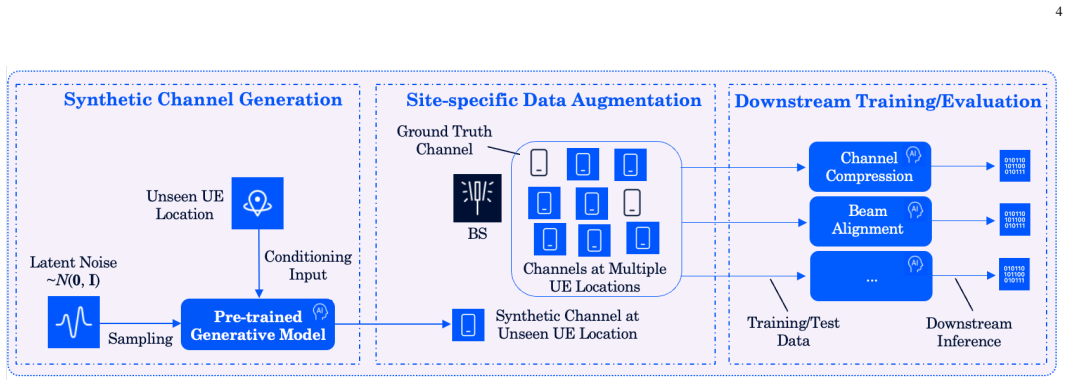
Conditional generative models synthesize accurate site-specific MIMO channels that enhance downstream wireless tasks even with limited real data.
A machine-rendered reading of the paper's core claim, the machinery that carries it, and where it could break.
Core claim
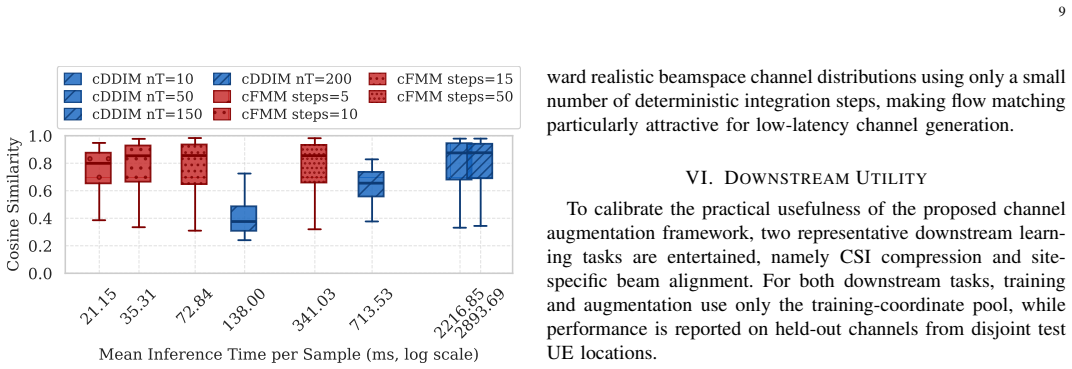
Both the conditional denoising diffusion implicit model and the conditional flow matching model accurately capture site-specific MIMO channel characteristics across different frequencies and propagation conditions, even with scarce training data. The flow matching model achieves comparable quality to the diffusion model with about ten times less inference time. Augmenting scarce real datasets with these synthetic channels leads to significant performance improvements in downstream physical layer tasks such as channel-state information compression and beam alignment, outperforming the use of scarce data alone or stochastic channels.
What carries the argument
Location-conditioned generative models (cDDIM and cFMM) that synthesize full MIMO channel matrices directly from user coordinates to preserve site-specific spatial structure.
If this is right
- The generated channels can supplement limited measurement campaigns for training AI models in wireless systems.
- Flow matching offers a faster route to producing large volumes of site-specific data without sacrificing fidelity.
- Gains appear consistently in both line-of-sight and non-line-of-sight conditions at 28 GHz and 3.5 GHz.
- The approach directly reduces reliance on costly, extensive real-world channel measurement campaigns.
Where Pith is reading between the lines
- The efficiency advantage of flow matching could support on-demand channel generation in mobile or rapidly changing environments.
- Similar conditioning on location could be tested for generating other site-dependent quantities such as interference statistics.
- If the models generalize across nearby sites, the data-augmentation benefit might extend to new deployments with even fewer measurements.
Load-bearing premise
The synthetic channels must retain enough of the real site's spatial structure and statistical properties that mixing them with limited real measurements improves performance on downstream tasks.
What would settle it
If augmenting a small real dataset with the generated channels produces no improvement or a decline in beam alignment accuracy or CSI compression performance relative to the real data alone, the utility claim would be refuted.
Figures


read the original abstract
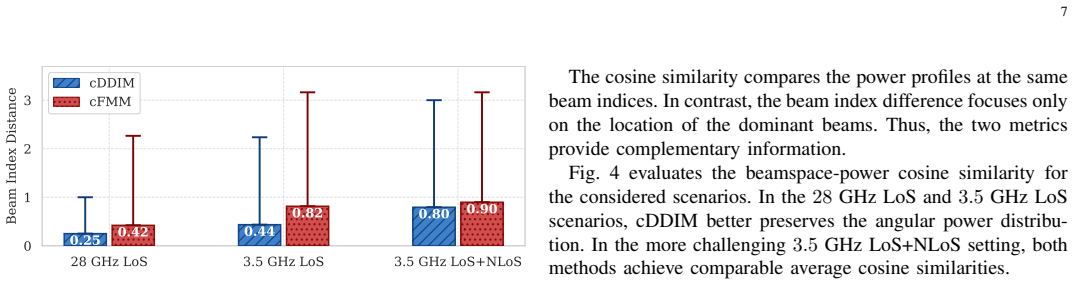
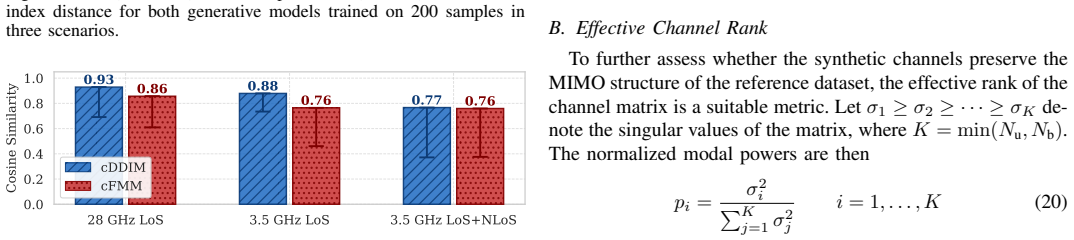
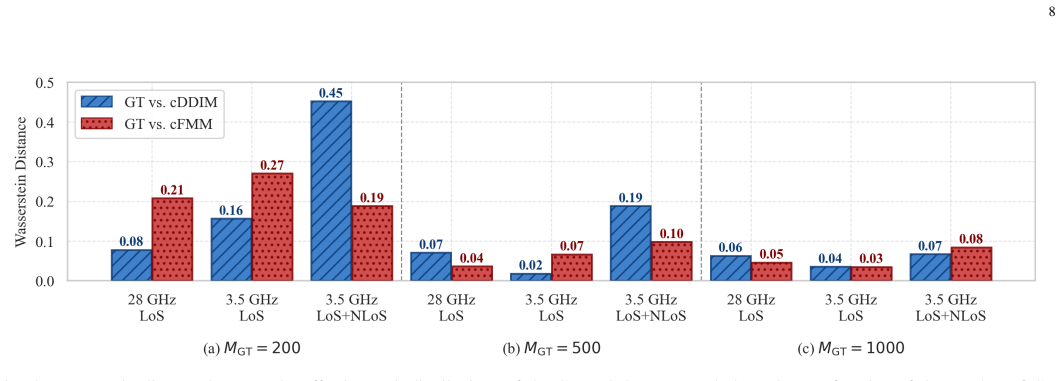
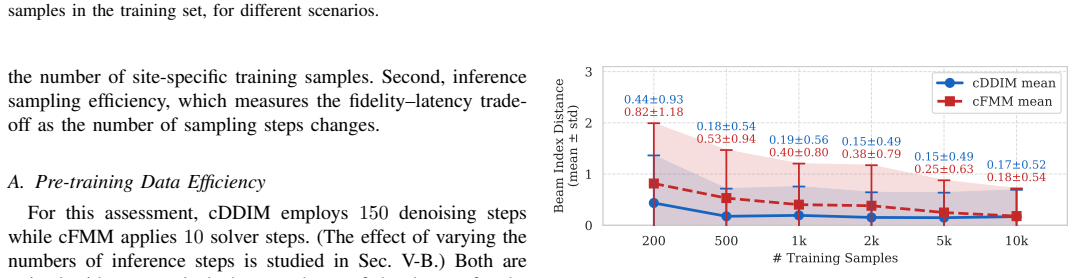
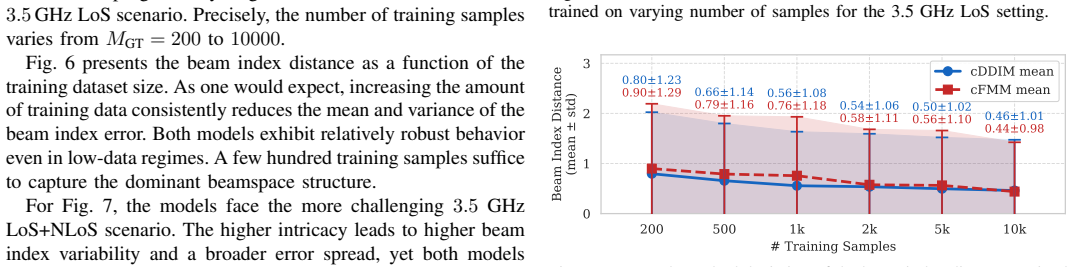
This paper explores the use of generative models to synthesize high-quality, site-specific multiple-input multiple-output (MIMO) channel data, addressing the high cost of the extensive measurement campaigns required to acquire real-world data for AI-native wireless networks. Two location-conditioned generative paradigms are compared: a conditional denoising diffusion implicit model (cDDIM), and a conditional flow matching model (cFMM). Both these models generate MIMO channel matrices conditioned on user coordinates, to preserve the spatial structure of the deployment site. The approaches are evaluated across three dimensions: statistical fidelity (including beam consistency and effective rank), generation efficiency, and utility in downstream tasks such as channel-state information compression and beam alignment. Results across diverse propagation scenarios (28 GHz and 3.5 GHz, both line-of-sight and non-line-of-sight) demonstrate that both models accurately capture site-specific characteristics, even when trained on scarce ground-truth data. Notably, cFMM achieves a quality comparable to cDDIM with roughly an order of magnitude less inference time. Augmenting scarce site-specific datasets with these synthetic channels yields hefty performance gains in downstream physical layer tasks compared to using scarce data alone or stochastic channels.
Editorial analysis
A structured set of objections, weighed in public.
Referee Report
Summary. The paper proposes and compares two location-conditioned generative models—conditional denoising diffusion implicit model (cDDIM) and conditional flow matching model (cFMM)—for synthesizing site-specific MIMO channel matrices from user coordinates. It evaluates statistical fidelity via beam consistency and effective rank, generation efficiency, and downstream utility in CSI compression and beam alignment tasks. Experiments span 28 GHz and 3.5 GHz carriers under both LOS and NLOS conditions, claiming that both models capture site-specific propagation characteristics even when trained on scarce real data, that cFMM matches cDDIM quality at roughly 10x lower inference time, and that augmenting limited real datasets with the generated channels produces substantial gains over using scarce data alone or stochastic channel models.
Significance. If the reported empirical results hold under the stated evaluation protocol, the work offers a practical route to mitigating the high cost of site-specific measurement campaigns for AI-native wireless systems. The direct comparison of diffusion and flow-matching paradigms on the same conditioning and downstream tasks, together with explicit attention to scarce-data regimes and physical-layer utility, provides actionable evidence on the relative merits of these generative approaches for MIMO channel synthesis.
minor comments (3)
- Abstract: the summary statement that augmentation 'yields hefty performance gains' would be strengthened by including at least one representative quantitative delta (e.g., percentage improvement in beam-alignment accuracy or compression MSE) together with the number of real samples used in the scarce-data regime.
- The manuscript would benefit from an explicit statement of the total number of measured channels, the train/validation/test split sizes, and the precise definition of 'scarce' (e.g., number of locations or snapshots) in the experimental sections.
- Notation: the distinction between the effective rank metric and the beam-consistency metric should be clarified with a short equation or reference to the precise computation used for each.
Simulated Author's Rebuttal
We thank the referee for the positive summary of our manuscript and the recommendation of minor revision. The assessment correctly identifies the core contributions regarding conditional diffusion and flow-matching models for site-specific MIMO channel synthesis, their efficiency comparison, and utility in downstream tasks under data-scarce regimes.
Circularity Check
No significant circularity detected
full rationale
The paper is an empirical study comparing two conditional generative models (cDDIM and cFMM) for synthesizing site-specific MIMO channels. Claims rest on training the models on coordinate-conditioned data, then measuring statistical fidelity (beam consistency, effective rank), inference speed, and downstream task gains (CSI compression, beam alignment) against baselines. No mathematical derivation chain, first-principles predictions, or parameter fits are presented as outputs; all results are direct empirical measurements. No self-citations are invoked as load-bearing uniqueness theorems or ansatzes. The central results do not reduce to inputs by construction.
Axiom & Free-Parameter Ledger
axioms (1)
- domain assumption MIMO channel distributions at a given site can be learned and reproduced by generative models when conditioned only on user coordinates.
Reference graph
Works this paper leans on
-
[1]
https://github.com/Telefonica-Scientific-Research/GenAI_Channel_ Modeling
-
[2]
(2025, Oct.) Nvidia’s $1 billion stake sends Nokia to decade high on AI hopes
Reuters. (2025, Oct.) Nvidia’s $1 billion stake sends Nokia to decade high on AI hopes. Accessed: 2025- 12-21. [Online]. Available: https://www.reuters.com/world/europe/ nvidia-make-1-billion-investment-finlands-nokia-2025-10-28/
2025
-
[3]
Generative diffusion model- based compression of MIMO CSI,
H. Kim, T. Lee, H. Kim, G. De V eciana, M. A. Arfaoui, A. Koc, P . Pietraski, G. Zhang, and J. Kaewell, “Generative diffusion model- based compression of MIMO CSI,” in ICC 2025 - Proc. IEEE Int. Conf. Commun., 2025, pp. 6323–6328
2025
-
[4]
Channel geometry preserving generative models for CSI feedback in MU-MIMO,
J. Park, T. Lee, F. Sohrabi, and J. G. Andrews, “Channel geometry preserving generative models for CSI feedback in MU-MIMO,” 2026. [Online]. Available: https://arxiv.org/abs/2605.08628
Pith/arXiv arXiv 2026
-
[5]
Site-specific beam alignment in 6G via deep learning,
Y . Heng, Y . Zhang, A. Alkhateeb, and J. G. Andrews, “Site-specific beam alignment in 6G via deep learning,” IEEE Commun. Mag. , vol. 62, no. 8, pp. 162–168, 2024
2024
-
[6]
Views on AI/ML in 6GR air interface (TDoc R1-2506243),
DeepSig, “Views on AI/ML in 6GR air interface (TDoc R1-2506243),” 3GPP , Tech. Rep., 6 2025, document R1-2506243, WG1 RL1 meeting TSG RAN1#122. Accessed: 2026-05-21. [Online]. Available: https://www. 3gpp.org/ftp/tsg_ran/WG1_RL1/TSGR1_122/Docs/R1-2506243.zip
2025
-
[7]
The road of artificial intelligence towards the 6G air interface,
A. García-Rodríguez, “The road of artificial intelligence towards the 6G air interface,” OpenAirInterface Software Alliance / © Ericsson Research, Tech. Rep., Sep. 2024, workshop presentation, OpenAirInterface 10th Anniversary Workshop, 12 Sept 2024. Accessed: 2026-05-21. [Online]. Available: https://openairinterface.org/wp-content/uploads/2024/ 09/OAI-10t...
2024
-
[8]
Generative- adversarial-network-based wireless channel modeling: Challenges and op- portunities,
Y . Y ang, Y . Li, W. Zhang, F. Qin, P . Zhu, and C.-X. Wang, “Generative- adversarial-network-based wireless channel modeling: Challenges and op- portunities,” IEEE Commun. Mag. , vol. 57, no. 3, pp. 22–27, Mar. 2019
2019
-
[9]
Approximating the void: Learning stochastic channel models from observation with variational generative adversarial networks,
T. J. O’Shea, T. Roy, and N. West, “Approximating the void: Learning stochastic channel models from observation with variational generative adversarial networks,” in Proc. IEEE Int. Conf. Comput. Netw. Commun. (ICNC), 2019, pp. 681–686
2019
-
[10]
Wireless channel modeling using generative machine learning models,
J. Juhava, “Wireless channel modeling using generative machine learning models,” Master’s thesis, Aalto University School of Electrical Engineering, Espoo, Finland, Jun. 2023. [Online]. Available: https: //aaltodoc.aalto.fi/items/c431df84-f96b-4a22-ae00-eedfa5153904
2023
-
[11]
Channel modeling and generation: Train generative networks and generate 6G channel data,
Z. Liu, Z. Teng, Y . Song, X. Y e, and Y . Ouyang, “Channel modeling and generation: Train generative networks and generate 6G channel data,” in Proc. 2022 IEEE 8th Int. Conf. Comput. Commun. (ICCC) , 2022, pp. 72– 78
2022
-
[12]
ChannelGAN: Deep learning- based channel modeling and generating,
H. Xiao, W. Tian, W. Liu, and J. Shen, “ChannelGAN: Deep learning- based channel modeling and generating,” IEEE Wireless Commun. Letters , vol. 11, no. 3, pp. 650–654, Mar. 2022
2022
-
[13]
Real and fake channel: GAN-based wireless channel modeling and generating,
W. Xie, M. Xiong, Z. Y ang, W. Liu, L. Fan, and J. Zou, “Real and fake channel: GAN-based wireless channel modeling and generating,” Phys. Commun., vol. 61, p. 102214, 2023
2023
-
[14]
Deep learning based modeling of wireless communication channel with fading,
Y . Lee, X. Ma, A. S. I. D. Lang, E. F. V alderrama-Araya, and A. L. Chapuis, “Deep learning based modeling of wireless communication channel with fading,” in Proc. Int. Wireless Commun. Mobile Comput. (IWCMC) , 2024, pp. 1577–1582
2024
-
[15]
MIMO-GAN: Generative MIMO channel modeling,
T. Orekondy, A. Behboodi, and J. B. Soriaga, “MIMO-GAN: Generative MIMO channel modeling,” in Proc. IEEE Int. Conf. Commun. , 2022, pp. 5322–5328
2022
-
[16]
GAN-based massive MIMO channel model trained on measured data,
F. Euchner, J. Sanzi, M. Henninger, and S. ten Brink, “GAN-based massive MIMO channel model trained on measured data,” in Proc. 27th Int. Workshop Smart Antennas (WSA) , 2024, pp. 109–116
2024
-
[17]
Channel modeling for FR3 upper mid-band via generative adversarial networks,
Y . Hu, M. Yin, M. Mezzavilla, H. Guo, and S. Rangan, “Channel modeling for FR3 upper mid-band via generative adversarial networks,” in Proc. IEEE Workshop on Signal Process. Advances in Wireless Commun. (SPA WC), 2024, pp. 776–780
2024
-
[18]
Generative neural network channel modeling for millimeter- wave UA V communication,
W. Xia, S. Rangan, M. Mezzavilla, A. Lozano, G. Geraci, V . Semkin, and G. Loianno, “Generative neural network channel modeling for millimeter- wave UA V communication,” IEEE Trans. Wireless Commun. , vol. 21, no. 11, pp. 9417–9431, Nov. 2022
2022
-
[19]
Spatially consistent air-to-ground channel modeling via generative neural networks,
A. Giuliani, R. Nikbakht, G. Geraci, S. Kang, A. Lozano, and S. Rangan, “Spatially consistent air-to-ground channel modeling via generative neural networks,” IEEE Commun. Wireless Letters , vol. 13, no. 4, pp. 1158–1162, Apr. 2024
2024
-
[20]
Generative network-based channel modeling and generation for air-to- ground communication scenarios,
Y . Tian, H. Li, Q. Zhu, K. Mao, F. Ali, X. Chen, and W. Zhong, “Generative network-based channel modeling and generation for air-to- ground communication scenarios,” IEEE Commun. Letters , vol. 28, no. 4, pp. 892–896, Apr. 2024
2024
-
[21]
Generative adversarial networks based digital twin channel modeling for intelligent communication networks,
Y . Zhang, R. He, B. Ai, M. Y ang, R. Chen, C.-X. Wang, Z. Zhang, and Z. Zhong, “Generative adversarial networks based digital twin channel modeling for intelligent communication networks,” China Communica- tions, vol. 20, no. 8, pp. 32–43, Aug. 2023
2023
-
[22]
A GAN-GRU based space-time predictive channel model for 6G wireless communications,
Z. Li, C.-X. Wang, C. Huang, J. Huang, J. Li, W. Zhou, and Y . Chen, “A GAN-GRU based space-time predictive channel model for 6G wireless communications,” IEEE Trans. V eh. Technol. , vol. 73, no. 7, pp. 9370– 9386, Jul. 2024
2024
-
[23]
Transformer- based neural surrogate for link-level path loss prediction from variable- sized maps,
T. M. Hehn, T. Orekondy, O. Shental, A. Behboodi, J. Bucheli, A. S. Doshi, J. Namgoong, T. Y oo, A. Sampath, and J. B. Soriaga, “Transformer- based neural surrogate for link-level path loss prediction from variable- sized maps,” in Proc. IEEE Global Commun. Conf. (GLOBECOM) , 2023, pp. 4804–4809
2023
-
[24]
Genera- tive diffusion models for radio wireless channel modelling and sampling,
U. Sengupta, C. Jao, A. Bernacchia, S. V akili, and D. shan Shiu, “Genera- tive diffusion models for radio wireless channel modelling and sampling,” in Proc. IEEE Global Commun. Conf. (GLOBECOM) , 2023, pp. 4779– 4784
2023
-
[25]
K. K. Reddy Chagari, K. Chowdhury, S. Akoum, and J. G. Andrews, in Proc. 59th Asilomar Conf. on Signals, Systems, and Computers , 2025, pp. 1183–1187
2025
-
[26]
Learning ray-tracing for radio propagation via cross-attention-based diffusion mod- els,
J. Park, T. Lee, Y . Xing, J. Chen, A. Ghosh, and J. G. Andrews, “Learning ray-tracing for radio propagation via cross-attention-based diffusion mod- els,” in Proc. 59th Asilomar Conf. on Signals, Systems, and Computers , 2025, pp. 1210–1214
2025
-
[27]
Generating high dimensional user-specific wireless channels using diffusion models,
T. Lee, J. Park, H. Kim, and J. G. Andrews, “Generating high dimensional user-specific wireless channels using diffusion models,” IEEE Trans. Wire- less Commun. , vol. 25, pp. 2907–2921, 2026
2026
-
[28]
Flow matching for generative modeling,
Y . Lipman, R. T. Chen, H. Ben-Hamu, M. Nickel, and M. Le, “Flow matching for generative modeling,” arXiv preprint arXiv:2210.02747 , 2022
Pith/arXiv arXiv 2022
-
[29]
Evaluation metrics and methods for generative models in the wireless PHY layer,
M. Baur, N. Turan, S. Wallner, and W. Utschick, “Evaluation metrics and methods for generative models in the wireless PHY layer,” Aug. 2024. [Online]. Available: https://arxiv.org/abs/2408.00634
arXiv 2024
-
[30]
F. Aït Aoudia, J. Hoydis, M. Nimier-David, B. Nicolet, S. Cammerer, and A. Keller, “Sionna RT: Technical report,” arXiv:2504.21719, Nov. 2025
arXiv 2025
-
[31]
Openstreetmap: User-generated street maps,
M. Haklay and P . Weber, “Openstreetmap: User-generated street maps,” IEEE Pervasive Comput. , vol. 7, no. 4, pp. 12–18, 2008
2008
-
[32]
U-net: Convolutional networks for biomedical image segmentation,
O. Ronneberger, P . Fischer, and T. Brox, “U-net: Convolutional networks for biomedical image segmentation,” in International Conference on Medi- cal image computing and computer-assisted intervention . Springer, 2015, pp. 234–241
2015
-
[33]
High-resolution image synthesis with latent diffusion models,
R. Rombach, A. Blattmann, D. Lorenz, P . Esser, and B. Ommer, “High-resolution image synthesis with latent diffusion models,” in Proc. IEEE/CVF Conf. Comput. Vis. Pattern Recognit. (CVPR), 2022, pp. 10 684– 10 695
2022
-
[34]
Study on channel model for frequencies from 0.5 to 100 GHz (Release 17),
3GPP Technical Report 38.901, “Study on channel model for frequencies from 0.5 to 100 GHz (Release 17),” 2022
2022
-
[35]
The effective rank: A measure of effective dimensionality,
O. Roy and M. V etterli, “The effective rank: A measure of effective dimensionality,” in Proc. 15th Eur . Signal Process. Conf. (EUSIPCO) , 2007, pp. 606–610
2007
-
[36]
Multi-resolution CSI feedback with deep learning in massive MIMO system,
Z. Lu, J. Wang, and J. Song, “Multi-resolution CSI feedback with deep learning in massive MIMO system,” in Proc. IEEE Int. Conf. Commun. (ICC), 2020, pp. 1–6
2020
-
[37]
Grid-free MIMO beam alignment through site-specific deep learning,
Y . Heng and J. G. Andrews, “Grid-free MIMO beam alignment through site-specific deep learning,” IEEE Trans. Wireless Commun., vol. 23, no. 2, pp. 908–921, 2024
2024
discussion (0)
Sign in with ORCID, Apple, or X to comment. Anyone can read and Pith papers without signing in.