REVIEW 4 major objections 4 minor 2 cited by
Prompting Strategies for Enabling Large Language Models to Infer Causation from Correlation
T0 review · 4 major / 4 minor · reviewed 2026-08-11 · deepseek-v4-flash
Pith's one-line read PC-SubQ prompts large language models through the steps of the PC algorithm, and on the Corr2Cause benchmark this beats standard prompting across five LLMs.
desk verdict A clean, fully-specified prompt chain for LLM causal discovery, but the headline gain is confounded with a much larger demonstration and compute budget, so the PC decomposition's contribution is unproven. read the letter →
The pith
A machine-rendered reading of the paper's core claim, the machinery that carries it, and where it could break.
The reading
What carries the argument
The load-bearing object is a chain of eight fixed prompts, PC-SubQ, whose subquestions correspond to the steps of the PC algorithm—a constraint-based causal discovery method that starts from a complete undirected graph, deletes edges via conditional-independence information, orients v-structures, and then orients remaining edges without introducing new v-structures, yielding a partially directed graph (a CPDAG). The mechanism is sequential prompting: each subquestion is asked in its own LLM call, the next prompt is augmented with only the prior answer (not the full history), and two calls per subquestion separate the reasoning text from the extracted answer. This lets the model execute a formal procedure stepwise, producing interpretable intermediate outputs that can be inspected to localize mistakes.
What would settle it
Run PC-SubQ on Corr2Cause but also score the intermediate answers (skeleton after SubQ2, oriented graph after SubQ7) against the ground-truth CPDAGs; if intermediate accuracy is low or a wrong intermediate graph still yields the right final label, the reported F1 gain would not demonstrate that the LLM is actually following the PC steps.
Extended reading notes
Core claim
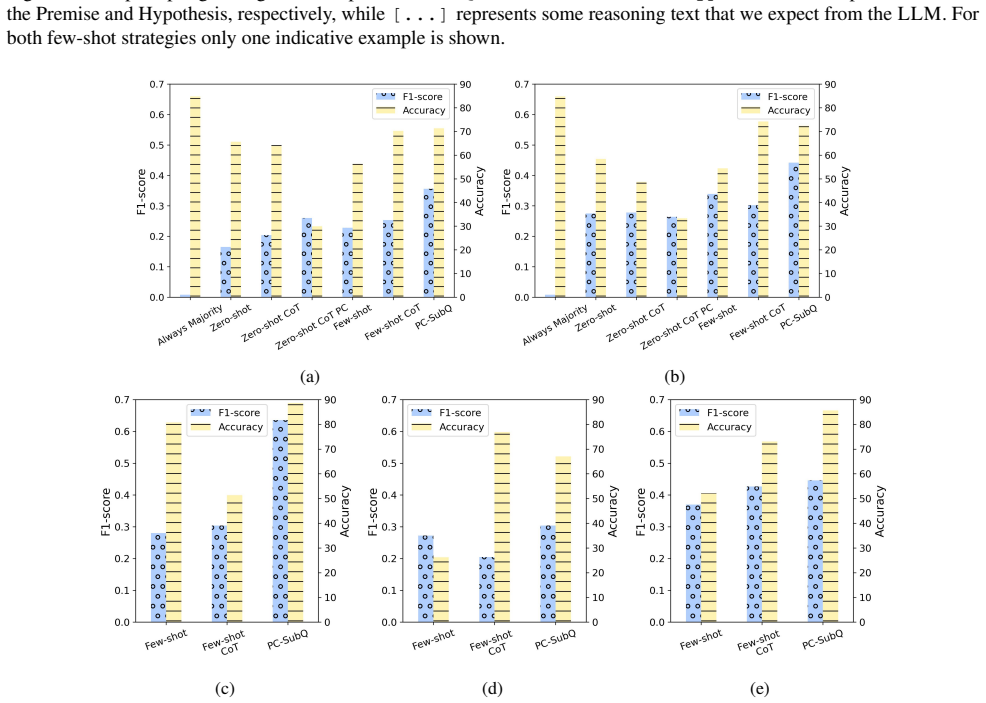
PC-SubQ breaks natural-language causal discovery into eight subquestions that mirror the PC algorithm: initialize a fully connected undirected graph, remove edges using the stated conditional independencies, enumerate paths of length two, identify candidate v-structures, orient v-structures, merge orientations into a partially directed graph, orient remaining edges without creating new v-structures, and finally read off whether the queried hypothesis holds in the inferred graph. The LLM is prompted with one subquestion at a time; only the answer to the previous subquestion is inserted into the next prompt, and each subquestion is preceded by few-shot chain-of-thought demonstrations. The paper reports that this chain raises F1 relative to all baselines on all five models tested, is robust to variable renaming and paraphrasing of the prompts, and produces correct answers on natural-story examples even though the demonstrations use only symbolic variables.
Load-bearing premise
The chain works only if the language model can faithfully carry out each PC step from the natural-language premise and pass its answer forward without errors snowballing, and the paper checks only the final answer, not the intermediate graphs.
Editorial extensions
If this is right
- On Corr2Cause, PC-SubQ yields higher F1 than zero-shot, zero-shot COT, few-shot, and few-shot COT prompting for all five LLMs tested (Gemini Pro 1.0, Gemini Ultra 1.0, PaLM 2 L, GPT-3.5-turbo, GPT-4-turbo).
- The strategy is robust to prompt perturbations: performance does not drop under variable refactoring and drops only slightly under paraphrasing, a failure mode that the paper reports for fine-tuned models.
- PC-SubQ transfers, without modification, to natural-language stories with natural variable names, producing correct reasoning and answers despite seeing only symbolic-name demonstrations.
- Because each step is visible, a wrong final answer can be traced to the specific subquestion that failed, making the LLM's causal reasoning auditable.
- The approach requires no fine-tuning and uses only a handful of demonstrations per subquestion, suggesting a general recipe: decompose a task along the steps of a shared algorithmic procedure.
Reading between the lines
- A testable extension the paper does not run is to score the intermediate outputs (skeleton after SubQ2, partial graph after SubQ7) against ground-truth graphs; that would reveal whether the F1 gain comes from faithful PC execution or from the final hypothesis step compensating for earlier mistakes.
- If the chain's bottleneck is SubQ2, as the paper's own limitation discussion hints, then paraphrasing the premise or reordering the conditional-independence statements might change accuracy without changing the underlying graph—an experiment that would isolate the model's ability to map premises to edge removals.
- The same fixed-chain recipe could be applied to other constraint-based discovery algorithms, such as variants that allow latent confounders, by replacing the subquestions; the paper explicitly frames the approach as general to tasks with a common underlying algorithm.
- For natural stories, formal and commonsense reasoning are entangled; a useful extension would compare PC-SubQ with and without semantic variable names to measure how much of the gain is formal versus semantic.
Editorial analysis
A structured set of objections, weighed in public.
Referee Report
Summary. The paper proposes PC-SubQ, a prompting strategy that decomposes the task of inferring causal relationships from natural-language correlation statements into eight fixed subquestions modeled on the steps of the PC algorithm. The prompts are chained by passing the answer of each subquestion to the next, with few-shot chain-of-thought demonstrations prepended to each subquestion. The authors evaluate PC-SubQ on the Corr2Cause benchmark using five LLMs, reporting F1 improvements over zero-shot, zero-shot COT, few-shot, and few-shot COT baselines, and they present robustness experiments involving variable renaming, paraphrasing, and two natural-story examples.
Significance. If the reported results hold, PC-SubQ is a valuable contribution to formal causal reasoning in LLMs: it shows that a fixed prompt chain can steer an off-the-shelf LLM through a standard causal discovery algorithm without retraining, while providing transparent intermediate reasoning. The paper has notable strengths: the full few-shot prompts are provided in the appendix, making the experiments reproducible; no parameters are fitted to the benchmark; the Corr2Cause benchmark is external; and the robustness analysis is motivated by prior work on fine-tuned models. The interpretability benefit is demonstrated concretely in Appendix E. However, the central comparison is confounded by unequal demonstration and inference budgets, and the absence of error bars or significance tests leaves the magnitude of the reported gains uncertain.
major comments (4)
- [Section 5 (Fig. 4) vs. Appendix B and Tables 1-10] The headline comparison is confounded by unequal demonstration and inference budgets. PC-SubQ uses 28 few-shot demonstrations (SubQ1: 1, SubQ2: 1, SubQ3: 3, SubQ4: 4, SubQ5: 3, SubQ6: 2, SubQ7: 3, SubQ8: 11, from Tables 1-10) and 16 LLM calls (two per subquestion, as stated in Appendix A), whereas the few-shot COT baseline uses 6 demonstrations and a single LLM call (Appendix B). SubQ8 alone contains 11 demonstrations, nearly double the baseline's entire shot budget, and includes explicit reminders that directed and undirected edges differ. The paper does not include a control that matches shot count or compute without the PC structure, so the specific claim that guiding the LLM through the PC algorithm steps drives the improvement is not established. I ask for such a control, for example a flat 28-shot prompt without the PC chain, or a non-PC multi-step decomposition with the same call budget.
- [Section 5] No error bars, significance tests, or sampling details are reported for any of the LLM experiments. LLM outputs are stochastic, and footnote 5 states that GPT-4-turbo was evaluated on only a random 20% subset of the dataset, but no seed or repeated-run information is provided. As a result, the reported F1 differences, some of which are modest, cannot be distinguished from run-to-run variation. Please report the number of runs, seeds, standard deviations or confidence intervals, and, where feasible, significance tests on the F1 differences.
- [Section 6 (Discussion and Conclusion)] The manuscript explicitly acknowledges that only the final SubQ8 output is evaluated, with no ground-truth labels for the intermediate SubQ1-7 answers. Since PC-SubQ's claimed mechanism is faithful execution of the PC algorithm, an incorrect intermediate graph that still yields a correct final label would go undetected; Appendix E is a single qualitative trace. To support the mechanistic claim, the authors should evaluate intermediate outputs, at least SubQ7's inferred graph against the MEC/CPDAG ground truth, or otherwise quantify error propagation across the chain.
- [Section 5 (Robustness analysis)] The robustness to variable refactoring and paraphrasing is demonstrated only for PaLM 2 (Fig. 5, left), and the natural-story evidence consists of two qualitative examples (Fig. 5, right). The abstract states that "Results are robust to causal query perturbations" without restricting this claim to one model. Please either test robustness across the five LLMs or soften the claim to avoid overgeneralization.
minor comments (4)
- [Table 5, second exemplar] The premise says "All the statistical relations among these 3 variables" although the example has 4 variables (A, B, C, D); this should be corrected.
- [Appendix C] In the refactored and paraphrased shots, the reasoning line restates the hypothesis incorrectly: the original "A and B together cause" becomes "A and E together cause", and the refactored version says "Z and V" instead of "Z and Y". These typos should be fixed since the appendix is intended to support reproduction.
- [Related Work] The phrase "constrained-based causal discovery" should be "constraint-based causal discovery".
- [Appendix B] For PaLM 2 L, the reasoning parts of the last three baseline shots were shortened to fit the context limit; please state whether the same truncation was applied to PC-SubQ prompts or discuss the potential effect on the comparison.
Circularity Check
No significant circularity: PC-SubQ is an empirical prompting evaluation against an external benchmark, and no claimed prediction reduces to its inputs by construction or through load-bearing self-citation.
full rationale
The paper's central claim is that a fixed eight-subquestion prompting chain mirroring the PC algorithm improves LLM performance on Corr2Cause. The PC algorithm is a standard external method cited to Spirtes et al., and Corr2Cause is an external benchmark due to Jin et al.; neither is defined by this paper or by its authors. The subquestions and few-shot demonstrations are fixed prompt content, not fitted parameters, and the reported F1/accuracy numbers are measured against held-out test labels. It is true that Corr2Cause labels are generated from Markov equivalence classes and that the PC algorithm returns the corresponding CPDAG/MEC, so a perfectly executed PC-style chain is well matched to the benchmark by construction; however, this is a property of the external task design, not a circular reduction within the paper's own derivation. The paper explicitly acknowledges that intermediate subquestion answers are not quantitatively evaluated against ground truth (Section 6, Discussion), which is an evaluation limitation, not a circularity. The larger demonstration and inference budget of PC-SubQ relative to baseline prompting strategies (28 total shots and 16 LLM calls versus 6 shots and 1 call) is a potential experimental confound regarding why the method helps, but it does not make any result equivalent to its input by definition. No fitted-input-renamed-as-prediction, self-citation chain, or imported uniqueness argument appears. Accordingly, the circularity score is 0.
Assumptions & free parameters
free parameters (1)
- few-shot count per subquestion =
1-4 shots except SubQ8 with 11 shots
assumptions (3)
- domain assumption Faithfulness: the only conditional independencies are those implied by d-separation in the underlying DAG.
- domain assumption Causal sufficiency: no unobserved confounders.
- domain assumption The natural-language premise lists all statistical relations completely.
Cite this review
Pith. "Pith review of Prompting Strategies for Enabling Large Language Models to Infer Causation from Correlation." pith.science (2026). https://pith.science/paper/TAK4YOSR
@misc{pith2026241213952,
  author       = {Pith},
  title        = {Pith review of: Prompting Strategies for Enabling Large Language Models to Infer Causation from Correlation},
  year         = {2026},
  howpublished = {\url{https://pith.science/paper/TAK4YOSR}},
  note         = {Machine review of arXiv:2412.13952}
}
read the original abstract
The reasoning abilities of Large Language Models (LLMs) are attracting increasing attention. In this work, we focus on causal reasoning and address the task of establishing causal relationships based on correlation information, a highly challenging problem on which several LLMs have shown poor performance. We introduce a prompting strategy for this problem that breaks the original task into fixed subquestions, with each subquestion corresponding to one step of a formal causal discovery algorithm, the PC algorithm. The proposed prompting strategy, PC-SubQ, guides the LLM to follow these algorithmic steps, by sequentially prompting it with one subquestion at a time, augmenting the next subquestion's prompt with the answer to the previous one(s). We evaluate our approach on an existing causal benchmark, Corr2Cause: our experiments indicate a performance improvement across five LLMs when comparing PC-SubQ to baseline prompting strategies. Results are robust to causal query perturbations, when modifying the variable names or paraphrasing the expressions.
Figures


Figures from the paper (3 more)


Forward citations
Cited by 2 Pith papers
-
Causal Reasoning in Pieces: Modular In-Context Learning for Causal Discovery
A four-stage, PC-algorithm-based prompting pipeline raises OpenAI o3-mini's F1 on the Corr2Cause benchmark from 66.28 to 83.83, a new high for in-context causal discovery.
-
Structured Thinking Matters: Improving LLMs Generalization in Causal Inference Tasks
Guiding Qwen3-32B to construct an intermediate knowledge graph before answering causal queries raises Corr2Cause F1 from 32.71 to 48.26.
Reference graph
Works this paper leans on
-
[1]
Abdulaal, A., adamos hadjivasiliou, Montana-Brown, N., He, T., Ijishakin, A., Drobnjak, I., Castro, D. C., and Alexander, D. C. Causal modelling agents: Causal graph discovery through synergising metadata- and data-driven reasoning. In The Twelfth International Conference on Learning Representations, 2024
work page 2024
-
[2]
Beyond the imitation game: Quantifying and extrapolating the capabilities of language models
Authors, B. Beyond the imitation game: Quantifying and extrapolating the capabilities of language models. Transactions on Machine Learning Research, 2023. ISSN 2835-8856
work page 2023
-
[3]
D., Dhariwal, P., Neelakantan, A., Shyam, P., Sastry, G., Askell, A., et al
Brown, T., Mann, B., Ryder, N., Subbiah, M., Kaplan, J. D., Dhariwal, P., Neelakantan, A., Shyam, P., Sastry, G., Askell, A., et al. Language models are few-shot learners. In Advances in Neural Information Processing Systems, pp.\ 1877--1901, 2020
work page 1901
-
[4]
Chickering, D. M. Learning equivalence classes of B ayesian-network structures. Journal of Machine Learning Research, 2: 0 445--498, 2002
work page 2002
-
[5]
Large language models for constrained-based causal discovery
Cohrs, K.-H., Diaz, E., Sitokonstantinou, V., Varando, G., and Camps-Valls, G. Large language models for constrained-based causal discovery. In AAAI 2024 Workshop on ``Are Large Language Models Simply Causal Parrots?'' , 2024
work page 2024
-
[6]
Successive prompting for decomposing complex questions
Dua, D., Gupta, S., Singh, S., and Gardner, M. Successive prompting for decomposing complex questions. In Conference on Empirical Methods in Natural Language Processing, pp.\ 1251--1265, 2022
work page 2022
-
[7]
Gemini: A family of highly capable multimodal models
Gemini Team Google . Gemini: A family of highly capable multimodal models. arXiv preprint arXiv:2312.11805, 2023
arXiv 2023
-
[8]
Google and, R. A., Dai, A. M., Firat, O., Johnson, M., Lepikhin, D., Passos, A., Shakeri, S., Taropa, E., Bailey, P., Chen, Z., Chu, E., Clark, J. H., Shafey, L. E., Huang, Y., Meier-Hellstern, K., Mishra, G., Moreira, E., Omernick, M., Robinson, K., Ruder, S., Tay, Y., Xiao, K., Xu, Y., Zhang, Y., Abrego, G. H., Ahn, J., Austin, J., Barham, P., Botha, J....
arXiv 2023
Show all 42 references
-
[9]
M., Peters, J., and Sch \"o lkopf, B
Hoyer, P., Janzing, D., Mooij, J. M., Peters, J., and Sch \"o lkopf, B. Nonlinear causal discovery with additive noise models. Advances in Neural Information Processing Systems, 2008
2008
-
[10]
and Chang, K
Huang, J. and Chang, K. C.-C. Towards reasoning in large language models: A survey. In Findings of the Association for Computational Linguistics: ACL 2023 , pp.\ 1049--1065, 2023
2023
-
[11]
G., Kleiman-Weiner, M., Sachan, M., and Sch \"o lkopf, B
Jin, Z., Chen, Y., Leeb, F., Gresele, L., Kamal, O., Zhiheng, L., Blin, K., Adauto, F. G., Kleiman-Weiner, M., Sachan, M., and Sch \"o lkopf, B. CL adder: Assessing causal reasoning in language models. In Advances in Neural Information Processing Systems, 2023
2023
-
[12]
T., and Sch \"o lkopf, B
Jin, Z., Liu, J., Lyu, Z., Poff, S., Sachan, M., Mihalcea, R., Diab, M. T., and Sch \"o lkopf, B. Can large language models infer causation from correlation? In International Conference on Learning Representations, 2024
2024
-
[13]
Efficient causal graph discovery using large language models
Jiralerspong, T., Chen, X., More, Y., Shah, V., and Bengio, Y. Efficient causal graph discovery using large language models. arXiv preprint arXiv:2402.01207, 2024
2024 arXiv
-
[14]
Decomposed prompting: A modular approach for solving complex tasks
Khot, T., Trivedi, H., Finlayson, M., Fu, Y., Richardson, K., Clark, P., and Sabharwal, A. Decomposed prompting: A modular approach for solving complex tasks. In International Conference on Learning Representations, 2023
2023
-
[15]
Causal reasoning and large language models: Opening a new frontier for causality
K c man, E., Ness, R., Sharma, A., and Tan, C. Causal reasoning and large language models: Opening a new frontier for causality. arXiv preprint arXiv:2305.00050, 2023
2023 arXiv
-
[16]
S., Reid, M., Matsuo, Y., and Iwasawa, Y
Kojima, T., Gu, S. S., Reid, M., Matsuo, Y., and Iwasawa, Y. Large language models are zero-shot reasoners. 2022
2022
-
[17]
Can large language models build causal graphs? In NeurIPS 2022 Workshop on Causal Machine Learning for Real-World Impact , 2022
Long, S., Schuster, T., and Pich \'e , A. Can large language models build causal graphs? In NeurIPS 2022 Workshop on Causal Machine Learning for Real-World Impact , 2022
2022
-
[18]
Causal discovery with language models as imperfect experts
Long, S., Pich \'e , A., Zantedeschi, V., Schuster, T., and Drouin, A. Causal discovery with language models as imperfect experts. In ICML Workshop on Structured Probabilistic Inference & Generative Modeling , 2023
2023
-
[19]
The clrs-text algorithmic reasoning language benchmark
Markeeva, L., McLeish, S., Ibarz, B., Bounsi, W., Kozlova, O., Vitvitskyi, A., Blundell, C., Goldstein, T., Schwarzschild, A., and Veli c kovi \'c , P. The clrs-text algorithmic reasoning language benchmark. arXiv preprint arXiv:2406.04229, 2024
2024 arXiv
-
[20]
J., Gur-Ari, G., Michalewski, H., Austin, J., Bieber, D., Dohan, D., Lewkowycz, A., Bosma, M., Luan, D., et al
Nye, M., Andreassen, A. J., Gur-Ari, G., Michalewski, H., Austin, J., Bieber, D., Dohan, D., Lewkowycz, A., Bosma, M., Luan, D., et al. Show your work: Scratchpads for intermediate computation with language models. arXiv preprint arXiv:2112.00114, 2021
2021 arXiv
-
[21]
GPT -4 technical report
OpenAI. GPT -4 technical report. arXiv preprint arXiv:2303.08774, 2023
2023 arXiv
-
[22]
Talm: Tool augmented language models, 2022
Parisi, A., Zhao, Y., and Fiedel, N. Talm: Tool augmented language models, 2022
2022
-
[23]
Causality: Models, Reasoning, and Inference
Pearl, J. Causality: Models, Reasoning, and Inference. Cambridge University Press, 2000
2000
-
[24]
and Mackenzie, D
Pearl, J. and Mackenzie, D. The Book of Why: The New Science of Cause and Effect. Basic Books, 2018
2018
-
[25]
M., Janzing, D., and Sch \"o lkopf, B
Peters, J., Mooij, J. M., Janzing, D., and Sch \"o lkopf, B. Causal discovery with continuous additive noise models. Journal of Machine Learning Research, 15: 0 2009--2053, 2014
2009
-
[26]
Reasoning with language model prompting: A survey
Qiao, S., Ou, Y., Zhang, N., Chen, X., Yao, Y., Deng, S., Tan, C., Huang, F., and Chen, H. Reasoning with language model prompting: A survey. In Annual Meeting of the Association for Computational Linguistics (Volume 1: Long Papers), pp.\ 5368--5393, 2023
2023
-
[27]
W., Borgeaud, S., Cai, T., Millican, K., Hoffmann, J., Song, F., Aslanides, J., Henderson, S., Ring, R., Young, S., et al
Rae, J. W., Borgeaud, S., Cai, T., Millican, K., Hoffmann, J., Song, F., Aslanides, J., Henderson, S., Ring, R., Young, S., et al. Scaling language models: Methods, analysis & insights from training gopher. arXiv preprint arXiv:2112.11446, 2021
2021 arXiv
-
[28]
Algorithm of thoughts: Enhancing exploration of ideas in large language models
Sel, B., Al-Tawaha, A., Khattar, V., Wang, L., Jia, R., and Jin, M. Algorithm of thoughts: Enhancing exploration of ideas in large language models. CoRR, abs/2308.10379, 2023. URL https://doi.org/10.48550/arXiv.2308.10379
-
[29]
O., Hyv \"a rinen, A., Kerminen, A., and Jordan, M
Shimizu, S., Hoyer, P. O., Hyv \"a rinen, A., Kerminen, A., and Jordan, M. A linear non- G aussian acyclic model for causal discovery. Journal of Machine Learning Research, 7: 0 2003--2030, 2006
2003
-
[30]
N., and Scheines, R
Spirtes, P., Glymour, C. N., and Scheines, R. Causation, Prediction, and Search. MIT Press, 2000
2000
-
[31]
A survey of reasoning with foundation models
Sun, J., Zheng, C., Xie, E., Liu, Z., Chu, R., Qiu, J., Xu, J., Ding, M., Li, H., Geng, M., et al. A survey of reasoning with foundation models. arXiv preprint arXiv:2312.11562, 2023
2023 arXiv
-
[32]
Causal-discovery performance of C hat GPT in the context of neuropathic pain diagnosis
Tu, R., Ma, C., and Zhang, C. Causal-discovery performance of C hat GPT in the context of neuropathic pain diagnosis. arXiv preprint arXiv:2301.13819, 2023
2023 arXiv
-
[33]
G., Kumar, A., Bachu, S., Balasubramanian, V
Vashishtha, A., Reddy, A. G., Kumar, A., Bachu, S., Balasubramanian, V. N., and Sharma, A. Causal inference using llm-guided discovery. arXiv preprint arXiv:2310.15117, 2023
2023 arXiv
-
[34]
P., Budden, D., Pascanu, R., Banino, A., Dashevskiy, M., Hadsell, R., and Blundell, C
Veli c kovi \'c , P., Badia, A. P., Budden, D., Pascanu, R., Banino, A., Dashevskiy, M., Hadsell, R., and Blundell, C. The clrs algorithmic reasoning benchmark. In International Conference on Machine Learning, pp.\ 22084--22102. PMLR, 2022
2022
-
[35]
V., Zhou, D., et al
Wei, J., Wang, X., Schuurmans, D., Bosma, M., Xia, F., Chi, E., Le, Q. V., Zhou, D., et al. Chain-of-thought prompting elicits reasoning in large language models. pp.\ 24824--24837, 2022
2022
-
[36]
S., and Kersting, K
Willig, M., Ze c evi \'c , M., Dhami, D. S., and Kersting, K. Can foundation models talk causality? In UAI Workshop on Causal Representation Learning , 2022
2022
-
[37]
React: Synergizing reasoning and acting in language models
Yao, S., Zhao, J., Yu, D., Du, N., Shafran, I., Narasimhan, K., and Cao, Y. React: Synergizing reasoning and acting in language models. In International Conference on Learning Representations, 2023
2023
-
[38]
S., and Kersting, K
Ze c evi \'c , M., Willig, M., Dhami, D. S., and Kersting, K. Causal parrots: Large language models may talk causality but are not causal. Transactions on Machine Learning Research, 2023
2023
-
[39]
Understanding causality with large language models: Feasibility and opportunities
Zhang, C., Bauer, S., Bennett, P., Gao, J., Gong, W., Hilmkil, A., Jennings, J., Ma, C., Minka, T., Pawlowski, N., and Vaughan, J. Understanding causality with large language models: Feasibility and opportunities. arXiv preprint arXiv:2304.05524, 2023
2023 arXiv
-
[40]
Zhou, D., Sch \"a rli, N., Hou, L., Wei, J., Scales, N., Wang, X., Schuurmans, D., Cui, C., Bousquet, O., Le, Q., and Chi, E. H. Least-to-most prompting enables complex reasoning in large language models. In International Conference on Learning Representations, 2023 a
2023
-
[41]
Teaching algorithmic reasoning via in-context learning
Zhou, H., Nova, A., Courville, A., Larochelle, H., Neyshabur, B., and Sedghi, H. Teaching algorithmic reasoning via in-context learning. In International Conference on Learning Representations, 2023 b
2023
-
[42]
write newline
" write newline "" before.all 'output.state := FUNCTION n.dashify 't := "" t empty not t #1 #1 substring "-" = t #1 #2 substring "--" = not "--" * t #2 global.max substring 't := t #1 #1 substring "-" = "-" * t #2 global.max substring 't := while if t #1 #1 substring * t #2 gl...
Reviewed August 11, 2026 · model on record in the stance chip above.
Discussion (0). Continue with ORCID to comment.