Entropy stable finite difference schemes for One-Fluid Two-Temperature Euler Non-equilibrium Hydrodynamics
Pith reviewed 2026-05-19 22:34 UTC · model grok-4.3
pith:TAQBMLTK Add to your LaTeX paper
What is a Pith Number?\usepackage{pith}
\pithnumber{TAQBMLTK}
Prints a linked pith:TAQBMLTK badge after your title and writes the identifier into PDF metadata. Compiles on arXiv with no extra files. Learn more
The pith
Reformulating non-conservative terms enables entropy-stable finite difference schemes for the one-fluid two-temperature Euler equations.
A machine-rendered reading of the paper's core claim, the machinery that carries it, and where it could break.
Core claim
By reformulating the OFTT-Euler equations such that the non-conservative part does not contribute to the entropy, higher-order entropy-conservative numerical schemes are designed by using Tadmor's relation for the conservative part and higher-order central differences for the non-conservative parts. Entropy-dissipation terms are then designed using the entropy-scaled right eigenvectors of the conservative part, thereby deriving the entropy inequality for the entire system.
What carries the argument
Reformulation of the non-conservative products so they contribute nothing to entropy production, allowing Tadmor's relation and central differences to produce entropy-conservative schemes before dissipation is added.
If this is right
- The schemes satisfy the entropy inequality for the full system.
- Higher-order accuracy is achieved while preserving entropy stability.
- The approach applies to both one- and two-dimensional non-equilibrium flow problems.
Where Pith is reading between the lines
- This reformulation approach may extend to other hyperbolic systems that include non-conservative products.
- The schemes could support more reliable long-time integrations in applications involving distinct electron and ion temperatures.
Load-bearing premise
The reformulation of the non-conservative products ensures they do not contribute to the entropy production in the system.
What would settle it
A simulation in which the discrete entropy fails to satisfy the expected inequality or shows growth instead of dissipation despite the proposed dissipation terms.
Figures





read the original abstract
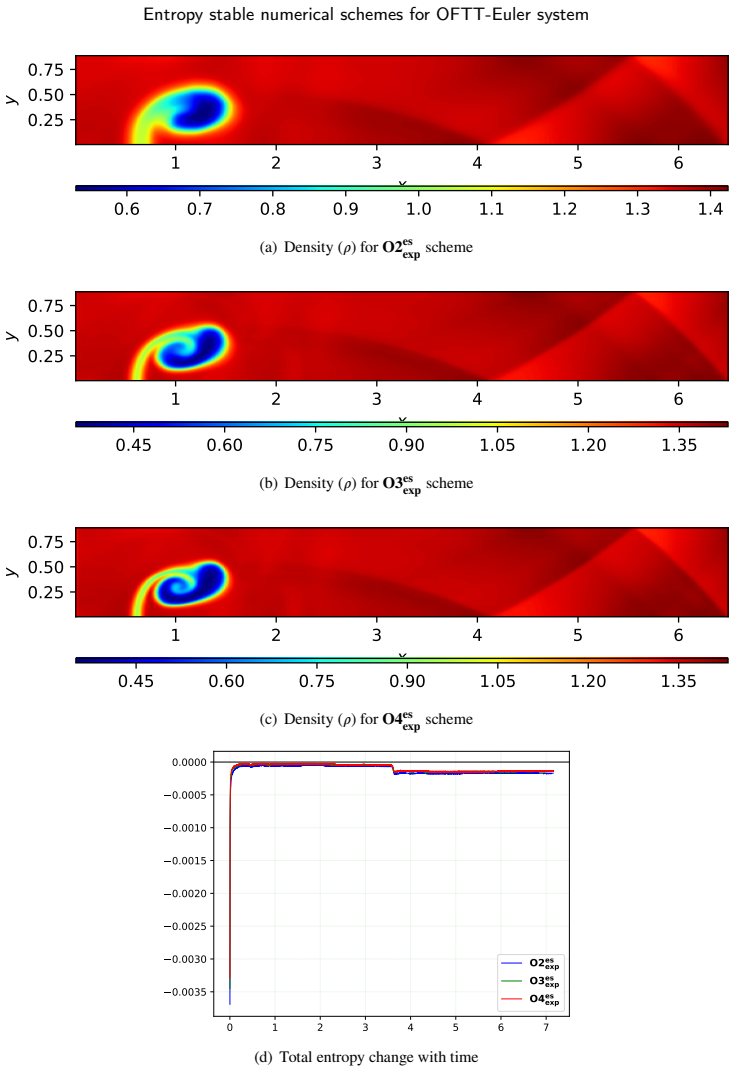
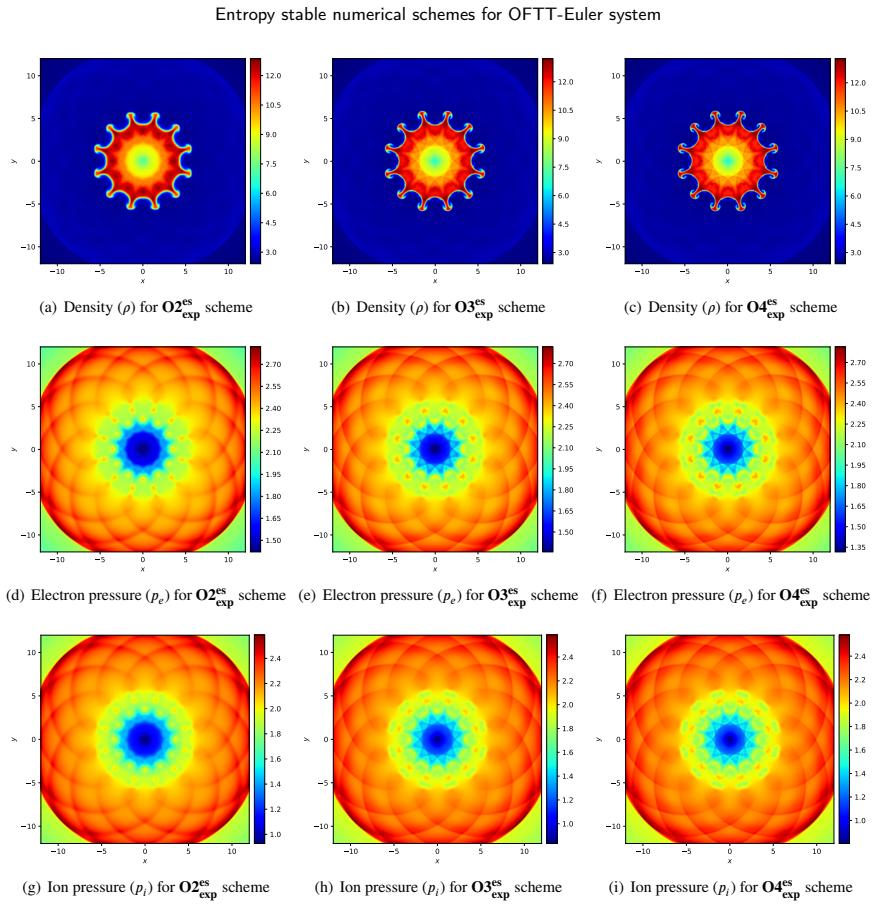
In this work, we consider the One-Fluid Two-Temperature Euler (OFTT-Euler) equations used for modeling non-equilibrium hydrodynamics. The model comprises a system of nonlinear hyperbolic partial differential equations with non-conservative products. The model decomposed the total pressure into two scalar components: one for electrons and one for ions. Our aim in this work is to design entropy-stable finite difference numerical schemes for the model. This is achieved by reformulating the equations such that the reformulated non-conservative part does not contribute to the entropy. Then, we design higher-order entropy-conservative numerical schemes by using Tadmor's relation for the conservative part and higher-order central differences for the non-conservative parts. Finally, we design the entropy-dissipation terms using the entropy-scaled right eigenvectors of the conservative part, thereby deriving the entropy inequality for the entire system. We present several test cases in one and two dimensions to demonstrate the accuracy and stability of the proposed schemes.
Editorial analysis
A structured set of objections, weighed in public.
Referee Report
Summary. The paper develops entropy-stable finite difference schemes for the One-Fluid Two-Temperature Euler (OFTT-Euler) equations, a hyperbolic system with non-conservative products. The central construction reformulates the non-conservative terms so they contribute zero to the continuous entropy balance, applies Tadmor's two-point entropy-conservative flux to the conservative part, uses higher-order central differences on the non-conservative part, and augments the scheme with dissipation constructed from entropy-scaled right eigenvectors of the conservative flux Jacobian. One- and two-dimensional numerical tests are shown to illustrate accuracy and robustness.
Significance. If the discrete entropy-conservation property for the composite scheme is established, the work would supply a practical, provably stable discretization for two-temperature non-equilibrium hydrodynamics, a model relevant to plasma and high-energy flow simulations. The combination of Tadmor's flux with a reformulation that isolates entropy-neutral non-conservative terms is a natural extension of existing entropy-stable methodology; the eigenvector-based dissipation is also standard. The numerical examples provide initial evidence of utility, but the absence of explicit discrete entropy proofs or quantitative entropy-error tables limits the immediate impact.
major comments (2)
- [§3] §3 (Scheme construction): The reformulation ensures the non-conservative products vanish from the continuous entropy equation, but the subsequent use of higher-order central differences on these terms does not automatically guarantee that the same cancellation holds at the discrete level. For the composite scheme to be entropy-conservative before dissipation is added, the central-difference operator applied to the reformulated non-conservative term (when contracted with the entropy variables) must produce a telescoping sum. No such discrete identity is stated or proved; without it the entropy-conservative claim for the non-dissipative part rests on an unverified assumption.
- [§4] §4 (Entropy dissipation): The dissipation matrix is built from the entropy-scaled right eigenvectors of the conservative flux Jacobian alone. It is not shown that this choice remains entropy-dissipative once the non-conservative terms (even if entropy-neutral) are present; a short calculation verifying that the dissipation term produces a non-positive contribution to the discrete entropy balance for the full system would close the argument.
minor comments (2)
- [Abstract] The abstract states that 'higher-order central differences' are used for the non-conservative part but does not specify the exact stencil or the order; adding this detail in §3 would improve reproducibility.
- [§5] Figure captions for the 2-D tests should explicitly state the grid resolution and the CFL number used; several captions currently omit these parameters.
Simulated Author's Rebuttal
We thank the referee for the careful and constructive review of our manuscript. The comments highlight important points regarding the discrete entropy properties, and we have revised the paper to address them explicitly.
read point-by-point responses
-
Referee: [§3] §3 (Scheme construction): The reformulation ensures the non-conservative products vanish from the continuous entropy equation, but the subsequent use of higher-order central differences on these terms does not automatically guarantee that the same cancellation holds at the discrete level. For the composite scheme to be entropy-conservative before dissipation is added, the central-difference operator applied to the reformulated non-conservative term (when contracted with the entropy variables) must produce a telescoping sum. No such discrete identity is stated or proved; without it the entropy-conservative claim for the non-dissipative part rests on an unverified assumption.
Authors: We agree that an explicit discrete identity is required to rigorously establish entropy conservation for the non-dissipative part of the scheme. In the revised manuscript we have added Lemma 3.2, which proves that the higher-order central difference operator applied to the reformulated non-conservative product, when contracted with the entropy variables, yields a telescoping sum. The proof follows from the specific algebraic structure of the reformulation (the non-conservative term is written as a difference of entropy potentials) and the summation-by-parts property of central differences. This closes the gap and confirms that the composite non-dissipative scheme is entropy conservative. revision: yes
-
Referee: [§4] §4 (Entropy dissipation): The dissipation matrix is built from the entropy-scaled right eigenvectors of the conservative flux Jacobian alone. It is not shown that this choice remains entropy-dissipative once the non-conservative terms (even if entropy-neutral) are present; a short calculation verifying that the dissipation term produces a non-positive contribution to the discrete entropy balance for the full system would close the argument.
Authors: We thank the referee for this observation. Because the non-conservative terms have been shown (both continuously and, in the revision, discretely) to contribute zero to the entropy balance, the dissipation term—constructed solely from the entropy-scaled eigenvectors of the conservative flux Jacobian—acts only on the conservative part. We have inserted a short calculation immediately after the definition of the dissipation matrix (now Equation (4.8)) demonstrating that its inner product with the entropy variables is non-positive for the full system. The cross terms involving the non-conservative operator vanish identically due to the entropy-neutral reformulation, so the sign of the dissipation contribution is preserved. revision: yes
Circularity Check
No circularity: derivation uses external Tadmor relation and standard central differencing on reformulated terms
full rationale
The paper reformulates the OFTT-Euler system so that non-conservative products contribute zero to the continuous entropy balance, then applies Tadmor's two-point entropy-conservative flux to the conservative fluxes and higher-order central differences to the non-conservative terms before adding dissipation via entropy-scaled eigenvectors. This construction depends on the external Tadmor relation and the algebraic properties of central differencing rather than any quantity defined by the paper itself or any self-citation chain. No step reduces a claimed prediction or uniqueness result to a fitted input or prior self-result by construction. The scheme design therefore remains self-contained against external mathematical benchmarks.
Axiom & Free-Parameter Ledger
axioms (1)
- domain assumption The one-fluid two-temperature Euler equations admit an entropy function and can be reformulated so that non-conservative products do not contribute to entropy production.
Lean theorems connected to this paper
-
IndisputableMonolith/Cost/FunctionalEquation.leanwashburn_uniqueness_aczel unclear?
unclearRelation between the paper passage and the cited Recognition theorem.
reformulating the equations such that the reformulated non-conservative part does not contribute to the entropy... Tadmor's relation for the conservative part and higher-order central differences for the non-conservative parts
What do these tags mean?
- matches
- The paper's claim is directly supported by a theorem in the formal canon.
- supports
- The theorem supports part of the paper's argument, but the paper may add assumptions or extra steps.
- extends
- The paper goes beyond the formal theorem; the theorem is a base layer rather than the whole result.
- uses
- The paper appears to rely on the theorem as machinery.
- contradicts
- The paper's claim conflicts with a theorem or certificate in the canon.
- unclear
- Pith found a possible connection, but the passage is too broad, indirect, or ambiguous to say the theorem truly supports the claim.
Reference graph
Works this paper leans on
-
[1]
John I Castor. Astrophysical radiation dynamics: The prospects for scaling.Astrophysics and Space Science, 307(1):207–211, 2007
work page 2007
-
[2]
Volker Springel. Smoothed particle hydrodynamics in astrophysics.Annual Review of Astronomy and Astrophysics, 48:391–430, 2010
work page 2010
-
[3]
Romain Teyssier. Grid-based hydrodynamics in astrophysical fluid flows.Annual Review of Astronomy and Astrophysics, 53(1):325–364, 2015. Singh et al.:Preprint to submitted Page 20 of 28 Entropy stable numerical schemes for OFTT-Euler system 10 5 0 5 10 x 10 5 0 5 10 y 3.0 4.5 6.0 7.5 9.0 10.5 12.0 (a) Density (𝜌) forO2es exp scheme 10 5 0 5 10 x 10 5 0 5 ...
work page 2015
-
[4]
Springer Science & Business Media, 2012
Karl-Heinz A Winkler and Michael L Norman.Astrophysical radiation hydrodynamics, volume 188. Springer Science & Business Media, 2012
work page 2012
-
[5]
Stefano Atzeni and Jürgen Meyer-ter Vehn.The Physics of Inertial Fusion: BeamPlasma Interaction, Hydrodynamics, Hot Dense Matter. Number 125. Oxford University Press, 2004
work page 2004
-
[6]
R Paul Drake. Radiation hydrodynamics. InHigh-Energy-Density Physics: Fundamentals, Inertial Fusion, and Experimental Astrophysics, pages 267–334. Springer, 2006
work page 2006
-
[7]
Dimitri Mihalas and Barbara Weibel Mihalas.Foundations of radiation hydrodynamics. Courier Corporation, 2013
work page 2013
-
[8]
J Sanz, R Betti, VA Smalyuk, M Olazabal-Loume, V Drean, V Tikhonchuk, X Ribeyre, and J Feugeas. Radiation hydrodynamic theory of double ablation fronts in direct-drive inertial confinement fusion.Physics of Plasmas, 16(8), 2009
work page 2009
-
[9]
RPaulDrake.Introductiontohigh-energy-densityphysics.In High-Energy-DensityPhysics:Fundamentals,InertialFusion,andExperimental Astrophysics, pages 1–17. Springer, 2006
work page 2006
-
[10]
A journey through high-energy-density physics.Nuclear Fusion, 59(3):035001, 2018
R Paul Drake. A journey through high-energy-density physics.Nuclear Fusion, 59(3):035001, 2018
work page 2018
-
[11]
Frontiers for discovery in high energy density physics
Ronald C Davidson, T Katsouleas, J Arons, M Baring, C Deeney, L Di Mauro, T Ditmire, R Falcone, D Hammer, W Hill, et al. Frontiers for discovery in high energy density physics. Technical report, DOESC (USDOE Office of Science (SC)), 2004. Singh et al.:Preprint to submitted Page 21 of 28 Entropy stable numerical schemes for OFTT-Euler system 6.35 3.17 0.00...
work page 2004
-
[12]
M Keith Matzen, MA Sweeney, RG Adams, JR Asay, JE Bailey, GR Bennett, DE Bliss, DD Bloomquist, TA Brunner, RB e Campbell, et al. Pulsed-power-driven high energy density physics and inertial confinement fusion research.Physics of Plasmas, 12(5), 2005
work page 2005
-
[13]
Jian Cheng. A high-order discontinuous galerkin method for one-fluid two-temperature euler non-equilibrium hydrodynamics.Journal of Scientific Computing, 100(3):82, 2024
work page 2024
-
[14]
Definition and weak stability of nonconservative products
Gianni Dal Maso, Philippe G Lefloch, and François Murat. Definition and weak stability of nonconservative products. Journal de mathématiques pures et appliquées, 74(6):483–548, 1995
work page 1995
-
[15]
A comment on the computation of non-conservative products
Rémi Abgrall and Smadar Karni. A comment on the computation of non-conservative products. Journal of Computational Physics, 229(8):2759–2763, 2010
work page 2010
-
[16]
Journal of Computational Physics, 517:113304, 2024
JuanChengandChi-WangShu.Highorderconservativefinitedifferencewenoschemeforthree-temperatureradiationhydrodynamics. Journal of Computational Physics, 517:113304, 2024
work page 2024
-
[17]
Highorderconservativelagrangianschemeforthree-temperatureradiationhydrodynamics
JuanCheng,NuoLei,andChi-WangShu. Highorderconservativelagrangianschemeforthree-temperatureradiationhydrodynamics. Journal of Computational Physics, 496:112595, 2024
work page 2024
-
[18]
Chetan Singh, Deepak Bhoriya, Anshu Yadav, Harish Kumar, and Dinshaw S Balsara. Chew, goldberger & low equations: Eigensystem analysis and applications to one-dimensional test problems.Computers & Mathematics with Applications, 188:195–220, 2025. Singh et al.:Preprint to submitted Page 22 of 28 Entropy stable numerical schemes for OFTT-Euler system 0.0 2....
work page 2025
-
[19]
DinshawSBalsara,DeepakBhoriya,ChetanSingh,HarishKumar,RogerKäppeli,andFedericoGatti. Physicalconstraintpreservinghigher- order finite volume schemes for divergence-free astrophysical mhd and rmhd.The Astrophysical Journal, 988(1):134, 2025
work page 2025
-
[20]
Lagrangian systems of conservation laws and approximate riemann solvers
Bruno Després. Lagrangian systems of conservation laws and approximate riemann solvers. InGodunov Methods: Theory and Applications, pages 233–245. Springer, 2001
work page 2001
-
[21]
Jérôme Breil, Stéphane Galera, and Pierre-Henri Maire. Multi-material ale computation in inertial confinement fusion code chic.Computers & fluids, 46(1):161–167, 2011
work page 2011
-
[22]
N Ya Moiseev and EA Shestakov. Solution of the riemann problem in twoand three-temperature gas dynamics.Computational Mathematics and Mathematical Physics, 55(9):1547–1553, 2015
work page 2015
-
[23]
Takashi Shiroto, Soshi Kawai, and Naofumi Ohnishi. Structure-preserving operators for thermal-nonequilibrium hydrodynamics.Journal of Computational Physics, 364:1–17, 2018
work page 2018
-
[24]
Denise Aregba-Driollet, Jérôme Breil, Stéphane Brull, Bruno Dubroca, and Elise Estibals. Modelling and numerical approximation for the nonconservative bitemperature euler model.ESAIM: Mathematical Modelling and Numerical Analysis, 52(4):1353–1383, 2018
work page 2018
-
[25]
Christophe Chalons and Frédéric Coquel. The riemann problem for the multi-pressure euler system.Journal of Hyperbolic Differential Equations, 2(03):745–782, 2005
work page 2005
-
[26]
Guang Lin and George Em Karniadakis. A discontinuous galerkin method for two-temperature plasmas.Computer methods in applied mechanics and engineering, 195(25-28):3504–3527, 2006
work page 2006
-
[27]
Tvbrunge-kuttalocalprojectiondiscontinuousgalerkinfiniteelementmethodforconservationlaws
BernardoCockburnandChi-WangShu. Tvbrunge-kuttalocalprojectiondiscontinuousgalerkinfiniteelementmethodforconservationlaws. ii. general framework.Mathematics of computation, 52(186):411–435, 1989
work page 1989
-
[28]
The runge–kutta discontinuous galerkin method for conservation laws v: multidimensional systems
Bernardo Cockburn and Chi-Wang Shu. The runge–kutta discontinuous galerkin method for conservation laws v: multidimensional systems. Journal of computational physics, 141(2):199–224, 1998
work page 1998
-
[29]
Derivation and numerical approximation of two-temperature euler plasma model
Afeintou Sangam, Élise Estibals, and Hervé Guillard. Derivation and numerical approximation of two-temperature euler plasma model. Journal of Computational Physics, 444:110565, 2021
work page 2021
-
[30]
JianChengandFanZhang. Mathematicalmodelandnumericaldiscretizationforthesimulationoftwo-materialtwo-temperaturecompressible flows. Journal of Computational Physics, 529:113896, 2025
work page 2025
-
[31]
Ya-Ru Zhao, Zhen Gao, and Bao-Shan Wang. Fifth-order equilibrium-preserving path-conservative characteristic-wise aweno scheme for one-fluid two-temperature euler model.Journal of Computational Physics, page 114409, 2025
work page 2025
-
[32]
Jian Cheng and Fan Zhang. Analysis and design of positivity-preserving high-order discontinuous galerkin methods for two-temperature compressible flows.Journal of Computational Physics, page 114581, 2025
work page 2025
-
[33]
Deepak Bhoriya, Harish Kumar, and Praveen Chandrashekar. High-order finite-difference entropy stable schemes for two-fluid relativistic plasma flow equations.Journal of Computational Physics, page 112207, 2023
work page 2023
-
[34]
EntropyStableNumericalSchemesforTwo-FluidPlasmaEquations
HarishKumarandSiddharthaMishra. EntropyStableNumericalSchemesforTwo-FluidPlasmaEquations. JournalofScientificComputing , 52(2):401–425, August 2012
work page 2012
-
[35]
Chhanda Sen and Harish Kumar. Entropy Stable Schemes For Ten-Moment Gaussian Closure Equations.Journal of Scientific Computing, 75(2):1128–1155, May 2018
work page 2018
-
[36]
Entropystablefinitevolumeschemeforidealcompressiblemhdon2-dcartesianmeshes
PraveenChandrashekarandChristianKlingenberg. Entropystablefinitevolumeschemeforidealcompressiblemhdon2-dcartesianmeshes. SIAM Journal on Numerical Analysis, 54(2):1313–1340, 2016
work page 2016
-
[37]
Praveen Chandrashekar. Kinetic energy preserving and entropy stable finite volume schemes for compressible euler and navier-stokes equations. Communications in Computational Physics, 14(5):1252–1286, 2013
work page 2013
-
[38]
Ulrik S Fjordholm, Siddhartha Mishra, and Eitan Tadmor. Arbitrarily high-order accurate entropy stable essentially nonoscillatory schemes for systems of conservation laws.SIAM Journal on Numerical Analysis, 50(2):544–573, 2012. Singh et al.:Preprint to submitted Page 23 of 28 Entropy stable numerical schemes for OFTT-Euler system
work page 2012
-
[39]
Eitan Tadmor. Entropy stability theory for difference approximations of nonlinear conservation laws and related time-dependent problems. Acta Numerica, 12:451–512, 2003
work page 2003
-
[40]
Dominik Derigs, Andrew R Winters, Gregor J Gassner, Stefanie Walch, and Marvin Bohm. Ideal glm-mhd: about the entropy consistent nine-wave magnetic field divergence diminishing ideal magnetohydrodynamics equations.Journal of Computational Physics, 364:420–467, 2018
work page 2018
-
[41]
Entropy stable schemes for the shear shallow water model equations
Anshu Yadav, Deepak Bhoriya, Harish Kumar, and Praveen Chandrashekar. Entropy stable schemes for the shear shallow water model equations. Journal of Scientific Computing, 97(3):77, 2023
work page 2023
-
[42]
Chetan Singh, Anshu Yadav, Deepak Bhoriya, Harish Kumar, and Dinshaw S Balsara. Entropy stable finite difference schemes for chew, goldberger and low anisotropic plasma flow equations.Journal of Scientific Computing, 102(2):51, 2025
work page 2025
-
[43]
Chetan Singh, Harish Kumar, Deepak Bhoriya, and Dinshaw S Balsara. Entropy stable numerical schemes for divergence diminishing chew, goldberger & low equations for plasma flows.arXiv preprint arXiv:2602.20757, 2026
-
[44]
AndrésMRueda-Ramírez,AlekseySikstel,andGregorJGassner. Anentropy-stablediscontinuousgalerkindiscretizationoftheidealmulti- ion magnetohydrodynamics system.arXiv preprint arXiv:2402.14615, 2024
-
[45]
The numerical viscosity of entropy stable schemes for systems of conservation laws
Eitan Tadmor. The numerical viscosity of entropy stable schemes for systems of conservation laws. i.Mathematics of Computation, 49(179):91–103, 1987
work page 1987
-
[46]
Affordable,entropyconsistentfluxfunctions
PhilipLRoe. Affordable,entropyconsistentfluxfunctions. In EleventhInternationalConferenceonHyperbolicProblems:Theory,Numerics and Applications, Lyon, 2006
work page 2006
-
[47]
Affordable,entropy-consistenteulerfluxfunctionsii:Entropyproductionatshocks
FarzadIsmailandPhilipLRoe. Affordable,entropy-consistenteulerfluxfunctionsii:Entropyproductionatshocks. JournalofComputational Physics, 228(15):5410–5436, 2009
work page 2009
-
[48]
Philippe G Lefloch, Jean-Marc Mercier, and Christian Rohde. Fully discrete, entropy conservative schemes of arbitraryorder.SIAM Journal on Numerical Analysis, 40(5):1968–1992, 2002
work page 1968
-
[49]
Numerical methods for gasdynamic systems on unstructured meshes
Timothy J Barth. Numerical methods for gasdynamic systems on unstructured meshes. An Introduction to Recent Developments in Theory and Numerics for Conservation Laws: Proceedings of the International School on Theory and Numerics for Conservation Laws, Freiburg/Littenweiler, October 20–24, 1997, pages 195–285, 1999
work page 1997
-
[50]
Enoreconstructionandenointerpolationarestable
UlrikSFjordholm,SiddharthaMishra,andEitanTadmor. Enoreconstructionandenointerpolationarestable. FoundationsofComputational Mathematics, 13(2):139–159, 2013
work page 2013
-
[51]
Strongstability-preservinghigh-ordertimediscretizationmethods
SigalGottlieb,Chi-WangShu,andEitanTadmor. Strongstability-preservinghigh-ordertimediscretizationmethods. SIAMreview,43(1):89– 112, 2001
work page 2001
-
[52]
Yong Liu, Jianfang Lu, and Chi-Wang Shu. An entropy stable essentially oscillation-free discontinuous galerkin method for solving ideal magnetohydrodynamic equations.Journal of Computational Physics, 530:113911, 2025
work page 2025
-
[53]
Peter D Lax and Xu-Dong Liu. Solution of two-dimensional riemann problems of gas dynamics by positive schemes.SIAM Journal on Scientific Computing, 19(2):319–340, 1998
work page 1998
-
[54]
Liang Pan, Jiequan Li, and Kun Xu. A few benchmark test cases for higher-order euler solvers.Numerical Mathematics: Theory, Methods and Applications, 10(4):711–736, 2017
work page 2017
-
[55]
Baolin Tian, Dexun Fu, and Yanwen Ma. Numerical investigation of richtmyer-meshkov instability driven by cylindrical shocks.Acta Mechanica Sinica, 22(1):9–16, 2006
work page 2006
-
[56]
Joshua Paul Sauppe, Sasikumar Palaniyappan, Eric Nicholas Loomis, John L Kline, Kirk Adler Flippo, and Bhuvana Srinivasan. Using cylindrical implosions to investigate hydrodynamic instabilities in convergent geometry.Matter and Radiation at Extremes, 4(6), 2019
work page 2019
-
[57]
Springer Science & Business Media, 2013
Edwige Godlewski and Pierre-Arnaud Raviart.Numerical approximation of hyperbolic systems of conservation laws, volume 118. Springer Science & Business Media, 2013. A. Entropy invariance of non-conservative terms in reformulated OFTT-Euler system Lemma A.1. The non-conservative terms of the reformulated system(12) do not contribute to the entropy evolution...
work page 2013
discussion (0)
Sign in with ORCID, Apple, or X to comment. Anyone can read and Pith papers without signing in.