Probing Inelastic Dark Matter via Cosmic-Ray Upscattering in NGC 1068
Pith reviewed 2026-06-28 09:29 UTC · model grok-4.3
The pith
Cosmic-ray cooling in NGC 1068 constrains sub-GeV inelastic dark matter.
A machine-rendered reading of the paper's core claim, the machinery that carries it, and where it could break.
Core claim
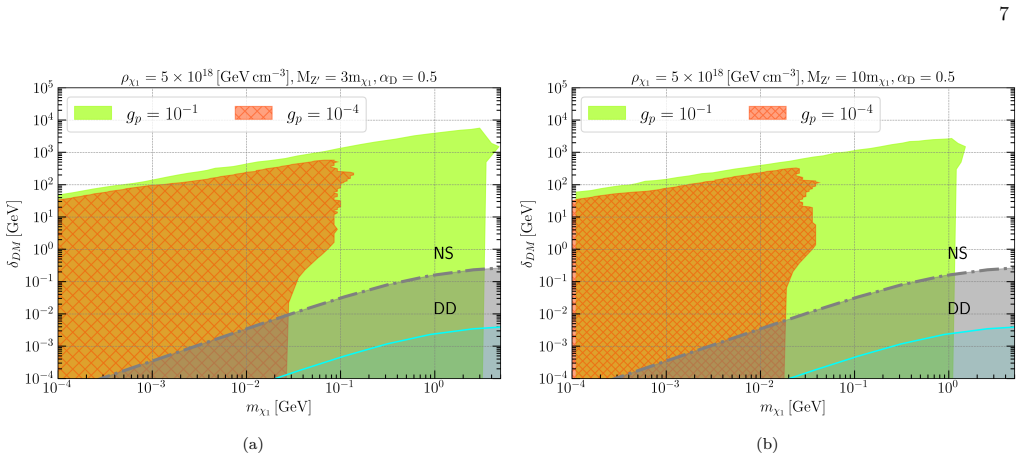
In a minimal vector-portal inelastic dark matter framework, the cosmic-ray energy-loss rate from scatterings with dark matter in NGC 1068 includes dominant deep inelastic scattering contributions at high momentum transfer. Requiring compatibility with observed standard model cooling yields constraints that probe previously unexplored regions of sub-GeV inelastic dark matter parameter space inaccessible to direct-detection experiments.
What carries the argument
The cosmic-ray energy-loss rate due to elastic and deep inelastic scatterings with inelastic dark matter in dense dark matter spikes around the supermassive black hole.
Load-bearing premise
A dense dark matter spike exists around the supermassive black hole in NGC 1068 and the cosmic-ray flux and spectrum are known accurately enough to isolate any extra cooling from dark matter.
What would settle it
A measurement of the cosmic-ray spectrum or cooling timescale in NGC 1068 showing no excess cooling beyond standard-model processes would falsify the derived constraints.
Figures
read the original abstract
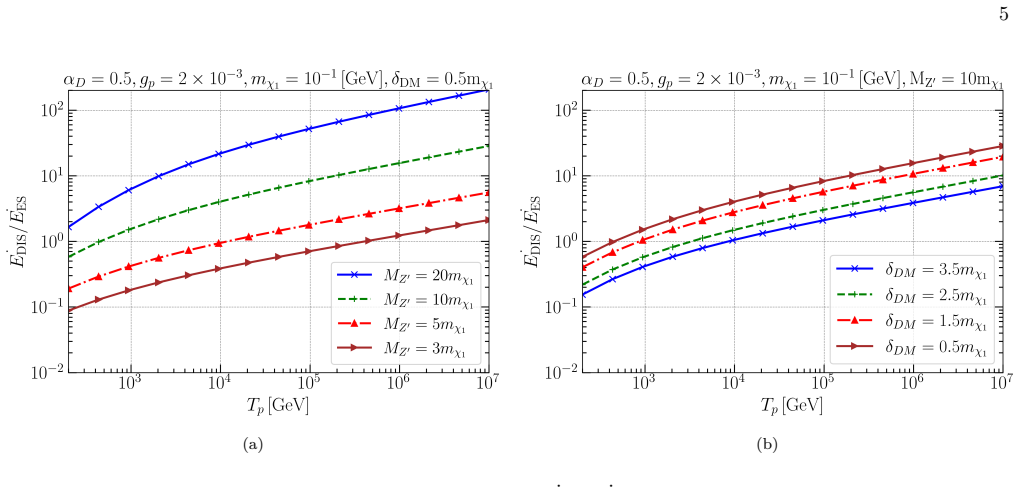
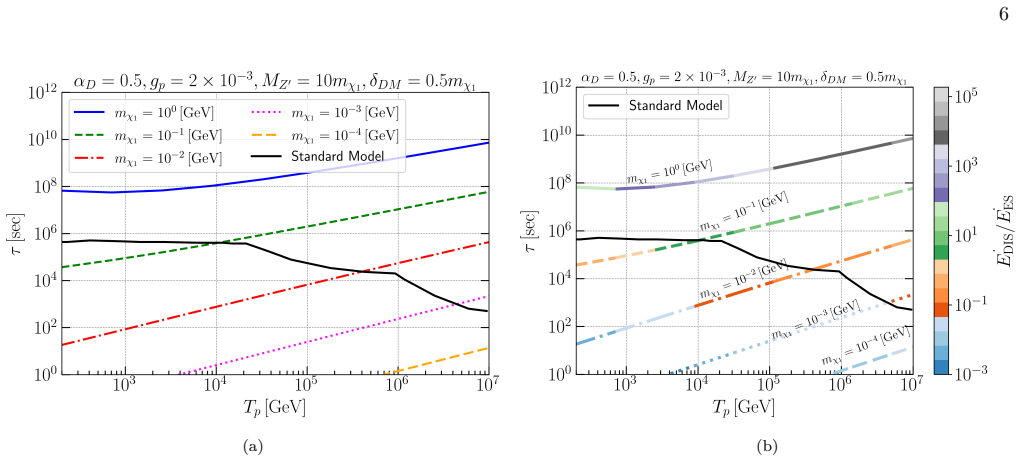
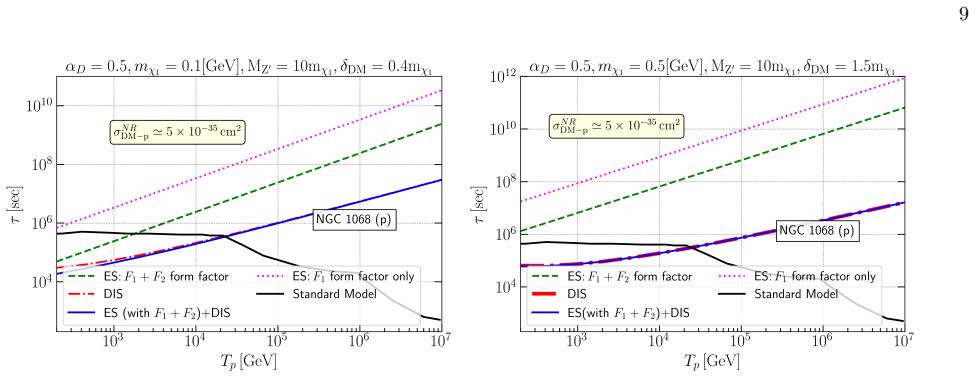
We study constraints on sub-GeV inelastic dark matter (iDM) from cosmic-ray (CR) cooling in the active galactic nucleus (AGN) NGC 1068. In dense dark matter (DM) spikes surrounding supermassive black holes, high-energy CR protons can efficiently lose energy through scatterings with dark matter particles. We consider a minimal vector-portal iDM framework and consistently include both elastic and deep inelastic scattering (DIS) contributions to the CR energy-loss rate. We find that DIS processes dominate at high momentum transfer and substantially enhance the DM-induced cooling effect. By requiring the resulting cooling timescale to remain compatible with the observed Standard Model cooling in NGC 1068, we derive constraints on the iDM parameter space. Our results demonstrate that AGN cosmic-ray cooling probes previously unexplored regions of sub-GeV iDM parameter space inaccessible to current direct-detection experiments.
Editorial analysis
A structured set of objections, weighed in public.
Referee Report
Summary. The manuscript claims that cosmic-ray protons in NGC 1068 can lose energy via elastic and deep-inelastic scattering with sub-GeV inelastic dark matter in a dense DM spike around the central supermassive black hole; requiring that the resulting DM-induced cooling timescale remain compatible with the observed Standard Model cooling yields new constraints on the iDM mass and vector-portal coupling that reach parameter space inaccessible to direct-detection experiments.
Significance. If the central modeling assumptions hold, the result would be significant because it introduces AGN cosmic-ray cooling as a probe of light inelastic DM, with the consistent inclusion of DIS processes providing a concrete enhancement to the cooling rate at high momentum transfer. The approach is complementary to terrestrial searches and rests on independently observed SM cooling rather than a circular fit to the same data.
major comments (2)
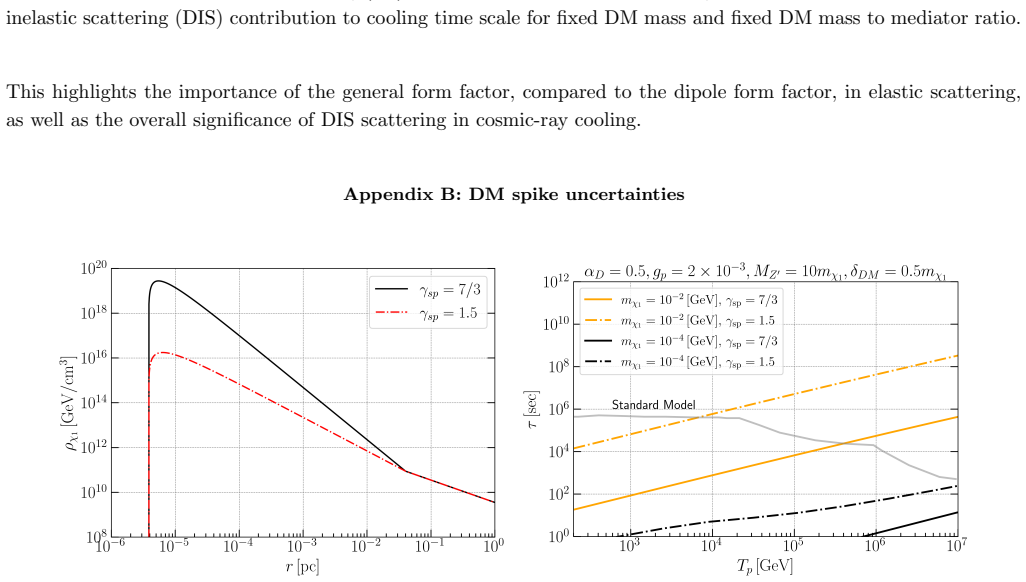
- [DM spike modeling (near Eq. for energy-loss rate)] The central claim requires a steep DM density spike (typically ho ho r^{-7/3} from adiabatic contraction) whose existence is not directly observed and depends on assumptions about the initial halo profile, absence of major mergers, and negligible dynamical heating. No section quantifies how the derived limits degrade if the local DM density is reduced by even a factor of a few; this is load-bearing because the cooling rate scales linearly with ho_DM.
- [Cosmic-ray flux and spectrum section] The CR proton spectrum and normalization near the black hole are taken from propagation models rather than local data. The manuscript does not show the effect on the final bounds if this normalization is lowered by an order of magnitude, which would make the DM cooling timescale exceed the observed SM cooling time and erase the constraints.
minor comments (2)
- Notation for the inelastic splitting u and the vector-portal coupling should be defined explicitly at first use to avoid ambiguity with standard model parameters.
- [Abstract] The abstract states that DIS 'substantially enhance[s] the DM-induced cooling effect,' but a quantitative comparison (e.g., ratio of DIS to elastic loss rates at representative energies) would strengthen the presentation.
Simulated Author's Rebuttal
We thank the referee for the constructive comments on our manuscript. We address each major point below and will revise the manuscript to incorporate sensitivity analyses where the comments identify gaps in the current presentation.
read point-by-point responses
-
Referee: [DM spike modeling (near Eq. for energy-loss rate)] The central claim requires a steep DM density spike (typically ρ ∝ r^{-7/3} from adiabatic contraction) whose existence is not directly observed and depends on assumptions about the initial halo profile, absence of major mergers, and negligible dynamical heating. No section quantifies how the derived limits degrade if the local DM density is reduced by even a factor of a few; this is load-bearing because the cooling rate scales linearly with ρ_DM.
Authors: We agree that the DM spike profile is a modeling assumption whose normalization is not directly observed and that the energy-loss rate scales linearly with ρ_DM. The ρ ∝ r^{-7/3} form follows from standard adiabatic contraction calculations in the literature, but we acknowledge the dependence on initial conditions and merger history. In the revised manuscript we will add an explicit discussion of this scaling, including a figure or table showing how the derived bounds on the vector coupling weaken for DM densities reduced by factors of 3 and 10 relative to the fiducial spike. This will make the load-bearing nature of the assumption transparent to readers. revision: yes
-
Referee: [Cosmic-ray flux and spectrum section] The CR proton spectrum and normalization near the black hole are taken from propagation models rather than local data. The manuscript does not show the effect on the final bounds if this normalization is lowered by an order of magnitude, which would make the DM cooling timescale exceed the observed SM cooling time and erase the constraints.
Authors: The CR spectrum is taken from published propagation models for NGC 1068 that are calibrated to multi-wavelength observations. We agree that an explicit sensitivity study to the overall normalization is warranted. In the revision we will add a paragraph and accompanying plot demonstrating the impact of lowering the CR flux normalization by a factor of 10; this will show that the DM-induced cooling time then exceeds the observed SM cooling time and the constraints are lost, as the referee notes. We will also state the minimum CR normalization required for any constraint to remain. revision: yes
Circularity Check
Derivation self-contained; no circular steps identified
full rationale
The paper derives constraints on sub-GeV iDM by modeling a DM spike and CR flux in NGC 1068, computing the additional energy-loss rate from elastic and DIS scattering, and requiring the resulting cooling timescale to remain compatible with independently observed SM cooling. This comparison uses external observational benchmarks rather than fitting parameters to the same dataset or redefining quantities by construction. No self-citations are load-bearing for the central result, and no equations reduce the predicted cooling to an input fit or ansatz smuggled via prior work. The derivation stands on modeled inputs tested against separate data.
Axiom & Free-Parameter Ledger
free parameters (1)
- iDM mass and portal coupling
axioms (2)
- domain assumption Dense DM spike surrounds the supermassive black hole in NGC 1068
- domain assumption Vector-portal framework correctly describes iDM interactions
Reference graph
Works this paper leans on
-
[1]
Particle dark matter: Evidence, candidates and constraints,
G. Bertone, D. Hooper, and J. Silk, “Particle dark matter: Evidence, candidates and constraints,”Phys. Rept.405 (2005) 279–390,arXiv:hep-ph/0404175
Pith/arXiv arXiv 2005
-
[2]
M. Cirelli, A. Strumia, and J. Zupan, “Dark Matter,”arXiv:2406.01705 [hep-ph]
-
[3]
Nonbaryonic dark matter: Observational evidence and detection methods,
L. Bergstr¨ om, “Nonbaryonic dark matter: Observational evidence and detection methods,”Rept. Prog. Phys.63(2000) 793,arXiv:hep-ph/0002126
Pith/arXiv arXiv 2000
-
[4]
Cosmological Lower Bound on Heavy Neutrino Masses,
B. W. Lee and S. Weinberg, “Cosmological Lower Bound on Heavy Neutrino Masses,”Phys. Rev. Lett.39(1977) 165–168
1977
-
[5]
G. Jungman, M. Kamionkowski, and K. Griest, “Supersymmetric dark matter,”Phys. Rept.267(1996) 195–373, arXiv:hep-ph/9506380
Pith/arXiv arXiv 1996
-
[6]
First Direct Detection Limits on sub-GeV Dark Matter from XENON10,
R. Essig, A. Manalaysay, J. Mardon, P. Sorensen, and T. Volansky, “First Direct Detection Limits on sub-GeV Dark Matter from XENON10,”Phys. Rev. Lett.109(2012) 021301,arXiv:1206.2644 [astro-ph.CO]. [7]XENON1TCollaboration, E. Aprile, “The XENON1T Dark Matter Search Experiment,”Springer Proc. Phys.148 (2013) 93–96,arXiv:1206.6288 [astro-ph.IM]. [8]PandaX-I...
Pith/arXiv arXiv 2012
-
[7]
Directly detecting sub-GeV dark matter with electrons from nuclear scattering,
M. J. Dolan, F. Kahlhoefer, and C. McCabe, “Directly detecting sub-GeV dark matter with electrons from nuclear scattering,”Phys. Rev. Lett.121no. 10, (2018) 101801,arXiv:1711.09906 [hep-ph]
Pith/arXiv arXiv 2018
-
[8]
N. F. Bell, J. B. Dent, R. F. Lang, J. L. Newstead, and A. C. Ritter, “Observing the Migdal effect from nuclear recoils of neutral particles with liquid xenon and argon detectors,”Phys. Rev. D105no. 9, (2022) 096015,arXiv:2112.08514 [hep-ph]
arXiv 2022
-
[9]
Maximizing Direct Detection with Highly Interactive Particle Relic Dark Matter,
G. Elor, R. McGehee, and A. Pierce, “Maximizing Direct Detection with Highly Interactive Particle Relic Dark Matter,”Phys. Rev. Lett.130no. 3, (2023) 031803,arXiv:2112.03920 [hep-ph]. [12]DAMIC-MCollaboration, I. Arnquistet al., “First Constraints from DAMIC-M on Sub-GeV Dark-Matter Particles Interacting with Electrons,”Phys. Rev. Lett.130no. 17, (2023) 1...
arXiv 2023
-
[10]
Did IceCube discover dark matter around blazars?,
A. G. De Marchi, A. Granelli, J. Nava, and F. Sala, “Did IceCube discover dark matter around blazars?,”Phys. Rev. D 112no. 4, (2025) 043042,arXiv:2412.07861 [astro-ph.HE]
arXiv 2025
-
[11]
Extragalactic dark matter and direct detection experiments,
A. N. Baushev, “Extragalactic dark matter and direct detection experiments,”Astrophys. J.771(2013) 117, arXiv:1208.0392 [astro-ph.CO]
Pith/arXiv arXiv 2013
-
[12]
The highest-speed local dark matter particles come from the Large Magellanic Cloud,
G. Besla, A. Peter, and N. Garavito-Camargo, “The highest-speed local dark matter particles come from the Large Magellanic Cloud,”JCAP11(2019) 013,arXiv:1909.04140 [astro-ph.GA]
arXiv 2019
-
[13]
Direct detection of non-galactic light dark matter,
G. Herrera and A. Ibarra, “Direct detection of non-galactic light dark matter,”Phys. Lett. B820(2021) 136551, arXiv:2104.04445 [hep-ph]
arXiv 2021
-
[14]
G. Herrera, A. Ibarra, and S. Shirai, “Enhanced prospects for direct detection of inelastic dark matter from a non-galactic diffuse component,”JCAP04(2023) 026,arXiv:2301.00870 [hep-ph]
arXiv 2023
-
[15]
The impact of the Large Magellanic Cloud on dark matter direct detection signals,
A. Smith-Orliket al., “The impact of the Large Magellanic Cloud on dark matter direct detection signals,”JCAP10 (2023) 070,arXiv:2302.04281 [astro-ph.GA]
arXiv 2023
-
[16]
Novel direct detection constraints on light dark matter,
T. Bringmann and M. Pospelov, “Novel direct detection constraints on light dark matter,”Phys. Rev. Lett.122no. 17, (2019) 171801,arXiv:1810.10543 [hep-ph]. 11
Pith/arXiv arXiv 2019
-
[17]
Light Dark Matter at Neutrino Experiments,
Y. Ema, F. Sala, and R. Sato, “Light Dark Matter at Neutrino Experiments,”Phys. Rev. Lett.122no. 18, (2019) 181802,arXiv:1811.00520 [hep-ph]
Pith/arXiv arXiv 2019
-
[18]
Detecting Light Dark Matter via Inelastic Cosmic Ray Collisions,
J. Alvey, M. Campos, M. Fairbairn, and T. You, “Detecting Light Dark Matter via Inelastic Cosmic Ray Collisions,” Phys. Rev. Lett.123(2019) 261802,arXiv:1905.05776 [hep-ph]
arXiv 2019
-
[19]
Direct Detection Constraints on Blazar-Boosted Dark Matter,
J.-W. Wang, A. Granelli, and P. Ullio, “Direct Detection Constraints on Blazar-Boosted Dark Matter,”Phys. Rev. Lett. 128no. 22, (2022) 221104,arXiv:2111.13644 [astro-ph.HE]
arXiv 2022
-
[20]
(In)direct Detection of Boosted Dark Matter,
K. Agashe, Y. Cui, L. Necib, and J. Thaler, “(In)direct Detection of Boosted Dark Matter,”JCAP10(2014) 062, arXiv:1405.7370 [hep-ph]
Pith/arXiv arXiv 2014
-
[21]
D. Kim, J.-C. Park, and S. Shin, “Dark Matter “Collider” from Inelastic Boosted Dark Matter,”Phys. Rev. Lett.119 no. 16, (2017) 161801,arXiv:1612.06867 [hep-ph]
Pith/arXiv arXiv 2017
-
[22]
Boosted dark matter from diffuse supernova neutrinos,
A. Das and M. Sen, “Boosted dark matter from diffuse supernova neutrinos,”Phys. Rev. D104no. 7, (2021) 075029, arXiv:2104.00027 [hep-ph]
arXiv 2021
-
[23]
C. V. Cappiello, N. P. A. Kozar, and A. C. Vincent, “Dark matter from Monogem,”Phys. Rev. D107no. 3, (2023) 035003,arXiv:2210.09448 [hep-ph]
arXiv 2023
-
[24]
Hadrophilic light dark matter from the atmosphere,
C. A. Arg¨ uelles, V. Mu˜ noz, I. M. Shoemaker, and V. Takhistov, “Hadrophilic light dark matter from the atmosphere,” Phys. Lett. B833(2022) 137363,arXiv:2203.12630 [hep-ph]
arXiv 2022
-
[25]
Searching for Afterglow: Light Dark Matter Boosted by Supernova Neutrinos,
Y.-H. Lin, W.-H. Wu, M.-R. Wu, and H. T.-K. Wong, “Searching for Afterglow: Light Dark Matter Boosted by Supernova Neutrinos,”Phys. Rev. Lett.130no. 11, (2023) 111002,arXiv:2206.06864 [hep-ph]
arXiv 2023
-
[26]
Mechanism for Thermal Relic Dark Matter of Strongly Interacting Massive Particles,
Y. Hochberg, E. Kuflik, T. Volansky, and J. G. Wacker, “Mechanism for Thermal Relic Dark Matter of Strongly Interacting Massive Particles,”Phys. Rev. Lett.113(2014) 171301,arXiv:1402.5143 [hep-ph]
Pith/arXiv arXiv 2014
-
[27]
New pathways to the relic abundance of vector-portal dark matter,
P. J. Fitzpatrick, H. Liu, T. R. Slatyer, and Y.-D. Tsai, “New pathways to the relic abundance of vector-portal dark matter,”Phys. Rev. D106no. 8, (2022) 083517,arXiv:2011.01240 [hep-ph]
arXiv 2022
-
[28]
Scalar and fermion two-component SIMP dark matter with an accidentalZ 4 symmetry,
S.-Y. Ho, P. Ko, and C.-T. Lu, “Scalar and fermion two-component SIMP dark matter with an accidentalZ 4 symmetry,”JHEP03(2022) 005,arXiv:2201.06856 [hep-ph]
arXiv 2022
-
[29]
Phenomenology of light fermionic asymmetric dark matter,
B. Bhattacherjee, S. Matsumoto, S. Mukhopadhyay, and M. M. Nojiri, “Phenomenology of light fermionic asymmetric dark matter,”JHEP10(2013) 032,arXiv:1306.5878 [hep-ph]
Pith/arXiv arXiv 2013
-
[30]
Analyzing the Discovery Potential for Light Dark Matter,
E. Izaguirre, G. Krnjaic, P. Schuster, and N. Toro, “Analyzing the Discovery Potential for Light Dark Matter,”Phys. Rev. Lett.115no. 25, (2015) 251301,arXiv:1505.00011 [hep-ph]
Pith/arXiv arXiv 2015
-
[31]
An asymmetric SIMP dark matter model,
S.-Y. Ho, “An asymmetric SIMP dark matter model,”JHEP10(2022) 182,arXiv:2207.13373 [hep-ph]
arXiv 2022
-
[32]
Dark matter freeze-in with a heavy mediator: beyond the EFT approach,
E. Frangipane, S. Gori, and B. Shakya, “Dark matter freeze-in with a heavy mediator: beyond the EFT approach,” JHEP09(2022) 083,arXiv:2110.10711 [hep-ph]
arXiv 2022
-
[33]
Freezing-in hadrophilic dark matter at low reheating temperatures,
P. N. Bhattiprolu, G. Elor, R. McGehee, and A. Pierce, “Freezing-in hadrophilic dark matter at low reheating temperatures,”JHEP01(2023) 128,arXiv:2210.15653 [hep-ph]
arXiv 2023
-
[34]
D. Tucker-Smith and N. Weiner, “Inelastic dark matter,”Phys. Rev. D64(2001) 043502,arXiv:hep-ph/0101138
Pith/arXiv arXiv 2001
-
[35]
The Status of inelastic dark matter,
D. Tucker-Smith and N. Weiner, “The Status of inelastic dark matter,”Phys. Rev. D72(2005) 063509, arXiv:hep-ph/0402065
Pith/arXiv arXiv 2005
-
[36]
Inelastic Dark Matter in Light of DAMA/LIBRA,
S. Chang, G. D. Kribs, D. Tucker-Smith, and N. Weiner, “Inelastic Dark Matter in Light of DAMA/LIBRA,”Phys. Rev. D79(2009) 043513,arXiv:0807.2250 [hep-ph]
Pith/arXiv arXiv 2009
-
[37]
Final model independent result of DAMA/LIBRA-phase1,
R. Bernabeiet al., “Final model independent result of DAMA/LIBRA-phase1,”Eur. Phys. J. C73(2013) 2648, arXiv:1308.5109 [astro-ph.GA]
Pith/arXiv arXiv 2013
-
[38]
Signatures of Pseudo-Dirac Dark Matter at High-Intensity Neutrino Experiments,
J. R. Jordan, Y. Kahn, G. Krnjaic, M. Moschella, and J. Spitz, “Signatures of Pseudo-Dirac Dark Matter at High-Intensity Neutrino Experiments,”Phys. Rev. D98no. 7, (2018) 075020,arXiv:1806.05185 [hep-ph]
Pith/arXiv arXiv 2018
-
[39]
Dark Sectors at the Fermilab SeaQuest Experiment,
A. Berlin, S. Gori, P. Schuster, and N. Toro, “Dark Sectors at the Fermilab SeaQuest Experiment,”Phys. Rev. D98 no. 3, (2018) 035011,arXiv:1804.00661 [hep-ph]
Pith/arXiv arXiv 2018
-
[40]
Inelastic dark matter at the Fermilab Short Baseline Neutrino Program,
B. Batell, J. Berger, L. Darm´ e, and C. Frugiuele, “Inelastic dark matter at the Fermilab Short Baseline Neutrino Program,”Phys. Rev. D104no. 7, (2021) 075026,arXiv:2106.04584 [hep-ph]
arXiv 2021
-
[41]
Constraining light thermal inelastic dark matter with NA64,
M. Mongillo, A. Abdullahi, B. B. Oberhauser, P. Crivelli, M. Hostert, D. Massaro, L. M. Bueno, and S. Pascoli, “Constraining light thermal inelastic dark matter with NA64,”Eur. Phys. J. C83no. 5, (2023) 391,arXiv:2302.05414 [hep-ph]
arXiv 2023
-
[42]
Discovering Inelastic Thermal-Relic Dark Matter at Colliders,
E. Izaguirre, G. Krnjaic, and B. Shuve, “Discovering Inelastic Thermal-Relic Dark Matter at Colliders,”Phys. Rev. D 93no. 6, (2016) 063523,arXiv:1508.03050 [hep-ph]. 12
Pith/arXiv arXiv 2016
-
[43]
Dark Matter attempts for CoGeNT and DAMA,
T. Schwetz and J. Zupan, “Dark Matter attempts for CoGeNT and DAMA,”JCAP08(2011) 008,arXiv:1106.6241 [hep-ph]
Pith/arXiv arXiv 2011
-
[44]
Inelastic frontier: Discovering dark matter at high recoil energy,
J. Bramante, P. J. Fox, G. D. Kribs, and A. Martin, “Inelastic frontier: Discovering dark matter at high recoil energy,” Phys. Rev. D94no. 11, (2016) 115026,arXiv:1608.02662 [hep-ph]
Pith/arXiv arXiv 2016
-
[45]
Electromagnetic signals of inelastic dark matter scattering,
M. Baryakhtar, A. Berlin, H. Liu, and N. Weiner, “Electromagnetic signals of inelastic dark matter scattering,”JHEP 06(2022) 047,arXiv:2006.13918 [hep-ph]
arXiv 2022
-
[46]
Pushing the frontier of WIMPy inelastic dark matter: Journey to the end of the periodic table,
N. Song, S. Nagorny, and A. C. Vincent, “Pushing the frontier of WIMPy inelastic dark matter: Journey to the end of the periodic table,”Phys. Rev. D104no. 10, (2021) 103032,arXiv:2104.09517 [hep-ph]
arXiv 2021
-
[47]
Cosmic-ray upscattered inelastic dark matter,
N. F. Bell, J. B. Dent, B. Dutta, S. Ghosh, J. Kumar, J. L. Newstead, and I. M. Shoemaker, “Cosmic-ray upscattered inelastic dark matter,”Phys. Rev. D104(2021) 076020,arXiv:2108.00583 [hep-ph]
arXiv 2021
-
[48]
J. Eby, P. J. Fox, and G. D. Kribs, “Earth-catalyzed detection of magnetic inelastic dark matter with photons in large underground detectors,”JHEP06(2024) 165,arXiv:2312.08478 [hep-ph]
arXiv 2024
-
[49]
S. Chatterjee and R. Laha, “Explorations of pseudo-Dirac dark matter having keV splittings and interacting via transition electric and magnetic dipole moments,”Phys. Rev. D107no. 8, (2023) 083036,arXiv:2202.13339 [hep-ph]
arXiv 2023
-
[50]
Low-mass constraints on WIMP effective models of inelastic scattering using the Migdal effect,
S. Kang, S. Scopel, and G. Tomar, “Low-mass constraints on WIMP effective models of inelastic scattering using the Migdal effect,”JCAP01(2025) 035,arXiv:2407.16187 [hep-ph]
arXiv 2025
-
[51]
Electron recoils from terrestrial upscattering of inelastic dark matter,
T. Emken, J. Frerick, S. Heeba, and F. Kahlhoefer, “Electron recoils from terrestrial upscattering of inelastic dark matter,”Phys. Rev. D105no. 5, (2022) 055023,arXiv:2112.06930 [hep-ph]
arXiv 2022
-
[52]
G. D. V. Garcia, F. Kahlhoefer, M. Ovchynnikov, and T. Schwetz, “Not-so-inelastic Dark Matter,”JHEP02(2025) 127,arXiv:2405.08081 [hep-ph]
arXiv 2025
-
[53]
R. Essiget al., “Snowmass2021 Cosmic Frontier: The landscape of low-threshold dark matter direct detection in the next decade,” inSnowmass 2021. 3, 2022.arXiv:2203.08297 [hep-ph]
arXiv 2021
-
[54]
Probing inelastic signatures of dark matter detection via polarized nucleus*,
Z. Yun, J. Sun, B. Zhu, and X. Liu, “Probing inelastic signatures of dark matter detection via polarized nucleus*,” Chin. Phys. C48no. 10, (2024) 103106,arXiv:2309.01203 [hep-ph]
arXiv 2024
-
[55]
J. Li, L. Su, L. Wu, and B. Zhu, “Spin-dependent sub-GeV inelastic dark matter-electron scattering and Migdal effect. Part I. Velocity independent operator,”JCAP04(2023) 020,arXiv:2210.15474 [hep-ph]
arXiv 2023
-
[56]
N. F. Bell, J. B. Dent, B. Dutta, J. Kumar, and J. L. Newstead, “Indirect detection of low mass dark matter in direct detection experiments with inelastic scattering,”Phys. Rev. D106no. 10, (2022) 103016,arXiv:2208.08020 [hep-ph]
arXiv 2022
-
[57]
Detection of inelastic dark matter via electron recoils in SENSEI,
Y. Gu, L. Wu, and B. Zhu, “Detection of inelastic dark matter via electron recoils in SENSEI,”Phys. Rev. D106no. 7, (2022) 075004,arXiv:2203.06664 [hep-ph]
arXiv 2022
-
[58]
Active Galactic Nuclei as Potential Sources of Ultra-High Energy Cosmic Rays,
F. M. Rieger, “Active Galactic Nuclei as Potential Sources of Ultra-High Energy Cosmic Rays,”Universe8no. 11, (2022) 607,arXiv:2211.12202 [astro-ph.HE]
arXiv 2022
-
[59]
Chapter 10: High-Energy Neutrinos from Active Galactic Nuclei,
K. Murase and F. W. Stecker, “Chapter 10: High-Energy Neutrinos from Active Galactic Nuclei,”arXiv:2202.03381 [astro-ph.HE]. [64]IceCubeCollaboration, R. Abbasiet al., “Evidence for neutrino emission from the nearby active galaxy NGC 1068,” Science378no. 6619, (2022) 538–543,arXiv:2211.09972 [astro-ph.HE]
arXiv 2022
-
[60]
Disentangling the Hadronic Components in NGC 1068,
M. Ajello, K. Murase, and A. McDaniel, “Disentangling the Hadronic Components in NGC 1068,”Astrophys. J. Lett. 954no. 2, (2023) L49,arXiv:2307.02333 [astro-ph.HE]. [66]IceCube, F ermi-LA T, MAGIC, AGILE, ASAS-SN, HA WC, H.E.S.S., INTEGRAL, Kanata, Kiso, Kapteyn, Liverpool T elescope, Subaru, Swift NuST AR, VERIT AS, VLA/17B-403Collaboration, M. G. Aartsen...
arXiv 2023
-
[61]
A. Keivaniet al., “A Multimessenger Picture of the Flaring Blazar TXS 0506+056: implications for High-Energy Neutrino Emission and Cosmic Ray Acceleration,”Astrophys. J.864no. 1, (2018) 84,arXiv:1807.04537 [astro-ph.HE]
Pith/arXiv arXiv 2018
-
[62]
TXS 0506+056, the first cosmic neutrino 13 source, is not a BL Lac,
P. Padovani, F. Oikonomou, M. Petropoulou, P. Giommi, and E. Resconi, “TXS 0506+056, the first cosmic neutrino 13 source, is not a BL Lac,”Mon. Not. Roy. Astron. Soc.484no. 1, (2019) L104–L108,arXiv:1901.06998 [astro-ph.HE]
Pith/arXiv arXiv 2019
-
[63]
Dark matter annihilation at the galactic center,
P. Gondolo and J. Silk, “Dark matter annihilation at the galactic center,”Phys. Rev. Lett.83(1999) 1719–1722, arXiv:astro-ph/9906391
Pith/arXiv arXiv 1999
-
[64]
A Dark matter spike at the galactic center?,
P. Ullio, H. Zhao, and M. Kamionkowski, “A Dark matter spike at the galactic center?,”Phys. Rev. D64(2001) 043504,arXiv:astro-ph/0101481
Pith/arXiv arXiv 2001
-
[65]
Unique probe of dark matter in the core of M87 with the Event Horizon Telescope,
T. Lacroix, M. Karami, A. E. Broderick, J. Silk, and C. Boehm, “Unique probe of dark matter in the core of M87 with the Event Horizon Telescope,”Phys. Rev. D96no. 6, (2017) 063008,arXiv:1611.01961 [astro-ph.GA]
Pith/arXiv arXiv 2017
-
[66]
Probing light dark matter through cosmic-ray cooling in active galactic nuclei,
G. Herrera and K. Murase, “Probing light dark matter through cosmic-ray cooling in active galactic nuclei,”Phys. Rev. D110no. 1, (2024) L011701,arXiv:2307.09460 [hep-ph]
arXiv 2024
-
[67]
Cosmic-ray boosted inelastic dark matter from neutrino-emitting active galactic nuclei,
R. A. Gustafson, G. Herrera, M. Mukhopadhyay, K. Murase, and I. M. Shoemaker, “Cosmic-ray boosted inelastic dark matter from neutrino-emitting active galactic nuclei,”arXiv:2508.20984 [hep-ph]
-
[68]
Enhanced Cosmic-Ray Cooling in AGN from Dark Matter Deep Inelastic Scattering,
L. Li, C.-T. Lu, A. K. Mishra, L. Su, and L. Wu, “Enhanced Cosmic-Ray Cooling in AGN from Dark Matter Deep Inelastic Scattering,”arXiv:2509.11906 [hep-ph]
-
[69]
Cosmic-ray cooling in active galactic nuclei as a new probe of inelastic dark matter,
R. A. Gustafson, G. Herrera, M. Mukhopadhyay, K. Murase, and I. M. Shoemaker, “Cosmic-ray cooling in active galactic nuclei as a new probe of inelastic dark matter,”Phys. Rev. D111no. 12, (2025) L121303,arXiv:2408.08947 [hep-ph]
arXiv 2025
-
[70]
Probing gauged U(1) sub-GeV dark matter via cosmic ray cooling in active galactic nuclei,
A. K. Mishra, N. Liu, and C.-T. Lu, “Probing gauged U(1) sub-GeV dark matter via cosmic ray cooling in active galactic nuclei,”Phys. Dark Univ.49(2025) 102050,arXiv:2504.03409 [hep-ph]
arXiv 2025
-
[71]
Illuminating scalar dark matter co-scattering in EFT with monophoton signatures,
G. B´ elanger, M. Mitra, R. Padhan, and A. Roy, “Illuminating scalar dark matter co-scattering in EFT with monophoton signatures,”JHEP01(2026) 007,arXiv:2508.06040 [hep-ph]
arXiv 2026
-
[72]
Three exceptions in the calculation of relic abundances,
K. Griest and D. Seckel, “Three exceptions in the calculation of relic abundances,”Phys. Rev. D43(1991) 3191–3203
1991
-
[73]
Coannihilation without chemical equilibrium,
M. Garny, J. Heisig, B. L¨ ulf, and S. Vogl, “Coannihilation without chemical equilibrium,”Phys. Rev. D96no. 10, (2017) 103521,arXiv:1705.09292 [hep-ph]
Pith/arXiv arXiv 2017
-
[74]
Neutralino with the right cold dark matter abundance in (almost) any supersymmetric model,
G. B. Gelmini and P. Gondolo, “Neutralino with the right cold dark matter abundance in (almost) any supersymmetric model,”Phys. Rev. D74(2006) 023510,arXiv:hep-ph/0602230
Pith/arXiv arXiv 2006
-
[75]
Thermal dark matter with low-temperature reheating,
N. Bernal, K. Deka, and M. Losada, “Thermal dark matter with low-temperature reheating,”JCAP09(2024) 024, arXiv:2406.17039 [hep-ph]
arXiv 2024
-
[76]
Scrutinizing fermionic Dark Matter in scotogenic model with low reheating temperature,
A. Roy and R. Sahu, “Scrutinizing fermionic Dark Matter in scotogenic model with low reheating temperature,”JCAP 03(2026) 014,arXiv:2508.14726 [hep-ph]
arXiv 2026
-
[77]
Z’-mediated dark matter with low-temperature reheating,
G. B´ elanger, N. Bernal, and A. Pukhov, “Z’-mediated dark matter with low-temperature reheating,”JHEP03(2025) 079,arXiv:2412.12303 [hep-ph]
arXiv 2025
-
[78]
Cosmology with a primordial scaling field,
P. G. Ferreira and M. Joyce, “Cosmology with a primordial scaling field,”Phys. Rev. D58(1998) 023503, arXiv:astro-ph/9711102
Pith/arXiv arXiv 1998
-
[79]
Electroweak Baryogenesis and the Expansion Rate of the Universe,
M. Joyce, “Electroweak Baryogenesis and the Expansion Rate of the Universe,”Phys. Rev. D55(1997) 1875–1878, arXiv:hep-ph/9606223
Pith/arXiv arXiv 1997
-
[80]
When the Universe Expands Too Fast: Relentless Dark Matter,
F. D’Eramo, N. Fernandez, and S. Profumo, “When the Universe Expands Too Fast: Relentless Dark Matter,”JCAP 05(2017) 012,arXiv:1703.04793 [hep-ph]
Pith/arXiv arXiv 2017
discussion (0)
Sign in with ORCID, Apple, or X to comment. Anyone can read and Pith papers without signing in.