Stationary subspace analysis for spatial data
Pith reviewed 2026-05-20 01:57 UTC · model grok-4.3
The pith
Spatially indexed data can be decomposed into stationary and nonstationary latent components by solving generalized eigenvalue problems on first- and second-order spatial statistics.
A machine-rendered reading of the paper's core claim, the machinery that carries it, and where it could break.
Core claim
Under a linear mixing model, the unmixing matrix that isolates the stationary subspace is recovered by solving generalized eigenvalue problems constructed from first- and second-order spatial statistics; the combined joint-diagonalization version yields superior separation, and a data-augmentation procedure estimates the unknown dimension of the nonstationary subspace.
What carries the argument
Generalized eigenvalue problems derived from spatial first- and second-order moments that isolate directions of nonstationarity, solved separately and then fused by approximate joint diagonalization.
If this is right
- When the dimension of the nonstationary subspace is supplied, the latent components are recovered reliably.
- The joint-diagonalization combination outperforms any single procedure when multiple nonstationarities are present.
- The same estimation steps transfer directly to ordinary time-series settings without spatial indexing.
- The data-augmentation dimension estimator removes the need to know the subspace size in advance.
Where Pith is reading between the lines
- The framework could be tested on geospatial sensor networks or satellite imagery to isolate stable background patterns from localized changes.
- The same eigenvalue construction might be adapted to graph-structured data where adjacency replaces spatial distance.
- If the dimension estimator proves consistent, it could serve as a plug-in for other blind-source-separation techniques that currently require this parameter.
Load-bearing premise
The observed spatial data arise from a linear mixture of latent components whose nonstationarity appears in first- and second-order spatial statistics.
What would settle it
Generate spatial data from known stationary and nonstationary sources with a given subspace dimension; if the estimated unmixing matrix fails to recover components whose spatial statistics match the assumed stationarity, the separation claim is falsified.
Figures





read the original abstract
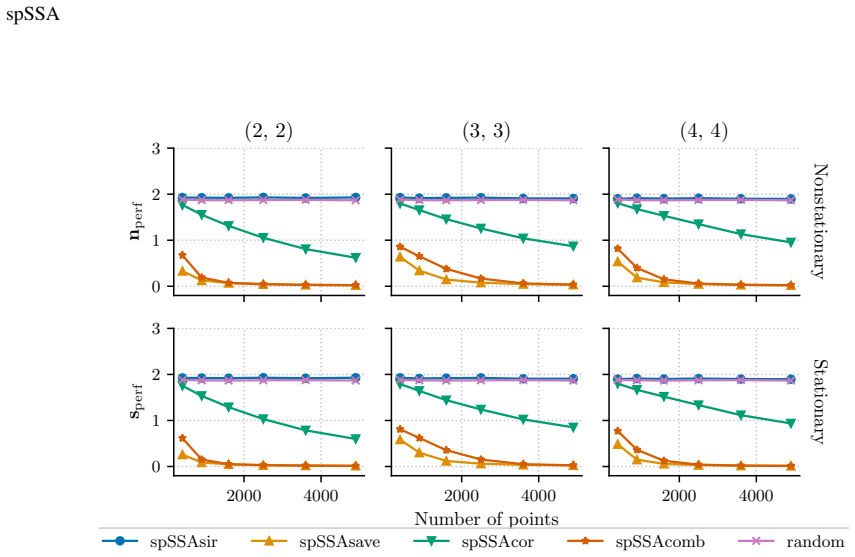
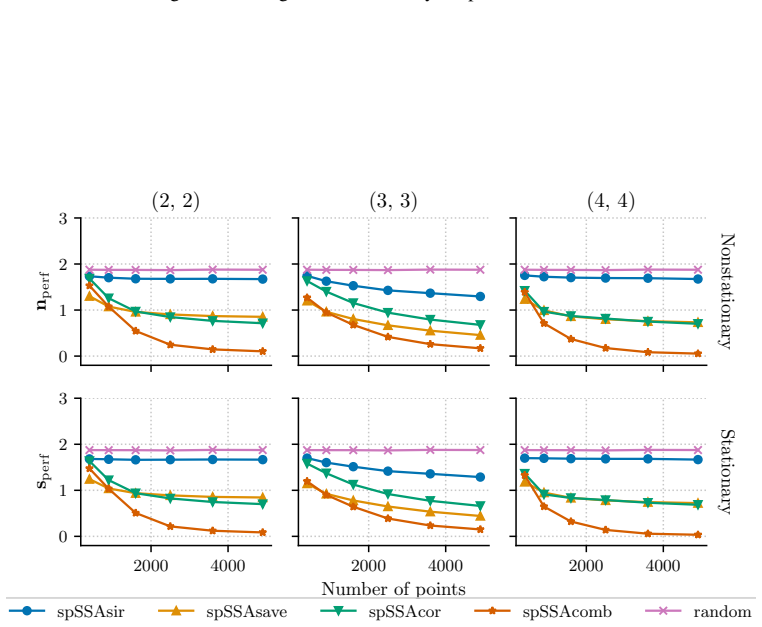
Stationary subspace analysis (SSA) is a blind source separation framework that decomposes linearly mixed multivariate data into stationary and nonstationary components. We extend SSA to spatially indexed data by introducing spatial stationary subspace analysis (spSSA), which explicitly accounts for spatial dependence. We propose three estimation procedures for the unmixing matrix based on first- and second-order spatial statistics. Each procedure targets a different type of nonstationarity and can be formulated as the solution to a generalized eigenvalue problem. To address situations where multiple forms of nonstationarity are present simultaneously, we combine the three procedures using approximate joint diagonalization. Simulation studies demonstrate that this combined approach yields superior separation performance. When the dimension of the nonstationary subspace is known, the proposed methods reliably recover the latent stationary and nonstationary components. However, determining this dimension remains a fundamental challenge in SSA, for which no generally accepted solution currently exists. Building on our estimation procedures, we propose a novel data augmentation approach to estimate the dimension of the nonstationary subspace and demonstrate its effectiveness through simulation studies. The proposed methodology is easily transferable to time series settings, making it of broader methodological interest.
Editorial analysis
A structured set of objections, weighed in public.
Referee Report
Summary. The paper extends stationary subspace analysis (SSA) to spatially indexed data via spatial SSA (spSSA). It introduces three estimation procedures for the unmixing matrix, each based on distinct first- or second-order spatial statistics and cast as a generalized eigenvalue problem. These are combined via approximate joint diagonalization (AJD) when multiple nonstationarity types coexist. A data-augmentation scheme is proposed to estimate the dimension of the nonstationary subspace. Simulation studies are reported to show reliable recovery of latent stationary and nonstationary components when this dimension is known and superior separation performance for the combined AJD approach. The methods are noted to transfer to time-series settings.
Significance. If the central claims hold, the work supplies a practical, computationally tractable extension of SSA to spatial settings that could be useful in geostatistics, environmental monitoring, and spatial econometrics. Formulating the procedures as generalized eigenproblems and employing AJD for joint handling of multiple nonstationarity sources are technically attractive features. The dimension-estimation proposal directly addresses a long-standing open problem in SSA. The explicit transferability remark to time series broadens potential impact.
major comments (2)
- [Simulation studies] Simulation studies: the reported reliable recovery and superiority of the combined AJD approach are demonstrated only under data generated from the assumed linear mixing model in which nonstationarity is present in the first- and second-order spatial moments. No experiments are described in which nonstationarity is confined to higher-order moments (e.g., spatially varying skewness or kurtosis) while first- and second-order statistics remain constant; in that regime the three eigenproblems would treat the components as stationary and the unmixing matrix would fail to recover the true partition. This boundary case is load-bearing for the identifiability claim.
- [Estimation procedures] Estimation procedures and AJD combination: when the three generalized eigenproblems are solved separately and then jointly diagonalized, it is not shown how the procedure behaves if one or more of the targeted spatial statistics exhibits no nonstationarity. The paper should clarify whether the joint diagonalization step remains stable or introduces spurious directions in such cases.
minor comments (2)
- The abstract states that the methodology is 'easily transferable to time series settings'; a short dedicated subsection or illustrative example would make this claim concrete rather than promissory.
- Notation for the spatial covariance and variogram operators should be introduced with explicit definitions before the generalized eigenvalue problems are stated, to improve readability for readers outside spatial statistics.
Simulated Author's Rebuttal
We thank the referee for the careful reading and constructive comments. We address each major point below and describe the changes we will make to the manuscript.
read point-by-point responses
-
Referee: [Simulation studies] Simulation studies: the reported reliable recovery and superiority of the combined AJD approach are demonstrated only under data generated from the assumed linear mixing model in which nonstationarity is present in the first- and second-order spatial moments. No experiments are described in which nonstationarity is confined to higher-order moments (e.g., spatially varying skewness or kurtosis) while first- and second-order statistics remain constant; in that regime the three eigenproblems would treat the components as stationary and the unmixing matrix would fail to recover the true partition. This boundary case is load-bearing for the identifiability claim.
Authors: Our procedures are explicitly constructed around first- and second-order spatial statistics, and the simulation design follows the model assumptions under which nonstationarity is expressed through changes in these moments. We do not claim identifiability or recovery when nonstationarity appears solely in higher-order moments; such regimes lie outside the scope of the present first- and second-order extension. To make this boundary explicit, we will add a short discussion of the modeling assumptions together with a targeted simulation that demonstrates the expected failure when only higher-order nonstationarity is present. revision: yes
-
Referee: [Estimation procedures] Estimation procedures and AJD combination: when the three generalized eigenproblems are solved separately and then jointly diagonalized, it is not shown how the procedure behaves if one or more of the targeted spatial statistics exhibits no nonstationarity. The paper should clarify whether the joint diagonalization step remains stable or introduces spurious directions in such cases.
Authors: When a given spatial statistic is stationary, the associated matrix is already (approximately) diagonal. The AJD step seeks a single unmixing matrix that simultaneously diagonalizes all supplied matrices; a matrix that is already diagonal contributes no additional constraint and should not generate spurious directions. We have not, however, provided explicit verification of this behavior. In the revision we will insert a brief theoretical remark on the stability of AJD under partial nonstationarity and include a small simulation study in which one or two of the three statistics are stationary while the others are not. revision: yes
Circularity Check
No circularity: spSSA estimation procedures derived independently from spatial statistics
full rationale
The paper formulates three distinct generalized eigenvalue problems directly from first- and second-order spatial statistics to recover the unmixing matrix separating stationary and nonstationary subspaces under a linear mixing model. The combined approach via approximate joint diagonalization and the data-augmentation method for estimating nonstationary dimension are presented as novel extensions, with performance claims supported by simulations generated under the stated model assumptions. No step reduces by construction to a fitted parameter, self-referential prediction, or load-bearing self-citation chain; the derivation remains self-contained against external spatial statistics benchmarks without tautological equivalence to inputs.
Axiom & Free-Parameter Ledger
free parameters (1)
- dimension of nonstationary subspace
axioms (1)
- domain assumption Data is a linear mixture of stationary and nonstationary latent components
Reference graph
Works this paper leans on
-
[1]
Frontiers in Handwriting Recognition (ICFHR), 2014 14th International Conference on , pages=
Real-time segmentation of on-line handwritten arabic script , author=. Frontiers in Handwriting Recognition (ICFHR), 2014 14th International Conference on , pages=. 2014 , organization=
work page 2014
-
[2]
Soft Computing and Pattern Recognition (SoCPaR), 2014 6th International Conference of , pages=
Fast classification of handwritten on-line Arabic characters , author=. Soft Computing and Pattern Recognition (SoCPaR), 2014 6th International Conference of , pages=. 2014 , organization=
work page 2014
-
[3]
Estimate and Replace: A Novel Approach to Integrating Deep Neural Networks with Existing Applications , author=. arXiv preprint arXiv:1804.09028 , year=
work page internal anchor Pith review Pith/arXiv arXiv
-
[4]
P. Comon , keywords =. Tensor Diagonalization, A Useful Tool in Signal Processing , journal =. 1994 , note =
work page 1994
-
[5]
Tsay, Ruey S. , TITLE =. 2005 , PAGES =. doi:10.1002/0471746193 , URL =
-
[6]
Dinh-Tuan Pham and Cardoso, J.-F. , journal=. Blind separation of instantaneous mixtures of nonstationary sources , year=
-
[7]
Smith, J. M. and Jones, A. B. , year =
-
[8]
Jones, A. B. and Smith, J. M. , title =. 2013 , volume =
work page 2013
-
[9]
J. Miettinen and K. Nordhausen and S. Taskinen , journal =. Blind Source Separation Based on Joint Diagonalization in. 2017 , volume =
work page 2017
-
[10]
K. Illner and J. Miettinen and C. Fuchs and S. Taskinen and K. Nordhausen and H. Oja and F. J. Theis. Model selection using limiting distributions of second-order blind source separation algorithms. Signal Processing. 2015
work page 2015
- [11]
-
[12]
L. J. Crone and D. S. Crosby , journal =. Statistical Applications of a Metric on Subspaces to Satellite Meteorology , volume =
-
[13]
Nordhausen, K. and Oja, H. , title =. WIREs: Computational Statistics , volume =. doi:10.1002/wics.1440 , year =
-
[14]
Combining Linear Dimension Reduction Subspaces
Liski, Eero and Nordhausen, Klaus and Oja, Hannu and Ruiz-Gazen, Anne. Combining Linear Dimension Reduction Subspaces. Recent Advances in Robust Statistics: Theory and Applications. 2016
work page 2016
-
[15]
D. A. J. IEEE Transactions on Neural Networks and Learning Systems , title=. 2012 , volume=
work page 2012
-
[16]
doi:10.1088/1741-2560/10/2/026018 , year = 2013, volume =
Duncan A J Blythe and Frank C Meinecke and Paul von B\"unau and Klaus-Robert Müller , title =. doi:10.1088/1741-2560/10/2/026018 , year = 2013, volume =
-
[17]
Physical Review Letters , volume =
Finding Stationary Subspaces in Multivariate Time Series , author =. Physical Review Letters , volume =. 2009 , doi =
work page 2009
-
[18]
2010 Annual International Conference of the IEEE Engineering in Medicine and Biology , title=
P. 2010 Annual International Conference of the IEEE Engineering in Medicine and Biology , title=. 2010 , pages=
work page 2010
- [19]
-
[20]
S. Choi and A. Cichocki , title =. Electronics Letters , volume =. 2000 , pages =
work page 2000
-
[21]
Handbook of Blind Source Separation: Independent Component Analysis and Applications , author=. 2010 , publisher=
work page 2010
- [22]
-
[23]
Stationary Subspace Analysis as a Generalized Eigenvalue Problem
Hara, Satoshi and Kawahara, Yoshinobu and Washio, Takashi and von B \"u nau, Paul. Stationary Subspace Analysis as a Generalized Eigenvalue Problem. Neural Information Processing. Theory and Algorithms. 2010
work page 2010
-
[24]
Geometry-aware stationary subspace analysis , booktitle =
Inbal Horev and Florian Yger and Masashi Sugiyama , editor =. Geometry-aware stationary subspace analysis , booktitle =
-
[25]
IEEE Journal of Selected Topics in Signal Processing , title=
S. IEEE Journal of Selected Topics in Signal Processing , title=. 2018 , volume=
work page 2018
-
[26]
Sliced Inverse Regression for Dimension Reduction , author=. 1991 , journal=
work page 1991
-
[27]
F. C. 2009 IEEE 12th International Conference on Computer Vision Workshops, ICCV Workshops , title=. 2009 , pages=
work page 2009
-
[28]
Miettinen, J. and Illner, K. and Nordhausen, K. and Oja, H. and Taskinen, S. and Theis, F. , title=. 2016 , journal=
work page 2016
-
[29]
Nieto and Daniel Peña and Dagoberto Saboyá , journal =
Fabio H. Nieto and Daniel Peña and Dagoberto Saboyá , journal =. Common Seasonality in Multivariate Time Series , volume =
-
[30]
Journal of Time Series Analysis , volume =
Sundararajan, Raanju Ragavendar and Pourahmadi, Mohsen , title =. Journal of Time Series Analysis , volume =. doi:https://doi.org/10.1111/jtsa.12274 , year =
-
[31]
WIREs Computational Statistics , volume =
Pan, Yan and Matilainen, Markus and Taskinen, Sara and Nordhausen, Klaus , title =. WIREs Computational Statistics , volume =. doi:https://doi.org/10.1002/wics.1550 , year =
-
[32]
Journal of the American Statistical Association , volume =
Valentin Patilea and Hamdi Raissi , title =. Journal of the American Statistical Association , volume =. 2014 , doi =
work page 2014
-
[33]
Eero Liski and Klaus Nordhausen and Hannu Oja and Anne Ruiz-Gazen , year =
-
[34]
R: A Language and Environment for Statistical Computing , author =. 2021 , url =
work page 2021
-
[35]
Peter Filzmoser , year =
- [36]
- [37]
-
[38]
M. Matilainen and C. Croux and K. Nordhausen and H. Oja , title =. Statistics , volume =. 2019 , doi =
work page 2019
-
[39]
Supervised dimension reduction for multivariate time series , journal =. 2017 , issn =. doi:https://doi.org/10.1016/j.ecosta.2017.04.002 , author =
-
[40]
Sufficient Dimension Reduction Methods and Applications with R , author=. 2018 , publisher=
work page 2018
-
[41]
Dennis Cook and Frank Critchley , journal =
R. Dennis Cook and Frank Critchley , journal =. Identifying Regression Outliers and Mixtures Graphically , volume =
-
[42]
Computational Statistics & Data Analysis , volume =
Zhu, Li-Xing and Ohtaki, Megu and Li, Yingxing , title =. Computational Statistics & Data Analysis , volume =
-
[43]
Journal of the American Statistical Association , volume =
Zhishen Ye and Robert E Weiss , title =. Journal of the American Statistical Association , volume =
-
[44]
Amanda J. Shaker and Luke A. Prendergast , title =. Electronic Journal of Statistics , volume =
-
[45]
In Search of Non-Gaussian Components of a High-Dimensional Distribution , journal =
Gilles Blanchard and Motoaki Kawanabe and Masashi Sugiyama and Vladimir Spokoiny and Klaus-Robert M. In Search of Non-Gaussian Components of a High-Dimensional Distribution , journal =. 2006 , volume =
work page 2006
-
[46]
Miettinen, J. and Nordhausen, K. and Oja, H. and Taskinen, S. , title =. Statistics & Probability Letters , volume =
- [47]
-
[48]
Tong, L. and Soon, V.C. and Huang, Y.F. and Liu, R. , title =. Proceedings of. 1990 , publisher =
work page 1990
-
[49]
Miettinen, J. and Matilainen, M. and Nordhausen, K. and Taskinen, S. , title =. 2020 , journal =
work page 2020
-
[50]
Matilainen, M. and Nordhausen, K. and Oja, H. , title =. Statistics & Probability Letters , volume =
-
[51]
Belouchrani, A. and Abed Meraim, K. and Cardoso, J.-F. and Moulines, E. , title =
-
[52]
Jari Miettinen and Sara Taskinen and Klaus Nordhausen and Hannu Oja , title =. Statistical Science , pages =. 2015 , doi =
work page 2015
-
[53]
IEEE Signal Processing Letters , title=
K. IEEE Signal Processing Letters , title=. 2017 , volume=
work page 2017
- [54]
-
[55]
IEEE Transactions on Biomedical Engineering , title=
J. IEEE Transactions on Biomedical Engineering , title=. 2007 , volume=
work page 2007
-
[56]
Markus Matilainen and Lea Flumian and Klaus Nordhausen and Sara Taskinen , year =
-
[57]
Adali, Tulay and Anderson, Matthew and Fu, Geng-Shen , journal=. Diversity in Independent Component and Vector Analyses: Identifiability, algorithms, and applications in medical imaging , year=
-
[58]
Cichocki, Andrzej and Amari, Shun-Ichi , title =. 2002 , publisher =
work page 2002
-
[59]
A more efficient second order blind identification method for separation of uncorrelated stationary time series , journal =. 2016 , doi =
work page 2016
-
[60]
Journal of Time Series Analysis , volume =
Aue, Alexander and Horvath, Lajos , title =. Journal of Time Series Analysis , volume =. doi:https://doi.org/10.1111/j.1467-9892.2012.00819.x , year =
-
[61]
Blind source separation with nonlinear autocorrelation and non-Gaussianity , journal =. 2009 , doi =
work page 2009
-
[62]
A fixed-point algorithm for blind source separation with nonlinear autocorrelation , journal =. 2009 , doi =
work page 2009
-
[63]
Cardinali, A. and Nason, G.P. , TITLE =. J. Time Ser. Econom. , JOURNAL =. 2010 , NUMBER =
work page 2010
-
[64]
Journal of Multivariate Analysis , volume=
Asymptotic and bootstrap tests for subspace dimension , author=. Journal of Multivariate Analysis , volume=. 2022 , publisher=
work page 2022
-
[65]
TBSSvis: Visual analytics for Temporal Blind Source Separation , journal =. 2022 , doi =
work page 2022
-
[66]
Stationary subspace analysis based on second-order statistics , journal =. 2024 , doi =
work page 2024
-
[67]
Bachoc, François and Genton, Marc G and Nordhausen, Klaus and Ruiz-Gazen, Anne and Virta, Joni , title = ". Biometrika , volume =. 2020 , month =
work page 2020
- [68]
- [69]
-
[70]
Order Determination in Second-Order Source Separation Models Using Data Augmentation
Radoji c i \' c , Una and Nordhausen, Klaus. Order Determination in Second-Order Source Separation Models Using Data Augmentation. Combining, Modelling and Analyzing Imprecision, Randomness and Dependence. 2024. doi:10.1007/978-3-031-65993-5\_46
-
[71]
Blind source separation for non-stationary random fields
Christoph Muehlmann and Francois Bachoc and Klaus Nordhausen. Blind source separation for non-stationary random fields. Spatial statistics. 2022. doi:10.1016/j.spasta.2021.100574
-
[72]
Radojičić, U and Virta, J , title =. Biometrika , volume =. 2025 , doi =
work page 2025
-
[73]
Sampson, Paul D. and Guttorp, Peter , title =. Journal of the American Statistical Association , year =
-
[74]
Paciorek, Christopher J. and Schervish, Mark J. , title =. Environmetrics , year =
- [75]
-
[76]
Anderes, Ethan B. and Stein, Michael L. , title =. Journal of Multivariate Analysis , year =
-
[77]
and Kim, Hyon-Jung and Sirmans, C
Gelfand, Alan E. and Kim, Hyon-Jung and Sirmans, C. F. and Banerjee, Sudipto , title =. Journal of the American Statistical Association , year =
-
[78]
Risser, Mark D. and Calder, Catherine A. , title =. Environmental and Ecological Statistics , year =
-
[79]
Lindgren, Finn and Rue, H. An Explicit Link Between. Journal of the Royal Statistical Society, Series B , year =
-
[80]
Spatial models with explanatory variables in the dependence structure , journal =. 2014 , doi =
work page 2014
discussion (0)
Sign in with ORCID, Apple, or X to comment. Anyone can read and Pith papers without signing in.