REVIEW 4 major objections 5 minor 75 references
Emission from multiple molecular isotopologues in a high-inclination protoplanetary disk
T0 review · 4 major / 5 minor · reviewed 2026-08-08 · deepseek-v4-flash
Pith's one-line read A JWST MIRI-MRS spectrum of the edge-on disk MY Lup yields the first inner-disk detections of the rare isotopologues C18O16O and H13CN, opening isotopic fractionation in planet-forming regions to observation.
desk verdict Genuinely new inner-disk isotopologue detections that hold up; the derived isotope ratios are honestly labeled as model-dependent and need a closer look, but the paper deserves refereeing. read the letter →
The pith
A machine-rendered reading of the paper's core claim, the machinery that carries it, and where it could break.
The reading
What carries the argument
The load-bearing tool is a single-temperature, single-column LTE slab emission model (a 'slab model') applied to the blended Q-branch spectra: for each molecular species, a grid of column densities and temperatures is generated, the projected emitting area is scaled to match peak fluxes, and chi-squared contours locate the best fit. The key trick for isotopologues is using the Q-branch peak ratios of the main and rare species, with one isotope ratio fixed to an ISM value, to break the degeneracy between column density and abundance ratio. A second geometric ingredient is the high inclination: in a plane-parallel atmosphere, the path through the gas grows roughly as the secant of the inclination angle (a factor of 3–4 at MY Lup's 77° inclination), amplifying the line-of-sight column without requiring unusual abundances.
What would settle it
Take a deeper, higher-resolution MIRI spectrum of MY Lup that resolves the C$^{17}$O$^{16}$O and HC$^{15}$N Q branches: if the C$^{17}$O$^{16}$O feature disappears at higher signal-to-noise, the tentative $^{17}$O depletion is not real; if it persists with a peak ratio implying $^{16}$O/$^{17}$O below roughly 2000, the depletion is confirmed and simple mass-dependent fractionation alone cannot explain the isotope pattern.
Extended reading notes
Core claim
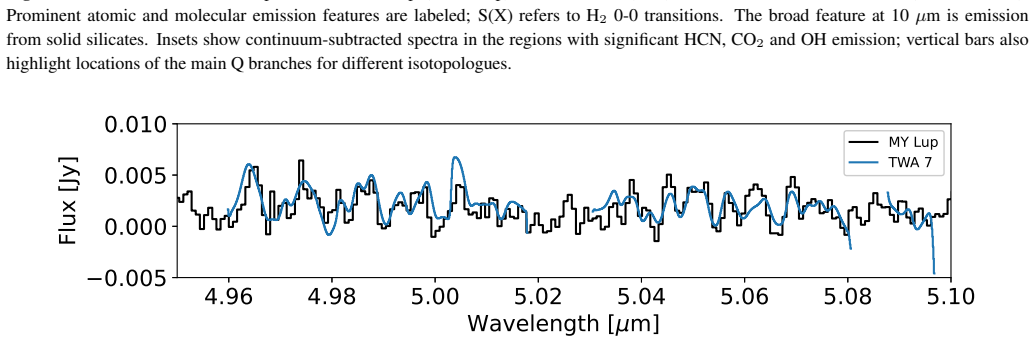
The central observational claim is that MY Lup's inner disk emits from multiple isotopologues of CO$_2$ and HCN, including the first clear detections of C$^{18}$O$^{16}$O and H$^{13}$CN in any inner disk and tentative detections of C$^{17}$O$^{16}$O and HC$^{15}$N. When fit with single-temperature, single-column LTE slabs, the emission requires CO$_2$ column densities of $3.5\times10^{18}$ to $5.6\times10^{18}$ cm$^{-2}$ at $T \approx 300$–$325$ K and a high HCN column of $1.4\times10^{19}$ cm$^{-2}$ at $T = 250$ K, with small emitting radii near 0.4–0.65 AU. The isotopologue Q-branch peak ratios, combined with assumed ISM carbon or oxygen ratios, yield $^{16}$O/$^{18}$O $\approx 381^{+132}_{-100}$, $^{12}$C/$^{13}$C $\approx 77^{+84}_{-25}$, and a marginal $^{16}$O/$^{17}$O that suggests mild depletion of $^{17}$O relative to ISM in both modeling approaches; all are consistent with ISM values within about 2σ. The paper proposes that MY Lup's unique spectrum is caused by a cleared inner disk that suppresses warm water, combined with the edge-on viewing geometry that lengthens the observed gas column.
Load-bearing premise
Everything derived about isotope ratios assumes the main and rare isotopologues of each molecule share a single well-mixed slab with one temperature and column density, an assumption the paper acknowledges is 'certainly not strictly true' for a disk with vertical and radial structure.
Editorial extensions
If this is right
- Trace isotopologues of CO$_2$ and HCN are detectable in inner disks with JWST MIRI-MRS, making inner-disk isotope ratios an observable quantity rather than an extrapolation from the solar system.
- Nearly edge-on disks and disks with inner clearings are the most promising targets for isotopologue searches, since geometry and reduced dust opacity raise the observed gas column.
- The derived ratios, while uncertain, are consistent with ISM values within about 2σ, so this dataset does not yet demand exotic fractionation; it sets the stage for higher-resolution tests.
- If follow-up spectroscopy confirms the high CO$_2$ and HCN columns at cold temperatures, models invoking inner clearing and pebble drift of volatile-rich material become testable for MY Lup specifically.
Reading between the lines
- A natural extension is to relax the single-slab assumption and fit the main and rare isotopologues with separate temperature layers; if the apparent $^{18}$O enhancement and $^{17}$O depletion shift together or vanish, the current isotope ratios are artifacts of vertical stratification.
- A survey of high-inclination and transition disks with MIRI-MRS could map $^{12}$C/$^{13}$C and $^{16}$O/$^{18}$O/$^{17}$O in inner disks and compare directly with ALMA measurements of outer-disk CO isotopologues, exposing radial fractionation gradients.
- The apparent link between high column density and isotopologue detectability implies a selection effect: any statistical sample of inner-disk isotope ratios will be biased toward the most column-rich, often edge-on, disks, which should be accounted for in population interpretations.
Editorial analysis
A structured set of objections, weighed in public.
Referee Report
Summary. This paper presents JWST MIRI-MRS spectroscopy of the high-inclination protoplanetary disk around MY Lup. The spectrum shows weak H2O emission but strong CO2 and HCN emission, and the authors report detections of the rare isotopologues C18O16O and H13CN, with tentative detections of C17O16O and HC15N. LTE slab modeling is used to derive temperatures, column densities, and emitting areas for H2O, CO2, and HCN, and isotopologue ratios are estimated by fixing either the carbon or oxygen isotope ratio to ISM values. The paper attributes the unusual spectral appearance to a combination of inner disk clearing and the near-edge-on viewing geometry, and discusses the implications for isotopic fractionation studies in inner disks.
Significance. If the line identifications are correct, the C18O16O and H13CN detections are the first in an inner protoplanetary disk and demonstrate that JWST MIRI-MRS can access trace isotopologues in the terrestrial-planet-forming region. This is a valuable observational result with clear follow-up potential. The paper is transparent about its modeling degeneracies, makes the reduced data publicly available, and places the results in the context of other MIRI-MRS disk spectra. The main quantitative conclusions on isotope ratios and column densities are, however, conditional on a single-slab LTE assumption and on fixing one isotope ratio to ISM values; the quoted uncertainties do not include the resulting systematic errors, so the fractionation interpretation is not yet supported at the claimed confidence.
major comments (4)
- [Section 4.2 and Appendix B] The central quantitative analysis assumes that all CO2 isotopologues arise from a single LTE slab with one temperature and column density. The paper's own residual analysis shows this assumption is already strained: the 13.88 micron and 16.2 micron features prefer high column densities (~1e18 cm^-2) while the red edge of the main CO2 Q branch near 14.98 micron prefers low column densities. Since the isotope-ratio estimates are derived from Q-branch peak ratios under the same single-slab assumption, the inconsistency introduces an unquantified systematic bias into the derived N and isotope ratios. The authors should either fit a multi-component or non-LTE model, or explicitly present the isotope ratios as conditional on the single-slab assumption with an estimate of the resulting systematic uncertainty.
- [Section 4.2, Table 1] The derivation of the isotope ratios is circular in a practical sense: the 16O/18O value of 381(+132,-100) is obtained after fixing 12C/13C to the ISM value of 68, while the 12C/13C value of 77(+84,-25) is obtained after fixing 16O/18O to the ISM value of 557. The paper explicitly acknowledges the N-versus-ratio degeneracy, but the quoted error bars nevertheless include only the statistical scatter under each fixed-ratio assumption. The systematic uncertainty from the fixed ratio and from the same-reservoir assumption is not propagated. Because the derived ratios are consistent with ISM values at only about 2 sigma, the statements in Section 5.1 about possible 18O enhancement and 17O depletion should be reframed as conditional constraints rather than measurements.
- [Section 4.3 and Figure 12] The HCN analysis has a similar load-bearing degeneracy. The HCN-only fit produces a family of models within the 1-sigma contour with 12C/13C values spanning roughly 21 to 373, and the combined HCN plus H13CN fit only tightly constrains the parameters after fixing 12C/13C to the ISM value. Consequently, the quoted NHCN = 1.4e19 cm^-2 and NH13CN = 2.0e17 cm^-2 are conditional on that fixed ratio and on the same-temperature, same-area assumption. The claim that the high HCN column density is supported by the isotopologue detection is therefore only as strong as the fixed-ratio assumption; this should be stated more prominently and the systematic dependence of NHCN on the assumed ratio should be quantified.
- [Section 5.2 and Figure 15] The geometric enhancement factor invoked to explain the high line-of-sight column densities assumes a plane-parallel slab with no self-absorption. The paper itself notes that the high inclination could produce self-absorption in the molecular lines, which would affect the measured fluxes and hence the derived column densities and ratios. Since the inclination argument is one of the two main explanations for MY Lup's unique spectrum, the authors should estimate the magnitude of possible self-absorption effects or clearly state that the column densities and ratios are upper/lower limits under the adopted geometry.
minor comments (5)
- [Abstract] The phrase 'observations at higher spectral resolving power is needed' should be 'observations at higher spectral resolving power are needed'.
- [Figure 7 caption] The caption refers to '12CO and 13CO' and to '12CO/C18O16O'; these should be '12CO2 and 13CO2' and '12CO2/C18O16O' to match the plotted species.
- [Table 1] The notation for isotope ratios is confusing: column (a) defines the ratio as main isotope divided by heavy isotope, while note (b) defines Ri as the heavy-to-main ratio. Please reconcile the definitions so the reader does not have to invert ratios when reading the table.
- [Section 4.2] The sentence describing C17O16O says 'a12CO2 P-branch line' with a missing space after the article; this should read 'a 12CO2 P-branch line'.
- [Section 5.1] The statement that 'It is not clear that there is a mechanism to explain enhancement in one heavy isotope with simultaneous depletion in another' would benefit from a reference to relevant photodissociation or chemical fractionation models, if one exists.
Circularity Check
No significant circularity: the detections are direct spectroscopic identifications, and the isotopologue ratio estimates are explicitly conditional fits, not self-referential predictions.
full rationale
The paper's central claims are empirical detections of C18O16O, H13CN, C17O16O, and HC15N, identified by Q-branch positions and HITRAN line data; these identifications do not depend on the model inputs. The slab-model temperatures, column densities, and emitting areas are fits to the spectra, and the paper explicitly acknowledges the N-T degeneracy in Section 4.2. The isotopologue ratios are obtained by fixing the complementary ratio to an assumed ISM value: Section 4.2 states 'we therefore cannot independently fit the column density and abundance ratio' and 'We start by fixing the C ratios to the ISM value (12C/13C=68) ... using the resulting constraints to pinpoint the oxygen isotope ratios.' This is transparent conditional model fitting rather than circularity, because the fitted 16O/18O and 12C/13C values are still constrained by independent spectral features (the C18O16O, 13CO2, and H13CN Q branches), rather than being algebraic identities of the fixed inputs. The paper twice discloses the conditioning: Section 5.1 notes 'one of the points we showed was artificially fixed to the ISM value on the x axis,' and Section 6 states that isotopologue fitting 'requires the fixing of isotopologue ratios.' The single-reservoir LTE assumption is acknowledged as 'certainly not strictly true' (Section 5.1), and Appendix B documents an internal inconsistency (the CO2 red edge preferring low N while the 16.2 um feature prefers high N), suggesting non-LTE or multi-component emission; this is a modeling limitation and a correctness risk, not a circular reduction. Self-citations (Pontoppidan et al. 2024 for data reduction, Salyk 2022 for spectools-ir, and the in-prep JDISCS survey for uniqueness context) are methodological or observational context, and no uniqueness theorem or ansatz is imported from them to force the results. The 'first ever detection' uniqueness claim depends partly on an in-prep survey citation, which is a completeness or evidence matter, not a circular derivation. No step of the claimed derivation chain is equivalent to its own input by construction.
Assumptions & free parameters
free parameters (16)
- H2O_T =
336 K
- H2O_logN =
18.00 cm-2
- H2O_R =
1.20 AU
- CO2_T_fixedC =
325 K
- CO2_N_fixedC =
3.5e18 cm-2
- CO2_R_fixedC =
0.58 AU
- CO2_T_fixedO =
300 K
- CO2_N_fixedO =
5.6e18 cm-2
- CO2_R_fixedO =
0.65 AU
- HCN_T =
250 K
- HCN_N =
1.4e19 cm-2
- HCN_R =
0.61 AU
- H13CN_N =
2.0e17 cm-2
- 16O/18O_ratio_fixedC =
381 (+132,-100)
- 16O/17O_ratio_fixedC =
2272 (-882)
- 12C/13C_ratio_fixedO =
77 (+84,-25)
assumptions (7)
- domain assumption LTE slab model for all molecular emission
- domain assumption Single shared reservoir for isotopologues
- domain assumption Disk geometry conversion Aproj = pi R^2 cos(i) with i=77 deg
- domain assumption Continuum can be approximated by interpolation between line-free regions
- domain assumption ISM isotope ratios as fixed inputs
- standard math HITRAN line lists are accurate
- domain assumption Fringe correction is stable over time
Cite this review
Pith. "Pith review of Emission from multiple molecular isotopologues in a high-inclination protoplanetary disk." pith.science (2026). https://pith.science/paper/TG4AEKQQ
@misc{pith2026250205061,
  author       = {Pith},
  title        = {Pith review of: Emission from multiple molecular isotopologues in a high-inclination protoplanetary disk},
  year         = {2026},
  howpublished = {\url{https://pith.science/paper/TG4AEKQQ}},
  note         = {Machine review of arXiv:2502.05061}
}
abstract
We present a MIRI-MRS spectrum of the high-inclination protoplanetary disk around the solar-mass (K0) star MY Lup, obtained as part of the JWST Disk Infrared Spectral Chemistry Survey (JDISCS). The spectrum shows an unusually weak water emission spectrum for a disk around a star of its spectral type, but strong emission from CO$_2$, HCN, and isotopologues of both molecules. This includes the first ever detection of C$^{18}$O$^{16}$O and H$^{13}$CN in an inner disk, as well as tentative detections of C$^{17}$O$^{16}$O and HC$^{15}$N. Slab modeling provides molecular temperatures, column densities and emitting areas of the detected molecules. The emitting molecular gas is cold compared to that of other observed protoplanetary disk spectra. We estimate the isotopologue ratios of CO$_2$ and HCN, albeit with significant uncertainty. We suggest that the unusual spectrum of MY Lup arises from a combination of inner disk clearing, which removes emission from warm water, and its nearly edge-on inclination, which enhances line-of-sight column densities, although unusual chemistry may also be required. MY Lup's spectrum highlights the potential to detect and measure trace isotopologues to study isotopic fractionation in protoplanetary disks; observations at higher spectral resolving power is needed to constrain the isotopologue ratios to greater precision.
Figures


Figures from the paper (15 more)


Reference graph
Works this paper leans on
-
[1]
Aikawa, Y., Umebayashi, T., Nakano, T., et al.\ 1997, , 486, L51. doi:10.1086/310837
-
[2]
Alcal \'a , J. M., Manara, C. F., Natta, A., et al.\ 2017, , 600, A20. doi:10.1051/0004-6361/201629929
-
[3]
Alcal \'a , J. M., Manara, C. F., France, K., et al.\ 2019, , 629, A108. doi:10.1051/0004-6361/201935657
-
[4]
Andrews, S. M., Huang, J., P \'e rez, L. M., et al.\ 2018, , 869, L41. doi:10.3847/2041-8213/aaf741
-
[5]
P., Garufi, A., et al.\ 2018, , 863, 44
Avenhaus, H., Quanz, S. P., Garufi, A., et al.\ 2018, , 863, 44. doi:10.3847/1538-4357/aab846
-
[6]
Banzatti, A., Pontoppidan, K. M., Carr, J. S., et al.\ 2023, , 957, L22. doi:10.3847/2041-8213/acf5ec
-
[7]
M., et al.\ 2024, arXiv:2409.16255
Banzatti, A., Salyk, C., Pontoppidan, K. M., et al.\ 2024, arXiv:2409.16255. doi:10.48550/arXiv.2409.16255
-
[8]
A., Bosman, A., Teague, R., et al.\ 2024, , 965, 147
Bergin, E. A., Bosman, A., Teague, R., et al.\ 2024, , 965, 147. doi:10.3847/1538-4357/ad3443
Show all 75 references
-
[9]
& Bergin, E.\ 2009, Science, 326, 1675
Bethell, T. & Bergin, E.\ 2009, Science, 326, 1675. doi:10.1126/science.1176879
2009 doi
-
[10]
doi:10.1007/s11214-015-0156-9
Bockel \'e e-Morvan, D., Calmonte, U., Charnley, S., et al.\ 2015, , 197, 47. doi:10.1007/s11214-015-0156-9
2015 doi
-
[11]
D., Bruderer, S., & van Dishoeck, E
Bosman, A. D., Bruderer, S., & van Dishoeck, E. F.\ 2017, , 601, A36. doi:10.1051/0004-6361/201629946
2017 doi
-
[12]
D., Bergin, E
Bosman, A. D., Bergin, E. A., Calahan, J. K., et al.\ 2022, , 933, L40. doi:10.3847/2041-8213/ac7d9f
2022 doi
-
[13]
W., Shappee, B
Bredall, J. W., Shappee, B. J., Gaidos, E., et al.\ 2020, , 496, 3257. doi:10.1093/mnras/staa1588
2020 doi
-
[14]
F.\ 2015, , 575, A94
Bruderer, S., Harsono, D., & van Dishoeck, E. F.\ 2015, , 575, A94. doi:10.1051/0004-6361/201425009
2015 doi
-
[15]
Bushouse, H., Eisenhamer, J., Dencheva, N., et al.\ 2024, Zenodo
2024
-
[16]
K., Bergin, E
Calahan, J. K., Bergin, E. A., & Bosman, A. D.\ 2022, , 934, L14. doi:10.3847/2041-8213/ac7e55
2022 doi
-
[17]
doi:10.1086/339061
Calvet, N., D'Alessio, P., Hartmann, L., et al.\ 2002, , 568, 1008. doi:10.1086/339061
2002 doi
-
[18]
Carr, J. S. & Najita, J. R.\ 2008, Science, 319, 1504. doi:10.1126/science.1153807
2008 doi
-
[19]
Carr, J. S. & Najita, J. R.\ 2011, , 733, 102. doi:10.1088/0004-637X/733/2/102
2011 doi
-
[20]
N., Grossman, L., & Mayeda, T
Clayton, R. N., Grossman, L., & Mayeda, T. K.\ 1973, Science, 182, 485. doi:10.1126/science.182.4111.485
1973 doi
-
[21]
W., Lang, D., et al.\ 2013, , 125, 306
Foreman-Mackey, D., Hogg, D. W., Lang, D., et al.\ 2013, , 125, 306. doi:10.1086/670067
2013 doi
-
[22]
F., Grant, S
Gasman, D., van Dishoeck, E. F., Grant, S. L., et al.\ 2023, , 679, A117. doi:10.1051/0004-6361/202347005
2023 doi
-
[23]
E., Rothman, L
Gordon, I. E., Rothman, L. S., Hargreaves, R. J., et al.\ 2022, , 277, 107949. doi:10.1016/j.jqsrt.2021.107949
2022
-
[24]
L., van Dishoeck, E
Grant, S. L., van Dishoeck, E. F., Tabone, B., et al.\ 2023, , 947, L6. doi:10.3847/2041-8213/acc44b
2023 doi
- [25]
-
[26]
doi:10.1088/1538-3873/ad3455
Henning, T., Kamp, I., Samland, M., et al.\ 2024, , 136, 054302. doi:10.1088/1538-3873/ad3455
2024 doi
-
[27]
doi:10.1051/0004-6361/201730524
Hily-Blant, P., Magalhaes, V., Kastner, J., et al.\ 2017, , 603, L6. doi:10.1051/0004-6361/201730524
2017 doi
-
[28]
doi:10.1051/0004-6361/201936750
Hily-Blant, P., Magalhaes de Souza, V., Kastner, J., et al.\ 2019, , 632, L12. doi:10.1051/0004-6361/201936750
2019 doi
-
[29]
R., Roellig, T
Houck, J. R., Roellig, T. L., van Cleve, J., et al.\ 2004, , 154, 18. doi:10.1086/423134
2004 doi
-
[30]
M., Dullemond, C
Huang, J., Andrews, S. M., Dullemond, C. P., et al.\ 2018, , 869, L42. doi:10.3847/2041-8213/aaf740
2018 doi
-
[31]
doi:10.3847/1538-4357/ac1e96
Kalyaan, A., Pinilla, P., Krijt, S., et al.\ 2021, , 921, 84. doi:10.3847/1538-4357/ac1e96
2021 doi
-
[32]
Karhu, J.A., Bekker, A. (2023). Carbon Isotopes in the Solar System. In: Gargaud, M., et al. Encyclopedia of Astrobiology. Springer, Berlin, Heidelberg. https://doi.org/10.1007/978-3-662-65093-6\_5395
2023 doi
-
[33]
W., Sargent, A
Koerner, D. W., Sargent, A. I., & Beckwith, S. V. W.\ 1993, , 106, 2. doi:10.1006/icar.1993.1154
1993
-
[34]
C., Biver, N., Bockel \'e e-Morvan, D., et al.\ 2013, , 774, L3
Lis, D. C., Biver, N., Bockel \'e e-Morvan, D., et al.\ 2013, , 774, L3. doi:10.1088/2041-8205/774/1/L3
2013 doi
-
[35]
doi:10.3847/2041-8213/ad99d2
Long, F., Pascucci, I., Houge, A., et al.\ 2025, , 978, L30. doi:10.3847/2041-8213/ad99d2
2025 doi
-
[36]
Lyons, J. R. & Young, E. D.\ 2005, , 435, 317. doi:10.1038/nature03557
2005 doi
-
[37]
doi:10.1016/j.epsl.2011.10.040
Marty, B.\ 2012, Earth and Planetary Science Letters, 313, 56. doi:10.1016/j.epsl.2011.10.040
2012 doi
-
[38]
D., Kallio, A
McKeegan, K. D., Kallio, A. P. A., Heber, V. S., et al.\ 2011, Science, 332, 1528. doi:10.1126/science.1204636
2011 doi
-
[39]
M., Blake, G
Meijerink, R., Pontoppidan, K. M., Blake, G. A., et al.\ 2009, , 704, 1471. doi:10.1088/0004-637X/704/2/1471
2009 doi
-
[40]
N., Savage, C., Brewster, M
Milam, S. N., Savage, C., Brewster, M. A., et al.\ 2005, , 634, 1126. doi:10.1086/497123
2005 doi
-
[41]
F.\ 2014, , 572, A96
Miotello, A., Bruderer, S., & van Dishoeck, E. F.\ 2014, , 572, A96. doi:10.1051/0004-6361/201424712
2014 doi
-
[42]
A.\ 2009, , 700, L92
Moynier, F., Dauphas, N., & Podosek, F. A.\ 2009, , 700, L92. doi:10.1088/0004-637X/700/2/L92
2009 doi
-
[43]
E., \"O berg, K
Mu \ n oz-Romero, C. E., \"O berg, K. I., Banzatti, A., et al.\ 2024, , 964, 36. doi:10.3847/1538-4357/ad20e9
2024 doi
-
[44]
doi:10.1086/300636
Muzerolle, J., Hartmann, L., & Calvet, N.\ 1998, , 116, 2965. doi:10.1086/300636
1998 doi
-
[45]
R., \'A d \'a mkovics, M., & Glassgold, A
Najita, J. R., \'A d \'a mkovics, M., & Glassgold, A. E.\ 2011, , 743, 147. doi:10.1088/0004-637X/743/2/147
2011 doi
-
[46]
R., Carr, J
Najita, J. R., Carr, J. S., Salyk, C., et al.\ 2018, , 862, 122. doi:10.3847/1538-4357/aaca39
2018 doi
-
[47]
doi:10.1038/s41586-023-06317-9
Perotti, G., Christiaens, V., Henning, T., et al.\ 2023, , 620, 516. doi:10.1038/s41586-023-06317-9
2023 doi
-
[48]
M., Salyk, C., Blake, G
Pontoppidan, K. M., Salyk, C., Blake, G. A., et al.\ 2010, , 720, 887. doi:10.1088/0004-637X/720/1/887
2010 doi
-
[49]
M., Salyk, C., Banzatti, A., et al.\ 2024, , 963, 158
Pontoppidan, K. M., Salyk, C., Banzatti, A., et al.\ 2024, , 963, 158. doi:10.3847/1538-4357/ad20f0
2024 doi
-
[50]
A., Savage, P
Pringle, E. A., Savage, P. S., Jackson, M. G., et al.\ 2013, , 779, 123. doi:10.1088/0004-637X/779/2/123
2013 doi
-
[51]
H., Wright, G
Rieke, G. H., Wright, G. S., B \"o ker, T., et al.\ 2015, , 127, 584. doi:10.1086/682252
2015 doi
-
[52]
doi:10.1088/0004-637X/801/1/31
Rigliaco, E., Pascucci, I., Duchene, G., et al.\ 2015, , 801, 31. doi:10.1088/0004-637X/801/1/31
2015 doi
-
[53]
A., Schreiber, M
Romero, G. A., Schreiber, M. R., Cieza, L. A., et al.\ 2012, , 749, 79. doi:10.1088/0004-637X/749/1/79
2012 doi
-
[54]
S., Jacquemart, D., Barbe, A., et al.\ 2005, , 96, 139
Rothman, L. S., Jacquemart, D., Barbe, A., et al.\ 2005, , 96, 139. doi:10.1016/j.jqsrt.2004.10.008
2005 doi
-
[55]
M., Blake, G
Salyk, C., Pontoppidan, K. M., Blake, G. A., et al.\ 2008, , 676, L49. doi:10.1086/586894
2008 doi
-
[56]
A., Boogert, A
Salyk, C., Blake, G. A., Boogert, A. C. A., et al.\ 2009, , 699, 330. doi:10.1088/0004-637X/699/1/330
2009 doi
-
[57]
github.com/csalyk/spectools\_ir: First release, v1.0.0, Zenodo, 1104 doi: 10.5281/zenodo.5818682
-
[58]
& Golay, M
Savitzky, A. & Golay, M. J. E.\ 1964, Analytical Chemistry, 36, 1627
1964
-
[59]
R., Henning, T., Christiaens, V., et al.\ 2024, , 962, 8
Schwarz, K. R., Henning, T., Christiaens, V., et al.\ 2024, , 962, 8. doi:10.3847/1538-4357/ad1393
2024 doi
-
[60]
L., Pontoppidan, K
Smith, R. L., Pontoppidan, K. M., Young, E. D., et al.\ 2009, , 701, 163. doi:10.1088/0004-637X/701/1/163
2009 doi
-
[61]
L., Pontoppidan, K
Smith, R. L., Pontoppidan, K. M., Young, E. D., et al.\ 2015, , 813, 120. doi:10.1088/0004-637X/813/2/120
2015 doi
-
[62]
F., et al.\ 2023, Nature Astronomy, 7, 805
Tabone, B., Bettoni, G., van Dishoeck, E. F., et al.\ 2023, Nature Astronomy, 7, 805. doi:10.1038/s41550-023-01965-3
2023 doi
-
[63]
A., Perevalov, V
Tashkun, S. A., Perevalov, V. I., Teffo, J.-L., et al.\ 2003, , 82, 165. doi:10.1016/S0022-4073(03)00152-3
2003 doi
-
[64]
F., Grant, S
Temmink, M., van Dishoeck, E. F., Grant, S. L., et al.\ 2024, , 686, A117. doi:10.1051/0004-6361/202348911
2024 doi
-
[65]
F., Gasman, D., et al.\ 2024, , 689, A330
Temmink, M., van Dishoeck, E. F., Gasman, D., et al.\ 2024, , 689, A330. doi:10.1051/0004-6361/202450355
2024 doi
-
[66]
Thiemens, M. H. & Heidenreich, J. E.\ 1983, Science, 219, 1073. doi:10.1126/science.219.4588.1073
1983
-
[67]
P., Ansdell, M., et al.\ 2018, , 854, 177
van der Marel, N., Williams, J. P., Ansdell, M., et al.\ 2018, , 854, 177. doi:10.3847/1538-4357/aaaa6b
2018 doi
-
[68]
E., et al.\ 2020, Nature Methods, 17, 261
Virtanen, P., Gommers, R., Oliphant, T. E., et al.\ 2020, Nature Methods, 17, 261. doi:10.1038/s41592-019-0686-2
2020 doi
-
[69]
F., Tabone, B., et al.\ 2024, , 682, A91
Vlasblom, M., van Dishoeck, E. F., Tabone, B., et al.\ 2024, , 682, A91. doi:10.1051/0004-6361/202348224
2024 doi
-
[70]
L.\ 1999, Reports on Progress in Physics, 62, 143
Wilson, T. L.\ 1999, Reports on Progress in Physics, 62, 143. doi:10.1088/0034-4885/62/2/002
1999 doi
-
[71]
S., Rieke, G
Wright, G. S., Rieke, G. H., Glasse, A., et al.\ 2023, , 135, 048003. doi:10.1088/1538-3873/acbe66
2023 doi
-
[72]
doi:10.3847/2041-8213/ad0ed9
Xie, C., Pascucci, I., Long, F., et al.\ 2023, , 959, L25. doi:10.3847/2041-8213/ad0ed9
2023 doi
-
[73]
C., Nomura, H., Furuya, K., et al.\ 2022, , 932, 126
Yoshida, T. C., Nomura, H., Furuya, K., et al.\ 2022, , 932, 126. doi:10.3847/1538-4357/ac6efb
2022 doi
-
[74]
& Kuramoto, K.\ 2004, Science, 305, 1763
Yurimoto, H. & Kuramoto, K.\ 2004, Science, 305, 1763. doi:10.1126/science.1100989
2004 doi
-
[75]
K., Guo, Y., O'Nions, R
Zhu, X. K., Guo, Y., O'Nions, R. K., et al.\ 2001, , 412, 311
2001
Reviewed August 8, 2026 · model on record in the stance chip above.
Discussion (0). Continue with ORCID to comment.