A Dual-Track Framework for Template-Constrained LaTeX Conversion
Pith reviewed 2026-06-26 08:37 UTC · model grok-4.3
The pith
A dual-track framework converts Markdown to template-compliant LaTeX by extracting constraints offline and using a hybrid LLM-rule pipeline online.
A machine-rendered reading of the paper's core claim, the machinery that carries it, and where it could break.
Core claim
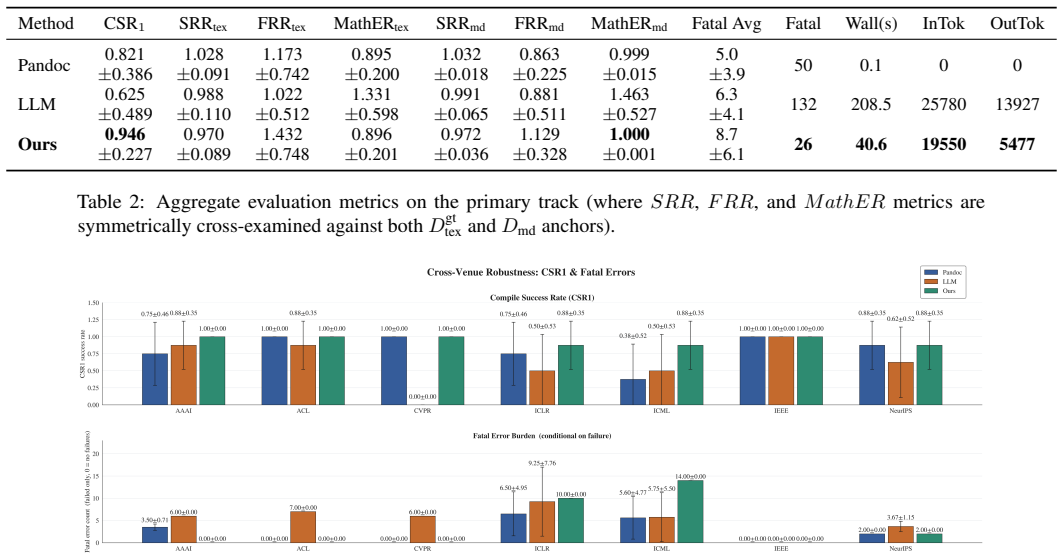
The central claim is that the Dual-Track Framework, by extracting template constraints into an offline manifest and running a hybrid online pipeline that limits LLM use to semantic metadata, bibliographic references, and complex layouts while delegating the rest to rule-based engines, preserves structural fidelity, meets diverse layout constraints, and reaches higher compilation success rates than prior rule-only or LLM-only methods.
What carries the argument
Dual-Track Framework consisting of an offline manifest that records template constraints and an online hybrid pipeline that assigns LLM reasoning only to complex components while using deterministic rules elsewhere.
If this is right
- Converted documents retain higher structural fidelity to the original Markdown drafts.
- The approach satisfies layout constraints from a range of different LaTeX templates.
- Compilation success rates increase relative to both rule-based and end-to-end LLM baselines.
- Semantic drift is limited by restricting LLM application to reasoning-intensive sections only.
Where Pith is reading between the lines
- The same split between offline constraint capture and selective LLM use could apply to conversion into other structured formats such as HTML or Word templates.
- Limiting LLM calls to specific subtasks may lower overall processing cost and error-debugging effort in automated publishing workflows.
- Extending the manifest format to include version-specific or conditional constraints could further widen the set of supported templates.
Load-bearing premise
The assumption that an offline manifest can fully capture every template-specific constraint and that the hybrid pipeline can split tasks between LLM and rules without introducing semantic drift.
What would settle it
A set of test papers from a new template where the manifest is built from the template files yet the converted output still fails to compile or alters reference content compared with the source Markdown.
Figures





read the original abstract
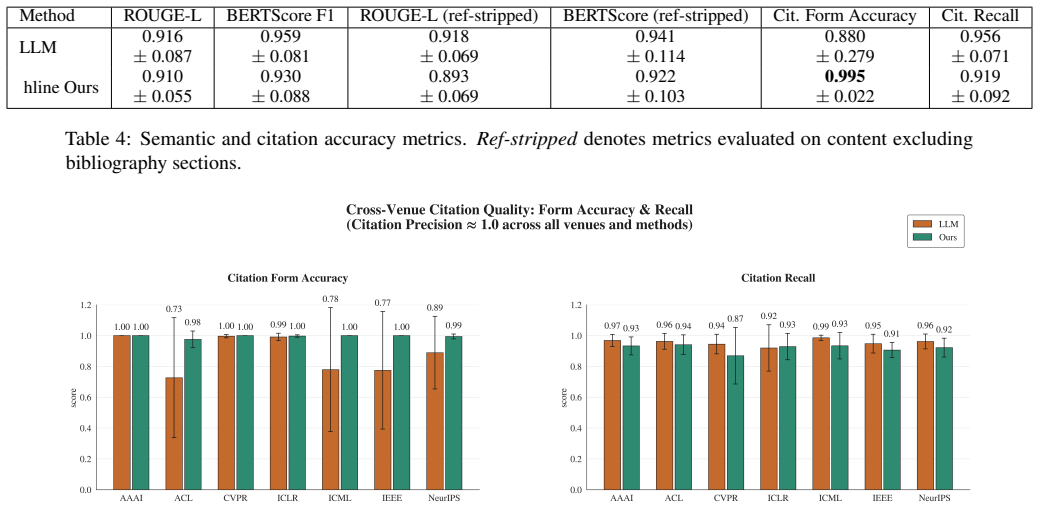
With the increasing demands for advanced document conversion, mapping structured Markdown drafts into template-compliant formats like LaTeX remains a challenge. Existing approaches largely depend on either deterministic rule-based converters or pure end-to-end Large Language Model (LLM) generation. The former fails to correctly handle asset insertions and template-specific constraints, while the latter tends to induce semantic drift, leading to hallucinations that are difficult to debug. To address these limitations, we introduce a robust Dual-Track Framework that systematically decouples template formatting from document processing: an offline track extracts template constraints into a reusable manifest, while an online track implements a hybrid execution pipeline. This pipeline confines LLM usage exclusively to reasoning-intensive components (e.g., semantic metadata, bibliographic references, and complex visual/tabular layouts) while delegating rule-based engines for deterministic processing. Empirical evaluation across 7 LaTeX templates and 56 published research papers demonstrates that our method preserves better structural fidelity, satisfies diverse layout constraints, and achieves a higher compilation success rate compared to the previous baselines.
Editorial analysis
A structured set of objections, weighed in public.
Referee Report
Summary. The manuscript introduces a Dual-Track Framework for converting structured Markdown drafts into template-compliant LaTeX. An offline track extracts template constraints into a reusable manifest; an online track uses a hybrid pipeline that restricts LLMs to reasoning-intensive subtasks (semantic metadata, references, complex layouts) while delegating deterministic processing to rule-based engines. The central claim is that this yields better structural fidelity, constraint satisfaction, and higher compilation success than prior baselines, supported by evaluation on 7 LaTeX templates and 56 published papers.
Significance. If the empirical results and manifest-extraction claims hold, the framework offers a concrete way to combine the reliability of rule-based methods with the flexibility of LLMs for a recurring practical task in academic publishing. The explicit separation of offline constraint capture from online execution is a clear architectural contribution that could be reusable beyond the reported templates.
major comments (2)
- [Abstract] Abstract: the headline claim of superior performance (better structural fidelity, constraint satisfaction, higher compilation success) across 7 templates and 56 papers is asserted without any quantitative metrics, baseline descriptions, error analysis, or experimental protocol. This absence makes the central empirical result impossible to assess and is load-bearing for the paper's contribution.
- [Abstract] Abstract (framework description): the offline manifest is presented as capturing 'all template-specific constraints' and being 'reusable,' yet no verification, coverage metrics, or handling of implicit/cross-package interactions is described. Because the reported compilation-success gains rest on the manifest being exhaustive, the lack of evidence for this precondition directly undermines the claimed delta over baselines.
minor comments (1)
- [Abstract] The abstract would be clearer if it named the specific baselines and the exact success-rate or fidelity measures used in the 56-paper evaluation.
Simulated Author's Rebuttal
We thank the referee for the constructive comments. We address each major comment below and will revise the abstract and related sections accordingly.
read point-by-point responses
-
Referee: [Abstract] Abstract: the headline claim of superior performance (better structural fidelity, constraint satisfaction, higher compilation success) across 7 templates and 56 papers is asserted without any quantitative metrics, baseline descriptions, error analysis, or experimental protocol. This absence makes the central empirical result impossible to assess and is load-bearing for the paper's contribution.
Authors: We agree that the abstract should include quantitative metrics and a brief reference to the evaluation protocol to make the claims assessable at a glance. The full manuscript details the baselines, metrics, and results in the evaluation section, but we will revise the abstract to incorporate key numbers (e.g., compilation success rates and structural fidelity improvements) from the experiments on 7 templates and 56 papers. revision: yes
-
Referee: [Abstract] Abstract (framework description): the offline manifest is presented as capturing 'all template-specific constraints' and being 'reusable,' yet no verification, coverage metrics, or handling of implicit/cross-package interactions is described. Because the reported compilation-success gains rest on the manifest being exhaustive, the lack of evidence for this precondition directly undermines the claimed delta over baselines.
Authors: The abstract as written refers to 'template constraints' without claiming completeness with the word 'all', but we accept the referee's concern that stronger evidence for exhaustiveness is needed to support the performance claims. We will revise the abstract to clarify the manifest's scope and add a discussion of the extraction process, verification approach, and any limitations on implicit or cross-package interactions in the methods section. revision: yes
Circularity Check
No circularity: empirical framework evaluated on external benchmarks
full rationale
The paper presents a Dual-Track Framework with an offline manifest extraction step and an online hybrid pipeline, then reports empirical results on 7 LaTeX templates and 56 published papers. No derivation chain, equations, predictions, or first-principles claims are present that could reduce to fitted inputs or self-citations by construction. The central claims are comparative performance metrics against baselines, which are externally falsifiable on the stated test set. The reader's provided score of 2.0 aligns with a minor or absent self-citation load; no load-bearing step matches any of the enumerated circularity patterns. The skeptic concern addresses an untested assumption about manifest completeness, which is a correctness or coverage issue rather than circularity.
Axiom & Free-Parameter Ledger
Reference graph
Works this paper leans on
-
[1]
ACM computing surveys , volume=
Survey of hallucination in natural language generation , author=. ACM computing surveys , volume=. 2023 , publisher=
2023
-
[2]
Artificial Intelligence Review , volume=
Neurosymbolic ai: The 3 rd wave , author=. Artificial Intelligence Review , volume=. 2023 , publisher=
2023
-
[3]
Text summarization branches out , pages=
Rouge: A package for automatic evaluation of summaries , author=. Text summarization branches out , pages=
-
[4]
Transactions of the association for computational linguistics , volume=
Lost in the middle: How language models use long contexts , author=. Transactions of the association for computational linguistics , volume=
-
[5]
, title =
MacFarlane, J. , title =. 2009 , howpublished =
2009
-
[6]
2024 , eprint=
Qwen2 Technical Report , author=. 2024 , eprint=
2024
-
[7]
Weinberger and Yoav Artzi , booktitle=
Tianyi Zhang and Varsha Kishore and Felix Wu and Kilian Q. Weinberger and Yoav Artzi , booktitle=. 2020 , url=
2020
-
[8]
Advances in neural information processing systems , volume=
Deepproblog: Neural probabilistic logic programming , author=. Advances in neural information processing systems , volume=
-
[9]
arXiv preprint arXiv:2603.01341 , year=
Structural Hallucination in Large Language Models: A Network-Based Evaluation of Knowledge Organization and Citation Integrity , author=. arXiv preprint arXiv:2603.01341 , year=
-
[10]
arXiv preprint arXiv:2603.02873 , year=
LaTeX Compilation: Challenges in the Era of LLMs , author=. arXiv preprint arXiv:2603.02873 , year=
-
[11]
IEEE Transactions on Software Engineering , year=
Beyond Functional Correctness: Exploring Hallucinations in LLM-Generated Code , author=. IEEE Transactions on Software Engineering , year=
-
[12]
Science China Information Sciences , volume=
What is wrong with your code generated by large language models? An extensive study , author=. Science China Information Sciences , volume=. 2026 , publisher=
2026
-
[13]
Engelmore memorial lecture , author=
The third AI summer: AAAI Robert S. Engelmore memorial lecture , author=. Ai magazine , volume=
-
[14]
arXiv preprint arXiv:2201.11227 , year=
Synchromesh: Reliable code generation from pre-trained language models , author=. arXiv preprint arXiv:2201.11227 , year=
-
[15]
Proceedings of the 2021 conference on empirical methods in natural language processing , pages=
PICARD: Parsing incrementally for constrained auto-regressive decoding from language models , author=. Proceedings of the 2021 conference on empirical methods in natural language processing , pages=
2021
-
[16]
and Abulaiti, A
Li, Z. and Abulaiti, A. and Lu, Y. and Chen, X. and Zheng, J. and Lin, H. and Sun, L. , title =. Findings of the Association for Computational Linguistics: ACL 2025 , year =
2025
-
[17]
Proceedings of the Fifth Workshop on Scholarly Document Processing (SDP 2025) , pages=
Texpert: A multi-level benchmark for evaluating latex code generation by llms , author=. Proceedings of the Fifth Workshop on Scholarly Document Processing (SDP 2025) , pages=
2025
-
[18]
Advances in Neural Information Processing Systems , volume=
Image2struct: Benchmarking structure extraction for vision-language models , author=. Advances in Neural Information Processing Systems , volume=
-
[19]
Proceedings of the IEEE/CVF Conference on Computer Vision and Pattern Recognition , pages=
Omnidocbench: Benchmarking diverse pdf document parsing with comprehensive annotations , author=. Proceedings of the IEEE/CVF Conference on Computer Vision and Pattern Recognition , pages=
-
[20]
Proceedings of The First Workshop on Human--LLM Collaboration for Ethical and Responsible Science Production (SciProdLLM) , pages=
TransLaTeX: Exposing the Last-Mile Execution Gap in LLM-Agent for Scientific Formatting , author=. Proceedings of The First Workshop on Human--LLM Collaboration for Ethical and Responsible Science Production (SciProdLLM) , pages=
-
[21]
MADP: A Multi-Agent Pipeline for Sustainable Document Processing with Human-in-the-Loop
MADP: A Multi-Agent Pipeline for Sustainable Document Processing with Human-in-the-Loop , author=. arXiv preprint arXiv:2605.17159 , year=
work page internal anchor Pith review Pith/arXiv arXiv
-
[22]
Operationalizing Document AI: A Microservice Architecture for OCR and LLM Pipelines in Production
Operationalizing Document AI: A Microservice Architecture for OCR and LLM Pipelines in Production , author=. arXiv preprint arXiv:2605.18818 , year=
work page internal anchor Pith review Pith/arXiv arXiv
-
[23]
Advances in Neural Information Processing Systems , volume=
Stratus: A multi-agent system for autonomous reliability engineering of modern clouds , author=. Advances in Neural Information Processing Systems , volume=
-
[24]
arXiv preprint arXiv:2506.03401 , year=
RAGOps: Operating and Managing Retrieval-Augmented Generation Pipelines , author=. arXiv preprint arXiv:2506.03401 , year=
-
[25]
ICRA 2025 Workshop on Foundation Models and Neuro-Symbolic AI for Robotics , year=
Neuro-Symbolic Task Planning and Replanning using Large Language Models , author=. ICRA 2025 Workshop on Foundation Models and Neuro-Symbolic AI for Robotics , year=
2025
-
[26]
Frontiers in Artificial Intelligence , volume=
Neuro-symbolic NLP: taxonomy, assessment, and directions , author=. Frontiers in Artificial Intelligence , volume=. 2026 , publisher=
2026
discussion (0)
Sign in with ORCID, Apple, or X to comment. Anyone can read and Pith papers without signing in.