REVIEW 3 major objections 5 minor 88 references
Upgraded antennas for pulsar observations in the Argentine Institute of Radio astronomy
T0 review · 3 major / 5 minor · reviewed 2026-08-14 · deepseek-v4-flash
Pith's one-line read Refurbished 30-meter antennas time southern pulsars to under a microsecond, enabling daily monitoring for gravitational-wave and transient science.
desk verdict A genuinely useful commissioning paper that delivers the first systematic South American pulsar timing program with sub-µs residuals on J0437−4715; the main open question is whether the GPS-based clock can actually support that timing precision. read the letter →
The pith
A machine-rendered reading of the paper's core claim, the machinery that carries it, and where it could break.
The reading
What carries the argument
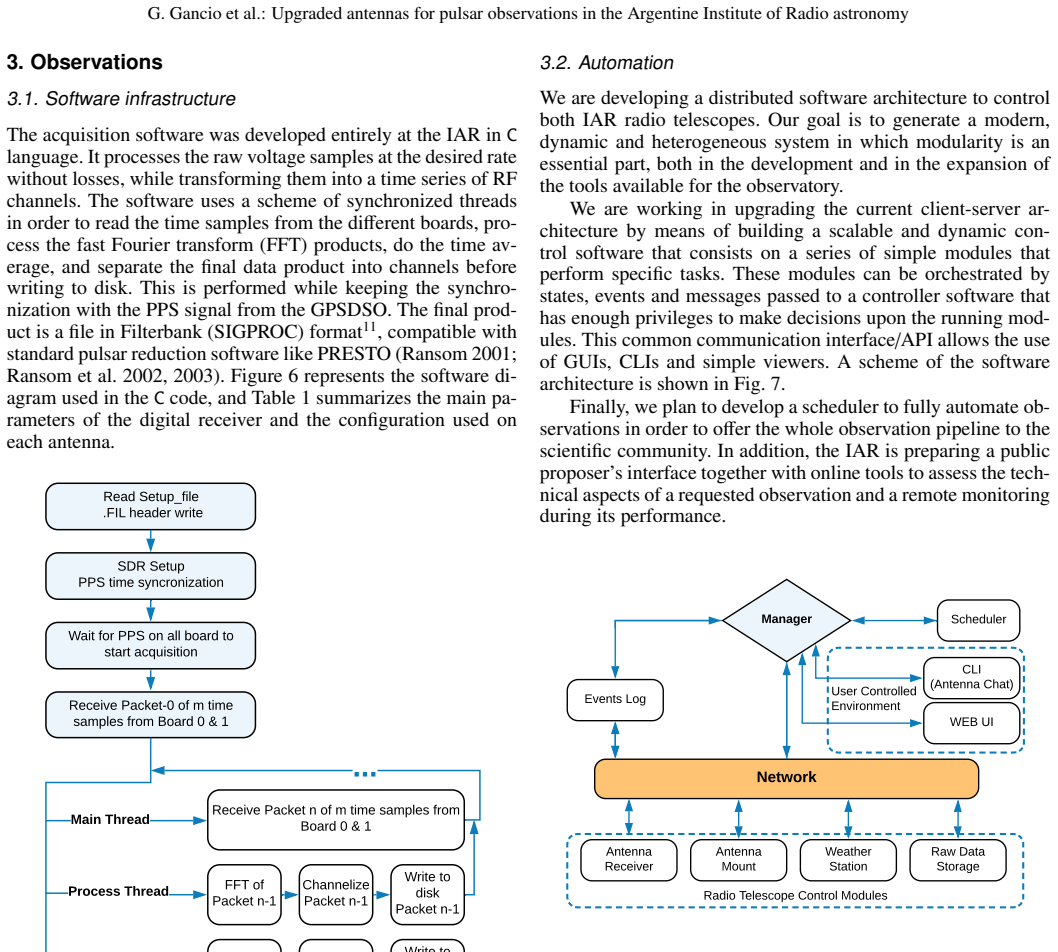
The central objects are the two 30-meter parabolic antennas, each with a refurbished frontend and a software-defined-radio backend that digitizes 56–112 MHz of bandwidth at 1.4 GHz, with data stamped by one-pulse-per-second signals from a GPS-disciplined oscillator. The timing argument rests on residuals computed with the TEMPO2 software from pulse arrival times extracted with PSRCHIVE; the comparison of those residuals to published expectations for J0437−4715 is what supports the sub-microsecond precision claim.
What would settle it
Connect the hydrogen maser at the nearby geodetic observatory to the data acquisition and take simultaneous observations; if the maser-based arrival times disagree with the GPS-based times by more than one microsecond, the quoted residuals are not real timing precision. Alternatively, cross-correlate the IAR residuals for J0437−4715 with simultaneous observations from another southern telescope and look for a common low-frequency wander that would reveal a clock error.
Extended reading notes
Core claim
After a two-year upgrade of receivers, backends, and clock synchronization, the two antennas achieve timing residuals of 0.55 µs and 0.81 µs for the millisecond pulsar J0437−4715, values the authors show are compatible with published expectations for that pulsar. They also detect radio pulsations from the reactivated magnetar XTE J1810−197 and measure the February 2019 glitch of the Vela pulsar, obtaining a period jump consistent with an independent estimate within 7 percent. These results are presented as evidence that the observatory is now a viable contributor to pulsar timing arrays and related science.
Load-bearing premise
The sub-microsecond timing claim assumes the GPS-disciplined oscillator stamps each observation with an absolute time accurate to better than a microsecond, because no independent clock is yet connected to verify it.
Editorial extensions
If this is right
- Daily observations of J0437−4715 could increase the effective cadence of southern-hemisphere pulsar timing arrays by a factor of 20–30, improving their sensitivity to the gravitational-wave background.
- The demonstrated ability to catch a glitch (Vela, February 2019) and to monitor a reactivated magnetar gives the observatory a concrete role in high-cadence transient and glitch follow-up programs.
- With the planned hydrogen-maser connection and a wider bandwidth, the timing precision could approach the 0.1 µs level achieved by leading arrays, better sampling the southern sky.
- Observations from this site complement those of other southern radio telescopes, potentially allowing nearly continuous monitoring of fast radio bursts and other transient sources.
- The collected data, combined with the planned public archive, could support archival searches for bursts and other one-off events.
Reading between the lines
- If the sub-microsecond residuals are confirmed by an independent clock, the same instrumentation could time several other millisecond pulsars listed in the paper, effectively adding a new node to global pulsar timing arrays.
- The planned raw-data archive could be re-searched for fast radio bursts and other transients, a strategy that has already uncovered new bursts in archival data from other telescopes.
- Sustained daily timing of J0437−4715 will eventually characterize its timing noise and jitter, quantities needed to weight that pulsar optimally in array analyses.
- The current timing residuals may be partly limited by the GPS clock, so connecting the nearby hydrogen maser could reveal whether the quoted precision is dominated by the instrument or by the time reference.
Signed reviews
Editorial analysis
A structured set of objections, weighed in public.
Referee Report
Summary. The paper reports on the refurbishment and commissioning of the two 30 m antennas at the Argentine Institute of Radio astronomy (IAR) for 1.4 GHz pulsar observations. It describes the frontend/backend hardware, clock synchronization via a GPS-disciplined oscillator and PPS signal, the RFI environment, and a processing pipeline based on PRESTO, PSRCHIVE, and TEMPO2. The main scientific results are daily timing of PSR J0437−4715 with post-fit residuals of 0.55–0.81 µs, a follow-up of the radio outburst of the magnetar XTE J1810−197, and a measurement of the February 2019 Vela glitch reported as consistent with an independent estimate by Kerr (2019) within 7%. The paper argues these capabilities make IAR suitable for pulsar timing array contributions, continuous gravitational wave target support, magnetar and glitch monitoring, FRB follow-up, and interstellar scintillation studies, with a 12 h longitudinal complement to Parkes and MeerKAT.
Significance. If the sub-microsecond absolute timing claim holds, the paper describes a valuable new southern-hemisphere facility that can complement existing PTAs and provide high-cadence monitoring of bright MSPs and glitching pulsars. The paper's strengths are its concrete instrumental description, the use of standard processing tools, and the fact that the Vela glitch measurement is checked against an independent published value. There is no fitted theoretical model, so circularity is not an issue. The main caveat is that the quoted timing residuals explicitly exclude systematics, and the absolute time reference has not yet been independently validated; this weakens the central capability claim as currently stated. The PTA sensitivity projection in §4.1 also appears overstated and should be corrected.
major comments (3)
- [§2.3, Fig. 10] The central capability claim of sub-microsecond timing precision for PSR J0437−4715 is not yet demonstrated, because the residuals in Fig. 10 have error bars that, as the caption states, include only template-fitting errors and no systematics. The only absolute time reference is the GPSDO/PPS system described in §2.3; its quoted one-day frequency accuracy of 1.16e-12 does not bound PPS alignment jitter, short-term phase wander, or an offset between the A1 and A2 time bases, and the hydrogen-maser link that could validate these is described as a future upgrade. A constant clock offset would be absorbed by the timing model, while short-term clock wander would appear as additional ToA scatter. The quoted rms values (0.55–0.81 µs) should therefore be stated as lower limits on the true timing error, and the abstract and conclusions should be qualified until an independent clock check or a quantitative clock-noise budget is provided.
- [§4.4, Fig. 12] The Vela glitch amplitude is quoted as ΔP ≈ −0.241 µs and stated to be consistent with Kerr (2019) within 7%, but no uncertainty is given for ΔP, and the Fig. 12 caption warns that the plotted error bars are 'likely to represent an underestimation.' Without a realistic error estimate that accounts for the pre-glitch ephemeris uncertainty and the observed scatter difference between short and long integrations, the 7% consistency statement cannot be evaluated. Please quote the uncertainty on ΔP, give the Kerr (2019) value with its uncertainty, and specify how the 7% figure is computed.
- [§4.1] The sentence stating that IAR observations 'are projected to increase the sensitivity of pulsar timing arrays by increasing the observing cadence by a factor 20-30' conflates an increase in cadence for one pulsar with an increase in PTA sensitivity. PTA sensitivity to a stochastic gravitational-wave background depends on the combined timing precision and number of pulsars across the array, not simply on the cadence of a single well-timed MSP. Adding daily J0437−4715 data is valuable, but it does not automatically multiply the array sensitivity by 20-30. Please replace this with a quantitative statement of the expected improvement in the array's detection statistic, or rephrase it as an increase in observing cadence and sky coverage for this pulsar.
minor comments (5)
- [Eq. (1)] The '≲' symbol in the signal-to-noise equation appears to be used as an approximation sign; please use '≈' or state explicitly that this is a standard estimate.
- [Fig. 3] The x-axis label contains a typo: 'Frecuency' should be 'Frequency'.
- [§2.4] The sentence 'the 90% of RFIs are detected below the −160 power spectral density' is ambiguous; please clarify whether this refers to 90% of RFI events, 90% of the time, or 90% of the power.
- [Introduction] The claim that the project represents 'the first systematic pulsar timing observations in South America' should be supported by a reference or softened, since historical pulsar timing efforts in the region may exist.
- [Table 2] The asterisk entry for W50 of PSR J1652−48 should be explained in the table notes; currently the note indicates only that quoted widths are indicative, not why one value is missing.
Circularity Check
No circularity: the paper reports instrumentation measurements (timing residuals, magnetar detection, Vela glitch) and external scaling-law projections; no derivational step reduces to its own inputs.
full rationale
This is an observational and instrumentation paper, not a derivation from fitted parameters. The central quantitative claims are measurements: TEMPO2 residuals of 0.55–0.81 µs for J0437−4715, a detected magnetar period of P = 5.54137(3) s, and a fitted Vela glitch period jump of ΔP ∼ −0.241 µs. None of these quantities is defined in terms of another claimed output. The glitch analysis imports only the glitch epoch from Kerr (2019) while fitting the period jump from IAR data, so the stated consistency 'within 7% error' compares an independently fitted amplitude with Kerr's estimate and is not forced by construction. The sensitivity projections use the standard S/N formula (Eq. 1, Lorimer & Kramer 2012) with aperture efficiencies and gains from Testori et al. (2001) and pulsar parameters from the ATNF catalog, all external sources; no fitted value from this paper is fed back into these projections. The self-citations (Lopez Armengol et al. 2019; del Palacio et al. 2018) are ATels reporting the same observations and do not carry any load-bearing derivation. The clearly stated limitation that Figure 10 error bars 'correspond only to template-fitting errors (i.e., no systematics considered)' is an honest caveat about clock-related uncertainty, not a circular reduction: the residuals are still measurements whose interpretation depends on unverified absolute clock accuracy. No self-definitional steps, fitted-input-as-prediction steps, or ansatz-smuggling citations were found. Score 0 out of 10 for circularity.
Assumptions & free parameters
assumptions (4)
- domain assumption The aperture efficiencies and gains from Testori et al. (2001) remain valid after the receiver upgrades.
- domain assumption The GPS-disciplined oscillator meets its stated one-day accuracy of 1.16e-12 and is correctly applied across both SDR boards.
- domain assumption The ATNF catalog ephemerides used for folding and TEMPO2 fitting are accurate enough to avoid introducing systematic residuals at the sub-microsecond level.
- domain assumption Equation (1) with the W approximately W50 substitution gives a valid estimate of expected S/N for source selection.
Cite this review
Pith. "Pith review of Upgraded antennas for pulsar observations in the Argentine Institute of Radio astronomy." pith.science (2026). https://pith.science/paper/TKBTB5GE
@misc{pith2026190807049,
  author       = {Pith},
  title        = {Pith review of: Upgraded antennas for pulsar observations in the Argentine Institute of Radio astronomy},
  year         = {2026},
  howpublished = {\url{https://pith.science/paper/TKBTB5GE}},
  note         = {Machine review of arXiv:1908.07049}
}
abstract
The Argentine Institute of Radio astronomy (IAR) is equipped with two single-dish 30mts radio antennas capable of performing daily observations of pulsars and radio transients in the southern hemisphere at 1.4 GHz. We aim to introduce to the international community the upgrades performed and to show that IAR observatory has become suitable for investigations in numerous areas of pulsar radio astronomy, such as pulsar timing arrays, targeted searches of continuous gravitational waves sources, monitoring of magnetars and glitching pulsars, and studies of short time scale interstellar scintillation. We refurbished the two antennas at IAR to achieve high-quality timing observations. We gathered more than $1\,000$ hours of observations with both antennas to study the timing precision and sensitivity they can achieve. We introduce the new developments for both radio telescopes at IAR. We present observations of the millisecond pulsar J0437$-$4715 with timing precision better than 1~$\mu$s. We also present a follow-up of the reactivation of the magnetar XTE J1810--197 and the measurement and monitoring of the latest (Feb. 1st. 2019) glitch of the Vela pulsar (J0835--4510). We show that IAR is capable of performing pulsar monitoring in the 1.4 GHz radio band for long periods of time with a daily cadence. This opens the possibility of pursuing several goals in pulsar science, including coordinated multi-wavelength observations with other observatories. In particular, observations of the millisecond pulsar J0437$-$4715 will increase the gravitational wave sensitivity of the NANOGrav array in their current blind spot. We also show IAR's great potential for studying targets of opportunity and transient phenomena such as magnetars, glitches, and fast-radio-burst sources.
Figures


Figures from the paper (7 more)



Reference graph
Works this paper leans on
-
[1]
P., Abbott, R., et al
Abadie, J., Abbott, B. P., Abbott, R., et al. 2011, Phys. Rev. D, 83, 042001
2011
-
[2]
P., Abbott, R., Abbott, T
Abbott, B. P., Abbott, R., Abbott, T. D., et al. 2016, Phys. Rev. D, 93, 122008
2016
-
[3]
Alves, M. E. D. S. & Tinto, M. 2011, Phys. Rev. D, 83, 123529
2011
-
[4]
Andersson, N., Glampedakis, K., Ho, W. C. G., & Espinoza, C. M. 2012, Phys. Rev. Lett., 109, 241103
2012
-
[5]
F., Kaspi, V
Archibald, R. F., Kaspi, V . M., Ng, C.-Y ., et al. 2013, Nature, 497, 591 20 https://www.esa.int/Our_Activities/Operations/ Estrack/Malarguee_-_DSA_3 21 https://www.argentina.gob.ar/ciencia/conae/ centros-y-estaciones/estacion-cltc-conae-neuquen 22 https://casleo.conicet.gov.ar/hsh/
2013
-
[6]
2018, ApJS, 235, 37
Arzoumanian, Z., Brazier, A., Burke-Spolaor, S., et al. 2018, ApJS, 235, 37
2018
-
[7]
Ashton, G., Prix, R., & Jones, D. I. 2017, Phys. Rev. D, 96, 063004
2017
-
[8]
Ashton, G., Prix, R., & Jones, D. I. 2018, Phys. Rev. D, 98, 063011
2018
Show all 88 references
-
[9]
M., Larrarte, J
Bajaja, E., Arnal, E. M., Larrarte, J. J., et al. 2005, A&A, 440, 767
2005
-
[10]
W., Deller, A
Bannister, K. W., Deller, A. T., Phillips, C., et al. 2019, Science, 365, 565
2019
-
[11]
G., Tendulkar, S
Bassa, C. G., Tendulkar, S. P., Adams, E. A. K., et al. 2017, ApJ, 843, L8
2017
-
[12]
W., James, C
Bhandari, S., Bannister, K. W., James, C. W., et al. 2019, MNRAS, 486, 70
2019
-
[13]
R., Will, C
Blanchet, L., Iyer, B. R., Will, C. M., & Wiseman, A. G. 1996, Class. Quant. Grav., 13, 575
1996
-
[14]
B., Mewes, V ., Campanelli, M., et al
Bowen, D. B., Mewes, V ., Campanelli, M., et al. 2018, ApJ, 853, L17
2018
-
[15]
B., Mewes, V ., Noble, S
Bowen, D. B., Mewes, V ., Noble, S. C., et al. 2019, ApJ, 879, 76
2019
-
[16]
J., Lommen, A
Burt, B. J., Lommen, A. N., & Finn, L. S. 2011, ApJ, 730, 17
2011
-
[17]
M., Halpern, J
Camilo, F., Ransom, S. M., Halpern, J. P., et al. 2016, ApJ, 820, 110
2016
-
[18]
M., Halpern, J
Camilo, F., Ransom, S. M., Halpern, J. P., et al. 2006, Nature, 442, 892
2006
-
[19]
2007, ApJ, 659, L37
Camilo, F., Reynolds, J., Johnston, S., et al. 2007, ApJ, 659, L37
2007
-
[20]
Chamberlin, S. J. & Siemens, X. 2012, Phys. Rev. D, 85, 082001
2012
-
[21]
2013, Phys
Chamel, N. 2013, Phys. Rev. Lett., 110, 011101
2013
-
[22]
J., Wharton, R
Chatterjee, S., Law, C. J., Wharton, R. S., et al. 2017, Nature, 541, 58 CHIME/FRB Collaboration, Amiri, M., Bandura, K., et al. 2019, Nature, 566, 235
2017
-
[23]
Cordes, J. M. & Chatterjee, S. 2019, arXiv e-prints [arXiv:1906.05878]
2019 arXiv
-
[24]
J., O’Beirne, L., Taylor, S
Cornish, N. J., O’Beirne, L., Taylor, S. R., & Yunes, N. 2018, Phys. Rev. Lett., 120, 181101
2018
-
[25]
N., et al
Dai, S., Hobbs, G., Manchester, R. N., et al. 2015, MNRAS, 449, 3223 d’Ascoli, S., Noble, S. C., Bowen, D. B., et al. 2018, ApJ, 865, 140 del Palacio, S., Garcia, F., Combi, L., et al. 2018, The Astronomer’s Telegram, 12323, 1
2015
-
[26]
N., Lentati, L., et al
Desvignes, G., Caballero, R. N., Lentati, L., et al. 2016, MNRAS, 458, 3341
2016
-
[27]
1979, ApJ, 234, 1100
Detweiler, S. 1979, ApJ, 234, 1100
1979
-
[28]
2019, ApJ, 876, L10
Eftekhari, T., Berger, E., Margalit, B., et al. 2019, ApJ, 876, L10
2019
-
[29]
M., Lyne, A
Espinoza, C. M., Lyne, A. G., Stappers, B. W., & Kramer, M. 2011, MNRAS, 414, 1679
2011
-
[30]
Esposito, P., Rea, N., & Israel, G. L. 2018, arXiv e-prints [arXiv:1803.05716]
2018 arXiv
-
[31]
R., Espinoza, C
Fuentes, J. R., Espinoza, C. M., Reisenegger, A., et al. 2017, A&A, 608, A131
2017
-
[32]
J., Diaz, E., Aquino, F., & Spagnolo, S
Gancio, G., Larrarte, J. J., Diaz, E., Aquino, F., & Spagnolo, S. 2014, in Inter- national VLBI Service for Geodesy and Astrometry 2014 General Meeting Proceedings: ”VGOS: The New VLBI Network, 210–214
2014
-
[33]
& Gualtieri, L
Glampedakis, K. & Gualtieri, L. 2018, in Astrophysics and Space Science Li- brary, V ol. 457, Astrophysics and Space Science Library, ed. L. Rezzolla, P. Pizzochero, D. I. Jones, N. Rea, & I. Vidaña, 673
2018
-
[34]
& Melatos, A
Haskell, B. & Melatos, A. 2015, International Journal of Modern Physics D, 24, 1530008
2015
-
[35]
Hellings, R. W. & Downs, G. S. 1983, ApJ, 265, L39
1983
- [36]
-
[37]
B., Edwards, R
Hobbs, G. B., Edwards, R. T., & Manchester, R. N. 2006, MNRAS, 369, 655
2006
-
[38]
W., van Straten, W., & Manchester, R
Hotan, A. W., van Straten, W., & Manchester, R. N. 2004, PASA, 21, 302
2004
-
[39]
I., Markwardt, C
Ibrahim, A. I., Markwardt, C. B., Swank, J. H., et al. 2004, ApJ, 609, L21
2004
-
[40]
J., Jerkstrand, A., et al
Inserra, C., Smartt, S. J., Jerkstrand, A., et al. 2013, ApJ, 770, 128
2013
-
[41]
Kalberla, P. M. W., Burton, W. B., Hartmann, D., et al. 2005, A&A, 440, 775
2005
-
[42]
2019, arXiv e-prints [arXiv:1907.04717]
Keitel, D., Woan, G., Pitkin, M., et al. 2019, arXiv e-prints [arXiv:1907.04717]
2019 arXiv
-
[43]
J., Johnston, S., Ray, P
Keith, M. J., Johnston, S., Ray, P. S., et al. 2011, MNRAS, 414, 1292
2011
-
[44]
Z., Blecha, L., Hernquist, L., Sesana, A., & Taylor, S
Kelley, L. Z., Blecha, L., Hernquist, L., Sesana, A., & Taylor, S. R. 2018, MN- RAS, 477, 964
2018
-
[45]
2019, The Astronomer’s Telegram, 12481, 1
Kerr, M. 2019, The Astronomer’s Telegram, 12481, 1
2019
-
[46]
& Rubakov, V
Khmelnitsky, A. & Rubakov, V . 2014, J. Cosmology Astropart. Phys., 2, 019
2014
-
[47]
T., Cordes, J
Lam, M. T., Cordes, J. M., Chatterjee, S., et al. 2016, ApJ, 819, 155
2016
-
[48]
J., Jenet, F
Lee, K. J., Jenet, F. A., & Price, R. H. 2008, ApJ, 685, 1304
2008
-
[49]
G., Desvignes, G., et al
Levin, L., Lyne, A. G., Desvignes, G., et al. 2019, MNRAS, 488, 5251 Lopez Armengol, F. G., Lousto, C. O., del Palacio, S., et al. 2019, The As- tronomer’s Telegram, 12482, 1
2019
-
[50]
R., Bailes, M., McLaughlin, M
Lorimer, D. R., Bailes, M., McLaughlin, M. A., Narkevic, D. J., & Crawford, F. 2007, Science, 318, 777
2007
-
[51]
Lorimer, D. R. & Kramer, M. 2012, Handbook of Pulsar Astronomy (Cambridge University Press)
2012
-
[52]
Lousto, C. O. & Healy, J. 2019, Phys. Rev. D, 99, 064023
2019
-
[53]
O., Zlochower, Y ., & Campanelli, M
Lousto, C. O., Zlochower, Y ., & Campanelli, M. 2017, ApJ, 841, L28
2017
-
[54]
2018, The Astronomer’s Telegram, 12284
Lyne, A., Levin, L., Stappers, B., et al. 2018, The Astronomer’s Telegram, 12284
2018
-
[55]
Manchester, R. N. 2018, in IAU Symposium, V ol. 337, Pulsar Astrophysics the Next Fifty Years, ed. P. Weltevrede, B. B. P. Perera, L. L. Preston, & S. Sanidas, 197–202
2018
-
[56]
N., Hobbs, G
Manchester, R. N., Hobbs, G. B., Teoh, A., & Hobbs, M. 2005, AJ, 129, 1993
2005
-
[57]
F., et al
Mena, J., Bandura, K., Cliche, J. F., et al. 2013, Journal of Instrumentation, 8, T10003 Osłowski, S., van Straten, W., Bailes, M., Jameson, A., & Hobbs, G. 2014, MN- RAS, 441, 3148 Osłowski, S., van Straten, W., Hobbs, G. B., Bailes, M., & Demorest, P. 2011, MNRAS, 418, 1258
2013
-
[58]
2005, MNRAS, 359, 1150 Article number, page 12 of 13 G
Palomba, C. 2005, MNRAS, 359, 1150 Article number, page 12 of 13 G. Gancio et al.: Upgraded antennas for pulsar observations in the Argentine Institute of Radio astronomy
2005
-
[59]
Perera, B. B. P., DeCesar, M. E., Demorest, P. B., et al. 2019, MN- RAS[arXiv:1909.04534] Petroff, E., Hessels, J. W. T., & Lorimer, D. R. 2019, A&A Rev., 27, 4
2019 arXiv
-
[60]
J., & Horowitz, C
Piekarewicz, J., Fattoyev, F. J., & Horowitz, C. J. 2014, Phys. Rev. C, 90, 015803
2014
-
[61]
2018, The Journal of Open Source Software, 3, 538
Pitkin, M. 2018, The Journal of Open Source Software, 3, 538
2018
-
[62]
2011, Phys
Prix, R., Giampanis, S., & Messenger, C. 2011, Phys. Rev. D, 84, 023007
2011
-
[63]
Ransom, S. M. 2001, in Bulletin of the American Astronomical Society, V ol. 33, American Astronomical Society Meeting Abstracts, 1484
2001
-
[64]
M., Cordes, J
Ransom, S. M., Cordes, J. M., & Eikenberry, S. S. 2003, ApJ, 589, 911
2003
-
[65]
M., Eikenberry, S
Ransom, S. M., Eikenberry, S. S., & Middleditch, J. 2002, AJ, 124, 1788
2002
-
[66]
2019, Nature Astronomy [arXiv:1907.06619]
Ravi, V . 2019, Nature Astronomy [arXiv:1907.06619]
2019 arXiv
-
[67]
Reardon, D. J. 2018, PhD thesis, Monash Centre for Astrophysics (MoCA), School of Physics and Astronomy, Monash University, Victoria 3800, Aus- tralia
2018
-
[68]
J., Coles, W
Reardon, D. J., Coles, W. A., Hobbs, G., et al. 2019, MNRAS, 485, 4389
2019
-
[69]
J., Hobbs, G., Coles, W., et al
Reardon, D. J., Hobbs, G., Coles, W., et al. 2016, MNRAS, 455, 1751
2016
-
[70]
2019, arXiv e-prints [arXiv:1905.13720]
Renevey, C. 2019, arXiv e-prints [arXiv:1905.13720]
2019 arXiv
-
[71]
2019, The Astronomer’s Telegram, 12466, 1
Sarkissian, J., Hobbs, G., Reynolds, J., Palfreyman, J., & Olney, S. 2019, The Astronomer’s Telegram, 12466, 1
2019
-
[72]
M., Reynolds, J
Sarkissian, J. M., Reynolds, J. E., Hobbs, G., & Harvey-Smith, L. 2017, PASA, 34, e027
2017
-
[73]
G., Hessels, J
Scholz, P., Spitler, L. G., Hessels, J. W. T., et al. 2016, ApJ, 833, 177
2016
-
[74]
M., Osłowski, S., Dai, S., et al
Shannon, R. M., Osłowski, S., Dai, S., et al. 2014, MNRAS, 443, 1463
2014
-
[75]
G., Scholz, P., Hessels, J
Spitler, L. G., Scholz, P., Hessels, J. W. T., et al. 2016, Nature, 531, 202
2016
-
[76]
R., Smirnova, T
Stinebring, D. R., Smirnova, T. V ., Hankins, T. H., et al. 2000, ApJ, 539, 300
2000
-
[77]
C., Reich, P., Bava, J
Testori, J. C., Reich, P., Bava, J. A., et al. 2001, A&A, 368, 1123 The CHIME/FRB Collaboration, :, Andersen, B. C., et al. 2019, arXiv e-prints, arXiv:1908.03507 The LIGO Scientific Collaboration, the Virgo Collaboration, Abbott, B. P., et al. 2018, arXiv e-prints [arXiv:1811.12907]
2001 arXiv
-
[78]
P., et al
Torne, P., Desvignes, G., Eatough, R. P., et al. 2017, MNRAS, 465, 242
2017
-
[79]
Turolla, R., Zane, S., & Watts, A. L. 2015, Reports on Progress in Physics, 78, 116901
2015
-
[80]
Verbiest, J. P. W., Lentati, L., Hobbs, G., et al. 2016, MNRAS, 458, 1267
2016
-
[81]
2018, arXiv e-prints [arXiv:1810.02680]
Weltman, A., Bull, P., Camera, S., et al. 2018, arXiv e-prints [arXiv:1810.02680]
2018 arXiv
-
[82]
Will, C. M. 2018, Theory and Experiment in Gravitational Physics (Cambridge University Press)
2018
-
[83]
D., Haskell, B., Jones, D
Woan, G., Pitkin, M. D., Haskell, B., Jones, D. I., & Lasky, P. D. 2018, ApJ, 863, L40
2018
-
[84]
2017, Phys
Yang, H., Nishizawa, A., & Pen, U.-L. 2017, Phys. Rev. D, 95, 084049
2017
-
[85]
M., Manchester, R
Yao, J. M., Manchester, R. N., & Wang, N. 2017, ApJ, 835, 29
2017
-
[86]
N., Hobbs, G., et al
Yu, M., Manchester, R. N., Hobbs, G., et al. 2013, MNRAS, 429, 688
2013
-
[87]
2019, MNRAS, 484, L147
Zhang, S.-B., Hobbs, G., Dai, S., et al. 2019, MNRAS, 484, L147
2019
-
[88]
2015, MNRAS, 449, 1650 Article number, page 13 of 13
Zhu, X.-J., Wen, L., Hobbs, G., et al. 2015, MNRAS, 449, 1650 Article number, page 13 of 13
2015
Reviewed August 14, 2026 · model on record in the stance chip above.
Discussion (0). Continue with ORCID to comment.