REVIEW 5 major objections 5 minor 24 references
Higher Equipments, Double Colimits and Homotopy Colimits
T0 review · 5 major / 5 minor · reviewed 2026-08-14 · deepseek-v4-flash
Pith's one-line read In any higher equipment, homotopy colimits are double colimits of companion diagrams.
desk verdict A genuinely promising unifying idea whose central theorem currently rests on an unproved (and likely false as stated) equipment property for sSet^♯. read the letter →
The pith
A machine-rendered reading of the paper's core claim, the machinery that carries it, and where it could break.
The reading
What carries the argument
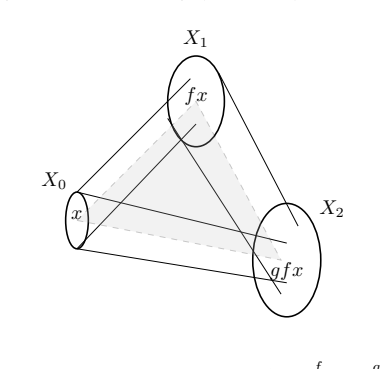
The equipment property is the load-bearing mechanism: for x ∈ E_n, any coherent family f_i : d_i x → y_i in E_{n-1} with matching faces extends universally to f : x → y in E_n with d_i y = y_i and d_i f = f_i. The companion construction σ* = s^n x_0(φ_{d_n σ}, ..., φ_{d_0 σ}) recursively fills the cylinder over x0 along the faces, and the tower representation expresses σ* as a composition of universal extensions. The vertical sSet-category Ev, with mapping spaces E_v(x,y)_n = E_n($s_0^{{(n)}}$x, $s_0^{{(n)}}$y), is the bridge that turns double colimits into homotopy colimits.
What would settle it
For a specific boundary datum in sSet^♯, say an n=2 datum with three face collages Y0, Y1, Y2 glued along common edges, form the pushout Y = X ⊔_{∂X} Y• and check whether the three faces of the resulting map Y → $Δ^{2}$ are the specified Y_i up to the natural isomorphism the paper allows. If any face comes out with extra identifications or the induced map fails the universal property, the equipment property—and with it Theorem 4—fails in the main example.
Extended reading notes
Core claim
Simplicial categories, functors E : Δ^op → Cat, are presented as two-fold structures: objects of E0 are objects, maps of E0 are vertical arrows, objects of En are horizontal n-simplices, and morphisms in En are bisimplices. The paper defines an equipment property for such E: every map from the boundary ∂x of an n-simplex x to a compatible family y• extends universally to a map x → y whose faces are exactly y•. Using this property it constructs a companion σ* for each vertical n-simplex σ = (x0 → ... → xn), built recursively as a universal extension of the companions of its faces; in sSet^♯, where E_n = sSet/Δ^n, the companion is the homotopy colimit of the chain, i.e. its higher mapping cylinder. The vertical direction Ev is a simplicially enriched category, and the main result is that the double colimit of F* equals the homotopy colimit of F in Ev.
Load-bearing premise
Everything rests on the claim that the pushout construction in examples like sSet^♯ really satisfies the equipment property—that filling a simplex boundary by pushout produces an object over Δ^n whose faces are exactly the specified ones and whose universal property is the stated one; the paper asserts this with a one-line diagram rather than verifying the simplicial identities and coherence.
Editorial extensions
If this is right
- In any higher equipment, the homotopy colimit of F : J → E0 in Ev is representable as a double colimit, so it inherits the unique-morphism universal property of double colimits.
- For sSet^♯, the companion of a chain is the higher mapping cylinder, so the homotopy colimit of a diagram of spaces is assembled by gluing mapping cylinders of its simplices, now with a universal property.
- Because Theorem 3 shows Ev is cotensored when E has double colimits, the double-colimit structure supplies tensors K ⊙ x = dcolim K_x for every simplicial set K.
- The dual right-equipment property gives homotopy limits as double limits, so the same framework covers limits by reversing arrows.
- The theorem generalizes the earlier result that the Grothendieck construction of a diagram of categories is the double colimit of its companion profunctors.
Reading between the lines
- If the equipment property holds coherently for sSet^♯, then every homotopy colimit of simplicial sets can be computed as a colimit of cotabulators, suggesting a purely categorical account of the homotopy colimit that avoids coend formulas.
- The paper's note that the axioms do not force invertible comparison maps for degeneracies leaves a natural test: find a higher equipment where the comparison fails to be an isomorphism, which would delimit how close the companion construction is to a strict functor.
- One could test the same double-colimit machinery on diagrams indexed by arbitrary simplicial sets rather than ordinary categories, potentially defining homotopy colimits for a wider class of indexing shapes.
Signed reviews
Editorial analysis
A structured set of objections, weighed in public.
Referee Report
Summary. The paper proposes a theory of higher equipments: simplicial categories E (simplicial objects in Cat) equipped with a universal extension property for maps from the boundary of an n-simplex, together with examples Cat^♯, sSet^♯, Top^♯ and coSpan(C)^♯. It defines companions of vertical simplices, double colimits of horizontal diagrams, and a vertical simplicially enriched category E_v. The main result, Theorem 4, asserts that for a higher equipment E, an indexing category J, and a functor F:J→E_0, the double colimit of the companion diagram F* is isomorphic to the homotopy colimit of F in E_v. The paper also states an adjunction between simplicial categories and sSet-categories and proposes the principle that simplicial categories are to simplicially enriched categories what double categories are to 2-categories.
Significance. The central analogy is attractive and, if fully established, would give a genuinely new double-categorical description of homotopy colimits. The paper is written in an expository spirit, with explicit definitions, illustrations, and helpful pedagogical passages. It also honestly flags some of its own limitations, such as the lack of a constructed simplicial category Set^♯. However, the main theorem is only sketched, and the equipment property for the flagship example sSet^♯ is asserted rather than proved. Since companions, the tower representation, and Theorem 4 all rest on the equipment property, the current manuscript does not yet substantiate its principal claims.
major comments (5)
- [§3.2, Definition 4] The verification of the equipment property for sSet^♯ is a single sentence: after displaying the pushout diagram, the text says 'Similarly Cat^♯, Top^♯ and coSpan(C)^♯ satisfy the equipment property.' This is load-bearing. For n≥3 the proposed pushout Y = X ∐_{∂X} Y• generally does not satisfy Definition 4(i). For example, when n=3, if Y_1 contains a 1-simplex over the common edge d_0∩d_1 that is not in the image of the corresponding edge of X under f_1, then d_0Y contains that extra simplex, so d_0Y ≠ Y_0. Thus the universal extension is not an object of sSet^♯_n with the prescribed faces. Because Definition 4 underlies the companion construction, Proposition 5, and Theorem 4, this gap is fundamental.
- [§3.1, §3.2, §3.3] The paper explicitly says that Cat^♯ and sSet^♯ are only weak simplicial categories: 'Verifying the simplcial identities (up to isomorphism) and coherence laws is an easy but tedious exercice' and d_1s_0≅1. However, Definition 4, the boundary notation ∂x, Proposition 3, the companion recursion in §3.3, and the construction of E_v all treat E as a strict simplicial category. There is no definition of a weak simplicial category and no explanation of how the universal extension property and the equations d_i y = y_i are to be interpreted when face functors compose only up to isomorphism. This ambiguity affects the well-definedness of σ* and of the vertical enrichment E_v.
- [§3.6, proof of Theorem 4] The proof of Theorem 4 is a one-paragraph sketch. It invokes Theorem 2, Proposition 5, and Proposition 6, but it does not verify that the composite F* is an oplax transformation satisfying the coherence conditions required by Definition 5, nor does it prove that the claimed isomorphism is natural. The statement that a morphism σ*→s^n y corresponds precisely to morphisms from the staircase diagram is asserted without checking the universal properties at each step. A complete proof must exhibit the double-colimit universal property explicitly and compare it with the mapping-cylinder description of homotopy colimits.
- [§3.5, §3.6, Theorem 3] Theorem 3 states that if E has double colimits then E_v is cotensored, but the proof actually defines K⊙x = dcolim K_x and derives the tensor isomorphism sSet(K, E_v(x,y)) ≅ E_v0(K⊙x,y). This is the tensor property, not the cotensor property; the dual statement, using double limits, gives cotensors. The misstatement matters because the homotopy colimit formula in §3.5 uses tensors, and the paper's use of tensors should be grounded in a correctly stated theorem.
- [§3.3, companion construction] The companion construction is asserted to define an oplax transformation (·)*: E_0→E, but no proof is given that the comparison maps α_i satisfy the required naturality and coherence diagrams. The recursion indicates that the faces of s_i φ_σ factor through the faces of φ_{s_i σ}, but the coherence laws for the α_i are not demonstrated. This coherence is essential because Theorem 4 composes F:J→E_0 with (·)* to produce the horizontal diagram F* whose double colimit is computed.
minor comments (5)
- [§1] In the discussion of collages, the text says 'with p^{-1}(0)=C and p^{-1}(0)=D'; the second occurrence should be p^{-1}(1)=D.
- [§3.1] The notation X(n) for the set of n-simplices of a simplicial set X conflicts with the earlier convention X_n and should be standardized.
- [§3.1, Definition 3] In the definition of an n-collage, the displayed formula ob(C)=∐_{i=1}^n ob(C_i) should be indexed from i=0 to n, since the tuple is (C_0,...,C_n,C).
- [§3.7] In the duality discussion, the sentence 'and the homotopy colimit on the left side is interpreted' should refer to the homotopy limit, since the equation displayed is dlim *F ≅ holim F.
- [§2.5.2] In the proof of Proposition 2, the statement that verifying the universal property is 'an easy exercise' leaves the uniqueness clause unaddressed; the proof would be more complete if the universal property were written out.
Circularity Check
Theorem 4 reduces to the companion construction: the double-colimit side is, by the paper's own tower representation and Proposition 6, a restatement of the staircase colimit used to define homotopy colimits.
-
self definitional
[§3.3 (companion recursion), §3.4 Proposition 6, and §3.6 proof of Theorem 4]
"σ∗ = { σ if n = 0, snx0(φdnσ,...,φ d0σ) if n> 0 } ... As we may intuit from the examples the degeneracy s0x0 represents the cylinder of x0 and extending the cylinder along f : x0→ x1 universally to form f ∗ represents the formation of the mapping cylinder of f . ... the tower representation (Proposition 5) of σ∗ together with Proposition 6 imply that morphism in En σ∗→sny for some y ∈ E0 corresponds precisely to morphisms from the step diagram corresponding to Mσ to y."
The companion is not an independently chosen invariant: it is defined by iterated universal extensions whose cotabulators are, by Proposition 6 ('a mere restatement of the universality'), the very pushouts that make up the staircase diagram Mσ. Proposition 5 ('tower representation') asserts that σ∗ is exactly that iterated extension. Hence, for J = Δ^n, the cotabulator of σ∗ is Mσ by construction, and the proof of Theorem 4 uses this correspondence to conclude dcolim F∗ = hocolim F. In the flagship example sSet^♯, the equipment extension is itself defined as the pushout that is the mapping cylinder. The theorem therefore restates the companion construction rather than deriving the equality from first principles.
full rationale
The circularity here is definitional rather than citational: the paper contains no load-bearing self-citation chain. The concerning reduction is that Theorem 4's conclusion is built into the companion recursion. The companion σ∗ is defined by universal extensions, and the paper's Proposition 6 explicitly identifies the cotabulator of any universal extension with a pushout of the constituent cotabulators; the tower representation then identifies σ∗ with the same inductive colimit as the 'staircase diagram' Mσ used in §3.5 to define homotopy colimits. The proof of Theorem 4 is a one-line appeal to these two results, so the claimed equality dcolim F∗ = hocolim F is a translation of definitions, not an independent derivation. Separate from circularity, the verification of the equipment property for sSet^♯ via a one-line pushout is a genuine correctness risk: the paper does not check the simplicial identities or that faces of the pushout exactly equal the prescribed Y_i. That is a mathematical gap, not a circular step, and it does not affect the score. The abstract comparison between double categories and sSet-categories, and the adjunction |·| ⊣ (·)_v, have some independent content, but the central theorem as stated is substantially a reformulation of the companion/homotopy-colimit identification.
Assumptions & free parameters
assumptions (5)
- standard math Basic category theory, simplicial sets, homotopy colimits, double categories, equipments and enriched categories as background.
- domain assumption Simplicial categories (objects in Cat) can be treated as 2-fold structures with vertical category E0 and horizontal n-simplices.
- ad hoc to paper The equipment property (Definition 4) is satisfied by the examples, in particular sSet^♯, via pushouts.
- ad hoc to paper The weak simplicial identities in Cat^♯ and sSet^♯ can be treated coherence-coherently within the strict theory.
- domain assumption The vertical sSet-category E_v of a simplicial category is a simplicially enriched category and for sSet^♯ recovers the usual enrichment.
invented entities (3)
-
Higher equipment (simplicial category with equipment property)
independent evidence
-
Companion simplex σ*
independent evidence
-
Double colimit of a horizontal diagram in a simplicial category
independent evidence
Cite this review
Pith. "Pith review of Higher Equipments, Double Colimits and Homotopy Colimits." pith.science (2026). https://pith.science/paper/TKK4GXHC
@misc{pith2026190806201,
  author       = {Pith},
  title        = {Pith review of: Higher Equipments, Double Colimits and Homotopy Colimits},
  year         = {2026},
  howpublished = {\url{https://pith.science/paper/TKK4GXHC}},
  note         = {Machine review of arXiv:1908.06201}
}
read the original abstract
This document is centered around a main idea: simplicial categories, by which we mean simplicial objects in the category of categories, can be treated as a two-fold categorical structure and their double category theory is homotopically meaningful. The most well-known two-fold structures are double categories, typically used to organize bimodules in various contexts. However there is no double category of spaces even though notions of bimodule are conceivable. We first remedy this defect of double category theory by constructing a meaningful simplicial category of spaces. Then we develop the analogy with double categories by defining double colimits and by postulating an equipment property, which is promptly satisfied in the examples. As an application we prove that certain double colimits are naturally interpreted as homotopy colimits. Quite surprisingly this analogy unveils a principle: simplicial categories are to simplicially enriched categories what double categories are to 2-categories!
Figures

Reference graph
Works this paper leans on
-
[1]
A unified framework for generalized multicategories
Geoffrey SH Cruttwell and Michael A Shulman. A unified framework for generalized multicategories. Theory and Applications of Categories , 24(21):580--655, 2010
work page 2010
-
[2]
Daniel Dugger. A primer on homotopy colimits. preprint , 2008
work page 2008
-
[3]
Simplicial matrices and the nerves of weak n-categories
John W Duskin. Simplicial matrices and the nerves of weak n-categories. i. nerves of bicategories. Theory and applications of categories , 9(10):198--308, 2002
work page 2002
-
[4]
Span and cospan representations of weak double categories
Marco Grandis et al. Span and cospan representations of weak double categories. Categories and General Algebraic Structures with Applications , 6(Speical Issue on the Occasion of Banaschewski's 90th Birthday (I)):85--105, 2017
work page 2017
-
[5]
Lax colimits and free fibrations in $\infty$-categories
David Gepner, Rune Haugseng, and Thomas Nikolaus. Lax colimits and free fibrations in infinity-categories, 2015. arXiv preprint arXiv:1501.02161
work page Pith review arXiv 2015
-
[6]
Simplicial homotopy theory
Paul G Goerss and John F Jardine. Simplicial homotopy theory . Springer Science & Business Media, 2009
2009
-
[7]
Marco Grandis and Robert Par \'e . Limits in double categories. Cahiers de Topologie et G \'e om \'e trie Diff \'e rentielle Cat \'e goriques , 40(3):162--220, 1999
work page 1999
-
[8]
Marco Grandis and Robert Par \'e . Adjoint for double categories. Cahiers de topologie et g \'e om \'e trie diff \'e rentielle cat \'e goriques , 45(3):193--240, 2004
work page 2004
Show all 24 references
-
[9]
Kan extensions in double categories (on weak double categories, part iii)
Marco Grandis and Robert Par \'e . Kan extensions in double categories (on weak double categories, part iii). Theory and Applications of Categories , 20(8):152--185, 2008
2008
-
[10]
The theory of quasi-categories and its applications
Andr \'e Joyal. The theory of quasi-categories and its applications. 2008
2008
-
[11]
A double-dimensional approach to formal category theory
Seerp Roald Koudenburg. A double-dimensional approach to formal category theory. arXiv preprint arXiv:1511.04070 , 2015
2015 arXiv
- [12]
-
[13]
Higher operads, higher categories , volume 298
Tom Leinster. Higher operads, higher categories , volume 298. Cambridge University Press, 2004
2004
-
[14]
This is the (co) end, my only (co) friend
Fosco Loregian. This is the (co) end, my only (co) friend. arXiv preprint arXiv:1501.02503 , 2015
2015 arXiv
-
[15]
Higher Topos Theory (AM-170) , volume 189
Jacob Lurie. Higher Topos Theory (AM-170) , volume 189. Princeton University Press, 2009
2009
-
[16]
Categories for the working mathematician , volume 5
Saunders Mac Lane. Categories for the working mathematician , volume 5. Springer Science & Business Media, 2013
2013
-
[17]
Yoneda theory for double categories
Robert Par \'e . Yoneda theory for double categories. Theory and Applications of Categories , 25(17):436--489, 2011
2011
-
[18]
Weighted limits and colimits
Emily Riehl et al. Weighted limits and colimits. available at math. harvard. edu/ eriehl , 2009
2009
-
[19]
A leisurely introduction to simplicial sets
Emily Riehl. A leisurely introduction to simplicial sets. Unpublished expository article available online at http://www. math. harvard. edu/\ eriehl , 2011
2011
-
[20]
Categorical homotopy theory , volume 24
Emily Riehl. Categorical homotopy theory , volume 24. Cambridge University Press, 2014
2014
-
[21]
Category theory in context
Emily Riehl. Category theory in context . Courier Dover Publications, 2017
2017
-
[22]
Homotopy limits and colimits and enriched homotopy theory
Michael Shulman. Homotopy limits and colimits and enriched homotopy theory. arXiv preprint math/0610194 , 2006
2006 arXiv
-
[23]
Framed bicategories and monoidal fibrations
Michael Shulman. Framed bicategories and monoidal fibrations. Theory and applications of categories , 20(18):650--738, 2008
2008
-
[24]
Equipments
Michael Shulman. Equipments. https://golem.ph.utexas.edu/category/2009/11/equipments.html, 2009
2009
Reviewed August 14, 2026 · model on record in the stance chip above.
Discussion (0). Continue with ORCID to comment.