PHGNet: Prototype-Guided Hypergraph Construction for Heterogeneous Spatiotemporal Forecasting
Pith reviewed 2026-06-29 21:53 UTC · model grok-4.3
The pith
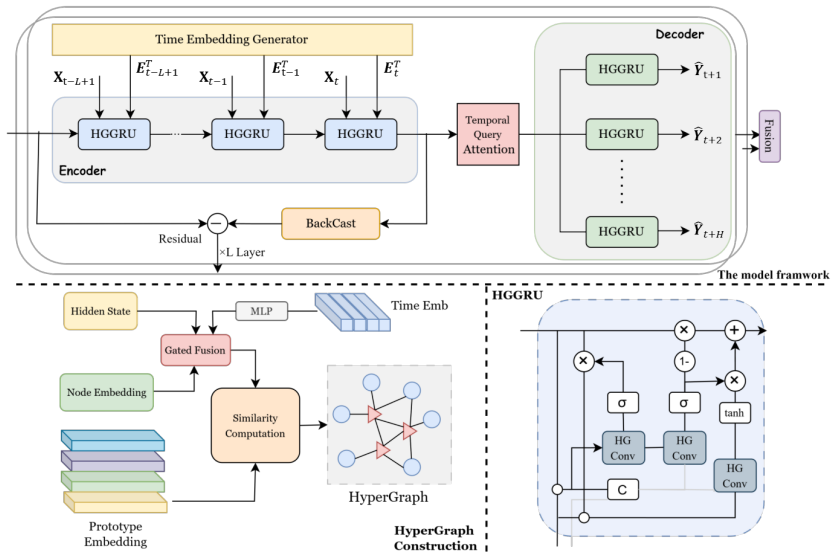
PHGNet uses prototype learning to dynamically group similar nodes into hyperedges for capturing high-order spatiotemporal dependencies in traffic forecasting.
A machine-rendered reading of the paper's core claim, the machinery that carries it, and where it could break.
Core claim
PHGNet builds time-varying hypergraphs by using a prototype learning mechanism to adaptively place pattern-similar nodes into shared hyperedges, thereby modeling high-order interactions that standard pairwise graphs miss, and combines this with global-local features, iterative residual refinement, and Temporal Query Attention to achieve higher forecasting accuracy.
What carries the argument
Prototype-guided hypergraph construction that adaptively assigns nodes to hyperedges based on learned pattern similarity.
If this is right
- Dynamic hyperedges allow the model to reflect changing spatial relationships over time instead of assuming a static graph.
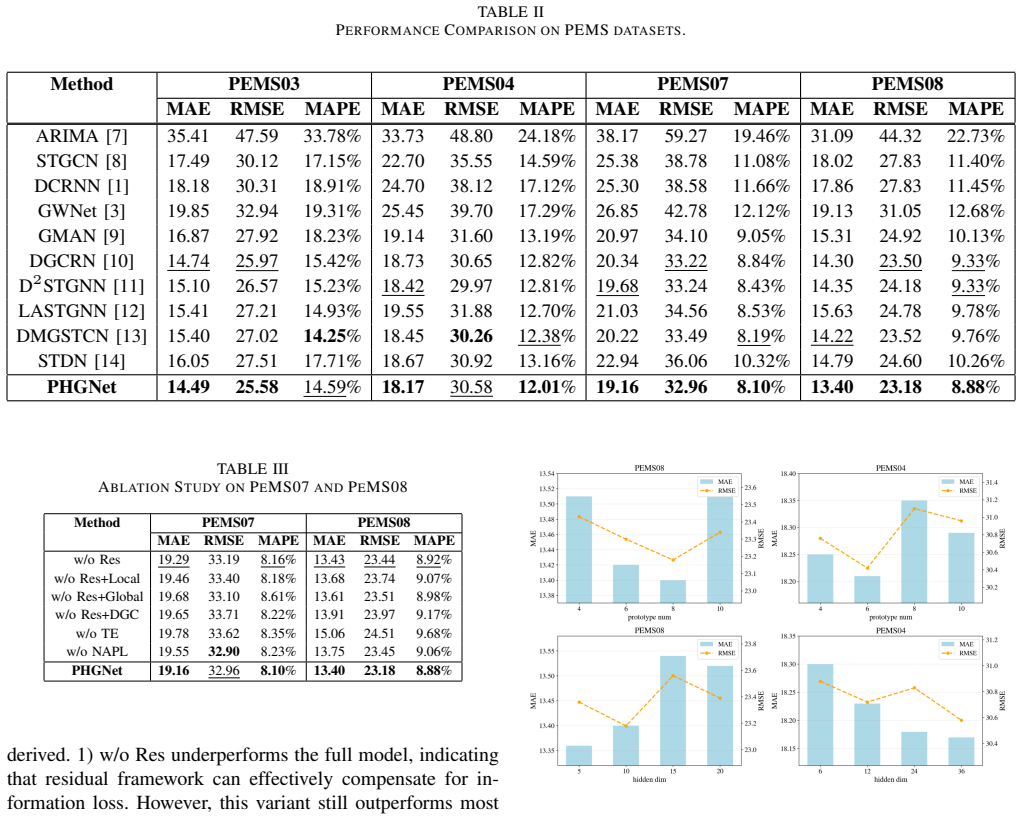
- The approach yields higher accuracy than prior spatiotemporal methods on multiple real traffic datasets.
- Global-local node features reduce instability in the online hypergraph updates.
- Iterative residual refinement combined with parallel decoding improves both accuracy and computational efficiency during prediction.
Where Pith is reading between the lines
- The same prototype assignment idea could be tested on other heterogeneous spatiotemporal domains such as electricity load or epidemic spread where high-order group effects matter.
- If the learned prototypes prove stable across cities, the construction step might replace hand-designed adjacency matrices in existing forecasting pipelines.
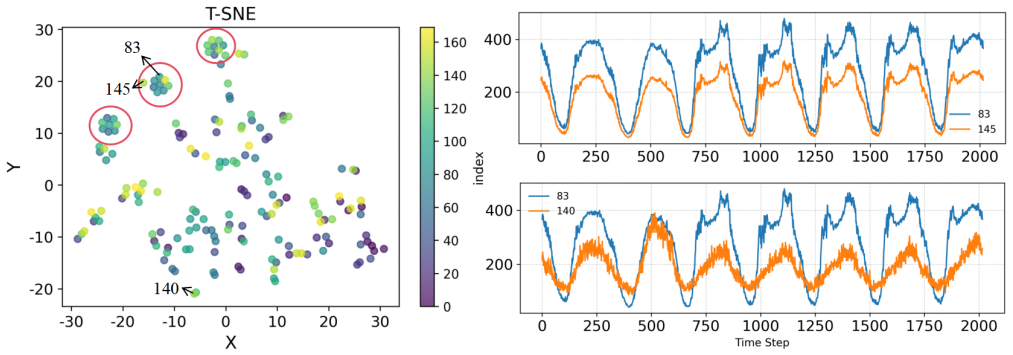
- A natural next measurement would be whether the hyperedges discovered by the prototypes align with known functional regions like commercial districts or highway corridors.
Load-bearing premise
The prototype learning step will consistently identify and group nodes that share meaningful traffic patterns rather than noise or spurious similarities.
What would settle it
Training an otherwise identical model but replacing the prototype assignment with random hyperedge membership and observing whether accuracy on the same datasets drops, stays flat, or rises.
Figures

read the original abstract
As a core task in intelligent transportation systems, traffic forecasting plays a critical role in urban traffic management. Accurate traffic forecasting relies on modeling complex spatiotemporal dependencies, which is inherently challenging due to spatial heterogeneity in traffic systems.Despite significant progress, most existing methods are still limited to pairwise spatial dependency modeling, making it difficult to capture dynamic high-order interactions among nodes with similar traffic patterns. To address this issue, we propose PHGNet, a novel spatiotemporal forecasting framework based on prototype-guided hypergraph construction. At the core of PHGNet, a prototype learning mechanism is designed to adaptively assign pattern-similar nodes to hyperedges, thereby capturing high-order interactions with time-varying structures. To improve the reliability of dynamic hypergraph construction, we further develop a global-local node representation module to extract time-consistent features. For forecasting, iterative residual refinement and Temporal Query Attention are introduced to improve forecasting accuracy while supporting efficient parallel decoding. Extensive experiments on multiple real-world datasets demonstrate that PHGNet achieves superior predictive performance compared with state-of-the-art methods.
Editorial analysis
A structured set of objections, weighed in public.
Referee Report
Summary. The paper proposes PHGNet, a spatiotemporal forecasting framework for traffic data that introduces a prototype learning mechanism to adaptively construct time-varying hypergraphs by assigning pattern-similar nodes to hyperedges, thereby capturing high-order interactions. It augments this with a global-local node representation module for time-consistent features, iterative residual refinement, and Temporal Query Attention for forecasting, claiming superior predictive performance over state-of-the-art methods on multiple real-world datasets.
Significance. If the prototype-guided dynamic hypergraph construction can be shown to reliably discover meaningful high-order, time-varying structures rather than spurious connections, the work would advance spatiotemporal modeling beyond pairwise GNNs for heterogeneous systems, with direct relevance to intelligent transportation applications.
major comments (1)
- [Prototype learning mechanism and experimental validation sections] The central claim that the prototype learning mechanism 'adaptively assign[s] pattern-similar nodes to hyperedges' to capture meaningful high-order interactions (abstract) is load-bearing, yet the manuscript supplies no analysis of hyperedge assignment stability across time steps, no regularization against prototype drift, and no ablation or comparison showing that the learned hyperedges differ meaningfully from a static clustering baseline. Without these, it is impossible to confirm that the reported gains arise from the dynamic construction rather than hyperparameter tuning or noise.
minor comments (1)
- [Abstract] The abstract asserts superior performance but contains no quantitative metrics, baseline names, or dataset details; these should be summarized concisely to allow readers to assess the claim at a glance.
Simulated Author's Rebuttal
We thank the referee for the constructive feedback on the prototype learning mechanism. We address the major comment point by point below and will revise the manuscript to strengthen the validation of the dynamic hypergraph construction.
read point-by-point responses
-
Referee: [Prototype learning mechanism and experimental validation sections] The central claim that the prototype learning mechanism 'adaptively assign[s] pattern-similar nodes to hyperedges' to capture meaningful high-order interactions (abstract) is load-bearing, yet the manuscript supplies no analysis of hyperedge assignment stability across time steps, no regularization against prototype drift, and no ablation or comparison showing that the learned hyperedges differ meaningfully from a static clustering baseline. Without these, it is impossible to confirm that the reported gains arise from the dynamic construction rather than hyperparameter tuning or noise.
Authors: We agree that the manuscript lacks explicit analyses of hyperedge assignment stability across time steps, regularization against prototype drift, and direct comparison to a static clustering baseline. While the global-local node representation module is introduced to extract time-consistent features and thereby improve reliability of the dynamic construction, this does not substitute for the requested empirical validations. In the revised manuscript we will add: (1) quantitative stability analysis, such as average Jaccard similarity of hyperedge node sets between consecutive time steps; (2) discussion of how the prototype learning objective, optimized jointly with the forecasting loss, provides implicit regularization against drift; and (3) an ablation replacing the prototype-guided construction with a static k-means clustering baseline on node features to isolate the benefit of the adaptive, time-varying approach. These additions will clarify whether performance gains originate from the dynamic mechanism. revision: yes
Circularity Check
No circularity; standard empirical ML architecture proposal
full rationale
The paper introduces PHGNet as a neural architecture with a prototype learning module for dynamic hypergraph construction, global-local representations, and attention-based forecasting. All core components are design choices implemented via trainable parameters and optimized on data; no derivation chain reduces a claimed result to its own inputs by construction, no self-citation is load-bearing for a uniqueness theorem, and no fitted parameter is relabeled as an independent prediction. Performance claims rest on comparative experiments across datasets rather than algebraic equivalence. This is the normal non-circular case for a proposed spatiotemporal forecasting model.
Axiom & Free-Parameter Ledger
Reference graph
Works this paper leans on
-
[1]
Diffusion convolutional recur- rent neural network: Data-driven traffic forecasting,
Y . Li, R. Yu, C. Shahabi, and Y . Liu, “Diffusion convolutional recur- rent neural network: Data-driven traffic forecasting,” inInternational Conference on Learning Representations, 2018
2018
-
[2]
Connect- ing the dots: Multivariate time series forecasting with graph neural networks,
Z. Wu, S. Pan, G. Long, J. Jiang, X. Chang, and C. Zhang, “Connect- ing the dots: Multivariate time series forecasting with graph neural networks,” inProceedings of the 26th ACM SIGKDD international conference on knowledge discovery & data mining, 2020, pp. 753– 763
2020
-
[3]
Graph wavenet for deep spatial-temporal graph modeling,
Z. Wu, S. Pan, G. Long, J. Jiang, and C. Zhang, “Graph wavenet for deep spatial-temporal graph modeling,” inInternational Joint Conference on Artificial Intelligence 2019. Association for the Advancement of Artificial Intelligence (AAAI), 2019, pp. 1907–1913
2019
-
[4]
Empirical Evaluation of Gated Recurrent Neural Networks on Sequence Modeling
J. Chung, C. Gulcehre, K. Cho, and Y . Bengio, “Empirical evaluation of gated recurrent neural networks on sequence modeling,”arXiv preprint arXiv:1412.3555, 2014
work page internal anchor Pith review Pith/arXiv arXiv 2014
-
[5]
An Empirical Evaluation of Generic Convolutional and Recurrent Networks for Sequence Modeling
S. Bai, J. Z. Kolter, and V . Koltun, “An empirical evaluation of generic convolutional and recurrent networks for sequence modeling,”arXiv preprint arXiv:1803.01271, 2018
work page internal anchor Pith review Pith/arXiv arXiv 2018
-
[6]
Pattern- matching dynamic memory network for dual-mode traffic prediction,
W. Weng, M. Wu, H. Jiang, W. Kong, X. Kong, and F. Xia, “Pattern- matching dynamic memory network for dual-mode traffic prediction,” IEEE Transactions on Intelligent Transportation Systems, 2025
2025
-
[7]
G. E. Box, G. M. Jenkins, G. C. Reinsel, and G. M. Ljung,Time series analysis: forecasting and control. John Wiley & Sons, 2015
2015
-
[8]
Spatio-temporal graph convolutional networks: a deep learning framework for traffic forecasting,
B. Yu, H. Yin, and Z. Zhu, “Spatio-temporal graph convolutional networks: a deep learning framework for traffic forecasting,” in Proceedings of the 27th International Joint Conference on Artificial Intelligence, 2018, pp. 3634–3640
2018
-
[9]
Gman: A graph multi-attention network for traffic prediction,
C. Zheng, X. Fan, C. Wang, and J. Qi, “Gman: A graph multi-attention network for traffic prediction,” inProceedings of the AAAI conference on artificial intelligence, vol. 34, no. 01, 2020, pp. 1234–1241
2020
-
[10]
Dynamic graph convolutional recurrent network for traffic prediction: Benchmark and solution,
F. Li, J. Feng, H. Yan, G. Jin, F. Yang, F. Sun, D. Jin, and Y . Li, “Dynamic graph convolutional recurrent network for traffic prediction: Benchmark and solution,”ACM Transactions on Knowledge Discovery from Data, vol. 17, no. 1, pp. 1–21, 2023
2023
-
[11]
Decoupled dynamic spatial-temporal graph neural network for traffic forecasting,
Z. Shao, Z. Zhang, W. Wei, F. Wang, Y . Xu, X. Cao, and C. S. Jensen, “Decoupled dynamic spatial-temporal graph neural network for traffic forecasting,”arXiv preprint arXiv:2206.09112, 2022
-
[12]
Localised adaptive spatial-temporal graph neural network,
W. Duan, X. He, Z. Zhou, L. Thiele, and H. Rao, “Localised adaptive spatial-temporal graph neural network,” inProceedings of the 29th acm sigkdd conference on knowledge discovery and data mining, 2023, pp. 448–458
2023
-
[13]
Dmgstcn: Dynamic multigraph spatio–temporal convolution network for traffic forecasting,
Y . Qin, X. Tao, Y . Fang, H. Luo, F. Zhao, and C. Wang, “Dmgstcn: Dynamic multigraph spatio–temporal convolution network for traffic forecasting,”IEEE Internet of Things Journal, vol. 11, no. 12, pp. 22 208–22 219, 2024
2024
-
[14]
Revisiting spatial- temporal similarity: A deep learning framework for traffic prediction,
H. Yao, X. Tang, H. Wei, G. Zheng, and Z. Li, “Revisiting spatial- temporal similarity: A deep learning framework for traffic prediction,” inProceedings of the AAAI conference on artificial intelligence, vol. 33, no. 01, 2019, pp. 5668–5675
2019
discussion (0)
Sign in with ORCID, Apple, or X to comment. Anyone can read and Pith papers without signing in.