Absorption of 1P-wave heavy charmonium chi_(c1)(1P) in nuclei
Pith reviewed 2026-05-21 10:41 UTC · model grok-4.3
The pith
Nuclear photoproduction observables distinguish different strengths of χ_c1(1P) absorption in nuclei.
A machine-rendered reading of the paper's core claim, the machinery that carries it, and where it could break.
Core claim
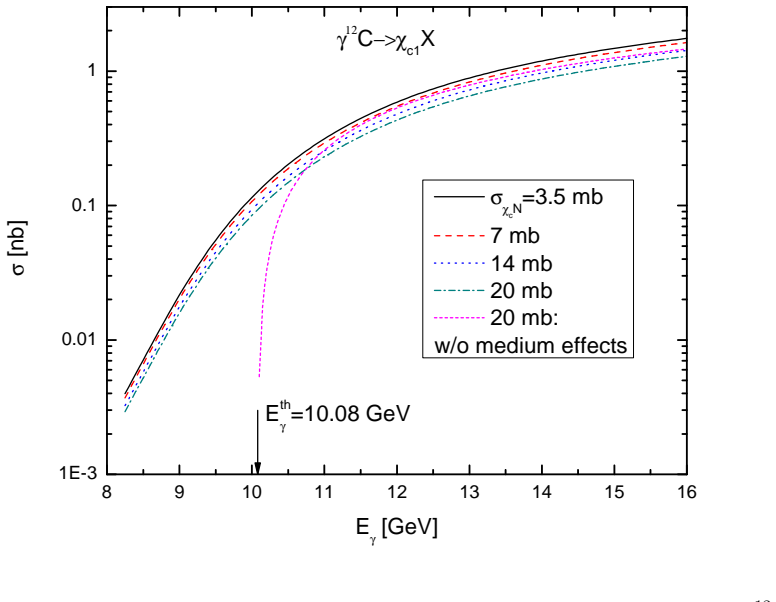
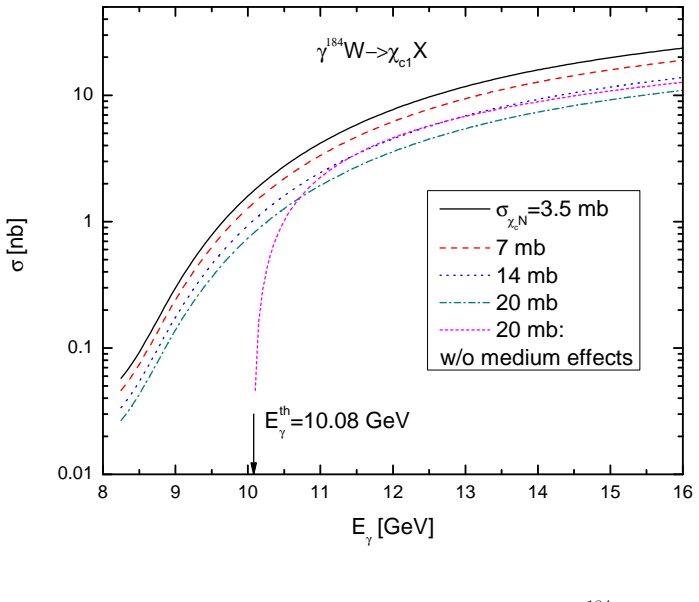
The absolute and relative observables for χ_c1(1P) photoproduction on 12C and 184W nuclei exhibit distinct sensitivity to different scenarios for the χ_c1(1P) absorption cross section in nuclei, making them useful for determining this cross section from future experimental data at the CEBAF facility.
What carries the argument
The collision model based on the nuclear spectral function for incoherent direct photon-nucleon charmonium creation processes, which incorporates final-state absorption, target nucleon binding, and Fermi motion.
If this is right
- Absolute and relative excitation functions at photon energies of 8.25-16 GeV will differ visibly between weak and strong absorption scenarios on both nuclei.
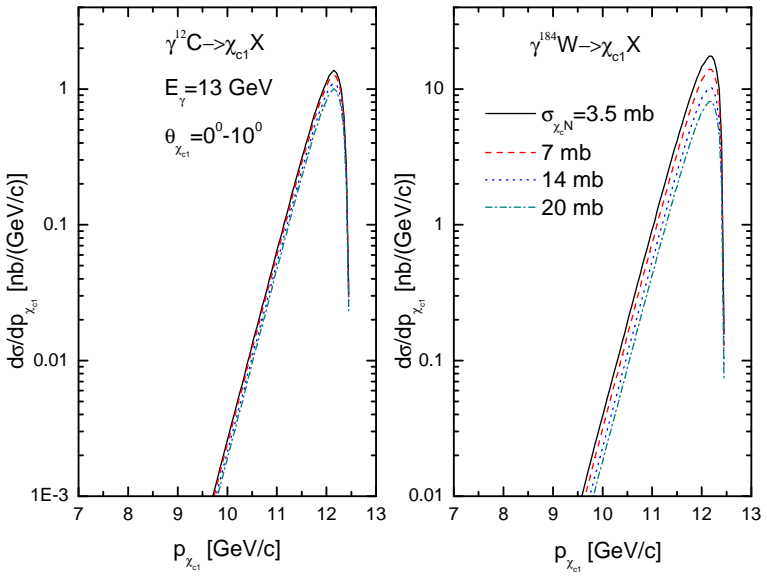
- Momentum differential cross sections at 13 GeV and angles 0-10 degrees will vary in shape and magnitude according to the absorption strength.
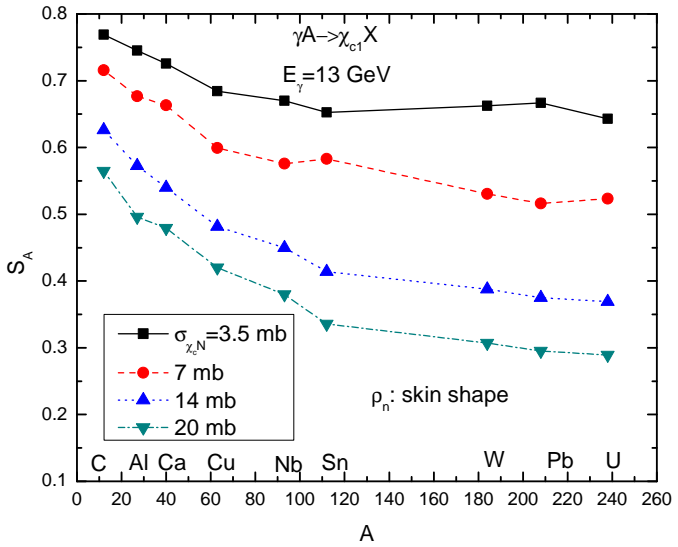
- A-dependences of transparency ratios at 13 GeV will separate the scenarios through their variation with nuclear mass.
- Comparison with future data can fix the value of the in-medium absorption cross section.
- The extracted cross section informs models of charmonium suppression in high-energy heavy-ion collisions.
Where Pith is reading between the lines
- The same framework applied to other charmonium states such as J/ψ could separate state-dependent absorption from common nuclear effects.
- Energy dependence extracted from the 8-16 GeV range might be extrapolated to higher energies relevant for collider experiments.
- If the sensitivities hold, the observables provide an independent constraint on charmonium transport coefficients in nuclear matter.
Load-bearing premise
The nuclear spectral function model accurately describes incoherent direct photon-nucleon processes without significant missing nuclear effects or medium modifications.
What would settle it
Measurements at the upgraded CEBAF facility showing identical results for the considered observables across all assumed absorption cross sections would falsify the predicted distinct sensitivities.
Figures






read the original abstract
We study the inclusive heavy charmonium $\chi_{c1}(1P)$ photoproduction from nuclei near the kinematic threshold within the collision model, based on the nuclear spectral function, for incoherent direct photon--nucleon charmonium creation processes. The model accounts for the final $\chi_{c1}(1P)$ absorption in nuclear medium, target nucleon binding and Fermi motion. We calculate the absolute and relative excitation functions on $^{12}$C and $^{184}$W target nuclei at near-threshold photon beam energies of 8.25--16.0 GeV, the absolute momentum differential cross sections and ratios of them for its production off these target nuclei at laboratory polar angles of 0$^{\circ}$--10$^{\circ}$ and for photon energy of 13 GeV as well as the A-dependences of the transparency ratios for the $\chi_{c1}(1P)$ at photon energy of 13 GeV within the different scenarios for its absorption cross section in nuclei. We demonstrate that the absolute and relative observables considered reveal distinct sensitivity to these scenarios. Therefore, they might be useful for the determination of this cross section from the comparison of them with the experimental data from the future experiments at the upgraded up to 22 GeV CEBAF facility, which is of crucial importance in understanding of charmonium production and suppression in high-energy heavy--ion collisions in a search for the quark-gluon plasma.
Editorial analysis
A structured set of objections, weighed in public.
Referee Report
Summary. The paper studies inclusive photoproduction of the χ_c1(1P) charmonium near kinematic threshold on nuclei using a nuclear spectral function model for incoherent direct photon-nucleon processes. The model includes final-state absorption in the nuclear medium together with target nucleon binding and Fermi motion. Absolute and relative excitation functions are computed for 12C and 184W at photon energies 8.25–16 GeV; absolute momentum spectra and their ratios are given at 13 GeV for lab angles 0°–10°; and A-dependences of transparency ratios are presented at 13 GeV. These observables are evaluated under several scenarios for the χ_c1(1P) absorption cross section, and the authors conclude that the observables display distinct sensitivity to the choice of scenario, offering a route to extract the cross section from future CEBAF data.
Significance. If the claimed sensitivities survive a more complete treatment of formation dynamics, the work supplies a concrete set of observables that could constrain the in-medium absorption cross section of the 1P charmonium state. Such a constraint would be directly relevant to the interpretation of charmonium suppression patterns in heavy-ion collisions and to the search for quark-gluon plasma signatures.
major comments (1)
- The nuclear spectral function model employed throughout the manuscript does not modulate the absorption probability by a position-dependent formation factor. Near threshold (E_γ = 8.25–16 GeV) the formation length l_form ≈ (E_χ / m_χ) τ_form can reach several fm and become comparable to nuclear radii; any such effect would vary with photon energy, emission angle, and target mass, potentially correlating with or masking the differences between the assumed absorption scenarios and thereby weakening the central claim of distinct sensitivity.
minor comments (1)
- The abstract and introduction would benefit from an explicit statement of the numerical values adopted for the absorption cross section in each scenario.
Simulated Author's Rebuttal
We thank the referee for the careful reading of our manuscript and the constructive comment. We address the major point below.
read point-by-point responses
-
Referee: The nuclear spectral function model employed throughout the manuscript does not modulate the absorption probability by a position-dependent formation factor. Near threshold (E_γ = 8.25–16 GeV) the formation length l_form ≈ (E_χ / m_χ) τ_form can reach several fm and become comparable to nuclear radii; any such effect would vary with photon energy, emission angle, and target mass, potentially correlating with or masking the differences between the assumed absorption scenarios and thereby weakening the central claim of distinct sensitivity.
Authors: We acknowledge that the nuclear spectral function model used in the manuscript does not incorporate an explicit position-dependent formation factor for the χ_c1(1P) state. The calculations assume absorption of the fully formed charmonium in the nuclear medium after production via the incoherent photon-nucleon process. While formation-length effects could in principle introduce additional energy, angle, and A dependence near threshold, the relative observables (such as ratios of excitation functions, momentum spectra, and transparency ratios) are constructed to highlight differences arising from the choice of absorption cross section. We will revise the manuscript to include a dedicated paragraph discussing the formation-length approximation, its possible influence on the reported sensitivities, and the limitations of the present approach. revision: partial
Circularity Check
No circularity: parametric sensitivity study with independent inputs
full rationale
The paper treats the χ_c1(1P) absorption cross section as an external input varied across explicit scenarios, then computes absolute/relative excitation functions, momentum spectra, and transparency ratios via the nuclear spectral function model that incorporates binding and Fermi motion. These forward calculations are not derived from or fitted to the target observables; the claimed distinct sensitivity follows directly from the differing input values propagated through the model equations. No self-definitional steps, fitted inputs renamed as predictions, or load-bearing self-citations appear in the derivation chain. The work is self-contained against external benchmarks because the model assumptions (spectral function, incoherent production) are stated separately from the absorption scenarios and can be tested independently with data.
Axiom & Free-Parameter Ledger
free parameters (1)
- absorption cross section
axioms (1)
- domain assumption Use of nuclear spectral function for photon-nucleon interactions
Reference graph
Works this paper leans on
-
[1]
Adareet al.[the PHENIX Collaboration], Phys
A. Adareet al.[the PHENIX Collaboration], Phys. Rev. Lett.111, 202301 (2013), arXiv:1305.5516 [nucl-ex]
-
[2]
Arseneet al.[the BRAHMS Collaboration], Nucl
I. Arseneet al.[the BRAHMS Collaboration], Nucl. Phys. A757, 1 (2005), arXiv:nucl- ex/0410020
- [3]
-
[4]
Adamset al.[the STAR Collaboration], Nucl
J. Adamset al.[the STAR Collaboration], Nucl. Phys. A757, 102 (2005), arXiv:nucl- ex/0501009
-
[5]
Adcoxet al.[the PHENIX Collaboration], Nucl
K. Adcoxet al.[the PHENIX Collaboration], Nucl. Phys. A757, 184 (2005), arXiv:nucl- ex/0410003
-
[6]
Heavy Ion Collisions: The Big Picture, and the Big Questions
W. Busza, K. Rajagopal, and W. van der Schee, Ann. Rev. Nucl. Part. Sci68, 339 (2018); arXiv:1802.04801 [hep-ph]
work page internal anchor Pith review Pith/arXiv arXiv 2018
- [7]
- [8]
- [9]
- [10]
- [11]
- [12]
-
[13]
Sequential charmonium dissociation
F. Karsch, D. Kharzeev, and H. Satz, Phys. Lett. B637, 75 (2006); arXiv:hep-ph/0512239
work page internal anchor Pith review Pith/arXiv arXiv 2006
-
[14]
String Breaking and Quarkonium Dissociation at Finite Temperatures
S. Digal, P. Petreczky, and H. Satz, Phys. Lett. B514, 57 (2001); arXiv:hep-ph/0105234
work page internal anchor Pith review Pith/arXiv arXiv 2001
-
[15]
Quarkonium Feed-Down and Sequential Suppression
S. Digal, P. Petreczky, and H. Satz, Phys. Rev. D64, 094015 (2001); arXiv:hep-ph/0106017
work page internal anchor Pith review Pith/arXiv arXiv 2001
-
[16]
H. Satz, J. Phys. G.32, R25 (2006); arXiv:hep-ph/0512217
work page internal anchor Pith review Pith/arXiv arXiv 2006
-
[17]
Quarkonium Binding and Dissociation: The Spectral Analysis of the QGP
H. Satz, Nucl. Phys. A783, 249 (2007); arXiv:hep-ph/0609197
work page internal anchor Pith review Pith/arXiv arXiv 2007
-
[18]
Dissociation of a Heavy Quarkonium at High Temperatures
C.-Y. Wong, Phys. Rev. C65, 034902 (2002); arXiv:nucl-th/0110004
work page internal anchor Pith review Pith/arXiv arXiv 2002
-
[19]
Aaijet al.[the LHCb Collaboration], Eur
R. Aaijet al.[the LHCb Collaboration], Eur. Phys. J. C80, 185 (2020); arXiv:1908.03099 [hep-ex]
-
[20]
Aaijet al.[the LHCb Collaboration], Eur
R. Aaijet al.[the LHCb Collaboration], Eur. Phys. J. C85, 562 (2025); arXiv:2410.18018 [hep-ex]
-
[21]
N. J. Abdulameeret al.[the PHENIX Collaboration], Phys. Rev. D112, L051103 (2025); arXiv:2409.03728 [hep-ex]. U. A. Acharyaet al.[the PHENIX Collaboration], Phys. Rev. D101, 052006 (2020); arXiv:1912.13424 [hep-ex]. U. A. Acharyaet al.[the PHENIX Collaboration], Phys. Rev. C102, 014902 (2020); arXiv:1910.14487 [hep-ex]
-
[22]
Antoniazziet al.[the E705 Collaboration], Phys
L. Antoniazziet al.[the E705 Collaboration], Phys. Rev. Lett.70, 383 (1993)
work page 1993
-
[23]
Study of psi' and chi_c decays as feed-down sources of J/psi hadro-production
P. Faccioli, C. Lourenco, J. Seixas, and H. K. Woehri, JHEP10, 004 (2008); arXiv:0809.2153 [hep-ph]
work page internal anchor Pith review Pith/arXiv arXiv 2008
-
[24]
Alessandroet al.[the NA50 Collaboration], Eur
B. Alessandroet al.[the NA50 Collaboration], Eur. Phys. J. C39, 335 (2005); arXiv:hep- ex/0412036
-
[25]
Alessandroet al.[the NA50 Collaboration], Eur
B. Alessandroet al.[the NA50 Collaboration], Eur. Phys. J. C33, 31 (2004)
work page 2004
-
[26]
Adareet al.[the PHENIX Collaboration], Phys
A. Adareet al.[the PHENIX Collaboration], Phys. Rev. Lett.98, 232301 (2007); arXiv:nucl- ex/0611020
-
[27]
Adamet al.[the STAR Collaboration], Phys
J. Adamet al.[the STAR Collaboration], Phys. Lett. B797, 134917 (2019); arXiv:1905.13669 [nucl-ex]
-
[28]
J/$\psi$ suppression at forward rapidity in Pb-Pb collisions at $\sqrt{s_{{\rm NN}}} = 5.02$ TeV
J. Adamet al.[the ALICE Collaboration], Phys. Lett. B766, 212 (2017); arXiv:1606.08197 [nucl-ex]
work page internal anchor Pith review Pith/arXiv arXiv 2017
-
[29]
Suppression of non-prompt J/psi, prompt J/psi, and Y(1S) in PbPb collisions at sqrt(sNN) = 2.76 TeV
S. Chatrchyanet al.[the CMS Collaboration], JHEP05, 063 (2012); arXiv:1201.5069 [nucl-ex]
work page internal anchor Pith review Pith/arXiv arXiv 2012
-
[30]
R. Aaijet al.[the LHCb Collaboration], Phys. Lett. B774, 159 (2017); arXiv:1706.07122 [hep-ex]. 19
work page internal anchor Pith review Pith/arXiv arXiv 2017
-
[31]
W. K. Brooks [for the ATLAS Collaboration], Nucl. Part. Phys. Proc.276-278, 149 (2016); arXiv:1509.06797 [hep-ex]
work page internal anchor Pith review Pith/arXiv arXiv 2016
-
[32]
R. Aaijet al.[the LHCb Collaboration], JHEP03, 133 (2016); arXiv:1601.07878 [nucl-ex]
work page internal anchor Pith review Pith/arXiv arXiv 2016
-
[33]
Adareet al.[the PHENIX Collaboration], Phys
A. Adareet al.[the PHENIX Collaboration], Phys. Rev. C95, 034904 (2017); arXiv:1609.06550 [nucl-ex]
-
[34]
A. M. Sirunyanet al.[the CMS Collaboration], Phys. Lett. B790, 509 (2019); arXiv:1805.02248 [hep-ex]
work page internal anchor Pith review Pith/arXiv arXiv 2019
-
[35]
Acharyaet al.[the ALICE Collaboration], Phys
S. Acharyaet al.[the ALICE Collaboration], Phys. Rev. Lett.132, 042301 (2024); arXiv:2210.08893 [nucl-ex]
-
[36]
S. Chatrchyanet al.[the CMS Collaboration], Eur. Phys. J. C72, 2251 (2012); arXiv:1210.0875 [hep-ex]
work page internal anchor Pith review Pith/arXiv arXiv 2012
-
[37]
Measurement of chi_c1 and chi_c2 production with sqrt(s) = 7 TeV pp collisions at ATLAS
G. Aadet al.[the ATLAS Collaboration], JHEP07, 154 (2014); arXiv:1404.7035 [hep-ex]
work page internal anchor Pith review Pith/arXiv arXiv 2014
-
[38]
R. Aaijet al.[the LHCb Collaboration], Phys. Lett. B714, 215 (2012); arXiv:1202.1080 [hep- ex]
work page internal anchor Pith review Pith/arXiv arXiv 2012
-
[39]
R. Aaijet al.[the LHCb Collaboration], Phys. Lett. B718, 431 (2012); arXiv:1204.1462 [hep- ex]
work page internal anchor Pith review Pith/arXiv arXiv 2012
-
[40]
R. Aaijet al.[the LHCb Collaboration], JHEP10, 115 (2013); arXiv:1307.4285 [hep-ex]
work page internal anchor Pith review Pith/arXiv arXiv 2013
-
[41]
Ambrogianiet al.[the E835 Collaboration], Phys
M. Ambrogianiet al.[the E835 Collaboration], Phys. Rev. Lett.83, 2902 (1999)
work page 1999
-
[42]
Lemoigneet al.[the WA11 Collaboration], Phys
Y. Lemoigneet al.[the WA11 Collaboration], Phys. Lett. B113, 509 (1982)
work page 1982
-
[43]
Abeet al.[the CDF Collaboration], Phys
F. Abeet al.[the CDF Collaboration], Phys. Rev. Lett.79, 578 (1997)
work page 1997
-
[44]
Abulenciaet al.[the CDF Collaboration], Phys
A. Abulenciaet al.[the CDF Collaboration], Phys. Rev. Lett.98, 232001 (2007); arXiv:hep- ex/0703028
-
[45]
I. Abtet al.[the HERA-B Collaboration], Phys. Rev. D79, 012001 (2009); arXiv:0807.2167 [hep-ex]
work page internal anchor Pith review Pith/arXiv arXiv 2009
-
[46]
Ablikimet al.[the BESIII Collaboration], arXiv:2601.01758 [hep-ex]
M. Ablikimet al.[the BESIII Collaboration], arXiv:2601.01758 [hep-ex]
-
[47]
Ablikimet al.[the BESIII Collaboration], arXiv:2601.19493 [hep-ex]
M. Ablikimet al.[the BESIII Collaboration], arXiv:2601.19493 [hep-ex]
-
[48]
J. Y. Sungu and A. C. Jumasahatov, J. Phys. G46, 035007 (2019)
work page 2019
- [49]
-
[50]
D mesons in matter and the in-medium properties of charmonium
B. Friman, S. H. Lee, and T. Song, Phys. Lett. B548, 153 (2002); arXiv:nucl-th/0207006
work page internal anchor Pith review Pith/arXiv arXiv 2002
-
[51]
Agarwal [for the CBM Collaboration], arXiv:2207.14585 [hep-ex]
K. Agarwal [for the CBM Collaboration], arXiv:2207.14585 [hep-ex]
-
[52]
Abgaryanet al.[the MPD Collaboration], Eur
V. Abgaryanet al.[the MPD Collaboration], Eur. Phys. J. A58, 140 (2022); arXiv:2202.08970 [physics.ins-det]
-
[53]
Quarkonium at finite temperature: Towards realistic phenomenology from first principles
Y. Burnier, O. Kaczmarek, and A. Rothkopf, JHEP12, 101 (2015); arXiv:1509.07366 [hep-ph]. 20
work page internal anchor Pith review Pith/arXiv arXiv 2015
-
[54]
Gluo-dissociation of Heavy Quarkonium in the Quark-Gluon Plasma Revisited
S. Chen and M. He, Phys. Rev. C96, 034901 (2017); arXiv:1705.10110 [nucl-th]
work page internal anchor Pith review Pith/arXiv arXiv 2017
-
[55]
Thermal width and gluo-dissociation of quarkonium in pNRQCD
N. Brambilla, M. A. Escobedo, J. Ghiglieri, and A. Vairo, JHEP12, 116 (2011); arXiv:1109.5826 [hep-ph]
work page internal anchor Pith review Pith/arXiv arXiv 2011
-
[56]
Thermal width and quarkonium dissociation by inelastic parton scattering
N. Brambilla, M. A. Escobedo, J. Ghiglieri, and A. Vairo, JHEP05, 130 (2013); arXiv:1303.6097 [hep-ph]
work page internal anchor Pith review Pith/arXiv arXiv 2013
-
[57]
Charmonium Suppression and Regeneration from SPS to RHIC
L. Grandchamp and R. Rapp, Nucl. Phys. A709, 415 (2002); arXiv:hep-ph/0205305
work page internal anchor Pith review Pith/arXiv arXiv 2002
-
[58]
L. Grandchamp, R. Rapp, and G. E. Brown, Phys. Rev. Lett.92, 212301 (2004); arXiv:hep- ph/0306077
- [59]
-
[60]
T. Song and J. Zhao, Phys. Rev. C113, 024916 (2026); arXiv:2512.06339 [nucl-th]
-
[61]
Charmonium Cross Sections and the QGP
T. Barnes, Eur. Phys. J. A18, 531 (2003); arXiv:nucl-th/0306031
work page internal anchor Pith review Pith/arXiv arXiv 2003
- [62]
-
[63]
$J/\psi$ reaction mechanisms and suppression in the nuclear medium
R. Molina, C. Xiao, and E. Oset, Phys. Rev. C86, 014604 (2012); arXiv:1203.0979 [nucl-th]
work page internal anchor Pith review Pith/arXiv arXiv 2012
-
[64]
J/\Psi N and Psi' N total cross sections from photoproduction data: failure of vector dominance
J. Huefner and B. Z. Kopeliovich, Phys. Lett. B426, 154 (1998); arXiv:hep-ph/9712297
work page internal anchor Pith review Pith/arXiv arXiv 1998
-
[65]
L. Gerland, L. Frankfurt, and M. Strikman, Phys. Lett. B619, 95 (2005); arXiv:nucl- th/0501074
-
[66]
R. L. Andersonet al., Phys. Rev. Lett.38, 263 (1977)
work page 1977
-
[67]
Empirical regularities in the $x$--dependence of nuclear J/Psi suppression
C. Gerschel, J. Huefner and E. Quack, J. Phys. G22, 1335 (1996); arXiv:hep-ph/9502299
work page internal anchor Pith review Pith/arXiv arXiv 1996
-
[68]
D. Kharzeev, C. Lourenco, M. Nardi, and H. Satz, Z. Phys. C74, 307 (1997); arXiv:hep- ph/9612217
- [69]
-
[70]
Are the $J/\psi$ and $\chi_c A$ Dependencies the Same?
R. Vogt, Nucl. Phys. A700, 539 (2002); arXiv:hep-ph/0107045
work page internal anchor Pith review Pith/arXiv arXiv 2002
-
[71]
J/\Psi production, $\chi$ polarization and Color Fluctuations
L. Gerland, L. Frankfurt, M. Strikman, H. Stoecker, and W. Greiner, Phys. Rev. Lett.81, 762 (1998); arXiv:nucl-th/9803034
work page internal anchor Pith review Pith/arXiv arXiv 1998
-
[72]
Photoproduction of Charmonia and Total Charmonium-Proton Cross Sections
J. Huefner, Yu. P. Ivanov, B. Z. Kopeliovich, and A. V. Tarasov, Phys. Rev. D62, 094022 (2000); arXiv:hep-ph/0007111
work page internal anchor Pith review Pith/arXiv arXiv 2000
- [73]
-
[74]
Wave Function Based Characteristics of Hybrid Mesons
N. Akbar, B. Masud, and S. Noor, Eur. Phys. J. A47, 124 (2011); arXiv:1106.3465 [hep-ph]. Erratum: Eur. Phys. J. A50, 121 (2014)
work page internal anchor Pith review Pith/arXiv arXiv 2011
-
[75]
T. Das, D. K. Choudhury, and K. K. Pathak, Indian Journal of Physics90, 1307 (2016); arXiv:1505.05634 [hep-ph]
work page internal anchor Pith review Pith/arXiv arXiv 2016
- [76]
- [77]
-
[78]
T. Barnes, E. S. Swanson, C.-Y. Wong, and X.-M. Xu, Phys. Rev. C68, 014903 (2003); arXiv:nucl-th/0302052
work page internal anchor Pith review Pith/arXiv arXiv 2003
- [79]
- [80]
discussion (0)
Sign in with ORCID, Apple, or X to comment. Anyone can read and Pith papers without signing in.