Bulgeless Evolution And the Rise of Discs (BEARD) I. Physical drivers of the mass-size relation for Milky Way-like galaxies
Pith reviewed 2026-05-20 08:49 UTC · model grok-4.3
The pith
Bulgeless galaxies trace the upper envelope of the mass-size relation for Milky Way-like galaxies.
A machine-rendered reading of the paper's core claim, the machinery that carries it, and where it could break.
Core claim
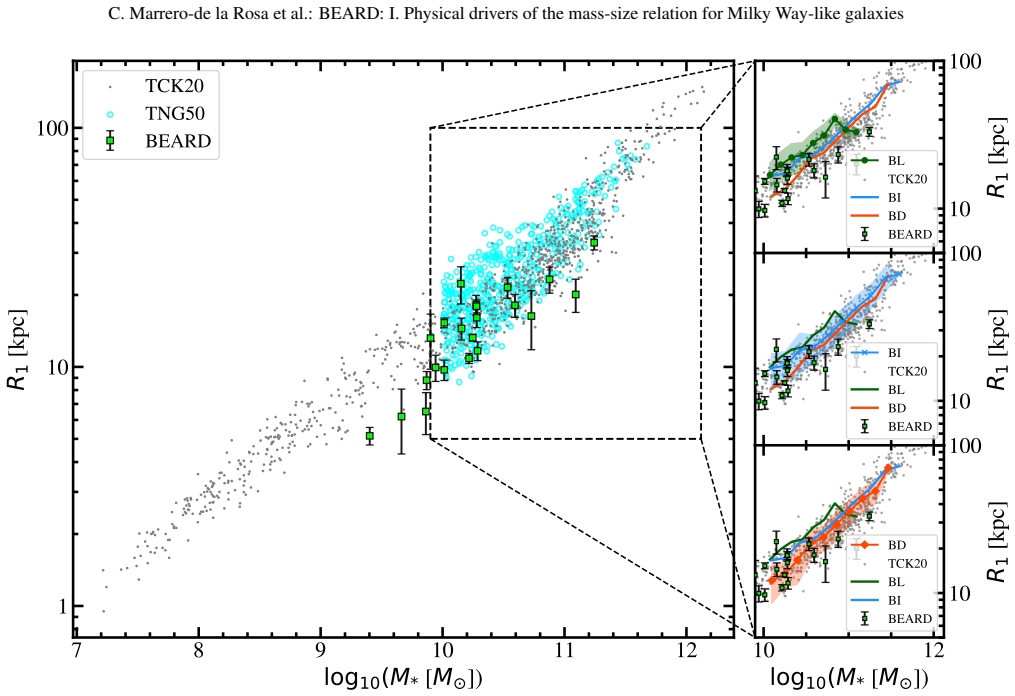
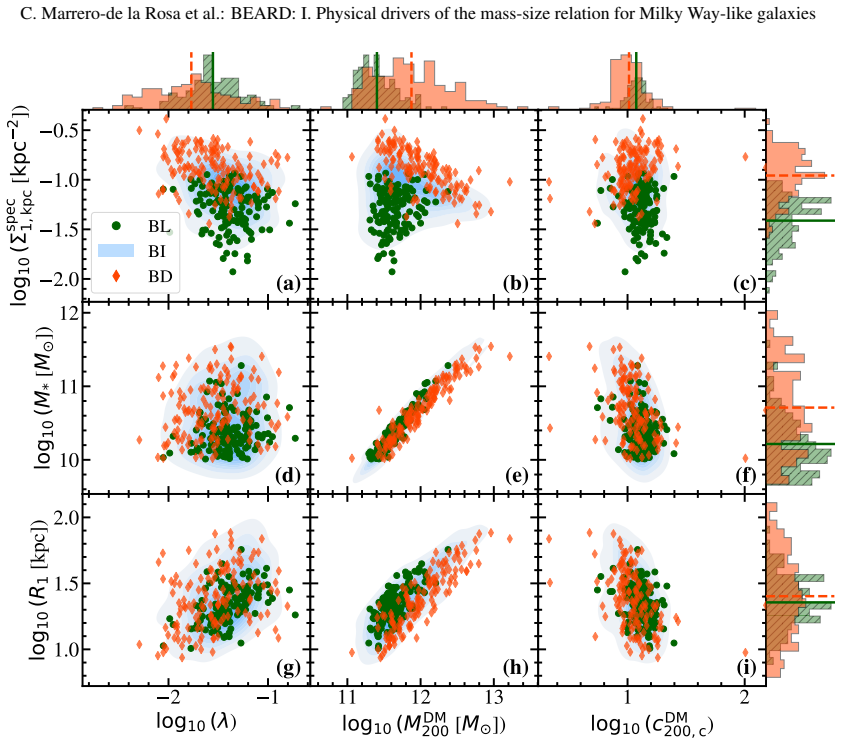
Using galaxies from the IllustrisTNG50 simulation, the scatter in the stellar mass-size relation is linked to morphology, with bulgeless, BEARD-like analogues and bulge-dominated galaxies tracing the upper and lower envelopes of the relation, respectively. This trend correlates with the specific central stellar mass density, and the physical driver is the spatial configuration of merger events rather than their frequency, with bulgeless systems tending to inhabit halos with a slightly higher spin.
What carries the argument
The specific central stellar mass density that separates bulgeless systems on the upper envelope from bulge-dominated systems on the lower envelope of the mass-size relation.
If this is right
- The observed scatter of about 0.1 dex in the mass-size relation for bulgeless galaxies is explained by their position on the upper envelope.
- Merger spatial configuration, not merger frequency, determines whether a galaxy remains bulgeless.
- Higher halo spin favors the formation and survival of pure disc galaxies.
- Differences between real observations and simulations stem from the wider central density range in actual bulgeless galaxies.
Where Pith is reading between the lines
- Improving simulations to better match the central density distribution of bulgeless galaxies could reduce discrepancies with observations.
- Direct measurements of halo spin in nearby galaxies could test whether bulgeless systems indeed have higher spins.
- Similar morphological segregation might appear in the mass-size relations at higher redshifts if merger geometry plays a similar role.
Load-bearing premise
The IllustrisTNG50 simulation accurately reproduces the merger histories, halo spins, and central density distributions of real bulgeless galaxies.
What would settle it
Finding that bulgeless galaxies in observations have central densities and merger spatial configurations indistinguishable from those of bulge-dominated galaxies would falsify the proposed driver of the scatter.
Figures





read the original abstract
In the standard $\Lambda$ cold dark matter ($\Lambda$CDM) cosmology, the existence of massive pure-disc galaxies remains challenging within the hierarchical framework and is key to understanding the evolutionary history of Milky Way-like systems. In this work, we investigate the physical origin of the scatter in the stellar mass-size relation of massive spiral galaxies, with a particular focus on bulgeless systems. We analyse 22 nearby bulgeless galaxies from the Bulgeless Evolution And the Rise of Discs (BEARD) survey using deep $g$- and $r$-band imaging obtained with the 2.5 m Isaac Newton Telescope Wide Field Camera. We derive surface-brightness, colour, and stellar-mass-density radial profiles to measure $R_1$, the radius where $\Sigma_* = 1\,\mathrm{M}_\odot\,\mathrm{pc}^{-2}$, adopted here as a physically motivated size proxy. Point spread function (PSF) effects are corrected through star subtraction and wavelet deconvolution. BEARD bulgeless galaxies follow the tight stellar mass-$R_1$ relation defined in previous studies, with a similar scatter of $\sim 0.1$ dex. Using galaxies from the IllustrisTNG50 simulation, we find that the scatter is linked to morphology, with bulgeless, BEARD-like analogues and bulge-dominated galaxies tracing the upper and lower envelopes of the relation, respectively. This trend correlates with the specific central stellar mass density, $\Sigma^{\mathrm{spec}}_{1,\mathrm{kpc}}$, suggesting that differences between observations and simulations reflect the broader central-density range spanned by BEARD bulgeless galaxies. A deeper analysis of the physical driver of this morphological segregation reveals that the scatter in the mass-size relation is also related to the spatial configuration of merger events, rather than their frequency, with bulgeless systems tending to inhabit halos with a slightly higher spin. (abridged)
Editorial analysis
A structured set of objections, weighed in public.
Referee Report
Summary. The manuscript analyzes 22 nearby bulgeless galaxies from the BEARD survey using deep g- and r-band imaging from the Isaac Newton Telescope. It derives surface-brightness and stellar-mass-density profiles to measure R1 (the radius at Σ* = 1 M⊙ pc⁻²) after PSF correction via star subtraction and wavelet deconvolution. The sample is shown to follow the stellar mass–R1 relation with ~0.1 dex scatter. Comparison to IllustrisTNG50 galaxies indicates that scatter correlates with morphology: BEARD-like bulgeless analogues occupy the upper envelope while bulge-dominated systems occupy the lower envelope. This segregation is linked to specific central stellar mass density Σ^spec_{1,kpc}. The authors further identify the spatial configuration of mergers (rather than frequency) and slightly higher halo spin as the physical drivers of the morphological trend.
Significance. If the TNG50-to-observation mapping on central densities, merger geometries, and spins holds, the work supplies a concrete physical interpretation for the small observed scatter in the mass-size relation of massive spirals and for the persistence of bulgeless discs in ΛCDM. The observational measurement of R1 on a uniformly selected bulgeless sample and the explicit separation of merger spatial configuration from frequency are useful additions to the literature on disc assembly.
major comments (3)
- [simulation comparison] Simulation comparison section: The claim that 'differences between observations and simulations reflect the broader central-density range spanned by BEARD bulgeless galaxies' is load-bearing for the morphological-segregation result, yet the manuscript provides only a qualitative statement rather than a direct, quantitative comparison (e.g., histograms or KS-test p-value) of the Σ^spec_{1,kpc} distributions between the 22 observed BEARD galaxies and the selected TNG50 analogues.
- [physical driver analysis] Physical-driver analysis: The conclusion that scatter is driven by the spatial configuration of mergers (rather than their frequency) and by slightly higher halo spin rests on the assumption that TNG50 BEARD-like analogues faithfully reproduce the central-density, merger-tree, and spin distributions of the real sample. No independent observational anchor (e.g., merger-remnant signatures or spin proxies) is presented to test this correspondence, which directly affects the security of the driver interpretation.
- [observational methods] Observational methods: The reported 0.1 dex scatter and the robustness of R1 measurements depend on the details of galaxy selection for the BEARD sample and on the validation of the PSF-correction procedure (star subtraction plus wavelet deconvolution). The manuscript does not supply the error budget or quantitative tests (e.g., recovery of injected profiles) that would confirm these steps do not artificially tighten the relation.
minor comments (2)
- [abstract] The abstract states the scatter is 'similar' to previous studies; a brief quantitative comparison (e.g., to the exact literature values cited) would clarify the degree of agreement.
- [simulation comparison] Notation: Σ^spec_{1,kpc} is introduced without an explicit definition equation; adding the formula (specific central stellar mass density within 1 kpc) would aid readability.
Simulated Author's Rebuttal
We thank the referee for their constructive and detailed report. The comments have prompted us to strengthen the quantitative support for our claims and to clarify the assumptions underlying our interpretations. We address each major comment below and have revised the manuscript accordingly.
read point-by-point responses
-
Referee: Simulation comparison section: The claim that 'differences between observations and simulations reflect the broader central-density range spanned by BEARD bulgeless galaxies' is load-bearing for the morphological-segregation result, yet the manuscript provides only a qualitative statement rather than a direct, quantitative comparison (e.g., histograms or KS-test p-value) of the Σ^spec_{1,kpc} distributions between the 22 observed BEARD galaxies and the selected TNG50 analogues.
Authors: We agree that a quantitative comparison strengthens the result. In the revised manuscript we have added a new figure (Fig. 8) displaying histograms of Σ^spec_{1,kpc} for the 22 BEARD galaxies and the matched TNG50 analogues. We also report a two-sample Kolmogorov-Smirnov test (p = 0.003) confirming that the observed sample spans a significantly broader central-density range. This addition directly supports the statement that the morphological segregation arises from the wider central-density distribution in the real bulgeless galaxies. revision: yes
-
Referee: Physical-driver analysis: The conclusion that scatter is driven by the spatial configuration of mergers (rather than their frequency) and by slightly higher halo spin rests on the assumption that TNG50 BEARD-like analogues faithfully reproduce the central-density, merger-tree, and spin distributions of the real sample. No independent observational anchor (e.g., merger-remnant signatures or spin proxies) is presented to test this correspondence, which directly affects the security of the driver interpretation.
Authors: We acknowledge that the physical-driver conclusions rely on the fidelity of TNG50. While our sample lacks direct observational tracers of merger geometry or halo spin, the central-density–morphology correlation is measured directly in the data and is reproduced in the simulation. In the revised text we have expanded the discussion to state these assumptions explicitly, to quantify the differences in merger spatial configuration between BEARD-like and bulge-dominated analogues, and to note that future integral-field or HI observations could provide independent tests. We therefore present the driver analysis as a simulation-guided interpretation rather than a definitive observational result. revision: partial
-
Referee: Observational methods: The reported 0.1 dex scatter and the robustness of R1 measurements depend on the details of galaxy selection for the BEARD sample and on the validation of the PSF-correction procedure (star subtraction plus wavelet deconvolution). The manuscript does not supply the error budget or quantitative tests (e.g., recovery of injected profiles) that would confirm these steps do not artificially tighten the relation.
Authors: We have added an appendix (Appendix B) that provides a full error budget for R1, separating contributions from sky subtraction, photometric calibration, PSF modeling, star subtraction, and wavelet deconvolution. We also performed profile-injection tests: synthetic exponential and Sérsic profiles with known R1 values were inserted into the raw frames, processed through the identical pipeline, and recovered. The tests show that the measured scatter is not artificially suppressed (recovered R1 values agree with input values to within 0.05 dex on average). Sample selection criteria and their robustness are now summarized with a brief sensitivity analysis in Section 2. revision: yes
Circularity Check
No significant circularity; external simulation benchmark supplies independent content
full rationale
The derivation compares the observed stellar mass-R1 relation (measured from BEARD imaging with R1 defined as the radius at Σ*=1 M⊙ pc^{-2}) against the tight relation from prior independent literature, then maps scatter onto morphological envelopes in the separate IllustrisTNG50 simulation. No equation or claim reduces by construction to a fit performed on the same dataset; the simulation supplies an external benchmark for morphology, central density, merger geometry, and halo spin rather than re-deriving the observed scatter from parameters fitted within the BEARD sample itself. Self-citations, if present for the BEARD survey definition, are not load-bearing for the central physical-driver conclusion.
Axiom & Free-Parameter Ledger
axioms (1)
- domain assumption Standard LambdaCDM cosmology governs galaxy formation and merger histories
Lean theorems connected to this paper
-
IndisputableMonolith/Foundation/AlexanderDuality.leanalexander_duality_circle_linking unclear?
unclearRelation between the paper passage and the cited Recognition theorem.
the scatter in the mass-size relation is also related to the spatial configuration of merger events, rather than their frequency, with bulgeless systems tending to inhabit halos with a slightly higher spin
What do these tags mean?
- matches
- The paper's claim is directly supported by a theorem in the formal canon.
- supports
- The theorem supports part of the paper's argument, but the paper may add assumptions or extra steps.
- extends
- The paper goes beyond the formal theorem; the theorem is a base layer rather than the whole result.
- uses
- The paper appears to rely on the theorem as machinery.
- contradicts
- The paper's claim conflicts with a theorem or certificate in the canon.
- unclear
- Pith found a possible connection, but the passage is too broad, indirect, or ambiguous to say the theorem truly supports the claim.
Reference graph
Works this paper leans on
-
[1]
Baryonic imprints on DM haloes: population statistics from dwarf galaxies to galaxy clusters. , keywords =. doi:10.1093/mnras/stab3177 , archivePrefix =. 2109.02713 , primaryClass =
-
[2]
Research Notes of the American Astronomical Society , keywords =
Gnuastro: Visualizing the Full Dynamic Range in Color Images. Research Notes of the American Astronomical Society , keywords =. doi:10.3847/2515-5172/ad1aae , archivePrefix =. 2401.03814 , primaryClass =
-
[3]
M. A. Stephens , journal =. EDF Statistics for Goodness of Fit and Some Comparisons , urldate =
-
[4]
A multidimensional version of the Kolmogorov-Smirnov test. , keywords =. doi:10.1093/mnras/225.1.155 , adsurl =
-
[5]
Planck 2015 results. XXVII. The second Planck catalogue of Sunyaev-Zeldovich sources. , keywords =. doi:10.1051/0004-6361/201525823 , archivePrefix =. 1502.01598 , primaryClass =
work page internal anchor Pith review Pith/arXiv arXiv doi:10.1051/0004-6361/201525823 2015
-
[6]
The inner structure of CDM haloes - I. A numerical convergence study. , keywords =. doi:10.1046/j.1365-8711.2003.05925.x , archivePrefix =. astro-ph/0201544 , primaryClass =
-
[7]
ERGO-ML I: inferring the assembly histories of IllustrisTNG galaxies from integral observable properties via invertible neural networks. , keywords =. doi:10.1093/mnras/stac3295 , archivePrefix =. 2202.06967 , primaryClass =
-
[8]
The role of mergers and halo spin in shaping galaxy morphology
The role of mergers and halo spin in shaping galaxy morphology. , keywords =. doi:10.1093/mnras/stx305 , archivePrefix =. 1609.09498 , primaryClass =
work page internal anchor Pith review Pith/arXiv arXiv doi:10.1093/mnras/stx305
-
[9]
Dynamical Structure of Small Bulges Reveals Their Early Formation in CDM Paradigm. , keywords =. doi:10.3847/2041-8213/ab6459 , archivePrefix =. 2001.04984 , primaryClass =
-
[10]
Expectations of the Size Evolution of Massive Galaxies at 3 z 6 from the TNG50 Simulation: The CEERS/JWST View. , keywords =. doi:10.3847/1538-4357/acb926 , archivePrefix =. 2208.00007 , primaryClass =
-
[11]
Stellar masses of SDSS-III BOSS galaxies at z~0.5 and constraints to galaxy formation models
Stellar masses of SDSS-III/BOSS galaxies at z 0.5 and constraints to galaxy formation models. , keywords =. doi:10.1093/mnras/stt1424 , archivePrefix =. 1207.6114 , primaryClass =
work page internal anchor Pith review Pith/arXiv arXiv doi:10.1093/mnras/stt1424
-
[12]
The influence of diffuse scattered light. I. The PSF and its role in observations of the edge-on galaxy NGC 5907. , keywords =. doi:10.1051/0004-6361/201423429 , archivePrefix =. 1406.5508 , primaryClass =
work page internal anchor Pith review Pith/arXiv arXiv doi:10.1051/0004-6361/201423429
-
[13]
Galactic cirri in deep optical imaging. , keywords =. doi:10.1051/0004-6361/201936111 , archivePrefix =. 1907.00978 , primaryClass =
-
[14]
NIHAO XXI: The emergence of Low Surface Brightness galaxies
NIHAO XXI: the emergence of low surface brightness galaxies. , keywords =. doi:10.1093/mnras/stz985 , archivePrefix =. 1901.08559 , primaryClass =
work page internal anchor Pith review Pith/arXiv arXiv doi:10.1093/mnras/stz985 1901
-
[15]
Hierarchical formation of bulgeless galaxies: why outflows have low angular momentum. , keywords =. doi:10.1111/j.1365-2966.2011.18545.x , archivePrefix =. 1010.1004 , primaryClass =
-
[16]
2010, MNRAS, 401, 791, doi:10.1111/j.1365-2966.2009
Forming a large disc galaxy from a z < 1 major merger. , keywords =. doi:10.1111/j.1365-2966.2009.15143.x , archivePrefix =. 0812.0379 , primaryClass =
-
[17]
At the heart of the matter: the origin of bulgeless dwarf galaxies and Dark Matter cores
Bulgeless dwarf galaxies and dark matter cores from supernova-driven outflows. , keywords =. doi:10.1038/nature08640 , archivePrefix =. 0911.2237 , primaryClass =
work page internal anchor Pith review Pith/arXiv arXiv doi:10.1038/nature08640
-
[18]
Discovery of disc truncations above the galaxies' mid-plane in Milky Way-like galaxies
Discovery of disc truncations above the galaxies' mid-plane in Milky Way-like galaxies. , keywords =. doi:10.1093/mnras/sty2886 , archivePrefix =. 1804.01546 , primaryClass =
work page internal anchor Pith review Pith/arXiv arXiv doi:10.1093/mnras/sty2886
-
[19]
Are ultra-diffuse galaxies Milky Way-sized?. , keywords =. doi:10.1051/0004-6361/201936821 , archivePrefix =. 2001.02691 , primaryClass =
-
[20]
Star formation thresholds and galaxy edges: why and where
Star Formation Thresholds and Galaxy Edges: Why and Where. , keywords =. doi:10.1086/421232 , archivePrefix =. astro-ph/0205125 , primaryClass =
work page internal anchor Pith review Pith/arXiv arXiv doi:10.1086/421232
-
[21]
The Gaia mission. , keywords =. doi:10.1051/0004-6361/201629272 , archivePrefix =. 1609.04153 , primaryClass =
work page internal anchor Pith review Pith/arXiv arXiv doi:10.1051/0004-6361/201629272
-
[22]
Summary of the content and survey properties
Gaia Data Release 3. Summary of the content and survey properties. , keywords =. doi:10.1051/0004-6361/202243940 , archivePrefix =. 2208.00211 , primaryClass =
-
[23]
Total Galaxy Magnitudes and Effective Radii from Petrosian Magnitudes and Radii
Total Galaxy Magnitudes and Effective Radii from Petrosian Magnitudes and Radii. , keywords =. 2005a , month = oct, volume =. doi:10.1086/444475 , archivePrefix =. astro-ph/0504287 , primaryClass =
work page internal anchor Pith review Pith/arXiv arXiv doi:10.1086/444475
-
[24]
Color Separation of Galaxy Types in the Sloan Digital Sky Survey Imaging Data
Color Separation of Galaxy Types in the Sloan Digital Sky Survey Imaging Data. , keywords =. doi:10.1086/323301 , archivePrefix =. astro-ph/0107201 , primaryClass =
work page internal anchor Pith review Pith/arXiv arXiv doi:10.1086/323301
-
[25]
The 13th Data Release of the Sloan Digital Sky Survey: First Spectroscopic Data from the SDSS-IV Survey Mapping Nearby Galaxies at Apache Point Observatory. , keywords =. doi:10.3847/1538-4365/aa8992 , archivePrefix =. 1608.02013 , primaryClass =
work page internal anchor Pith review Pith/arXiv arXiv doi:10.3847/1538-4365/aa8992
-
[26]
HyperLEDA. III. The catalogue of extragalactic distances. , keywords =. doi:10.1051/0004-6361/201423496 , archivePrefix =. 1408.3476 , primaryClass =
work page internal anchor Pith review Pith/arXiv arXiv doi:10.1051/0004-6361/201423496
-
[27]
, archivePrefix = "arXiv", eprint =
Frequency and properties of bars in cluster and field galaxies at intermediate redshifts. , archivePrefix = "arXiv", eprint =. doi:10.1051/0004-6361/200810352 , adsurl =
-
[28]
Theoretical Challenges in Galaxy Formation
Theoretical Challenges in Galaxy Formation. , keywords =. doi:10.1146/annurev-astro-081913-040019 , archivePrefix =. 1612.06891 , primaryClass =
work page internal anchor Pith review Pith/arXiv arXiv doi:10.1146/annurev-astro-081913-040019
-
[29]
Edge-on disk galaxies in the SDSS DR6: Fractions of bulgeless and other disk galaxies
Edge-on disk galaxies in the SDSS DR6: Fractions of bulgeless and other disk galaxies. Astronomische Nachrichten , keywords =. doi:10.1002/asna.200811132 , archivePrefix =. 0901.1894 , primaryClass =
work page internal anchor Pith review Pith/arXiv arXiv doi:10.1002/asna.200811132
-
[30]
How do Disks Survive Mergers?. , keywords =. doi:10.1088/0004-637X/691/2/1168 , archivePrefix =. 0806.1739 , primaryClass =
work page internal anchor Pith review Pith/arXiv arXiv doi:10.1088/0004-637x/691/2/1168
-
[31]
Annales d'Astrophysique , year = 1948, month = jan, volume =
Recherches sur les Nebuleuses Extragalactiques. Annales d'Astrophysique , year = 1948, month = jan, volume =
work page 1948
-
[32]
Evolutionary pathways of disk galaxies with different sizes. , keywords =. doi:10.1051/0004-6361/202450397 , archivePrefix =. 2404.10432 , primaryClass =
-
[33]
Bulgeless Giant Galaxies Challenge our Picture of Galaxy Formation by Hierarchical Clustering
Bulgeless Giant Galaxies Challenge Our Picture of Galaxy Formation by Hierarchical Clustering. , keywords =. doi:10.1088/0004-637X/723/1/54 , archivePrefix =. 1009.3015 , primaryClass =
work page internal anchor Pith review Pith/arXiv arXiv doi:10.1088/0004-637x/723/1/54
-
[34]
Our Milky Way as a Pure-Disk Galaxy -- A Challenge for Galaxy Formation
Our Milky Way as a Pure-disk Galaxy A Challenge for Galaxy Formation. , keywords =. doi:10.1088/2041-8205/720/1/L72 , archivePrefix =. 1005.0385 , primaryClass =
work page internal anchor Pith review Pith/arXiv arXiv doi:10.1088/2041-8205/720/1/l72 2041
-
[35]
Luminosity distribution in galaxies. II. A study of accidental and systematic errors with application to NGC 3379. , keywords =. doi:10.1086/190879 , adsurl =
-
[36]
A Concise Reference to (Projected) S \'e rsic R ^ 1/n Quantities, Including Concentration, Profile Slopes, Petrosian Indices, and Kron Magnitudes. , keywords =. 2005b , month = jan, volume =. doi:10.1071/AS05001 , archivePrefix =. astro-ph/0503176 , primaryClass =
work page internal anchor Pith review Pith/arXiv arXiv doi:10.1071/as05001
-
[37]
On The Robustness of z=0-1 Galaxy Size Measurements Through Model and Non-Parametric Fits
On the Robustness of z = 0-1 Galaxy Size Measurements through Model and Non-parametric Fits. , keywords =. doi:10.1088/0004-637X/777/2/117 , archivePrefix =. 1302.6240 , primaryClass =
work page internal anchor Pith review Pith/arXiv arXiv doi:10.1088/0004-637x/777/2/117
-
[38]
The ATLAS ^ 3D project - XXV. Two-dimensional kinematic analysis of simulated galaxies and the cosmological origin of fast and slow rotators. , keywords =. doi:10.1093/mnras/stt1919 , archivePrefix =. 1311.0284 , primaryClass =
work page internal anchor Pith review Pith/arXiv arXiv doi:10.1093/mnras/stt1919
-
[39]
3D-HST+CANDELS: The Evolution of the Galaxy Size-Mass Distribution since $z=3$
3D-HST+CANDELS: The Evolution of the Galaxy Size-Mass Distribution since z = 3. , keywords =. doi:10.1088/0004-637X/788/1/28 , archivePrefix =. 1404.2844 , primaryClass =
work page internal anchor Pith review Pith/arXiv arXiv doi:10.1088/0004-637x/788/1/28
-
[40]
Readdressing galaxy growth using a physically motivated size indicator
Strong size evolution of disc galaxies since z = 1. Readdressing galaxy growth using a physically motivated size indicator. , keywords =. doi:10.1051/0004-6361/202346133 , archivePrefix =. 2311.07656 , primaryClass =
-
[41]
The Sloan Digital Sky Survey: Technical Summary
The Sloan Digital Sky Survey: Technical Summary. , keywords =. doi:10.1086/301513 , archivePrefix =. astro-ph/0006396 , primaryClass =
work page internal anchor Pith review Pith/arXiv arXiv doi:10.1086/301513
-
[42]
A physically motivated definition for the size of galaxies in an era of ultradeep imaging. , keywords =. doi:10.1093/mnras/staa236 , archivePrefix =. 2001.02689 , primaryClass =
-
[43]
First results from the TNG50 simulation: galactic outflows driven by supernovae and black hole feedback. , keywords =. doi:10.1093/mnras/stz2306 , archivePrefix =. 1902.05554 , primaryClass =
work page internal anchor Pith review Pith/arXiv arXiv doi:10.1093/mnras/stz2306 1902
-
[44]
Monthly Notices of the Royal Astronomical Society , volume =
Pillepich, Annalisa and Nelson, Dylan and Springel, Volker and Pakmor, Rüdiger and Torrey, Paul and Weinberger, Rainer and Vogelsberger, Mark and Marinacci, Federico and Genel, Shy and van der Wel, Arjen and Hernquist, Lars , title =. Monthly Notices of the Royal Astronomical Society , volume =. 2019 , month =. doi:10.1093/mnras/stz2338 , url =
-
[45]
Sparse Image and Signal Processing : Wavelets, Curvelets, Morphological Diversity , isbn =
Starck, Jean-Luc and Murtagh, Fionn and Fadili, Mohamed-Jalal , year =. Sparse Image and Signal Processing : Wavelets, Curvelets, Morphological Diversity , isbn =. Sparse Image and Signal Processing: Wavelets, Curvelets, Morphological Diversity , doi =
-
[46]
Carrillo, R. E. and McEwen, J. D. and Wiaux, Y. , title =. Monthly Notices of the Royal Astronomical Society , volume =. 2012 , month =. doi:10.1111/j.1365-2966.2012.21605.x , url =
-
[47]
Minor mergers and the size evolution of elliptical galaxies
Minor Mergers and the Size Evolution of Elliptical Galaxies. , keywords =. doi:10.1088/0004-637X/699/2/L178 , archivePrefix =. 0903.1636 , primaryClass =
work page internal anchor Pith review Pith/arXiv arXiv doi:10.1088/0004-637x/699/2/l178
-
[48]
Image restoration with noise suppression using the wavelet transform. , keywords =
-
[49]
The Sloan Digital Sky Survey extended point spread functions. , keywords =. doi:10.1093/mnras/stz3111 , archivePrefix =. 1911.01430 , primaryClass =
-
[50]
Sedighi, Nafise and Sharbaf, Zahra and Trujillo, Ignacio and Eskandarlou, Sepideh and Golini, Giulia and Infante-Sainz, Ra. LIGHTS. The Open Journal of Astrophysics , doi =. 2025 , month =
work page 2025
-
[51]
The Fornax Deep Survey with VST. VIII. Connecting the accretion history with the cluster density. , keywords =. doi:10.1051/0004-6361/202038015 , archivePrefix =. 2005.00025 , primaryClass =
-
[52]
IC 1101 and the Galaxies of Tomorrow: Toward an Observational Detection of the Splashback Radius , note =
-
[53]
LIGHTS - A robust technique to identify galaxy edges , DOI= "10.1051/0004-6361/202555288", url= "https://doi.org/10.1051/0004-6361/202555288", journal =
-
[54]
Bulgeless Evolution And the Rise of Discs (BEARD) - III. A numerical simulation view of satellites around Milky-Way analogues , DOI= "10.1051/0004-6361/202557194", url= "https://doi.org/10.1051/0004-6361/202557194", journal =
-
[55]
Bulgeless Evolution And the Rise of Discs (BEARD) - II. The role of mergers in shaping the Milky Way analogues in TNG50 , DOI= "10.1051/0004-6361/202556875", url= "https://doi.org/10.1051/0004-6361/202556875", journal =
-
[56]
A universal angular momentum profile for galactic halos
A Universal Angular Momentum Profile for Galactic Halos. , keywords =. doi:10.1086/321477 , archivePrefix =. astro-ph/0011001 , primaryClass =
work page internal anchor Pith review Pith/arXiv arXiv doi:10.1086/321477
-
[57]
Removing Internal Reflections from Deep Imaging Datasets
Removing Internal Reflections from Deep Imaging Data Sets. , keywords =. doi:10.1086/648457 , archivePrefix =. 0909.3320 , primaryClass =
work page internal anchor Pith review Pith/arXiv arXiv doi:10.1086/648457
-
[58]
Beyond 31 mag/arcsec^2: the low surface brightness frontier with the largest optical telescopes
Beyond 31 mag arcsec ^ -2 : The Frontier of Low Surface Brightness Imaging with the Largest Optical Telescopes. , keywords =. doi:10.3847/0004-637X/823/2/123 , archivePrefix =. 1510.04696 , primaryClass =
work page internal anchor Pith review Pith/arXiv arXiv doi:10.3847/0004-637x/823/2/123
-
[59]
Noise Based Detection and Segmentation of Nebulous Objects
Noise-based Detection and Segmentation of Nebulous Objects. , keywords =. doi:10.1088/0067-0049/220/1/1 , archivePrefix =. 1505.01664 , primaryClass =
work page internal anchor Pith review Pith/arXiv arXiv doi:10.1088/0067-0049/220/1/1
-
[60]
Carving out the low surface brightness universe with NoiseChisel. arXiv e-prints , keywords =. doi:10.48550/arXiv.1909.11230 , archivePrefix =. 1909.11230 , primaryClass =
-
[61]
Mathematical Morphology - Theory and Applications , doi =
Statistical attribute filtering to detect faint extended astronomical sources , author =. Mathematical Morphology - Theory and Applications , doi =. 2016 , lastchecked =
work page 2016
-
[62]
Observations, reduction and results
CCD surface photometry of elliptical galaxies - I. Observations, reduction and results. , keywords =. doi:10.1093/mnras/226.4.747 , adsurl =
-
[63]
doi:10.5281/zenodo.3478575 , version =
astropy/photutils: v0.7.1. doi:10.5281/zenodo.3478575 , version =
-
[64]
On the Uncertainties of Stellar Mass Estimates via Colour Measurements
On the uncertainties of stellar mass estimates via colour measurements. , keywords =. doi:10.1093/mnras/stv1499 , archivePrefix =. 1507.03016 , primaryClass =
work page internal anchor Pith review Pith/arXiv arXiv doi:10.1093/mnras/stv1499
-
[65]
Color Profiles of Spiral Galaxies: Clues on Outer-Disk Formation Scenarios
Color Profiles of Spiral Galaxies: Clues on Outer-Disk Formation Scenarios. , keywords =. doi:10.1086/591671 , archivePrefix =. 0807.2776 , primaryClass =
work page internal anchor Pith review Pith/arXiv arXiv doi:10.1086/591671
-
[66]
The edges of galaxies: Tracing the limits of star formation. , keywords =. doi:10.1051/0004-6361/202243612 , archivePrefix =. 2209.05497 , primaryClass =
-
[67]
The Absolute Magnitude of the Sun in Several Filters
The Absolute Magnitude of the Sun in Several Filters. , keywords =. doi:10.3847/1538-4365/aabfdf , archivePrefix =. 1804.07788 , primaryClass =
work page internal anchor Pith review Pith/arXiv arXiv doi:10.3847/1538-4365/aabfdf
-
[68]
A physically motivated galaxy size definition across different state-of-the-art hydrodynamical simulations , DOI= "10.1051/0004-6361/202554290", url= "https://doi.org/10.1051/0004-6361/202554290", journal =
-
[69]
Structural and stellar-population properties versus bulge types in Sloan Digital Sky Survey central galaxies. , keywords =. doi:10.1093/mnras/staa328 , archivePrefix =. 1908.08055 , primaryClass =
-
[70]
The Dependence of Quenching upon the Inner Structure of Galaxies at 0.5 <= z < 0.8 in the DEEP2/AEGIS Survey. , keywords =. doi:10.1088/0004-637X/760/2/131 , archivePrefix =. 1210.4173 , primaryClass =
work page internal anchor Pith review Pith/arXiv arXiv doi:10.1088/0004-637x/760/2/131
-
[71]
Dense cores in galaxies out to z=2.5 in SDSS, UltraVISTA, and the five 3D-HST/CANDELS fields
Dense Cores in Galaxies Out to z = 2.5 in SDSS, UltraVISTA, and the Five 3D-HST/CANDELS Fields. , keywords =. doi:10.1088/0004-637X/791/1/45 , archivePrefix =. 1404.4874 , primaryClass =
work page internal anchor Pith review Pith/arXiv arXiv doi:10.1088/0004-637x/791/1/45
-
[72]
Evidence for Mature Bulges and an Inside-out Quenching Phase 3 Billion Years After the Big Bang
Evidence for mature bulges and an inside-out quenching phase 3 billion years after the Big Bang. Science , keywords =. doi:10.1126/science.1261094 , archivePrefix =. 1504.04021 , primaryClass =
work page internal anchor Pith review Pith/arXiv arXiv doi:10.1126/science.1261094
-
[73]
The Intrinsic Characteristics of Galaxies on the SFR-M _ * Plane at 1.2 < z < 4: I. The Correlation between Stellar Age, Central Density, and Position Relative to the Main Sequence. , keywords =. doi:10.3847/1538-4357/aaa40f , archivePrefix =. 1706.02311 , primaryClass =
work page internal anchor Pith review Pith/arXiv arXiv doi:10.3847/1538-4357/aaa40f
-
[74]
Evolution of central galaxy alignments in simulations. , keywords =. doi:10.1051/0004-6361/202450597 , archivePrefix =. 2405.02398 , primaryClass =
-
[75]
Strong bimodality in the host halo mass of central galaxies from galaxy-galaxy lensing
Strong bimodality in the host halo mass of central galaxies from galaxy-galaxy lensing. , keywords =. doi:10.1093/mnras/stw188 , archivePrefix =. 1509.06762 , primaryClass =
work page internal anchor Pith review Pith/arXiv arXiv doi:10.1093/mnras/stw188
-
[76]
MNRAS , archivePrefix = "arXiv", eprint =
Satellite abundances around bright isolated galaxies. , keywords =. doi:10.1111/j.1365-2966.2012.21256.x , archivePrefix =. 1203.0009 , primaryClass =
-
[77]
Galaxy disc scaling relations: A tight linear galaxy-halo connection challenges abundance matching. , keywords =. doi:10.1051/0004-6361/201935982 , archivePrefix =. 1909.01344 , primaryClass =
-
[78]
Monthly Notices of the Royal Astronomical Society , volume =
Proctor, Katy L and Ludlow, Aaron D and Lagos, Claudia del P and Robotham, Aaron S G , title =. Monthly Notices of the Royal Astronomical Society , volume =. 2025 , month =. doi:10.1093/mnras/staf1339 , url =
-
[79]
Galactic Angular Momentum in the Illustris Simulation: Feedback and the Hubble Sequence
Galactic Angular Momentum in the Illustris Simulation: Feedback and the Hubble Sequence. , keywords =. doi:10.1088/2041-8205/804/2/L40 , archivePrefix =. 1503.01117 , primaryClass =
work page internal anchor Pith review Pith/arXiv arXiv doi:10.1088/2041-8205/804/2/l40 2041
-
[80]
Morphological quenching of star formation: making early-type galaxies red
Morphological Quenching of Star Formation: Making Early-Type Galaxies Red. , keywords =. doi:10.1088/0004-637X/707/1/250 , archivePrefix =. 0905.4669 , primaryClass =
work page internal anchor Pith review Pith/arXiv arXiv doi:10.1088/0004-637x/707/1/250
discussion (0)
Sign in with ORCID, Apple, or X to comment. Anyone can read and Pith papers without signing in.