REVIEW 4 major objections 5 minor 1 cited by
Globular cluster formation from inertial inflows: accreting extremely massive stars as the origin of abundance anomalies
T0 review · 4 major / 5 minor · reviewed 2026-08-10 · deepseek-v4-flash
Pith's one-line read The paper argues that globular clusters' light-element abundance anomalies are produced by winds from accreting extremely massive stars of roughly 10^3–10^4 solar masses that form naturally through inertial inflows during cluster formation.
desk verdict A plausible, honestly self-assessed aEMS model for GC abundance anomalies that lives or dies by the assumption that accreting ~10^3-10^4 Msun stars are fully mixed; worth serious review but conclusions should be treated as conditional. read the letter →
The pith
A machine-rendered reading of the paper's core claim, the machinery that carries it, and where it could break.
The reading
What carries the argument
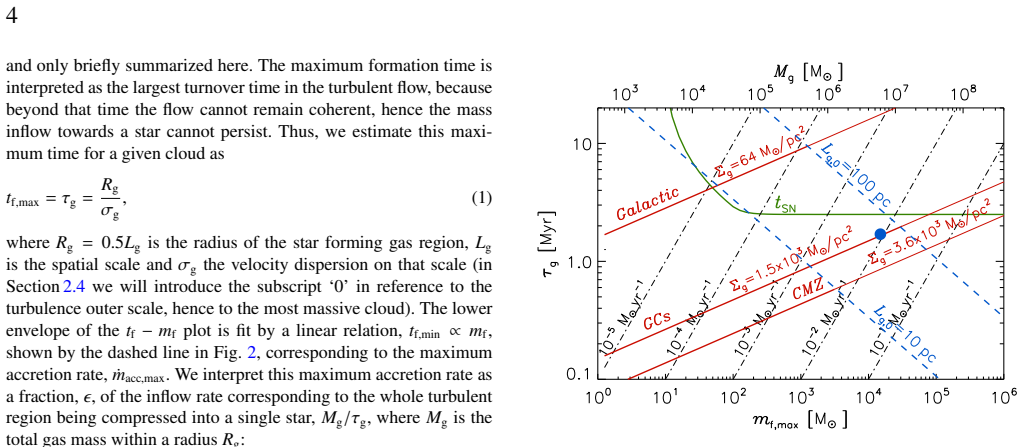
The load-bearing object is the inertial-inflow scaling $m_{\mathrm{f,max}} = \epsilon M_g$, where $\epsilon \simeq 2.5\times10^{-3}$ relates the most massive star in a cloud to the cloud mass, so that proto-globular clusters of $\sim10^{5-7}\,M_\odot$ inevitably host accreting extremely massive stars. The second essential mechanism is the balance between accretion and wind mass loss, $m_\infty = 100\,M_\odot\,\sqrt{\dot m_{\rm acc}/\dot m_{\rm wind,100}(Z)}$, which sets the effective maximum stellar mass and makes it depend on both cluster mass and metallicity. The model then follows the growth of the stellar mass function during the 1–2 Myr formation time, using the assumption that accreting EMSs are fully convective, so their winds carry the interior abundances, and a dilution model in which wind material mixes with pristine gas to form low-mass stars.
What would settle it
Compute a stellar-structure model of an accreting 3,000-solar-mass star at 0.1 solar metallicity with a treatment of superadiabatic convection that keeps the envelope radiative; if the wind leaves the surface with unprocessed abundances, the pollution mechanism cannot produce the observed globular cluster patterns.
Extended reading notes
Core claim
The central claim is that the light-element abundance anomalies of globular clusters are produced during cluster formation by accreting extremely massive stars (EMSs), objects with final masses near $10^{3}$–$10^{4}$ solar masses. In the inertial-inflow model of star formation, the maximum stellar mass is a fixed fraction of the parent cloud mass, $m_{\mathrm{f,max}} = \epsilon M_g$ with $\epsilon \simeq 2.5\times10^{-3}$, so clouds of a few $10^6$ solar masses naturally form EMSs. Because these stars are expected to be fully convective while accreting, their strong winds release hot-hydrogen burning products at the same composition as their interiors; this polluted gas dilutes with pristine gas and forms the low-mass stars we see today. The paper shows that a parameterised model of this process reproduces the observed helium spreads, the fraction of polluted stars, and the mass and metallicity dependence of the O-Na and Mg-Al anticorrelations, and it concludes that globular clusters formed from gas with surface density $\Sigma_g \gtrsim 10^3\,M_\odot\,\mathrm{pc}^{-2}$.
Load-bearing premise
The argument collapses if accreting stars of a few thousand solar masses are not fully mixed, because then their winds carry pristine surface composition instead of hot-hydrogen burning products; current stellar models disagree on whether such stars become fully convective.
Editorial extensions
If this is right
- If globular clusters formed from gas at $\Sigma_g \gtrsim 10^3\,M_\odot\,\mathrm{pc}^{-2}$, the same model predicts that the helium spread and the fraction of polluted stars rise with initial cluster mass roughly as observed, making the surface density of the birth gas a measurable parameter.
- Massive, metal-poor globular clusters should show the largest aluminium enhancement and deepest magnesium depletion, while low-mass or metal-rich clusters should have only mild sodium-oxygen spreads, providing a sharp ranking test across the whole globular cluster population.
- Pollution happens during cluster formation, so young massive clusters formed from dense, low-metallicity gas in the local Universe should show nitrogen and sodium enhancements, contrary to the assumption that multiple populations require high redshift.
- The most massive EMSs leave black holes above the pair-instability gap, with tens of such objects predicted in clusters like M15; gravitational-wave detectors should see mergers of these intermediate-mass black holes at redshifts above roughly 3.
- Because there is no separate first and second generation of stars, low-mass stars that form early and late share the same stellar mass function, matching the observed similarity of the two populations' mass functions.
Reading between the lines
- If the $m_{\mathrm{f,max}} = \epsilon M_g$ scaling is universal, it should be visible in resolved young massive clusters: the most massive star in a $10^4\,M_\odot$ cluster should cap near 250 solar masses, and in a $10^5\,M_\odot$ cluster near 2500 solar masses, a test JWST or the next generation of 30-metre-class telescopes could attempt in lensed clusters.
- The model implicitly predicts that the absence of multiple populations in local young clusters is an environmental selection effect rather than an epoch effect; searching for nitrogen-rich and sodium-rich turnoff stars in the most massive dense clusters of low-metallicity dwarf galaxies would test this without needing high redshift.
- A cleaner observational falsifier of the pollution channel comes from lithium: if the winds are lithium-free, the most sodium-rich, oxygen-poor second-population stars should have measurably lower lithium, and existing samples may simply not reach the extreme abundance region.
- The fully convective assumption could be checked with multi-dimensional simulations of convection in accreting stars; if rotationally induced mixing is what actually carries burning products to the surface, the minimum mass for pollution would shift and the model's yield scaling would need revision.
Editorial analysis
A structured set of objections, weighed in public.
Referee Report
Summary. The paper proposes that the multiple populations (MPs) of globular clusters arise from winds of accreting extremely massive stars (aEMSs, roughly 10^3--10^4 M_sun) that form naturally when the inertial-inflow model of massive star formation is scaled to GC-mass clouds. It constructs a time-dependent, parameterized model of the IMF during GC formation (Section 3), including gas inflow, wind mass loss, helium evolution under accretion and nuclear burning, and dilution of processed wind material with pristine gas. Predictions are compared with Milky Way GC data for the helium spread Delta Y as a function of GC mass, the fraction of second-population stars f_P2, the O-Na and Mg-Al anticorrelations, and Li abundances. The authors conclude that GCs formed from gas with surface density Sigma_g ~ 1.5e3 M_sun pc^-2, that EMSs are a natural outcome of GC formation, that N-rich galaxies at high redshift may be dominated by EMS-rich GCs, and that EMS remnants may be intermediate-mass black holes above the pair-instability gap.
Significance. If the mechanism holds, the paper offers a single, analytically transparent framework that connects GC mass, metallicity, and the main abundance anomalies, with several genuinely testable predictions: the f_P2-M_GC slope, the mass/metallicity dependence of Mg-Al spreads, Li-dilution tracks, and gravitational-wave signatures of IMBHs. The inertial-inflow basis and the tabulated parameter choices are strengths, and the paper is commendably explicit about many of its uncertainties. However, the central mechanism depends on full convection in accreting EMSs, which current stellar models do not robustly establish, and some of the headline agreements are partly circular because Sigma_g is chosen to match the helium spread and abundance zero-points are adjusted after visual inspection. The quantitative case is therefore not yet as strong as the abstract implies.
major comments (4)
- [Section 6.2, Eq. (23)] The claim that aEMS winds carry hot-hydrogen-burning products rests entirely on the assumption that accreting stars above about 10^3 M_sun are fully mixed. Equation (23) omits the wind term explicitly on this basis, and Section 3.7.1 states that the abundances of the winds are the same as those in the stellar interior. The paper itself reports that Ramírez-Galeano et al. (2025) find full convection only in a mass range that depends strongly on the treatment of superadiabatic convection, and that for different treatments of energy transport the accreting model is never fully convective until the end of the main sequence. Because the dominant polluters are at a few times 10^3 M_sun (Section 3.7.2), the mechanism operates precisely in the mass range where the assumption is least secure. This is load-bearing: if the envelope remains radiative, winds are launched from unprocessed surface layers and the predicted anomalies largely disappear. The manuscript should either supply a dedicated stellar-model demonstration of full mixing for the relevant accretion-rate and metallicity range, or quantify how partial mixing or rotationally induced transport changes the yields and show that the observed trends survive.
- [Sections 3.6 and 5.2, Fig. 14] The vertical offset of the predicted Delta Y--M_GC relation is not an independent prediction. The text states that Sigma_g was selected because it gives satisfactory agreement with observed helium spreads (Section 3.6) and later concedes that the vertical offset is reproduced because it is sensitive to Sigma_g, 'whose value we picked to match these observations' (Section 5.2). Section 5.3 further uses f_P2 to constrain the same parameter. The slope of Delta Y with GC mass is a genuine scaling prediction, but the amplitude agreement is circular. The paper should present the comparison as a constraint on Sigma_g with a proper goodness-of-fit, or marginalize over plausible Sigma_g values, rather than listing the amplitude agreement as a success.
- [Section 5.4, Figs. 16-17] The comparison to O-Na and Mg-Al data is qualitative and includes manually adjusted zero-points: 'After visual inspection, we updated [O/Fe]_0 for NGC 4590 ... and [Al/Fe]_0 for NGC 1904, NGC 2808, NGC 3201, NGC 6254, NGC 6809 and NGC 6388 to [Al/Fe]_0 = -0.2.' These zero-points enter the model abundances directly, and no statistical metric (likelihood, Kolmogorov-Smirnov test, etc.) is provided for the agreement shown in Figs. 16 and 17. The claim that the model reproduces the anticorrelations is therefore not yet quantitatively demonstrated. The paper should either fix the zero-points a priori from independent abundance determinations, show that the adjusted values are within the relevant observational uncertainties, or provide a quantitative comparison of the model distributions to the data.
- [Section 3.8, Figs. 16-17] The dilution model is acknowledged to be 'optimistic' and to involve physics that is 'complex, and its outcome uncertain', and Section 5.4 states that the model distributions are 'extremely sensitive to the details of the dilution model'. Because the dilution prescription (Eqs. 26-27, including the 50 percent pristine-outflow assumption) directly sets the shapes and extents of the O-Na and Mg-Al anticorrelations, the apparent success in Figs. 16 and 17 is not strongly constraining until the mixing physics is better justified or bracketed. At minimum, the paper should include a sensitivity study varying the pristine-outflow fraction and the assumed local mixing geometry, and show the resulting range of predicted anticorrelations.
minor comments (5)
- [Table 2] The caption title 'Summery' should be 'Summary'.
- [Fig. 14] The y-axis label of the top panel reads 'log10 YP2, P1' but the plotted quantity is the helium spread, not the absolute helium abundance; it should be 'log10 Delta Y_P2,P1' or similar.
- [Section 3.6] The phrase 'Sigma_g ≳ 10^3 M_sun pc2' is missing a superscript; it should be 'pc^-2'.
- [Section 7] The sentence in the Summary and Conclusions beginning '...released into the intra-cluster medium where they are di' is cut off and should be completed.
- [Section 5.4] The text 'blur the resulting 2-dimensional histograms with a Gaussian with two pixel width' should read 'a Gaussian with two-pixel width'.
Circularity Check
Partial circularity: Sigma_g is tuned to the helium spread, so the Delta Y amplitude is a fitted output; the mass/metallicity trends remain independent predictions.
-
fitted input called prediction
[Section 3.6 (Table 3) and Section 5.2 (Fig. 14)]
"We will later show that ∆Y is sensitive to Σg and we find that for Σg =1.5×10^3 M⊙ pc−2 we obtain satisfactory agreement between the model and observed helium spreads, hence we adopt this from hereon."
Sigma_g is a free environmental parameter of the model. The paper explicitly sets it to 1.5e3 M_sun/pc^2 because that value makes the model's helium spread agree with observations, and then in Section 5.2 presents the helium-spread comparison as a successful prediction, noting that 'the vertical offset is reproduced so well is because it is sensitive to Σg, whose value we picked to match these observations.' The amplitude of Delta Y is therefore enforced by construction rather than derived from the model. The Delta Y-M_GC slope, the f_P2 trends, and the Mg-Al anticorrelation shapes were not used to set Sigma_g and remain genuine predictions, so the circularity is partial.
full rationale
The aEMS model is mostly self-contained: the EMS mass scale comes from the inertial-inflow relation m_f,max = epsilon M_g, the wind/accretion balance sets m_infinity, and the yields come from the independent nucleosynthesis calculations of Prantzos et al. (2017). The mass slope of Delta Y, the f_P2 dependence on mass and metallicity, and the Mg-Al anticorrelation shapes are derived from these ingredients and were not used to calibrate Sigma_g. However, the vertical (amplitude) agreement of Delta Y in Fig. 14 is not an independent prediction: Section 3.6 states that Sigma_g was chosen to match the observed helium spread, and Section 5.2 explicitly credits the reproduced offset to that choice. The zero-point adjustments to [O/Fe]_0 and [Al/Fe]_0 in Section 5.4 are additional fitted elements, but they only set the locations of the abundance distributions and do not determine the predicted spreads. The fully-convective assumption for aEMSs (Section 6.2) is a load-bearing physical assumption with acknowledged dependence on uncertain convection modeling, but it is an input assumption rather than a circular reduction. Thus one headline prediction is partly a fit, while the remaining trends are independent, making the paper only partially circular.
Assumptions & free parameters
free parameters (7)
- epsilon =
2.5e-3
- SFE =
0.1
- wind mass-loss normalization (mdot_wind,100 at Z_sun) =
30 Msun/Myr
- eta =
0.6
- Sigma_g =
1.5e3 Msun/pc^2
- tau_nuc =
3 Myr
- Y_init =
0.25
assumptions (6)
- domain assumption Maximum stellar mass is proportional to cloud mass: m_f,max = epsilon M_g (Eq. 4), extrapolated from MHD simulations to GC scales.
- domain assumption Star-forming regions satisfy alpha_vir = 1 at all scales (Section 2.4).
- ad hoc to paper Accreting EMSs are fully convective and fully mixed (Section 6.2).
- ad hoc to paper Winds stall and mix locally with pristine gas; 50% of inflowing gas is ejected as pristine outflows and mixes with wind material (Section 3.8).
- domain assumption Nucleosynthesis yields are taken from Prantzos et al. (2017) constant-T, constant-density models at [Fe/H] = -1.5, scaled to other metallicities by proportionality of Na to Ne and Al to Mg (Section 5.4).
- domain assumption GC formation ends at the dynamical time tau_g, before the first supernovae (Section 3).
invented entities (2)
-
Extremely massive stars (EMSs), 10^3-10^4 M_sun, and specifically accreting EMSs (aEMSs)
independent evidence
-
Intermediate-mass black holes above the pair-instability gap (120 to several thousand M_sun) left behind by EMSs
independent evidence
Cite this review
Pith. "Pith review of Globular cluster formation from inertial inflows: accreting extremely massive stars as the origin of abundance anomalies." pith.science (2026). https://pith.science/paper/TRSL3BTB
@misc{pith2026250112138,
  author       = {Pith},
  title        = {Pith review of: Globular cluster formation from inertial inflows: accreting extremely massive stars as the origin of abundance anomalies},
  year         = {2026},
  howpublished = {\url{https://pith.science/paper/TRSL3BTB}},
  note         = {Machine review of arXiv:2501.12138}
}
abstract
We use the inertial-inflow model of massive star formation to describe the formation of globular clusters (GCs) in turbulent molecular clouds. A key aspect of this model is that the maximum stellar mass scales linearly with cloud mass, such that extremely massive stars (EMSs, $10^{3-4}\,\msun$) form in massive GCs ($\gtrsim10^5\,\msun$). The total wind mass loss is dominated by accreting EMSs (aEMSs), whose wind mass-loss rates have become comparable to their accretion rates ($\gtrsim10^{-2}\,\msun\,\yr^{-1}$). These winds pollute the intra-cluster medium with hot-hydrogen burning yields during GC formation. We propose a parameterised model for the evolution of the stellar mass function during GC formation ($\sim 1-2\,\myr$), accounting for gas inflow, wind mass loss and mixing of aEMS yields with pristine gas that has initial proto-GC abundances. Low-mass stars ($\lesssim1\,\msun$) form continuously from this mixed gas and their abundances resemble observed abundance trends with GC mass and metallicity, specifically: (i) the helium spread in a typical GC is small ($\Delta Y \simeq 0.01$) and increases with GC mass; (ii) the fraction of polluted stars increases with GC mass and metallicity; (iii) the extent of the Mg-Al anticorrelations is more pronounced in metal-poor and massive GCs. We conclude that GCs formed with a population of EMSs from gas with surface densities $\gtrsim10^3\,\msun\,\pc^{-2}$ and that nitrogen-rich galaxies discovered by the James Webb Space Telescope ({\it JWST}) are dominated by EMS-rich GCs that formed in the earliest phases of galaxy formation. These EMSs may have left behind intermediate-mass black holes with masses above the pair-instability gap ($\gtrsim120\,\msun$) that could be found with ongoing gravitational wave experiments.
Figures


Figures from the paper (15 more)


Forward citations
Cited by 1 Pith paper
-
Collision-induced mass loss and mass gain on an extremely massive star. An analytical approach and a static proto-globular cluster test-case
Collisions can make extremely massive accreting stars lose or gain significant mass, and a "conveyor belt" state can process over 10^4 M_sun of gas, potentially explaining globular cluster abundance anomalies.
Reference graph
Works this paper leans on
-
[1]
Adamo A., et al., 2020a, @doi [ ] 10.1007/s11214-020-00690-x , https://ui.adsabs.harvard.edu/abs/2020SSRv..216...69A 216, 69
-
[2]
Adamo A., et al., 2020b, @doi [ ] 10.1093/mnras/staa2380 , https://ui.adsabs.harvard.edu/abs/2020MNRAS.499.3267A 499, 3267
-
[3]
Adamo A., et al., 2024, @doi [ ] 10.1038/s41586-024-07703-7 , https://ui.adsabs.harvard.edu/abs/2024Natur.632..513A 632, 513
-
[4]
\'A lvarez-Guti \'e rrez R. H., et al., 2024, @doi [ ] 10.1051/0004-6361/202450321 , https://ui.adsabs.harvard.edu/abs/2024A&A...689A..74A 689, A74
-
[5]
Andalman Z. L., Teyssier R., Dekel A., 2025, @doi [ ] 10.1093/mnras/staf930 , https://ui.adsabs.harvard.edu/abs/2025MNRAS.tmp..908A
-
[6]
Andersen M., Zinnecker H., Moneti A., McCaughrean M. J., Brandl B., Brandner W., Meylan G., Hunter D., 2009, @doi [ ] 10.1088/0004-637X/707/2/1347 , http://adsabs.harvard.edu/abs/2009ApJ...707.1347A 707, 1347
-
[7]
D., Piotto G., eds, Astronomical Society of the Pacific Conference Series Vol
Anderson J., 2002, in van Leeuwen F., Hughes J. D., Piotto G., eds, Astronomical Society of the Pacific Conference Series Vol. 265, Omega Centauri, A Unique Window into Astrophysics. p. 87
2002
-
[8]
Antonini F., Gieles M., 2020a, @doi [ ] 10.1103/PhysRevD.102.123016 , https://ui.adsabs.harvard.edu/abs/2020PhRvD.102l3016A 102, 123016
Show all 280 references
-
[9]
Antonini F., Gieles M., 2020b, @doi [ ] 10.1093/mnras/stz3584 , https://ui.adsabs.harvard.edu/abs/2020MNRAS.492.2936A 492, 2936
-
[10]
A., 2016, @doi [ ] 10.3847/0004-637X/831/2/187 , http://adsabs.harvard.edu/abs/2016ApJ...831..187A 831, 187
Antonini F., Rasio F. A., 2016, @doi [ ] 10.3847/0004-637X/831/2/187 , http://adsabs.harvard.edu/abs/2016ApJ...831..187A 831, 187
2016 doi
-
[11]
Antonini F., Gieles M., Gualandris A., 2019, @doi [ ] 10.1093/mnras/stz1149 , https://ui.adsabs.harvard.edu/abs/2019MNRAS.486.5008A 486, 5008
2019 doi
-
[12]
Armante M., et al., 2024, @doi [ ] 10.1051/0004-6361/202347595 , https://ui.adsabs.harvard.edu/abs/2024A&A...686A.122A 686, A122
2024 doi
-
[13]
M., Grevesse N., 2021, @doi [ ] 10.1051/0004-6361/202140445 , https://ui.adsabs.harvard.edu/abs/2021A&A...653A.141A 653, A141
Asplund M., Amarsi A. M., Grevesse N., 2021, @doi [ ] 10.1051/0004-6361/202140445 , https://ui.adsabs.harvard.edu/abs/2021A&A...653A.141A 653, A141
2021 doi
-
[14]
T., Longmore S
Barnes A. T., Longmore S. N., Battersby C., Bally J., Kruijssen J. M. D., Henshaw J. D., Walker D. L., 2017, @doi [ ] 10.1093/mnras/stx941 , https://ui.adsabs.harvard.edu/abs/2017MNRAS.469.2263B 469, 2263
2017 doi
-
[15]
Bastian N., Lardo C., 2018, @doi [ ] 10.1146/annurev-astro-081817-051839 , http://adsabs.harvard.edu/abs/2018ARA
2018 doi
-
[16]
Bastian N., Lamers H. J. G. L. M., de Mink S. E., Longmore S. N., Goodwin S. P., Gieles M., 2013, @doi [ ] 10.1093/mnras/stt1745 , http://adsabs.harvard.edu/abs/2013MNRAS.436.2398B 436, 2398
2013 doi
-
[17]
Bastian N., Cabrera-Ziri I., Salaris M., 2015, @doi [ ] 10.1093/mnras/stv543 , http://adsabs.harvard.edu/abs/2015MNRAS.449.3333B 449, 3333
2015 doi
-
[18]
Battersby C., Bally J., Svoboda B., 2017, @doi [ ] 10.3847/1538-4357/835/2/263 , https://ui.adsabs.harvard.edu/abs/2017ApJ...835..263B 835, 263
2017 doi
-
[19]
Baumgardt H., Hilker M., 2018, @doi [ ] 10.1093/mnras/sty1057 , http://adsabs.harvard.edu/abs/2018MNRAS.478.1520B 478, 1520
2018 doi
-
[20]
Baumgardt H., Hilker M., Sollima A., Bellini A., 2019, @doi [ ] 10.1093/mnras/sty2997 , https://ui.adsabs.harvard.edu/abs/2019MNRAS.482.5138B 482, 5138
2019 doi
-
[21]
Baumgardt H., Sollima A., Hilker M., 2020, @doi [ ] 10.1017/pasa.2020.38 , https://ui.adsabs.harvard.edu/abs/2020PASA...37...46B 37, e046
2020 doi
-
[22]
C., Christlieb N., 2005, @doi [ ] 10.1146/annurev.astro.42.053102.134057 , https://ui.adsabs.harvard.edu/abs/2005ARA&A..43..531B 43, 531
Beers T. C., Christlieb N., 2005, @doi [ ] 10.1146/annurev.astro.42.053102.134057 , https://ui.adsabs.harvard.edu/abs/2005ARA&A..43..531B 43, 531
2005
-
[23]
Belokurov V., Kravtsov A., 2023, @doi [ ] 10.1093/mnras/stad2241 , https://ui.adsabs.harvard.edu/abs/2023MNRAS.525.4456B 525, 4456
2023 doi
-
[24]
Bonifacio P., et al., 2007, @doi [ ] 10.1051/0004-6361:20077227 , http://adsabs.harvard.edu/abs/2007A
2007 doi
-
[25]
A., Bate M
Bonnell I. A., Bate M. R., 2002, @doi [ ] 10.1046/j.1365-8711.2002.05794.x , https://ui.adsabs.harvard.edu/abs/2002MNRAS.336..659B 336, 659
2002
-
[26]
A., Bate M
Bonnell I. A., Bate M. R., 2006, @doi [ ] 10.1111/j.1365-2966.2006.10495.x , https://ui.adsabs.harvard.edu/abs/2006MNRAS.370..488B 370, 488
2006
-
[27]
A., Bate M
Bonnell I. A., Bate M. R., Zinnecker H., 1998, @doi [ ] 10.1046/j.1365-8711.1998.01590.x , http://adsabs.harvard.edu/abs/1998MNRAS.298...93B 298, 93
1998
-
[29]
A., Clarke C
Bonnell I. A., Clarke C. J., Bate M. R., Pringle J. E., 2001b, @doi [ ] 10.1046/j.1365-8711.2001.04311.x , https://ui.adsabs.harvard.edu/abs/2001MNRAS.324..573B 324, 573
2001
-
[30]
Borisov S., Charbonnel C., Prantzos N., Dumont T., Palacios A., 2024, @doi [ ] 10.1051/0004-6361/202450093 , https://ui.adsabs.harvard.edu/abs/2024A&A...690A.245B 690, A245
2024 doi
-
[31]
G., Lucatello S., 2017, @doi [ ] 10.1051/0004-6361/201731526 , https://ui.adsabs.harvard.edu/abs/2017A&A...607A..44B 607, A44
Bragaglia A., Carretta E., D'Orazi V., Sollima A., Donati P., Gratton R. G., Lucatello S., 2017, @doi [ ] 10.1051/0004-6361/201731526 , https://ui.adsabs.harvard.edu/abs/2017A&A...607A..44B 607, A44
2017 doi
-
[32]
G., Heggie D
Breen P. G., Heggie D. C., 2013, @doi [ ] 10.1093/mnras/stt628 , http://adsabs.harvard.edu/abs/2013MNRAS.432.2779B 432, 2779
2013 doi
-
[33]
J., 2002, @doi [ ] 10.1086/339440 , http://adsabs.harvard.edu/abs/2002ApJ...566L...1B 566, L1
Bromm V., Clarke C. J., 2002, @doi [ ] 10.1086/339440 , http://adsabs.harvard.edu/abs/2002ApJ...566L...1B 566, L1
2002 doi
-
[34]
Brott I., et al., 2011, @doi [ ] 10.1051/0004-6361/201016113 , https://ui.adsabs.harvard.edu/abs/2011A&A...530A.115B 530, A115
2011 doi
-
[35]
Brunetti N., et al., 2024, @doi [ ] 10.1093/mnras/stae890 , https://ui.adsabs.harvard.edu/abs/2024MNRAS.530..597B 530, 597
2024 doi
-
[36]
J., et al., 2023, @doi [ ] 10.1051/0004-6361/202346159 , https://ui.adsabs.harvard.edu/abs/2023A&A...677A..88B 677, A88
Bunker A. J., et al., 2023, @doi [ ] 10.1051/0004-6361/202346159 , https://ui.adsabs.harvard.edu/abs/2023A&A...677A..88B 677, A88
2023 doi
-
[37]
Busso M., Vescovi D., Palmerini S., Cristallo S., Antonuccio-Delogu V., 2021, @doi [ ] 10.3847/1538-4357/abca8e , https://ui.adsabs.harvard.edu/abs/2021ApJ...908...55B 908, 55
2021 doi
-
[38]
S., Hernandez S., 2016, @doi [ ] 10.1093/mnras/stw1090 , http://adsabs.harvard.edu/abs/2016MNRAS.460.1869C 460, 1869
Cabrera-Ziri I., Lardo C., Davies B., Bastian N., Beccari G., Larsen S. S., Hernandez S., 2016, @doi [ ] 10.1093/mnras/stw1090 , http://adsabs.harvard.edu/abs/2016MNRAS.460.1869C 460, 1869
2016 doi
-
[39]
Cameron A. G. W., Fowler W. A., 1971, @doi [ ] 10.1086/150821 , https://ui.adsabs.harvard.edu/abs/1971ApJ...164..111C 164, 111
1971 doi
-
[40]
S., Lin D
Cantiello M., Jermyn A. S., Lin D. N. C., 2021, @doi [ ] 10.3847/1538-4357/abdf4f , https://ui.adsabs.harvard.edu/abs/2021ApJ...910...94C 910, 94
2021 doi
-
[41]
M., 2023, @doi [ ] 10.1051/0004-6361/202346613 , https://ui.adsabs.harvard.edu/abs/2023A&A...679A.109C 679, A109
Carretero-Castrillo M., Rib \'o M., Paredes J. M., 2023, @doi [ ] 10.1051/0004-6361/202346613 , https://ui.adsabs.harvard.edu/abs/2023A&A...679A.109C 679, A109
2023 doi
-
[42]
Carretta E., 2014, @doi [ ] 10.1088/2041-8205/795/2/L28 , https://ui.adsabs.harvard.edu/abs/2014ApJ...795L..28C 795, L28
2014 doi
-
[43]
Carretta E., Bragaglia A., 2025, @doi [ ] 10.1051/0004-6361/202453153 , https://ui.adsabs.harvard.edu/abs/2025A&A...695A.150C 695, A150
2025 doi
-
[44]
Carretta E., et al., 2009a, @doi [ ] 10.1051/0004-6361/200912096 , http://adsabs.harvard.edu/abs/2009A
-
[45]
Carretta E., Bragaglia A., Gratton R., Lucatello S., 2009b, @doi [ ] 10.1051/0004-6361/200912097 , http://adsabs.harvard.edu/abs/2009A
-
[46]
G., Recio-Blanco A., Lucatello S., D'Orazi V., Cassisi S., 2010, @doi [ ] 10.1051/0004-6361/200913451 , http://adsabs.harvard.edu/abs/2010A
Carretta E., Bragaglia A., Gratton R. G., Recio-Blanco A., Lucatello S., D'Orazi V., Cassisi S., 2010, @doi [ ] 10.1051/0004-6361/200913451 , http://adsabs.harvard.edu/abs/2010A
2010 doi
-
[47]
G., Bragaglia A., D'Orazi V., 2011, @doi [ ] 10.1051/0004-6361/201117269 , https://ui.adsabs.harvard.edu/abs/2011A&A...533A..69C 533, A69
Carretta E., Lucatello S., Gratton R. G., Bragaglia A., D'Orazi V., 2011, @doi [ ] 10.1051/0004-6361/201117269 , https://ui.adsabs.harvard.edu/abs/2011A&A...533A..69C 533, A69
2011 doi
-
[48]
Castro N., Fossati L., Langer N., Sim \'o n-D \' az S., Schneider F. R. N., Izzard R. G., 2014, @doi [ ] 10.1051/0004-6361/201425028 , https://ui.adsabs.harvard.edu/abs/2014A&A...570L..13C 570, L13
2014 doi
-
[49]
Chabrier G., 2003, @doi [ ] 10.1086/376392 , http://adsabs.harvard.edu/abs/2003PASP..115..763C 115, 763
2003 doi
-
[50]
Charbonnel C., Schaerer D., Prantzos N., Ram \' rez-Galeano L., Fragos T., Kuruvanthodi A., Marques-Chaves R., Gieles M., 2023, @doi [ ] 10.1051/0004-6361/202346410 , https://ui.adsabs.harvard.edu/abs/2023A&A...673L...7C 673, L7
2023 doi
-
[51]
M., 2023, @doi [ ] 10.1093/mnras/stad3048 , https://ui.adsabs.harvard.edu/abs/2023MNRAS.526.4908C 526, 4908
Chattopadhyay D., Stegmann J., Antonini F., Barber J., Romero-Shaw I. M., 2023, @doi [ ] 10.1093/mnras/stad3048 , https://ui.adsabs.harvard.edu/abs/2023MNRAS.526.4908C 526, 4908
2023 doi
-
[52]
Cheng Y., et al., 2024, @doi [ ] 10.3847/1538-4357/ad3c41 , https://ui.adsabs.harvard.edu/abs/2024ApJ...967...56C 967, 56
2024 doi
-
[53]
Chiappini C., Frischknecht U., Meynet G., Hirschi R., Barbuy B., Pignatari M., Decressin T., Maeder A., 2011, @doi [ ] 10.1038/nature10000 , https://ui.adsabs.harvard.edu/abs/2011Natur.472..454C 472, 454
2011 doi
-
[54]
Y., Li H., 2018, @doi [ ] 10.1093/mnras/sty1952 , https://ui.adsabs.harvard.edu/abs/2018MNRAS.480.2343C 480, 2343
Choksi N., Gnedin O. Y., Li H., 2018, @doi [ ] 10.1093/mnras/sty1952 , https://ui.adsabs.harvard.edu/abs/2018MNRAS.480.2343C 480, 2343
2018 doi
-
[55]
Choplin A., Hirschi R., Meynet G., Ekstr \"o m S., Chiappini C., Laird A., 2018, @doi [ ] 10.1051/0004-6361/201833283 , https://ui.adsabs.harvard.edu/abs/2018A&A...618A.133C 618, A133
2018 doi
-
[56]
Claeyssens A., Adamo A., Richard J., Mahler G., Messa M., Dessauges-Zavadsky M., 2023, @doi [ ] 10.1093/mnras/stac3791 , https://ui.adsabs.harvard.edu/abs/2023MNRAS.520.2180C 520, 2180
2023 doi
-
[57]
P., Mastrobuono-Battisti A., Marino A
Cordoni G., Milone A. P., Mastrobuono-Battisti A., Marino A. F., Lagioia E. P., Tailo M., Baumgardt H., Hilker M., 2020, @doi [ ] 10.3847/1538-4357/ab5aee , https://ui.adsabs.harvard.edu/abs/2020ApJ...889...18C 889, 18
2020 doi
-
[59]
D'Antona F., et al., 2023, @doi [ ] 10.1051/0004-6361/202348240 , https://ui.adsabs.harvard.edu/abs/2023A&A...680L..19D 680, L19
2023 doi
-
[61]
D'Orazi V., Lucatello S., Gratton R., Bragaglia A., Carretta E., Shen Z., Zaggia S., 2010, @doi [ ] 10.1088/2041-8205/713/1/L1 , https://ui.adsabs.harvard.edu/abs/2010ApJ...713L...1D 713, L1
2010 doi
-
[62]
S., Norris J
Da Costa G. S., Norris J. E., Yong D., 2013, @doi [ ] 10.1088/0004-637X/769/1/8 , https://ui.adsabs.harvard.edu/abs/2013ApJ...769....8D 769, 8
2013 doi
-
[63]
Dalessandro E., et al., 2024, @doi [ ] 10.1051/0004-6361/202451054 , https://ui.adsabs.harvard.edu/abs/2024A&A...691A..94D 691, A94
2024 doi
-
[64]
B., Piotto G., de Angeli F., 2004, @doi [ ] 10.1111/j.1365-2966.2004.07474.x , https://ui.adsabs.harvard.edu/abs/2004MNRAS.349..129D 349, 129
Davies M. B., Piotto G., de Angeli F., 2004, @doi [ ] 10.1111/j.1365-2966.2004.07474.x , https://ui.adsabs.harvard.edu/abs/2004MNRAS.349..129D 349, 129
2004
-
[65]
Decressin T., Meynet G., Charbonnel C., Prantzos N., Ekstr \"o m S., 2007a, @doi [ ] 10.1051/0004-6361:20066013 , http://adsabs.harvard.edu/abs/2007A
-
[66]
Decressin T., Charbonnel C., Meynet G., 2007b, @doi [ ] 10.1051/0004-6361:20078425 , http://adsabs.harvard.edu/abs/2007A
-
[67]
Decressin T., Charbonnel C., Siess L., Palacios A., Meynet G., Georgy C., 2009, @doi [ ] 10.1051/0004-6361/200911822 , http://adsabs.harvard.edu/abs/2009A
2009 doi
-
[68]
Della Croce A., Pascale R., Giunchi E., Nipoti C., Cignoni M., Dalessandro E., 2024, @doi [ ] 10.1051/0004-6361/202347569 , https://ui.adsabs.harvard.edu/abs/2024A&A...682A..22D 682, A22
2024 doi
-
[69]
A., Hartwick F
Denissenkov P. A., Hartwick F. D. A., 2014, @doi [ ] 10.1093/mnrasl/slt133 , http://adsabs.harvard.edu/abs/2014MNRAS.437L..21D 437, L21
2014 doi
-
[70]
A., VandenBerg D
Denissenkov P. A., VandenBerg D. A., Hartwick F. D. A., Herwig F., Weiss A., Paxton B., 2015, @doi [ ] 10.1093/mnras/stv211 , http://adsabs.harvard.edu/abs/2015MNRAS.448.3314D 448, 3314
2015 doi
-
[71]
J., 2023, @doi [ ] 10.1093/mnras/stad1254 , https://ui.adsabs.harvard.edu/abs/2023MNRAS.522.5320D 522, 5320
Dickson N., H \'e nault-Brunet V., Baumgardt H., Gieles M., Smith P. J., 2023, @doi [ ] 10.1093/mnras/stad1254 , https://ui.adsabs.harvard.edu/abs/2023MNRAS.522.5320D 522, 5320
2023 doi
-
[72]
Dobrovolskas V., et al., 2014, @doi [ ] 10.1051/0004-6361/201322868 , https://ui.adsabs.harvard.edu/abs/2014A&A...565A.121D 565, A121
2014 doi
-
[73]
Dondoglio E., et al., 2022, @doi [ ] 10.3847/1538-4357/ac5046 , https://ui.adsabs.harvard.edu/abs/2022ApJ...927..207D 927, 207
2022 doi
-
[74]
G., 2017, @doi [ ] 10.3847/1538-4357/836/1/80 , http://adsabs.harvard.edu/abs/2017ApJ...836...80E 836, 80
Elmegreen B. G., 2017, @doi [ ] 10.3847/1538-4357/836/1/80 , http://adsabs.harvard.edu/abs/2017ApJ...836...80E 836, 80
2017 doi
-
[75]
G., Efremov Y
Elmegreen B. G., Efremov Y. N., 1997, @doi [ ] 10.1086/303966 , http://adsabs.harvard.edu/abs/1997ApJ...480..235E 480, 235
1997 doi
-
[76]
G., Kim S., Staveley-Smith L., 2001, ApJ, 548, 749
Elmegreen B. G., Kim S., Staveley-Smith L., 2001, ApJ, 548, 749
2001
-
[77]
M., Rees M
Fall S. M., Rees M. J., 1985, @doi [ ] 10.1086/163585 , http://adsabs.harvard.edu/abs/1985ApJ...298...18F 298, 18
1985 doi
-
[78]
M., Zhang Q., 2001, @doi [ ] 10.1086/323358 , http://adsabs.harvard.edu/cgi-bin/nph-bib_query?bibcode=2001ApJ...561..751F&db_key=AST 561, 751
Fall S. M., Zhang Q., 2001, @doi [ ] 10.1086/323358 , http://adsabs.harvard.edu/cgi-bin/nph-bib_query?bibcode=2001ApJ...561..751F&db_key=AST 561, 751
2001 doi
-
[79]
S., 2012, @doi [ ] 10.1088/0004-637X/761/2/156 , http://adsabs.harvard.edu/abs/2012ApJ...761..156F 761, 156
Federrath C., Klessen R. S., 2012, @doi [ ] 10.1088/0004-637X/761/2/156 , http://adsabs.harvard.edu/abs/2012ApJ...761..156F 761, 156
2012 doi
-
[80]
C., et al., 2023, @doi [ ] 10.3847/1538-4357/acb53e , https://ui.adsabs.harvard.edu/abs/2023ApJ...948..107F 948, 107
Forbes J. C., et al., 2023, @doi [ ] 10.3847/1538-4357/acb53e , https://ui.adsabs.harvard.edu/abs/2023ApJ...948..107F 948, 107
2023 doi
-
[81]
Frischknecht U., et al., 2016, @doi [ ] 10.1093/mnras/stv2723 , https://ui.adsabs.harvard.edu/abs/2016MNRAS.456.1803F 456, 1803
2016 doi
-
[82]
S., Portegies Zwart S., 2011, @doi [Science] 10.1126/science.1211927 , http://adsabs.harvard.edu/abs/2011Sci...334.1380F 334, 1380
Fujii M. S., Portegies Zwart S., 2011, @doi [Science] 10.1126/science.1211927 , http://adsabs.harvard.edu/abs/2011Sci...334.1380F 334, 1380
2011 doi
-
[84]
Gaia Collaboration et al., 2024, @doi [ ] 10.1051/0004-6361/202449763 , https://ui.adsabs.harvard.edu/abs/2024A&A...686L...2G 686, L2
2024 doi
-
[85]
D., Conti P
Garmany C. D., Conti P. S., Chiosi C., 1982, @doi [ ] 10.1086/160548 , https://ui.adsabs.harvard.edu/abs/1982ApJ...263..777G 263, 777
1982 doi
-
[86]
Y., 2023, @doi [ ] 10.1093/mnras/stad1287 , https://ui.adsabs.harvard.edu/abs/2023MNRAS.522.5340G 522, 5340
Gieles M., Gnedin O. Y., 2023, @doi [ ] 10.1093/mnras/stad1287 , https://ui.adsabs.harvard.edu/abs/2023MNRAS.522.5340G 522, 5340
2023 doi
-
[87]
Gieles M., et al., 2018, @doi [ ] 10.1093/mnras/sty1059 , https://ui.adsabs.harvard.edu/abs/2018MNRAS.478.2461G 478, 2461
2018 doi
-
[88]
Gilmozzi R., Spyromilio J., 2007, The Messenger, https://ui.adsabs.harvard.edu/abs/2007Msngr.127...11G 127, 11
2007
-
[89]
S., de Koter A., Langer N., 2011, @doi [ ] 10.1051/0004-6361/201116701 , https://ui.adsabs.harvard.edu/abs/2011A&A...535A..56G 535, A56
Gr \"a fener G., Vink J. S., de Koter A., Langer N., 2011, @doi [ ] 10.1051/0004-6361/201116701 , https://ui.adsabs.harvard.edu/abs/2011A&A...535A..56G 535, A56
2011 doi
-
[90]
Gratton R., Bragaglia A., Carretta E., D'Orazi V., Lucatello S., Sollima A., 2019, @doi [ ] 10.1007/s00159-019-0119-3 , https://ui.adsabs.harvard.edu/abs/2019A&ARv..27....8G 27, 8
2019 doi
-
[91]
H., Johnson J
Greif T. H., Johnson J. L., Klessen R. S., Bromm V., 2008, @doi [ ] 10.1111/j.1365-2966.2008.13326.x , https://ui.adsabs.harvard.edu/abs/2008MNRAS.387.1021G 387, 1021
2008
-
[92]
Y., Offner S
Grudic M. Y., Offner S. S. R., Guszejnov D., Faucher-Gigu \`e re C.-A., Hopkins P. F., 2023a, @doi [The Open Journal of Astrophysics] 10.21105/astro.2307.00052 , https://ui.adsabs.harvard.edu/abs/2023OJAp....6E..48G 6, 48
-
[93]
Y., Hafen Z., Rodriguez C
Grudi \'c M. Y., Hafen Z., Rodriguez C. L., Guszejnov D., Lamberts A., Wetzel A., Boylan-Kolchin M., Faucher-Gigu \`e re C.-A., 2023b, @doi [ ] 10.1093/mnras/stac3573 , https://ui.adsabs.harvard.edu/abs/2023MNRAS.519.1366G 519, 1366
-
[94]
H \"a berle M., et al., 2024, @doi [ ] 10.1038/s41586-024-07511-z , https://ui.adsabs.harvard.edu/abs/2024Natur.631..285H 631, 285
2024 doi
-
[95]
Harikane Y., et al., 2023, @doi [ ] 10.3847/1538-4365/acaaa9 , https://ui.adsabs.harvard.edu/abs/2023ApJS..265....5H 265, 5
2023 doi
-
[96]
E., 1996, @doi [ ] 10.1086/118116 , http://adsabs.harvard.edu/cgi-bin/nph-bib_query?bibcode=1996AJ....112.1487H&db_key=AST 112, 1487
Harris W. E., 1996, @doi [ ] 10.1086/118116 , http://adsabs.harvard.edu/cgi-bin/nph-bib_query?bibcode=1996AJ....112.1487H&db_key=AST 112, 1487
1996 doi
-
[97]
E., 2010, arXiv:1012.3224, http://adsabs.harvard.edu/abs/2010arXiv1012.3224H
Harris W. E., 2010, arXiv:1012.3224, http://adsabs.harvard.edu/abs/2010arXiv1012.3224H
2010 arXiv
-
[98]
E., Pudritz R
Harris W. E., Pudritz R. E., 1994, @doi [ ] 10.1086/174310 , http://adsabs.harvard.edu/cgi-bin/nph-bib_query?bibcode=1994ApJ...429..177H&db_key=AST 429, 177
1994 doi
-
[99]
Hartmann L., Herczeg G., Calvet N., 2016, @doi [ ] 10.1146/annurev-astro-081915-023347 , http://adsabs.harvard.edu/abs/2016ARA
2016 doi
-
[100]
Haugb lle T., Padoan P., Nordlund A ., 2018, @doi [ ] 10.3847/1538-4357/aaa432 , https://ui.adsabs.harvard.edu/abs/2018ApJ...854...35H 854, 35
2018 doi
-
[101]
C., 1975, , http://adsabs.harvard.edu/abs/1975MNRAS.173..729H 173, 729
Heggie D. C., 1975, , http://adsabs.harvard.edu/abs/1975MNRAS.173..729H 173, 729
1975
-
[102]
H., 2005, @doi [ ] 10.1086/428896 , http://adsabs.harvard.edu/abs/2005ApJ...624..773H 624, 773
Heiles C., Troland T. H., 2005, @doi [ ] 10.1086/428896 , http://adsabs.harvard.edu/abs/2005ApJ...624..773H 624, 773
2005 doi
-
[103]
H \'e nault-Brunet V., et al., 2012, @doi [ ] 10.1051/0004-6361/201219471 , https://ui.adsabs.harvard.edu/abs/2012A&A...546A..73H 546, A73
2012 doi
-
[104]
I., 2015, @doi [ ] 10.1093/mnras/stv675 , http://adsabs.harvard.edu/abs/2015MNRAS.450.1164H 450, 1164
H \'e nault-Brunet V., Gieles M., Agertz O., Read J. I., 2015, @doi [ ] 10.1093/mnras/stv675 , http://adsabs.harvard.edu/abs/2015MNRAS.450.1164H 450, 1164
2015 doi
-
[105]
D., Caselli P., Fontani F., Jim \'e nez-Serra I., Tan J
Henshaw J. D., Caselli P., Fontani F., Jim \'e nez-Serra I., Tan J. C., 2014, @doi [ ] 10.1093/mnras/stu446 , https://ui.adsabs.harvard.edu/abs/2014MNRAS.440.2860H 440, 2860
2014 doi
-
[106]
R., Vink J
Higgins E. R., Vink J. S., Hirschi R., Laird A. M., Sabhahit G. N., 2023, @doi [ ] 10.1093/mnras/stad2537 , https://ui.adsabs.harvard.edu/abs/2023MNRAS.526..534H 526, 534
2023 doi
-
[107]
Holgado G., et al., 2020, @doi [ ] 10.1051/0004-6361/202037699 , https://ui.adsabs.harvard.edu/abs/2020A&A...638A.157H 638, A157
2020 doi
-
[108]
F., 2013, @doi [ ] 10.1093/mnras/sts704 , http://adsabs.harvard.edu/abs/2013MNRAS.430.1653H 430, 1653
Hopkins P. F., 2013, @doi [ ] 10.1093/mnras/sts704 , http://adsabs.harvard.edu/abs/2013MNRAS.430.1653H 430, 1653
2013 doi
-
[109]
Horta D., et al., 2021, @doi [ ] 10.1093/mnras/staa3598 , https://ui.adsabs.harvard.edu/abs/2021MNRAS.500.5462H 500, 5462
2021 doi
-
[110]
G., Lugaro M., Karakas A
Izzard R. G., Lugaro M., Karakas A. I., Iliadis C., van Raai M., 2007, @doi [ ] 10.1051/0004-6361:20066903 , https://ui.adsabs.harvard.edu/abs/2007A&A...466..641I 466, 641
2007 doi
-
[111]
L., Tsamis Y
James B. L., Tsamis Y. G., Barlow M. J., Westmoquette M. S., Walsh J. R., Cuisinier F., Exter K. M., 2009, @doi [ ] 10.1111/j.1365-2966.2009.15172.x , https://ui.adsabs.harvard.edu/abs/2009MNRAS.398....2J 398, 2
2009
-
[112]
S., et al., 2023, @doi [ ] 10.3847/1538-4365/acae8d , https://ui.adsabs.harvard.edu/abs/2023ApJS..265...15J 265, 15
Jermyn A. S., et al., 2023, @doi [ ] 10.3847/1538-4365/acae8d , https://ui.adsabs.harvard.edu/abs/2023ApJS..265...15J 265, 15
2023 doi
-
[113]
Jiao W., Wang K., Xu F., 2024, @doi [ ] 10.3847/1538-3881/ad6dda , https://ui.adsabs.harvard.edu/abs/2024AJ....168..151J 168, 151
2024 doi
-
[114]
Jim \'e nez E., Lagos C. d. P., Ludlow A. D., Wisnioski E., 2023, @doi [ ] 10.1093/mnras/stad2119 , https://ui.adsabs.harvard.edu/abs/2023MNRAS.524.4346J 524, 4346
2023 doi
-
[115]
C., et al., 2017, @doi [ ] 10.3847/1538-4357/aa6a1f , https://ui.adsabs.harvard.edu/abs/2017ApJ...839...78J 839, 78
Johnson L. C., et al., 2017, @doi [ ] 10.3847/1538-4357/aa6a1f , https://ui.adsabs.harvard.edu/abs/2017ApJ...839...78J 839, 78
2017 doi
-
[116]
Jord \'a n A., et al., 2007, @doi [ ] 10.1086/516840 , http://adsabs.harvard.edu/abs/2007ApJS..171..101J 171, 101
2007 doi
-
[117]
Jorissen A., et al., 2016, @doi [ ] 10.1051/0004-6361/201526992 , https://ui.adsabs.harvard.edu/abs/2016A&A...586A.158J 586, A158
2016 doi
-
[118]
R., Mac Low M.-M., Bryan G
Joung M. R., Mac Low M.-M., Bryan G. L., 2009, @doi [ ] 10.1088/0004-637X/704/1/137 , https://ui.adsabs.harvard.edu/abs/2009ApJ...704..137J 704, 137
2009 doi
-
[119]
S., et al., 2025, @doi [ ] 10.1093/mnras/stae2781 , https://ui.adsabs.harvard.edu/abs/2025MNRAS.536.3090K 536, 3090
Kalita B. S., et al., 2025, @doi [ ] 10.1093/mnras/stae2781 , https://ui.adsabs.harvard.edu/abs/2025MNRAS.536.3090K 536, 3090
2025 doi
-
[120]
I., Lattanzio J
Karakas A. I., Lattanzio J. C., 2014, @doi [ ] 10.1017/pasa.2014.21 , https://ui.adsabs.harvard.edu/abs/2014PASA...31...30K 31, e030
2014 doi
-
[121]
M., Goldsmith P
Kauffmann J., Pillai T., Zhang Q., Menten K. M., Goldsmith P. F., Lu X., Guzm \'a n A. E., 2017, @doi [ ] 10.1051/0004-6361/201628088 , https://ui.adsabs.harvard.edu/abs/2017A&A...603A..89K 603, A89
2017 doi
-
[122]
J., Champagne A
Kelly K. J., Champagne A. E., Downen L. N., Dermigny J. R., Hunt S., Iliadis C., Cooper A. L., 2017, @doi [Phys. Rev. C] 10.1103/PhysRevC.95.015806 , 95, 015806
2017 doi
-
[123]
K., 2016, @doi [ ] 10.3847/0004-637X/823/1/52 , http://adsabs.harvard.edu/abs/2016ApJ...823...52K 823, 52
Kimm T., Cen R., Rosdahl J., Yi S. K., 2016, @doi [ ] 10.3847/0004-637X/823/1/52 , http://adsabs.harvard.edu/abs/2016ApJ...823...52K 823, 52
2016 doi
-
[124]
M., 2014, @doi [ ] 10.1051/0004-6361/201323239 , https://ui.adsabs.harvard.edu/abs/2014A&A...565A..43K 565, A43
Kirsten F., Vlemmings W., Freire P., Kramer M., Rottmann H., Campbell R. M., 2014, @doi [ ] 10.1051/0004-6361/201323239 , https://ui.adsabs.harvard.edu/abs/2014A&A...565A..43K 565, A43
2014 doi
-
[125]
Kong S., 2019, @doi [ ] 10.3847/1538-4357/aaffd5 , https://ui.adsabs.harvard.edu/abs/2019ApJ...873...31K 873, 31
2019 doi
-
[126]
G., Shirley Y., Glasgow C., 2021, @doi [ ] 10.3847/1538-4357/abefe7 , https://ui.adsabs.harvard.edu/abs/2021ApJ...912..156K 912, 156
Kong S., Arce H. G., Shirley Y., Glasgow C., 2021, @doi [ ] 10.3847/1538-4357/abefe7 , https://ui.adsabs.harvard.edu/abs/2021ApJ...912..156K 912, 156
2021 doi
-
[127]
J., Grundahl F., Richard O., Mashonkina L., Barklem P
Korn A. J., Grundahl F., Richard O., Mashonkina L., Barklem P. S., Collet R., Gustafsson B., Piskunov N., 2007, @doi [ ] 10.1086/523098 , http://adsabs.harvard.edu/abs/2007ApJ...671..402K 671, 402
2007 doi
-
[128]
Krause M. G. H., Charbonnel C., Bastian N., Diehl R., 2016, @doi [ ] 10.1051/0004-6361/201526685 , http://adsabs.harvard.edu/abs/2016A
2016 doi
-
[129]
Kroupa P., Aarseth S., Hurley J., 2001, , http://adsabs.harvard.edu/cgi-bin/nph-bib_query?bibcode=2001MNRAS.321..699K&db_key=AST 321, 699
2001
-
[130]
Kruijssen J. M. D., Longmore S. N., Elmegreen B. G., Murray N., Bally J., Testi L., Kennicutt R. C., 2014, @doi [ ] 10.1093/mnras/stu494 , https://ui.adsabs.harvard.edu/abs/2014MNRAS.440.3370K 440, 3370
2014 doi
-
[131]
Kruijssen J. M. D., Pfeffer J. L., Reina-Campos M., Crain R. A., Bastian N., 2019, @doi [ ] 10.1093/mnras/sty1609 , https://ui.adsabs.harvard.edu/abs/2019MNRAS.486.3180K 486, 3180
2019 doi
-
[132]
R., 2015, in Vink J
Krumholz M. R., 2015, in Vink J. S., ed., Astrophysics and Space Science Library Vol. 412, Very Massive Stars in the Local Universe. p. 43 ( @eprint arXiv 1403.3417 ), @doi 10.1007/978-3-319-09596-7_3
2015 arXiv
-
[133]
R., McKee C
Krumholz M. R., McKee C. F., 2005, @doi [ ] 10.1086/431734 , http://adsabs.harvard.edu/abs/2005ApJ...630..250K 630, 250
2005 doi
-
[134]
R., Klein R
Krumholz M. R., Klein R. I., McKee C. F., Offner S. S. R., Cunningham A. J., 2009, @doi [Science] 10.1126/science.1165857 , http://adsabs.harvard.edu/abs/2009Sci...323..754K 323, 754
2009 doi
-
[135]
R., Burkhart B., Forbes J
Krumholz M. R., Burkhart B., Forbes J. C., Crocker R. M., 2018, @doi [ ] 10.1093/mnras/sty852 , https://ui.adsabs.harvard.edu/abs/2018MNRAS.477.2716K 477, 2716
2018 doi
-
[136]
Kuiper R., Klahr H., Beuther H., Henning T., 2010, @doi [ ] 10.1088/0004-637X/722/2/1556 , https://ui.adsabs.harvard.edu/abs/2010ApJ...722.1556K 722, 1556
2010 doi
-
[137]
R., Hut P., McMillan S., 1993, @doi [ ] 10.1038/364421a0 , http://adsabs.harvard.edu/abs/1993Natur.364..421K 364, 421
Kulkarni S. R., Hut P., McMillan S., 1993, @doi [ ] 10.1038/364421a0 , http://adsabs.harvard.edu/abs/1993Natur.364..421K 364, 421
1993 doi
-
[138]
Lah \'e n N., Naab T., Sz \'e csi D., 2024, @doi [ ] 10.1093/mnras/stae904 , https://ui.adsabs.harvard.edu/abs/2024MNRAS.530..645L 530, 645
2024 doi
-
[139]
arXiv:2504.18620
Lah \'e n N., Naab T., Rantala A., Partmann C., 2025, @doi [arXiv e-prints] 10.48550/arXiv.2504.18620 , https://ui.adsabs.harvard.edu/abs/2025arXiv250418620L p. arXiv:2504.18620
2025 doi
-
[140]
P., Gazak J
Lardo C., Davies B., Kudritzki R. P., Gazak J. Z., Evans C. J., Patrick L. R., Bergemann M., Plez B., 2015, @doi [ ] 10.1088/0004-637X/812/2/160 , https://ui.adsabs.harvard.edu/abs/2015ApJ...812..160L 812, 160
2015 doi
-
[141]
Lardo C., Mucciarelli A., Bastian N., 2016, @doi [ ] 10.1093/mnras/stv2802 , https://ui.adsabs.harvard.edu/abs/2016MNRAS.457...51L 457, 51
2016 doi
-
[142]
Lardo C., Cabrera-Ziri I., Davies B., Bastian N., 2017, @doi [ ] 10.1093/mnras/stx628 , https://ui.adsabs.harvard.edu/abs/2017MNRAS.468.2482L 468, 2482
2017 doi
-
[143]
Lardo C., Salaris M., Cassisi S., Bastian N., Mucciarelli A., Cabrera-Ziri I., Dalessandro E., 2023, @doi [ ] 10.1051/0004-6361/202245090 , https://ui.adsabs.harvard.edu/abs/2023A&A...669A..19L 669, A19
2023 doi
-
[144]
S., Brodie J
Larsen S. S., Brodie J. P., Strader J., 2017, @doi [ ] 10.1051/0004-6361/201630130 , https://ui.adsabs.harvard.edu/abs/2017A&A...601A..96L 601, A96
2017 doi
-
[145]
B., 1981, MNRAS, 194, 809
Larson R. B., 1981, MNRAS, 194, 809
1981
-
[146]
B., Starrfield S., 1971, , https://ui.adsabs.harvard.edu/abs/1971A&A....13..190L 13, 190
Larson R. B., Starrfield S., 1971, , https://ui.adsabs.harvard.edu/abs/1971A&A....13..190L 13, 190
1971
-
[147]
Leitinger E., Baumgardt H., Cabrera-Ziri I., Hilker M., Pancino E., 2023, @doi [ ] 10.1093/mnras/stad093 , https://ui.adsabs.harvard.edu/abs/2023MNRAS.520.1456L 520, 1456
2023 doi
-
[148]
I., Baumgardt H., Cabrera-Ziri I., Hilker M., Carbajo-Hijarrubia J., Gieles M., Husser T
Leitinger E. I., Baumgardt H., Cabrera-Ziri I., Hilker M., Carbajo-Hijarrubia J., Gieles M., Husser T. O., Kamann S., 2025, @doi [ ] 10.1051/0004-6361/202452477 , https://ui.adsabs.harvard.edu/abs/2025A&A...694A.184L 694, A184
2025 doi
-
[149]
Y., Gnedin N
Li H., Gnedin O. Y., Gnedin N. Y., Meng X., Semenov V. A., Kravtsov A. V., 2017, @doi [ ] 10.3847/1538-4357/834/1/69 , http://adsabs.harvard.edu/abs/2017ApJ...834...69L 834, 69
2017 doi
-
[150]
Y., Gnedin N
Li H., Gnedin O. Y., Gnedin N. Y., 2018, @doi [ ] 10.3847/1538-4357/aac9b8 , https://ui.adsabs.harvard.edu/abs/2018ApJ...861..107L 861, 107
2018 doi
-
[151]
Limongi M., Chieffi A., 2018, @doi [ ] 10.3847/1538-4365/aacb24 , https://ui.adsabs.harvard.edu/abs/2018ApJS..237...13L 237, 13
2018 doi
-
[152]
Lind K., Primas F., Charbonnel C., Grundahl F., Asplund M., 2009, @doi [ ] 10.1051/0004-6361/200912524 , http://adsabs.harvard.edu/abs/2009A
2009 doi
-
[153]
Liu H.-L., et al., 2023, @doi [ ] 10.1093/mnras/stad047 , https://ui.adsabs.harvard.edu/abs/2023MNRAS.522.3719L 522, 3719
2023 doi
-
[154]
O., Zlochower Y., Dotti M., Volonteri M., 2012, @doi [ ] 10.1103/PhysRevD.85.084015 , https://ui.adsabs.harvard.edu/abs/2012PhRvD..85h4015L 85, 084015
Lousto C. O., Zlochower Y., Dotti M., Volonteri M., 2012, @doi [ ] 10.1103/PhysRevD.85.084015 , https://ui.adsabs.harvard.edu/abs/2012PhRvD..85h4015L 85, 084015
2012 doi
-
[155]
C., Carretta E., Gratton R
Lucatello S., Tsangarides S., Beers T. C., Carretta E., Gratton R. G., Ryan S. G., 2005, @doi [ ] 10.1086/428104 , https://ui.adsabs.harvard.edu/abs/2005ApJ...625..825L 625, 825
2005 doi
-
[156]
Lugaro M., Pignatari M., Reifarth R., Wiescher M., 2023, @doi [Annual Review of Nuclear and Particle Science] 10.1146/annurev-nucl-102422-080857 , https://ui.adsabs.harvard.edu/abs/2023ARNPS..73..315L 73, 315
2023 doi
-
[157]
Maeder A., 1999, , https://ui.adsabs.harvard.edu/abs/1999A&A...347..185M 347, 185
1999
-
[158]
Maeder A., Meynet G., 2000a, @doi [ ] 10.1146/annurev.astro.38.1.143 , https://ui.adsabs.harvard.edu/abs/2000ARA&A..38..143M 38, 143
- [159]
-
[160]
Maeder A., Meynet G., 2006, @doi [ ] 10.1051/0004-6361:200600012 , http://adsabs.harvard.edu/abs/2006A
2006 doi
-
[161]
Maiolino R., et al., 2024, @doi [ ] 10.1038/s41586-024-07052-5 , https://ui.adsabs.harvard.edu/abs/2024Natur.627...59M 627, 59
2024 doi
-
[162]
F., Villanova S., Piotto G., Milone A
Marino A. F., Villanova S., Piotto G., Milone A. P., Momany Y., Bedin L. R., Medling A. M., 2008, @doi [ ] 10.1051/0004-6361:200810389 , https://ui.adsabs.harvard.edu/abs/2008A&A...490..625M 490, 625
2008 doi
-
[163]
F., et al., 2011, @doi [ ] 10.1051/0004-6361/201116546 , https://ui.adsabs.harvard.edu/abs/2011A&A...532A...8M 532, A8
Marino A. F., et al., 2011, @doi [ ] 10.1051/0004-6361/201116546 , https://ui.adsabs.harvard.edu/abs/2011A&A...532A...8M 532, A8
2011 doi
-
[164]
F., et al., 2015, @doi [ ] 10.1093/mnras/stv420 , https://ui.adsabs.harvard.edu/abs/2015MNRAS.450..815M 450, 815
Marino A. F., et al., 2015, @doi [ ] 10.1093/mnras/stv420 , https://ui.adsabs.harvard.edu/abs/2015MNRAS.450..815M 450, 815
2015 doi
-
[165]
F., et al., 2023, @doi [ ] 10.3847/1538-4357/acfca3 , https://ui.adsabs.harvard.edu/abs/2023ApJ...958...31M 958, 31
Marino A. F., et al., 2023, @doi [ ] 10.3847/1538-4357/acfca3 , https://ui.adsabs.harvard.edu/abs/2023ApJ...958...31M 958, 31
2023 doi
-
[166]
C., Kelly J
Marshall C., Setoodehnia K., Cinquegrana G. C., Kelly J. H., Portillo Chaves F., Karakas A., Longland R., 2023, @doi [Phys. Rev. C] 10.1103/PhysRevC.107.035806 , 107, 035806
2023 doi
-
[167]
L., et al., 2016, @doi [ ] 10.3847/0004-637X/825/2/146 , https://ui.adsabs.harvard.edu/abs/2016ApJ...825..146M 825, 146
Martell S. L., et al., 2016, @doi [ ] 10.3847/0004-637X/825/2/146 , https://ui.adsabs.harvard.edu/abs/2016ApJ...825..146M 825, 146
2016 doi
-
[168]
Martinet S., Meynet G., Ekstr \"o m S., Georgy C., Hirschi R., 2023, @doi [ ] 10.1051/0004-6361/202347514 , https://ui.adsabs.harvard.edu/abs/2023A&A...679A.137M 679, A137
2023 doi
-
[169]
Martins F., Palacios A., 2022, @doi [ ] 10.1051/0004-6361/202243048 , https://ui.adsabs.harvard.edu/abs/2022A&A...659A.163M 659, A163
2022 doi
-
[170]
Martocchia S., et al., 2018, @doi [ ] 10.1093/mnras/stx2556 , http://adsabs.harvard.edu/abs/2018MNRAS.473.2688M 473, 2688
2018 doi
-
[171]
F., Tan J
McKee C. F., Tan J. C., 2002, , http://adsabs.harvard.edu/abs/2002Natur.416...59M 416, 59
2002
-
[172]
F., Tan J
McKee C. F., Tan J. C., 2003, @doi [ ] 10.1086/346149 , http://adsabs.harvard.edu/abs/2003ApJ...585..850M 585, 850
2003 doi
-
[173]
Y., 2021, @doi [ ] 10.1093/mnras/stab088 , https://ui.adsabs.harvard.edu/abs/2021MNRAS.502.1433M 502, 1433
Meng X., Gnedin O. Y., 2021, @doi [ ] 10.1093/mnras/stab088 , https://ui.adsabs.harvard.edu/abs/2021MNRAS.502.1433M 502, 1433
2021 doi
-
[174]
Messa M., Dessauges-Zavadsky M., Adamo A., Richard J., Claeyssens A., 2024, @doi [ ] 10.1093/mnras/stae565 , https://ui.adsabs.harvard.edu/abs/2024MNRAS.529.2162M 529, 2162
2024 doi
-
[175]
M \'e sz \'a ros S., et al., 2020, @doi [ ] 10.1093/mnras/stz3496 , https://ui.adsabs.harvard.edu/abs/2020MNRAS.492.1641M 492, 1641
2020 doi
-
[176]
Me s tri \'c U., et al., 2023, @doi [ ] 10.1051/0004-6361/202345895 , https://ui.adsabs.harvard.edu/abs/2023A&A...673A..50M 673, A50
2023 doi
-
[177]
P., et al., 2012, @doi [ ] 10.1051/0004-6361/201016384 , http://adsabs.harvard.edu/abs/2012A
Milone A. P., et al., 2012, @doi [ ] 10.1051/0004-6361/201016384 , http://adsabs.harvard.edu/abs/2012A
2012 doi
-
[178]
P., et al., 2015, @doi [ ] 10.1088/0004-637X/808/1/51 , http://adsabs.harvard.edu/abs/2015ApJ...808...51M 808, 51
Milone A. P., et al., 2015, @doi [ ] 10.1088/0004-637X/808/1/51 , http://adsabs.harvard.edu/abs/2015ApJ...808...51M 808, 51
2015 doi
-
[179]
P., et al., 2017, @doi [ ] 10.1093/mnras/stw2531 , http://adsabs.harvard.edu/abs/2017MNRAS.464.3636M 464, 3636
Milone A. P., et al., 2017, @doi [ ] 10.1093/mnras/stw2531 , http://adsabs.harvard.edu/abs/2017MNRAS.464.3636M 464, 3636
2017 doi
-
[180]
P., Marino A
Milone A. P., Marino A. F., Mastrobuono-Battisti A., Lagioia E. P., 2018a, @doi [ ] 10.1093/mnras/sty1873 , https://ui.adsabs.harvard.edu/abs/2018MNRAS.479.5005M 479, 5005
-
[181]
P., et al., 2018b, @doi [ ] 10.1093/mnras/sty2573 , https://ui.adsabs.harvard.edu/abs/2018MNRAS.481.5098M 481, 5098
Milone A. P., et al., 2018b, @doi [ ] 10.1093/mnras/sty2573 , https://ui.adsabs.harvard.edu/abs/2018MNRAS.481.5098M 481, 5098
-
[182]
G., 2012, @doi [ ] 10.1051/0004-6361/201117709 , https://ui.adsabs.harvard.edu/abs/2012A&A...539A.157M 539, A157
Monaco L., Villanova S., Bonifacio P., Caffau E., Geisler D., Marconi G., Momany Y., Ludwig H. G., 2012, @doi [ ] 10.1051/0004-6361/201117709 , https://ui.adsabs.harvard.edu/abs/2012A&A...539A.157M 539, A157
2012 doi
-
[183]
Morii K., et al., 2023, @doi [ ] 10.3847/1538-4357/acccea , https://ui.adsabs.harvard.edu/abs/2023ApJ...950..148M 950, 148
2023 doi
-
[184]
L., Peeters E., Damour F., Baluteau J
Morisset C., Schaerer D., Mart \' n-Hern \'a ndez N. L., Peeters E., Damour F., Baluteau J. P., Cox P., Roelfsema P., 2002, @doi [ ] 10.1051/0004-6361:20020283 , https://ui.adsabs.harvard.edu/abs/2002A&A...386..558M 386, 558
2002 doi
-
[185]
C., et al., 2011, @doi [ ] 10.1088/2041-8205/730/2/L33 , https://ui.adsabs.harvard.edu/abs/2011ApJ...730L..33M 730, L33
Mottram J. C., et al., 2011, @doi [ ] 10.1088/2041-8205/730/2/L33 , https://ui.adsabs.harvard.edu/abs/2011ApJ...730L..33M 730, L33
2011 doi
-
[186]
R., Lanzoni B., Lucatello S., Gratton R
Mucciarelli A., Salaris M., Lovisi L., Ferraro F. R., Lanzoni B., Lucatello S., Gratton R. G., 2011, @doi [ ] 10.1111/j.1365-2966.2010.17884.x , http://adsabs.harvard.edu/abs/2011MNRAS.412...81M 412, 81
2011
-
[187]
B., Ferraro F
Mucciarelli A., Lapenna E., Massari D., Pancino E., Stetson P. B., Ferraro F. R., Lanzoni B., Lardo C., 2015, @doi [ ] 10.1088/0004-637X/809/2/128 , https://ui.adsabs.harvard.edu/abs/2015ApJ...809..128M 809, 128
2015 doi
-
[188]
R., Lanzoni B., 2018, @doi [ ] 10.3847/1538-4357/aaba80 , https://ui.adsabs.harvard.edu/abs/2018ApJ...859...75M 859, 75
Mucciarelli A., Lapenna E., Ferraro F. R., Lanzoni B., 2018, @doi [ ] 10.3847/1538-4357/aaba80 , https://ui.adsabs.harvard.edu/abs/2018ApJ...859...75M 859, 75
2018 doi
-
[189]
A., Lallement R., 2022, @doi [ ] 10.1051/0004-6361/202142889 , https://ui.adsabs.harvard.edu/abs/2022A&A...661A.153M 661, A153
Mucciarelli A., Monaco L., Bonifacio P., Salaris M., Deal M., Spite M., Richard O. A., Lallement R., 2022, @doi [ ] 10.1051/0004-6361/202142889 , https://ui.adsabs.harvard.edu/abs/2022A&A...661A.153M 661, A153
2022 doi
-
[190]
C., 2009, @doi [ ] 10.1088/0004-637X/700/2/1609 , https://ui.adsabs.harvard.edu/abs/2009ApJ...700.1609M 700, 1609
Myers P. C., 2009, @doi [ ] 10.1088/0004-637X/700/2/1609 , https://ui.adsabs.harvard.edu/abs/2009ApJ...700.1609M 700, 1609
2009 doi
-
[191]
Nagele C., Umeda H., 2024, @doi [ ] 10.1103/PhysRevD.110.L061301 , https://ui.adsabs.harvard.edu/abs/2024PhRvD.110c1301N 110, L061301
2024 doi
-
[192]
Nagele C., Umeda H., Takahashi K., 2023, @doi [ ] 10.1093/mnras/stad1522 , https://ui.adsabs.harvard.edu/abs/2023MNRAS.523.1629N 523, 1629
2023 doi
-
[193]
Nony T., et al., 2023, @doi [ ] 10.1051/0004-6361/202244762 , https://ui.adsabs.harvard.edu/abs/2023A&A...674A..75N 674, A75
2023 doi
-
[194]
Nony T., et al., 2024, @doi [ ] 10.1051/0004-6361/202449279 , https://ui.adsabs.harvard.edu/abs/2024A&A...687A..84N 687, A84
2024 doi
-
[195]
M., Rasio F
O'Leary R. M., Rasio F. A., Fregeau J. M., Ivanova N., O'Shaughnessy R., 2006, @doi [ ] 10.1086/498446 , http://adsabs.harvard.edu/abs/2006ApJ...637..937O 637, 937
2006 doi
-
[196]
C., Shetty R., 2011, @doi [ ] 10.1088/0004-637X/731/1/41 , https://ui.adsabs.harvard.edu/abs/2011ApJ...731...41O 731, 41
Ostriker E. C., Shetty R., 2011, @doi [ ] 10.1088/0004-637X/731/1/41 , https://ui.adsabs.harvard.edu/abs/2011ApJ...731...41O 731, 41
2011 doi
-
[197]
P., Cranmer S
Owocki S. P., Cranmer S. R., Blondin J. M., 1994, @doi [ ] 10.1086/173938 , https://ui.adsabs.harvard.edu/abs/1994ApJ...424..887O 424, 887
1994 doi
-
[198]
Padoan P., Nordlund ., 2002, , http://adsabs.harvard.edu/cgi-bin/nph-bib_query?bibcode=2002ApJ...576..870P&db_key=AST 576, 870
2002
-
[199]
Padoan P., Nordlund ., 2011a, @doi [ ] 10.1088/0004-637X/730/1/40 , http://adsabs.harvard.edu/abs/2011ApJ...730...40P 730, 40
-
[200]
Padoan P., Nordlund ., 2011b, @doi [ ] 10.1088/2041-8205/741/1/L22 , http://adsabs.harvard.edu/abs/2011ApJ...741L..22P 741, L22
-
[201]
Padoan P., Kim S., Goodman A., Staveley-Smith L., 2001, ApJL, 555, L33
2001
-
[202]
Padoan P., Haugb lle T., Nordlund ., 2012, @doi [ ] 10.1088/2041-8205/759/2/L27 , http://adsabs.harvard.edu/abs/2012ApJ...759L..27P 759, L27
2012 doi
-
[203]
Padoan P., Haugb lle T., Nordlund ., 2014, @doi [ ] 10.1088/0004-637X/797/1/32 , http://adsabs.harvard.edu/abs/2014ApJ...797...32P 797, 32
2014 doi
-
[204]
Padoan P., Pan L., Haugb lle T., Nordlund ., 2016a, @doi [ ] 10.3847/0004-637X/822/1/11 , http://adsabs.harvard.edu/abs/2016ApJ...822...11P 822, 11
-
[205]
Padoan P., Juvela M., Pan L., Haugb lle T., Nordlund ., 2016b, @doi [ ] 10.3847/0004-637X/826/2/140 , http://adsabs.harvard.edu/abs/2016ApJ...826..140P 826, 140
-
[206]
Padoan P., Haugb lle T., Nordlund ., Frimann S., 2017, @doi [ ] 10.3847/1538-4357/aa6afa , http://adsabs.harvard.edu/abs/2017ApJ...840...48P 840, 48
2017 doi
-
[207]
Padoan P., Pan L., Juvela M., Haugb lle T., Nordlund A ., 2020, @doi [ ] 10.3847/1538-4357/abaa47 , https://ui.adsabs.harvard.edu/abs/2020ApJ...900...82P 900, 82
2020 doi
-
[208]
Pancino E., et al., 2017, @doi [ ] 10.1051/0004-6361/201730474 , http://adsabs.harvard.edu/abs/2017A
2017 doi
-
[209]
G., Carretta E., Wolff B., 2005, @doi [ ] 10.1051/0004-6361:20053607 , http://adsabs.harvard.edu/abs/2005A
Pasquini L., Bonifacio P., Molaro P., Francois P., Spite F., Gratton R. G., Carretta E., Wolff B., 2005, @doi [ ] 10.1051/0004-6361:20053607 , http://adsabs.harvard.edu/abs/2005A
2005 doi
-
[210]
Paxton B., Bildsten L., Dotter A., Herwig F., Lesaffre P., Timmes F., 2011, @doi [ ] 10.1088/0067-0049/192/1/3 , http://adsabs.harvard.edu/abs/2011ApJS..192....3P 192, 3
2011 doi
-
[211]
Paxton B., et al., 2013, @doi [ ] 10.1088/0067-0049/208/1/4 , http://adsabs.harvard.edu/abs/2013ApJS..208....4P 208, 4
2013 doi
-
[212]
Paxton B., et al., 2015, @doi [ ] 10.1088/0067-0049/220/1/15 , https://ui.adsabs.harvard.edu/abs/2015ApJS..220...15P 220, 15
2015 doi
-
[213]
Paxton B., et al., 2018, @doi [ ] 10.3847/1538-4365/aaa5a8 , https://ui.adsabs.harvard.edu/abs/2018ApJS..234...34P 234, 34
2018 doi
-
[214]
Paxton B., et al., 2019, @doi [ ] 10.3847/1538-4365/ab2241 , https://ui.adsabs.harvard.edu/abs/2019ApJS..243...10P 243, 10
2019 doi
-
[215]
Peebles P. J. E., Dicke R. H., 1968, @doi [ ] 10.1086/149811 , http://adsabs.harvard.edu/abs/1968ApJ...154..891P 154, 891
1968 doi
-
[216]
M., Padoan P., Haugb lle T., Nordlund A ., 2021, @doi [ ] 10.1093/mnras/stab844 , https://ui.adsabs.harvard.edu/abs/2021MNRAS.504.1219P 504, 1219
Pelkonen V. M., Padoan P., Haugb lle T., Nordlund A ., 2021, @doi [ ] 10.1093/mnras/stab844 , https://ui.adsabs.harvard.edu/abs/2021MNRAS.504.1219P 504, 1219
2021 doi
- [217]
-
[218]
Pfeffer J., Kruijssen J. M. D., Crain R. A., Bastian N., 2018, @doi [ ] 10.1093/mnras/stx3124 , https://ui.adsabs.harvard.edu/abs/2018MNRAS.475.4309P 475, 4309
2018 doi
-
[219]
Pfeffer J., Lardo C., Bastian N., Saracino S., Kamann S., 2021, @doi [ ] 10.1093/mnras/staa3407 , https://ui.adsabs.harvard.edu/abs/2021MNRAS.500.2514P 500, 2514
2021 doi
-
[220]
Piotto G., et al., 2015, @doi [ ] 10.1088/0004-6256/149/3/91 , http://adsabs.harvard.edu/abs/2015AJ....149...91P 149, 91
2015 doi
-
[221]
F., McMillan S
Portegies Zwart S. F., McMillan S. L. W., Gieles M., 2010, @doi [ ] 10.1146/annurev-astro-081309-130834 , http://adsabs.harvard.edu/abs/2010ARA
2010 doi
-
[222]
Prantzos N., Charbonnel C., 2006, @doi [ ] 10.1051/0004-6361:20065374 , http://adsabs.harvard.edu/abs/2006A
2006 doi
-
[223]
Prantzos N., Charbonnel C., Iliadis C., 2007, @doi [ ] 10.1051/0004-6361:20077205 , http://adsabs.harvard.edu/abs/2007A
2007 doi
-
[224]
Prantzos N., Charbonnel C., Iliadis C., 2017, @doi [ ] 10.1051/0004-6361/201731528 , http://adsabs.harvard.edu/abs/2017A
2017 doi
-
[225]
Prantzos N., Abia C., Limongi M., Chieffi A., Cristallo S., 2018, @doi [ ] 10.1093/mnras/sty316 , https://ui.adsabs.harvard.edu/abs/2018MNRAS.476.3432P 476, 3432
2018 doi
-
[227]
arXiv:2506.12132
Ram \' rez-Galeano L., Charbonnel C., Fragos T., Tazakkati Z., Roman-Garza J., Gieles M., 2025, arXiv e-prints, https://ui.adsabs.harvard.edu/abs/2025arXiv250612132R p. arXiv:2506.12132
2025 arXiv
-
[228]
Rawat V., et al., 2024, @doi [ ] 10.1093/mnras/stae060 , https://ui.adsabs.harvard.edu/abs/2024MNRAS.528.2199R 528, 2199
2024 doi
-
[229]
F., Milone A
Renzini A., Marino A. F., Milone A. P., 2022, @doi [ ] 10.1093/mnras/stac973 , https://ui.adsabs.harvard.edu/abs/2022MNRAS.513.2111R 513, 2111
2022 doi
-
[230]
E., Zapartas E., Marchant P., Smith N., 2020, @doi [ ] 10.1051/0004-6361/202037710 , https://ui.adsabs.harvard.edu/abs/2020A&A...640A..56R 640, A56
Renzo M., Farmer R., Justham S., G \"o tberg Y., de Mink S. E., Zapartas E., Marchant P., Smith N., 2020, @doi [ ] 10.1051/0004-6361/202037710 , https://ui.adsabs.harvard.edu/abs/2020A&A...640A..56R 640, A56
2020 doi
-
[231]
L., Hafen Z., Grudi \'c M
Rodriguez C. L., Hafen Z., Grudi \'c M. Y., Lamberts A., Sharma K., Faucher-Gigu \`e re C.-A., Wetzel A., 2023, @doi [ ] 10.1093/mnras/stad578 , https://ui.adsabs.harvard.edu/abs/2023MNRAS.521..124R 521, 124
2023 doi
-
[232]
L., Krumholz M
Rosen A. L., Krumholz M. R., Ramirez-Ruiz E., 2012, @doi [ ] 10.1088/0004-637X/748/2/97 , https://ui.adsabs.harvard.edu/abs/2012ApJ...748...97R 748, 97
2012 doi
-
[233]
L., Krumholz M
Rosen A. L., Krumholz M. R., McKee C. F., Klein R. I., 2016, @doi [ ] 10.1093/mnras/stw2153 , http://cdsads.u-strasbg.fr/abs/2016MNRAS.463.2553R 463, 2553
2016 doi
-
[234]
N., Vink J
Sabhahit G. N., Vink J. S., Higgins E. R., Sander A. A. C., 2022, @doi [ ] 10.1093/mnras/stac1410 , https://ui.adsabs.harvard.edu/abs/2022MNRAS.514.3736S 514, 3736
2022 doi
-
[235]
N., Vink J
Sabhahit G. N., Vink J. S., Sander A. A. C., Higgins E. R., 2023, @doi [ ] 10.1093/mnras/stad1888 , https://ui.adsabs.harvard.edu/abs/2023MNRAS.524.1529S 524, 1529
2023 doi
-
[236]
A., et al., 2025, @doi [ ] 10.1051/0004-6361/202452589 , https://ui.adsabs.harvard.edu/abs/2025A&A...696A.202S 696, A202
Sandoval-Garrido N. A., et al., 2025, @doi [ ] 10.1051/0004-6361/202452589 , https://ui.adsabs.harvard.edu/abs/2025A&A...696A.202S 696, A202
2025 doi
-
[237]
Sanhueza P., et al., 2019, @doi [ ] 10.3847/1538-4357/ab45e9 , https://ui.adsabs.harvard.edu/abs/2019ApJ...886..102S 886, 102
2019 doi
-
[238]
Saracino S., et al., 2020, @doi [ ] 10.1093/mnras/staa2748 , https://ui.adsabs.harvard.edu/abs/2020MNRAS.498.4472S 498, 4472
2020 doi
-
[239]
Schaerer D., Charbonnel C., 2011, @doi [ ] 10.1111/j.1365-2966.2011.18304.x , http://adsabs.harvard.edu/abs/2011MNRAS.413.2297S 413, 2297
2011
-
[240]
Schaerer D., Guibert J., Marques-Chaves R., Martins F., 2025, @doi [ ] 10.1051/0004-6361/202451454 , https://ui.adsabs.harvard.edu/abs/2025A&A...693A.271S 693, A271
2025 doi
-
[241]
Schaller G., Schaerer D., Meynet G., Maeder A., 1992, , http://adsabs.harvard.edu/abs/1992A
1992
-
[242]
Schootemeijer A., et al., 2021, @doi [ ] 10.1051/0004-6361/202038789 , https://ui.adsabs.harvard.edu/abs/2021A&A...646A.106S 646, A106
2021 doi
-
[243]
B., Semenov V
Segovia Otero \'A ., Agertz O., Renaud F., Kraljic K., Romeo A. B., Semenov V. A., 2025, @doi [ ] 10.1093/mnras/staf423 , https://ui.adsabs.harvard.edu/abs/2025MNRAS.538.2646S 538, 2646
2025 doi
-
[244]
P., Rudie G
Senchyna P., Plat A., Stark D. P., Rudie G. C., Berg D., Charlot S., James B. L., Mingozzi M., 2024, @doi [ ] 10.3847/1538-4357/ad235e , https://ui.adsabs.harvard.edu/abs/2024ApJ...966...92S 966, 92
2024 doi
-
[245]
Sharma S., et al., 2024, @doi [ ] 10.3847/1538-3881/ad19cd , https://ui.adsabs.harvard.edu/abs/2024AJ....167..106S 167, 106
2024 doi
-
[246]
X., Bonifacio P., Pasquini L., Zaggia S., 2010, @doi [ ] 10.1051/0004-6361/201015738 , https://ui.adsabs.harvard.edu/abs/2010A&A...524L...2S 524, L2
Shen Z. X., Bonifacio P., Pasquini L., Zaggia S., 2010, @doi [ ] 10.1051/0004-6361/201015738 , https://ui.adsabs.harvard.edu/abs/2010A&A...524L...2S 524, L2
2010 doi
-
[247]
Sibony Y., et al., 2024, @doi [ ] 10.1051/0004-6361/202450180 , https://ui.adsabs.harvard.edu/abs/2024A&A...690A..91S 690, A91
2024 doi
-
[248]
J., Crowther P
Smith L. J., Crowther P. A., Calzetti D., Sidoli F., 2016, @doi [ ] 10.3847/0004-637X/823/1/38 , https://ui.adsabs.harvard.edu/abs/2016ApJ...823...38S 823, 38
2016 doi
-
[249]
J., et al., 2023, @doi [ ] 10.3847/1538-4357/ad00b4 , https://ui.adsabs.harvard.edu/abs/2023ApJ...958..194S 958, 194
Smith L. J., et al., 2023, @doi [ ] 10.3847/1538-4357/ad00b4 , https://ui.adsabs.harvard.edu/abs/2023ApJ...958..194S 958, 194
2023 doi
-
[250]
M., Rivolo A
Solomon P. M., Rivolo A. R., Barrett J. W., Yahil A. M., 1987, ApJ, 319, 730
1987
-
[251]
Spera M., Mapelli M., 2017, @doi [ ] 10.1093/mnras/stx1576 , http://cdsads.u-strasbg.fr/abs/2017MNRAS.470.4739S 470, 4739
2017 doi
-
[252]
Spite F., Spite M., 1982, , http://adsabs.harvard.edu/abs/1982A
1982
-
[253]
J., Hart M
Spitzer L. J., Hart M. H., 1971, , http://adsabs.harvard.edu/abs/1971ApJ...164..399S 164, 399
1971
-
[254]
Stoop M., et al., 2024, @doi [ ] 10.1038/s41586-024-08013-8 , https://ui.adsabs.harvard.edu/abs/2024Natur.634..809S 634, 809
2024 doi
-
[255]
J., Genzel R., Neri R., Cox P., Cooper M
Tacconi L. J., Genzel R., Neri R., Cox P., Cooper M. C., Shapiro K., Bolatto A., Bouch \'e N. e. a., 2010, @doi [ ] 10.1038/nature08773 , http://adsabs.harvard.edu/abs/2010Natur.463..781T 463, 781
2010 doi
-
[256]
Tamburello V., Mayer L., Shen S., Wadsley J., 2015, @doi [ ] 10.1093/mnras/stv1695 , https://ui.adsabs.harvard.edu/abs/2015MNRAS.453.2490T 453, 2490
2015 doi
-
[257]
Tanaka K. E. I., Tan J. C., Zhang Y., 2017, @doi [ ] 10.3847/1538-4357/835/1/32 , https://ui.adsabs.harvard.edu/abs/2017ApJ...835...32T 835, 32
2017 doi
-
[258]
W., et al., 2024, @doi [ ] 10.1093/mnras/stae682 , https://ui.adsabs.harvard.edu/abs/2024MNRAS.529.3301T 529, 3301
Topping M. W., et al., 2024, @doi [ ] 10.1093/mnras/stae682 , https://ui.adsabs.harvard.edu/abs/2024MNRAS.529.3301T 529, 3301
2024 doi
-
[259]
Traficante A., Fuller G. A., Billot N., Duarte-Cabral A., Merello M., Molinari S., Peretto N., Schisano E., 2017, @doi [ ] 10.1093/mnras/stx1375 , https://ui.adsabs.harvard.edu/abs/2017MNRAS.470.3882T 470, 3882
2017 doi
-
[260]
Tremou E., et al., 2018, @doi [ ] 10.3847/1538-4357/aac9b9 , https://ui.adsabs.harvard.edu/abs/2018ApJ...862...16T 862, 16
2018 doi
-
[261]
Trenti M., Padoan P., Jimenez R., 2015, @doi [ ] 10.1088/2041-8205/808/2/L35 , http://adsabs.harvard.edu/abs/2015ApJ...808L..35T 808, L35
2015 doi
-
[262]
R., 2024, @doi [ ] 10.1051/0004-6361/202449184 , https://ui.adsabs.harvard.edu/abs/2024A&A...686A.185U 686, A185
Upadhyaya A., Marques-Chaves R., Schaerer D., Martins F., P \'e rez-Fournon I., Palacios A., Stanway E. R., 2024, @doi [ ] 10.1051/0004-6361/202449184 , https://ui.adsabs.harvard.edu/abs/2024A&A...686A.185U 686, A185
2024 doi
-
[263]
J., Cabrera-Ziri I., Magris G
Vaca R. J., Cabrera-Ziri I., Magris G. C., Bastian N., Salaris M., 2024, @doi [ ] 10.1051/0004-6361/202451285 , https://ui.adsabs.harvard.edu/abs/2024A&A...690A.199V 690, A199
2024 doi
-
[264]
Van Eck S., Shetye S., Siess L., 2022, @doi [Universe] 10.3390/universe8040220 , https://ui.adsabs.harvard.edu/abs/2022Univ....8..220V 8, 220
2022 doi
-
[265]
Ventura P., D'Antona F., Mazzitelli I., Gratton R., 2001, @doi [ ] 10.1086/319496 , http://adsabs.harvard.edu/abs/2001ApJ...550L..65V 550, L65
2001 doi
-
[266]
S., 2018, @doi [ ] 10.1051/0004-6361/201832773 , https://ui.adsabs.harvard.edu/abs/2018A&A...615A.119V 615, A119
Vink J. S., 2018, @doi [ ] 10.1051/0004-6361/201832773 , https://ui.adsabs.harvard.edu/abs/2018A&A...615A.119V 615, A119
2018 doi
-
[267]
S., 2023, @doi [ ] 10.1051/0004-6361/202347827 , https://ui.adsabs.harvard.edu/abs/2023A&A...679L...9V 679, L9
Vink J. S., 2023, @doi [ ] 10.1051/0004-6361/202347827 , https://ui.adsabs.harvard.edu/abs/2023A&A...679L...9V 679, L9
2023 doi
-
[268]
S., Muijres L
Vink J. S., Muijres L. E., Anthonisse B., de Koter A., Gr \"a fener G., Langer N., 2011, @doi [ ] 10.1051/0004-6361/201116614 , http://adsabs.harvard.edu/abs/2011A
2011 doi
-
[269]
Weidner C., Kroupa P., 2006, @doi [ ] 10.1111/j.1365-2966.2005.09824.x , https://ui.adsabs.harvard.edu/abs/2006MNRAS.365.1333W 365, 1333
2006
-
[270]
Wells M. R. A., et al., 2024, @doi [ ] 10.1051/0004-6361/202449794 , https://ui.adsabs.harvard.edu/abs/2024A&A...690A.185W 690, A185
2024 doi
-
[271]
F., et al., 2007, @doi [ ] 10.1086/509317 , http://cdsads.u-strasbg.fr/abs/2007ApJ...654..835W 654, 835
Williams B. F., et al., 2007, @doi [ ] 10.1086/509317 , http://cdsads.u-strasbg.fr/abs/2007ApJ...654..835W 654, 835
2007 doi
-
[272]
H., Abel T., 2007, @doi [ ] 10.1086/520036 , https://ui.adsabs.harvard.edu/abs/2007ApJ...665..899W 665, 899
Wise J. H., Abel T., 2007, @doi [ ] 10.1086/520036 , https://ui.adsabs.harvard.edu/abs/2007ApJ...665..899W 665, 899
2007 doi
- [273]
-
[274]
Wofford A., et al., 2023, @doi [ ] 10.1093/mnras/stad1622 , https://ui.adsabs.harvard.edu/abs/2023MNRAS.523.3949W 523, 3949
2023 doi
-
[275]
G., Cassinelli J
Wolfire M. G., Cassinelli J. P., 1987, @doi [ ] 10.1086/165503 , https://ui.adsabs.harvard.edu/abs/1987ApJ...319..850W 319, 850
1987 doi
-
[276]
Wood D. O. S., Churchwell E., 1989, @doi [ ] 10.1086/167390 , https://ui.adsabs.harvard.edu/abs/1989ApJ...340..265W 340, 265
1989 doi
-
[277]
Yang D., et al., 2023, @doi [ ] 10.3847/1538-4357/acdf42 , https://ui.adsabs.harvard.edu/abs/2023ApJ...953...40Y 953, 40
2023 doi
-
[278]
I., Lattanzio J
Yong D., Grundahl F., D'Antona F., Karakas A. I., Lattanzio J. C., Norris J. E., 2009, @doi [ ] 10.1088/0004-637X/695/1/L62 , https://ui.adsabs.harvard.edu/abs/2009ApJ...695L..62Y 695, L62
2009 doi
-
[279]
W., Sonnhalter C., 2002, @doi [ ] 10.1086/339264 , https://ui.adsabs.harvard.edu/abs/2002ApJ...569..846Y 569, 846
Yorke H. W., Sonnhalter C., 2002, @doi [ ] 10.1086/339264 , https://ui.adsabs.harvard.edu/abs/2002ApJ...569..846Y 569, 846
2002 doi
-
[280]
Zhou J.-W., et al., 2022, @doi [ ] 10.1093/mnras/stac1735 , https://ui.adsabs.harvard.edu/abs/2022MNRAS.514.6038Z 514, 6038
2022 doi
-
[281]
O., Weisz D
Zick T. O., Weisz D. R., Boylan-Kolchin M., 2018, @doi [ ] 10.1093/mnras/sty662 , https://ui.adsabs.harvard.edu/abs/2018MNRAS.477..480Z 477, 480
2018 doi
-
[282]
Zinnecker H., 1982, @doi [Annals of the New York Academy of Sciences] 10.1111/j.1749-6632.1982.tb43399.x , https://ui.adsabs.harvard.edu/abs/1982NYASA.395..226Z 395, 226
1982
-
[283]
W., 2007, @doi [ ] 10.1146/annurev.astro.44.051905.092549 , http://adsabs.harvard.edu/abs/2007ARA
Zinnecker H., Yorke H. W., 2007, @doi [ ] 10.1146/annurev.astro.44.051905.092549 , http://adsabs.harvard.edu/abs/2007ARA
2007 arXiv
-
[284]
A., Breitschwerdt D., 2007, @doi [ ] 10.1086/521222 , https://ui.adsabs.harvard.edu/abs/2007ApJ...665L..35D 665, L35
de Avillez M. A., Breitschwerdt D., 2007, @doi [ ] 10.1086/521222 , https://ui.adsabs.harvard.edu/abs/2007ApJ...665L..35D 665, L35
2007 doi
-
[285]
E., Pols O
de Mink S. E., Pols O. R., Langer N., Izzard R. G., 2009, @doi [ ] 10.1051/0004-6361/200913205 , http://adsabs.harvard.edu/abs/2009A
2009 doi
Reviewed August 10, 2026 · model on record in the stance chip above.
Discussion (0). Continue with ORCID to comment.