Asymptotic Compression of Interactive Quantum Communication using Type-Constrained de Finetti Reduction
Pith reviewed 2026-06-26 00:02 UTC · model grok-4.3
The pith
Type-constrained de Finetti reduction proves prior-free quantum information cost equals worst-case amortized quantum communication cost for interactive protocols.
A machine-rendered reading of the paper's core claim, the machinery that carries it, and where it could break.
Core claim
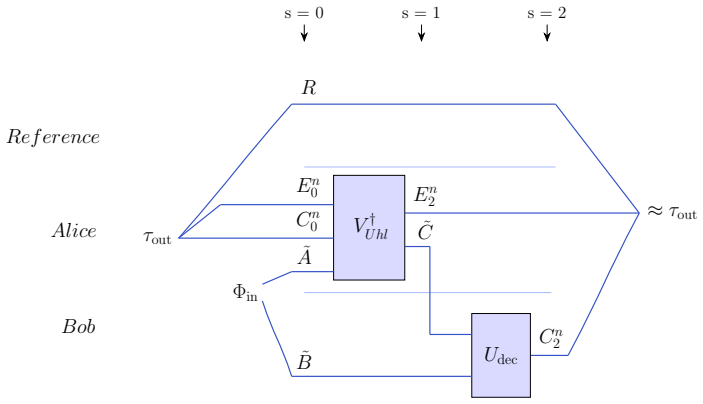
Using the type-constrained de Finetti reduction for classical probability distributions, the paper proves that the prior-free quantum information cost equals the worst-case input amortized quantum communication cost for quantum interactive communication protocols with classical inputs.
What carries the argument
The type-constrained de Finetti reduction, which uses the input type to map permutation-invariant worst-case inputs to i.i.d. instances without altering the cost equality.
If this is right
- Protocol compression rates can be computed via i.i.d. techniques even when inputs are chosen adversarially.
- The prior-free information cost fully determines the amortized communication cost in the worst-case setting.
- Proofs of cost equalities in quantum communication become available through direct application of type properties rather than more involved reductions.
Where Pith is reading between the lines
- The same type constraint might be adapted to other quantum tasks that admit classical inputs and permutation symmetry.
- If the method extends beyond classical inputs, it could simplify analysis of fully quantum interactive protocols.
Load-bearing premise
The inputs to the protocols must possess permutation-invariance symmetry so the type-constrained reduction can convert worst-case analysis to i.i.d. analysis while keeping the equality valid.
What would settle it
An explicit interactive protocol with classical inputs satisfying permutation symmetry for which the prior-free quantum information cost differs numerically from the worst-case amortized communication cost would falsify the equality.
Figures



read the original abstract
For many information processing tasks, de Finetti-style theorems can often simplify the analysis in worst-case input scenarios for which the task exhibits some permutation-invariance symmetry, as they can allow for a reduction from an analysis on worst-case inputs to that of i.i.d. inputs. If further information is available on the inputs, it might be advantageous to reflect this information in the de Finetti reduction. In our work, we focus on a form of such constraint, based on the type of the input. This allows us to obtain a conceptually simple proof of a new de Finetti reduction for classical probability distributions, derived from elementary properties from the method of types. We apply our constrained de Finetti reduction to the compression of quantum interactive communication protocols with classical inputs, and prove that the prior-free quantum information cost equals the worst-case input amortized quantum communication cost.
Editorial analysis
A structured set of objections, weighed in public.
Referee Report
Summary. The manuscript introduces a type-constrained de Finetti reduction for classical distributions, obtained from elementary method-of-types properties. It applies the reduction to quantum interactive communication protocols with classical inputs and proves that the prior-free quantum information cost equals the worst-case-input amortized quantum communication cost.
Significance. If valid, the result equates two central quantities in asymptotic quantum communication, allowing worst-case analysis to be reduced to the i.i.d. case via input-type symmetry. The elementary derivation from method-of-types properties is a strength, as it avoids additional parameters or ad-hoc constructions.
major comments (1)
- [Application to quantum interactive communication (post-abstract)] Application to interactive protocols: the type-constrained reduction maps worst-case inputs to i.i.d. inputs only if permuting the classical input string leaves the sequence of quantum messages and measurements statistically equivalent. The manuscript does not verify that conditional quantum operations (generated round-by-round on prior outcomes) commute with arbitrary input permutations; without this, a non-vanishing discrepancy may survive the asymptotic limit and undermine the claimed equality.
minor comments (1)
- The abstract states that the reduction 'follows from elementary method-of-types properties' but does not indicate where the error terms or type-class size bounds are controlled; a short explicit statement of the reduction theorem (with its error scaling) would improve readability.
Simulated Author's Rebuttal
We thank the referee for their careful reading of the manuscript and for the positive evaluation of its significance. We address the single major comment below.
read point-by-point responses
-
Referee: Application to interactive protocols: the type-constrained reduction maps worst-case inputs to i.i.d. inputs only if permuting the classical input string leaves the sequence of quantum messages and measurements statistically equivalent. The manuscript does not verify that conditional quantum operations (generated round-by-round on prior outcomes) commute with arbitrary input permutations; without this, a non-vanishing discrepancy may survive the asymptotic limit and undermine the claimed equality.
Authors: We appreciate the referee highlighting this subtlety. The manuscript applies the type-constrained de Finetti reduction to the classical inputs of the interactive protocol; because the inputs are classical, a permutation of the input string induces a corresponding relabeling of the protocol's local classical processing steps. The quantum messages and measurements are generated conditionally on these classical values and prior outcomes, but the overall joint distribution remains invariant under such relabelings when the input type is held fixed, as the protocol treats each input instance symmetrically in the amortized setting. Nevertheless, the manuscript does not contain an explicit verification of this invariance. We will add a short clarifying paragraph in the application section to state this symmetry explicitly and confirm that no non-vanishing discrepancy arises in the asymptotic limit. revision: yes
Circularity Check
No significant circularity; derivation applies new reduction to obtain equality
full rationale
The paper first derives a type-constrained de Finetti reduction for classical distributions from elementary method-of-types properties, then applies this reduction to interactive quantum communication protocols under a permutation-invariance assumption on classical inputs. The claimed equality (prior-free QIC equals worst-case amortized QC) is presented as a consequence of this application rather than being presupposed by the definition of either quantity or by any fitted parameter. No equations or steps reduce a prediction to an input by construction, and no load-bearing self-citation chain or smuggled ansatz is exhibited. The derivation remains self-contained against the external symmetry assumption.
Axiom & Free-Parameter Ledger
axioms (1)
- standard math Elementary properties of the method of types for classical probability distributions
Reference graph
Works this paper leans on
-
[1]
Round-preserving asymptotic compression of prior-free interactive protocols,
G. Padda and D. Touchette, “Round-preserving asymptotic compression of prior-free interactive protocols,” in2025 IEEE Information Theory Workshop (ITW), 2025, pp. 1–6
2025
-
[2]
Near-optimal bounds on bounded-round quantum communication complexity of disjointness,
M. Braverman, A. Garg, Y. Ko, J. Mao, and D. Touchette, “Near-optimal bounds on bounded-round quantum communication complexity of disjointness,” inProceedings - 2015 IEEE 56th Annual Symposium on Foundations of Computer Science, FOCS 2015, ser. Proceedings - Annual IEEE Symposium on Foundations of Computer Science, FOCS. United States: IEEE Computer Socie...
2015
-
[3]
D. Touchette, “Quantum information complexity,” inProceedings of the Forty-Seventh Annual ACM Symposium on Theory of Computing, ser. STOC ’15. New York, NY, USA: Association for Computing Machinery, 2015, p. 317–326. [Online]. Available: https://doi.org/10.1145/2746539.2746613
-
[4]
Postselection technique for quantum channels with applications to quantum cryptography,
M. Christandl, R. K¨ onig, and R. Renner, “Postselection technique for quantum channels with applications to quantum cryptography,”Phys. Rev. Lett., vol. 102, p. 020504, Jan 2009. [Online]. Available: https://link.aps.org/doi/10.1103/PhysRevLett.102.020504
-
[5]
Reliable quantum state tomography,
M. Christandl and R. Renner, “Reliable quantum state tomography,”Phys. Rev. Lett., vol. 109, p. 120403, Sep 2012. [Online]. Available: https://link.aps.org/doi/10.1103/PhysRevLett.109.120403 47
-
[6]
The quantum reverse Shannon theorem based on one-shot information theory,
M. Berta, M. Christandl, and R. Renner, “The quantum reverse Shannon theorem based on one-shot information theory,”Communications in Mathematical Physics, vol. 306, no. 3, p. 579–615, Aug. 2011. [Online]. Available: http://dx.doi.org/10.1007/s00220-011-1309-7
-
[7]
Flexible constrained de Finetti reductions and applications,
C. Lancien and A. Winter, “Flexible constrained de Finetti reductions and applications,” Journal of Mathematical Physics, vol. 58, no. 9, p. 092203, 09 2017. [Online]. Available: https://doi.org/10.1063/1.5003633
-
[8]
de Finetti reductions for correlations,
R. Arnon-Friedman and R. Renner, “de Finetti reductions for correlations,”Journal of Mathematical Physics, vol. 56, no. 5, p. 052203, 05 2015. [Online]. Available: https://doi.org/10.1063/1.4921341
-
[9]
Postselection technique for optical quantum key distribution with improved de finetti reductions,
S. Nahar, D. Tupkary, Y. Zhao, N. L¨ utkenhaus, and E. Y.-Z. Tan, “Postselection technique for optical quantum key distribution with improved de finetti reductions,”PRX Quantum, vol. 5, p. 040315, Oct
-
[10]
[Online]. Available: https://link.aps.org/doi/10.1103/PRXQuantum.5.040315
-
[11]
A doubly composite chernoff-stein lemma and its applications,
L. Lami, “A doubly composite chernoff-stein lemma and its applications,” 2025. [Online]. Available: https://arxiv.org/abs/2510.06342
arXiv 2025
-
[12]
Quantum data processing and error correction,
B. Schumacher and M. A. Nielsen, “Quantum data processing and error correction,”Physical Review A, vol. 54, no. 4, p. 2629, 1996
1996
-
[13]
M. Horodecki, J. Oppenheim, and A. Winter, “Partial quantum information,”Nature, vol. 436, no. 7051, p. 673–676, Aug. 2005. [Online]. Available: http://dx.doi.org/10.1038/nature03909
-
[14]
Quantum state merging and negative information,
——, “Quantum state merging and negative information,”Communications in Mathematical Physics, vol. 269, no. 1, p. 107–136, Oct. 2006. [Online]. Available: http://dx.doi.org/10.1007/s00220-006-0118-x
-
[15]
The mother of all protocols: restructuring quantum information’s family tree,
A. Abeyesinghe, I. Devetak, P. Hayden, and A. Winter, “The mother of all protocols: restructuring quantum information’s family tree,”Proceedings of the Royal Society A: Mathematical, Physical and Engineering Sciences, vol. 465, no. 2108, p. 2537–2563, Jun. 2009. [Online]. Available: http://dx.doi.org/10.1098/rspa.2009.0202
-
[16]
Entanglement-assisted capacity of a quantum channel and the reverse Shannon theorem,
C. H. Bennett, P. W. Shor, J. A. Smolin, and A. V. Thapliyal, “Entanglement-assisted capacity of a quantum channel and the reverse Shannon theorem,”IEEE Transactions on Information Theory, vol. 48, no. 10, pp. 2637–2655, 2002
2002
-
[17]
M. M. Wilde,Quantum Information theory. Cambridge University Press, 2017
2017
-
[18]
The quantum reverse Shannon theorem and resource tradeoffs for simulating quantum channels,
C. H. Bennett, I. Devetak, A. W. Harrow, P. W. Shor, and A. Winter, “The quantum reverse Shannon theorem and resource tradeoffs for simulating quantum channels,”IEEE Transactions on Information Theory, vol. 60, no. 5, p. 2926–2959, 2014
2014
-
[19]
Exact cost of redistributing multipartite quantum states,
I. Devetak and J. Yard, “Exact cost of redistributing multipartite quantum states,”Phys. Rev. Lett., vol. 100, p. 230501, Jun 2008. [Online]. Available: https://link.aps.org/doi/10.1103/PhysRevLett.100.230501
-
[20]
Quantum circuit complexity,
A. C.-C. Yao, “Quantum circuit complexity,” inProceedings of 1993 IEEE 34th Annual Foundations of Computer Science. IEEE, 1993, pp. 352–361
1993
-
[21]
Substituting quantum entanglement for communication,
R. Cleve and H. Buhrman, “Substituting quantum entanglement for communication,”Phys. Rev. A, vol. 56, pp. 1201–1204, Aug 1997. [Online]. Available: https://link.aps.org/doi/10.1103/PhysRevA.56.1201
-
[22]
Quantum state redistribution based on a generalized decoupling,
M.-Y. Ye, Y.-K. Bai, and Z. D. Wang, “Quantum state redistribution based on a generalized decoupling,” Physical Review A, vol. 78, no. 3, p. 030302, sept 2008, arXiv:0805.1542 [quant-ph]. [Online]. Available: http://arxiv.org/abs/0805.1542
Pith/arXiv arXiv 2008
-
[23]
Symmetry and quantum information,
M. Walter, “Symmetry and quantum information,” 2018, lecture notes
2018
-
[24]
State redistribution as merging: introducing the coherent relay,
J. Oppenheim, “State redistribution as merging: introducing the coherent relay,” 2008. [Online]. Available: https://arxiv.org/abs/0805.1065 48
Pith/arXiv arXiv 2008
discussion (0)
Sign in with ORCID, Apple, or X to comment. Anyone can read and Pith papers without signing in.