REVIEW 4 major objections 7 minor 16 references
ContextQFormer: A New Context Modeling Method for Multi-Turn Multi-Modal Conversations
T0 review · 4 major / 7 minor · reviewed 2026-08-07 · deepseek-v4-flash
Pith's one-line read ContextQFormer stores past images and turns as compact tokens in a memory queue, and this lifts long multi-turn multimodal dialogue quality by 2-4% over baselines.
desk verdict The module is a plausible engineering contribution, but the headline 2-4% gain rests on a GPT-4 judge that never sees the images and on a 329-dialogue comparison with no error bars. read the letter →
The pith
A machine-rendered reading of the paper's core claim, the machinery that carries it, and where it could break.
The reading
What carries the argument
The central object is the ContextQFormer memory queue: a first-in-first-out buffer of [CLS] token embeddings, one per image (from ViT) and one per text turn (from RoBERTa), which is fused with the current instruction through Q-Former-style cross-attention. The queue gives the model a fixed-size memory of the whole dialogue without extending the self-attention context window, and it is the component whose removal produces the LoRA-only baseline.
What would settle it
Run the 329 TMDialog-Eva samples with human raters (or an image-capable judge) who see the actual images, and recompute available rates; if ContextQFormer's gap over LoRA-only disappears or reverses, the claimed improvement is an artifact of description-based scoring.
Extended reading notes
Core claim
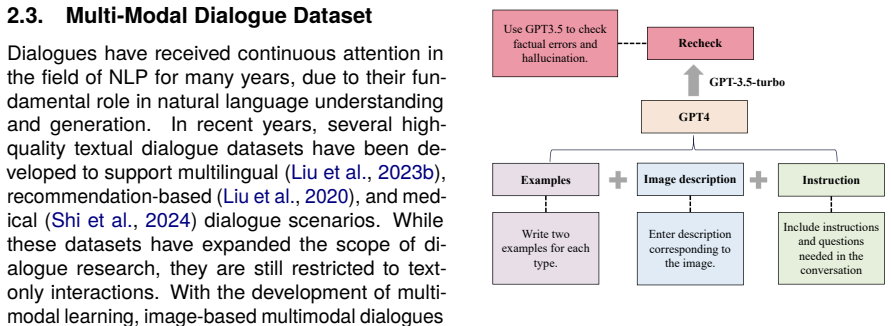
ContextQFormer is a Q-Former-style module with an attached memory queue. For every image and every text turn in the dialogue, a [CLS] token is extracted with ViT or RoBERTa and pushed into the queue; when a new instruction arrives, learnable queries first self-attend over the instruction and then cross-attend over the queued historical representations, so a late question can reactivate an image or fact from many turns earlier. On the 329-sample TMDialog-Eva benchmark, ContextQFormer reaches a 68.17% available rate versus 64.01% for LoRA-only, 66.40% for mPLUG-owl, and 62.46% for visualGLM, with the largest gains in interaction, long-memory, and multi-image categories. The authors claim the module can be inserted into larger models without full fine-tuning, and they observe that the GPT-4-generated training data may cap performance below GPT-4 itself.
Load-bearing premise
The evaluation assumes that a GPT-4 judge can score rationality and hallucination correctly from a text description of each image rather than from the image itself, and that those descriptions capture everything a model could see.
Editorial extensions
If this is right
- Adding ContextQFormer to a LoRA fine-tune of a frozen 7B LLM improves long-context response quality without changing the training data or loss.
- The biggest gains appear in interaction, long-memory, and multi-image categories, while short continuous-question dialogues show little difference across methods.
- The available rate metric, defined as the percentage of responses that are both rational and non-hallucinated, offers a single scalar for comparing multimodal dialogue models.
- TMDialog, with average dialogue length around 46 tokens and most conversations image-relevant, gives the community a long-context resource for pretraining, instruction tuning, and evaluation.
- Because the module is separate from the frozen LLM, it can be appended to larger models without full fine-tuning.
Reading between the lines
- If description-based scoring is replaced with a judge that sees actual images, the reported 2-4% advantage could shrink or grow; this is testable with an image-capable judge.
- The memory-queue idea could extend to other modalities such as audio or video, or to streaming settings where the context window must stay bounded.
- The gain on long-memory questions suggests a natural extension: evict stale queue entries or weight queue items by recency and relevance instead of using a plain FIFO queue.
- Because TMDialog is generated by GPT-4, models trained on it may implicitly match GPT-4's text-description style, which could inflate scores from a GPT-4 judge.
Signed reviews
Editorial analysis
A structured set of objections, weighed in public.
Referee Report
Summary. The paper proposes ContextQFormer, a module that maintains a queue of [CLS] features from past visual and textual turns and fuses them with the current instruction via learnable queries and cross-attention, aiming to improve long-context multi-turn multimodal dialogue. The authors also construct TMDialog, a GPT-4-generated dataset for pre-training, instruction tuning, and evaluation, with an evaluation benchmark of 329 handwritten multi-turn dialogues. They train LLaMA-7B with LoRA plus ContextQFormer and compare against LoRA-only, mPLUG-owl, and visualGLM, reporting an "available rate" (rational and non-hallucinated responses) of 68.17% for ContextQFormer versus 64.01% for LoRA-only, 66.40% for mPLUG-owl, and 62.46% for visualGLM. The central claim is that the memory-queue module improves response quality in long-context settings beyond identical training without the module.
Significance. If the result holds, ContextQFormer offers a lightweight, parameter-efficient way to improve multi-turn multimodal LLMs without full fine-tuning, and TMDialog could be a useful resource for long-context dialogue research. The controlled LoRA-only comparison is the right experimental design and gives the paper independent grounding for its central claim. The paper also contributes a new benchmark and a clear evaluation metric, and the authors openly discuss limitations such as model-collapse risks from synthetic data. However, the current evidence is weakened by the evaluation protocol (a text-only GPT-4 judge that cannot see images), the small benchmark size with no significance testing, and an internal inconsistency in the dataset statistics; these issues make the headline 2%-4% improvement less convincing than it appears.
major comments (4)
- [§5.2] The evaluation protocol is load-bearing for the central claim: hallucination is defined as content "not present in the image or information that cannot be inferred from it," yet the GPT-4 judge receives only a text description of each image and the dialogue history. As the paper states, "The evaluation is based on the image description and the dialogue history input." A judge that cannot see the image cannot verify whether a response is grounded; it can only check consistency with the provided description. This is not a symmetric error: ContextQFormer is designed to activate more historical and visual information and may produce more specific visual claims, which a text-only judge might mark as unverifiable or hallucinated, while a generic response that matches the description could be scored as rational. I request an image-grounded evaluation (e.g., GPT-4V or human annotators viewing the images) or at least a human spot-check on a random sample, and a per-category analysis of judge errors, to establish that the LoRA-only gap is not an artifact of description coverage.
- [Table 5] The main results are reported from a single evaluation run on 329 benchmark dialogues with no confidence intervals, significance tests, or error analysis. For a binary per-dialogue available-rate outcome, the difference between 68.17% and 64.01% (4.16 percentage points) has an approximate standard error of 3-4 percentage points (sqrt(p(1-p)/n) for n≈329 per group, two-group difference), so the observed gap is about one standard error. The paper states "our method exhibits a 4.2% improvement in the available rate compared to Lora-only" and treats this as decisive, but the evidence is not statistically persuasive. Please provide bootstrap confidence intervals across the 329 dialogues, report the number of response-level units evaluated, and if possible run the evaluation multiple times or across judge temperature settings to quantify stability.
- [Tables 2 and 4] There is a direct internal inconsistency in the dataset characterization. Table 2 reports that TMDialog-IT has an average of 4.83 turns and an average length of 51.20, while Table 4 lists TMDialog-IT as having 9.1 average turns and 46.2 average length. The paper's abstract and Section 3.3 claim that TMDialog contains "longer conversations" than other datasets, a claim that depends on these statistics. The discrepancy must be resolved: either the numbers in Table 4 are for a different subset (e.g., only the generated portion vs. the full set), or one table is erroneous. Without clarification, the dataset's reported properties are unreliable and the comparison to ImageChat and VisualDialogue is unverifiable.
- [§5.3] The comparison against mPLUG-owl and visualGLM is not controlled: these external baselines were not trained or instruction-tuned on TMDialog-IT, whereas ContextQFormer and LoRA-only were trained on TMDialog-IT and the same TMDialog-PT. The abstract's claim of a "2%-4% improvement over baselines" conflates the controlled LoRA-only comparison with these uncontrolled ones. The only controlled comparison is LoRA-only, which is the appropriate ablation. Please either fine-tune the external baselines on TMDialog-IT (if feasible with the same budget), or clearly state in the abstract and Section 5.3 that mPLUG-owl and visualGLM are evaluated zero-shot and that the state-of-the-art claim is limited to the controlled LoRA-only comparison.
minor comments (7)
- [Abstract] The abstract states an "improvement of 2%-4% in available rate," but Table 5 shows improvements of 1.77 percentage points over mPLUG-owl, 4.16 points over LoRA-only, and 5.71 points over visualGLM. Please use precise percentage-point numbers or a range that matches the data.
- [§1] In the introduction, the text says "As demonstrated in Figure 2, previous multi-modal LLMs may miss out on essential context," but Figure 2 in the paper is titled "The process of data generation." The correct reference appears to be Figure 1 or a new figure showing the baseline failure modes.
- [§6] The section heading "Limation" should be "Limitations." Additionally, in §4.2, "prat prompts" should be "prompt templates" or similar, and "training object" should be "training objective."
- [§3.1] The phrase "two examples of handwriting" is unclear; it likely means "handwritten examples" or "manually written examples." Please rephrase.
- [§4.2] The text says visual features are extracted with "the pre-trained ViT" and textual features with "Roberta." Use the standard capitalization "RoBERTa" and specify the exact checkpoint (e.g., RoBERTa-base) and the source of the ViT (e.g., CLIP ViT-L/14) for reproducibility.
- [§5.2] The evaluation prompt is described only schematically as "<History><Description><Instruction>". Including the full prompt (or an appendix) would strengthen reproducibility and allow readers to assess the judge's instructions for rationality, information, hallucination, and safety.
- [Table 3] The table lists "Continuous Question" as a category with 199 samples, but the text in §3.2 says the benchmark includes "two types called Long Conversation and Continuous Question" in addition to the three instruction-tuning types. Please ensure the type names and counts are consistent across the text and table.
Circularity Check
No significant circularity: the main ContextQFormer vs. LoRA-only comparison is a controlled ablation, and the GPT-4-based evaluation is a proxy-validity concern rather than a reduction by construction.
full rationale
The paper's central empirical claim is that ContextQFormer raises the available rate by 2%–4% over baselines. The comparison that carries this claim is ContextQFormer against LoRA-only, which Section 5.3 states is obtained by removing the context-modeling module while maintaining the same training data and configuration; hence the gap is not fitted from the evaluation set and is not equivalent to the module's input by construction. The evaluation benchmark (TMDialog-Eva) is a separately handwritten set of 329 samples, not the GPT-4-generated training data. GPT-4 does act as both a data generator for TMDialog-IT and as the judge, and Section 5.2 explicitly states that scoring is based on image descriptions rather than images; this is a real threat to construct validity because hallucination is defined relative to the image but checked against a text proxy. However, it is not circularity: the available-rate score is not defined as 'GPT-4 agreement' and the same judge/description protocol is applied to all methods, so the ContextQFormer advantage is not forced by the definition. No load-bearing self-citations, uniqueness theorems, or ansatz-by-citation steps appear; the Q-Former architecture is cited to external BLIP-2 work. The paper's own Limation section discloses the GPT-4-generated-data risk. The lack of error bars is a statistical reporting concern, not a circularity.
Assumptions & free parameters
free parameters (1)
- ContextQFormer queue capacity and number of learnable queries =
not reported
assumptions (4)
- domain assumption The [CLS] token output of ViT and RoBERTa is a sufficient representation of an image or utterance for historical context.
- domain assumption The image descriptions in TMDialog-Eva faithfully represent the images they describe.
- domain assumption GPT-4 scoring of rationality, information, hallucination, and safety from text descriptions is a valid measure of response quality.
- domain assumption The LoRA-only ablation isolates the effect of ContextQFormer.
Cite this review
Pith. "Pith review of ContextQFormer: A New Context Modeling Method for Multi-Turn Multi-Modal Conversations." pith.science (2026). https://pith.science/paper/TY3LLDH2
@misc{pith2026250523121,
  author       = {Pith},
  title        = {Pith review of: ContextQFormer: A New Context Modeling Method for Multi-Turn Multi-Modal Conversations},
  year         = {2026},
  howpublished = {\url{https://pith.science/paper/TY3LLDH2}},
  note         = {Machine review of arXiv:2505.23121}
}
read the original abstract
Multi-modal large language models have demonstrated remarkable zero-shot abilities and powerful image-understanding capabilities. However, the existing open-source multi-modal models suffer from the weak capability of multi-turn interaction, especially for long contexts. To address the issue, we first introduce a context modeling module, termed ContextQFormer, which utilizes a memory block to enhance the presentation of contextual information. Furthermore, to facilitate further research, we carefully build a new multi-turn multi-modal dialogue dataset (TMDialog) for pre-training, instruction-tuning, and evaluation, which will be open-sourced lately. Compared with other multi-modal dialogue datasets, TMDialog contains longer conversations, which supports the research of multi-turn multi-modal dialogue. In addition, ContextQFormer is compared with three baselines on TMDialog and experimental results illustrate that ContextQFormer achieves an improvement of 2%-4% in available rate over baselines.
Figures


Figures from the paper (3 more)


Reference graph
Works this paper leans on
-
[1]
Introduction Large language models (LLMs) lie at the heart of natural language processing and artificial intel- ligence (OpenAI, 2023; Xu et al., 2023; Tu et al., 2023; Singhal et al., 2023) thanks to their astonish- ing capabilities in natural language generation. To further expand the capabilities of large language models, multi-modal models are develop...
work page 2023
-
[2]
Related Work 2.1. Multi-Modal Large Language Models Whilelargelanguagemodels(LLMs)haveachieved significant success in natural language process- ing, other modalities such as vision and audio in combination with LLMs are still in the exploratory stage. Existing fusion methods for multi-modal LLMs can generally be categorized into three dif- ferent paradigm...
work page 2023
-
[3]
Dataset The data required during the experiment can be categorized into two parts. The first part comprises the data used for training, including multi-modal pretraining and instruction tuning. The second part consists of the proposed benchmark, which effec- tivelyevaluatesthecapabilitiesofmulti-modallarge language models in multi-turn dialogue tasks. Thu...
work page 2011
-
[4]
To reduce hallucinations, GPT-3.5 is utilized to recheck the output. Statistics show that dialogues in TMDialog are much longer, with more relevant questions and answers, than other datasets. To facilitate model comparison, we conduct bench-marking experiments on the dataset. Specif- ically, experiments are conducted on mPLUG- owl (Ye et al., 2023), visua...
work page 2023
-
[5]
Experiments 5.1. Experimental Setup During the pre-training and fine-tuning phases, we execute a total of 40,000 and 10,000 training itera- tions, respectively. For hardware, we employ four clusters of 8 A100(80GB) GPUs and one cluster of 8 V100(32GB) GPUs, with batch sizes per GPU of 256 and 32 for the pre-training and instruction- tuning,respectively. T...
work page 2023
-
[6]
Method To achieve an effective multi-modal large language model, we propose a two-stage training approach. The purpose of the first stage is to align the image encoder and the text decoder to acquire vision-language knowledge by utilizing amounts of TMDialog-PT TMDialog-IT Give this picture a suitable name. Okay, a picture name that blends animal elements...
work page 2023
-
[7]
Conclusion In this paper, we propose a two-stage learning framework to enhance the model’s visual under- standing and instruction-following ability. We intro- duce a method that effectively utilizes the GPT-4 API for multi-modal multi-turn dialogue data gen- erating. We carefully build a train and evalua- tion dataset for multi-modal multi-turn dialogue t...
-
[8]
Limation Due to the high cost of manual labeling, a consider- ableportionofthetrainingdataisgenerateddirectly using the GPT-4 API. While we applied prompt en- gineering techniques and performed data filtering andmodification,itispossiblethatsomelow-quality dialogues remain in the resulting dataset. More- over, researchers (Shumailov et al., 2023) have dem...
work page 2023
Show all 16 references
-
[10]
Bibliographical References Jean-Baptiste Alayrac, Jeff Donahue, Pauline Luc, Antoine Miech, Iain Barr, Yana Hasson, Karel Lenc, Arthur Mensch, Katherine Millican, Mal- colm Reynolds, Roman Ring, Eliza Ruther- ford, Serkan Cabi, Tengda Han, Zhitao Gong, Sina Samangooei, Mariann...
2022 arXiv
-
[12]
Jiazhan Feng, Qingfeng Sun, Can Xu, Pu Zhao, Yaming Yang, Chongyang Tao, Dongyan Zhao, and Qingwei Lin
Addressing some limitations of trans- formers with feedback memory.arXiv preprint arXiv:2002.09402. Jiazhan Feng, Qingfeng Sun, Can Xu, Pu Zhao, Yaming Yang, Chongyang Tao, Dongyan Zhao, and Qingwei Lin. 2022. Mmdialog: A large- scale multi-turn dialogue dataset towards multi-...
2002 arXiv
-
[15]
Kurt Shuster, Samuel Humeau, Antoine Bordes, and Jason Weston
The curse of recursion: Training on gen- erated data makes models forget.arXiv preprint arxiv:2305.17493. Kurt Shuster, Samuel Humeau, Antoine Bordes, and Jason Weston. 2018. Image chat: En- gaging grounded conversations.arXiv preprint arXiv:1811.00945. Karan Singhal, Shekoofe...
2018 arXiv
-
[16]
arXiv preprint arXiv:2303.11381
Mm-react: Prompting chatgpt for mul- timodal reasoning and action. arXiv preprint arXiv:2303.11381. Qinghao Ye, Haiyang Xu, Guohai Xu, Jiabo Ye, Ming Yan, Yiyang Zhou, Junyang Wang, An- wen Hu, Pengcheng Shi, Yaya Shi, et al. 2023. mplug-owl: Modularization empowers large lan-...
2023 arXiv
-
[2011]
Jordi Pont-Tuset, Jasper Uijlings, Soravit Chang- pinyo, Radu Soricut, and Vittorio Ferrari
Im2text: Describing images using 1 mil- lion captioned photographs.Advances in neural information processing systems, 24. Jordi Pont-Tuset, Jasper Uijlings, Soravit Chang- pinyo, Radu Soricut, and Vittorio Ferrari. 2020. Connecting vision and language with localized narratives...
2020 arXiv
-
[2019]
Abhishek Das, Satwik Kottur, Khushi Gupta, Avi Singh, Deshraj Yadav, José MF Moura, Devi Parikh, and Dhruv Batra
Transformer-xl: Attentive language mod- els beyond a fixed-length context.arXiv preprint arXiv:1901.02860. Abhishek Das, Satwik Kottur, Khushi Gupta, Avi Singh, Deshraj Yadav, José MF Moura, Devi Parikh, and Dhruv Batra. 2017. Visual dialog. In Proceedings of the IEEE conferen...
1901 arXiv
-
[2020]
are capable of processing long inputs, they may still struggle to capture crucial contextual in- formation in exceptionally lengthy texts. As demon- strated in Figure 2, previous multi-modal LLMs may miss out on essential context from preceding text because of the accumulation...
2023 arXiv
-
[2023]
Xiaoming Shi, Zeming Liu, Li Du, Yuxuan Wang, Hongru Wang, Yuhang Guo, Tong Ruan, Jie Xu, Xiaofan Zhang, and Shaoting Zhang
Hugginggpt: Solving ai tasks with chat- gpt and its friends in huggingface.arXiv preprint arXiv:2303.17580. Xiaoming Shi, Zeming Liu, Li Du, Yuxuan Wang, Hongru Wang, Yuhang Guo, Tong Ruan, Jie Xu, Xiaofan Zhang, and Shaoting Zhang. 2024. Med- ical dialogue system: A survey of...
2024 arXiv
Reviewed August 7, 2026 · model on record in the stance chip above.
Discussion (0). Continue with ORCID to comment.