Thick branes and fermion localization in five-dimensional f(T,T_G) gravity
Pith reviewed 2026-05-20 05:10 UTC · model grok-4.3
The pith
In five-dimensional f(T,T_G) gravity the torsional Gauss-Bonnet term deforms thick branes and produces a normalizable chiral fermion zero mode together with resonant massive states.
A machine-rendered reading of the paper's core claim, the machinery that carries it, and where it could break.
Core claim
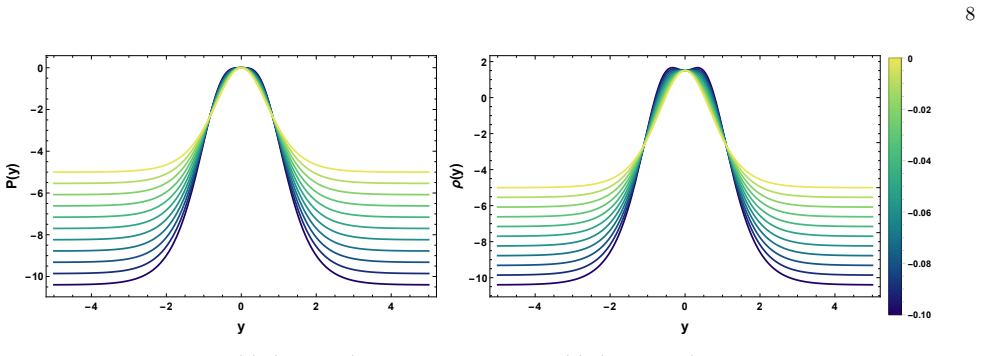
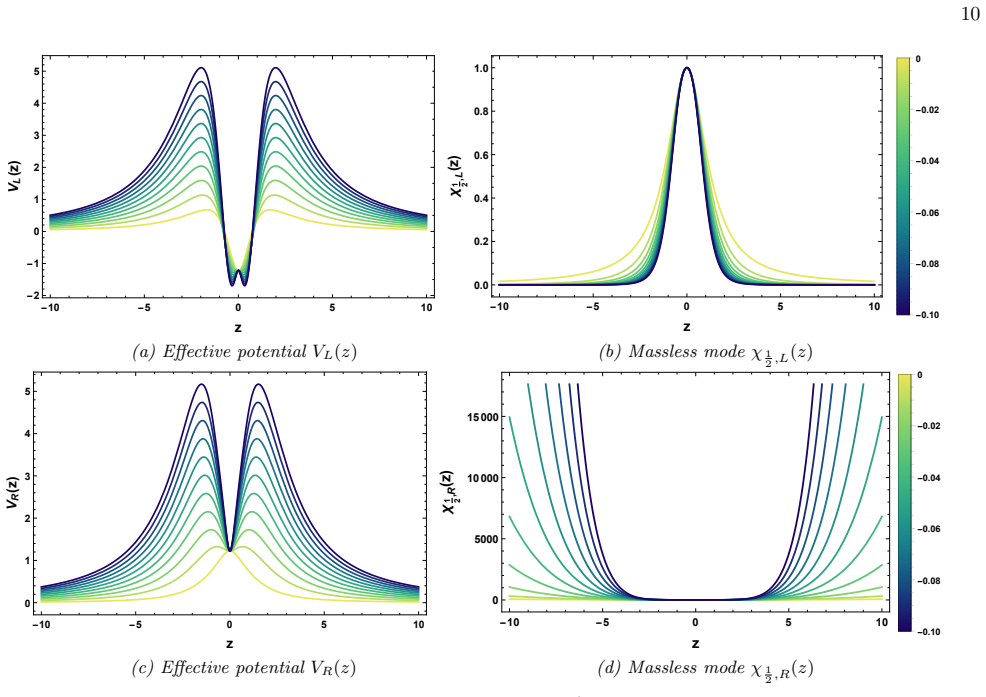
Within a warped geometry supported by a scalar field, we construct explicit solutions and show that the T_G sector significantly modifies the brane structure. In particular, the coupling parameter controls the deformation of the warp factor and energy density, allowing for the emergence of brane splitting and nontrivial internal structure. We further analyze the localization of spin-1/2 fermions via a Yukawa coupling. The system admits a normalizable chiral zero mode, while the opposite chirality remains delocalized. The massive Kaluza-Klein spectrum is strongly affected by the torsional Gauss-Bonnet term, which modifies the effective potentials and leads to the appearance of resonant quasi-
What carries the argument
The torsional Gauss-Bonnet invariant T_G appearing in the five-dimensional f(T,T_G) action, which supplies an additional dynamical contribution to the warped metric and to the effective potentials felt by fermions.
If this is right
- The coupling parameter in f(T,T_G) can be tuned to produce brane splitting and a rich internal energy-density profile.
- A single chiral zero mode for fermions is normalizable and trapped on the brane while the opposite chirality is not.
- Modified effective potentials for massive Kaluza-Klein fermions produce resonant quasi-localized states.
- f(T,T_G) gravity supplies a broader class of braneworld geometries than standard teleparallel or Einstein gravity.
Where Pith is reading between the lines
- The same T_G-induced deformation mechanism could be examined in other extra-dimension scenarios to see whether splitting persists when the scalar field potential is changed.
- Resonant massive modes might leave observable signatures in collider or cosmological data if the extra dimension is not too far above the electroweak scale.
- Analogous torsional corrections could be studied in six- or higher-dimensional braneworld models to test the robustness of the localization results.
Load-bearing premise
The warped geometry ansatz supported by a scalar field admits consistent explicit solutions for the metric, warp factor, and energy density under the f(T,T_G) field equations.
What would settle it
Substitute the reported warp-factor and scalar-field profiles into the full set of f(T,T_G) field equations and verify that they are satisfied; any mismatch would show that the claimed brane solutions and the resulting localization properties do not hold.
Figures




read the original abstract
We investigate thick-brane configurations in five-dimensional $f(T,T_G)$ modified teleparallel gravity. In five dimensions, the torsional Gauss-Bonnet invariant $T_G$ contributes dynamically, leading to genuinely new effects even at linear order. Within a warped geometry supported by a scalar field, we construct explicit solutions and show that the $T_G$ sector significantly modifies the brane structure. In particular, the coupling parameter controls the deformation of the warp factor and energy density, allowing for the emergence of brane splitting and nontrivial internal structure. We further analyze the localization of spin-$1/2$ fermions via a Yukawa coupling. The system admits a normalizable chiral zero mode, while the opposite chirality remains delocalized. The massive Kaluza-Klein spectrum is strongly affected by the torsional Gauss-Bonnet term, which modifies the effective potentials and leads to the appearance of resonant quasi-localized states.Our results show that $f(T,T_G)$ gravity provides a richer framework for braneworld models, where torsional higher-order corrections play a key role in shaping both geometry and field localization.
Editorial analysis
A structured set of objections, weighed in public.
Referee Report
Summary. The paper investigates thick brane configurations in five-dimensional f(T, T_G) modified teleparallel gravity. Within a warped geometry supported by a scalar field, explicit solutions are constructed showing that the T_G sector modifies the brane structure, with a coupling parameter controlling deformation of the warp factor and energy density to produce brane splitting and nontrivial internal structure. Fermion localization is studied via Yukawa coupling, yielding a normalizable chiral zero mode while the opposite chirality is delocalized; the massive Kaluza-Klein spectrum exhibits resonant quasi-localized states due to modifications of the effective potentials by the torsional Gauss-Bonnet term.
Significance. If the reported explicit solutions satisfy the full set of f(T, T_G) field equations, the work would demonstrate how torsional higher-order corrections enrich braneworld models by enabling controlled brane splitting and affecting fermion resonances, extending beyond standard teleparallel or Einstein gravity frameworks. The construction of explicit solutions and the identification of normalizable zero modes represent concrete strengths that could be falsifiable through the derived effective potentials.
major comments (2)
- [Section 3 (explicit solutions)] The central claim rests on explicit solutions for the warp factor A(y), scalar profile, and energy density within the warped ansatz. These must be shown to satisfy the complete f(T, T_G) field equations obtained by varying the action, including all linear-order contributions from the torsional Gauss-Bonnet invariant T_G; if the solutions are obtained only from a reduced system that neglects higher-order T_G terms, the reported deformation, splitting, and resonance effects would not follow from the theory.
- [Section 4 (fermion localization)] The effective potentials for the massive Kaluza-Klein fermions are stated to be strongly modified by the T_G term, leading to resonant states. The derivation of these potentials from the five-dimensional Dirac equation in the warped background must explicitly incorporate the torsional contributions at the level of the spin connection and metric functions to confirm that the resonances are not an artifact of the auxiliary assumptions used for the background.
minor comments (2)
- [Abstract and §1] The abstract and introduction should specify the explicit functional form chosen for f(T, T_G) at the outset, as the linear-order T_G effects depend on this choice.
- [Figures 1-2] In the plots of warp factor and energy density versus the extra dimension, the specific numerical values of the coupling parameter corresponding to the splitting cases should be indicated directly on the figures or in the captions for reproducibility.
Simulated Author's Rebuttal
We thank the referee for the thorough review and insightful comments on our manuscript. We address each of the major comments in detail below and have made revisions to the manuscript to enhance clarity and rigor.
read point-by-point responses
-
Referee: [Section 3 (explicit solutions)] The central claim rests on explicit solutions for the warp factor A(y), scalar profile, and energy density within the warped ansatz. These must be shown to satisfy the complete f(T, T_G) field equations obtained by varying the action, including all linear-order contributions from the torsional Gauss-Bonnet invariant T_G; if the solutions are obtained only from a reduced system that neglects higher-order T_G terms, the reported deformation, splitting, and resonance effects would not follow from the theory.
Authors: We appreciate the referee pointing out the necessity of verifying the solutions against the full field equations. In our work, the solutions were derived by substituting the warped metric ansatz into the complete set of field equations from the variation of the f(T, T_G) action. Since in five dimensions T_G contributes at linear order in the perturbations around the background, the equations are solved including these terms without reduction or neglect of higher-order contributions. The specific choice of f(T, T_G) allows analytic solutions that satisfy all components of the equations. To make this explicit, we have added a new subsection in Section 3 detailing the substitution and verification that the solutions fulfill the full field equations derived from the action. revision: yes
-
Referee: [Section 4 (fermion localization)] The effective potentials for the massive Kaluza-Klein fermions are stated to be strongly modified by the T_G term, leading to resonant states. The derivation of these potentials from the five-dimensional Dirac equation in the warped background must explicitly incorporate the torsional contributions at the level of the spin connection and metric functions to confirm that the resonances are not an artifact of the auxiliary assumptions used for the background.
Authors: We thank the referee for this comment, which helps strengthen the presentation. The effective potentials are derived from the five-dimensional Dirac equation, where the spin connection in the teleparallel formulation includes the torsional contributions. The warp factor A(y) and its derivatives, modified by the T_G term, enter the potentials through both the metric and the connection terms. We have revised Section 4 to include the explicit steps: starting from the Dirac equation with the full spin connection incorporating torsion, reducing to the effective 4D Schrödinger equation, and showing how the T_G-induced modifications to A(y) affect the potential shape leading to resonances. This confirms the effects are genuine consequences of the theory. revision: yes
Circularity Check
No significant circularity in derivation chain
full rationale
The paper derives explicit solutions for the warp factor, scalar profile, and energy density by assuming a standard five-dimensional warped metric ansatz supported by a scalar field and substituting into the field equations obtained from varying the f(T, T_G) action. The T_G contributions enter the equations at linear order and modify the resulting profiles for chosen values of the coupling parameter, leading to brane splitting and altered fermion potentials. These steps are independent: the solutions satisfy the modified teleparallel equations by construction of the ansatz, the localization analysis follows from the resulting effective potentials without renaming prior results or relying on load-bearing self-citations, and no fitted subset is relabeled as a prediction. The framework is self-contained against the stated assumptions and does not reduce the central claims to inputs by definition.
Axiom & Free-Parameter Ledger
free parameters (1)
- coupling parameter
axioms (1)
- domain assumption Warped geometry ansatz supported by a scalar field in five dimensions
Lean theorems connected to this paper
-
IndisputableMonolith/Foundation/AlexanderDuality.leanalexander_duality_circle_linking unclear?
unclearRelation between the paper passage and the cited Recognition theorem.
Within a warped geometry supported by a scalar field, we construct explicit solutions... f(T,T_G)=-T+αT_G... brane splitting and nontrivial internal structure.
What do these tags mean?
- matches
- The paper's claim is directly supported by a theorem in the formal canon.
- supports
- The theorem supports part of the paper's argument, but the paper may add assumptions or extra steps.
- extends
- The paper goes beyond the formal theorem; the theorem is a base layer rather than the whole result.
- uses
- The paper appears to rely on the theorem as machinery.
- contradicts
- The paper's claim conflicts with a theorem or certificate in the canon.
- unclear
- Pith found a possible connection, but the passage is too broad, indirect, or ambiguous to say the theorem truly supports the claim.
Reference graph
Works this paper leans on
-
[1]
On the Unification Problem in Physics
T. Kaluza, Sitzungsber. Preuss. Akad. Wiss. Berlin (Math. Phys. )1921, 966-972 (1921) [arXiv:1803.08616 [physics.hist- ph]]
work page internal anchor Pith review Pith/arXiv arXiv 1921
- [2]
-
[3]
The Hierarchy Problem and New Dimensions at a Millimeter
N. Arkani-Hamed, S. Dimopoulos and G. R. Dvali, Phys. Lett. B429, 263-272 (1998) [arXiv:hep-ph/9803315 [hep-ph]]
work page internal anchor Pith review Pith/arXiv arXiv 1998
-
[4]
New Dimensions at a Millimeter to a Fermi and Superstrings at a TeV
I. Antoniadis, N. Arkani-Hamed, S. Dimopoulos and G. R. Dvali, Phys. Lett. B436, 257-263 (1998) [arXiv:hep-ph/9804398 [hep-ph]]
work page internal anchor Pith review Pith/arXiv arXiv 1998
-
[5]
Braneworld models of dark energy
V. Sahni and Y. Shtanov, JCAP11, 014 (2003) [arXiv:astro-ph/0202346 [astro-ph]]
work page internal anchor Pith review Pith/arXiv arXiv 2003
-
[6]
J. E. Lidsey, S. Nojiri and S. D. Odintsov, JHEP06, 026 (2002) [arXiv:hep-th/0202198 [hep-th]]
work page internal anchor Pith review Pith/arXiv arXiv 2002
-
[7]
New Cosmological Singularities in Braneworld Models
Y. Shtanov and V. Sahni, Class. Quant. Grav.19, L101-L107 (2002) [arXiv:gr-qc/0204040 [gr-qc]]
work page internal anchor Pith review Pith/arXiv arXiv 2002
-
[8]
M. C. Bento, O. Bertolami and A. A. Sen, Phys. Rev. D67, 063511 (2003) [arXiv:hep-th/0208124 [hep-th]]
work page internal anchor Pith review Pith/arXiv arXiv 2003
-
[9]
Small localized black holes in a braneworld: Formulation and numerical method
H. Kudoh, T. Tanaka and T. Nakamura, Phys. Rev. D68, 024035 (2003) [arXiv:gr-qc/0301089 [gr-qc]]
work page internal anchor Pith review Pith/arXiv arXiv 2003
-
[10]
E. F. Eiroa, Phys. Rev. D71, 083010 (2005) [arXiv:gr-qc/0410128 [gr-qc]]
work page internal anchor Pith review Pith/arXiv arXiv 2005
-
[11]
Slow-roll parameters in braneworld cosmologies
G. Calcagni, Phys. Rev. D69, 103508 (2004) [arXiv:hep-ph/0402126 [hep-ph]]
work page internal anchor Pith review Pith/arXiv arXiv 2004
-
[12]
Quantum effects, soft singularities and the fate of the universe in a braneworld cosmology
P. Tretyakov, A. Toporensky, Y. Shtanov and V. Sahni, Class. Quant. Grav.23, 3259-3274 (2006) [arXiv:gr-qc/0510104 [gr-qc]]
work page internal anchor Pith review Pith/arXiv arXiv 2006
-
[13]
A. S. Majumdar and N. Mukherjee, Int. J. Mod. Phys. D14, 1095 (2005) [arXiv:astro-ph/0503473 [astro-ph]]
work page internal anchor Pith review Pith/arXiv arXiv 2005
-
[14]
Confronting Braneworld Cosmology with Supernova data and Baryon Oscillations
U. Alam and V. Sahni, Phys. Rev. D73, 084024 (2006) [arXiv:astro-ph/0511473 [astro-ph]]
work page internal anchor Pith review Pith/arXiv arXiv 2006
-
[15]
Observational constraints on phantom-like braneworld cosmologies
R. Lazkoz, R. Maartens and E. Majerotto, Phys. Rev. D74, 083510 (2006) [arXiv:astro-ph/0605701 [astro-ph]]
work page internal anchor Pith review Pith/arXiv arXiv 2006
-
[16]
E. N. Saridakis, Phys. Lett. B661, 335-341 (2008) [arXiv:0712.3806 [gr-qc]]
work page internal anchor Pith review Pith/arXiv arXiv 2008
-
[17]
F. S. N. Lobo, Phys. Rev. D75, 064027 (2007) [arXiv:gr-qc/0701133 [gr-qc]]
work page internal anchor Pith review Pith/arXiv arXiv 2007
-
[18]
Non-linear interactions in a cosmological background in the DGP braneworld
K. Koyama and F. P. Silva, Phys. Rev. D75, 084040 (2007) [arXiv:hep-th/0702169 [hep-th]]
work page internal anchor Pith review Pith/arXiv arXiv 2007
-
[19]
E. N. Saridakis, Nucl. Phys. B808, 224-236 (2009) [arXiv:0710.5269 [hep-th]]
work page internal anchor Pith review Pith/arXiv arXiv 2009
-
[20]
Profiles of emission lines generated by rings orbiting braneworld Kerr black holes
J. Schee and Z. Stuchlik, Gen. Rel. Grav.41, 1795-1818 (2009) [arXiv:0812.3017 [astro-ph]]
work page internal anchor Pith review Pith/arXiv arXiv 2009
-
[21]
M. R. Setare and E. N. Saridakis, JCAP03, 002 (2009) [arXiv:0811.4253 [hep-th]]
work page internal anchor Pith review Pith/arXiv arXiv 2009
-
[22]
Self-Consistent Cosmological Simulations of DGP Braneworld Gravity
F. Schmidt, Phys. Rev. D80, 043001 (2009) [arXiv:0905.0858 [astro-ph.CO]]
work page internal anchor Pith review Pith/arXiv arXiv 2009
-
[23]
Charged Particle Motion Around Rotating Black Hole in Braneworld Immersed in Magnetic Field
A. Abdujabbarov and B. Ahmedov, Phys. Rev. D81, 044022 (2010) [arXiv:0905.2730 [gr-qc]]
work page internal anchor Pith review Pith/arXiv arXiv 2010
-
[24]
Cosmological Simulations of Normal-Branch Braneworld Gravity
F. Schmidt, Phys. Rev. D80, 123003 (2009) [arXiv:0910.0235 [astro-ph.CO]]
work page internal anchor Pith review Pith/arXiv arXiv 2009
-
[25]
Cosmological Constraints on DGP Braneworld Gravity with Brane Tension
L. Lombriser, W. Hu, W. Fang and U. Seljak, Phys. Rev. D80, 063536 (2009) [arXiv:0905.1112 [astro-ph.CO]]
work page internal anchor Pith review Pith/arXiv arXiv 2009
-
[26]
Spherical Collapse and the Halo Model in Braneworld Gravity
F. Schmidt, W. Hu and M. Lima, Phys. Rev. D81, 063005 (2010) [arXiv:0911.5178 [astro-ph.CO]]
work page internal anchor Pith review Pith/arXiv arXiv 2010
-
[27]
A. Abdujabbarov, B. Ahmedov, N. Dadhich and F. Atamurotov, Phys. Rev. D96, no.8, 084017 (2017)
work page 2017
-
[28]
An Alternative to Compactification
L. Randall and R. Sundrum, Phys. Rev. Lett.83, 4690-4693 (1999) [arXiv:hep-th/9906064 [hep-th]]
work page internal anchor Pith review Pith/arXiv arXiv 1999
-
[29]
L. Randall and R. Sundrum, Phys. Rev. Lett.83, 3370-3373 (1999) [arXiv:hep-ph/9905221 [hep-ph]]
work page internal anchor Pith review Pith/arXiv arXiv 1999
-
[30]
Braneworld Models of Scalar Fields with Generalized Dynamics
D. Bazeia, A. R. Gomes, L. Losano and R. Menezes, Phys. Lett. B671, 402-410 (2009) [arXiv:0808.1815 [hep-th]]
work page internal anchor Pith review Pith/arXiv arXiv 2009
-
[31]
V. Dzhunushaliev, V. Folomeev and M. Minamitsuji, Rept. Prog. Phys.73, 066901 (2010) [arXiv:0904.1775 [gr-qc]]
work page internal anchor Pith review Pith/arXiv arXiv 2010
-
[32]
Four-dimensional gravity on a thick domain wall
M. Gremm, Phys. Lett. B478, 434-438 (2000) [arXiv:hep-th/9912060 [hep-th]]
work page internal anchor Pith review Pith/arXiv arXiv 2000
-
[33]
Self-gravity of Brane Worlds: A New Hierarchy Twist
C. Charmousis, R. Emparan and R. Gregory, JHEP05, 026 (2001) [arXiv:hep-th/0101198 [hep-th]]
work page internal anchor Pith review Pith/arXiv arXiv 2001
-
[34]
Thick Brane Worlds Arising From Pure Geometry
O. Arias, R. Cardenas and I. Quiros, Nucl. Phys. B643, 187-200 (2002) [arXiv:hep-th/0202130 [hep-th]]
work page internal anchor Pith review Pith/arXiv arXiv 2002
- [35]
-
[36]
M. Peyravi, S. Nazifkar, F. S. N. Lobo and K. Javidan, Eur. Phys. J. C83, no.9, 832 (2023) [arXiv:2210.17387 [gr-qc]]
- [37]
- [38]
-
[39]
T. Azizi and M. Alimoradi, Class. Quant. Grav.43, no.1, 015006 (2026) [arXiv:2512.22405 [gr-qc]]
- [40]
-
[41]
Y. X. Liu, J. Yang, Z. H. Zhao, C. E. Fu and Y. S. Duan, Phys. Rev. D80, 065019 (2009) [arXiv:0904.1785 [hep-th]]
work page internal anchor Pith review Pith/arXiv arXiv 2009
-
[42]
Y. X. Liu, H. T. Li, Z. H. Zhao, J. X. Li and J. R. Ren, JHEP10, 091 (2009) [arXiv:0909.2312 [hep-th]]
work page internal anchor Pith review Pith/arXiv arXiv 2009
-
[43]
R. Aldrovandi and J. G. Pereira,Teleparallel Gravity: An Introduction, Springer, 2013
work page 2013
-
[44]
Y. F. Cai, S. Capozziello, M. De Laurentis and E. N. Saridakis, Rept. Prog. Phys.79, no.10, 106901 (2016) [arXiv:1511.07586 [gr-qc]]
work page internal anchor Pith review Pith/arXiv arXiv 2016
-
[45]
S. H. Chen, J. B. Dent, S. Dutta and E. N. Saridakis, Phys. Rev. D83, 023508 (2011) [arXiv:1008.1250 [astro-ph.CO]]
work page internal anchor Pith review Pith/arXiv arXiv 2011
-
[46]
G. R. Bengochea, Phys. Lett. B695, 405-411 (2011) [arXiv:1008.3188 [astro-ph.CO]]
work page internal anchor Pith review Pith/arXiv arXiv 2011
-
[47]
K. Karami and A. Abdolmaleki, Res. Astron. Astrophys.13, 757-771 (2013) [arXiv:1009.2459 [gr-qc]]
work page internal anchor Pith review Pith/arXiv arXiv 2013
-
[48]
New Static Solutions in f(T) Theory
M. Hamani Daouda, M. E. Rodrigues and M. J. S. Houndjo, Eur. Phys. J. C71, 1817 (2011) [arXiv:1108.2920 [astro- ph.CO]]
work page internal anchor Pith review Pith/arXiv arXiv 2011
-
[49]
X. h. Meng and Y. b. Wang, Eur. Phys. J. C71, 1755 (2011) [arXiv:1107.0629 [astro-ph.CO]]
work page internal anchor Pith review Pith/arXiv arXiv 2011
-
[50]
Generalized second law of thermodynamics in f(T) gravity
K. Karami and A. Abdolmaleki, JCAP04, 007 (2012) [arXiv:1201.2511 [gr-qc]]
work page internal anchor Pith review Pith/arXiv arXiv 2012
-
[51]
Good and bad tetrads in f(T) gravity
N. Tamanini and C. G. Boehmer, Phys. Rev. D86, 044009 (2012) [arXiv:1204.4593 [gr-qc]]
work page internal anchor Pith review Pith/arXiv arXiv 2012
-
[52]
V. F. Cardone, N. Radicella and S. Camera, Phys. Rev. D85, 124007 (2012) [arXiv:1204.5294 [astro-ph.CO]]
work page internal anchor Pith review Pith/arXiv arXiv 2012
-
[53]
I. G. Salako, M. E. Rodrigues, A. V. Kpadonou, M. J. S. Houndjo and J. Tossa, JCAP11, 060 (2013) [arXiv:1307.0730 [gr-qc]]
work page internal anchor Pith review Pith/arXiv arXiv 2013
-
[54]
G. G. L. Nashed, Phys. Rev. D88, 104034 (2013) [arXiv:1311.3131 [gr-qc]]
work page internal anchor Pith review Pith/arXiv arXiv 2013
-
[55]
Y. C. Ong, K. Izumi, J. M. Nester and P. Chen, Phys. Rev. D88, 024019 (2013) [arXiv:1303.0993 [gr-qc]]
work page internal anchor Pith review Pith/arXiv arXiv 2013
-
[56]
A novel teleparallel dark energy model
G. Otalora, Int. J. Mod. Phys. D25, no.02, 1650025 (2015) [arXiv:1402.2256 [gr-qc]]
work page internal anchor Pith review Pith/arXiv arXiv 2015
-
[57]
Solar System tests in $f(T)$ gravity
G. Farrugia, J. Levi Said and M. L. Ruggiero, Phys. Rev. D93, no.10, 104034 (2016) [arXiv:1605.07614 [gr-qc]]
work page internal anchor Pith review Pith/arXiv arXiv 2016
-
[58]
Y. F. Cai, C. Li, E. N. Saridakis and L. Xue, Phys. Rev. D97, no.10, 103513 (2018) [arXiv:1801.05827 [gr-qc]]
work page internal anchor Pith review Pith/arXiv arXiv 2018
-
[59]
Hamiltonian formalism for f(T) gravity
R. Ferraro and M. J. Guzm´ an, Phys. Rev. D97, no.10, 104028 (2018) [arXiv:1802.02130 [gr-qc]]
work page internal anchor Pith review Pith/arXiv arXiv 2018
- [60]
- [61]
- [62]
- [63]
- [64]
-
[65]
S. Swagat Mishra, N. S. Kavya and P. K. Sahoo, Phys. Lett. B872, 140036 (2026)
work page 2026
- [66]
-
[67]
R. Manzoor, M. Yousaf, Z. Ikram and A. Siddiqa, Eur. Phys. J. C86, no.2, 193 (2026)
work page 2026
-
[68]
M. Bouhmadi-L´ opez, C. G. Boiza, M. Petronikolou and E. N. Saridakis, Universe12, 81 (2026) [arXiv:2601.22225 [gr-qc]]
-
[69]
J. Yang, Y. L. Li, Y. Zhong and Y. Li, Phys. Rev. D85, 084033 (2012) [arXiv:1202.0129 [hep-th]]
work page internal anchor Pith review Pith/arXiv arXiv 2012
-
[70]
First Order Formalism for Thick Branes in Modified Teleparallel Gravity
R. Menezes, Phys. Rev. D89, no.12, 125007 (2014) [arXiv:1403.5587 [hep-th]]
work page internal anchor Pith review Pith/arXiv arXiv 2014
-
[71]
W. D. Guo, Q. M. Fu, Y. P. Zhang and Y. X. Liu, Phys. Rev. D93, no.4, 044002 (2016) [arXiv:1511.07143 [hep-th]]
work page internal anchor Pith review Pith/arXiv arXiv 2016
-
[72]
K. Yang, W. D. Guo, Z. C. Lin and Y. X. Liu, Phys. Lett. B782, 170-175 (2018) [arXiv:1709.01047 [hep-th]]
work page internal anchor Pith review Pith/arXiv arXiv 2018
-
[73]
A. R. P. Moreira, J. E. G. Silva, F. C. E. Lima and C. A. S. Almeida, Phys. Rev. D103(2021) no.6, 064046
work page 2021
- [74]
- [75]
-
[76]
J. Wang, W. D. Guo, Z. C. Lin and Y. X. Liu, Phys. Rev. D98, no.8, 084046 (2018) [arXiv:1808.00771 [hep-th]]
work page internal anchor Pith review Pith/arXiv arXiv 2018
-
[77]
A. R. P. Moreira, F. C. E. Lima, J. E. G. Silva and C. A. S. Almeida, Eur. Phys. J. C81(2021) no.12, 1081
work page 2021
-
[78]
A. R. P. Moreira, F. M. Belchior, R. V. Maluf and C. A. S. Almeida, Eur. Phys. J. C83, no.1, 48 (2023)
work page 2023
- [79]
-
[80]
Teleparallel equivalent of Gauss-Bonnet gravity and its modifications
G. Kofinas and E. N. Saridakis, Phys. Rev. D90, 084044 (2014) [arXiv:1404.2249 [gr-qc]]
work page internal anchor Pith review Pith/arXiv arXiv 2014
discussion (0)
Sign in with ORCID, Apple, or X to comment. Anyone can read and Pith papers without signing in.