REVIEW 4 major objections 7 minor 11 references
Modular Arrangements
T0 review · 4 major / 7 minor · reviewed 2026-08-11 · deepseek-v4-flash
Pith's one-line read The paper proves that for admissible pairs of Hauptmodule modular arrangements, the Aomoto dilogarithm pairing of two co-residue 2-forms on the square of a modular curve equals a rational combination of Bloch-Wigner dilogarithm values at…
desk verdict The construction is novel and the direction is right, but the main theorem is not proved: closedness of CoRes2(D) and the Stokes/Rudenko reduction are asserted, not shown. read the letter →
The pith
A machine-rendered reading of the paper's core claim, the machinery that carries it, and where it could break.
The reading
What carries the argument
The load-bearing object is the modular Cauchy kernel $C_{0(n)}(z,w)$, a $(1,0)$-form with logarithmic singularities along the Hecke curve $T_n$; for genus-zero level it takes the explicit form $\partial \log|J_{\Gamma_0(n)}(z)-J_{\Gamma_0(n)}(w)|^2$. This kernel, pushed forward along the maps $\lambda\times\rho: Y_0(n)\times Y_0(n)\to Y\times Y$, produces the co-residue forms $\operatorname{CoRes}_2(n,a,b)$ whose residues are differences of Cauchy kernels at the chosen CM points. The final reduction rests on the identity expressing $\operatorname{CoRes}_2(n,a,b)$ as the pullback of a wedge product of two such single-logarithm forms, on a fiber-product cover that makes both arrangements pull back to one surface, and on a reciprocity law for tame symbols that converts the resulting one-dimensional integrals into Bloch-Wigner dilogarithm values.
What would settle it
Compute the first Fourier coefficient of $\omega(w,\bar z)$ as a function of $w$ at a cusp: any nonzero coefficient refutes the asserted vanishing and invalidates closedness of $\operatorname{CoRes}_2(D)$; alternatively, numerically integrate $d\operatorname{CoRes}_2(D)$ over a cycle in the complement of the triangle and look for a nonzero result.
Extended reading notes
Core claim
The central claim is Theorem 1: for an admissible pair $(D,D')$ of Hauptmodule modular arrangements, the Aomoto dilogarithm $$\int_{$Y^{2}$} \operatorname{CoRes}_2(D') \wedge \operatorname{CoRes}_2(D)$$ equals a rational linear combination of values $(2\pi i)^2 D_2(\eta_j)$ with each $\eta_j$ algebraic. The proof realizes each side of the triangle arrangement as the pullback, under the maps $\lambda\times\rho$ from a product of level-$n$ modular curves, of the single-logarithm form $\partial \log|J(z)-J(w)|^2$, rewrites $\operatorname{CoRes}_2(D)$ as an alternating sum of three such terms attached to the three vertices of the triangle, passes to a finite fiber-product cover, applies Stokes' theorem to reduce the integral to curves, and invokes a reciprocity law to express the remaining curve integrals as sums of Bloch-Wigner dilogarithms.
Load-bearing premise
The proof depends on the unproved assertion that the auxiliary series $\omega(w,\bar z)$ vanishes identically; without that vanishing, the co-residue form is not $\bar\partial$-closed and the Stokes reduction in the proof of Theorem 1 collapses.
Editorial extensions
If this is right
- For every admissible Hauptmodule pair, the Aomoto dilogarithm is not a new transcendental but a rational combination of dilogarithm values at algebraic arguments.
- The same construction applies to any cyclic chain, or polygon, of Hecke curves, so the reduction is not tied to the specific triangle arrangement.
- Because the square of the modular curve is the moduli space of split abelian surfaces, the formula computes explicit periods of mixed Hodge structures arising from Hecke-curve arrangements in that moduli space.
- The co-residue forms are claimed to be closed and to have the prescribed logarithmic residues, giving explicit representatives for cohomology classes of the complement of the arrangement.
Reading between the lines
- Inference: the algebraic arguments $\eta_j$ appearing in the final combination should be the CM intersection points of the chosen Hecke curves, which would make the theorem numerically checkable by computing both sides at small levels to high precision.
- Inference: the same mechanism may extend to arrangements whose components have positive genus if the Cauchy-kernel single-logarithm expression is replaced by a suitable regularized kernel, though the Hauptmodule assumption is what makes the formulas fully explicit.
- Inference: if the unproved vanishing of the auxiliary series $\omega(w,\bar z)$ fails, one could still attempt to repair the theorem by proving closedness of the assembled combination $\operatorname{CoRes}_2(D)$ directly, rather than of each summand.
Editorial analysis
A structured set of objections, weighed in public.
Referee Report
Summary. The paper constructs meromorphic differential forms with logarithmic singularities along Hecke curves in the square X×X of the modular curve, using the modular Cauchy kernel from the authors' previous work and pullbacks along the maps λ×ρ from X0(n)×X0(n). For a triangular arrangement of Hecke curves, it defines a 2-form CoRes2(D) by a signed sum of pullbacks of forms built from a Hauptmodul, asserts that this form is closed, and states Theorem 1: for an admissible pair of 'Hauptmodule modular arrangements' D and D′, the Aomoto dilogarithm integral of CoRes2(D′)∧CoRes2(D) equals a rational combination of values of the Bloch–Wigner dilogarithm (2πi)²D₂ at algebraic numbers. The proof is a sketch that reduces the integral by Stokes' formula to one-dimensional integrals and then invokes Rudenko's reciprocity law.
Significance. If the theorem is proved, it would give an explicit regulator formula for certain modular arrangements, a concrete test of the conjectural framework of mixed Hodge structure periods. The construction is interesting: it combines the modular Cauchy kernel, pullbacks from level structures, and Rudenko's strong Suslin reciprocity. The intended reduction is plausible, and the paper connects several nontrivial inputs from the literature. However, the proof as written leaves two load-bearing steps unverified: the closedness of the constructed form and the boundary-term analysis in the Stokes reduction. Both concerns raised in the stress-test note are substantiated by the text, so the central claim is not yet established.
major comments (4)
- [§4.3, proof of Theorem 1, Eq. (18)] The reduction to Rudenko's theorem is the central step and is not demonstrated. Starting from Eq. (18), applying Stokes' formula produces boundary currents supported on divisors C with ord_C(F)≠0 or ord_C(f)≠0; these give sums of one-dimensional integrals of the form ∫_C r₂(G,g)∧∂log|f|² and ∫_C r₂(G,g)∧∂log|F|², together with point-current terms from Eqs. (12)/(15). To invoke Rudenko's reciprocity (14), one must show that, after summing over all such divisors C and over the three sides of each triangle, these boundary terms combine exactly into the tame-symbol data required by (14). The sentence 'by the Stokes formula, we reduce the integral to one-dimensional ... now we apply result of Rudenko' skips precisely that verification. Without it, the claimed rational combination of dilogarithms does not follow even if the forms are closed.
- [§3.5, closedness of CoRes2(D)] The asserted ∂-closedness of CoRes₂(D) rests on the unproved statement that Zagier's function ω(w,z̄) is a cusp form of weight 2 for the full modular group and therefore vanishes identically, following the displayed limit formula for lim_{s→1}(d/dz̄)Ξ(w,z,s). This assertion is load-bearing: if it fails, CoRes₂(D) is not closed and the Stokes argument in the proof of Theorem 1 collapses. The text says only 'It is easy to show' and gives no proof or precise reference; it is not demonstrated that the cited [Sa19] contains this statement. A complete proof of the vanishing (or an exact citation with the statement) must be supplied before the theorem can be accepted.
- [§4.3, algebraicity in Theorem 1] The conclusion 'at algebraic number' is not justified by the proof. Rudenko's theorem produces arguments ηⱼ that are values of the pulled-back functions at points on the curves; to conclude that the ηⱼ are algebraic, the proof must show that the J-values J_{Γ₀(n)}(a), J_{Γ₀(n)}(b), etc. at the CM intersection points are algebraic. This is presumably a complex-multiplication statement, but it is neither stated nor proved in Section 4.3.
- [§4.3, orbifold and current setup] The proof passes to the fiber product Y^(2)(n′,n) and then to a finite covering 'by enlarging level' without specifying the algebro-geometric setting. The modular curves here are orbifolds or stacks, and the Hecke correspondences may not be smooth in the coarse moduli space; the current identities (12) and (15) and Stokes' theorem require a precise statement about the smooth domain, the normal-crossing property of the divisors, and the convergence of the integrals. Without this, the formal manipulation with currents in Eq. (18) is not fully rigorous.
minor comments (7)
- [Throughout] There are repeated typos and terminological inconsistencies: 'Hautmodule' should be 'Hauptmodule'; 'Bellow' should be 'Below'; 'Maas' should be 'Maass'; 'Stocks' should be 'Stokes'; 'reponds' should be 'responds'; and the author line 'N. Sakharov A' in the header is garbled.
- [§3.3, Definition 2] The series defining Ξ_{0(n)}(z,w,s) in (1) is written with s appearing only in the exponents; it would help to state the domain of convergence and the precise meaning of the limit s→1, especially since this is an analytic continuation result quoted from [Sa15].
- [§2.3] The field F in Isog(F;a,b) is not defined; it should be F = O_Δ ⊗ Q, and the index function I(μ) should be defined before it is used.
- [§4.2, Eq. (12)] Equation (12) appears to have a parenthesis mismatch in the point-current term: '(ord_p(f₂)(φ₁(p)φ₃(p)) − ord_p(f₁)(φ₂(p)φ₃(p)))' should be checked and the line-breaking clarified.
- [§3.4, proof of Lemma 1] The notation h and h* appears in the residue computation without definition; the proof would be clearer if the representatives and the action of Γ₀(n) on the indices were made explicit.
- [§4.3, after Definition 4] The term 'Hauptmodule modular arrangement' is used in Theorem 1 but is never formally defined; the informal sentence restricting to genus-zero correspondences should be turned into a precise definition.
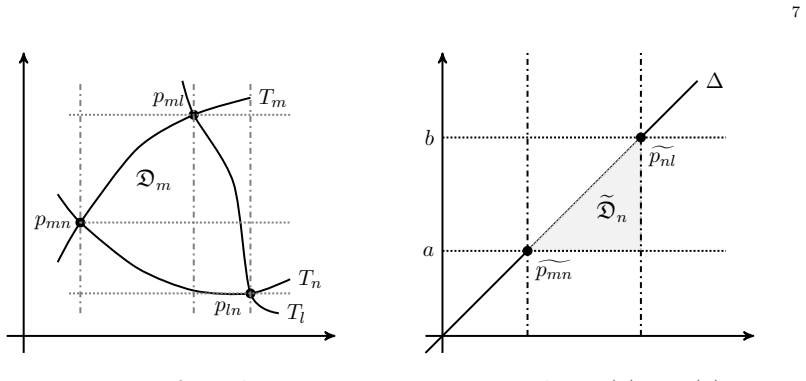
- [Figure 1] The labels in Figure 1 (p_mn, p_ml, p_nl, ~p_mn, ~p_nl) are not introduced in the caption, making it hard to verify the geometry of the triangle and the preimages used in Definition 3.
Circularity Check
No significant circularity: the central reduction to dilogarithm values is supplied by Rudenko's external reciprocity theorem, while the modular Cauchy kernel is taken from prior published work by the same authors but is not redefined in terms of the theorem's conclusion.
full rationale
The paper's derivation chain is not circular in the sense targeted by this review. Theorem 1 is obtained by constructing CoRes2(D) from the modular Cauchy kernel, using the genus-zero formula C_{0(n)}(z,w) = d log |J(z)-J(w)|^2 from the author's own [Sa19], and then expanding the wedge product, applying Stokes' theorem, and invoking Rudenko's reciprocity law [Ru15] to convert the resulting one-dimensional integrals into combinations of Bloch-Wigner dilogarithms. The final step is an external theorem by another author and is not fitted to, or implied by, the Aomoto dilogarithm being computed. The formula from [Sa19] is a prior published result with stated assumptions and does not itself contain the conclusion that the integral is a rational combination of D2-values. No parameter is fitted to the target integral, and no quantity is defined in terms of the quantity it is supposed to predict. The paper does contain two proof gaps that are correctness risks rather than circularity: the unproved assertion in Section 3.5 that Zagier's omega function vanishes because it is a cusp form of weight 2, and the end of the proof of Theorem 1, where the boundary terms in identity (18) are said to be handled by Stokes' formula and Rudenko's theorem without the required verification that the divisor data assemble into the tame-symbol hypothesis of (14). These are omissions of proof, not instances of the argument reducing to its own inputs. The self-citations [Sa15] and [Sa19] are load-bearing in the construction, but they are external published results independent of the claimed regulator formula, so they do not constitute circularity under the stated rules.
Assumptions & free parameters
assumptions (8)
- standard math Analytic continuation and pole structure of Ξ0(n)(z,w) and the asymptotic expansions from [Sa15], [Sa19].
- standard math Equation (4): for genus zero Γ0(n), C0(n)(z,w) = ∂ log |J(z)-J(w)|^2, from [Sa19].
- standard math Rudenko's Strong Suslin reciprocity law (Fact), [Ru15].
- standard math Goncharov's regulator formulas for r2 and r3, equations (10)-(12).
- ad hoc to paper The vanishing of Zagier's ω(w,\bar z) as a cusp form of weight 2 for the full modular group.
- standard math For genus zero levels, the Hauptmodule JΓ0(n) exists and generates the field of modular functions.
- domain assumption The direct image (λ×ρ)* maps the diagonal to the Hecke curve and preserves the described singularity structure.
- domain assumption Admissible pairs of arrangements yield convergent Aomoto integrals.
Cite this review
Pith. "Pith review of Modular Arrangements." pith.science (2026). https://pith.science/paper/TYWFBHGG
@misc{pith2026241217795,
  author       = {Pith},
  title        = {Pith review of: Modular Arrangements},
  year         = {2026},
  howpublished = {\url{https://pith.science/paper/TYWFBHGG}},
  note         = {Machine review of arXiv:2412.17795}
}
read the original abstract
The modular curves serve as excellent objects for testing conjectures in arithmetic geometry. They possess a natural geometric definition in contrast with rather nontrivial structure. On the other hand, they are well-studied from the perspective of number theory. Furthermore, there is a well-developed and powerful analytic technique available. We will use the square of the modular curve as the experimental object to investigate the arithmetic properties of the periods of mixed Hodge structures. There is an additional reason for this study: this square is naturally associated with a family of (Hecke) curves. These curves form components of the Neron-Severi locus, allowing for the interpretation of the square of the moduli curve as the moduli space of split (i.e., the product of two elliptic curves) abelian surfaces.
Figures
Reference graph
Works this paper leans on
-
[1]
A. A. Beilinson, Higher regulators of modular curves. Applications of algebraic K-theory to algebraic geometry and number theory\/ . Contemporary Mathematics 55, 1-34 (1986)
work page 1986
-
[2]
K. Bringmann and B. Kane, A problem of Petersson about weight 0 meromorphic modular forms\/ . Research in Mathematical Sciences (2016)
work page 2016
-
[3]
K. Bringmann, B. Kane, S. Lobrich, K. Ono, L. Rolen, On divisors of modular forms\/ , https://arxiv.org/pdf/1609.08100 https://arxiv.org/pdf/1609.08100 (2017)
work page Pith review arXiv 2017
- [4]
-
[5]
A. B. Goncharov, Polylogarithms, regulators, and Arakelov motivic complexes\/ , arXiv:math/0207036v3 arXiv:math/0207036v3 (2002)
work page Pith review arXiv 2002
-
[6]
M. Kontsevich, D. Zagier, Periods, Mathematics unlimited -- 2001 and beyond\/ . Springer, Berlin, 771-808 (2001)
work page 2001
-
[7]
The Strong Suslin Reciprocity Law
D. Rudenko, The Strong Suslin Reciprocity Law\/ , arXiv:1511.00520v3 arXiv:1511.00520v3 (2015)
work page Pith review arXiv 2015
-
[8]
Convergence of the Zagier type series for the Cauchy kernel
N. Sakharova, Convergence of the Zagier type series for the Cauchy kernel\/ , https://arxiv.org/abs/1503.05503 https://arxiv.org/abs/1503.05503 (2015)
work page Pith review arXiv 2015
Show all 11 references
-
[9]
Sakharova, Modular Cauchy kernel corresponding to the Hecke curve\/
N. Sakharova, Modular Cauchy kernel corresponding to the Hecke curve\/ . Arnold Mathematical Journal, 4(3), 301-313 (2019)
2019
-
[10]
Zagier, Traces des opérateurs de Hecke\/
D. Zagier, Traces des opérateurs de Hecke\/ . Séminaire Delange-Pisot-Poitou. Théorie des nombres, Volume: 17, Issue: 2, page 1-12 (1975-1976)
1975
-
[11]
Zagier, B
D. Zagier, B. Gross, Heegner points and derivative of L-series\/ . Invent. Math., 85, 225-320 (1986)
1986
Reviewed August 11, 2026 · model on record in the stance chip above.
Discussion (0). Continue with ORCID to comment.