Shape, Orientation and Colors Combined approach for Asteroids (SOCCA)
Pith reviewed 2026-06-26 23:05 UTC · model grok-4.3
The pith
SOCCA extends the HG1G2 phase function with the projected area of a rotating triaxial ellipsoid to jointly recover asteroid absolute magnitude, phase parameters, spin state and shape ratios from sparse multi-band photometry.
A machine-rendered reading of the paper's core claim, the machinery that carries it, and where it could break.
Core claim
SOCCA jointly fits multi-band photometry by extending the HG1G2 formalism with the projected surface of a rotating triaxial ellipsoid; the model recovers the absolute magnitude, phase parameters, sidereal rotation period, spin-axis orientation and the three axes ratios of the best-fitting ellipsoid while remaining computationally tractable for large surveys.
What carries the argument
The SOCCA model, an extension of the HG1G2 phase function that multiplies the usual brightness term by the instantaneous projected area of a rotating triaxial ellipsoid whose surface albedo is uniform within each band.
If this is right
- Mean photometric residuals drop by half relative to standard HG1G2 fits.
- Scatter in retrieved absolute magnitudes is reduced by a factor of about three.
- Phase-slope parameters are determined with comparable improvement in precision.
- Sidereal periods, pole directions and ellipsoid axis ratios are recovered as additional outputs.
- The fraction of solutions meeting physical plausibility criteria rises by 10-20 percent per filter, yielding an overall 53 percent success rate.
Where Pith is reading between the lines
- The method can be run on existing ZTF or ATLAS archives without new observations.
- Joint color and shape solutions may tighten constraints on surface composition when combined with spectroscopic surveys.
- Because the model is linear in the projected-area term, it can be extended to include light-curve inversion once denser sampling becomes available.
Load-bearing premise
Brightness changes are produced solely by the changing projected area of a uniform-albedo triaxial ellipsoid rotating about a fixed axis.
What would settle it
Direct comparison of SOCCA-derived shapes and poles against independent high-resolution models obtained from radar or spacecraft flybys for a sample of ten or more asteroids with known periods.
Figures





read the original abstract
Large photometric surveys provide sparse multi-band photometry for millions of Solar System objects, offering an opportunity to jointly constrain their physical and compositional properties. However, current phase function models do not account for rotational variability, limiting their ability to retrieve accurate parameters. Similarly, methods that recover shape and rotational parameters remain both computationally and observationally expensive. We present a model capable of simultaneously retrieving the absolute magnitude, phase parameters, spin state, and shape proportions of SSOs from sparse photometric data, while remaining computationally efficient. We introduce the Shape, Orientation and Colors Combined approach for Asteroids (SOCCA), which extends the HG1G2 formalism by incorporating the projected surface of a rotating triaxial ellipsoid. The model jointly fits multi-band photometry, and includes a dedicated treatment of rotational period determination. We implement the model on a 10-year LSST simulation as well as on real data of asteroid (45) Eugenia for validation purposes. SOCCA significantly improves the fit to photometric data, reducing the mean residuals to half, compared to previous models. It retrieves the absolute magnitude with a scatter about three times smaller than existing approaches, and improves the determination of phase parameters by a similar factor. It also recovers the sidereal rotation period, spin axis orientation and the axes ratios of the best fitting ellipsoid. The inclusion of shape and rotation increases the number of physically meaningful solutions by 10-20% per filter, leading to an overall success rate of 53%. Its performance and scalability make it well suited for current and upcoming large surveys such as the Zwicky Transient Facility and the recently started Legacy Survey of Space and Time.
Editorial analysis
A structured set of objections, weighed in public.
Referee Report
Summary. The manuscript introduces SOCCA, an extension of the HG1G2 phase-function formalism that multiplies the phase term by the projected area of a rotating triaxial ellipsoid whose surface is uniform except for a per-band scale factor. The model jointly fits sparse multi-band photometry to recover absolute magnitude H, phase parameters G1/G2, sidereal period, spin-axis orientation, and ellipsoid axis ratios. On a 10-year LSST simulation it reports halved mean residuals, ~3× smaller scatter in H and phase parameters, and a 53 % success rate (10–20 % more physically meaningful solutions per filter than prior approaches); the method is also applied to real photometry of (45) Eugenia.
Significance. If the reported improvements are robust, SOCCA would provide a scalable route to extract shape, spin, and compositional information from the millions of sparse light curves expected from LSST and ZTF. The joint multi-band treatment and explicit period-search component are practical strengths for survey-scale application.
major comments (3)
- [Abstract] Abstract: the central quantitative claims (mean residuals halved, H and phase-parameter scatter reduced by a factor of three) are presented without accompanying error budgets, cross-validation statistics, or a description of the period-search and ellipsoid-fitting procedure, so the improvements cannot be assessed for statistical significance or possible overfitting.
- [Model description / LSST simulation] Model description (and § on LSST simulation): the triaxial-ellipsoid projected-area term assumes convex shape and band-independent surface properties except for overall scaling. When this assumption is violated (non-convex bodies or rotational color variegation), the additional free parameters (period, pole, a/b/c) can absorb residuals that would otherwise be attributed to the HG1G2 phase function, potentially biasing the recovered H, G1, G2; the 53 % success rate already indicates the assumption is not universally satisfied.
- [Validation on (45) Eugenia] Validation section: the only real-data test is a single object ((45) Eugenia); no quantitative comparison of recovered parameters against independent shape or spin solutions (e.g., from radar or dense light-curve inversion) is supplied, leaving the claimed factor-of-three improvement unverified on actual observations.
minor comments (2)
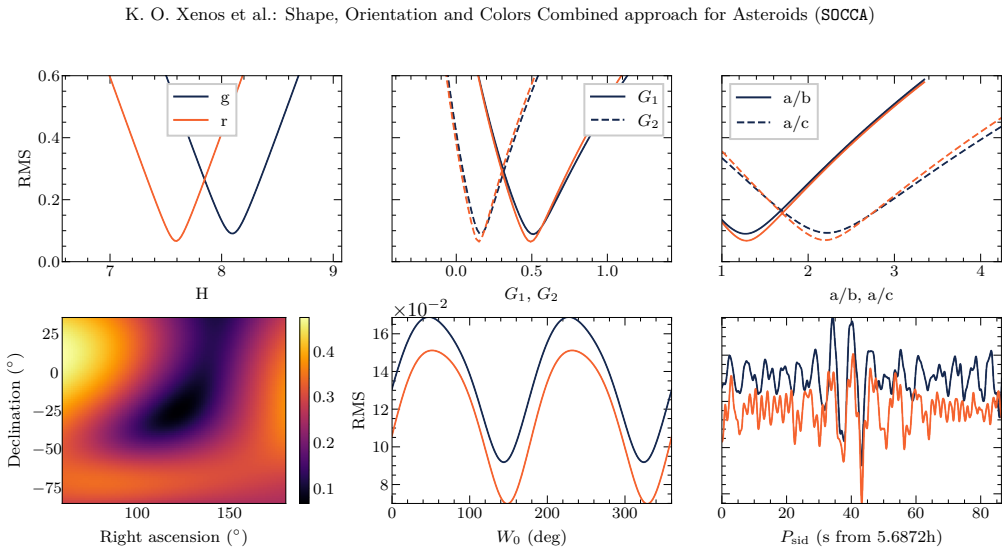
- [Model description] Notation for the projected-area factor and its coupling to the HG1G2 terms should be written explicitly (ideally as an equation) rather than described only in prose.
- [LSST simulation results] The success-rate definition (what constitutes a “physically meaningful solution”) is not stated; a clear criterion (e.g., period uncertainty < X %, axis-ratio bounds) would aid reproducibility.
Simulated Author's Rebuttal
We thank the referee for their constructive and detailed comments. We respond point-by-point below and have revised the manuscript to improve clarity on the abstract claims, to discuss model assumptions and limitations, and to better contextualize the real-data example.
read point-by-point responses
-
Referee: [Abstract] Abstract: the central quantitative claims (mean residuals halved, H and phase-parameter scatter reduced by a factor of three) are presented without accompanying error budgets, cross-validation statistics, or a description of the period-search and ellipsoid-fitting procedure, so the improvements cannot be assessed for statistical significance or possible overfitting.
Authors: We agree that the abstract would benefit from additional context on the methods. In the revised version we have added a concise description of the period-search procedure and the triaxial-ellipsoid projection fitting. The supporting error budgets, cross-validation approach, and statistical details remain in Sections 3 and 4; we have also inserted a short sentence in the abstract directing readers to those sections for the quantitative assessment. revision: yes
-
Referee: [Model description / LSST simulation] Model description (and § on LSST simulation): the triaxial-ellipsoid projected-area term assumes convex shape and band-independent surface properties except for overall scaling. When this assumption is violated (non-convex bodies or rotational color variegation), the additional free parameters (period, pole, a/b/c) can absorb residuals that would otherwise be attributed to the HG1G2 phase function, potentially biasing the recovered H, G1, G2; the 53 % success rate already indicates the assumption is not universally satisfied.
Authors: The referee correctly notes the model's assumptions. SOCCA is formulated under the convex triaxial ellipsoid with per-band scaling only. The reported 53 % success rate is defined precisely as the fraction of cases yielding physically plausible solutions under these assumptions. We have added an explicit limitations paragraph in the discussion section that addresses potential absorption of phase-function residuals by the shape/rotation parameters, the risk of bias in H/G1/G2 for non-convex or variegated bodies, and guidance on interpreting the success rate as a diagnostic of model applicability. revision: yes
-
Referee: [Validation on (45) Eugenia] Validation section: the only real-data test is a single object ((45) Eugenia); no quantitative comparison of recovered parameters against independent shape or spin solutions (e.g., from radar or dense light-curve inversion) is supplied, leaving the claimed factor-of-three improvement unverified on actual observations.
Authors: The factor-of-three improvement is quantified exclusively on the LSST simulation where ground truth is known (Section 4). The Eugenia application is presented as an illustrative demonstration on real sparse photometry rather than the basis for the improvement claim. We have revised the validation section to state this distinction explicitly, added references to published spin-axis solutions for Eugenia, and noted that a direct numerical comparison with radar or dense-inversion results lies outside the present scope. revision: partial
Circularity Check
SOCCA derivation is self-contained; no load-bearing steps reduce to inputs by construction
full rationale
The paper defines SOCCA as an explicit extension of the existing HG1G2 phase-function formalism by adding a multiplicative projected-area term from a rotating triaxial ellipsoid (abstract and model description). Reported improvements (halved residuals, 3× tighter scatter on H and phase parameters) are obtained by fitting the augmented model to an LSST simulation and to real photometry of (45) Eugenia; these are empirical outcomes of the extra degrees of freedom rather than algebraic identities. No equations, fitting procedures, or self-citations are shown that would make the target quantities equivalent to the inputs by construction. The central claim therefore remains independent of its own reported performance metrics.
Axiom & Free-Parameter Ledger
axioms (1)
- domain assumption Brightness variations are dominated by the changing projected area of a triaxial ellipsoid with uniform surface properties per band.
Reference graph
Works this paper leans on
-
[1]
Galileo Encounter with 951 Gaspra: First Pictures of an Asteroid. Science , keywords =. doi:10.1126/science.257.5077.1647 , adsurl =
-
[2]
A refined ``standard'' thermal model for asteroids based on observations of 1 Ceres and 2 Pallas. , keywords =. doi:10.1016/0019-1035(86)90021-7 , adsurl =
-
[3]
, year = 1999, month = dec, volume =
Physical Characteristics of Near-Earth Asteroids from Thermal Infrared Spectrophotometry. , year = 1999, month = dec, volume =. doi:10.1006/icar.1999.6248 , adsurl =
-
[4]
Thermal physics of asteroids. I. Effects of shape, heat conduction and beaming. , keywords =
-
[5]
Asteroids II , year = 1989, editor =
Radiometry and thermal modeling of asteroids. Asteroids II , year = 1989, editor =
1989
-
[6]
, year = 2000, month = sep, volume =
Opposition Effect of Asteroids. , year = 2000, month = sep, volume =. doi:10.1006/icar.2000.6410 , adsurl =
-
[7]
Astronomische Nachrichten , year = 1932, month = oct, volume =
Die Bestimmung der Winkelelemente der inneren Bewegung von Eros. Astronomische Nachrichten , year = 1932, month = oct, volume =. doi:10.1002/asna.19322462402 , adsurl =
-
[8]
Investigation of systematic bias in radiometric diameter determination of near-Earth asteroids: the night emission simulated thermal model (NESTM). , keywords =. doi:10.1111/j.1365-2966.2009.14996.x , archivePrefix =. 0905.1601 , primaryClass =
-
[9]
Speckle interferometry of asteroids. I - 433 Eros. , keywords =. doi:10.1016/0019-1035(85)90160-5 , adsurl =
-
[11]
, keywords =
The dimensions of (6) Hebe as a result of occultation observations. , keywords =
-
[12]
Shape, size and multiplicity of main-belt asteroids. I. Keck Adaptive Optics survey. , year = 2006, month = nov, volume =. doi:10.1016/j.icarus.2006.06.001 , adsurl =
-
[13]
, year = 1994, month = aug, volume =
Density and size of comet Shoemaker-Levy 9 deduced from a tidal breakup model. , year = 1994, month = aug, volume =. doi:10.1038/370349a0 , adsurl =
-
[14]
Direct Measurement of the Size of the Large Kuiper Belt Object (50000) Quaoar. , keywords =. doi:10.1086/382513 , adsurl =
-
[15]
Laser Guide Star Adaptive Optics for Astronomy , year = 2000, editor =
Measuring Asteroids with Adaptive Optics. Laser Guide Star Adaptive Optics for Astronomy , year = 2000, editor =
2000
-
[16]
Triaxial ellipsoid dimensions and rotational pole of 2 Pallas from two stellar occultations. , keywords =. doi:10.1016/0019-1035(89)90180-2 , adsurl =
-
[17]
ADAM: a general method for using various data types in asteroid reconstruction
ADAM: a general method for using various data types in asteroid reconstruction. , keywords =. doi:10.1051/0004-6361/201425259 , archivePrefix =. 1501.05958 , primaryClass =
work page internal anchor Pith review Pith/arXiv arXiv doi:10.1051/0004-6361/201425259
-
[18]
Physical Properties of (2) Pallas
Physical properties of (2) Pallas. , keywords =. doi:10.1016/j.icarus.2009.08.007 , archivePrefix =. 0912.3626 , primaryClass =
work page internal anchor Pith review Pith/arXiv arXiv doi:10.1016/j.icarus.2009.08.007 2009
-
[19]
Science , year = 1994, month = feb, volume =
Shape of Asteroid 4769 Castalia (1989 PB) from Inversion of Radar Images. Science , year = 1994, month = feb, volume =. doi:10.1126/science.263.5149.940 , adsurl =
-
[20]
, year = 1997, month = nov, volume =
Constraints on Spin State and Hapke Parameters of Asteroid 4769 Castalia Using Lightcurves and a Radar-Derived Shape Model. , year = 1997, month = nov, volume =. doi:10.1006/icar.1997.5804 , adsurl =
-
[21]
Shaping Asteroids with Genetic Evolution (SAGE)
Shaping asteroid models using genetic evolution (SAGE). , keywords =. doi:10.1093/mnras/stx2535 , archivePrefix =. 1904.08940 , primaryClass =
work page internal anchor Pith review Pith/arXiv arXiv doi:10.1093/mnras/stx2535 1904
-
[22]
Polarimetric Observations of Small Asteroids: Preliminary Results. , keywords =. doi:10.1006/icar.1998.6062 , adsurl =
-
[23]
Asteroids, Comets, and Meteors , year = 1983, month = jan, pages =
An analytical method for the determination of the rotational direction of asteroids. Asteroids, Comets, and Meteors , year = 1983, month = jan, pages =
1983
-
[24]
Finding asteroids with slow spin
V-band photometry of asteroids from ASAS-SN. Finding asteroids with slow spin. , keywords =. doi:10.1051/0004-6361/202140759 , archivePrefix =. 2107.10027 , primaryClass =
-
[25]
Optimization Methods for Asteroid Lightcurve Inversion. I. Shape Determination. , year = 2001, month = sep, volume =. doi:10.1006/icar.2001.6673 , adsurl =
-
[26]
Combining asteroid models derived by lightcurve inversion with asteroidal occultation silhouettes
Combining asteroid models derived by lightcurve inversion with asteroidal occultation silhouettes. , keywords =. doi:10.1016/j.icarus.2011.03.016 , archivePrefix =. 1104.4227 , primaryClass =
work page internal anchor Pith review Pith/arXiv arXiv doi:10.1016/j.icarus.2011.03.016 2011
-
[27]
Sizes of main-belt asteroids by combining shape models and Keck adaptive aptics observations
Sizes of main-belt asteroids by combining shape models and Keck adaptive optics observations. , keywords =. doi:10.1016/j.icarus.2013.07.023 , archivePrefix =. 1308.0446 , primaryClass =
work page internal anchor Pith review Pith/arXiv arXiv doi:10.1016/j.icarus.2013.07.023 2013
-
[28]
Thermophysical modeling of asteroids from WISE thermal infrared data - Significance of the shape model and the pole orientation uncertainties. , keywords =. doi:10.1016/j.icarus.2015.04.014 , archivePrefix =. 1504.04199 , primaryClass =
work page internal anchor Pith review Pith/arXiv arXiv doi:10.1016/j.icarus.2015.04.014 2015
-
[29]
Asteroid shapes and thermal properties from combined optical and mid-infrared photometry inversion
Asteroid shapes and thermal properties from combined optical and mid-infrared photometry inversion. , keywords =. doi:10.1051/0004-6361/201730868 , archivePrefix =. 1706.01232 , primaryClass =
work page internal anchor Pith review Pith/arXiv arXiv doi:10.1051/0004-6361/201730868
-
[30]
Celestial Mechanics and Dynamical Astronomy , keywords =
Astrometric masses of 21 asteroids, and an integrated asteroid ephemeris. Celestial Mechanics and Dynamical Astronomy , keywords =. doi:10.1007/s10569-007-9103-8 , adsurl =
-
[31]
A determination of the masses of Ceres, Pallas, and Vesta from their perturbations upon the orbit of Mars. , keywords =. doi:10.1016/0019-1035(89)90143-7 , adsurl =
-
[32]
Based on Gaia astrometric data
Asteroid (4337) Arecibo: Two ice-rich bodies forming a binary. Based on Gaia astrometric data. , keywords =. doi:10.1051/0004-6361/202450586 , adsurl =
-
[33]
, year = 1999, month = oct, volume =
Discovery of a moon orbiting the asteroid 45 Eugenia. , year = 1999, month = oct, volume =. doi:10.1038/44089 , adsurl =
-
[34]
Radar Imaging of Binary Near-Earth Asteroid (66391) 1999 KW4. Science , keywords =. doi:10.1126/science.1133622 , adsurl =
-
[35]
, year = 2000, month = jul, volume =
Two-Period Lightcurves of 1996 FG _ 3 , 1998 PG, and (5407) 1992 AX: One Probable and Two Possible Binary Asteroids. , year = 2000, month = jul, volume =. doi:10.1006/icar.2000.6375 , adsurl =
-
[37]
An advanced multipole model for (216) Kleopatra triple system. , keywords =. doi:10.1051/0004-6361/202140901 , archivePrefix =. 2105.09134 , primaryClass =
-
[38]
Orbit and Bulk Density of the OSIRIS-REx Target Asteroid (101955) Bennu
Orbit and bulk density of the OSIRIS-REx target Asteroid (101955) Bennu. , keywords =. doi:10.1016/j.icarus.2014.02.020 , archivePrefix =. 1402.5573 , primaryClass =
work page internal anchor Pith review Pith/arXiv arXiv doi:10.1016/j.icarus.2014.02.020 2014
-
[39]
, year = 2007, month = mar, volume =
Nucleus properties of Comet 9P/Tempel 1 estimated from non-gravitational force modeling. , year = 2007, month = mar, volume =. doi:10.1016/j.icarus.2006.07.022 , adsurl =
-
[40]
Science , year = 1970, month = jun, volume =
Asteroid Vesta: Spectral Reflectivity and Compositional Implications. Science , year = 1970, month = jun, volume =. doi:10.1126/science.168.3938.1445 , adsurl =
-
[41]
The taxonomic distribution of asteroids from multi-filter all-sky photometric surveys
The taxonomic distribution of asteroids from multi-filter all-sky photometric surveys. , keywords =. doi:10.1016/j.icarus.2013.06.027 , archivePrefix =. 1307.2424 , primaryClass =
work page internal anchor Pith review Pith/arXiv arXiv doi:10.1016/j.icarus.2013.06.027 2013
-
[42]
Physical parameters of near-Earth asteroid 1982 DV. , keywords =. doi:10.1016/0019-1035(85)90004-1 , adsurl =
-
[44]
doi:10.1126/science.1091452 , keywords =
Science , year =. doi:10.1126/science.1091452 , keywords =
-
[45]
Detection of the Yarkovsky effect for C-type asteroids in the Veritas family
Detection of the Yarkovsky effect for C-type asteroids in the Veritas family. , keywords =. doi:10.1093/mnras/stx1186 , archivePrefix =. 1705.04333 , primaryClass =
work page internal anchor Pith review Pith/arXiv arXiv doi:10.1093/mnras/stx1186
-
[46]
Asteroid Families. I. Identification by Hierarchical Clustering and Reliability Assessment. , keywords =. doi:10.1086/115658 , adsurl =
-
[47]
Yarkovsky V-shape identification of asteroid families
Yarkovsky V-shape identification of asteroid families. , keywords =. doi:10.1016/j.icarus.2016.09.029 , archivePrefix =. 1609.06384 , primaryClass =
work page internal anchor Pith review Pith/arXiv arXiv doi:10.1016/j.icarus.2016.09.029 2016
-
[48]
Asteroid phase curves from ATLAS dual-band photometry. , keywords =. doi:10.1016/j.icarus.2020.114094 , archivePrefix =. 2009.05129 , primaryClass =
-
[49]
A Taxonomic Study of Asteroid Families from KMTNet-SAAO Multi-band Photometry
A Taxonomic Study of Asteroid Families from KMTNET-SAAO Multiband Photometry. , keywords =. doi:10.3847/1538-4365/ab1344 , archivePrefix =. 1903.08019 , primaryClass =
work page internal anchor Pith review Pith/arXiv arXiv doi:10.3847/1538-4365/ab1344 1903
-
[50]
, year = 2000, month = jul, volume =
The 2MASS Asteroid and Comet Survey. , year = 2000, month = jul, volume =. doi:10.1006/icar.2000.6366 , adsurl =
-
[51]
Low thermal conductivity of the superfast rotator (499998) 2011 PT. , keywords =. doi:10.1051/0004-6361/202039628 , archivePrefix =. 2101.04399 , primaryClass =
-
[52]
, year = 2011, month = jul, volume =
Online multi-parameter phase-curve fitting and application to a large corpus of asteroid photometric data. , year = 2011, month = jul, volume =. doi:10.1016/j.jqsrt.2011.03.003 , adsurl =
-
[53]
Photometric Studies of Asteroids. V. The Light-Curve and Phase Function of 20 Massalia. , year = 1956, month = mar, volume =. doi:10.1086/146166 , adsurl =
-
[54]
Fast error-controlling MOID computation for confocal elliptic orbits
Fast error-controlling MOID computation for confocal elliptic orbits. Astronomy and Computing , keywords =. doi:10.1016/j.ascom.2019.02.005 , archivePrefix =. 1811.06373 , primaryClass =
work page internal anchor Pith review Pith/arXiv arXiv doi:10.1016/j.ascom.2019.02.005 2019
-
[55]
Escape of asteroids from the main belt. , keywords =. doi:10.1051/0004-6361/201629252 , adsurl =
-
[56]
Acta Astronautica , keywords =
A Delta-V map of the known Main Belt Asteroids. Acta Astronautica , keywords =. doi:10.1016/j.actaastro.2018.02.014 , adsurl =
-
[57]
Astronomy and Computing , keywords =
The astorb database at Lowell Observatory. Astronomy and Computing , keywords =. doi:10.1016/j.ascom.2022.100661 , archivePrefix =. 2210.10217 , primaryClass =
-
[58]
Handbook of Cosmic Hazards and Planetary Defense , year = 2015, pages =
Minor Planet Center. Handbook of Cosmic Hazards and Planetary Defense , year = 2015, pages =. doi:10.1007/978-3-319-03952-7_89 , adsurl =
-
[59]
Dynamics, Ephemerides, and Astrometry of the Solar System , year = 1996, editor =
Production d'elements orbitaux de cometes sur PC. Dynamics, Ephemerides, and Astrometry of the Solar System , year = 1996, editor =
1996
-
[60]
Handbook of Cosmic Hazards and Planetary Defense , year =
-
[61]
Journal of the British Astronomical Association , year = 2018, month = oct, volume =
Introducing the Comet Observation database (COBS). Journal of the British Astronomical Association , year = 2018, month = oct, volume =
2018
-
[62]
Evidence for differentiation of the most primitive small bodies. , keywords =. doi:10.1051/0004-6361/202140342 , archivePrefix =. 2103.06349 , primaryClass =
-
[63]
The Mass of Dwarf Planet Eris. Science , keywords =. doi:10.1126/science.1139415 , adsurl =
-
[64]
, year = 2005, month = aug, volume =
Discovery of the triple asteroidal system 87 Sylvia. , year = 2005, month = aug, volume =. doi:10.1038/nature04018 , adsurl =
-
[65]
Physical, spectral, and dynamical properties of asteroid (107) Camilla and its satellites
Physical, spectral, and dynamical properties of asteroid (107) Camilla and its satellites. , keywords =. doi:10.1016/j.icarus.2018.03.003 , archivePrefix =. 1803.02722 , primaryClass =
work page internal anchor Pith review Pith/arXiv arXiv doi:10.1016/j.icarus.2018.03.003 2018
-
[66]
Extreme AO Observations of Two Triple Asteroid Systems with SPHERE
Extreme AO Observations of Two Triple Asteroid Systems with SPHERE. , keywords =. doi:10.3847/2041-8205/820/2/L35 , archivePrefix =. 1603.04435 , primaryClass =
work page internal anchor Pith review Pith/arXiv arXiv doi:10.3847/2041-8205/820/2/l35 2041
-
[67]
Detection of a third moon around (130) Elektra with SPHERE/IFS
First observation of a quadruple asteroid. Detection of a third moon around (130) Elektra with SPHERE/IFS. , keywords =. doi:10.1051/0004-6361/202142623 , archivePrefix =. 2202.04425 , primaryClass =
-
[68]
The homogeneous internal structure of CM-like asteroid (41) Daphne
Homogeneous internal structure of CM-like asteroid (41) Daphne. , keywords =. doi:10.1051/0004-6361/201833898 , archivePrefix =. 1901.01890 , primaryClass =
work page internal anchor Pith review Pith/arXiv arXiv doi:10.1051/0004-6361/201833898 1901
-
[69]
, year = 2008, month = nov, volume =
Roche figures of doubly synchronous asteroids. , year = 2008, month = nov, volume =. doi:10.1016/j.pss.2008.02.040 , adsurl =
-
[70]
Mass and density of B-type asteroid (702) Alauda
Mass and Density of the B-type Asteroid (702) Alauda. , keywords =. doi:10.1088/0004-637X/727/2/69 , archivePrefix =. 1011.6577 , primaryClass =
work page internal anchor Pith review Pith/arXiv arXiv doi:10.1088/0004-637x/727/2/69
-
[71]
M-type (22) Kalliope: A tiny Mercury. , keywords =. doi:10.1051/0004-6361/202243200 , adsurl =
-
[72]
Characteristics and Large Bulk Density of the C-type Main-Belt Triple Asteroid (93) Minerva
Characteristics and large bulk density of the C-type main-belt triple asteroid (93) Minerva. , keywords =. doi:10.1016/j.icarus.2013.02.018 , archivePrefix =. 1310.3209 , primaryClass =
work page internal anchor Pith review Pith/arXiv arXiv doi:10.1016/j.icarus.2013.02.018 2013
-
[73]
Preimpact Mutual Orbit of the DART Target Binary Asteroid (65803) Didymos Derived from Observations of Mutual Events in 2003-2021. , keywords =. doi:10.3847/PSJ/ac7233 , adsurl =
-
[74]
The nature of near-earth asteroids from the study of their thermal infrared emission
-
[75]
NASA Planetary Data System , year = 2019, month = dec, pages =
Small Bodies Occultations Bundle V3.0. NASA Planetary Data System , year = 2019, month = dec, pages =. doi:10.26033/ap0g-wf63 , adsurl =
-
[76]
The Albedo Distribution of Jovian Trojan Asteroids. , keywords =. doi:10.1086/377015 , adsurl =
-
[77]
Main Belt Binary Asteroidal Systems With Eccentric Mutual Orbits
Main belt binary asteroidal systems with eccentric mutual orbits. , keywords =. doi:10.1016/j.icarus.2007.12.010 , archivePrefix =. 0804.1385 , primaryClass =
work page internal anchor Pith review Pith/arXiv arXiv doi:10.1016/j.icarus.2007.12.010 2007
-
[78]
Binary asteroid (31) Euphrosyne: ice-rich and nearly spherical. , keywords =. doi:10.1051/0004-6361/202038372 , archivePrefix =. 2007.08059 , primaryClass =
-
[79]
Main Belt Binary Asteroidal Systems With Circular Mutual Orbits
Main belt binary asteroidal systems with circular mutual orbits. , keywords =. doi:10.1016/j.icarus.2008.03.007 , archivePrefix =. 0804.1383 , primaryClass =
work page internal anchor Pith review Pith/arXiv arXiv doi:10.1016/j.icarus.2008.03.007 2008
-
[80]
New insights on the binary asteroid 121 Hermione
New insights on the binary Asteroid 121 Hermione. , keywords =. doi:10.1016/j.icarus.2009.04.032 , archivePrefix =. 0904.2033 , primaryClass =
work page internal anchor Pith review Pith/arXiv arXiv doi:10.1016/j.icarus.2009.04.032 2009
-
[81]
Kinematics and Physics of Celestial Bodies , year = 1991, month = jan, volume =
Photometry and polarimetry of the asteroid 47 Aglaja. Kinematics and Physics of Celestial Bodies , year = 1991, month = jan, volume =
1991
-
[82]
, year = 1996, month = mar, volume =
The Shape of Ida. , year = 1996, month = mar, volume =. doi:10.1006/icar.1996.0033 , adsurl =
- [83]
discussion (0)
Sign in with ORCID, Apple, or X to comment. Anyone can read and Pith papers without signing in.