Unified theory of oscillons and modes
Pith reviewed 2026-06-26 09:32 UTC · model grok-4.3
The pith
Oscillons arise as localized discrete resonant modes from threshold or antibound states localized by nonlinearity.
A machine-rendered reading of the paper's core claim, the machinery that carries it, and where it could break.
Core claim
We show that an oscillon can be understood as a localized discrete resonant (non-normalizable) mode. Specifically, oscillon in the vacuum arises from the threshold mode, which because of nonlinearity gets localized. Following this idea, we find wobblerons—nonlinear excitations of kinks, that is, oscillons-kink bound state. Now, the oscillon can also originate in an antibound mode, i.e., a discrete, positive energy but non-normalizable mode.
What carries the argument
Localization of non-normalizable discrete resonant modes (threshold and antibound) into stable oscillons by nonlinearity.
If this is right
- Wobblerons exist as stable oscillon-kink bound states.
- Oscillons can form from antibound modes in addition to threshold modes.
- A single mechanism accounts for both vacuum oscillons and those attached to kinks.
- The linear spectrum of resonant modes directly predicts the existence and properties of nonlinear localized excitations.
Where Pith is reading between the lines
- The same localization picture may apply to oscillons in higher-dimensional or multi-field models where threshold and antibound modes can be identified.
- Stability criteria for oscillons could be read off from the linear mode spectrum rather than from full nonlinear simulations.
- This unification suggests that searches for new oscillon-like objects should begin by scanning the linear spectrum for discrete non-normalizable modes.
Load-bearing premise
Nonlinearity by itself is enough to localize a non-normalizable mode into a stable, non-radiating oscillon without further assumptions on the potential or dimension.
What would settle it
A time-dependent simulation starting from the threshold mode that shows continuous radiation or decay rather than a long-lived localized oscillon.
Figures



read the original abstract
We show that an oscillon can be understood as a localized discrete resonant (non-normalizable) mode. Specifically, oscillon in the vacuum arises from the threshold mode, which because of nonlinearity gets localized. Following this idea, we find {\it wobblerons} - nonlinear excitations of kinks, that is, oscillons-kink bound state. Now, the oscillon can also originate in an antibound mode, i.e., a discrete, positive energy but non-normalizable mode.
Editorial analysis
A structured set of objections, weighed in public.
Referee Report
Summary. The manuscript claims that oscillons arise as localized discrete resonant (non-normalizable) modes: vacuum oscillons from nonlinearity-localized threshold modes, and also from antibound modes; it further introduces wobblerons as nonlinear kink-oscillon bound states.
Significance. If the localization mechanism is derived explicitly, the work would link linear spectral features (threshold and antibound modes) to stable nonlinear excitations, offering a potential explanation for oscillon non-radiation and introducing the new wobbleron concept. The absence of any derivation, equations, or evidence in the abstract leaves the significance conditional on whether the full text supplies a concrete map from linear mode to localized periodic solution.
major comments (2)
- [Abstract] Abstract: the assertion that 'nonlinearity gets localized' the threshold or antibound mode into a non-radiating oscillon is stated without an explicit construction (e.g., perturbative expansion around the linear mode or self-consistent ansatz) showing cancellation of the spatially extended tail while keeping the frequency below the continuum and eliminating radiation.
- [Abstract] Abstract: no supporting equations, numerical profiles, or stability analysis are referenced to demonstrate that the resulting time-periodic solution remains non-radiating and stable, leaving the central unification claim unsupported.
minor comments (1)
- The newly coined term 'wobblerons' requires a brief comparison to existing literature on kink-oscillon bound states to clarify novelty.
Simulated Author's Rebuttal
We thank the referee for their careful review and comments on our manuscript. We respond to each major comment below, clarifying that the abstract summarizes results whose explicit derivations appear in the full text.
read point-by-point responses
-
Referee: [Abstract] Abstract: the assertion that 'nonlinearity gets localized' the threshold or antibound mode into a non-radiating oscillon is stated without an explicit construction (e.g., perturbative expansion around the linear mode or self-consistent ansatz) showing cancellation of the spatially extended tail while keeping the frequency below the continuum and eliminating radiation.
Authors: The abstract is a concise summary of the central claim. The full manuscript supplies the explicit construction: a perturbative expansion around the linear threshold and antibound modes is developed in the main sections, demonstrating how nonlinearity suppresses the spatially extended tail, keeps the frequency below the continuum, and eliminates radiation. We are willing to revise the abstract to briefly reference this perturbative approach. revision: partial
-
Referee: [Abstract] Abstract: no supporting equations, numerical profiles, or stability analysis are referenced to demonstrate that the resulting time-periodic solution remains non-radiating and stable, leaving the central unification claim unsupported.
Authors: Abstracts conventionally omit equations, profiles, and detailed analyses, which are instead presented in the body of the paper (including the governing equations, numerical oscillon profiles, and stability results confirming non-radiating periodic solutions). The unification claim is thereby supported by the explicit mapping from linear modes to nonlinear localized excitations shown in the manuscript. We do not believe the abstract itself requires such supporting material. revision: no
Circularity Check
No significant circularity; derivation presented as conceptual unification without reduction to inputs
full rationale
The abstract frames the central result as a demonstration that nonlinearity localizes non-normalizable threshold or antibound modes into oscillons, with wobblerons as a derived extension. No equations, parameter fits, or self-citations are supplied in the given text that would reduce the localization step to a tautology, a renamed fit, or a self-referential uniqueness theorem. The claim is advanced as an independent insight rather than a quantity forced by prior fitted values or definitional closure within the paper itself. Absent explicit load-bearing reductions matching the enumerated patterns, the derivation chain remains self-contained against external benchmarks.
Axiom & Free-Parameter Ledger
invented entities (1)
-
wobblerons
no independent evidence
Reference graph
Works this paper leans on
-
[1]
Atx sw ≈1.65 we have a spectral wall where the mode becomes the threshold mode
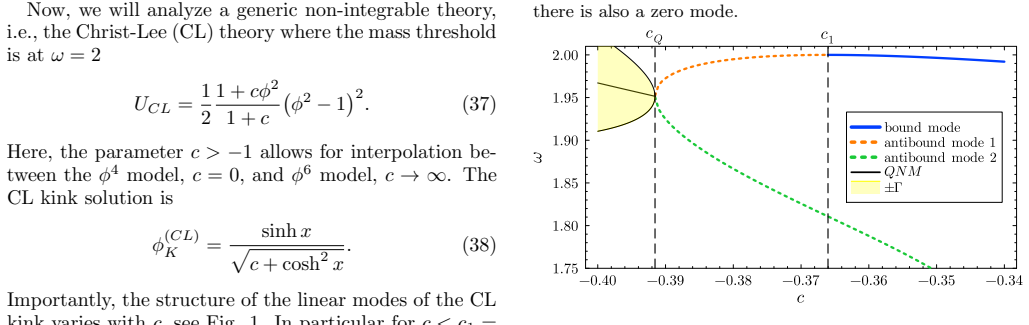
Importantly, there is an odd normal bound mode for x0 > x sw (blue curve), which asymptotically, asx→ ∞ tends to the shape mode of theϕ 4 kink. Atx sw ≈1.65 we have a spectral wall where the mode becomes the threshold mode. Forx < x sw it changes to an anti-bound mode, and then finally merges with another anti-bound mode and forms a quazinormal mode with ...
2024
-
[2]
On the Pulsed Soliton Lifetime in Two Classical Relativistic Theory Models,
I. L. Bogolyubsky and V. G. Makhankov, “On the Pulsed Soliton Lifetime in Two Classical Relativistic Theory Models,” JETP Lett.24, 12 (1976)
1976
-
[3]
Marcelo Gleiser, “Pseudostable bubbles,” Phys. Rev. D 49, 2978–2981 (1994), arXiv:hep-ph/9308279
Pith/arXiv arXiv 1994
-
[4]
Oscillons: Resonant configurations during bubble col- lapse,
Edmund J. Copeland, M. Gleiser, and H. R. Muller, “Oscillons: Resonant configurations during bubble col- lapse,” Phys. Rev. D52, 1920–1933 (1995), arXiv:hep- ph/9503217
arXiv 1920
-
[5]
Fine structure of oscillons in the spherically symmetricϕ 4 9 Klein-Gordon model,
Ethan P. Honda and Matthew W. Choptuik, “Fine structure of oscillons in the spherically symmetricϕ 4 9 Klein-Gordon model,” Phys. Rev. D65, 084037 (2002), arXiv:hep-ph/0110065
Pith/arXiv arXiv 2002
-
[6]
Compact oscillons in the signum-Gordon model,
H. Arodz, P. Klimas, and T. Tyranowski, “Compact oscillons in the signum-Gordon model,” Phys. Rev. D 77, 047701 (2008), arXiv:0710.2244 [hep-th]
Pith/arXiv arXiv 2008
-
[7]
Oscillons and quasi-breathers in D+1 dimensions,
Paul M. Saffin and Anders Tranberg, “Oscillons and quasi-breathers in D+1 dimensions,” JHEP01, 030 (2007), arXiv:hep-th/0610191
Pith/arXiv arXiv 2007
-
[8]
A General Theory of Oscillon Dynamics,
Marcelo Gleiser and David Sicilia, “A General Theory of Oscillon Dynamics,” Phys. Rev. D80, 125037 (2009), arXiv:0910.5922 [hep-th]
Pith/arXiv arXiv 2009
-
[9]
Radiation of scalar oscillons in 2 and 3 dimensions,
Gyula Fodor, Peter Forgacs, Zalan Horvath, and Mark Mezei, “Radiation of scalar oscillons in 2 and 3 dimensions,” Phys. Lett. B674, 319–324 (2009), arXiv:0903.0953 [hep-th]
Pith/arXiv arXiv 2009
-
[10]
Radiation and Re- laxation of Oscillons,
Petja Salmi and Mark Hindmarsh, “Radiation and Re- laxation of Oscillons,” Phys. Rev. D85, 085033 (2012), arXiv:1201.1934 [hep-th]
Pith/arXiv arXiv 2012
-
[11]
Recipes for oscillon longevity,
Jan Olle, Oriol Pujolas, and Fabrizio Rompineve, “Recipes for oscillon longevity,” JCAP09, 015 (2021), arXiv:2012.13409 [hep-ph]
arXiv 2021
-
[12]
Non-topological solitons and quasi- solitons,
Shuang-Yong Zhou, “Non-topological solitons and quasi- solitons,” (2024), arXiv:2411.16604 [hep-th]
arXiv 2024
-
[13]
Mustafa A. Amin, Richard Easther, Hal Finkel, Raphael Flauger, and Mark P. Hertzberg, “Oscillons Af- ter Inflation,” Phys. Rev. Lett.108, 241302 (2012), arXiv:1106.3335 [astro-ph.CO]
Pith/arXiv arXiv 2012
-
[14]
Gravitational Waves from Oscillon Preheating,
Shuang-Yong Zhou, Edmund J. Copeland, Richard Eas- ther, Hal Finkel, Zong-Gang Mou, and Paul M. Saffin, “Gravitational Waves from Oscillon Preheating,” JHEP 10, 026 (2013), arXiv:1304.6094 [astro-ph.CO]
Pith/arXiv arXiv 2013
-
[15]
End of infla- tion, oscillons, and matter-antimatter asymmetry,
Kaloian D. Lozanov and Mustafa A. Amin, “End of infla- tion, oscillons, and matter-antimatter asymmetry,” Phys. Rev. D90, 083528 (2014), arXiv:1408.1811 [hep-ph]
Pith/arXiv arXiv 2014
-
[16]
Jan Oll´ e, Oriol Pujol` as, and Fabrizio Rompineve, “Oscillons and Dark Matter,” JCAP02, 006 (2020), arXiv:1906.06352 [hep-ph]
arXiv 2020
-
[17]
Multi-field inflation and preheating in asymmetricα-attractors,
Oksana Iarygina, Evangelos I. Sfakianakis, Dong-Gang Wang, and Ana Ach´ ucarro, “Multi-field inflation and preheating in asymmetricα-attractors,” (2020), arXiv:2005.00528 [astro-ph.CO]
arXiv 2020
-
[18]
Gravitational wave spectra from oscillon formation after inflation,
Takashi Hiramatsu, Evangelos I. Sfakianakis, and Masahide Yamaguchi, “Gravitational wave spectra from oscillon formation after inflation,” JHEP03, 021 (2021), arXiv:2011.12201 [hep-ph]
arXiv 2021
-
[19]
Oscillons of Axion- Like Particle: Mass distribution and power spectrum,
Masahiro Kawasaki, Wakutaka Nakano, Hiromasa Nakatsuka, and Eisuke Sonomoto, “Oscillons of Axion- Like Particle: Mass distribution and power spectrum,” JCAP01, 061 (2021), arXiv:2010.09311 [astro-ph.CO]
arXiv 2021
-
[20]
Oscillon formation from preheating in asymmetric inflation- ary potentials,
Rafid Mahbub and Swagat S. Mishra, “Oscillon formation from preheating in asymmetric inflation- ary potentials,” Phys. Rev. D108, 063524 (2023), arXiv:2303.07503 [astro-ph.CO]
arXiv 2023
-
[21]
Oscillon formation during inflationary preheat- ing with general relativity,
Josu C. Aurrekoetxea, Katy Clough, and Francesco Muia, “Oscillon formation during inflationary preheat- ing with general relativity,” Phys. Rev. D108, 023501 (2023), arXiv:2304.01673 [gr-qc]
arXiv 2023
-
[22]
Numerical investi- gations of oscillons in 2 dimensions,
Mark Hindmarsh and Petja Salmi, “Numerical investi- gations of oscillons in 2 dimensions,” Phys. Rev. D74, 105005 (2006), arXiv:hep-th/0606016
Pith/arXiv arXiv 2006
-
[23]
Marcelo Gleiser and Joel Thorarinson, “A Phase transi- tion in U(1) configuration space: Oscillons as remnants of vortex-antivortex annihilation,” Phys. Rev. D76, 041701 (2007), arXiv:hep-th/0701294
Pith/arXiv arXiv 2007
-
[24]
Oscillons of Bose-Einstein condensate (A review),
N. N. Rosanov, N. A. Veretenov, N. V. Vysotina, L. A. Nesterov, S. V. Fedorov, and A. N. Shatsev, “Oscillons of Bose-Einstein condensate (A review),” Optics and Spec- troscopy119, 363–370 (2015)
2015
-
[25]
Oscil- lons in coupled Bose-Einstein condensates,
Shih-Wei Su, Shih-Chuan Gou, I.-Kang Liu, Ashton S. Bradley, Oleksandr Fialko, and Joachim Brand, “Oscil- lons in coupled Bose-Einstein condensates,” Phys. Rev. A91, 023631 (2015), arXiv:1412.5858 [cond-mat.quant- gas]
Pith/arXiv arXiv 2015
-
[26]
Long-lived nonlinear oscillatory states in in- teracting relativistic Bose-Einstein condensates,
Leone Di Mauro Villari, Ian Galbraith, and Fabio Bian- calana, “Long-lived nonlinear oscillatory states in in- teracting relativistic Bose-Einstein condensates,” Phys. Rev. A102, 033321 (2020), arXiv:1908.10641 [nlin.PS]
arXiv 2020
-
[27]
N. Graham, “An Electroweak oscillon,” Phys. Rev. Lett. 98, 101801 (2007), [Erratum: Phys.Rev.Lett. 98, 189904 (2007)], arXiv:hep-th/0610267
Pith/arXiv arXiv 2007
-
[28]
An Oscillon in the SU(2) gauged Higgs model,
E. Farhi, N. Graham, V. Khemani, R. Markov, and R. Rosales, “An Oscillon in the SU(2) gauged Higgs model,” Phys. Rev. D72, 101701 (2005), arXiv:hep- th/0505273
arXiv 2005
-
[29]
Quan- tum Oscillons are Long-Lived,
Jarah Evslin, Katarzyna Slawi´ nska, Tomasz Roma´ nczukiewicz, and Andrzej Wereszczy´ nski, “Quan- tum Oscillons are Long-Lived,” (2025), arXiv:2512.17193 [hep-th]
Pith/arXiv arXiv 2025
-
[30]
A Class of Scalar-Field Soliton Solutions in Three Space Dimen- sions,
R. Friedberg, T. D. Lee, and A. Sirlin, “A Class of Scalar-Field Soliton Solutions in Three Space Dimen- sions,” Phys. Rev. D13, 2739–2761 (1976)
1976
-
[31]
Q-balls,
Sidney R. Coleman, “Q-balls,” Nucl. Phys. B262, 263 (1985), [Addendum: Nucl.Phys.B 269, 744 (1986)]
1985
-
[32]
Su- persymmetric Q balls as dark matter,
Alexander Kusenko and Mikhail E. Shaposhnikov, “Su- persymmetric Q balls as dark matter,” Phys. Lett. B418, 46–54 (1998), arXiv:hep-ph/9709492
Pith/arXiv arXiv 1998
-
[33]
The Origin of the matter - antimatter asymmetry,
Michael Dine and Alexander Kusenko, “The Origin of the matter - antimatter asymmetry,” Rev. Mod. Phys.76, 1 (2003), arXiv:hep-ph/0303065
Pith/arXiv arXiv 2003
-
[34]
Oscillons and bubbles in Q-ball dynamics,
D. Canillas Mart´ ınez, P. Dorey, T. Rom´ anczukiewicz, Paul M. Saffin, K. Slawinska, and A. Wereszczy´nski, “Oscillons and bubbles in Q-ball dynamics,” JHEP12, 154 (2025), arXiv:2509.03192 [hep-th]
arXiv 2025
-
[35]
Edmund J. Copeland, Paul M. Saffin, and Shuang-Yong Zhou, “Charge-Swapping Q-balls,” Phys. Rev. Lett.113, 231603 (2014), arXiv:1409.3232 [hep-th]
Pith/arXiv arXiv 2014
-
[36]
Excited oscillons and charge- swapping,
A. Alonso-Izquierdo, D. Canillas Mart´ ınez, T. Roma´ nczukiewicz, K. S lawi´ nska, and A. Wereszczy´ nski, “Excited oscillons and charge- swapping,” (2025), arXiv:2504.17382 [hep-th]
arXiv 2025
-
[37]
Oscillons in gapless theories,
P. Dorey, T. Romanczukiewicz, Y. Shnir, and A. Wereszczynski, “Oscillons in gapless theories,” Phys. Rev. D109, 085017 (2024), arXiv:2312.05308 [hep-th]
arXiv 2024
-
[38]
Fabio van Dissel and Oriol Pujol` as, “Soft Oscillons,” (2025), arXiv:2505.00890 [hep-th]
arXiv 2025
-
[39]
Oscillons in the bro- ken vacuum and global vortex annihilation,
D. Canillas Mart´ ınez, A. Gonz´ alez-Parra, D. Migu´ elez- Caballero, and A. Wereszczynski, “Oscillons in the bro- ken vacuum and global vortex annihilation,” (2026), arXiv:2603.28298 [hep-th]
arXiv 2026
-
[40]
Small amplitude quasi-breathers and oscillons,
Gyula Fodor, Peter Forgacs, Zalan Horvath, and Arpad Lukacs, “Small amplitude quasi-breathers and oscillons,” Phys. Rev. D78, 025003 (2008), arXiv:0802.3525 [hep- th]
Pith/arXiv arXiv 2008
-
[41]
Oscillons from Q-Balls through Renormalization,
F. Blaschke, T. Roma´ nczukiewicz, K. S lawi´ nska, and A. Wereszczy´ nski, “Oscillons from Q-Balls through Renormalization,” Phys. Rev. Lett.134, 081601 (2025), arXiv:2410.24109 [hep-th]. 10
arXiv 2025
-
[42]
Amplitude modulations and resonant decay of excited oscillons,
F. Blaschke, T. Roma´ nczukiewicz, K. S lawi´ nska, and A. Wereszczy´ nski, “Amplitude modulations and resonant decay of excited oscillons,” Phys. Rev. E110, 014203 (2024), arXiv:2403.00443 [hep-th]
arXiv 2024
-
[43]
ϕ 4 kinks - gradient flow and dynamics,
N S Manton and H Merabet, “ϕ 4 kinks - gradient flow and dynamics,” Nonlinearity10, 3 (1997)
1997
-
[44]
Piotr Bizo ´L”, Tadeusz Chmaj, and Nikodem Sz- pak, “Dynamics near the threshold for blowup in the one-dimensional focusing nonlinear Klein-Gordon equation,” Journal of Mathematical Physics52, 103703 (2011), https://pubs.aip.org/aip/jmp/article- pdf/doi/10.1063/1.3645363/15797043/103703 1 online.pdf
-
[45]
Spectral Walls in Soliton Collisions,
C. Adam, K. Oles, T. Romanczukiewicz, and A. Wereszczynski, “Spectral Walls in Soliton Collisions,” Phys. Rev. Lett.122, 241601 (2019), arXiv:1903.12100 [hep-th]
Pith/arXiv arXiv 2019
-
[46]
Spectral walls in antikink-kink scat- tering in theϕ6 model,
C. Adam, K. Oles, T. Romanczukiewicz, and A. Wereszczynski, “Spectral walls in antikink-kink scat- tering in theϕ6 model,” Phys. Rev. D106, 105027 (2022), arXiv:2209.11479 [hep-th]
arXiv 2022
-
[47]
Spectral wall in collisions of ex- cited Abelian Higgs vortices,
A. Alonso-Izquierdo, J. Mateos Guillarte, M. Rees, and A. Wereszczynski, “Spectral wall in collisions of ex- cited Abelian Higgs vortices,” Phys. Rev. D110, 065004 (2024), arXiv:2406.05725 [hep-th]
arXiv 2024
-
[48]
Theϕ 4 model with the BPS preserving defect,
C. Adam, T. Romanczukiewicz, and A. Wereszczynski, “Theϕ 4 model with the BPS preserving defect,” JHEP 03, 131 (2019), arXiv:1812.04007 [hep-th]
Pith/arXiv arXiv 2019
-
[49]
Jarah Evslin, Chris Halcrow, Tomasz Romanczukiewicz, and Andrzej Wereszczynski, “Spectral walls at one loop,” Phys. Rev. D105, 125002 (2022), arXiv:2202.08249 [hep- th]
arXiv 2022
-
[50]
Kink-antikink collisions in the two- dimensionalϕ 4 model,
T. Sugiyama, “Kink-antikink collisions in the two- dimensionalϕ 4 model,” Prog. Theor. Phys.61, 1550– 1563 (1979)
1979
-
[51]
Resonance structure in kink- antikink interactions inφ 4 theory ,
David K. Campbell, Jonathan F. Schonfeld, and Charles A. Wingate, “Resonance structure in kink- antikink interactions inφ 4 theory ,” Physica D9, 1 (1983)
1983
-
[52]
Collective Coordinate Model of Kink- Antikink Collisions inϕ 4 Theory,
N. S. Manton, K. Oles, T. Romanczukiewicz, and A. Wereszczynski, “Collective Coordinate Model of Kink- Antikink Collisions inϕ 4 Theory,” Phys. Rev. Lett.127, 071601 (2021), arXiv:2106.05153 [hep-th]
arXiv 2021
-
[53]
Kink dynamics in theϕ 4 model: asymptotic stability for odd perturbations in the energy space,
Micha l Kowalczyk, Yvan Martel, and Claudio Mu˜ noz, “Kink dynamics in theϕ 4 model: asymptotic stability for odd perturbations in the energy space,” arXiv e-prints , arXiv:1506.07420 (2015), arXiv:1506.07420 [math.AP]
Pith/arXiv arXiv 2015
-
[54]
Asymptotic sta- bility of the sine-Gordon kink under odd perturbations,
Jonas Luhrmann and Wilhelm Schlag, “Asymptotic sta- bility of the sine-Gordon kink under odd perturbations,” Duke Math. J.172, 2715–2820 (2023), arXiv:2106.09605 [math.AP]
arXiv 2023
-
[55]
Dis- secting normal modes of vibration on vortices in Ginzburg-Landau superconductors,
A. Alonso-Izquierdo and D. Miguelez-Caballero, “Dis- secting normal modes of vibration on vortices in Ginzburg-Landau superconductors,” Phys. Rev. D110, 125026 (2024), arXiv:2410.08705 [hep-th]
arXiv 2024
-
[56]
Spectral structure of fluctuations around n-vortices in the Abelian-Higgs model,
A. Alonso-Izquierdo, D. Migu´ elez-Caballero, and J. Queiruga, “Spectral structure of fluctuations around n-vortices in the Abelian-Higgs model,” Physica D492, 135235 (2026), arXiv:2505.05039 [hep-th]
arXiv 2026
-
[57]
Resonance phe- nomena in vortex-antivortex collisions,
M. Bachmaier and A. Wereszczynski, “Resonance phe- nomena in vortex-antivortex collisions,” Phys. Lett. B 875, 140324 (2026), arXiv:2510.17964 [hep-th]
arXiv 2026
-
[58]
Spectral flow of vortex shape modes over the BPS 2-vortex moduli space,
A. Alonso-Izquierdo, W. Garcia Fuertes, N. S. Manton, and J. Mateos Guilarte, “Spectral flow of vortex shape modes over the BPS 2-vortex moduli space,” JHEP01, 020 (2024), arXiv:2310.17486 [hep-th]
arXiv 2024
-
[59]
Dynamics of excited BPS three-vortices,
A. Alonso-Izquierdo, N. S. Manton, J. Mateos Guilarte, M. Rees, and A. Wereszczynski, “Dynamics of excited BPS three-vortices,” Phys. Rev. D111, 105021 (2025), arXiv:2502.15087 [hep-th]
arXiv 2025
-
[60]
From BPS geodesics to mode-driven dynamics in the scattering of multiple BPS vortices,
A. Alonso Izquierdo, M. Bachmaier, and A. Wereszczyn- ski, “From BPS geodesics to mode-driven dynamics in the scattering of multiple BPS vortices,” (2026), arXiv:2603.04495 [hep-th]
arXiv 2026
discussion (0)
Sign in with ORCID, Apple, or X to comment. Anyone can read and Pith papers without signing in.