A massive barred spiral galaxy at z = 5.102 discovered by JWST
Pith reviewed 2026-06-25 23:37 UTC · model grok-4.3
The pith
A barred spiral galaxy exists at redshift 5.102, the highest-redshift example identified so far.
A machine-rendered reading of the paper's core claim, the machinery that carries it, and where it could break.
Core claim
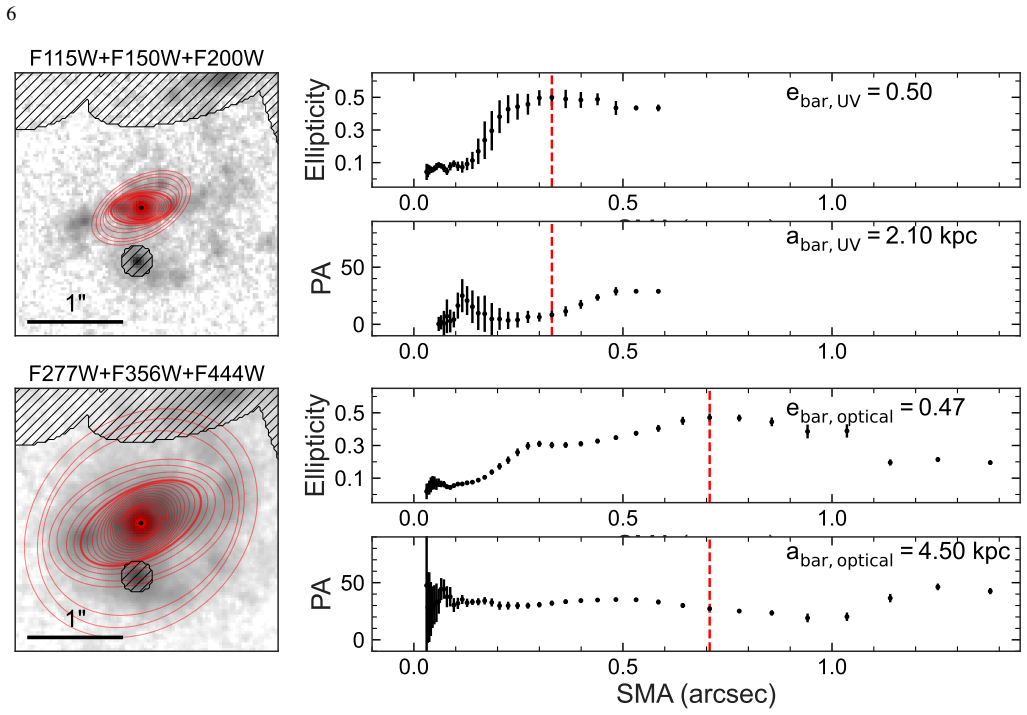
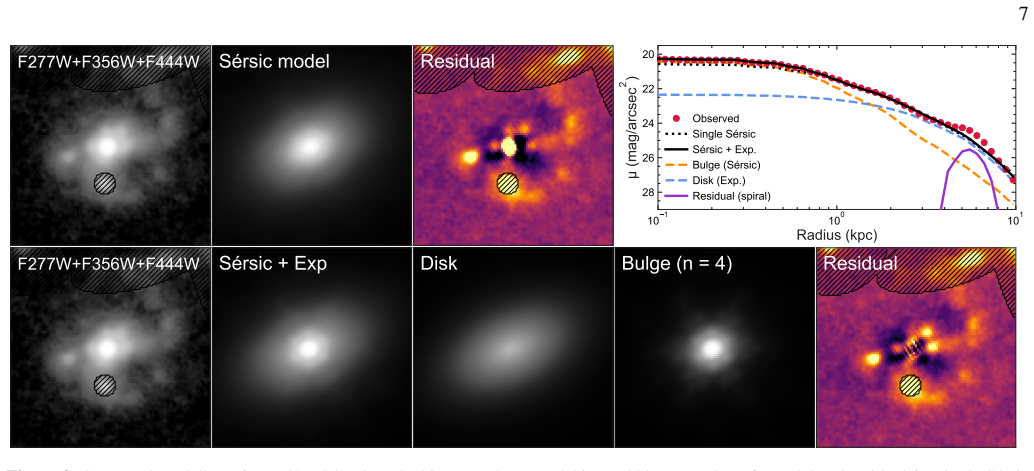
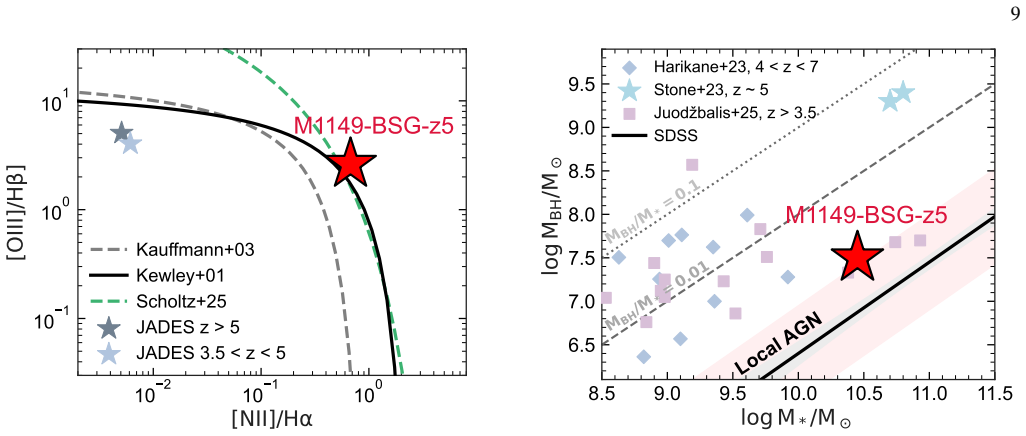
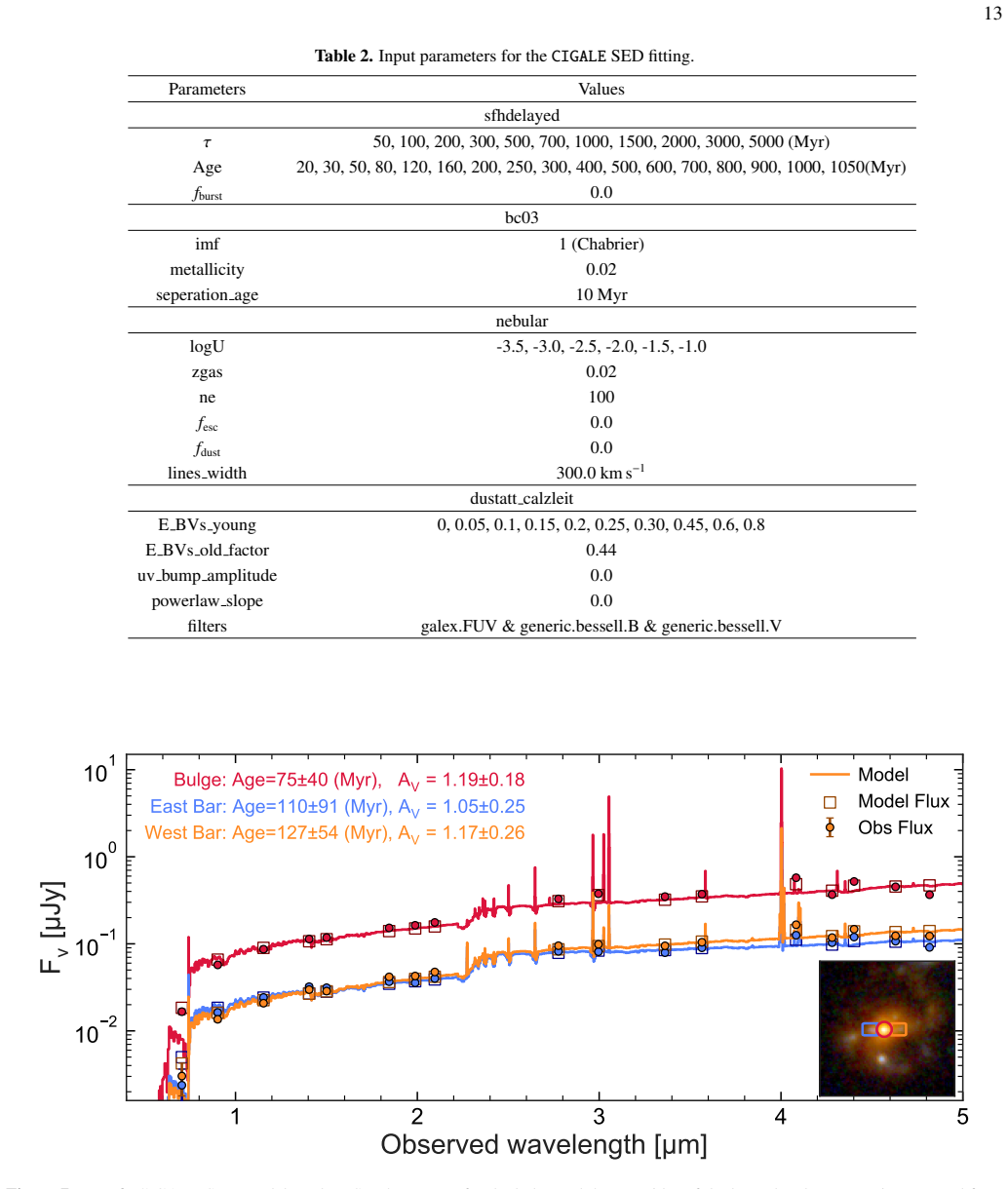
M1149-BSG-z5 is a barred spiral galaxy at z = 5.102 with a stellar bar of length a_bar ≈ 4.5 kpc and spiral arms peaking at r ≈ 5.5 kpc, embedded in an extended disk with global Sérsic index n = 2.37 and effective radius R_e = 2.61 kpc; the galaxy has stellar mass 10^10.45 M_⊙, star-formation rate 144 M_⊙ yr^−1, and hosts a broad-line AGN with M_BH/M_* ∼ 10^−3.
What carries the argument
Isophote ellipse fitting and two-dimensional structural modeling that together extract the bar length, disk scale, and spiral-arm locations from the observed light distribution.
If this is right
- Complex galactic structures such as bars and spiral arms can form and remain stable by z = 5.102.
- Interaction with a nearby companion in an overdense environment can trigger bar formation at early times.
- Baryon-dominated, gas-rich conditions enable gravitational instabilities that accelerate bar growth on short timescales.
- The galaxy's size and Sérsic index are already comparable to barred systems observed at 2 < z < 4, implying rapid structural maturation.
Where Pith is reading between the lines
- If this single detection is representative, the epoch when bars first appear may need to be pushed earlier in galaxy-formation models.
- Targeted JWST surveys of other overdense fields at z > 5 could test whether interaction-driven bars are common at these redshifts.
- Future integral-field spectroscopy could measure the bar's pattern speed and confirm dynamical stability directly.
Load-bearing premise
The observed light profile at the available resolution and wavelength traces a true stellar bar in a stable disk rather than projection effects, merger remnants, or other morphological features.
What would settle it
Higher-resolution imaging or spatially resolved kinematics that show the elongated feature lacks the expected orbital support or rotation curve of a bar would falsify the identification.
Figures



read the original abstract
We report M1149-BSG-z5, a barred spiral galaxy at $z = 5.102$, identified in the parallel field of MACS J1149+2223 with JWST and HST. M1149-BSG-z5 is the highest redshift barred galaxy candidate to date. Both isophote ellipse fitting and structural modeling support a stellar bar of length $a_\mathrm{bar} \approx 4.5$ kpc, and extended spiral arms peaking at $r \approx 5.5$ kpc. M1149-BSG-z5 is a massive main sequence star-forming galaxy, with a stellar mass of $10^{10.45}\rm M_\odot$ and a star-formation rate of $144\,\rm M_\odot/yr$. A concentrated bulge is embedded in an extended disk with a global S\'ersic index $n = 2.37$. With an effective radius of $R_{e} = 2.61\rm \ kpc$, M1149-BSG-z5 is larger than typical galaxies at $z \sim 5$ and comparable to barred galaxies at $2 < z < 4$. M1149-BSG-z5 also hosts a broad-line AGN, with a relatively low black-hole-to-stellar mass ratio of $\rm M_{\rm BH}/M_\ast\sim10^{-3}$. Its metal-enriched emission-line properties indicate that it is already chemically evolved. These properties imply M1149-BSG-z5 as an early-assembled and structurally evolved galaxy. We also find that M1149-BSG-z5 resides in an overdense region with a nearby companion galaxy, suggesting an interaction-driven bar formation mechanism. Its concentrated light, early assembly and main-sequence star formation also suggest baryon-dominated, gas-rich conditions, where gravitational instability can further accelerate the bar formation.
Editorial analysis
A structured set of objections, weighed in public.
Referee Report
Summary. The paper reports the discovery of M1149-BSG-z5, claimed as the highest-redshift barred spiral galaxy candidate at z=5.102, identified in JWST/HST imaging of the MACS J1149+2223 parallel field. The central claim rests on isophote ellipse fitting and structural (Sersic) modeling that yield a stellar bar of length a_bar ≈ 4.5 kpc and spiral arms peaking at r ≈ 5.5 kpc; the galaxy is further characterized as a massive main-sequence star-former (M_* = 10^{10.45} M_⊙, SFR = 144 M_⊙ yr^{-1}), with global Sersic index n=2.37, R_e=2.61 kpc, a broad-line AGN (M_BH/M_* ~ 10^{-3}), metal-enriched lines, and residence in an overdense region with a companion, implying early assembly and interaction-driven bar formation.
Significance. If the morphological classification is robust, the result would be significant for galaxy evolution studies, extending the observed epoch of bar formation by ~1 Gyr and providing a concrete example of a structurally mature, baryon-dominated disk at z>5. The combination of size, mass, and environment offers a falsifiable benchmark for simulations of early bar instability under gas-rich conditions.
major comments (3)
- [morphological analysis / structural modeling] Morphological analysis (ellipse fitting and Sersic modeling): the central claim that the observed isophotal twists and ellipticity profile indicate a true stellar bar of a_bar ≈ 4.5 kpc is load-bearing, yet the manuscript provides insufficient quantitative validation against degeneracies from the broad-line AGN point-source contribution, limited JWST resolution at z=5.1, or line-of-sight projection/merger effects; no alternative models (e.g., pure disk+bulge or merger remnant) or Monte-Carlo robustness tests are reported.
- [observations and data reduction] Data reduction and error propagation: the abstract states that ellipse fitting and Sersic modeling support the bar, but the text lacks explicit description of PSF modeling, background subtraction, multi-band consistency checks, or how uncertainties in a_bar and spiral-arm radii are propagated from the imaging data.
- [environment and discussion] Environmental and interaction context: the suggestion of interaction-driven bar formation relies on the presence of a companion and overdensity, but no quantitative measure of tidal strength, relative velocity, or comparison to control samples is given to distinguish this from secular bar formation.
minor comments (2)
- [abstract] Notation: the abstract uses both a_bar and R_e without defining the exact radial range over which the bar length is measured or how the Sersic fit separates bar from disk.
- [figures] Figure clarity: the isophote and residual maps should include explicit scale bars in kpc and indicate the JWST PSF FWHM to allow readers to assess resolution relative to the claimed 4.5 kpc bar.
Simulated Author's Rebuttal
We thank the referee for their thorough and constructive report. We address each major comment below, agreeing where additional analysis or clarification is warranted and providing our strongest honest defense on points of interpretation. We plan to submit a revised manuscript incorporating the suggested improvements.
read point-by-point responses
-
Referee: [morphological analysis / structural modeling] Morphological analysis (ellipse fitting and Sersic modeling): the central claim that the observed isophotal twists and ellipticity profile indicate a true stellar bar of a_bar ≈ 4.5 kpc is load-bearing, yet the manuscript provides insufficient quantitative validation against degeneracies from the broad-line AGN point-source contribution, limited JWST resolution at z=5.1, or line-of-sight projection/merger effects; no alternative models (e.g., pure disk+bulge or merger remnant) or Monte-Carlo robustness tests are reported.
Authors: We agree that more explicit validation against these degeneracies would strengthen the morphological claim. In the revised manuscript we will add Monte Carlo noise realizations of the ellipse fitting and GALFIT modeling, explicit subtraction of the broad-line AGN point-source contribution using the available multi-band constraints, and direct comparisons to alternative pure-disk+bulge and merger-remnant models. These additions will quantify the robustness of a_bar ≈ 4.5 kpc and the isophotal twist signature. revision: yes
-
Referee: [observations and data reduction] Data reduction and error propagation: the abstract states that ellipse fitting and Sersic modeling support the bar, but the text lacks explicit description of PSF modeling, background subtraction, multi-band consistency checks, or how uncertainties in a_bar and spiral-arm radii are propagated from the imaging data.
Authors: We acknowledge that the methods section would benefit from greater detail on these procedures. The revised version will include a dedicated subsection describing the JWST PSF construction and convolution, background estimation and subtraction steps, consistency checks across the available NIRCam and HST bands, and the propagation of photometric uncertainties into the derived bar length and spiral-arm radii via both analytic error estimates and bootstrap resampling. revision: yes
-
Referee: [environment and interaction context] Environmental and interaction context: the suggestion of interaction-driven bar formation relies on the presence of a companion and overdensity, but no quantitative measure of tidal strength, relative velocity, or comparison to control samples is given to distinguish this from secular bar formation.
Authors: We agree that quantitative tidal-strength metrics would be desirable. However, the current imaging dataset does not provide the spectroscopic redshifts or velocity information needed for precise relative-velocity or tidal-force calculations. We will expand the discussion to include a statistical comparison with control samples drawn from the literature at similar redshifts and environments, and we will clarify that the interaction-driven interpretation remains a plausible but not uniquely proven scenario given the observed proximity and local overdensity. revision: partial
- Quantitative tidal strength and relative velocity measurements for the companion require spectroscopic follow-up data that are not available in the present imaging-only dataset.
Circularity Check
No circularity: direct observational measurements from imaging data
full rationale
The paper is an observational discovery report identifying morphological features in JWST/HST imaging of a high-redshift galaxy. Bar length, spiral arm radii, Sersic index, effective radius, stellar mass, and SFR are all extracted directly from the observed light profile via standard ellipse fitting and GALFIT-style modeling. No equations or predictions are presented that reduce by construction to the fitted inputs themselves; the central claim is a measurement, not a derivation. No self-citations, uniqueness theorems, or ansatzes are invoked as load-bearing steps in any chain. The analysis remains self-contained against external benchmarks.
Axiom & Free-Parameter Ledger
free parameters (3)
- bar length a_bar
- stellar mass
- star-formation rate
axioms (2)
- standard math Standard flat Lambda-CDM cosmology for converting redshift to physical distances and sizes
- domain assumption Sersic profile and ellipse fitting accurately recover intrinsic galaxy morphology from observed surface brightness
Reference graph
Works this paper leans on
-
[1]
Allen, N., Oesch, P. A., Toft, S., et al. 2025, A&A, 698, A30, doi: 10.1051/0004-6361/202452690
-
[2]
Allingham, J. F. V ., Zitrin, A., Kokorev, V ., et al. 2026, arXiv e-prints, arXiv:2602.14074, doi: 10.48550/arXiv.2602.14074
-
[3]
Amvrosiadis, A., Lange, S., Nightingale, J. W., et al. 2025, MNRAS, 537, 1163, doi: 10.1093/mnras/staf048 Astropy Collaboration, Price-Whelan, A. M., Lim, P. L., et al. 2022, ApJ, 935, 167, doi: 10.3847/1538-4357/ac7c74
-
[4]
2002, ApJL, 569, L83, doi: 10.1086/340784
Athanassoula, E. 2002, ApJL, 569, L83, doi: 10.1086/340784
-
[5]
A., Peschken, N., & Lambert, J
Athanassoula, E., Rodionov, S. A., Peschken, N., & Lambert, J. C. 2016, ApJ, 821, 90, doi: 10.3847/0004-637X/821/2/90
-
[6]
Athanassoula, E., & Sellwood, J. A. 1986, MNRAS, 221, 213, doi: 10.1093/mnras/221.2.213
-
[7]
Baldwin, J. A., Phillips, M. M., & Terlevich, R. 1981, PASP, 93, 5, doi: 10.1086/130766
-
[8]
2022, ApJ, 934, 52, doi: 10.3847/1538-4357/ac779b
Bi, D., Shlosman, I., & Romano-D´ıaz, E. 2022, ApJ, 934, 52, doi: 10.3847/1538-4357/ac779b
-
[9]
2024, ApJ, 968, 86, doi: 10.3847/1538-4357/ad4118
Bland-Hawthorn, J., Tepper-Garcia, T., Agertz, O., & Federrath, C. 2024, ApJ, 968, 86, doi: 10.3847/1538-4357/ad4118
-
[10]
2023, The Astrophysical Journal, 947, 80, doi: 10.3847/1538-4357/acc469
Bland-Hawthorn, J., Tepper-Garcia, T., Agertz, O., & Freeman, K. 2023, ApJ, 947, 80, doi: 10.3847/1538-4357/acc469
-
[11]
A stellar bar hidden in an extreme gas-rich disk galaxy at z=4.055
Boogaard, L. A., Costantin, L., Tepper-Garc´ıa, T., et al. 2026, arXiv e-prints, arXiv:2605.15273, doi: 10.48550/arXiv.2605.15273
work page internal anchor Pith review Pith/arXiv arXiv doi:10.48550/arxiv.2605.15273 2026
-
[12]
CIGALE: a python Code Investigating GALaxy Emission
Boquien, M., Burgarella, D., Roehlly, Y ., et al. 2019, A&A, 622, A103, doi: 10.1051/0004-6361/201834156
work page internal anchor Pith review doi:10.1051/0004-6361/201834156 2019
-
[13]
Bournaud, F., Elmegreen, B. G., & Elmegreen, D. M. 2007, ApJ, 670, 237, doi: 10.1086/522077
-
[14]
2022, astropy/photutils: 1.5.0, 1.5.0 Zenodo, doi: 10.5281/zenodo.6825092
Bradley, L., Sip˝ocz, B., Robitaille, T., et al. 2022, astropy/photutils: 1.5.0, 1.5.0 Zenodo, doi: 10.5281/zenodo.6825092
-
[15]
2025, astropy/photutils: 2.2.0, 2.2.0 Zenodo, doi: 10.5281/zenodo.14889440
Bradley, L., Sip˝ocz, B., Robitaille, T., et al. 2025, astropy/photutils: 2.2.0, 2.2.0 Zenodo, doi: 10.5281/zenodo.14889440
-
[16]
2022, msaexp: NIRSpec analyis tools, 0.3 doi: 10.5281/zenodo.7299500
Brammer, G. 2022, msaexp: NIRSpec analyis tools, 0.3 doi: 10.5281/zenodo.7299500
-
[17]
Brammer, G. B., van Dokkum, P. G., & Coppi, P. 2008, ApJ, 686, 1503, doi: 10.1086/591786
work page internal anchor Pith review doi:10.1086/591786 2008
-
[18]
Bruzual, G., & Charlot, S. 2003, MNRAS, 344, 1000, doi: 10.1046/j.1365-8711.2003.06897.x
-
[19]
Burgarella, D., Buat, V ., & Iglesias-P´aramo, J. 2005, MNRAS, 360, 1413, doi: 10.1111/j.1365-2966.2005.09131.x
-
[20]
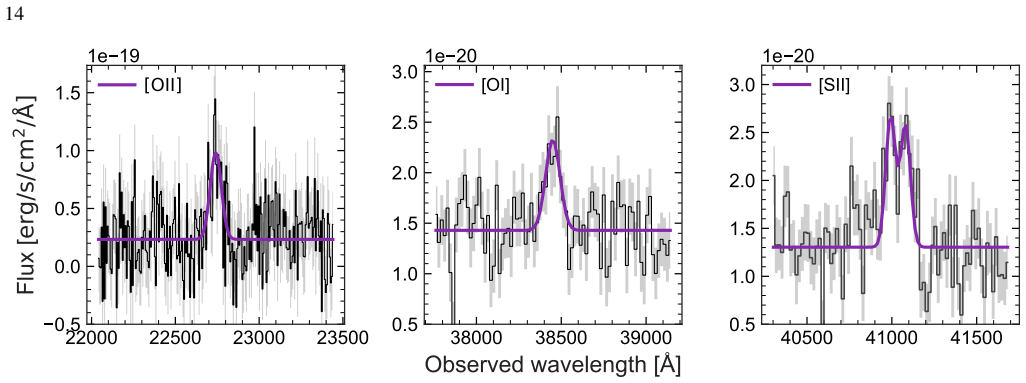
Bushouse, H., Eisenhamer, J., Dencheva, N., et al. 2023, JWST Calibration Pipeline, 1.11.2 Zenodo, doi: 10.5281/zenodo.8140011 15 Table 3.Rest-optical emission line fluxes † Ion+Wavelength (Å) Flux (10 −19 erg s−1 cm−2) [Oii]λλ3726,3729 ‡ 62.7±11.0 Hβ15.5±2.0 [Oiii]λ5007 40.7±3.4 [Oi]λ6302 9.5±1.9 Hα(narrow) 57.7±4.6 Hα(broad) 106.3±9.4 [Nii]λ6584 39.1±3....
-
[21]
J., Sheth, K., Athanassoula, E., et al
Buta, R. J., Sheth, K., Athanassoula, E., et al. 2015, ApJS, 217, 32, doi: 10.1088/0067-0049/217/2/32
-
[22]
Calzetti, D., Armus, L., Bohlin, R. C., et al. 2000, ApJ, 533, 682, doi: 10.1086/308692
work page internal anchor Pith review doi:10.1086/308692 2000
-
[23]
, archivePrefix = "arXiv", eprint =
Carilli, C. L., & Walter, F. 2013, ARA&A, 51, 105, doi: 10.1146/annurev-astro-082812-140953
-
[24]
2024, A&A, 685, A99, doi: 10.1051/0004-6361/202347230
Carniani, S., Venturi, G., Parlanti, E., et al. 2024, A&A, 685, A99, doi: 10.1051/0004-6361/202347230
-
[25]
Casteels, K. R. V ., Bamford, S. P., Skibba, R. A., et al. 2013, MNRAS, 429, 1051, doi: 10.1093/mnras/sts391
-
[26]
Ceverino, D., Dekel, A., & Bournaud, F. 2010, MNRAS, 404, 2151, doi: 10.1111/j.1365-2966.2010.16433.x
-
[27]
Galactic Stellar and Substellar Initial Mass Function
Chabrier, G. 2003, PASP, 115, 763, doi: 10.1086/376392
work page internal anchor Pith review doi:10.1086/376392 2003
-
[28]
Champagne, J. B., Wang, F., Yang, J., et al. 2025, ApJ, 981, 114, doi: 10.3847/1538-4357/adb1bc
-
[29]
Cheung, E., Athanassoula, E., Masters, K. L., et al. 2013, ApJ, 779, 162, doi: 10.1088/0004-637X/779/2/162
-
[30]
Costantin, L., P´erez-Gonz´alez, P. G., Guo, Y ., et al. 2023a, Nature, 623, 499, doi: 10.1038/s41586-023-06636-x
-
[31]
Costantin, L., P´erez-Gonz´alez, P. G., Vega-Ferrero, J., et al. 2023b, ApJ, 946, 71, doi: 10.3847/1538-4357/acb926
-
[32]
, archivePrefix = "arXiv", eprint =
Dekel, A., Sari, R., & Ceverino, D. 2009, ApJ, 703, 785, doi: 10.1088/0004-637X/703/1/785
-
[33]
Doyon, R., Willott, C. J., Hutchings, J. B., et al. 2023, PASP, 135, 098001, doi: 10.1088/1538-3873/acd41b
-
[34]
A JWST study of pair fractions, merger rates, and stellar mass accretion rates at z = 4.5─11.5
Duan, Q., Conselice, C. J., Li, Q., et al. 2025, MNRAS, 540, 774, doi: 10.1093/mnras/staf638
-
[35]
2018, MNRAS, 474, 5372, doi: 10.1093/mnras/stx3117
Erwin, P. 2018, MNRAS, 474, 5372, doi: 10.1093/mnras/stx3117
-
[36]
Eskridge, P. B., Frogel, J. A., Pogge, R. W., et al. 2000, AJ, 119, 536, doi: 10.1086/301203 Espejo Salcedo, J. M., Pastras, S., V´acha, J., et al. 2025, A&A, 700, A42, doi: 10.1051/0004-6361/202554725
-
[37]
L., Liu, L.-J., Dubois, Y ., et al
Faisst, A. L., Liu, L.-J., Dubois, Y ., et al. 2026, ApJ, 1004, 22, doi: 10.3847/1538-4357/ae6645
-
[38]
Fakhouri, O., Ma, C.-P., & Boylan-Kolchin, M. 2010, MNRAS, 406, 2267, doi: 10.1111/j.1365-2966.2010.16859.x
-
[39]
2015, MNRAS, 454, 3641, doi: 10.1093/mnras/stv2247
Fanali, R., Dotti, M., Fiacconi, D., & Haardt, F. 2015, MNRAS, 454, 3641, doi: 10.1093/mnras/stv2247
-
[40]
Ferreira, L., Conselice, C. J., Sazonova, E., et al. 2023, ApJ, 955, 94, doi: 10.3847/1538-4357/acec76 F¨orster Schreiber, N. M., & Wuyts, S. 2020, ARA&A, 58, 661, doi: 10.1146/annurev-astro-032620-021910 F¨orster Schreiber, N. M., Genzel, R., Bouch´e, N., et al. 2009, ApJ, 706, 1364, doi: 10.1088/0004-637X/706/2/1364
-
[41]
Fragkoudi, F., Grand, R. J. J., Pakmor, R., et al. 2025, MNRAS, 538, 1587, doi: 10.1093/mnras/staf389 16
-
[42]
2020, MNRAS, 499, 1116, doi: 10.1093/mnras/staa2866
Fraser-McKelvie, A., Merrifield, M., Arag´on-Salamanca, A., et al. 2020, MNRAS, 499, 1116, doi: 10.1093/mnras/staa2866
-
[43]
2025, ApJ, 987, 186, doi: 10.3847/1538-4357/adddb1
Fu, S., Sun, F., Jiang, L., et al. 2025, ApJ, 987, 186, doi: 10.3847/1538-4357/adddb1
-
[44]
2025, Nature Astronomy, 9, 1553, doi: 10.1038/s41550-025-02592-w
Fujimoto, S., Ouchi, M., Kohno, K., et al. 2025, Nature Astronomy, 9, 1553, doi: 10.1038/s41550-025-02592-w
-
[45]
2025, A&A, 696, A95, doi: 10.1051/0004-6361/202452493
Galbiati, M., Cantalupo, S., Steidel, C., et al. 2025, A&A, 696, A95, doi: 10.1051/0004-6361/202452493
-
[46]
1990, A&A, 230, 37 G´eron, T., Smethurst, R
Gerin, M., Combes, F., & Athanassoula, E. 1990, A&A, 230, 37 G´eron, T., Smethurst, R. J., Dickinson, H., et al. 2025, ApJ, 987, 74, doi: 10.3847/1538-4357/add7d0
-
[47]
Guo, Y ., Jogee, S., Finkelstein, S. L., et al. 2023, ApJL, 945, L10, doi: 10.3847/2041-8213/acacfb
-
[48]
2025, ApJ, 985, 181, doi: 10.3847/1538-4357/adc8a7 G´ eron, T., Smethurst, R
Guo, Y ., Jogee, S., Wise, E., et al. 2025, ApJ, 985, 181, doi: 10.3847/1538-4357/adc8a7
-
[49]
Hainline, K. N., Johnson, B. D., Robertson, B., et al. 2024, ApJ, 964, 71, doi: 10.3847/1538-4357/ad1ee4
-
[50]
Harikane, Y ., Zhang, Y ., Nakajima, K., et al. 2023, ApJ, 959, 39, doi: 10.3847/1538-4357/ad029e
-
[51]
Helton, J. M., Sun, F., Woodrum, C., et al. 2024, ApJ, 974, 41, doi: 10.3847/1538-4357/ad6867
-
[52]
1971, ApJ, 168, 343, doi: 10.1086/151091
Hohl, F. 1971, ApJ, 168, 343, doi: 10.1086/151091
-
[53]
Hopkins, P. F., Kereˇs, D., O˜norbe, J., et al. 2014, MNRAS, 445, 581, doi: 10.1093/mnras/stu1738
work page internal anchor Pith review doi:10.1093/mnras/stu1738 2014
-
[54]
2025, Nature, 641, 861, doi: 10.1038/s41586-025-08914-2
Huang, S., Kawabe, R., Umehata, H., et al. 2025, Nature, 641, 861, doi: 10.1038/s41586-025-08914-2
-
[55]
2025, A&A, 704, A94, doi: 10.1051/0004-6361/202553782
Huertas-Company, M., Shuntov, M., Dong, Y ., et al. 2025, A&A, 704, A94, doi: 10.1051/0004-6361/202553782
-
[56]
2025, A&A, 703, A96, doi: 10.1051/0004-6361/202451689
Jain, R., & Wadadekar, Y . 2025, A&A, 703, A96, doi: 10.1051/0004-6361/202451689
-
[57]
2022, 661, A80, doi: 10.1051/0004-6361/202142663
Jakobsen, P., Ferruit, P., Alves de Oliveira, C., et al. 2022, A&A, 661, A80, doi: 10.1051/0004-6361/202142663
work page internal anchor Pith review doi:10.1051/0004-6361/202142663 2022
-
[58]
Jogee, S., Barazza, F. D., Rix, H.-W., et al. 2004, ApJL, 615, L105, doi: 10.1086/426138
-
[59]
Jolly, J.-B., Tacconi, L. J., Genzel, R., et al. 2026, arXiv e-prints, arXiv:2604.18503, doi: 10.48550/arXiv.2604.18503 Juodˇzbalis, I., Maiolino, R., Baker, W. M., et al. 2026, MNRAS, 546, stag086, doi: 10.1093/mnras/stag086
work page internal anchor Pith review Pith/arXiv arXiv doi:10.48550/arxiv.2604.18503 2026
-
[60]
Kalita, B. S., Ho, L. C., Silverman, J. D., et al. 2026, ApJ, 997, 247, doi: 10.3847/1538-4357/ae2755
-
[61]
Kassin, S. A., Weiner, B. J., Faber, S. M., et al. 2012, ApJ, 758, 106, doi: 10.1088/0004-637X/758/2/106
-
[62]
Kauffmann, G., Heckman, T. M., Tremonti, C., et al. 2003, MNRAS, 346, 1055, doi: 10.1111/j.1365-2966.2003.07154.x
-
[63]
Trevena, J. 2001, ApJ, 556, 121, doi: 10.1086/321545
work page internal anchor Pith review doi:10.1086/321545 2001
-
[64]
H., Shlosman, I., & Peletier, R
Knapen, J. H., Shlosman, I., & Peletier, R. F. 2000, ApJ, 529, 93, doi: 10.1086/308266
-
[65]
2012, ApJ, 757, 60, doi: 10.1088/0004-637X/757/1/60
Kraljic, K., Bournaud, F., & Martig, M. 2012, ApJ, 757, 60, doi: 10.1088/0004-637X/757/1/60
-
[66]
Kron, R. G. 1980, ApJS, 43, 305, doi: 10.1086/190669
-
[67]
Laseter, I. H., Maseda, M. V ., Curti, M., et al. 2024, A&A, 681, A70, doi: 10.1051/0004-6361/202347133
-
[68]
Laurikainen, E., Salo, H., Buta, R., & Vasylyev, S. 2004, MNRAS, 355, 1251, doi: 10.1111/j.1365-2966.2004.08410.x Le Conte, Z. A., Gadotti, D. A., Ferreira, L., et al. 2024, MNRAS, 530, 1984, doi: 10.1093/mnras/stae921 Le Conte, Z. A., Gadotti, D. A., Ferreira, L., et al. 2026, MNRAS, 545, staf2010, doi: 10.1093/mnras/staf2010
-
[69]
Lelli, F., Di Teodoro, E. M., Fraternali, F., et al. 2021, Science, 371, 713, doi: 10.1126/science.abc1893
-
[70]
Liang, X., Yu, S.-Y ., Fang, T., & Ho, L. C. 2024, A&A, 688, A158, doi: 10.1051/0004-6361/202348539
-
[71]
2017, ApJ, 838, 105, doi: 10.3847/1538-4357/aa657a Łokas, E
Lin, L., Li, C., He, Y ., Xiao, T., & Wang, E. 2017, ApJ, 838, 105, doi: 10.3847/1538-4357/aa657a Łokas, E. L. 2025, ApJL, 991, L52, doi: 10.3847/2041-8213/ae07c2 Łokas, E. L., Ebrov ´a, I., del Pino, A., et al. 2016, ApJ, 826, 227, doi: 10.3847/0004-637X/826/2/227
-
[72]
J., D’Eugenio, F., Maiolino, R., et al
Looser, T. J., D’Eugenio, F., Maiolino, R., et al. 2025, A&A, 697, A88, doi: 10.1051/0004-6361/202347102
-
[73]
Lotz, J. M., Koekemoer, A., Coe, D., et al. 2017, ApJ, 837, 97, doi: 10.3847/1538-4357/837/1/97
-
[74]
Madau, P., & Dickinson, M. 2014, ARA&A, 52, 415, doi: 10.1146/annurev-astro-081811-125615
work page internal anchor Pith review doi:10.1146/annurev-astro-081811-125615 2014
-
[75]
2007, ApJ, 659, 1176, doi: 10.1086/512355
Marinova, I., & Jogee, S. 2007, ApJ, 659, 1176, doi: 10.1086/512355
-
[76]
, year = 2014, month = mar, volume =
Melvin, T., Masters, K., Lintott, C., et al. 2014, MNRAS, 438, 2882, doi: 10.1093/mnras/stt2397 M´endez-Abreu, J., S´anchez-Janssen, R., Aguerri, J. A. L., Corsini, E. M., & Zarattini, S. 2012, ApJL, 761, L6, doi: 10.1088/2041-8205/761/1/L6 Men´endez-Delmestre, K., Sheth, K., Schinnerer, E., Jarrett, T. H., & Scoville, N. Z. 2007a, ApJ, 657, 790, doi: 10....
-
[77]
2025, ApJ, 982, 153, doi: 10.3847/1538-4357/adb30f
Morishita, T., Liu, Z., Stiavelli, M., et al. 2025, ApJ, 982, 153, doi: 10.3847/1538-4357/adb30f
-
[78]
Nakajima, K., & Maiolino, R. 2022, MNRAS, 513, 5134, doi: 10.1093/mnras/stac1242
-
[79]
1996, ApJ, 469, 605, doi: 10.1086/177809
Noguchi, M. 1996, ApJ, 469, 605, doi: 10.1086/177809
-
[80]
2009, A&A, 507, 1793, doi: 10.1051/0004-6361/200912497
Noll, S., Burgarella, D., Giovannoli, E., et al. 2009, A&A, 507, 1793, doi: 10.1051/0004-6361/200912497
work page internal anchor Pith review doi:10.1051/0004-6361/200912497 2009
discussion (0)
Sign in with ORCID, Apple, or X to comment. Anyone can read and Pith papers without signing in.