REVIEW 2 major objections 5 minor 1 cited by
Central limit theorems for linear spectral statistics of inhomogeneous random graphs with graphon limits
T0 review · 2 major / 5 minor · reviewed 2026-08-11 · deepseek-v4-flash
Pith's one-line read This paper proves Gaussian central limit theorems for the eigenvalue fluctuations of inhomogeneous random graphs in every sparsity regime, with covariances determined by the graphon limit of the variance profile.
desk verdict Strong, likely-correct CLTs for graphon-based inhomogeneous random graphs across all sparsity regimes, with a fixable gap in the stated graphon-continuity lemmas. read the letter →
The pith
A machine-rendered reading of the paper's core claim, the machinery that carries it, and where it could break.
The reading
What carries the argument
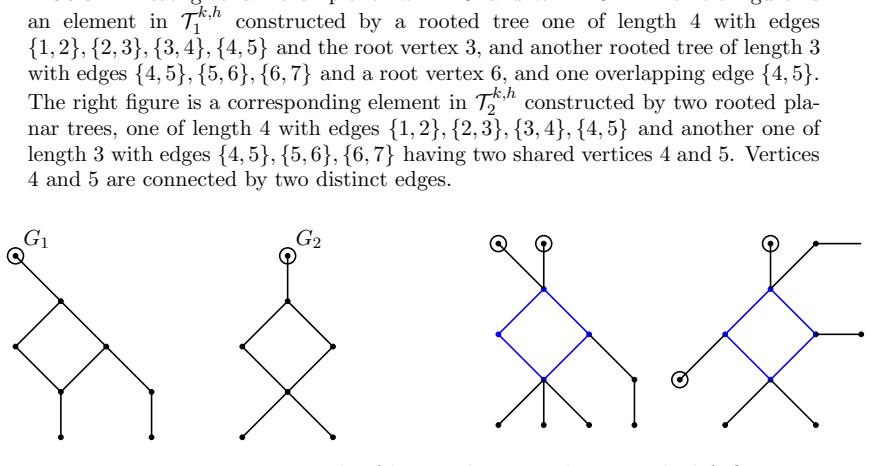
The central object is the variance-profile graphon $W_n$ built from the entrywise variance matrix $S_n$ of the random graph, together with its limit $W$ under one of three graphon topologies. The technical engine is the expansion of $\mathrm{tr}(M^k)$ as a sum over closed walks: a $k$-tuplet assigns a sequence of vertices, and the product of entries along the walk is a monomial whose graph is the union of the two walks in a covariance computation. The paper shows that only a short list of union-graph topologies survives the rescaling — trees glued along one edge, unicyclic graphs, and pairs of cycles with one shared edge — and each surviving topology contributes a homomorphism density times an explicit combinatorial multiplicity. Which topologies survive is determined by the size of $np$, which is why the covariance formulas and scalings change across regimes.
What would settle it
Simulate a homogeneous $G(n,p)$ random graph with $p = n^{-0.6}$, so that $n^{1/3} \ll np \ll n^{1/2}$. The theorem for the uncentered matrix predicts that $\mathrm{Var}(L_{n,4})$ diverges while $L_{n,5}$ satisfies a CLT with covariance $50$ (for constant graphon $W=1$). Monte Carlo data showing $\mathrm{Var}(L_{n,4})$ stabilising, or showing a non-Gaussian distribution for the standardized $L_{n,5}$, would refute the sparse phase-transition claim.
Extended reading notes
Core claim
The paper's central claim is that global eigenvalue fluctuations of inhomogeneous random graphs are Gaussian at every sparsity scale, once the traces are centered and rescaled in the sparsity-dependent way spelled out in (1), (5), and (6). The limiting covariance between the $k$-th and $h$-th monomial statistics is a finite sum of homomorphism densities $t(F,W)$ (or $t(F,W')$ with $W' = W(1-pW)$ in the dense centered case), where $F$ ranges over glued-tree, unicyclic, and two-cycle graphs whose combinatorial structure is enumerated by the walk expansion. The theorem statement distinguishes dense $p \in (0,1)$, sparse $np\to\infty$ with $np=n^{\Omega(1)}$, critically sparse $np=n^{o(1)}$ with $np\to\infty$, and bounded-degree $np\to c\in(0,\infty)$ regimes. A direct corollary is the phase transition in the centering effect: for $np=n^{\Omega(1)}$ the adjacency matrix and its centered version obey different CLTs, while for $np=n^{o(1)}$ they coincide. The paper also asserts that for the non-centered matrix, in the window $n^{1/m}\ll np \ll n^{1/(m-1)}$ a CLT with finite variance holds exactly for monomial degrees $k=2$ and $k\ge 2m-1$, and that the required graphon-convergence assumption weakens as $p$ decreases.
Load-bearing premise
The entire description assumes that the variance-profile matrices converge to a single limiting graphon in the topology required by the sparsity regime; if that convergence fails, the stated Gaussian limits and covariances are not defined.
Editorial extensions
If this is right
- A single framework now covers dense, sparse, and bounded-degree inhomogeneous random graphs, giving explicit Gaussian covariances in every case.
- When $np = n^{\Omega(1)}$, the centered and non-centered adjacency matrices have genuinely different fluctuation laws; when $np = n^{o(1)}$, centering no longer changes the CLT.
- For the non-centered matrix there are infinitely many sparsity windows labeled by $m \geq 2$, and inside each window the CLT applies to monomial degrees $2$ and $k \geq 2m-1$.
- The bounded-degree result $np \to c$ recovers the earlier $G(n,c/n)$ CLT for the centered adjacency matrix and extends it to inhomogeneous variance profiles.
- The three graphon-convergence assumptions form a hierarchy: dense regimes need $\delta_1$-convergence, sparse regimes need cut-metric or tree-homomorphism convergence.
Reading between the lines
- A practical consequence not drawn by the paper: the covariance formulas supply a goodness-of-fit test for graphon models, comparing observed fluctuations of trace statistics with the variance predicted by a fitted graphon.
- The infinitely many phase transitions imply that low-degree trace statistics are not stable across sparsities; empirical work using, say, $k=4$ must choose normalization for the specific $np$ window.
- Because the proof is built on union-graph counting rather than special structure of adjacency matrices, the same closure could plausibly handle Laplacian or non-backtracking matrices, though the paper does not claim this.
- The dense covariance's use of $W' = W(1-pW)$ suggests the natural effective limit is the variance graphon of the entries; finite-$n$ simulations could test whether the $-p t(C_2,W)$ correction is visible.
Editorial analysis
A structured set of objections, weighed in public.
Referee Report
Summary. The paper establishes central limit theorems for linear spectral statistics of the adjacency matrix and the centered adjacency matrix of inhomogeneous random graphs, under the assumption that the variance profile converges to a graphon. The results cover the dense regime, the sparse regime with np tending to infinity, and the bounded-expected-degree regime. The limiting covariances are expressed as homomorphism densities to the graphon limit of the variance profile. A phase transition is identified: for np = n^{Ω(1)} the two matrices require different scalings, while for np = n^{o(1)} they share the same scaling and the same limiting Gaussian process. For the non-centered adjacency matrix, additional phase transitions are described when n^{1/m} ≪ np ≪ n^{1/(m-1)}. The proofs are based on a careful enumeration of union graphs associated with products of walk indicators and a moment-method verification of joint Gaussianity.
Significance. If the technical gap noted below is repaired, this is a substantial contribution. It provides the first unified graphon-based treatment of global eigenvalue fluctuations for inhomogeneous random graphs across all sparsity regimes, with explicit covariance formulas and a new phase transition for the centering effect. The paper also weakens the required graphon convergence assumptions as the graph becomes sparser, connecting graphon theory with random matrix theory in a novel way. The proof strategy is systematic and the counting of contributing graph classes is carried out in detail, including an appendix with enumerations of the relevant tree and unicyclic families.
major comments (2)
- [§2, Lemmas 2.4 and 2.6; used in §4.1 and §5.2] Lemmas 2.4 and 2.6 are stated for graphons in W0 = {0 ≤ W ≤ 1}, but Assumption 3.1 only bounds the variance-profile entries by an absolute constant C, and C > 1 is allowed. Consequently the associated graphons W_n and the modified profiles W'_n = W_n(1 - pW_n) need not lie in W0; for instance, if s_ij = C and p ≤ 1/C, then W'_n is close to C(1-pC), which exceeds 1 whenever C > 1 and p < 1 - 1/C. The proofs of Theorem 3.8, Theorem 3.16, and Theorem 3.17 pass to the limit using these lemmas (e.g., §4.1 around Eq. (13) uses Lemma 2.6 for the multigraphs in T^{k,h}_2; §5.2.1 uses Lemma 2.4 for simple graphs under Assumption 3.3). As stated, the lemmas do not apply. The gap is repairable: the telescoping proof of Lemma A.1 yields |t(F,W) - t(F,W')| ≤ |E| C^{|E|-1} δ1(W,W') for graphons uniformly bounded by C, and the analogous Lipschitz bound for simple graphs under δ□ holds with the same constant, so the lemmas should be stated and proved for uniformly bounded graphons. Because every covariance formula relies on this limiting step, the gap is load-bearing for rigor.
- [§3.2, Theorem 3.17 and Remark 3.18] Remark 3.18 asserts that for 3 ≤ k ≤ 2m−2 in the regime n^{1/m} ≪ np ≪ n^{1/(m-1)}, Var(L_{n,k}) diverges at different scales, and therefore no CLT holds for those fixed k. This is a necessary-condition claim that is used to justify the restriction 'k = 2 and k ≥ 2m−1' in parts (3) and (4) of Theorem 3.17, but it is not proved in the manuscript. The proof of sufficiency is given, but the claimed necessary part is left as a remark. Since the theorem statements explicitly restrict the range of k, this omission does not affect the validity of the stated CLTs, but it should be either proved or clearly labeled as a conjecture.
minor comments (5)
- [§3.1, Definition 3.7] The phrase 'where and all other edges are visited exactly twice' contains an extra 'and'; it should read 'where all other edges are visited exactly twice'.
- [§5.2.1, Case 2(ii)] The sentence 'In this case, h must be even' is imprecise: it is the closed walk on the tree G_{J_h} that forces h to be even, not the cycle case. Please clarify which of k or h is being restricted.
- [§2, Definition 2.2] The definition of homomorphism density is given for loopless multigraphs, but Lemma 2.4 and Lemma 2.5 refer to simple graphs and multigraphs respectively; the distinction is clear, yet the text would benefit from an explicit sentence confirming that t(F,W) is defined for all loopless multigraphs used later, including T^{k,h}_2 and T C^{k,h}.
- [Appendix A, Lemma A.1 proof] In the proof of Lemma A.1, the notation m is used both for the number of edges |E| and later in the sentence 'm||W − W'||_1'; using |E| consistently would avoid confusion.
- [§3.1, Theorem 3.11] In the covariance formula (3), the factor 1/c^{(k+h)/2 - v(T)} is correct from the derivation, but the notation j ≤ l/2 appears in the proof where l should be h; this typo should be fixed.
Circularity Check
No significant circularity; the CLT derivations are independent moment computations, with only a minor non-load-bearing self-citation in Corollary 3.12.
full rationale
The derivation chain is not circular. The main theorems (Theorems 3.8, 3.9, 3.11, 3.16, 3.17, 3.19) are proved by direct moment computations: the covariance of the rescaled traces is expanded into sums over closed-walk tuples, and a graph-counting argument identifies which union graphs survive in each sparsity regime. The limiting covariance is then expressed as homomorphism densities t(·,W) or β_T; these are the assumed convergence parameters of the variance-profile graphons, but the theorems determine which finite graphs appear and with which coefficients, so the output is not identical to the input by construction. No parameter is fitted to the target CLT. The only self-citation occurs in the proof of Corollary 3.12, where [68, Lemma 4.1] is used as a published black box to verify β_T = 1 under condition (4); this corollary is not load-bearing for the main theorems, which assume Assumption 3.4 directly. The technical concern that Lemmas 2.4 and 2.6 are stated for [0,1]-valued graphons while Assumption 3.1 only bounds W_n by an absolute constant C is a rigor or correctness gap, not circularity: the same continuity proofs extend to uniformly bounded graphons, but that extension is not written out. Overall circularity score is 1.
Assumptions & free parameters
assumptions (5)
- domain assumption Entries of the adjacency matrix are independent Bernoulli up to symmetry with a_ii=0 and a_ij ~ Ber(p s_ij).
- domain assumption The variance profile matrix S_n has a graphon limit in one of the senses: δ1, δ□, or tree homomorphism density convergence (Assumptions 3.2-3.4).
- domain assumption Uniform boundedness of the variance profile: 0≤s_ij≤C and sup_ij(p s_ij)≤1.
- standard math Graphon theory lemmas: Lemma 2.4 (Lovász, Theorem 11.5) characterizing cut metric convergence via simple graph homomorphism densities, and Lemma 2.6 (proved in Appendix A) on continuity of multigraph homomorphism densities under δ1.
- standard math Wick's formula for Gaussian moments and the method of moments (Section 4 and 5, Step 2).
Cite this review
Pith. "Pith review of Central limit theorems for linear spectral statistics of inhomogeneous random graphs with graphon limits." pith.science (2026). https://pith.science/paper/UCOFGFKW
@misc{pith2026241219352,
  author       = {Pith},
  title        = {Pith review of: Central limit theorems for linear spectral statistics of inhomogeneous random graphs with graphon limits},
  year         = {2026},
  howpublished = {\url{https://pith.science/paper/UCOFGFKW}},
  note         = {Machine review of arXiv:2412.19352}
}
abstract
We establish central limit theorems (CLTs) for the linear spectral statistics of the adjacency matrix of inhomogeneous random graphs across all sparsity regimes, providing explicit covariance formulas under the assumption that the variance profile of the random graphs converges to a graphon limit. Two types of CLTs are derived for the (non-centered) adjacency matrix and the centered adjacency matrix, with different scaling factors when the sparsity parameter $p$ satisfies $np = n^{\Omega(1)}$, and with the same scaling factor when $np = n^{o(1)}$. In both cases, the limiting covariance is expressed in terms of homomorphism densities from certain types of finite graphs to a graphon. These results highlight a phase transition in the centering effect for global eigenvalue fluctuations. For the non-centered adjacency matrix, we also identify new phase transitions for the CLTs in the sparse regime when $n^{1/m} \ll np \ll n^{1/(m-1)}$ for $m \geq 2$. Furthermore, weaker conditions for the graphon convergence of the variance profile are sufficient as $p$ decreases from being constant to $np \to c\in (0,\infty)$. These findings reveal a novel connection between graphon limits and linear spectral statistics in random matrix theory.
Figures


Figures from the paper (2 more)


Forward citations
Cited by 1 Pith paper
-
The spectrum of dense kernel-based random graphs
Dense kernel-based random graphs on a torus with Pareto weights have a limiting spectral measure, given by a free multiplicative convolution with the semicircle law for the product kernel, and the limit is absolutely ...
Reference graph
Works this paper leans on
-
[68]
A graphon approach to limiting spectral dist ributions of wigner-type matrices
Yizhe Zhu. A graphon approach to limiting spectral dist ributions of wigner-type matrices. Random Structures & Algorithms , 56(1):251–279, 2020. 29 A. Proof of auxiliary lemmas A.1. Proof of Lemma 2.6. The proof is similar to [ 22, Theorem 3.7] and we prove a stronger statement. Lemma A.1. Let F = (V, E) is be a finite loopless multigraph, then for any W, ...
work page 2020
-
[1]
Community detection and stochastic bloc k models: recent developments
Emmanuel Abbe. Community detection and stochastic bloc k models: recent developments. Journal of Machine Learning Research, 18(177):1–86, 2018
work page 2018
-
[2]
Learning sp arse graphons and the generalized kesten–stigum threshold
Emmanuel Abbe, Shuangping Li, and Allan Sly. Learning sp arse graphons and the generalized kesten–stigum threshold. The Annals of Statistics , 51(2):599–623, 2023
work page 2023
-
[3]
Line ar eigenvalue statistics of random matrices with a variance profile
Kartick Adhikari, Indrajit Jana, and Koushik Saha. Line ar eigenvalue statistics of random matrices with a variance profile. Random Matrices: Theory and Applications , 10(03):2250004, 2021
work page 2021
-
[4]
Oskari Ajanki, L´ aszl´ o Erd˝ os, and Torben Kr¨ uger.Quadratic vector equations on complex upper half-plane , volume
-
[5]
Universality for general wigner-type matrices
Oskari H Ajanki, L´ aszl´ o Erd˝ os, and Torben Kr¨ uger. Universality for general wigner-type matrices. Probability Theory and Related Fields , 169:667–727, 2017
work page 2017
-
[6]
Johannes Alt, Rapha¨ el Ducatez, and Antti Knowles. Extr emal eigenvalues of critical Erd˝ os–R´ enyi graphs.The Annals of Probability , 49(3):1347–1401, 2021
work page 2021
-
[7]
An introduction to random matrices , volume 118
Greg W Anderson, Alice Guionnet, and Ofer Zeitouni. An introduction to random matrices , volume 118. Cam- bridge university press, 2010
work page 2010
Show all 69 references
-
[8]
A clt for a band matrix m odel
Greg W Anderson and Ofer Zeitouni. A clt for a band matrix m odel. Probability Theory and Related Fields , 134(2):283–338, 2006
2006
-
[9]
Large deviations of the empirical spectra l measure of supercritical sparse wigner matrices
Fanny Augeri. Large deviations of the empirical spectra l measure of supercritical sparse wigner matrices. arXiv preprint arXiv:2401.11925 , 2024
2024 arXiv
-
[10]
Li miting spectra of inhomogeneous random graphs
Luca Avena, Rajat Subhra Hazra, and Nandan Malhotra. Li miting spectra of inhomogeneous random graphs. arXiv preprint arXiv:2312.02805 , 2023
2023 arXiv
-
[11]
On the almost eigenvec tors of random regular graphs
´Agnes Backhausz and Bal´ azs Szegedy. On the almost eigenvec tors of random regular graphs. The Annals of Probability, 47(3):1677–1725, 2019
2019
-
[12]
Action convergence of operators and graphs
´Agnes Backhausz and Bal´ azs Szegedy. Action convergence of operators and graphs. Canadian Journal of Math- ematics, 74(1):72–121, 2022. 27
2022
-
[13]
Optimal hypothes is testing for stochastic block models with growing degrees
Debapratim Banerjee and Zongming Ma. Optimal hypothes is testing for stochastic block models with growing degrees. arXiv preprint arXiv:1705.05305 , 2017
2017 arXiv
-
[14]
On fluctuations of eigenv alues of random permutation matrices
G´ erard Ben Arous and Kim Dang. On fluctuations of eigenv alues of random permutation matrices. Annales de l’IHP Probabilit´ es et statistiques, 51(2):620–647, 2015
2015
-
[15]
Largest eigenvalues of sparse inhomogeneous erd˝ os–r´ enyi graphs.The Annals of Probability , 47(3):1653–1676, 2019
Florent Benaych-Georges, Charles Bordenave, and Antt i Knowles. Largest eigenvalues of sparse inhomogeneous erd˝ os–r´ enyi graphs.The Annals of Probability , 47(3):1653–1676, 2019
2019
-
[16]
Spectral radii of sparse random matrices
Florent Benaych-Georges, Charles Bordenave, and Antt i Knowles. Spectral radii of sparse random matrices. Annales de l’Institut Henri Poincar´ e-Probabilit´ es et Statistiques, 56(3):2141–2161, 2020
2020
-
[17]
Central limit theorems for linear statistics of heavy tailed random matrices
Florent Benaych-Georges, Alice Guionnet, and Camille Male. Central limit theorems for linear statistics of heavy tailed random matrices. Communications in Mathematical Physics , 329(2):641–686, 2014
2014
-
[18]
Detection thresholds in very sparse matrix comple- tion
Charles Bordenave, Simon Coste, and Raj Rao Nadakuditi . Detection thresholds in very sparse matrix comple- tion. Foundations of Computational Mathematics , 23(5):1619–1743, 2023
2023
-
[19]
L arge deviations for macroscopic observables of heavy- tailed matrices
Charles Bordenave, Alice Guionnet, and Camille Male. L arge deviations for macroscopic observables of heavy- tailed matrices. arXiv preprint arXiv:2409.14027 , 2024
2024 arXiv
-
[20]
Resolvent of large random graphs
Charles Bordenave and Marc Lelarge. Resolvent of large random graphs. Random Structures & Algorithms , 37(3):332–352, 2010
2010
-
[21]
The rank of diluted random graphs
Charles Bordenave, Marc Lelarge, and Justin Salez. The rank of diluted random graphs. Annals of Probability , 39(3):1097–1121, 2011
2011
-
[22]
Convergent sequences of dense graphs i: Subgraph frequencies, metric properties and testing
Christian Borgs, Jennifer T Chayes, L´ aszl´ o Lov´ asz,Vera T S´ os, and Katalin Vesztergombi. Convergent sequences of dense graphs i: Subgraph frequencies, metric properties and testing. Advances in Mathematics , 219(6):1801– 1851, 2008
2008
-
[23]
Convergent sequences of dense graphs ii
Christian Borgs, Jennifer T Chayes, L´ aszl´ o Lov´ asz,Vera T S´ os, and Katalin Vesztergombi. Convergent sequences of dense graphs ii. multiway cuts and statistical physics. Annals of Mathematics , pages 151–219, 2012
2012
-
[24]
Graphon-theoretic approach to central limit theorems for ǫ-independence
Guillaume C´ ebron, Patrick Oliveira Santos, and Pierr e Youssef. Graphon-theoretic approach to central limit theorems for ǫ-independence. arXiv preprint arXiv:2411.13062 , 2024
2024 arXiv
-
[25]
Eigenvalues outside the bulk of inhomogeneous erd˝ os–r´ enyi random graphs.Journal of Statistical Physics , 181(5):1746–1780, 2020
Arijit Chakrabarty, Sukrit Chakraborty, and Rajat Sub hra Hazra. Eigenvalues outside the bulk of inhomogeneous erd˝ os–r´ enyi random graphs.Journal of Statistical Physics , 181(5):1746–1780, 2020
2020
-
[26]
Spectra of adjacency and laplacian matrices of inhomogeneous erd˝ os–r´ enyi randomgraphs
Arijit Chakrabarty, Rajat Subhra Hazra, Frank Den Holl ander, and Matteo Sfragara. Spectra of adjacency and laplacian matrices of inhomogeneous erd˝ os–r´ enyi randomgraphs. Random matrices: Theory and applications , 10(01):2150009, 2021
2021
-
[27]
Spectral pr operties for the laplacian of a generalized wigner matrix
Anirban Chatterjee and Rajat Subhra Hazra. Spectral pr operties for the laplacian of a generalized wigner matrix. Random Matrices: Theory and Applications , 11(03):2250026, 2022
2022
-
[28]
Fluctuation of the largest eigenvalue of a kernel matrix with application in graphon-based random graphs
Anirban Chatterjee and Jiaoyang Huang. Fluctuation of the largest eigenvalue of a kernel matrix with application in graphon-based random graphs. arXiv preprint arXiv:2401.01866 , 2024
2024 arXiv
-
[29]
Fluctuations of eigenvalues and se cond order poincar´ e inequalities
Sourav Chatterjee. Fluctuations of eigenvalues and se cond order poincar´ e inequalities. Probability Theory and Related Fields, 143(1):1–40, 2009
2009
-
[30]
The limit of t he operator norm for random matrices with a variance profile
Dimitris Cheliotis and Michail Louvaris. The limit of t he operator norm for random matrices with a variance profile. arXiv preprint arXiv:2404.13795 , 2024
2024 arXiv
-
[31]
A traffic approach for profiled pennington-worah matrices
Issa Dabo and Camille Male. A traffic approach for profiled pennington-worah matrices. arXiv preprint arXiv:2409.13433, 2024
2024 arXiv
-
[32]
Two clts for sparse random matrices
Simona Diaconu. Two clts for sparse random matrices. arXiv preprint arXiv:2210.09625 , 2022
2022 arXiv
-
[33]
Functional limit theorems for random regular graphs
Ioana Dumitriu, Tobias Johnson, Soumik Pal, and Elliot Paquette. Functional limit theorems for random regular graphs. Probability Theory and Related Fields , 156(3-4):921–975, 2013
2013
-
[34]
Global fluctuation s for linear statistics of β-jacobi ensembles
Ioana Dumitriu and Elliot Paquette. Global fluctuation s for linear statistics of β-jacobi ensembles. Random Matrices: Theory and Applications , 1(04):1250013, 2012
2012
-
[35]
Sparse general wigner-ty pe matrices: Local law and eigenvector delocalization
Ioana Dumitriu and Yizhe Zhu. Sparse general wigner-ty pe matrices: Local law and eigenvector delocalization. Journal of Mathematical Physics , 60(2), 2019
2019
-
[36]
Global eigenvalue fluctua tions of random biregular bipartite graphs
Ioana Dumitriu and Yizhe Zhu. Global eigenvalue fluctua tions of random biregular bipartite graphs. Random Matrices: Theory and Applications , 12(03):2350004, 2023
2023
-
[37]
Extreme singular values o f inhomogeneous sparse random rectangular matrices
Ioana Dumitriu and Yizhe Zhu. Extreme singular values o f inhomogeneous sparse random rectangular matrices. Bernoulli, 30(4):2904–2931, 2024
2024
-
[38]
Spectra of large diluted but bushy random graphs
Nathana¨ el Enriquez and Laurent M´ enard. Spectra of large diluted but bushy random graphs. Random Structures & Algorithms , 49(1):160–184, 2016
2016
-
[39]
Spectral statistics of erd˝ os-r´ enyi graphs ii: Eigen- value spacing and the extreme eigenvalues
L´ aszl´ o Erd˝ os, Antti Knowles, Horng-Tzer Yau, and Jun Yin. Spectral statistics of erd˝ os-r´ enyi graphs ii: Eigen- value spacing and the extreme eigenvalues. Communications in Mathematical Physics , 314(3):587–640, 2012
2012
-
[40]
Spectral statistics of erd˝ os–r´ enyi graphs i: Local semicircle law
L´ aszl´ o Erd˝ os, Antti Knowles, Horng-Tzer Yau, and Jun Yin. Spectral statistics of erd˝ os–r´ enyi graphs i: Local semicircle law. The Annals of Probability , pages 2279–2375, 2013. 28
2013
-
[41]
Minimax rates in network analy sis: Graphon estimation, community detection and hypothesis testing
Chao Gao and Zongming Ma. Minimax rates in network analy sis: Graphon estimation, community detection and hypothesis testing. Statistical science, 36(1):16–33, 2021
2021
-
[42]
Bernoulli random matrices
Alice Guionnet. Bernoulli random matrices. arXiv preprint arXiv:2112.05506 , 2021
2021 arXiv
-
[43]
The spectral edge of co nstant degree Erd˝ os–R´ enyi graphs.arXiv preprint arXiv:2309.11007, 2023
Ella Hiesmayr and Theo McKenzie. The spectral edge of co nstant degree Erd˝ os–R´ enyi graphs.arXiv preprint arXiv:2309.11007, 2023
2023 arXiv
-
[44]
Graphons, cut norm and distance, coupli ngs and rearrangements
Svante Janson. Graphons, cut norm and distance, coupli ngs and rearrangements. New York Journal of Mathe- matics, 4, 2013
2013
-
[45]
Some limit theorems for the eigenvalues of a sample covariance matrix
Dag Jonsson. Some limit theorems for the eigenvalues of a sample covariance matrix. Journal of Multivariate Analysis, 12(1):1–38, 1982
1982
-
[46]
Delocalization and limiting s pectral distribution of Erd˝ os-R´ enyi graphs with constant expected degree
Paul Jung and Jaehun Lee. Delocalization and limiting s pectral distribution of Erd˝ os-R´ enyi graphs with constant expected degree. Electronic Communications in Probability , 23, 2018
2018
-
[47]
Central limit theorem for linear eigenvalue statistics of the adjacency matrices of random simplicial complexes
Shu Kanazawa and Khanh Duy Trinh. Central limit theorem for linear eigenvalue statistics of the adjacency matrices of random simplicial complexes. Random Structures & Algorithms , 2024
2024
-
[48]
Co nvergence and stability of graph convolutional networks on large random graphs
Nicolas Keriven, Alberto Bietti, and Samuel Vaiter. Co nvergence and stability of graph convolutional networks on large random graphs. Advances in Neural Information Processing Systems , 33:21512–21523, 2020
2020
-
[49]
Asymptotic properties of large random matrices with independent entries
Alexei M Khorunzhy, Boris A Khoruzhenko, and Leonid A Pa stur. Asymptotic properties of large random matrices with independent entries. Journal of Mathematical Physics , 37(10):5033–5060, 1996
1996
-
[50]
Mesoscopic spectral c lt for block correlated random matrices
Torben Kr¨ uger and Yuriy Nemish. Mesoscopic spectral c lt for block correlated random matrices. arXiv preprint arXiv:2303.17020, 2023
2023 arXiv
-
[51]
Single eigenvalue fluctuations of general wigner-type matrices
Benjamin Landon, Patrick Lopatto, and Philippe Sosoe. Single eigenvalue fluctuations of general wigner-type matrices. Probability Theory and Related Fields , 188(1):1–62, 2024
2024
-
[52]
Concen tration of random graphs and application to com- munity detection
Can M Le, Elizaveta Levina, and Roman Vershynin. Concen tration of random graphs and application to com- munity detection. In Proceedings of the International Congress of Mathematicia ns: Rio de Janeiro 2018 , pages 2925–2943. World Scientific, 2018
2018
-
[53]
American Mathematical Soc., 2012
L´ aszl´ o Lov´ asz.Large networks and graph limits , volume 60. American Mathematical Soc., 2012
2012
-
[54]
Subsampling spars e graphons under minimal assumptions
Robert Lunde and Purnamrita Sarkar. Subsampling spars e graphons under minimal assumptions. Biometrika, 110(1):15–32, 2023
2023
-
[55]
Operator-valued distributions
Alexandru Nica, Dimitri Shlyakhtenko, and Roland Spei cher. Operator-valued distributions. i. characterizatio ns of freeness. International Mathematics Research Notices , 2002(29):1509–1538, 2002
2002
-
[56]
Grap hon signal processing
Luana Ruiz, Luiz FO Chamon, and Alejandro Ribeiro. Grap hon signal processing. IEEE Transactions on Signal Processing, 69:4961–4976, 2021
2021
-
[57]
Tran sferability properties of graph neural networks
Luana Ruiz, Luiz FO Chamon, and Alejandro Ribeiro. Tran sferability properties of graph neural networks. IEEE Transactions on Signal Processing , 2023
2023
-
[58]
Singular value d istribution of dense random matrices with block markovian dependence
Jaron Sanders and Alexander Van Werde. Singular value d istribution of dense random matrices with block markovian dependence. Stochastic Processes and their Applications , 158:453–504, 2023
2023
-
[59]
Central limit theorem for fluctuations of linear eigenvalue statistics of large random graphs
Mariya Shcherbina and Brunello Tirozzi. Central limit theorem for fluctuations of linear eigenvalue statistics of large random graphs. Journal of mathematical physics , 51(2), 2010
2010
-
[60]
Central limit theorem for fluctuations of linear eigenvalue statistics of large random graphs: Diluted regime
Mariya Shcherbina and Brunello Tirozzi. Central limit theorem for fluctuations of linear eigenvalue statistics of large random graphs: Diluted regime. Journal of mathematical physics , 53(4), 2012
2012
-
[61]
Central limit theore m for traces of large random symmetric matrices with independent matrix elements
Ya Sinai and Alexander Soshnikov. Central limit theore m for traces of large random symmetric matrices with independent matrix elements. Boletim da Sociedade Brasileira de Matem´ atica-Bulletin/ Brazilian Mathematical Society, 29(1):1–24, 1998
1998
-
[62]
Non-backtrac king spectra of weighted inhomogeneous random graphs
Ludovic Stephan and Laurent Massouli´ e. Non-backtrac king spectra of weighted inhomogeneous random graphs. Mathematical Statistics and Learning , 5(3):201–271, 2022
2022
-
[63]
A non-backtracking meth od for long matrix and tensor completion
Ludovic Stephan and Yizhe Zhu. A non-backtracking meth od for long matrix and tensor completion. In The Thirty Seventh Annual Conference on Learning Theory , pages 4636–4690. PMLR, 2024
2024
-
[64]
Sparse random hypergrap hs: Non-backtracking spectra and community detec- tion
Ludovic Stephan and Yizhe Zhu. Sparse random hypergrap hs: Non-backtracking spectra and community detec- tion. Information and Inference: A Journal of the IMA , 13(1):iaae004, 2024
2024
-
[65]
Sparse random graphs: E igenvalues and eigenvectors
Linh V Tran, Van H Vu, and Ke Wang. Sparse random graphs: E igenvalues and eigenvectors. Random Structures & Algorithms , 42(1):110–134, 2013
2013
-
[66]
Central limit theorem for linear spectral statistics of block-wigner-type matrices
Zhenggang Wang and Jianfeng Yao. Central limit theorem for linear spectral statistics of block-wigner-type matrices. Random Matrices: Theory and Applications , 12(04):2350006, 2023
2023
-
[67]
The evaluation of the collision matri x
Gian-Carlo Wick. The evaluation of the collision matri x. Physical review, 80(2):268, 1950
1950
-
[261]
American Mathematical Society, 2019
2019
Reviewed August 11, 2026 · model on record in the stance chip above.
Discussion (0). Continue with ORCID to comment.