Hadamard-Based Recursive Aperture Decoded Ultrasound Imaging (READI) With Estimated Motion-Compensated Compounding (EMC2) Using Top-Orthogonal to Bottom Electrode (TOBE) Arrays
Pith reviewed 2026-05-18 17:13 UTC · model grok-4.3
The pith
Recursive decoding with motion estimation restores high-resolution ultrasound images from moving probes.
A machine-rendered reading of the paper's core claim, the machinery that carries it, and where it could break.
Core claim
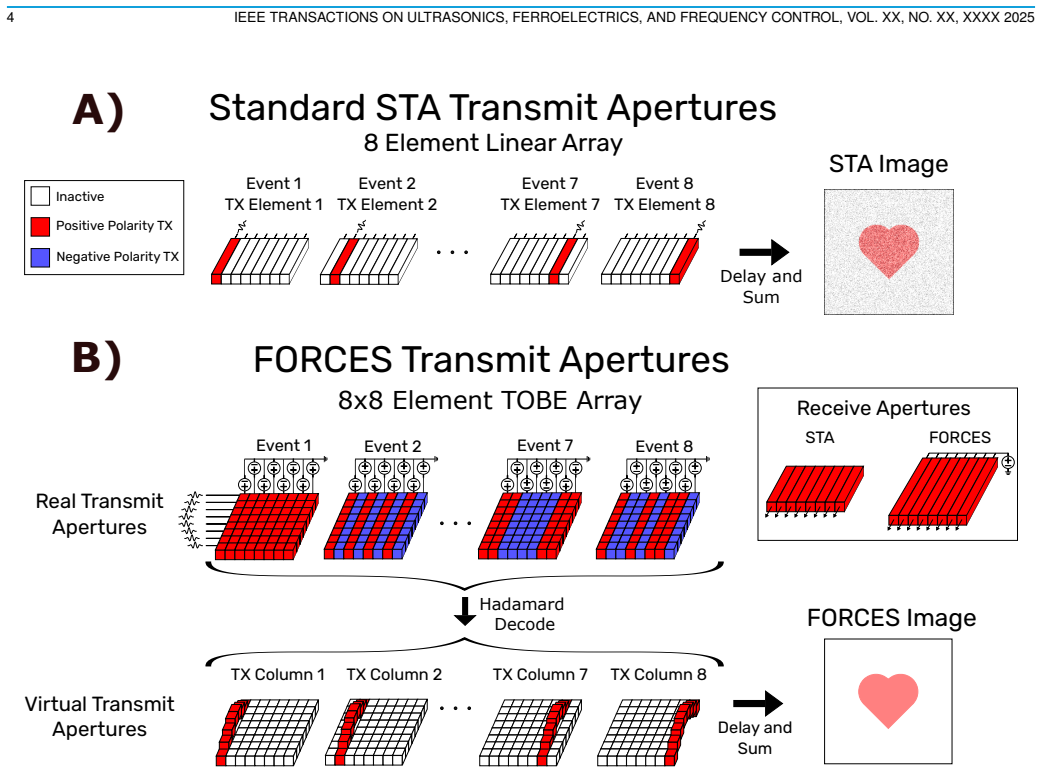
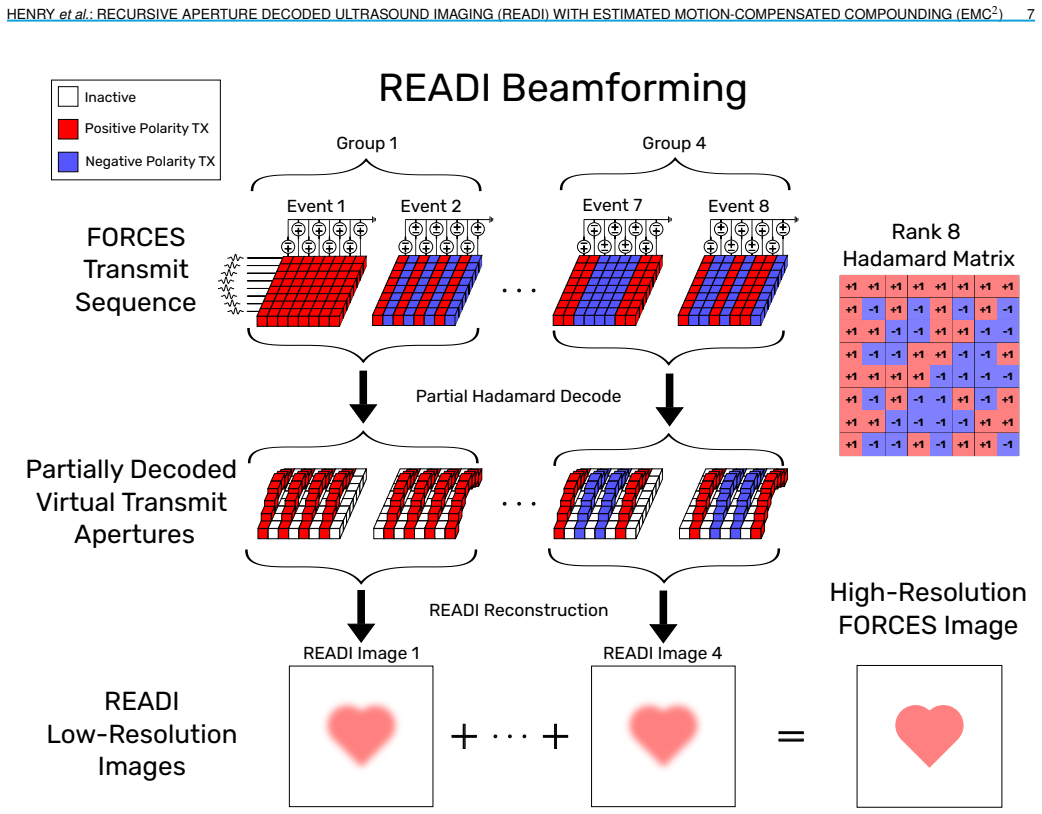
READI is a novel decoding and beamforming technique for Hadamard aperture-encoded sequences that produces multiple low-resolution images from subsets of the full sequence. These READI images are less affected by motion and sum to form the complete high-resolution image. EMC2 describes the process of comparing these low-resolution images to estimate the underlying motion, then warping them to align before compounding. This produces a high-resolution image that is resilient to motion. READI with EMC2 applied to the TOBE-based FORCES sequence fully restores images corrupted by probe motion and recovers tissue speckle and boundaries in images of a beating heart phantom. READI low-resolution sub-
What carries the argument
READI low-resolution sub-images generated from subsets of the Hadamard sequence, aligned via EMC2 motion estimation and compounding.
If this is right
- High-resolution images can be recovered from Hadamard sequences even when the probe moves during acquisition.
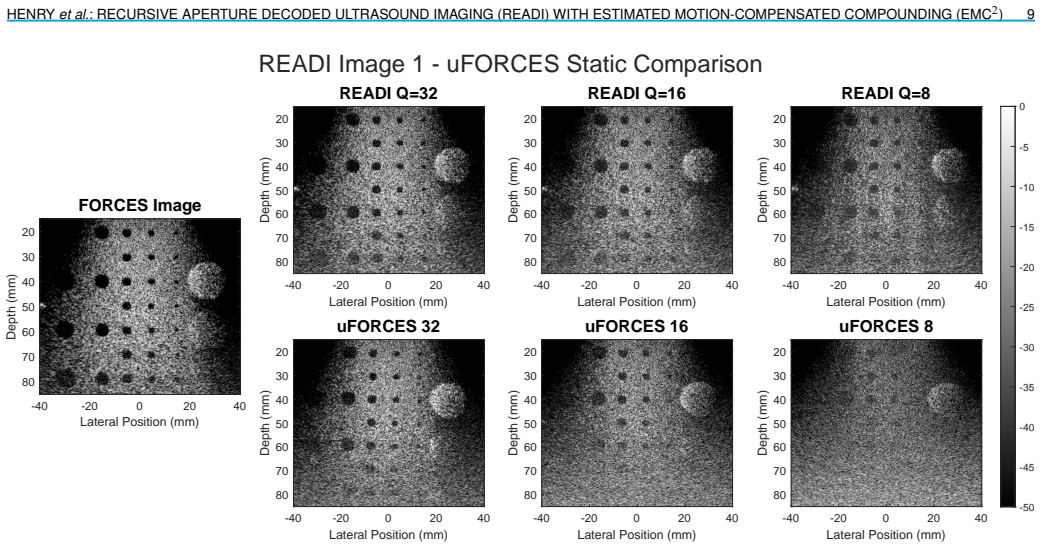
- READI low-resolution images by themselves improve on sparse Hadamard schemes that use the same number of transmits.
- Blood speckle remains visible at flow speeds of 42 cm/s when using the low-resolution READI sub-images.
- Tissue speckle and boundaries are recovered in dynamic heart-phantom scans where conventional compounding fails.
Where Pith is reading between the lines
- The sub-image alignment step could be combined with external tracking sensors to handle faster or more complex motions in clinical scans.
- The same READI splitting idea might reduce transmit count while preserving quality on other array geometries besides TOBE.
- Extending the motion estimation to include deformation rather than rigid warping could address tissue compression during cardiac cycles.
- Testing the method on in-vivo data with breathing or patient movement would show how well the estimated warping generalizes outside phantoms.
Load-bearing premise
Motion between the low-resolution READI sub-images can be estimated accurately enough from their differences to allow reliable warping and compounding without introducing new artifacts.
What would settle it
Image a beating heart phantom with known controlled probe motion, process the data with READI plus EMC2, and check whether the output matches a static reference image in speckle texture and boundary position.
Figures






read the original abstract
Hadamard matrix-based aperture encoding is a method for producing synthetic aperture datasets with high Signal-to-Noise Ratios. Recently, the pulse inversion capabilities of bias-sensitive Top-Orthogonal to Bottom Electrode (TOBE) arrays have driven the development of multiple Hadamard-based sequences. These sequences produce high-quality static images but are sensitive to motion. This work introduces Recursive Aperture Decoded Imaging (READI) and Estimated Motion-Compensated Compounding (EMC2), which look to reduce this sensitivity. READI is a novel decoding and beamforming technique for Hadamard aperture-encoded sequences that produces multiple low-resolution images from subsets of the full sequence. These READI images are less affected by motion and sum to form the complete high-resolution image. EMC2 describes the process of comparing these low-resolution images to estimate the underlying motion, then warping them to align before compounding. This produces a high-resolution image that is resiliant to motion. READI with EMC2 applied to the TOBE-based Fast Orthogonal Row-Column Electronic Scanning (FORCES) sequence. It is shown to fully restore images corrupted by probe motion and to recover tissue speckle and boundaries in images of a beating heart phantom. READI low-resolution images by themselves are demonstrated to be a marked improvement over a sparse Hadamard scheme with the same transmit count, and are able to recover blood speckle at a flow rate of 42 cm/s.
Editorial analysis
A structured set of objections, weighed in public.
Referee Report
Summary. The manuscript introduces Recursive Aperture Decoded Imaging (READI), a decoding and beamforming method that generates multiple low-resolution images from subsets of a Hadamard-encoded TOBE sequence, and Estimated Motion-Compensated Compounding (EMC2), which estimates motion from differences among these sub-images, warps them, and compounds to form a high-resolution output. Applied to the FORCES sequence, the work claims that READI+EMC2 fully restores probe-motion-corrupted images, recovers tissue speckle and boundaries in a beating-heart phantom, and outperforms a sparse Hadamard scheme with equivalent transmit count while recovering blood speckle at 42 cm/s.
Significance. If the motion-compensation step proves robust, the pipeline would address a key limitation of Hadamard-encoded TOBE sequences—sensitivity to probe or tissue motion—potentially enabling high-SNR synthetic-aperture imaging in cardiac and other dynamic applications. The approach is presented as a processing pipeline rather than a parameter-free derivation, and the phantom demonstrations of speckle preservation and motion recovery constitute the primary empirical support.
major comments (2)
- [Results (beating heart phantom experiments)] Results section on the beating-heart phantom: the central claim of 'full restoration' of motion-corrupted images rests on EMC2 accurately recovering displacement fields from the low-resolution READI sub-images, yet no registration-error metrics, residual-motion variance, or comparison against known ground-truth displacements are reported. Without these, it is impossible to verify that warping and summation do not re-introduce blur or coherent artifacts for the non-rigid, rapid motion present in the phantom.
- [Methods (EMC2)] Methods description of EMC2: the motion-estimation step is described as comparing low-resolution READI sub-images, but the manuscript provides neither the specific registration algorithm nor quantitative validation of its accuracy on the reduced-SNR, limited-support sub-images that result from disjoint Hadamard subsets. This assumption is load-bearing for the claim that EMC2 restores images without introducing new artifacts.
minor comments (2)
- [Abstract] The abstract states that READI images 'sum to form the complete high-resolution image,' but the precise weighting or normalization used in the final compounding step is not stated explicitly.
- [Figures] Figure captions and axis labels in the phantom results should include error bars or standard-deviation overlays when quantitative image-quality metrics are presented.
Simulated Author's Rebuttal
We thank the referee for the constructive feedback on our manuscript. The comments highlight important aspects of validation for the EMC2 motion-compensation pipeline. We address each major comment below and will incorporate clarifications and additional quantitative support in the revised version where feasible.
read point-by-point responses
-
Referee: [Results (beating heart phantom experiments)] Results section on the beating-heart phantom: the central claim of 'full restoration' of motion-corrupted images rests on EMC2 accurately recovering displacement fields from the low-resolution READI sub-images, yet no registration-error metrics, residual-motion variance, or comparison against known ground-truth displacements are reported. Without these, it is impossible to verify that warping and summation do not re-introduce blur or coherent artifacts for the non-rigid, rapid motion present in the phantom.
Authors: We agree that quantitative registration-error metrics would provide stronger support for the 'full restoration' claim. The current manuscript presents the primary evidence through side-by-side visual comparisons showing recovery of tissue speckle texture and boundary continuity in the beating-heart phantom after EMC2. These visuals demonstrate that compounding after alignment preserves high-frequency content better than uncompensated summation. In revision we will add displacement-field error statistics from controlled simulations matching the phantom's motion range and, where possible, residual speckle decorrelation metrics on the real data to quantify any re-introduced blur. revision: partial
-
Referee: [Methods (EMC2)] Methods description of EMC2: the motion-estimation step is described as comparing low-resolution READI sub-images, but the manuscript provides neither the specific registration algorithm nor quantitative validation of its accuracy on the reduced-SNR, limited-support sub-images that result from disjoint Hadamard subsets. This assumption is load-bearing for the claim that EMC2 restores images without introducing new artifacts.
Authors: The referee is correct that the exact registration implementation and its validation on the low-resolution sub-images are not specified. READI sub-images are formed from complementary Hadamard subsets and retain sufficient spatial support and SNR for pairwise motion estimation via normalized cross-correlation block matching with sub-pixel refinement. We will expand the Methods section to name the algorithm, list its parameters (block size, search range), and include a new quantitative validation subsection reporting endpoint error on both simulated motion fields and additional phantom acquisitions with known probe translations. revision: yes
Circularity Check
No circularity: method is an algorithmic pipeline validated experimentally, not a derivation reducing to its inputs
full rationale
The paper describes READI as a recursive decoding and beamforming process that generates low-resolution sub-images from Hadamard sequence subsets, which are then aligned via EMC2 motion estimation (comparing sub-images) and compounded. No equations define a quantity in terms of itself, no parameters are fitted to a subset and then relabeled as a prediction of a related quantity, and no uniqueness theorems or ansatzes are imported via self-citation to force the result. The central claims rest on phantom experiments showing restored speckle and boundaries rather than on a closed mathematical loop. This is a standard self-contained engineering pipeline with independent empirical support.
Axiom & Free-Parameter Ledger
axioms (2)
- domain assumption Hadamard-encoded transmit sequences produce additive synthetic aperture data when decoded.
- domain assumption Motion between sub-images is small and can be approximated by rigid or affine warping.
Lean theorems connected to this paper
-
IndisputableMonolith/Foundation/ArithmeticFromLogic.leanLogicNat inductive structure and embed from generator orbit echoes?
echoesECHOES: this paper passage has the same mathematical shape or conceptual pattern as the Recognition theorem, but is not a direct formal dependency.
the rank N Hadamard matrix can be expressed as a Kronecker product of rank S and Q matrices, provided S and Q are both powers of two... break the data into S sequential groups of Q transmissions... READI with Q=8, S=16
-
IndisputableMonolith/Foundation (headline theorem)reality_from_one_distinction (8-tick period) echoes?
echoesECHOES: this paper passage has the same mathematical shape or conceptual pattern as the Recognition theorem, but is not a direct formal dependency.
Hadamard matrix... recursive Sylvester definition... groups of 8 transmits
What do these tags mean?
- matches
- The paper's claim is directly supported by a theorem in the formal canon.
- supports
- The theorem supports part of the paper's argument, but the paper may add assumptions or extra steps.
- extends
- The paper goes beyond the formal theorem; the theorem is a base layer rather than the whole result.
- uses
- The paper appears to rely on the theorem as machinery.
- contradicts
- The paper's claim conflicts with a theorem or certificate in the canon.
- unclear
- Pith found a possible connection, but the passage is too broad, indirect, or ambiguous to say the theorem truly supports the claim.
discussion (0)
Sign in with ORCID, Apple, or X to comment. Anyone can read and Pith papers without signing in.