TG-DIN: Theory-Guided Demand Inference Network for Generalizable QoS Measurement and Prediction
Pith reviewed 2026-05-19 20:00 UTC · model grok-4.3
pith:UFBAJUVN Add to your LaTeX paper
What is a Pith Number?\usepackage{pith}
\pithnumber{UFBAJUVN}
Prints a linked pith:UFBAJUVN badge after your title and writes the identifier into PDF metadata. Compiles on arXiv with no extra files. Learn more
The pith
A neural network infers latent user demand from QoS measurements by embedding scheduling and queuing rules as a differentiable theory layer.
A machine-rendered reading of the paper's core claim, the machinery that carries it, and where it could break.
Core claim
TG-DIN explicitly models latent demand as an intermediate variable and links it to observable behavior through a differentiable theory layer grounded in scheduling and queuing principles. This design yields an interpretable, mechanism-consistent representation of user demand that is directly applicable to downstream tasks such as congestion diagnosis, resource allocation, capacity planning, and policy evaluation. The theory layer further enables a principled randomized training regime that exposes the model to diverse yet physically meaningful operating conditions without requiring labeled demand data.
What carries the argument
Differentiable theory layer grounded in scheduling and queuing principles that links latent demand to observable QoS measurements.
Load-bearing premise
The scheduling and queuing principles encoded in the theory layer accurately reflect the real mechanisms that connect latent demand to QoS measurements.
What would settle it
If the inferred per-user allocations from TG-DIN applied to real packet traces fail to match independent ground-truth measurements or if prediction accuracy drops sharply under traffic patterns absent from the synthetic training distribution.
Figures


read the original abstract
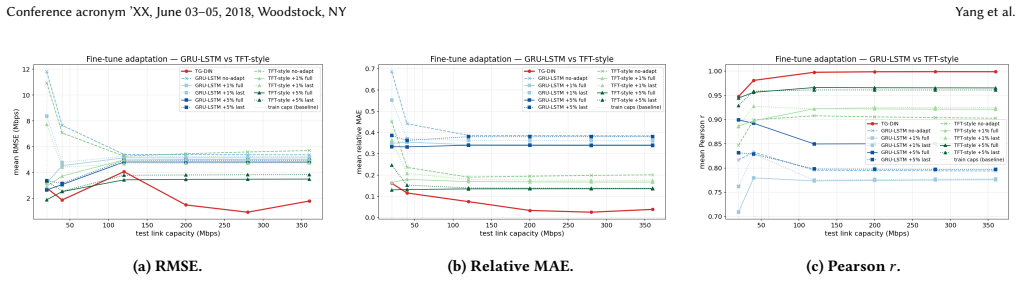
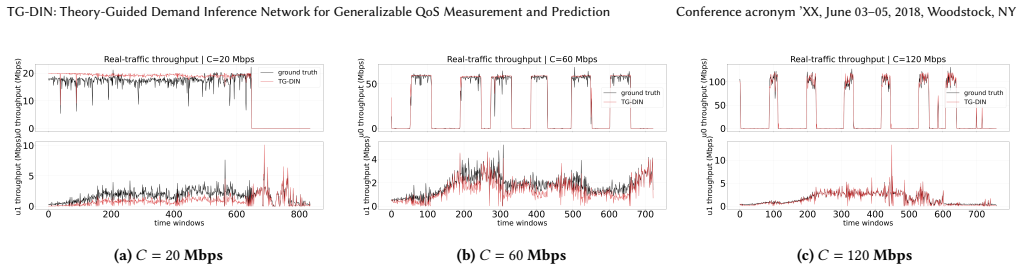
In this paper, we introduce TG-DIN, a theory-guided demand inference network that infers latent user demand from observable network quality-of-service (QoS) measurements. Rather than directly predicting QoS outcomes using black-box models, TG-DIN explicitly models latent demand as an intermediate variable and links it to observable behavior through a differentiable theory layer grounded in scheduling and queuing principles. This design yields an interpretable, mechanism-consistent representation of user demand that is directly applicable to downstream tasks such as congestion diagnosis, resource allocation, capacity planning, and policy evaluation. The theory layer further enables a principled randomized training regime that exposes the model to diverse yet physically meaningful operating conditions without requiring labeled demand data. Extensive synthetic experiments show that TG-DIN generalizes robustly across capacities, demand levels, and traffic patterns, substantially outperforming purely data-driven baselines under distribution shift. Moreover, when trained exclusively on synthetic data and applied directly to real packet traces, TG-DIN accurately recovers per-user allocation structure in shared-link scenarios. Together, these results demonstrate the effectiveness of theory-guided inductive biases for achieving transferable, deployment-ready inference in dynamic network environments.
Editorial analysis
A structured set of objections, weighed in public.
Referee Report
Summary. The paper introduces TG-DIN, a neural architecture that infers latent user demand from observable QoS measurements by inserting an explicit intermediate demand variable linked to behavior via a differentiable theory layer grounded in scheduling and queuing principles. The layer enables a randomized synthetic training regime that exposes the model to diverse operating conditions without labeled demand data. Experiments claim robust generalization across capacities, demand levels, and traffic patterns on synthetic data (outperforming black-box baselines under distribution shift) and accurate recovery of per-user allocation structure when the synthetically trained model is applied directly to real packet traces.
Significance. If the central claims hold, the work would demonstrate a practical route to interpretable, mechanism-consistent demand inference that transfers from synthetic to real network settings. The randomized training regime and explicit demand modeling are strengths that could support downstream tasks such as congestion diagnosis and resource allocation. The approach adds to the literature on theory-guided neural networks in networking by showing direct applicability to real traces without retraining.
major comments (3)
- [§3.2] §3.2, Theory Layer: the differentiable mapping from latent demand to QoS is described as grounded in scheduling and queuing principles, yet the manuscript does not state whether the layer employs stationary M/M/1, processor-sharing, or fluid approximations. If the layer embeds these idealized assumptions, the reported recovery of allocation structure on real traces (which exhibit long-range dependence and TCP backoff) only validates output structure, not demand fidelity or mechanism consistency, weakening the generalization claim.
- [§5.3] §5.3, Real-trace experiments: the paper reports that TG-DIN recovers per-user allocation structure when trained exclusively on synthetic data, but supplies no quantitative error metric (e.g., allocation RMSE or correlation with any proxy for demand) and no ablation that isolates the contribution of the theory layer versus the neural backbone. Without such controls, it is unclear whether the result demonstrates successful demand inference or merely that the model reproduces average link behavior.
- [§4.2] §4.2, Synthetic generalization results: while the paper states that TG-DIN substantially outperforms purely data-driven baselines under distribution shift, the tables do not report confidence intervals or statistical significance tests across the multiple capacity/demand/traffic-pattern combinations. This makes it difficult to assess whether the claimed robustness is load-bearing or sensitive to particular random seeds.
minor comments (3)
- [Abstract] The abstract would benefit from one or two key quantitative results (e.g., relative error reduction on synthetic data or allocation correlation on real traces) to allow readers to gauge the magnitude of improvement.
- [§3] Notation for the demand variable and the theory-layer output should be introduced once and used consistently; several equations reuse symbols without redefinition.
- [§4] Figure captions for the synthetic experiment plots should explicitly state the distribution-shift axis (e.g., capacity ratio or arrival-rate multiplier) rather than relying on legend colors alone.
Simulated Author's Rebuttal
We thank the referee for the thoughtful and constructive feedback on our manuscript. We have carefully considered each comment and provide point-by-point responses below. Where appropriate, we have made revisions to address the concerns raised.
read point-by-point responses
-
Referee: [§3.2] §3.2, Theory Layer: the differentiable mapping from latent demand to QoS is described as grounded in scheduling and queuing principles, yet the manuscript does not state whether the layer employs stationary M/M/1, processor-sharing, or fluid approximations. If the layer embeds these idealized assumptions, the reported recovery of allocation structure on real traces (which exhibit long-range dependence and TCP backoff) only validates output structure, not demand fidelity or mechanism consistency, weakening the generalization claim.
Authors: We appreciate the referee's point regarding the need for specificity in the theory layer description. The differentiable theory layer in TG-DIN implements a fluid approximation based on processor-sharing principles, which models the allocation of link capacity proportionally to user demands in a differentiable manner. This is distinct from stationary M/M/1 assumptions and is suitable for the dynamic, non-stationary conditions in our setting. We have updated §3.2 to clearly state this choice and include the relevant equations. While real packet traces do include phenomena such as long-range dependence and TCP backoff not explicitly modeled, the recovery of per-user allocation structure indicates that the inferred demands produce QoS predictions consistent with the observed behavior under the theory layer. We have added a limitations discussion to acknowledge these aspects and their implications for generalization. revision: yes
-
Referee: [§5.3] §5.3, Real-trace experiments: the paper reports that TG-DIN recovers per-user allocation structure when trained exclusively on synthetic data, but supplies no quantitative error metric (e.g., allocation RMSE or correlation with any proxy for demand) and no ablation that isolates the contribution of the theory layer versus the neural backbone. Without such controls, it is unclear whether the result demonstrates successful demand inference or merely that the model reproduces average link behavior.
Authors: We agree that additional quantitative analysis and controls would strengthen the presentation of the real-trace results. In the revised manuscript, we have included quantitative metrics including allocation RMSE and correlation coefficients with proxies for demand such as per-user throughput. Furthermore, we have added an ablation experiment that compares the full TG-DIN model against a variant without the theory layer on the real traces. The results show improved performance with the theory layer, supporting that the demand inference is enhanced by the mechanism-consistent component rather than solely reproducing average behaviors. revision: yes
-
Referee: [§4.2] §4.2, Synthetic generalization results: while the paper states that TG-DIN substantially outperforms purely data-driven baselines under distribution shift, the tables do not report confidence intervals or statistical significance tests across the multiple capacity/demand/traffic-pattern combinations. This makes it difficult to assess whether the claimed robustness is load-bearing or sensitive to particular random seeds.
Authors: We thank the referee for highlighting the importance of statistical reporting. We have extended the experiments in §4.2 to include results from multiple random seeds and now report mean values along with 95% confidence intervals in the relevant tables. We have also conducted statistical significance tests (paired t-tests) between TG-DIN and the baselines, confirming that the performance improvements are statistically significant (p < 0.05) across the distribution shift scenarios. These additions demonstrate that the robustness is not sensitive to particular seeds. revision: yes
Circularity Check
No significant circularity: theory layer supplies external inductive bias from queuing principles
full rationale
The paper's central construction introduces a differentiable theory layer grounded in standard scheduling and queuing principles to link latent demand to observable QoS. This layer is used to create a randomized training regime that generates diverse synthetic operating conditions without labeled demand data. Synthetic experiments test generalization under distribution shift, while direct application to real packet traces provides an external validation check on recovered allocation structure. No step reduces by construction to a fitted parameter renamed as prediction, no self-citation chain bears the load of a uniqueness claim, and the theory layer is not defined in terms of the model's outputs. The derivation remains self-contained against external benchmarks from queuing theory and real traces.
Axiom & Free-Parameter Ledger
axioms (1)
- domain assumption Scheduling and queuing principles supply an accurate, differentiable mapping from latent demand to observable QoS metrics.
Reference graph
Works this paper leans on
-
[1]
Abd AlRhman AlQiam, Yuanjun Yao, Zhaodong Wang, Satyajeet Singh Ahuja, Ying Zhang, Sanjay G Rao, Bruno Ribeiro, and Mohit Tawarmalani. 2024. Transfer- able neural wan te for changing topologies. InProceedings of the ACM SIGCOMM 2024 Conference. 86–102
work page 2024
-
[2]
Giuseppina Andresini, Feargus Pendlebury, Fabio Pierazzi, Corrado Loglisci, Annalisa Appice, and Lorenzo Cavallaro. 2021. INSOMNIA: Towards Concept- Drift Robustness in Network Intrusion Detection. InProceedings of the 14th ACM Workshop on Artificial Intelligence and Security(Virtual Event, Republic of Korea) (AISec ’21). Association for Computing Machine...
-
[3]
Ons Aouedi, Van An Le, Kandaraj Piamrat, and Yusheng Ji. 2025. Deep learning on network traffic prediction: Recent advances, analysis, and future directions. ACM computing surveys57, 6 (2025), 1–37
work page 2025
-
[4]
Athula Balachandran, Vyas Sekar, Aditya Akella, Srinivasan Seshan, Ion Stoica, and Hui Zhang. 2013. Developing a predictive model of quality of experience for internet video.ACM SIGCOMM Computer Communication Review43, 4 (2013), 339–350
work page 2013
-
[5]
Giuseppe Bianchi. 2000. Performance analysis of the IEEE 802.11 distributed coordination function.IEEE Journal on Selected Areas in Communications18, 3 (2000), 535–547
work page 2000
-
[6]
Giovanna Carofiglio, Giulio Grassi, Enrico Loparco, Luca Muscariello, Michele Papalini, and Jacques Samain. 2021. Characterizing the relationship between application QoE and network QoS for real-time services. InProceedings of the ACM SIGCOMM 2021 workshop on network-application integration. 20–25
work page 2021
-
[7]
Dah-Ming Chiu and Raj Jain. 1989. Analysis of the increase and decrease algo- rithms for congestion avoidance in computer networks.Computer Networks and ISDN Systems17, 1 (1989), 1–14
work page 1989
-
[8]
Cisco Systems. 2012. Congestion Management Overview — IOS QoS Configu- ration Guide. Cisco Documentation. https://www.cisco.com/c/en/us/td/docs/ ios/qos/configuration/guide/12_2sr/qos_12_2sr_book/congstion_mgmt_oview. html
work page 2012
-
[9]
Fei Gui, Songtao Wang, Dan Li, Li Chen, Kaihui Gao, Congcong Min, and Yi Wang
-
[10]
InProceedings of the ACM SIGCOMM 2024 Conference
RedTE: Mitigating subsecond traffic bursts with real-time and distributed traffic engineering. InProceedings of the ACM SIGCOMM 2024 Conference. 71–85
work page 2024
-
[11]
Chi-Yao Hong, Srikanth Kandula, Ratul Mahajan, Ming Zhang, Vijay Gill, Mohan Nanduri, and Roger Wattenhofer. 2013. Achieving high utilization with software- driven WAN. InProceedings of the ACM SIGCOMM 2013 Conference on SIGCOMM. 15–26
work page 2013
-
[12]
Shengxiang Hu, Guobing Zou, Bofeng Zhang, Shaogang Wu, Shiyi Lin, Yanglan Gan, and Yixin Chen. 2025. GACL: Graph Attention Collaborative Learning for Temporal QoS Prediction.IEEE Transactions on Network and Service Management (2025)
work page 2025
-
[13]
Rishabh Iyer, Katerina Argyraki, and George Candea. 2022. Performance inter- faces for network functions. In19th USENIX Symposium on Networked Systems Design and Implementation (NSDI 22). 567–584
work page 2022
-
[14]
Sushant Jain, Alok Kumar, Subhasree Mandal, Joon Ong, Leon Poutievski, Arjun Singh, Subbaiah Venkata, Jim Wanderer, Junlan Zhou, Min Zhu, et al. 2013. B4: Experience with a globally-deployed software defined WAN.ACM SIGCOMM Computer Communication Review43, 4 (2013), 3–14
work page 2013
-
[15]
Zeliang Kan, Feargus Pendlebury, Fabio Pierazzi, and Lorenzo Cavallaro. 2021. Investigating Labelless Drift Adaptation for Malware Detection. InProceedings of the 14th ACM Workshop on Artificial Intelligence and Security(Virtual Event, Republic of Korea)(AISec ’21). Association for Computing Machinery, New York, NY, USA, 123–134. doi:10.1145/3474369.3486873
-
[16]
Georgios Kougioumtzidis, Vladimir K Poulkov, Pavlos I Lazaridis, and Zaharias D Zaharis. 2025. Mobile network traffic prediction using temporal fusion trans- former.IEEE Transactions on Artificial Intelligence(2025)
work page 2025
-
[17]
Jinsung Lee, Sungyong Lee, Jongyun Lee, Sandesh Dhawaskar Sathyanarayana, Hyoyoung Lim, Jihoon Lee, Xiaoqing Zhu, Sangeeta Ramakrishnan, Dirk Grun- wald, Kyunghan Lee, et al. 2020. PERCEIVE: Deep learning-based cellular uplink prediction using real-time scheduling patterns. InProceedings of the 18th Interna- tional Conference on Mobile Systems, Applicatio...
work page 2020
-
[18]
Shinan Liu, Francesco Bronzino, Paul Schmitt, Arjun Nitin Bhagoji, Nick Feamster, Hector Garcia Crespo, Timothy Coyle, and Brian Ward. 2023. Leaf: Navigating concept drift in cellular networks.Proceedings of the ACM on Networking1, CoNEXT2 (2023), 1–24
work page 2023
-
[19]
Harsha V Madhyastha, Tomas Isdal, Michael Piatek, Colin Dixon, Thomas An- derson, Arvind Krishnamurthy, and Arun Venkataramani. 2006. iPlane: An information plane for distributed services. InProceedings of the 7th symposium on Operating systems design and implementation. 367–380
work page 2006
-
[20]
Harsha V Madhyastha, Ethan Katz-Bassett, Thomas E Anderson, Arvind Krish- namurthy, and Arun Venkataramani. 2009. iPlane Nano: Path Prediction for Peer-to-Peer Applications.. InNSDI, Vol. 9. 137–152
work page 2009
-
[21]
Alberto Medina, Nina Taft, Kave Salamatian, Supratik Bhattacharyya, and Christophe Diot. 2002. Traffic matrix estimation: Existing techniques and new directions.ACM SIGCOMM Computer Communication Review32, 4 (2002), 161– 174
work page 2002
-
[22]
K. Nichols, S. Blake, F. Baker, and D. Black. 1998.Definition of the Differentiated Services Field (DS Field) in the IPv4 and IPv6 Headers. RFC 2474. IETF. https: //www.rfc-editor.org/rfc/rfc2474
work page 1998
-
[23]
Abhay K. Parekh and Robert G. Gallager. 1993. A generalized processor sharing approach to flow control in integrated services networks: the single-node case. IEEE/ACM Transactions on Networking1, 3 (1993), 344–357
work page 1993
-
[24]
Yarin Perry, Felipe Vieira Frujeri, Chaim Hoch, Srikanth Kandula, Ishai Menache, Michael Schapira, and Aviv Tamar. 2023. {DOTE}: Rethinking (predictive){WAN} traffic engineering. In20th USENIX Symposium on Networked Systems Design and Implementation (NSDI 23). 1557–1581
work page 2023
-
[25]
Yan Qiao, Kui Wu, and Xinyu Yuan. 2024. AutoTomo: Learning-based traffic esti- mator incorporating network tomography.IEEE/ACM Transactions on Networking 32, 6 (2024), 4644–4659
work page 2024
-
[26]
Mohammad Arafath Uddin Shariff, Venkat Sai Suman Lamba Karanam, and Byrav Ramamurthy. 2025. Traffic prediction for research and education networks using an ensemble GRU-LSTM with varying lead times. In2025 IEEE International Conference on Communications Workshops (ICC Workshops). IEEE, 1676–1681
work page 2025
-
[27]
Paul Tune and Matthew Roughan. 2015. Spatiotemporal traffic matrix synthesis. InProceedings of the 2015 ACM Conference on Special Interest Group on Data Communication. 579–592
work page 2015
-
[28]
Bruno Missi Xavier, Magnos Martinello, Celio Trois, Brenno M. Alenca, and Ricardo A. Rios. 2024. Fast Learning Enabled by In-Network Drift Detection. In Proceedings of the 8th Asia-Pacific Workshop on Networking(Sydney, Australia) (APNet ’24). Association for Computing Machinery, New York, NY, USA, 129–134. doi:10.1145/3663408.3663427
-
[29]
Shenghe Xu, Murali Kodialam, TV Lakshman, and Shivendra S Panwar. 2021. Learning based methods for traffic matrix estimation from link measurements. IEEE Open Journal of the Communications Society2 (2021), 488–499
work page 2021
-
[30]
Zhiying Xu, Francis Y Yan, Rachee Singh, Justin T Chiu, Alexander M Rush, and Minlan Yu. 2023. Teal: Learning-accelerated optimization of wan traffic engineering. InProceedings of the ACM SIGCOMM 2023 Conference. 378–393
work page 2023
-
[31]
Xinyu Yuan, Yan Qiao, Pei Zhao, Rongyao Hu, and Benchu Zhang. 2023. Traffic matrix estimation based on denoising diffusion probabilistic model. In2023 IEEE Symposium on Computers and Communications (ISCC). IEEE, 316–322
work page 2023
-
[32]
Bo Zhang, TS Eugene Ng, Animesh Nandi, Rudolf Riedi, Peter Druschel, and Guohui Wang. 2006. Measurement based analysis, modeling, and synthesis of the internet delay space. InProceedings of the 6th ACM SIGCOMM conference on Internet measurement. 85–98
work page 2006
-
[33]
Yazhuo Zhang, Rebecca Isaacs, Yao Yue, Juncheng Yang, Lei Zhang, and Ymir Vigfusson. 2023. Latenseer: Causal modeling of end-to-end latency distributions by harnessing distributed tracing. InProceedings of the 2023 ACM Symposium on Cloud Computing. 502–519
work page 2023
-
[34]
Yin Zhang, Matthew Roughan, Carsten Lund, and David Donoho. 2003. An information-theoretic approach to traffic matrix estimation. InProceedings of the 2003 conference on Applications, technologies, architectures, and protocols for computer communications. 301–312
work page 2003
-
[35]
Kevin Zhao, Prateesh Goyal, Mohammad Alizadeh, and Thomas E Anderson
-
[36]
In20th USENIX Symposium on Networked Systems Design and Implementation (NSDI 23)
Scalable tail latency estimation for data center networks. In20th USENIX Symposium on Networked Systems Design and Implementation (NSDI 23). 685–702
-
[37]
Jie Zhou, Ding Ding, Ziteng Wu, and Yuting Xiu. 2023. Spatial context-aware time-series forecasting for QoS prediction.IEEE Transactions on Network and Service Management20, 2 (2023), 918–931. Received 20 February 2007; revised 12 March 2009; accepted 5 June 2009
work page 2023
discussion (0)
Sign in with ORCID, Apple, or X to comment. Anyone can read and Pith papers without signing in.