SWARD: Stochastic Window-Attention-Based Relational Distillation for Cross-Architectural Semantic Segmentation
Pith reviewed 2026-06-28 17:36 UTC · model grok-4.3
The pith
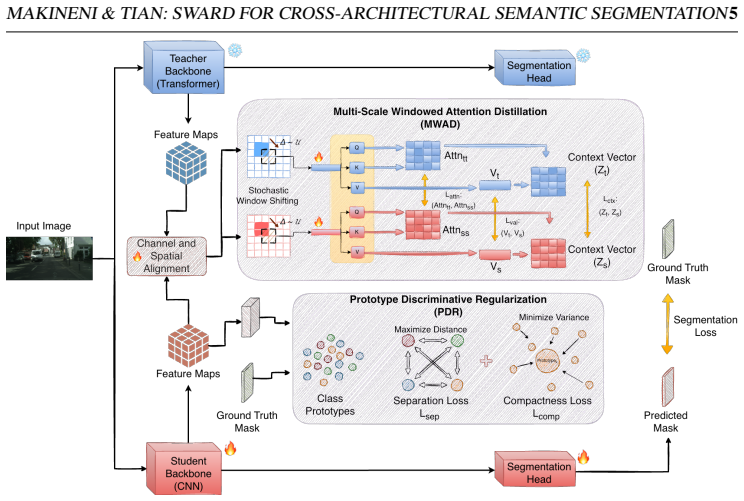
SWARD distills global context from transformer teachers to local CNN students for semantic segmentation without requiring matching architectures.
A machine-rendered reading of the paper's core claim, the machinery that carries it, and where it could break.
Core claim
The central claim is that aligning teacher-student attention relations inside stochastically shifted multi-scale windows, combined with a loss that shapes the student's feature distribution for inter-class separation and intra-class compactness, successfully transfers global spatial dependencies to locally biased CNN students and produces more accurate semantic segmentation than prior distillation techniques.
What carries the argument
The Multi-Scale Windowed Attention Distillation (MWAD) module with stochastic window shifts that removes boundary bias and captures short- and long-range dependencies, together with the Prototype Discriminative Regularization (PDR) loss that sharpens discriminative structure.
If this is right
- The framework achieves state-of-the-art performance on urban scene parsing datasets.
- The framework achieves state-of-the-art performance on medical image segmentation datasets.
- The method works across teacher-student pairs that differ in architecture.
- Performance gains come from relational alignment and distribution shaping rather than direct feature mimicry alone.
Where Pith is reading between the lines
- The stochastic window approach could be tested on other dense prediction tasks such as instance segmentation or depth estimation where spatial relations matter.
- If the method generalizes, it would reduce the deployment cost of foundation-model accuracy to edge devices without retraining the teacher.
- The same window-shift idea might apply to distillation in video or 3D tasks that also require handling long-range dependencies under local student constraints.
Load-bearing premise
The MWAD module with stochastic window shifts and the PDR loss will successfully align global context from transformer teachers with local CNN students and improve discriminative structure without requiring architectural homogeneity or direct feature mimicry.
What would settle it
A controlled ablation on the same benchmarks showing that performance drops to baseline levels when either the stochastic window shifts are removed or the PDR loss is ablated would falsify the claim that these two components are necessary for the reported gains.
Figures



read the original abstract
Large-scale vision foundation models have driven substantial gains on dense prediction tasks such as semantic segmentation, but their size makes deployment impractical in resource-constrained settings, motivating knowledge distillation as a means of transferring their capabilities to lightweight student networks. However, modern foundation teachers are predominantly transformer-based that encode global context, whereas efficient students are typically convolutional networks with locally biased receptive fields. Existing distillation methods largely assume architectural homogeneity and rely on direct feature mimicry, which fails to bridge this representational gap and neglects the structured spatial dependencies and discriminative organization required for accurate semantic segmentation. In this paper, we propose SWARD, a knowledge distillation framework that addresses this gap through two complementary mechanisms. First, we introduce a Multi-Scale Windowed Attention Distillation (MWAD) module that aligns teacher-student attention-based relations within stochastically shifted window partitions whose offsets are randomly resampled at every training iteration. This removes window boundary bias, and, combined with the multi-scale design, captures both short- and long-range spatial dependencies. Second, we introduce Prototype Discriminative Regularization (PDR), a loss that helps shape the student's feature distribution by enforcing inter-class separation and intra-class compactness, further sharpening the discriminative structure beyond what feature mimicry alone can produce under the student's reduced capacity. Experiments across different vision applications (i.e., urban scene parsing and medical image segmentation) show that SWARD achieves state-of-the-art performance.
Editorial analysis
A structured set of objections, weighed in public.
Referee Report
Summary. The paper proposes SWARD, a knowledge distillation framework for transferring capabilities from large transformer-based vision foundation models to lightweight CNN students on semantic segmentation. It introduces the Multi-Scale Windowed Attention Distillation (MWAD) module, which aligns relational attention across stochastically shifted multi-scale windows to capture short- and long-range dependencies without direct feature mimicry, and the Prototype Discriminative Regularization (PDR) loss, which enforces inter-class separation and intra-class compactness. The central claim is that these mechanisms enable state-of-the-art performance on urban scene parsing and medical image segmentation tasks.
Significance. If the empirical results hold, the work addresses a practically relevant gap in cross-architectural distillation for dense prediction, where transformer teachers provide global context but CNN students have local receptive fields. The stochastic window shifts and prototype-based regularization are presented as mechanisms that avoid assumptions of architectural homogeneity. This could support more efficient deployment of foundation models, though the magnitude of gains cannot be assessed without quantitative evidence.
major comments (1)
- [Abstract] Abstract: The central claim that SWARD 'achieves state-of-the-art performance' is load-bearing for the paper's contribution, yet the abstract (and available text) provides no quantitative numbers, specific baselines, ablation studies, datasets, or experimental protocol details. This prevents evaluation of whether the MWAD and PDR mechanisms deliver the asserted improvements.
minor comments (1)
- The description of MWAD and PDR is entirely qualitative with no equations, pseudocode, or algorithmic details visible, which hinders assessment of whether the relational alignment or prototype regularization introduces additional hyperparameters or reduces to standard attention mechanisms.
Simulated Author's Rebuttal
We thank the referee for their review and for highlighting the need for greater specificity in the abstract. We address the single major comment below.
read point-by-point responses
-
Referee: [Abstract] Abstract: The central claim that SWARD 'achieves state-of-the-art performance' is load-bearing for the paper's contribution, yet the abstract (and available text) provides no quantitative numbers, specific baselines, ablation studies, datasets, or experimental protocol details. This prevents evaluation of whether the MWAD and PDR mechanisms deliver the asserted improvements.
Authors: We agree that the abstract would benefit from quantitative grounding to support the SOTA claim. The full manuscript contains the detailed experimental results (including mIoU tables on Cityscapes, ACDC, and medical datasets, comparisons against recent distillation baselines, and ablations on MWAD/PDR), but these were not summarized numerically in the abstract. In the revised version we will add concise quantitative highlights (key mIoU gains and main datasets) while preserving the abstract's length constraints. revision: yes
Circularity Check
No significant circularity; empirical method with independent mechanisms
full rationale
The paper introduces MWAD (stochastic multi-scale window attention alignment) and PDR (prototype discriminative regularization) as novel components for cross-architectural distillation. No equations, derivations, or parameter-fitting steps are described that reduce by construction to the inputs or to self-citations. The central claims rest on the design of these modules and their empirical validation on standard benchmarks; the mechanisms are presented as independent contributions that address representational gaps without self-referential definitions or load-bearing uniqueness theorems imported from the authors' prior work. This is the common case of a self-contained empirical proposal.
Axiom & Free-Parameter Ledger
Reference graph
Works this paper leans on
-
[1]
Towards automatic polyp detec- tion with a polyp appearance model.Pattern Recognition, 45(9):3166–3182, 2012
Jorge Bernal, Javier Sánchez, and Fernando Vilarino. Towards automatic polyp detec- tion with a polyp appearance model.Pattern Recognition, 45(9):3166–3182, 2012
2012
-
[2]
Wm-dova maps for accurate polyp highlighting in colonoscopy: Validation vs
Jorge Bernal, F Javier Sánchez, Gloria Fernández-Esparrach, Debora Gil, Cristina Ro- dríguez, and Fernando Vilariño. Wm-dova maps for accurate polyp highlighting in colonoscopy: Validation vs. saliency maps from physicians.Computerized Medical Imaging and Graphics, 43:99–111, 2015
2015
-
[3]
Encoder-decoder with atrous separable convolution for semantic image seg- mentation
Liang-Chieh Chen, Yukun Zhu, George Papandreou, Florian Schroff, and Hartwig Adam. Encoder-decoder with atrous separable convolution for semantic image seg- mentation. InProceedings of the European conference on computer vision (ECCV), pages 801–818, 2018
2018
-
[4]
Yadang Chen, Xinyu Xu, Chenchen Wei, and Chuhan Lu. Prototype-wise self- knowledge distillation for few-shot segmentation.Signal Processing: Image Com- munication, 129:117186, 2024. ISSN 0923-5965. doi: https://doi.org/10.1016/j.image. 2024.117186
-
[5]
Improving deep detector robustness via detection-related discriminant maximization and reorganization
Jung Im Choi, Qizhen Lan, and Qing Tian. Improving deep detector robustness via detection-related discriminant maximization and reorganization. InProceedings of the IEEE/CVF Winter Conference on Applications of Computer Vision (WACV), 2025
2025
-
[6]
Jean-Baptiste Cordonnier, Andreas Loukas, and Martin Jaggi. On the relationship be- tween self-attention and convolutional layers.arXiv preprint arXiv:1911.03584, 2019
-
[7]
The cityscapes dataset for semantic urban scene understanding
Marius Cordts, Mohamed Omran, Sebastian Ramos, Timo Rehfeld, Markus Enzweiler, Rodrigo Benenson, Uwe Franke, Stefan Roth, and Bernt Schiele. The cityscapes dataset for semantic urban scene understanding. InProceedings of the IEEE conference on computer vision and pattern recognition, pages 3213–3223, 2016
2016
-
[8]
An Image is Worth 16x16 Words: Transformers for Image Recognition at Scale
Alexey Dosovitskiy, Lucas Beyer, Alexander Kolesnikov, Dirk Weissenborn, Xiaohua Zhai, Thomas Unterthiner, Mostafa Dehghani, Matthias Minderer, Georg Heigold, Syl- vain Gelly, et al. An image is worth 16x16 words: Transformers for image recognition at scale.arXiv preprint arXiv:2010.11929, 2020
work page internal anchor Pith review Pith/arXiv arXiv 2010
-
[9]
Augmentation-free dense contrastive knowledge distillation for efficient semantic segmentation.Advances in Neural Information Processing Systems, 36:51359–51370, 2023
Jiawei Fan, Chao Li, Xiaolong Liu, Meina Song, and Anbang Yao. Augmentation-free dense contrastive knowledge distillation for efficient semantic segmentation.Advances in Neural Information Processing Systems, 36:51359–51370, 2023
2023
-
[10]
One-for-all: Bridge the gap between heterogeneous architectures in knowledge distillation
Zhiwei Hao, Jianyuan Guo, Kai Han, Yehui Tang, Han Hu, Yunhe Wang, and Chang Xu. One-for-all: Bridge the gap between heterogeneous architectures in knowledge distillation. InAdvances in Neural Information Processing Systems, volume 36, 2023. 16MAKINENI & TIAN: SW ARD FOR CROSS-ARCHITECTURAL SEMANTIC SEGMENTA TION
2023
-
[11]
Distilling the Knowledge in a Neural Network
Geoffrey Hinton, Oriol Vinyals, and Jeff Dean. Distilling the knowledge in a neural network.arXiv preprint arXiv:1503.02531, 2015
work page internal anchor Pith review Pith/arXiv arXiv 2015
-
[12]
Searching for MobileNetV3
Andrew Howard, Mark Sandler, Grace Chu, Liang-Chieh Chen, Bo Chen, Mingxing Tan, Weijun Wang, Yukun Zhu, Ruoming Pang, Vijay Vasudevan, et al. Searching for MobileNetV3. InProceedings of the IEEE/CVF international conference on computer vision, pages 1314–1324, 2019
2019
-
[13]
Masked distillation with receptive tokens.arXiv preprint arXiv:2205.14589, 2022
Tao Huang, Yuan Zhang, Shan You, Fei Wang, Chen Qian, Jian Cao, and Chang Xu. Masked distillation with receptive tokens.arXiv preprint arXiv:2205.14589, 2022
-
[14]
Knowledge diffusion for distillation.Advances in Neural Information Processing Systems, 36:65299–65316, 2023
Tao Huang, Yuan Zhang, Mingkai Zheng, Shan You, Fei Wang, Chen Qian, and Chang Xu. Knowledge diffusion for distillation.Advances in Neural Information Processing Systems, 36:65299–65316, 2023
2023
-
[15]
ResUNet++: An advanced architecture for medical image segmentation
Debesh Jha, Pia H Smedsrud, Michael A Riegler, Dag Johansen, Thomas De Lange, Pål Halvorsen, and Håvard D Johansen. ResUNet++: An advanced architecture for medical image segmentation. In2019 IEEE international symposium on multimedia (ISM), pages 225–2255. IEEE, 2019
2019
-
[16]
Visual detector compression via location- aware discriminant analysis
Qizhen Lan, Jung Im Choi, and Qing Tian. Visual detector compression via location- aware discriminant analysis. InProceedings of the IEEE/CVF Winter Conference on Applications of Computer Vision (WACV), 2026
2026
-
[17]
BPKD: Boundary privileged knowledge distillation for semantic segmentation
Liyang Liu, Zihan Wang, Minh Hieu Phan, Bowen Zhang, Jinchao Ge, and Yifan Liu. BPKD: Boundary privileged knowledge distillation for semantic segmentation. InPro- ceedings of the IEEE/CVF winter conference on applications of computer vision, pages 1062–1072, 2024
2024
-
[18]
Structured knowledge distillation for semantic segmentation
Yifan Liu, Ke Chen, Chris Liu, Zengchang Qin, Zhenbo Luo, and Jingdong Wang. Structured knowledge distillation for semantic segmentation. InProceedings of the IEEE/CVF conference on computer vision and pattern recognition, pages 2604–2613, 2019
2019
-
[19]
Cross- architecture knowledge distillation
Yufan Liu, Jiajiong Cao, Bing Li, Weiming Hu, Jingting Ding, and Liang Li. Cross- architecture knowledge distillation. InProceedings of the Asian conference on com- puter vision, pages 3396–3411, 2022
2022
-
[20]
Swin transformer: Hierarchical vision transformer using shifted win- dows
Ze Liu, Yutong Lin, Yue Cao, Han Hu, Yixuan Wei, Zheng Zhang, Stephen Lin, and Baining Guo. Swin transformer: Hierarchical vision transformer using shifted win- dows. InProceedings of the IEEE/CVF international conference on computer vision, pages 10012–10022, 2021
2021
-
[21]
Decoupled Weight Decay Regularization
Ilya Loshchilov and Frank Hutter. Decoupled weight decay regularization.arXiv preprint arXiv:1711.05101, 2017
work page internal anchor Pith review Pith/arXiv arXiv 2017
-
[22]
arXiv preprint arXiv:2504.03600 (2025)
Jun Ma, Zongxin Yang, Sumin Kim, Bihui Chen, Mohammed Baharoon, Adibvafa Fal- lahpour, Reza Asakereh, Hongwei Lyu, and Bo Wang. MedSAM2: Segment anything in 3d medical images and videos.arXiv preprint arXiv:2504.03600, 2025
-
[23]
Heterogeneous knowledge dis- tillation using information flow modeling
Nikolaos Passalis, Maria Tzelepi, and Anastasios Tefas. Heterogeneous knowledge dis- tillation using information flow modeling. InProceedings of the IEEE/CVF conference on computer vision and pattern recognition, pages 2339–2348, 2020. MAKINENI & TIAN: SW ARD FOR CROSS-ARCHITECTURAL SEMANTIC SEGMENTA TION17
2020
-
[24]
Do vision transformers see like convolutional neural networks?Advances in neural information processing systems, 34:12116–12128, 2021
Maithra Raghu, Thomas Unterthiner, Simon Kornblith, Chiyuan Zhang, and Alexey Dosovitskiy. Do vision transformers see like convolutional neural networks?Advances in neural information processing systems, 34:12116–12128, 2021
2021
-
[25]
SAM 2: Segment anything in images and videos
Nikhila Ravi, Valentin Gabeur, Yuan-Ting Hu, Ronghang Hu, Chaitanya Ryali, Tengyu Ma, Haitham Khedr, Roman Rädle, Chloe Rolland, Laura Gustafson, Eric Mintun, Junting Pan, Kalyan Vasudev Alwala, Nicolas Carion, Chao-Yuan Wu, Ross Girshick, Piotr Dollar, and Christoph Feichtenhofer. SAM 2: Segment anything in images and videos. InThe Thirteenth Internation...
2025
-
[26]
FitNets: Hints for Thin Deep Nets
Adriana Romero, Nicolas Ballas, Samira Ebrahimi Kahou, Antoine Chassang, Carlo Gatta, and Yoshua Bengio. FitNets: Hints for Thin Deep Nets.arXiv e-prints, art. arXiv:1412.6550, December 2014. doi: 10.48550/arXiv.1412.6550
work page internal anchor Pith review Pith/arXiv arXiv doi:10.48550/arxiv.1412.6550 2014
-
[27]
Hiera: A hierarchical vision transformer without the bells-and-whistles
Chaitanya Ryali, Yuan-Ting Hu, Daniel Bolya, Chen Wei, Haoqi Fan, Po-Yao Huang, Vaibhav Aggarwal, Arkabandhu Chowdhury, Omid Poursaeed, Judy Hoffman, et al. Hiera: A hierarchical vision transformer without the bells-and-whistles. InInterna- tional conference on machine learning, pages 29441–29454. PMLR, 2023
2023
-
[28]
MobileNetV2: Inverted residuals and linear bottlenecks
Mark Sandler, Andrew Howard, Menglong Zhu, Andrey Zhmoginov, and Liang-Chieh Chen. MobileNetV2: Inverted residuals and linear bottlenecks. InProceedings of the IEEE conference on computer vision and pattern recognition, pages 4510–4520, 2018
2018
-
[29]
EfficientNet: Rethinking model scaling for convolutional neural networks
Mingxing Tan and Quoc Le. EfficientNet: Rethinking model scaling for convolutional neural networks. InInternational conference on machine learning, pages 6105–6114. PMLR, 2019
2019
-
[30]
Qing Tian, Tal Arbel, and James J. Clark. Grow-push-prune: Aligning deep discrim- inants for effective structural network compression.Computer Vision and Image Un- derstanding, 232:103682, 2023
2023
-
[31]
UNeXt: MLP-based rapid medical image segmentation network
Jeya Maria Jose Valanarasu and Vishal M Patel. UNeXt: MLP-based rapid medical image segmentation network. InInternational conference on medical image computing and computer-assisted intervention, pages 23–33. Springer, 2022
2022
-
[32]
Visualizing data using t-SNE.Journal of machine learning research, 9(11), 2008
Laurens Van der Maaten and Geoffrey Hinton. Visualizing data using t-SNE.Journal of machine learning research, 9(11), 2008
2008
-
[33]
Exploring cross-image pixel contrast for semantic segmentation
Wenguan Wang, Tianfei Zhou, Fisher Yu, Jifeng Dai, Ender Konukoglu, and Luc Van Gool. Exploring cross-image pixel contrast for semantic segmentation. InPro- ceedings of the IEEE/CVF International Conference on Computer Vision, pages 7303– 7313, 2021
2021
-
[34]
Cross-image relational knowledge distillation for semantic segmentation
Chuanguang Yang, Helong Zhou, Zhulin An, Xue Jiang, Yongjun Xu, and Qian Zhang. Cross-image relational knowledge distillation for semantic segmentation. InProceed- ings of the IEEE/CVF conference on computer vision and pattern recognition, pages 12319–12328, 2022
2022
-
[35]
Focal and global knowledge distillation for detectors
Zhendong Yang, Zhe Li, Xiaohu Jiang, Yuan Gong, Zehuan Yuan, Danpei Zhao, and Chun Yuan. Focal and global knowledge distillation for detectors. InProceedings of the IEEE/CVF conference on computer vision and pattern recognition, pages 4643–4652, 2022. 18MAKINENI & TIAN: SW ARD FOR CROSS-ARCHITECTURAL SEMANTIC SEGMENTA TION
2022
-
[36]
Wenhao Yuan, Xiaoyan Lu, Rongfen Zhang, and Yuhong Liu. FCKDNet: A feature condensation knowledge distillation network for semantic segmentation.Entropy, 25 (1):125, 2023. doi: 10.3390/e25010125
-
[37]
Paying more attention to attention: Im- proving the performance of convolutional neural networks via attention transfer
Sergey Zagoruyko and Nikos Komodakis. Paying more attention to attention: Im- proving the performance of convolutional neural networks via attention transfer. In International Conference on Learning Representations, 2017
2017
-
[38]
Scaling vision transformers
Xiaohua Zhai, Alexander Kolesnikov, Neil Houlsby, and Lucas Beyer. Scaling vision transformers. InProceedings of the IEEE/CVF conference on computer vision and pattern recognition, pages 12104–12113, 2022
2022
-
[39]
FreeKD: Knowledge distillation via semantic frequency prompt
Yuan Zhang, Tao Huang, Jiaming Liu, Tao Jiang, Kuan Cheng, and Shanghang Zhang. FreeKD: Knowledge distillation via semantic frequency prompt. InProceedings of the IEEE/CVF Conference on Computer Vision and Pattern Recognition, pages 15931– 15940, 2024
2024
-
[40]
Localization distillation for dense object detection
Zhaohui Zheng, Rongguang Ye, Ping Wang, Dongwei Ren, Wangmeng Zuo, Qibin Hou, and Ming-Ming Cheng. Localization distillation for dense object detection. In Proceedings of the IEEE/CVF conference on computer vision and pattern recognition, pages 9407–9416, 2022
2022
discussion (0)
Sign in with ORCID, Apple, or X to comment. Anyone can read and Pith papers without signing in.