From Abstraction to Instantiation: Learning Behavioral Representation for Vision-Language-Action Model
Pith reviewed 2026-05-22 06:01 UTC · model grok-4.3
The pith
Learning a single temporally coherent behavior representation allows VLA models to maintain consistent performance across distribution shifts in robotic manipulation.
A machine-rendered reading of the paper's core claim, the machinery that carries it, and where it could break.
Core claim
BehaviorVLA aggregates long-horizon trajectory information into a unified behavior representation using a causal Mamba-based Visuomotor Behavior Encoder, then decodes it into precise actions with a Phase-conditioned Behavior Decoder that aligns task-level priors with real-time execution progress.
What carries the argument
The Visuomotor Behavior Encoder, a causal Mamba architecture that turns entire trajectories into one coherent behavior token, combined with the Phase-conditioned Behavior Decoder that conditions action generation on both the behavior token and current phase progress.
If this is right
- State-of-the-art success rates of 58% on RoboTwin 2.0, 98% on LIBERO, and 4.36 average length on CALVIN.
- Matching OpenVLA-OFT performance in sim-to-real transfer while using only half the demonstration data.
- Improved robustness to distribution shifts through temporally coherent representations rather than action-centric latent variables.
- More data-efficient learning for vision-language-action control in complex scenarios.
Where Pith is reading between the lines
- If the unified representation truly captures task essence independent of specific execution paths, it could transfer to new robot morphologies with minimal retraining.
- Testing on longer-horizon tasks or multi-step planning problems would reveal whether the single-vector summary loses necessary sequencing information.
- Combining this encoder with larger language models might further improve instruction following in novel environments.
Load-bearing premise
A single causal Mamba encoder can compress long-horizon trajectories into one behavior representation that stays consistent and informative across different environments and tasks without losing critical details.
What would settle it
Running BehaviorVLA on a benchmark with extreme distribution shifts, such as new object shapes or lighting conditions not seen in training, and observing whether success rates drop to levels comparable to standard VLA models without the proposed encoder.
Figures




read the original abstract
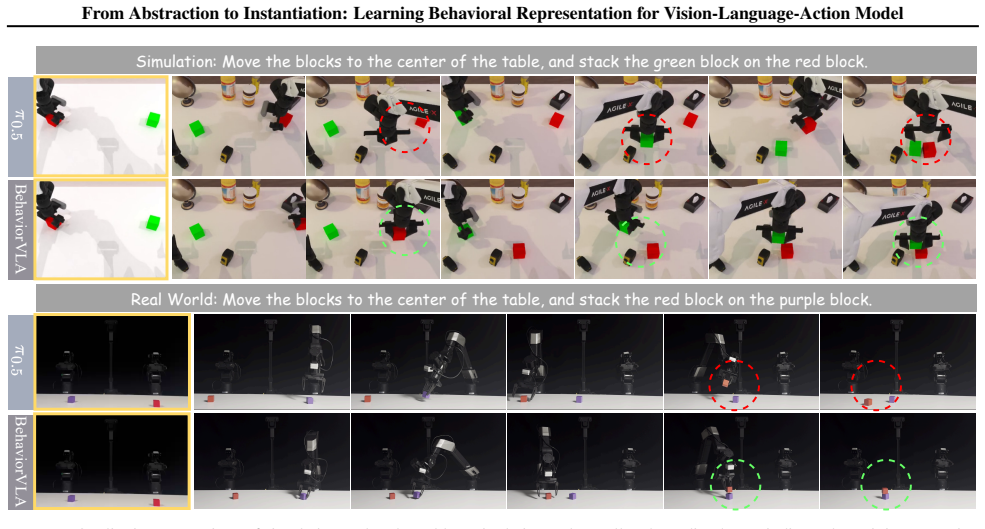
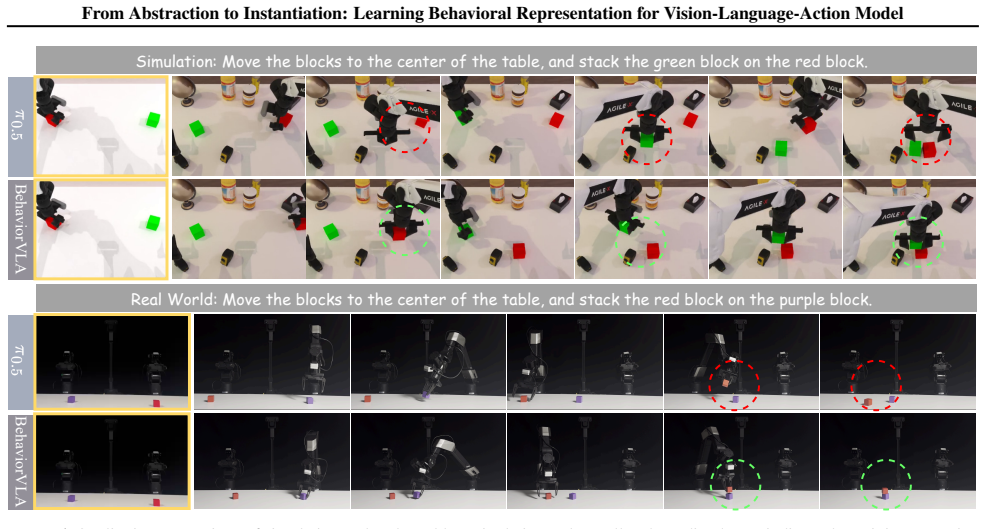
Vision-Language-Action (VLA) models often suffer from performance degradation under distribution shifts, as they struggle to learn generalized behavior representations across varying environments. While existing approaches attempt to construct behavior representations through action-centric latent variables, they are often limited by short-horizon temporal fragmentation and static execution-alignment, leading to inconsistent behaviors in complex scenarios. To address these limitations, we propose \textbf{BehaviorVLA}, a framework that facilitates robust manipulation through the learning of a temporally coherent behavioral representations. Our approach features two symmetric components: (1) the \textbf{Visuomotor Behavior Encoder (VBE)}, which utilizes a causal Mamba-based architecture to aggregate long-horizon trajectory information into a unified behavior representation; and (2) the \textbf{Phase-conditioned Behavior Decoder (PBD)}, which decodes this representation into precise actions by dynamically aligning task-level priors with real-time execution progress. Experiments on RoboTwin 2.0, LIBERO, and CALVIN demonstrate state-of-the-art success rates of 58\%, 98\%, and 4.36 (Avg.Len), respectively. Notably, in real-world sim-to-real transfer, BehaviorVLA matches the performance of OpenVLA-OFT using only 50\% of the demonstration data, showcasing its superior data efficiency and generalization.
Editorial analysis
A structured set of objections, weighed in public.
Referee Report
Summary. The manuscript introduces BehaviorVLA, a Vision-Language-Action framework consisting of a causal Mamba-based Visuomotor Behavior Encoder (VBE) that aggregates long-horizon trajectories into a single unified behavior representation and a Phase-conditioned Behavior Decoder (PBD) that decodes this representation into actions by aligning task priors with execution progress. It reports state-of-the-art success rates of 58% on RoboTwin 2.0, 98% on LIBERO, and 4.36 average length on CALVIN, plus matching OpenVLA-OFT performance in sim-to-real transfer using only 50% of the demonstration data.
Significance. If the unified representation produced by the VBE remains informative and non-collapsed across distribution shifts, the approach could meaningfully improve generalization and data efficiency in VLA models. The choice of causal Mamba for long-horizon aggregation is technically interesting and could influence future work on temporally coherent behavior modeling.
major comments (3)
- [§3.2] §3.2 (VBE architecture): the manuscript provides no auxiliary loss, contrastive term, or information-bottleneck analysis to enforce that the single Mamba state remains task-informative rather than collapsing to coarse priors under distribution shifts. This is load-bearing for the robustness and 50%-data-efficiency claims, as performance gains could instead arise from the PBD or dataset-specific tuning.
- [Table 2] Table 2 (main results): success rates and average lengths are reported without error bars, number of evaluation seeds, or statistical tests, so it is impossible to determine whether the reported margins over OpenVLA and other baselines are reliable.
- [§4.3] §4.3 (sim-to-real ablation): the 50% data-efficiency result is presented without component ablations that isolate the VBE representation from the phase-conditioning mechanism or other architectural choices, leaving open the possibility that the gains are not attributable to the claimed temporally coherent representation.
minor comments (2)
- Notation for the unified behavior representation (denoted variously as z or h in the text) is introduced without a single consistent equation or diagram reference, complicating traceability from encoder output to decoder input.
- [Figure 3] Figure 3 caption does not specify the exact trajectory length or number of Mamba layers used in the visualized state evolution, reducing clarity of the temporal coherence argument.
Simulated Author's Rebuttal
We thank the referee for the detailed and constructive feedback on our manuscript. We have carefully considered each comment and provide point-by-point responses below. We believe these revisions will enhance the clarity and rigor of our work.
read point-by-point responses
-
Referee: [§3.2] §3.2 (VBE architecture): the manuscript provides no auxiliary loss, contrastive term, or information-bottleneck analysis to enforce that the single Mamba state remains task-informative rather than collapsing to coarse priors under distribution shifts. This is load-bearing for the robustness and 50%-data-efficiency claims, as performance gains could instead arise from the PBD or dataset-specific tuning.
Authors: We agree that an explicit mechanism to prevent representation collapse would strengthen the claims regarding the VBE's robustness. While the causal Mamba's state update rules and the reconstruction objective through the PBD implicitly encourage informative representations, we acknowledge the absence of dedicated analysis. In the revised manuscript, we will include an information-bottleneck analysis and report the mutual information between the VBE state and task-specific variables to demonstrate that the representation remains task-informative across shifts. revision: yes
-
Referee: [Table 2] Table 2 (main results): success rates and average lengths are reported without error bars, number of evaluation seeds, or statistical tests, so it is impossible to determine whether the reported margins over OpenVLA and other baselines are reliable.
Authors: We concur that the lack of error bars and statistical validation makes it difficult to assess the significance of the improvements. We will rerun the evaluations with multiple random seeds (at least 5) and report means with standard deviations. Additionally, we will include p-values from appropriate statistical tests comparing BehaviorVLA to baselines in the updated Table 2. revision: yes
-
Referee: [§4.3] §4.3 (sim-to-real ablation): the 50% data-efficiency result is presented without component ablations that isolate the VBE representation from the phase-conditioning mechanism or other architectural choices, leaving open the possibility that the gains are not attributable to the claimed temporally coherent representation.
Authors: The referee correctly points out that the current ablation study does not fully isolate the contributions of the VBE. To address this, we will expand the ablation experiments in §4.3 to include variants where the VBE is replaced with a standard encoder or where phase conditioning is removed, while keeping other components fixed. This will help attribute the data-efficiency gains specifically to the temporally coherent representation learned by the VBE. revision: yes
Circularity Check
No circularity: empirical architecture proposal with benchmark validation
full rationale
The paper proposes BehaviorVLA as a new VLA framework consisting of a causal Mamba VBE for long-horizon aggregation into a unified representation and a phase-conditioned PBD decoder. All performance claims (SOTA rates on RoboTwin 2.0, LIBERO, CALVIN; 50% data efficiency in sim-to-real) are presented as direct experimental outcomes rather than derived predictions. No equations, self-definitional reductions, fitted parameters renamed as predictions, or load-bearing self-citations appear in the abstract or described chain. The work is self-contained as an architectural contribution validated on standard benchmarks.
Axiom & Free-Parameter Ledger
Reference graph
Works this paper leans on
-
[1]
Dexterous manipulation through imitation learning: A survey.arXiv preprint arXiv:2504.03515,
An, S., Meng, Z., Tang, C., Zhou, Y ., Liu, T., Ding, F., Zhang, S., Mu, Y ., Song, R., Zhang, W., et al. Dexterous manipulation through imitation learning: A survey.arXiv preprint arXiv:2504.03515,
-
[2]
GR00T N1: An Open Foundation Model for Generalist Humanoid Robots
Bjorck, J., Casta˜neda, F., Cherniadev, N., Da, X., Ding, R., Fan, L., Fang, Y ., Fox, D., Hu, F., Huang, S., et al. Gr00t n1: An open foundation model for generalist humanoid robots.arXiv preprint arXiv:2503.14734,
work page internal anchor Pith review Pith/arXiv arXiv
-
[4]
$\pi_0$: A Vision-Language-Action Flow Model for General Robot Control
doi: 10.48550. arXiv preprint ARXIV .2410.24164. Black, K., Brown, N., Driess, D., Esmail, A., Equi, M., Finn, C., Fusai, N., Groom, L., Hausman, K., Ichter, B., et al. pi 0: A vision-language-action flow model for general robot control.arXiv preprint arXiv:2410.24164,
work page internal anchor Pith review Pith/arXiv arXiv
-
[5]
Bu, Q., Li, H., Chen, L., Cai, J., Zeng, J., Cui, H., Yao, M., and Qiao, Y . Towards synergistic, generalized, and efficient dual-system for robotic manipulation.arXiv preprint arXiv:2410.08001,
-
[6]
UniVLA: Learning to Act Anywhere with Task-centric Latent Actions
Bu, Q., Yang, Y ., Cai, J., Gao, S., Ren, G., Yao, M., Luo, P., and Li, H. Univla: Learning to act anywhere with task- centric latent actions.arXiv preprint arXiv:2505.06111,
work page internal anchor Pith review Pith/arXiv arXiv
-
[7]
Less is more: Em- powering gui agent with context-aware simplification
Chen, G., Zhou, X., Shao, R., Lyu, Y ., Zhou, K., Wang, S., Li, W., Li, Y ., Qi, Z., and Nie, L. Less is more: Em- powering gui agent with context-aware simplification. In Proceedings of the IEEE/CVF International Conference on Computer Vision, pp. 5901–5911, 2025a. Chen, H., Liu, J., Gu, C., Liu, Z., Zhang, R., Li, X., He, X., Guo, Y ., Fu, C.-W., Zhang,...
-
[8]
Video Prediction Policy: A Generalist Robot Policy with Predictive Visual Representations
Hu, Y ., Guo, Y ., Wang, P., Chen, X., Wang, Y .-J., Zhang, J., Sreenath, K., Lu, C., and Chen, J. Video prediction policy: A generalist robot policy with predictive visual representations.arXiv preprint arXiv:2412.14803,
work page internal anchor Pith review Pith/arXiv arXiv
-
[9]
$\pi_{0.5}$: a Vision-Language-Action Model with Open-World Generalization
Intelligence, P., Black, K., Brown, N., Darpinian, J., Dha- balia, K., Driess, D., Esmail, A., Equi, M., Finn, C., Fusai, N., et al. pi05: a vision-language-action model with open- world generalization.arXiv preprint arXiv:2504.16054,
work page internal anchor Pith review Pith/arXiv arXiv
-
[10]
OpenVLA: An Open-Source Vision-Language-Action Model
Kim, M. J., Pertsch, K., Karamcheti, S., Xiao, T., Balakr- ishna, A., Nair, S., Rafailov, R., Foster, E., Lam, G., San- keti, P., et al. Openvla: An open-source vision-language- action model.arXiv preprint arXiv:2406.09246,
work page internal anchor Pith review Pith/arXiv arXiv
-
[11]
Fine-Tuning Vision-Language-Action Models: Optimizing Speed and Success
Kim, M. J., Finn, C., and Liang, P. Fine-tuning vision- language-action models: Optimizing speed and success. arXiv preprint arXiv:2502.19645,
work page internal anchor Pith review Pith/arXiv arXiv
-
[12]
Behavior generation with latent actions,
Lee, S., Wang, Y ., Etukuru, H., Kim, H. J., Shafiullah, N. M. M., and Pinto, L. Behavior generation with latent actions.arXiv preprint arXiv:2403.03181,
-
[13]
Li, C., Wen, J., Peng, Y ., Peng, Y ., Feng, F., and Zhu, Y . Pointvla: Injecting the 3d world into vision-language- action models.arXiv preprint arXiv:2503.07511, 2025a. Li, H., Lv, Q., Shao, R., Deng, X., Li, Y ., Hao, J., and Nie, L. Star: Learning diverse robot skill abstractions through rotation-augmented vector quantization.arXiv preprint arXiv:2506...
-
[14]
Li, Z., Xie, Y ., Shao, R., Chen, G., Guan, W., Jiang, D., and Nie, L. Optimus-3: Towards generalist multi- modal minecraft agents with scalable task experts.arXiv preprint arXiv:2506.10357, 2025f. Li, Z., Xie, Y ., Shao, R., Chen, G., Jiang, D., and Nie, L. Optimus-2: Multimodal minecraft agent with goal- observation-action conditioned policy. InProceedi...
-
[15]
URL https: //arxiv.org/abs/2511.18112. 10 From Abstraction to Instantiation: Learning Behavioral Representation for Vision-Language-Action Model Lin, T., Zhang, Y ., Li, Q., Qi, H., Yi, B., Levine, S., and Malik, J. Learning visuotactile skills with two multifin- gered hands. In2025 IEEE International Conference on Robotics and Automation (ICRA), pp. 5637...
-
[16]
Liu, H., Li, C., Wu, Q., and Lee, Y . J. Visual instruction tun- ing.Advances in neural information processing systems, 36, 2024a. Liu, H., Li, X., Li, P., Liu, M., Wang, D., Liu, J., Kang, B., Ma, X., Kong, T., and Zhang, H. Towards generalist robot policies: What matters in building vision-language-action models. 2025a. Liu, J., Liu, M., Wang, Z., An, P...
work page internal anchor Pith review Pith/arXiv arXiv
-
[17]
FAST: Efficient Action Tokenization for Vision-Language-Action Models
Pertsch, K., Stachowicz, K., Ichter, B., Driess, D., Nair, S., Vuong, Q., Mees, O., Finn, C., and Levine, S. Fast: Efficient action tokenization for vision-language-action models.arXiv preprint arXiv:2501.09747,
work page internal anchor Pith review Pith/arXiv arXiv
-
[18]
SpatialVLA: Exploring Spatial Representations for Visual-Language-Action Model
Qu, D., Song, H., Chen, Q., Yao, Y ., Ye, X., Ding, Y ., Wang, Z., Gu, J., Zhao, B., Wang, D., et al. Spatialvla: Exploring spatial representations for visual-language-action model. arXiv preprint arXiv:2501.15830,
work page internal anchor Pith review Pith/arXiv arXiv
-
[19]
Large VLM-based Vision-Language-Action Models for Robotic Manipulation: A Survey
Shao, R., Li, W., Zhang, L., Zhang, R., Liu, Z., Chen, R., and Nie, L. Large vlm-based vision-language-action models for robotic manipulation: A survey.arXiv preprint arXiv:2508.13073,
work page internal anchor Pith review Pith/arXiv arXiv
-
[20]
Hats: Hardness-aware trajectory syn- thesis for gui agents.arXiv preprint arXiv:2603.12138,
Shao, R., Gao, R., Xie, B., Li, Y ., Zhou, K., Wang, S., Guan, W., and Chen, G. Hats: Hardness-aware trajectory syn- thesis for gui agents.arXiv preprint arXiv:2603.12138,
-
[21]
MemoryVLA: Perceptual-Cognitive Memory in Vision-Language-Action Models for Robotic Manipulation
Shi, H., Xie, B., Liu, Y ., Sun, L., Liu, F., Wang, T., Zhou, E., Fan, H., Zhang, X., and Huang, G. Memo- ryvla: Perceptual-cognitive memory in vision-language- action models for robotic manipulation.arXiv preprint arXiv:2508.19236,
work page internal anchor Pith review Pith/arXiv arXiv
-
[22]
SmolVLA: A Vision-Language-Action Model for Affordable and Efficient Robotics
Shukor, M., Aubakirova, D., Capuano, F., Kooijmans, P., Palma, S., Zouitine, A., Aractingi, M., Pascal, C., Russi, M., Marafioti, A., et al. Smolvla: A vision-language- action model for affordable and efficient robotics.arXiv preprint arXiv:2506.01844,
work page internal anchor Pith review Pith/arXiv arXiv
-
[23]
11 From Abstraction to Instantiation: Learning Behavioral Representation for Vision-Language-Action Model Song, W., Zhou, Z., Zhao, H., Chen, J., Ding, P., Yan, H., Huang, Y ., Tang, F., Wang, D., and Li, H. Reconvla: Reconstructive vision-language-action model as effective robot perceiver.arXiv preprint arXiv:2508.10333,
-
[24]
Predictive Inverse Dynamics Models are Scalable Learners for Robotic Manipulation
Tian, Y ., Yang, S., Zeng, J., Wang, P., Lin, D., Dong, H., and Pang, J. Predictive inverse dynamics models are scalable learners for robotic manipulation.arXiv preprint arXiv:2412.15109,
work page internal anchor Pith review arXiv
-
[25]
Wang, Y ., Zhu, H., Liu, M., Yang, J., Fang, H.-S., and He, T. Vq-vla: Improving vision-language-action models via scaling vector-quantized action tokenizers.arXiv preprint arXiv:2507.01016,
-
[26]
Xie, Q., Min, S. Y ., Ji, P., Yang, Y ., Zhang, T., Xu, K., Ba- jaj, A., Salakhutdinov, R., Johnson-Roberson, M., and Bisk, Y . Embodied-rag: General non-parametric embod- ied memory for retrieval and generation.arXiv preprint arXiv:2409.18313,
-
[27]
Xie, Y ., Li, Z., Shao, R., Chen, G., Zhou, K., Li, Y ., Jiang, D., and Nie, L. Mirage-1: Augmenting and updating gui agent with hierarchical multimodal skills.arXiv preprint arXiv:2506.10387,
-
[28]
Yoo, Y ., Hu, J., Zhu, Y ., Liu, B., Liu, Q., Mart´ın-Mart´ın, R., and Stone, P. Robossm: Scalable in-context imi- tation learning via state-space models.arXiv preprint arXiv:2509.19658,
-
[29]
3D Diffusion Policy: Generalizable Visuomotor Policy Learning via Simple 3D Representations
Ze, Y ., Zhang, G., Zhang, K., Hu, C., Wang, M., and Xu, H. 3d diffusion policy: Generalizable visuomotor policy learning via simple 3d representations.arXiv preprint arXiv:2403.03954,
work page internal anchor Pith review Pith/arXiv arXiv
-
[30]
Zhang, J., Guo, Y ., Hu, Y ., Chen, X., Zhu, X., and Chen, J. Up-vla: A unified understanding and prediction model for embodied agent.arXiv preprint arXiv:2501.18867, 2025a. Zhang, R., Shao, R., Chen, G., Zhang, M., Zhou, K., Guan, W., and Nie, L. Falcon: Resolving visual redundancy and fragmentation in high-resolution multimodal large language models via...
-
[31]
12 From Abstraction to Instantiation: Learning Behavioral Representation for Vision-Language-Action Model A. Limitation and Future Work Although BehaviorVLA demonstrates superior robustness and data efficiency in sim-to-real transfer through the Visuomotor Behavior Encoder (VBE) and Phase-conditioned Behavior Decoder (PBD), several limitations remain. Fir...
work page 2022
-
[32]
have emerged as a promising paradigm in robot learning. Recent works have further extended VLA capabilities through the integration of enhanced visual perception(Li et al., 2025a; Qu et al., 2025; Liu et al., 2025b), efficient paradigms (Liu et al., 2024b; Chen et al., 2025b), and dual-system architectures (Bjorck et al., 2025; Wang et al., 2025; Wen et a...
work page 2025
-
[33]
represents scene and episodic information as declarative memory for retrieval and fusion. MAP-VLA(Li et al., 2025c) further reduces fragment inconsistency through stage-wise segmentation and alignment. Related ideas also appear in embodied agents and generalist policies (Zhu et al., 2024; Anwar et al., 2025; Xie et al., 2024), which retrieve trajectories ...
work page 2024
-
[34]
Recent VLAs(Black et al., 2025; Black et al.; Shukor et al.,
have become the standard for robot control, modeling generation as a transport process from gaussian noise to multi-modal distributions. Recent VLAs(Black et al., 2025; Black et al.; Shukor et al.,
work page 2025
-
[35]
We utilize the AdamW optimizer with a constant learning rate of5×10 −5. The training process spans 30,000 steps to ensure the convergence of both the fine-grained flow matching objective and the coarse-level prior distribution. Table 4.Performance comparison on CALVIN (Mees et al., 2022). We report the Success Rate of each track and average completion len...
work page 2022
discussion (0)
Sign in with ORCID, Apple, or X to comment. Anyone can read and Pith papers without signing in.