Highly filamentary H{\,small I} gas in the circumgalactic medium and intragalactic medium around NGC 4631
Pith reviewed 2026-06-26 08:35 UTC · model grok-4.3
The pith
Kpc-scale filamentary structures are detected in the diffuse HI gas around NGC 4631 using combined single-dish and interferometric data.
A machine-rendered reading of the paper's core claim, the machinery that carries it, and where it could break.
Core claim
The paper establishes the first robust detection of kpc-scale filamentary HI structures in the CGM/IGM around NGC 4631, with measured widths of 0.5-3.3 kpc and lengths of 6.1-49.8 kpc, confirming that low-density gas hosts velocity-coherent substructure; kinematic analysis further classifies the filaments into U-shaped, linear, and wavy types that imply diverse formation mechanisms and create a structural link from pc-scale interstellar filaments through kpc-scale CGM/IGM filaments to Mpc-scale cosmic-web filaments.
What carries the argument
The merger of FAST FEASTS single-dish and VLA THINGS interferometric HI datasets, processed through position-velocity kinematic analysis to isolate velocity-coherent filamentary features in the low-density gas.
Load-bearing premise
The velocity-coherent features are genuine physical filaments in the CGM/IGM rather than artifacts from merging single-dish and interferometric data, projection effects, or noise.
What would settle it
A follow-up observation of the same sky region with an independent radio telescope array at comparable resolution that recovers no matching filamentary velocity structures would falsify the detection.
Figures

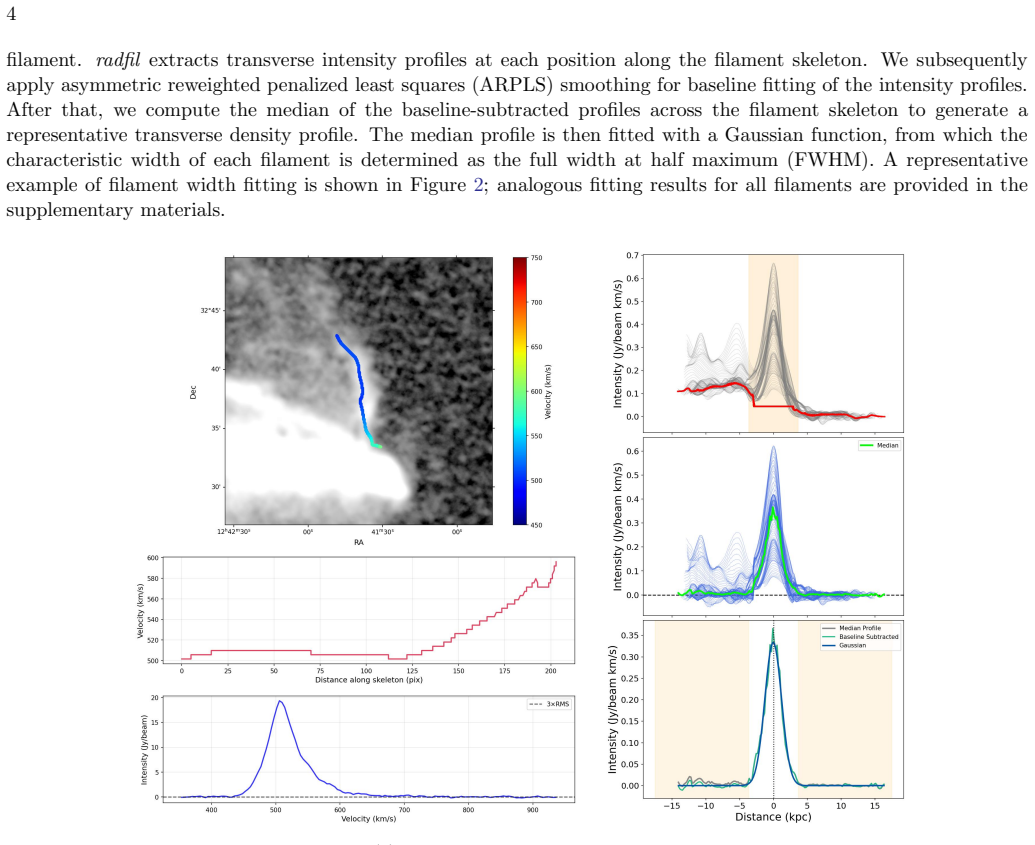
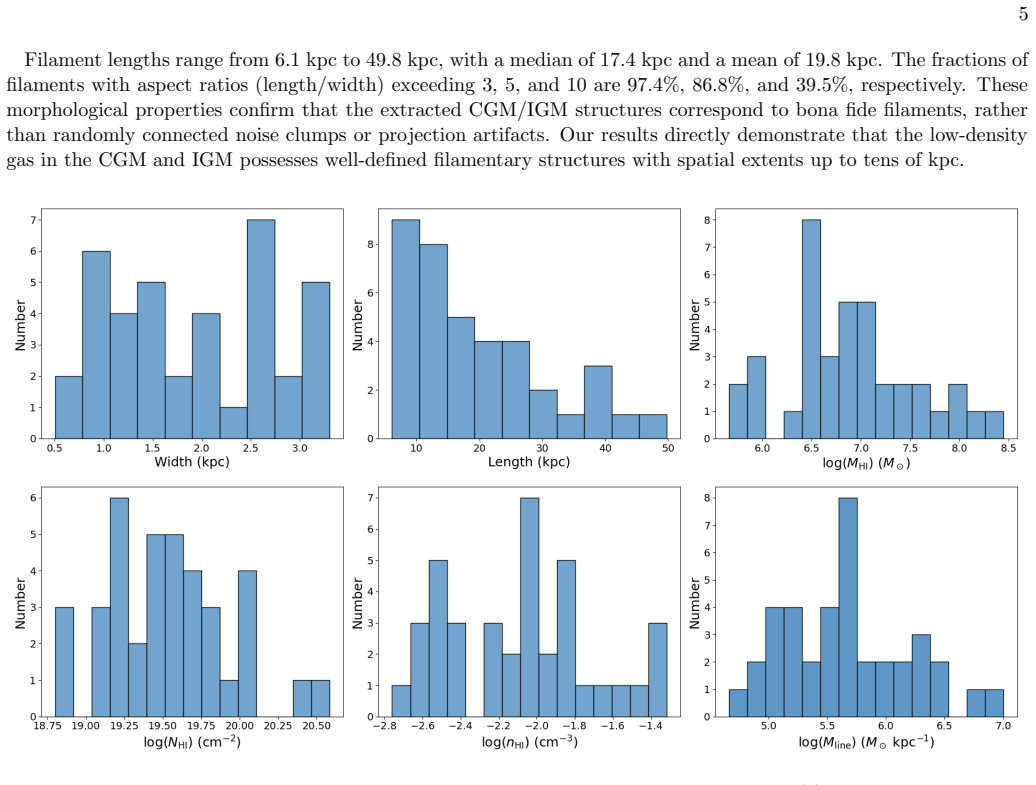
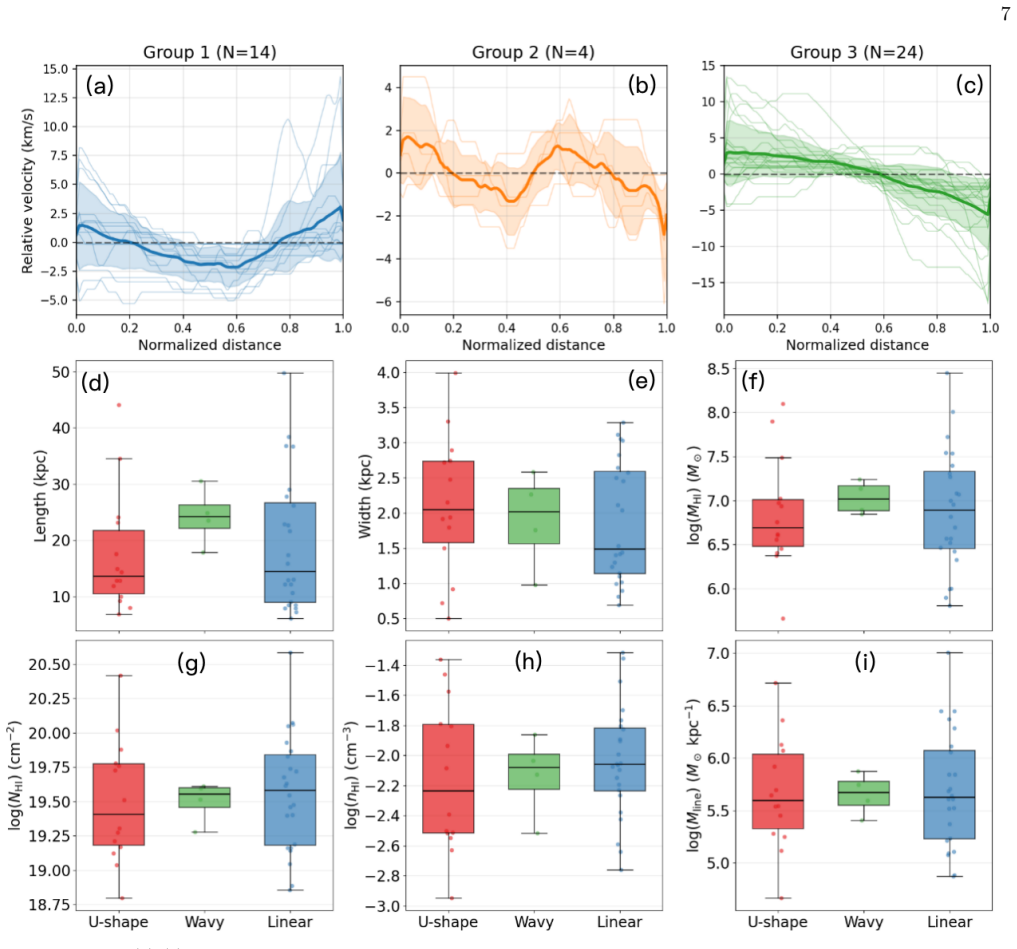
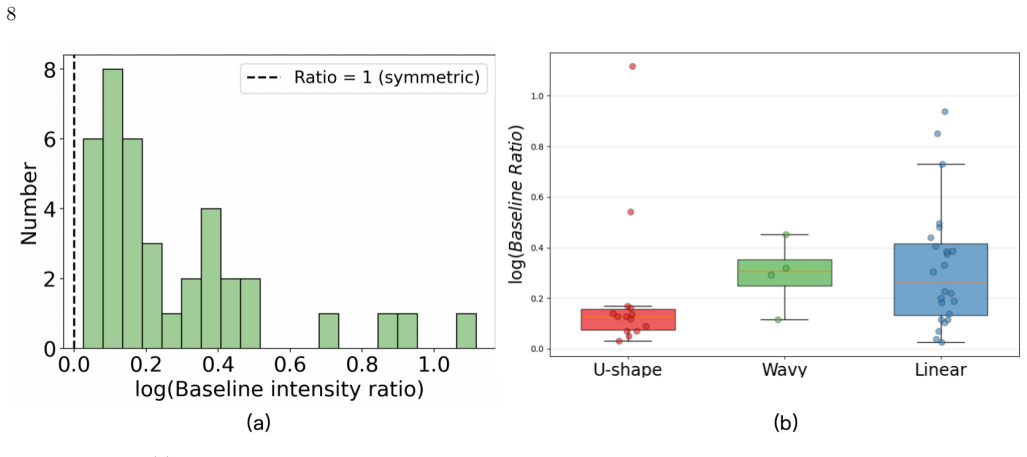
read the original abstract
Neutral hydrogen (H{\,\small I}) in the circumgalactic medium (CGM) and intergalactic medium (IGM) traces baryon cycling and galaxy evolution, yet fine filamentary substructures in diffuse CGM/IGM H{\,\small I} remain poorly constrained observationally. We combine FAST FEASTS single-dish and VLA THINGS interferometric H{\,\small I} data of the NGC 4631 group to report the first robust detection of kpc-scale filamentary structures in the CGM/IGM, with widths of $0.5$-$3.3\ \mathrm{kpc}$ and lengths of $6.1$-$49.8\ \mathrm{kpc}$. These features confirm that low-density CGM/IGM gas hosts velocity coherent substructure. From position-velocity kinematic analysis, we identify three filament classes (U-shaped, linear, and wavy), implying diverse formation mechanisms. Our results establish a structural bridge connecting pc-scale interstellar filaments, kpc-scale CGM/IGM filaments, and Mpc-scale cosmic-web filaments, providing key observational support for multiscale gaseous coupling in cosmic ecosystem.
Editorial analysis
A structured set of objections, weighed in public.
Referee Report
Summary. The manuscript combines FAST FEASTS single-dish and VLA THINGS interferometric HI observations of the NGC 4631 group. It reports the first robust detection of kpc-scale filamentary structures in the CGM/IGM, with widths 0.5-3.3 kpc and lengths 6.1-49.8 kpc, classifies them into U-shaped, linear, and wavy types from position-velocity analysis, and interprets the results as evidence that low-density CGM/IGM gas hosts velocity-coherent substructure, thereby bridging pc-scale ISM filaments, kpc-scale CGM/IGM filaments, and Mpc-scale cosmic web filaments.
Significance. If the detections hold after proper validation, the result would be significant for providing direct observational constraints on fine-scale velocity-coherent structure in diffuse CGM/IGM gas and supporting multiscale gaseous coupling in galaxy evolution. The purely observational character with no fitted parameters or derivations is a strength, as the measurements are presented as direct.
major comments (2)
- [Abstract] Abstract: the central claim of a 'robust detection' of physical kpc-scale filaments from the combined datasets rests on unstated details of the single-dish + interferometric merge; no description is given of the feathering algorithm, weighting, short-spacing recovery, or any injected-signal recovery tests, which directly bears on whether the reported velocity-coherent features could be artifacts.
- [Results] Results section (filament measurements): the reported widths (0.5-3.3 kpc) and lengths (6.1-49.8 kpc) and the three-class kinematic classification are presented without quantitative error analysis, noise characterization, or tests against projection effects and shuffled-velocity cubes, undermining the assertion that these are genuine CGM/IGM structures rather than data-processing products.
minor comments (1)
- [Abstract] The term 'intragalactic medium' in the abstract is non-standard and should be clarified or replaced with conventional usage.
Simulated Author's Rebuttal
We thank the referee for the constructive comments. The concerns about insufficient documentation of the data merge and lack of quantitative validation for the filament measurements are valid and point to areas where the original manuscript was incomplete. We address each point below and will revise accordingly to strengthen the presentation of our results.
read point-by-point responses
-
Referee: [Abstract] Abstract: the central claim of a 'robust detection' of physical kpc-scale filaments from the combined datasets rests on unstated details of the single-dish + interferometric merge; no description is given of the feathering algorithm, weighting, short-spacing recovery, or any injected-signal recovery tests, which directly bears on whether the reported velocity-coherent features could be artifacts.
Authors: We agree that the manuscript omitted key technical details on the combination of FAST FEASTS single-dish and VLA THINGS interferometric data. This gap could legitimately raise questions about possible artifacts in the velocity-coherent features. In the revised manuscript we will insert a dedicated subsection describing the feathering algorithm (including implementation and parameters), the weighting scheme, short-spacing recovery procedure, and results from injected-signal recovery tests that confirm the filamentary structures are recovered from the input data rather than introduced by merging. revision: yes
-
Referee: [Results] Results section (filament measurements): the reported widths (0.5-3.3 kpc) and lengths (6.1-49.8 kpc) and the three-class kinematic classification are presented without quantitative error analysis, noise characterization, or tests against projection effects and shuffled-velocity cubes, undermining the assertion that these are genuine CGM/IGM structures rather than data-processing products.
Authors: The referee is correct that the filament measurements were presented without accompanying quantitative errors, explicit noise characterization, or the requested validation tests. We will revise the Results section to add: error estimates on widths and lengths derived from beam size, S/N, and measurement repeatability; a description of the noise properties (rms per channel and spatial variation) in the merged cube; and a discussion of projection effects, emphasizing that the structures remain coherent across independent velocity channels. We will also generate and report results from velocity-shuffled cubes to demonstrate that the filamentary features and kinematic classes do not appear in randomized data. These additions will be included in the revision. revision: yes
Circularity Check
No circularity: purely observational detection report
full rationale
The manuscript is an observational report that combines existing FAST and VLA HI datasets to identify filamentary structures via direct imaging and position-velocity analysis. No equations, fitted parameters, predictions, or derivations are present that could reduce any claimed result to the inputs by construction. No self-citations are invoked as load-bearing uniqueness theorems or ansatzes. The central claim rests on the data combination and feature identification steps themselves, which are externally falsifiable via independent observations or null tests rather than internal redefinition.
Axiom & Free-Parameter Ledger
Reference graph
Works this paper leans on
-
[1]
´Alvarez-Guti´ errez, R. H., Stutz, A. M., Sandoval-Garrido, N., et al. 2024, A&A, 689, A74, doi: 10.1051/0004-6361/202450321 Andr´ e, P., Di Francesco, J., Ward-Thompson, D., et al. 2014, in Protostars and Planets VI, ed. H. Beuther, R. S
-
[2]
Klessen, C. P. Dullemond, & T. Henning, 27–51, doi: 10.2458/azu uapress 9780816531240-ch002 Andr´ e, P., Men’shchikov, A., Bontemps, S., et al. 2010, A&A, 518, L102, doi: 10.1051/0004-6361/201014666
work page doi:10.2458/azu 2010
-
[3]
Blumenthal, K. A., & Barnes, J. E. 2018, MNRAS, 479, 3952, doi: 10.1093/mnras/sty1605
-
[4]
2016, ApJ, 833, 259, doi: 10.3847/1538-4357/833/2/259
Borthakur, S., Heckman, T., Tumlinson, J., et al. 2016, ApJ, 833, 259, doi: 10.3847/1538-4357/833/2/259
-
[5]
CHEN, X. 2012, International Journal of Modern Physics: Conference Series, 12, 256, doi: 10.1142/S2010194512006459
-
[6]
Colombo, D., K¨ onig, C., Urquhart, J. S., et al. 2021, A&A, 655, L2, doi: 10.1051/0004-6361/202142182
-
[7]
Protostars and Planets VII , year = 2023, editor =
Hacar, A., Clark, S. E., Heitsch, F., et al. 2023, in Astronomical Society of the Pacific Conference Series, Vol. 534, Protostars and Planets VII, ed. S. Inutsuka, Y. Aikawa, T. Muto, K. Tomida, & M. Tamura, 153, doi: 10.48550/arXiv.2203.09562
-
[8]
Heald, G., J´ ozsa, G., Serra, P., et al. 2011, A&A, 526, A118, doi: 10.1051/0004-6361/201015938 12 T able 1.Physical parameters of NGC 4631 filaments Filament ID Width (kpc) Length (kpc)N HI (cm−2)n HI (cm−3)M HI (M⊙)M line (M⊙ kpc−1) Class 1 2.113±0.119 29.049 4.12e+19 8.05e-03 2.03e+07 6.98e+05 L 2 1.293±0.112 10.678 7.16e+18 2.29e-03 7.93e+05 7.42e+04...
-
[9]
2019, Science China
Jiang, P., Yue, Y., Gan, H., et al. 2019, Science China
2019
-
[10]
Physics, Mechanics, and Astronomy, 62, 959502, doi: 10.1007/s11433-018-9376-1
-
[11]
G., Verdes-Montenegro, L., Damas-Segovia, A., et al
Jones, M. G., Verdes-Montenegro, L., Damas-Segovia, A., et al. 2019, A&A, 632, A78, doi: 10.1051/0004-6361/201936349 Kereˇ s, D., Katz, N., Weinberg, D. H., & Dav´ e, R. 2005, Monthly Notices of the Royal Astronomical Society, 363, 2, doi: 10.1111/j.1365-2966.2005.09451.x
-
[12]
2018, ApJ, 866, 36, doi: 10.3847/1538-4357/aadc08
Lan, T.-W., & Mo, H. 2018, ApJ, 866, 36, doi: 10.3847/1538-4357/aadc08
-
[13]
2023, The Astrophysical Journal, 954, 139, doi: 10.3847/1538-4357/ace896
Li, Y., Wang, Y., Deng, F., et al. 2023, The Astrophysical Journal, 954, 139, doi: 10.3847/1538-4357/ace896
-
[14]
Lin, Z., Martin, D. C., Matuszewski, M., et al. 2025, ApJ, 995, 12, doi: 10.3847/1538-4357/ae10b2
-
[15]
Liu, X., Liu, T., Li, P.-S., et al. 2025, Nature Astronomy, 9, 1366, doi: 10.1038/s41550-025-02605-8 Mel´ endez, M., Veilleux, S., Martin, C., et al. 2015, ApJ, 804, 46, doi: 10.1088/0004-637X/804/1/46
-
[16]
2026, ApJ, 1002, 210, doi: 10.3847/1538-4357/ae61a5
Meng, Y., Wang, J., Jing, Y., Chen, H., & Liu, Z. 2026, ApJ, 1002, 210, doi: 10.3847/1538-4357/ae61a5
-
[17]
2022, MNRAS, 514, 3139, doi: 10.1093/mnras/stac1610 O’Sullivan, E., Vrtilek, J
Mohapatra, R., Federrath, C., & Sharma, P. 2022, MNRAS, 514, 3139, doi: 10.1093/mnras/stac1610 O’Sullivan, E., Vrtilek, J. M., David, L. P., et al. 2014, ApJ, 793, 74, doi: 10.1088/0004-637X/793/2/74
-
[18]
Putman, M. E., Peek, J. E. G., & Joung, M. R. 2012, ARA&A, 50, 491, doi: 10.1146/annurev-astro-081811-125612
-
[19]
E., Henning, T., Tackenberg, J., et al
Ragan, S. E., Henning, T., Tackenberg, J., et al. 2014, A&A, 568, A73, doi: 10.1051/0004-6361/201423401
-
[20]
Saintonge, A., Catinella, B., Tacconi, L. J., et al. 2017, ApJS, 233, 22, doi: 10.3847/1538-4365/aa97e0
-
[21]
Tumlinson, J., Werk, J. K., Thom, C., et al. 2011, ApJ, 733, 111, doi: 10.1088/0004-637X/733/2/111
-
[22]
S., Schilke, P., S´ anchez-Monge,´A., et al
Veena, V. S., Schilke, P., S´ anchez-Monge,´A., et al. 2021, ApJL, 921, L42, doi: 10.3847/2041-8213/ac341f
-
[23]
2020, ApJ, 890, 63, doi: 10.3847/1538-4357/ab68dd
Wang, J., Catinella, B., Saintonge, A., et al. 2020, ApJ, 890, 63, doi: 10.3847/1538-4357/ab68dd
-
[24]
2023, ApJ, 944, 102, doi: 10.3847/1538-4357/acafe8
Wang, J., Yang, D., Oh, S.-H., et al. 2023, ApJ, 944, 102, doi: 10.3847/1538-4357/acafe8
-
[25]
Yu, N., Ho, L. C., & Wang, J. 2022, ApJ, 930, 85, doi: 10.3847/1538-4357/ac5f07
-
[26]
Random gas motions inside sub-parsec scale supercritical filaments
Zhang, C., Liu, T., Juvela, M., et al. 2026, arXiv e-prints, arXiv:2604.04501, doi: 10.48550/arXiv.2604.04501
work page internal anchor Pith review Pith/arXiv arXiv doi:10.48550/arxiv.2604.04501 2026
-
[27]
2019, A&A, 622, A52, doi: 10.1051/0004-6361/201732400
Henning, T. 2019, A&A, 622, A52, doi: 10.1051/0004-6361/201732400
-
[28]
2026, arXiv e-prints, arXiv:2602.11617, doi: 10.48550/arXiv.2602.11617
Zhang, Y.-K., Liu, T., Jiao, W., et al. 2026, arXiv e-prints, arXiv:2602.11617, doi: 10.48550/arXiv.2602.11617
-
[29]
Zhou, J.-W., Liu, T., Evans, N. J., et al. 2022, MNRAS, 514, 6038, doi: 10.1093/mnras/stac1735
-
[30]
2015, ApJ, 815, 23, doi: 10.1088/0004-637X/815/1/23
Zucker, C., Battersby, C., & Goodman, A. 2015, ApJ, 815, 23, doi: 10.1088/0004-637X/815/1/23
discussion (0)
Sign in with ORCID, Apple, or X to comment. Anyone can read and Pith papers without signing in.